Foreign Policy

IrishinSyria

In truth lies victory
Messages
6,042
Reaction score
1,920
.... as always, follow the money. It almost ALWAYS leads you to both the truth and the future.


.... sadly.


What can the USA do about that? A lot.
What will the USA do about that? Nothing until our oil industry people and money-interest people tell "us" that Gulf State oil is no longer of global economic significance to them. {on a smaller but still significant scale}, The same behavior dominated the chlorofluorocarbon ozone-depleting governmental positions. We did nothing [even issuing denials of effect for awhile] until Dupont and IBM told government that they didn't need those exact chemicals any longer, as they'd hustled to develop alternatives, and so it was OK by them to ban the things. The Montreal Protocol was immediately approved.

Helped that we subsequently decided our adherence to the Montreal Protocol was entirely optional (those dang holdout farmers).

As for this... the one bit of comfort I get from our relationship with the House of Saud is that there is absolutely no pretense that there's any sort of moral underpinning to it. We are allies with the Saudis because and only because they have oil, and the entire world knows it. When Israel bombs civilians or cuts of shipments of food to the Gaza strip, I cringe because the basis of our relationship with them is supposed to be shared values, etc... With the Saudis it's pure realpolitik.

edit: obviously, does not excuse what's happening in Yemen, nor our tacit and material support.
 

IrishinSyria

In truth lies victory
Messages
6,042
Reaction score
1,920
Last edited:

Whiskeyjack

Mittens Margaritas Ante Porcos
Staff member
Messages
20,894
Reaction score
8,126
Foreign Policy's Stephen M. Walt just published an article titled "What Would a Realist World Have Looked Like?"

Here’s a puzzle for all you students of U.S. foreign policy: Why is a distinguished and well-known approach to foreign policy confined to the margins of public discourse, especially in the pages of our leading newspapers, when its recent track record is arguably superior to the main alternatives?

I refer, of course, to realism. I’m not suggesting that realism and realists are completely marginalized these days — after all, you’re reading a realist right now — but the public visibility and policy influence of the realist perspective is disproportionately small when compared either to liberal internationalism (among Democrats) or neoconservatism (in the GOP).

This situation is surprising insofar as realism is a well-established tradition in the study of foreign affairs, and realists like George Kennan, Hans Morgenthau, Reinhold Niebuhr, Walter Lippmann, and others said many smart things about U.S. foreign policy in the past. Realism also remains a foundational perspective in the academic study of international affairs and with good reason. At a minimum, you’d think this sophisticated body of thought would have a prominent place in debates on foreign policy and that card-carrying realists would be a visible force inside the Beltway and in the world of punditry.

Furthermore, realism’s predictions over the past 25 years are clearly better than the claims of liberals and neoconservatives, which have dominated U.S. foreign policymaking since the Cold War ended. Yet time and time again, presidents have pursued the liberal/neoconservative agenda and ignored the counsels of realism. Similarly, major media outlets have shown little inclination to give realists a prominent platform from which to disseminate their views.

The results, alas, speak for themselves. When the Cold War ended, the United States was on good terms with all of the world’s major powers, al Qaeda was a minor nuisance, a genuine peace process was underway in the Middle East, and America was enjoying its “unipolar moment.” Power politics was supposedly becoming a thing of the past, and humankind was going to get busy getting rich in a globalized world where concerns about prosperity, democracy, and human rights would increasingly dominate the international political agenda. Liberal values were destined to spread to every corner of the globe, and if that process didn’t move fast enough, American power would help push it along.

Fast forward to today. Relations with Russia and China are increasingly confrontational; democracy is in retreat in Eastern Europe and Turkey; and the entire Middle East is going from bad to worse. The United States has spent hundreds of billions of dollars fighting in Afghanistan for 14 years, and the Taliban are holding their own and may even be winning. Two decades of U.S. mediation have left the Israeli-Palestinian “peace process” in tatters. Even the European Union — perhaps the clearest embodiment of liberal ideals on the planet — is facing unprecedented strains for which there is no easy remedy.

All of which raises the following counterfactual: Would the United States and the world be better off today if the last three presidents had followed the dictates of realism, instead of letting liberals and neocons run the show? The answer is yes.

To remind you: Realism sees power as the centerpiece of political life and sees states as primarily concerned with ensuring their own security in a world where there’s no world government to protect them from others. Realists believe military power is essential to preserving a state’s independence and autonomy, but they recognize it is a crude instrument that often produces unintended consequences. Realists believe nationalism and other local identities are powerful and enduring; states are mostly selfish; altruism is rare; trust is hard to come by; and norms and institutions have a limited impact on what powerful states do. In short, realists have a generally pessimistic view of international affairs and are wary of efforts to remake the world according to some ideological blueprint, no matter how appealing it might be in the abstract.

Had Bill Clinton, George W. Bush, and Barack Obama been following the realist playbook, how would U.S. foreign policy since 1993 been different?

First, and most obviously, had Bush listened to Brent Scowcroft, Colin Powell, or some other notable realists, he would not have invaded Iraq in 2003. Bush would have focused solely on eliminating al Qaeda, instead of getting bogged down in Iraq. Thousands of U.S. soldiers would not have been killed or wounded, and several hundred thousand dead Iraqis would still be alive. Iran’s regional influence would be substantially smaller, and the Islamic State would not exist. Thus, rejecting sound realist advice has cost the U.S. taxpayer several trillion dollars, along with the obvious human price and the resulting geopolitical chaos.

Second, had American leaders embraced the wisdom of realism, the United States would not have pushed NATO expansion in the 1990s or would have limited it to Poland, Hungary, and the Czech Republic. Realists understood that great powers are especially sensitive to configurations of power on or near their borders, and thus experts such as George Kennan warned that NATO expansion would inevitably poison relations with Russia. Expanding NATO didn’t strengthen the alliance; it just committed the United States to defend a group of weak and hard-to-defend protectorates that were far from the United States but right next door to Russia. Ladies and gentlemen: This is a textbook combination of both hubris and bad geopolitics.

A better alternative was the original “Partnership for Peace,” which sought to build constructive security ties with former Warsaw Pact members, including Russia. Unfortunately, this sensible approach was abandoned in the idealistic rush to expand NATO, a decision reflecting liberal hopes that the security guarantees entailed by membership would never have to be honored.

Realists also understood that trying to bring Georgia or Ukraine into “the West” was likely to prompt a harsh reaction from Moscow and that Russia had the capacity to derail these efforts if it wished. Ukraine would still be a mess if realists had been in charge of U.S. foreign policy, but Crimea would still be part of Ukraine and the fighting that has taken place in eastern Ukraine since 2014 would probably not have occurred. Had Clinton, Bush, and Obama listened to realists, in short, relations with Russia would be significantly better and Eastern Europe would probably be more secure.

Third, a president following the realist playbook would not have embraced the strategy of “dual containment” in the Persian Gulf. Instead of pledging to contain Iran and Iraq simultaneously, a realist would have taken advantage of their mutual rivalry and used each to balance the other. Dual containment committed the United States to opposing two countries that were bitter rivals, and it forced Washington to keep large ground and air forces in Saudi Arabia and the Gulf. This long-term military presence became one of Osama bin Laden’s major grievances and thus helped put the United States on the road to the 9/11 attacks. A realist approach to Persian Gulf politics would have made that attack less likely, though of course not impossible.

Fourth, realists also warned that trying to “nation-build” in Afghanistan was a fool’s errand — especially after the invasion of Iraq allowed the Taliban to regroup — and correctly predicted that Obama’s 2009 “surge” was not going to work. Had Obama listened to the realists, the United States would have cut its losses in Afghanistan a long time ago and the outcome would be no different than what we are going to get anyway. Countless lives and vast sums of money would have been saved, and the United States would be in a stronger strategic position today.

Fifth, for realists, the nuclear deal with Iran shows what the United States can accomplish when it engages in tough-minded but flexible diplomacy. But Washington might have gotten an even better deal had Bush or Obama listened to the realists and conducted serious diplomacy back when Iran’s nuclear infrastructure was much smaller. Realists repeatedly warned that Iran would never agree to give up its entire enrichment capacity and that threatening Tehran with military force would only increase its desire for a latent weapons capability. Had the United States shown more flexibility earlier — as realists advised — it might have halted Iran’s nuclear development at a much lower level. More adroit U.S. diplomacy might even have forestalled the election of Mahmoud Ahmadinejad in 2005 and moved the two countries toward a more constructive relationship. Perhaps not, but the United States could hardly have done worse.

Sixth, realists of various stripes have been critical of America’s “special relationship” with Israel and warned that it was harmful to both countries. Contrary to the smears directed at them by some of Israel’s more ardent defenders, this position did not stem from any intrinsic hostility to Israel’s existence or to the idea that the United States and Israel should cooperate when their interests align. Rather, it stemmed from the belief that unconditional U.S. support for Israel was undermining America’s image in the world, making the terrorism problem worse, and allowing Tel Aviv to continue its self-destructive effort to create a “greater Israel” at the expense of the Palestinians. Realists also argued that achieving a two-state solution between Israel and the Palestinians required that the United States pressure both sides instead of acting as “Israel’s lawyer.” At this point, can anyone seriously question the accuracy of this view, given the repeated failures of alternative approaches?

Finally, had Obama listened to his more realistic advisors (e.g., Robert Gates), he would not have helped topple Muammar al-Qaddafi in Libya, creating yet another failed state in the process. Qaddafi was a despicable ruler, to be sure, but advocates of humanitarian intervention both exaggerated the risk of “genocide” and underestimated the disorder and violence that would follow the collapse of Qaddafi’s thugocracy.

A realist would also have warned Obama not to say “Assad must go” or to draw a “red line” about the use of chemical weapons. Not because Bashar al-Assad should be defended or because chemical weapons are legitimate instruments of war, but because U.S. vital interests were not involved and it was clear from the beginning that Assad and his associates had little choice but to try to cling to power by any means necessary. For realists, the overriding task was to end the civil war quickly and with as little loss of life as possible, even if that required doing business with a brutal tyrant. Had Obama listened to realists a few years ago, the Syrian civil war might — repeat, might — have been shut down before so many lives were lost and the country was irretrievably broken.

In short, had realists been at the helm of U.S. foreign policy over the past 20 years, it is likely that a number of costly debacles would have been avoided and some important achievements would have been realized. One might question some of these claims, but on the whole realists have a much better track record than those who keep insisting the United States has the right, responsibility, and wisdom to manage virtually every important global issue, and who have repeatedly urged Washington to take actions that now look foolish.

So here’s the puzzle: Realist advice has performed better than its main rivals over the past two-and-a-half decades, yet realists are largely absent from prominent mainstream publications.

Consider the regular op-ed columnists at the New York Times, Washington Post, and Wall Street Journal. These three newspapers are arguably the most important print publications in the United States, and their coverage and commentary set the tone for many other publications. Columnists at each paper are also widely sought out for lectures and other media appearances and routinely hobnob with influential figures in the policy worlds. All three publications are essentially realism-free zones, and the Post and the Journal are, if anything, openly hostile to a realist view of international politics and U.S. foreign policy.

At the New York Times, the list of columnists regularly writing on foreign affairs includes one neoconservative (David Brooks) and several well-known liberal internationalists (Thomas Friedman, Nicholas Kristof, and Roger Cohen). Ross Douthat is a more traditional conservative, but he rarely writes on foreign affairs and is certainly not a realist. Despite certain differences among them, all of these writers are eloquent defenders of U.S. interventionism all around the globe for all sorts of reasons. The Washington Post employs four hard-line neoconservatives—editorial page editor Fred Hiatt, Charles Krauthammer, Robert Kagan, and Jackson Diehl–and used to feature William Kristol as well. Its regular columnists also include former Bush administration speechwriters Marc Thiessen and Michael Gerson and far-right blogger Jennifer Rubin, along with the more centrist David Ignatius and the increasingly bellicose Richard Cohen. Needless to say, none of these writers is a realist and all of them strongly support an activist U.S. foreign policy. As James Carden and Jacob Heilbrunn observed in The National Interest last year, Hiatt has in effect “turned the paper into a megaphone for unrepentant warrior intellectuals,” and now leads “the most reckless editorial page in America.”

To be clear, I don’t think there’s anything wrong with giving these writers a prominent platform, and many of the people I just mentioned are worth reading. What is bizarre is the absence of anyone presenting a more straightforward realist view of contemporary world politics. On rare occasions, all three papers will publish a guest op-ed reflecting a more realist perspective, but there’s nobody on the regular payroll who comes close to advocating for a realist approach. You can find a few realists at specialized publications like this one (or at the National Interest), but not at the commanding heights of American journalism, let alone big broadcast outlets like Fox, CNN, or even MSNBC.

Why are these three elite outlets so allergic to realist views, given that realists have been (mostly) right about some very important issues, and the columnists they publish have often been wrong? I don’t really know, but I suspect it is because contemporary foreign-policy punditry is mostly about indulging hopes and promoting ideals, rather than providing hardheaded thinking about which policies are most likely to make the United States more prosperous and more secure. And because the United States is already so strong and safe, it can afford to pursue unrealistic goals again and again and let the unfortunate victims of our good intentions suffer the consequences.

So here’s my challenge to Rupert Murdoch, Jeff Bezos, the Sulzberger family, and anyone else who runs a major media operation: Why not hire a realist? If you’re looking for some suggestions, how about Paul Pillar, Chas Freeman Jr., Robert Blackwill, Steve Clemons, Michael Desch, Steve Chapman, John Mearsheimer, Barry Posen, Andrew Bacevich, or Daniel Larison? Give one of them a weekly column, and then you could genuinely claim to be offering your readers a reasonably comprehensive and balanced range of opinion on international affairs. I mean: What are you folks so afraid of?

That bolded list of names in the final paragraph is a great place to start for anyone looking to read some sane foreign policy analysis.
 
Last edited:

connor_in

Oh Yeeaah!!!
Messages
11,433
Reaction score
1,006
Wasn't sure where to put this...


<blockquote class="twitter-tweet" data-lang="en"><p lang="en" dir="ltr">Hamas paraded yesterday a "captured, rebuilt Israeli tank". FYI, tanks aren't made of wood and don't run on wheels. <a href="https://t.co/cP1e8KFjAJ">pic.twitter.com/cP1e8KFjAJ</a></p>— Ofir Gendelman (@ofirgendelman) <a href="https://twitter.com/ofirgendelman/status/694133450962526208">February 1, 2016</a></blockquote>
<script async src="//platform.twitter.com/widgets.js" charset="utf-8"></script>
 

kmoose

Banned
Messages
10,298
Reaction score
1,181
Wasn't sure where to put this...


<blockquote class="twitter-tweet" data-lang="en"><p lang="en" dir="ltr">Hamas paraded yesterday a "captured, rebuilt Israeli tank". FYI, tanks aren't made of wood and don't run on wheels. <a href="https://t.co/cP1e8KFjAJ">pic.twitter.com/cP1e8KFjAJ</a></p>— Ofir Gendelman (@ofirgendelman) <a href="https://twitter.com/ofirgendelman/status/694133450962526208">February 1, 2016</a></blockquote>
<script async src="//platform.twitter.com/widgets.js" charset="utf-8"></script>

I would have put it here: http://www.irishenvy.com/forums/leprechaun-lounge/25738-funny-picture-thread-70.html

But who cares? That's hilarious, thanks for posting it!!
 
B

Buster Bluth

Guest
<iframe width="560" height="315" src="https://www.youtube.com/embed/Jf4NiC_bqPM" frameborder="0" allowfullscreen></iframe>

<iframe width="560" height="315" src="https://www.youtube.com/embed/TfPXM9Mos-s" frameborder="0" allowfullscreen></iframe>

Two really good recent talks worth sharing.
 

Whiskeyjack

Mittens Margaritas Ante Porcos
Staff member
Messages
20,894
Reaction score
8,126
Here's TAC's 2016 Foreign Policy Report Card:

hawishness-scorecard-revised4-554x380.jpg


Follow the link for explanations.
 

mtnd15

Member
Messages
104
Reaction score
3
I would argue stance toward China / The Pacific is important enough to warrant its own grade but interesting nonetheless.
 

Whiskeyjack

Mittens Margaritas Ante Porcos
Staff member
Messages
20,894
Reaction score
8,126
The National Interest's Jacob Heilbrunn just published an article titled "Why Trump is Panicking Robert Kagan":

Anyone looking for further converts to the Hillary Clinton campaign might do well to look at the Marco Rubio campaign. If Clinton is the leading liberal hawk, Rubio is the foremost neocon candidate. In 2014 National Review published an article about him titled “The neocons return.

Whether it’s Cuba or Iran or Russia, he stakes out the most intransigent line: “I disagree with voices in my own party who argue we should not engage at all, who warn we should heed the words of John Quincy Adams not to go ‘abroad, in search of monsters to destroy.'” Not surprisingly, he’s surrounded himself with neocon advisers, ranging from Max Boot to Jamie Fly to Elliott Abrams.

If Donald Trump, as seems more than likely, prevails in the GOP primary, then a number of neocons may defect to the Clinton campaign. Already Robert Kagan announced in the Washington Post on Thursday that he intends to back Hillary Clinton if Donald Trump receives the GOP nomination. The fact is that the loyalty of the neocons has always been to an ideology of American exceptionalism, not to a particular party.

This is what separates the neocon conversion to Clinton from previous examples of Republicans endorsing Barack Obama. Colin Powell wasn’t making an ideological statement. He was making a practical one, based on his distaste for where the GOP was headed. For the neocons this is a much more heartfelt moment. They have invested decades in trying to reshape the GOP into their own image, and were quite successful at it. But now a formidable challenge is taking place as the GOP reverts to its traditional heritage.

The impulse of the neocons to return to the Democratic Party should not be wholly surprising. In 1972, for example, Robert L. Bartley, the editorial page editor of the Wall Street Journal, wrote that the fledgling neoconservatives represented “something of a swing group between the two major parties.” He was right. The neoconservatives had their home in the Democratic Party in the 1960s. Then they marched rightward, in reaction to the rise of the adversary culture inside the Democratic Party. George McGovern’s run for the presidency in 1972, followed by the Jimmy Carter presidency, sent them into the arms of Ronald Reagan and the GOP.

But it wasn’t until the George W. Bush presidency that the neocons became the dominant foreign policy force inside the GOP. They promptly proceeded to wreck his presidency by championing the war in Iraq. Today, having wrecked it, they are now threatening to bolt the GOP and support Hillary Clinton rather than Donald Trump for the presidency.

Something like this scenario is what I predicted in the New York Times in July 2014. Trump wasn’t around then as a force inside the GOP. But already it seemed clear that some of the leading neocons such as Kagan were receptive to Clinton. Now, in a Washington Post column, Kagan has gone all in.

He decries Republican obstructionism, antipathy to Obama, and the rise of Trump. The tone is apocalyptic. According to Kagan,

“So what to do now? The Republicans’ creation will soon be let loose on the land, leaving to others the job the party failed to carry out. For this former Republican, and perhaps for others, the only choice will be to vote for Hillary Clinton. The party cannot be saved, but the country still can be.”

This itself represents a curious case of neocon hyperbole. Kagan is an eloquent writer, but he elides the fact that many of Trump’s positions are not all that different from what the GOP has espoused in the past when it comes to domestic issues. It is on foreign affairs where Trump represents a marked shift and it is this that truly troubles the neocon wing.

Trump has made it clear that he’s dubious about foreign interventions. He’s indicated that he would treat with Russian president Vladimir Putin. His entire foreign policy credo, such as it is, seems to have a Jacksonian pedigree—don’t tread on me.

For its part, neoconservatism has always had a nationalistic streak. But Trump represents everything that the neocons believed that they had purged from the GOP. He represents continuity with the Buchananite wing, the belief that America should tend to its own knitting before launching hopeless wars abroad. When it comes to foreign policy, however, the second generation of neocons such as Kagan does not trace its lineage back to Ohio Senator Robert Taft but to the one that Republicans in the early 1950s reviled: the Truman administration.

Here we come full circle. The origins of the neocons are in the Democratic Party. Should Clinton become the Democratic nominee and Trump the Republican one, a number of neocons may make common cause with Clinton. Watch Rubio’s ranks first.

Not sure if the neocons would do less damage within the DNC, but they could hardly have done more within the GOP.
 

Whiskeyjack

Mittens Margaritas Ante Porcos
Staff member
Messages
20,894
Reaction score
8,126
We probably need a separate thread for immigration.

Edit: Moved to immigration posts to a new dedicated thread.
 
Last edited:

Whiskeyjack

Mittens Margaritas Ante Porcos
Staff member
Messages
20,894
Reaction score
8,126
Here's a rare piece of good news. It looks like the Iranian nuclear deal may already be bearing fruit:

Supporters of the nuclear deal with Iran hoped (but did not guarantee) that the successful completion of the deal would strengthen the relative moderates in the Iranian government and undermine the hard-liners. Fortunately, it appears that this is what has happened in the first Iranian elections since the deal was finished:

Iranian reformists and relative moderates who support last year’s nuclear deal won the most seats in parliament and a clerical body charged with selecting the next supreme leader in a major setback for hard-liners who opposed the agreement, official election results showed Monday.

As we all know, Iranian elections are very regulated, limited, and controlled by the regime, and that means that thousands of otherwise eligible candidates are barred from competing. The Iranian system is far from being free or democratic in any sense that we would understand those terms, and it’s important to keep that in mind when interpreting the results. Nonetheless, it is encouraging that despite all of this the elections have resulted in a clear defeat for the hard-liners. Indeed, their numbers in the Majlis were almost halved:

Hard-liners won just 68 seats, down from 112 in the current parliament.

That’s a very good result for Rouhani, and it seems to vindicate the hope that supporters of nuclear diplomacy had that successful negotiation with Iran would strengthen his position inside Iran. While the nuclear deal should be judged primarily on its success in restricting Iran’s nuclear program, there was always a chance that resolving the nuclear issue and providing sanction relief could have other desirable effects on Iranian politics. There was no guarantee that this would happen after the nuclear deal was concluded, but it seems reasonable to assume that the deal made this outcome more likely.
 

IrishLax

Something Witty
Staff member
Messages
37,544
Reaction score
28,990

More like an A- article. There's only one paragraph that truly talks about Russia's motivation for intervention, and that paragraph is full of excuse making too. The rest completely eschews any Russian responsibility or even acknowledgment of their territorial and geopolitical expansionism over the past decade or so. It's all "America made them do this," which is like 40% absolutely true and 60% total BS.
 

Whiskeyjack

Mittens Margaritas Ante Porcos
Staff member
Messages
20,894
Reaction score
8,126
TAC's Bill Lind just published an article titled "One Cheer for Colonialism":

A few years ago, just before NATO began its disastrous armed intervention in Libya, I received a call from Brussels asking me to come on short notice to an EU conference on the matter. (The EU official who invited me, a Frenchman, said, “I assume like most Americans you love France but wish it were not inhabited by the French.”) I declined because I know what such conferences are like.

Instead, I sent a short paper. It could be short because the situation was obvious, written on walls all over Iraq and Afghanistan. NATO intervention in Libya to oust Gaddafi would not merely overthrow his government, it would destroy the Libyan state. Libya would become another Petri dish for non-state, Fourth Generation war entities. That’s just what happened.

Now we’re about to do it again. Worse, instead of trying to destroy a government, we are taking on the mission impossible of creating a state. And we think we can do that by dropping bombs. In January the New York Times reported that

Worried about a growing threat from the Islamic State in Libya, the United States and its allies are … Preparing for possible air strikes and commando raids … ‘It’s fair to say we’re looking to take decisive military action against ISIL in conjunction with the political process’ in Libya General [Joint Chiefs of Staff Chairman Joseph F.] Dunford said. ‘The President has made clear that we have the authority to use military force.’

General Dunford is an intelligent, thoughtful man. But if we deconstruct his statement, it is nonsense.

First, a pinprick campaign of air strikes and commando raids will not be decisive. It has failed in Iraq, Afghanistan, and Syria. Why are we doing it again? Because it is all the U.S. armed forces know how to do. They could of course invade Libya, occupy it, and try to recreate a Libyan state. But Washington has figured out that yields a very expensive failure. So we will enjoy a bargain-basement failure instead.

Second, the “political process” to which the JCS chairman referred consists of a bunch of exiled Libyan politicians sitting in a hotel room in Tunis. Why not in Libya? Because their lifespans on Libyan soil would be measured in hours. The reality on the ground, to quote the Times, is “a patchwork of Libyan militias that remain unreliable, unaccountable, poorly organized and divided by region and tribe.” Libya is so enamored with parliaments it has two of them, at war with each other. How are airstrikes and commando raids going to make a state out of that? General Dunford said, “military leaders owe the president a way ahead,” but the means they are offering him are ludicrously inappropriate to the task.

So what should we do about ISIS in Libya? Stop being mesmerized by ISIS, or al-Qaeda, or any other Islamic nonstate entity. They will come and go. The problem is the decline or disappearance of the state. We must stop destroying states. We need an alliance of all states against non-state entities. Conflict between states is obsolete in the face of the threat Fourth Generation war poses to all states.

Recognize that the reductionist American way of war, putting firepower on targets, can destroy states but cannot rebuild them. For that, most of the U.S. armed forces are as useless as cavalry divisions or 74-gun ships of the line.

We cannot recreate the Libyan state we destroyed. Instead, we should buttress the states around Libya and try to quarantine the virus. The French, who know the area well, should take the lead.

There is another, seemingly improbable but intriguing option, one that answers the question “what would Bismarck do?” If we cannot recreate a Libyan state, perhaps we could import a different state into what was Libya. In other words, re-colonize the place.

Libya floats on a sea of oil. It has a small population divided against itself. Much of the public might now welcome a restoration of order regardless of the source. We need to present Libya not as a problem but as a prize worth taking. But to whom?

Egypt. Egypt needs Libya’s oil and the revenue it brings. Cairo is already militarily engaged there. The Egyptian security services are capable of firm measures. A Libyan province—more likely three—would fit well with the rest of Egypt.

It would be, again, a long shot. But importing a state into Libya has better prospects than using air strikes, commando raids, and exile governments to recreate one. The latter is, however, what we will do, knowing it will not work, adding to the establishment’s long line of policy failures. That, much more than ISIS, is the problem.
 

Grahambo

Varsity Club Member
Messages
4,259
Reaction score
2,606

Great article with lots of truths.

And just for fun, if you put your tin foil hat on, there are connections to be made with those who were named in the article and to the assassination of JFK.

More like an A- article. There's only one paragraph that truly talks about Russia's motivation for intervention, and that paragraph is full of excuse making too. The rest completely eschews any Russian responsibility or even acknowledgment of their territorial and geopolitical expansionism over the past decade or so. It's all "America made them do this," which is like 40% absolutely true and 60% total BS.

Russia, along with other countries, are attempting to re-create the Iraq boundary lines.
 
Last edited:

calvegas04

Well-known member
Messages
11,860
Reaction score
8,440
"North Korea warned it would make a "preemptive and offensive nuclear strike" in response to joint U.S.-South Korean military exercises set to begin Monday."
 

Blazers46

Adjectives: wise/brilliant/handsome.
Messages
8,105
Reaction score
5,458
"North Korea warned it would make a "preemptive and offensive nuclear strike" in response to joint U.S.-South Korean military exercises set to begin Monday."

That guy is crazy enough to push the button.
 

Whiskeyjack

Mittens Margaritas Ante Porcos
Staff member
Messages
20,894
Reaction score
8,126
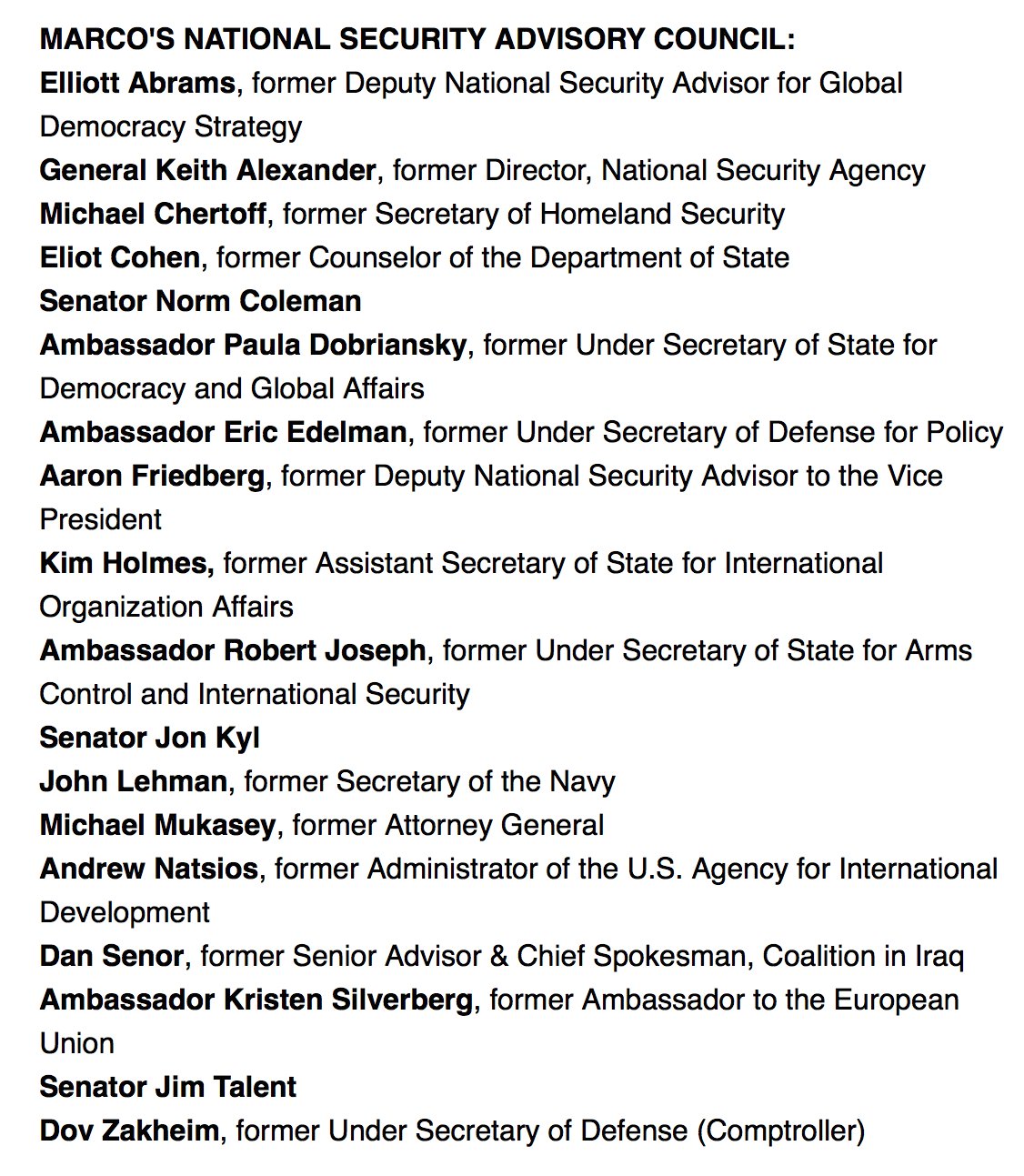
If you needed a reason to be grateful for Rubio's dwindling chances of securing the nomination, here's who he'd appoint to his national security advisory council:

Cc9csCnW4AEY4X8.jpg:large
 

Whiskeyjack

Mittens Margaritas Ante Porcos
Staff member
Messages
20,894
Reaction score
8,126
Foreign policy wonks have all been reacting to the long article Jeffrey Goldberg published in The Atlantic yesterday titled "The Obama Doctrine". Well worth a read if you have time for 20,000 words.

In case you don't, here are Dan Drezner's thoughts about it:

Remember Barack Obama? Nice guy, occasionally deft with words, surprisingly popular, and the current president of the United States. The 25-car pileup that has been the 2016 presidential primary season has obscured that last fact, but he’s still the leader of the free world for the next 10 months.

The Atlantic’s Jeffrey Goldberg has released to the world a nearly 20,000-word essay that consists primarily of Obama’s thoughts on foreign policy and America’s place in the world. For anyone interested in American foreign policy, it is well worth reading.

Clearly, many people read faster than I do, since hot take after hot take has already been filed. As someone who has written in the past about whether there’s an Obama Doctrine, I have thoughts. Here are the five things that surprised me the most from Goldberg’s essay:

1) Obama does not respect America’s foreign policy community. The essay is shot through with disdain from both the president himself and his White House staff about the opinions and judgments of the array of foreign policy think tanks and institutions in Washington. As Goldberg writes, “Obama generally believes that the Washington foreign-policy establishment, which he secretly disdains, makes a fetish of ‘credibility’—particularly the sort of credibility purchased with force. The preservation of credibility, he says, led to Vietnam.” Then there’s this:

By 2013, Obama’s resentments were well developed. He resented military leaders who believed they could fix any problem if the commander in chief would simply give them what they wanted, and he resented the foreign-policy think-tank complex. A widely held sentiment inside the White House is that many of the most prominent foreign-policy think tanks in Washington are doing the bidding of their Arab and pro-Israel funders. I’ve heard one administration official refer to Massachusetts Avenue, the home of many of these think tanks, as “Arab-occupied territory.”

I mean, damn. Speaking of Arabs …

2) Obama respects Arab Middle East leaders even less. The president does not think highly of Benjamin Netanyahu, but that’s nothing compared to his opinion of Arab leaders. Simply put, Obama does not say a single laudatory thing about any leader in the Arab world in this essay. He inherited a bunch of uneasy alliances with Sunni Arab states, but he doesn’t like it. He talks about how Saudi Arabia and Iran need to share power in the region, which is kind of like waving a big red cape in front of Riyadh. It’s clear that he resents any amount of time he has to devote to, in his opinion, ne’er-do-well partners in the region.

3) There’s a little bit of Donald Trump in Barack Obama. Trump is campaigning on the idea that the United States is getting a raw deal from the rest of the world and says he’d get along with Vladimir Putin. Surprisingly, Obama says his one-on-ones with Putin have been perfectly fine. And it was particularly interesting to see Obama espouse like-minded sentiments about free-riders:

If Obama ever questioned whether America really is the world’s one indispensable nation, he no longer does so. But he is the rare president who seems at times to resent indispensability, rather than embrace it. “Free riders aggravate me,” he told me. Recently, Obama warned that Great Britain would no longer be able to claim a “special relationship” with the United States if it did not commit to spending at least 2 percent of its GDP on defense. “You have to pay your fair share,” Obama told David Cameron, who subsequently met the 2 percent threshold.

That said, Obama’s logic for wanting more burden-sharing is radically different from Trump’s logic. Obama sees multilateralism as a useful constraint, “a way to check America’s more unruly impulses,” in Goldberg’s words. That’s a sentiment you will never hear from a current Republican.

4) Obama’s biggest foreign policy failure has been domestic in nature. Goldberg was overseas with Obama as the president whiffed badly in his initial response to the Paris and San Bernardino attacks. And everything about Obama’s reaction to those attacks in Goldberg’s essay confirms what I wrote in December.

As I noted a few days ago, Obama’s grand strategy de-emphasizes terrorism and the Middle East as threats in relation to the rise of China and climate change. Obviously, most Republicans disagree with that set of priorities, and as they say in this town, reasonable people can disagree about that set of priorities.

Obama’s greater problem is that he has failed to convince Americans that the threat of terrorism has been wildly overhyped.

5) Here’s the sentence that will infuriate so many about Obama, and it’s the reason I still admire him. If there’s a single sentence in the essay that encapsulates Obama’s view of America’s place in the world, it’s this one: “For all of our warts, the United States has clearly been a force for good in the world.”

I confess that what I love about that sentence is just how many people it will infuriate. Every conservative in America will rebel against the first clause. America has warts? That’s heresy!! It’s un-American to say that!! Obama’s willingness to acknowledge the United States as a flawed country is at the root of conservative criticism of this president as someone who doesn’t love the United States. Indeed, they tend to get so furious that they don’t notice the second clause in the sentence.

Many liberals do notice that second clause, however, and it infuriates them. Supporters of Bernie Sanders and left-wing critics of Hillary Clinton (and a few on the Buchananite right) severely doubt the second part of Obama’s claim, pointing to Iraq and Libya and myriad other American foreign policy screw-ups. And those are pretty big warts. But as the president noted in Goldberg’s essay, an awful lot of countries in the Pacific Rim, Latin America, and elsewhere have looked to the United States during the Obama era. That ain’t beanbag.
 

wizards8507

Well-known member
Messages
20,660
Reaction score
2,661
5) Here’s the sentence that will infuriate so many about Obama, and it’s the reason I still admire him. If there’s a single sentence in the essay that encapsulates Obama’s view of America’s place in the world, it’s this one: “For all of our warts, the United States has clearly been a force for good in the world.”

I confess that what I love about that sentence is just how many people it will infuriate. Every conservative in America will rebel against the first clause. America has warts? That’s heresy!! It’s un-American to say that!! Obama’s willingness to acknowledge the United States as a flawed country is at the root of conservative criticism of this president as someone who doesn’t love the United States. Indeed, they tend to get so furious that they don’t notice the second clause in the sentence.

Many liberals do notice that second clause, however, and it infuriates them. Supporters of Bernie Sanders and left-wing critics of Hillary Clinton (and a few on the Buchananite right) severely doubt the second part of Obama’s claim, pointing to Iraq and Libya and myriad other American foreign policy screw-ups. And those are pretty big warts. But as the president noted in Goldberg’s essay, an awful lot of countries in the Pacific Rim, Latin America, and elsewhere have looked to the United States during the Obama era. That ain’t beanbag.
This is completely backwards. I think most conservatives acknowledge the "America has warts" perspective and it's the second clause that infuriates them. Conservatives believe that America is a force for good, but they don't believe that Obama believes it. Obama believes that the superpower status of the United States is illegitimate, built on slavery, war-mongering, and the environmental destruction of the planet.
 

IrishinSyria

In truth lies victory
Messages
6,042
Reaction score
1,920
http://www.nytimes.com/2016/03/15/world/middleeast/putin-syria-russia-withdrawal.html

Seems like our plan of bankrupting Russia by flooding the natural resource markets worked?

FWIW, Russian troops accomplished exactly ZERO while they were there... minimal territory gains at best.

Realize this is an old post, but the pull-out was more symbolic than real and I think the consensus is there was actually a pretty huge impact from the Russian presence. SAR forces just retook Palmyra, and they've been tightening the noose on Aleppo ever since the Russians stepped in. If Putin's goal was to a: force Assad to the negotiating table while b: making sure he had the strongest hand, I think he succeeded.
 

calvegas04

Well-known member
Messages
11,860
Reaction score
8,440
US deploys F-15s to Iceland, Netherlands

US deploys F-15s to Iceland, Netherlands

The US has deployed 12 F-15C Eagles and around 350 airmen in Europe as part of Operation Atlantic Resolve (OAR), the Pentagon's demonstration of force designed to deter what the US calls Russian aggression against Europe.

The aircraft and troops were sent from the Barnes Air National Guard Base in Massachusetts and the Fresno Air National Guard Base in California for a six-month tour to Iceland's Keflavik and the Dutch Leeuwarden Air Base.

The American fighters “will conduct training alongside NATO allies and partners as part of OAR to strengthen interoperability, demonstrate US commitment to a Europe that is whole, free, at peace, secure, and prosperous and to deter further Russian aggression,” the USAF said in a statement.

During the tour the aircraft will forward-deploy to the Eastern European nations of Bulgaria, Romania and Estonia.

The deployment is one of several planned by the Pentagon. Next month it is planning to send six F-15s to Finland, which is not a NATO member, but an active participant in many of the bloc's activities.

Iceland is the only NATO member that has no military of its own, although it has a small coast guard force. The country used to host a US airbase during the Cold War, but it was shut down in 2006. Two years later US warplanes started paroling Iceland's airspace.

The US and NATO are pushing for a stronger military presence in Europe, and particularly in Eastern Europe and the Baltic, close to Russia's border. They argue that such deployment is necessary to deter Russia from military aggression.

Moscow says Western hawks are simply using the perceived Russian threat to justify greater military spending.
 

phgreek

New member
Messages
6,956
Reaction score
433
The US has deployed 12 F-15C Eagles and around 350 airmen in Europe as part of Operation Atlantic Resolve (OAR), the Pentagon's demonstration of force designed to deter what the US calls Russian aggression against Europe.

The aircraft and troops were sent from the Barnes Air National Guard Base in Massachusetts and the Fresno Air National Guard Base in California for a six-month tour to Iceland's Keflavik and the Dutch Leeuwarden Air Base.

The American fighters “will conduct training alongside NATO allies and partners as part of OAR to strengthen interoperability, demonstrate US commitment to a Europe that is whole, free, at peace, secure, and prosperous and to deter further Russian aggression,” the USAF said in a statement.

During the tour the aircraft will forward-deploy to the Eastern European nations of Bulgaria, Romania and Estonia.

The deployment is one of several planned by the Pentagon. Next month it is planning to send six F-15s to Finland, which is not a NATO member, but an active participant in many of the bloc's activities.

Iceland is the only NATO member that has no military of its own, although it has a small coast guard force. The country used to host a US airbase during the Cold War, but it was shut down in 2006. Two years later US warplanes started paroling Iceland's airspace.

The US and NATO are pushing for a stronger military presence in Europe, and particularly in Eastern Europe and the Baltic, close to Russia's border. They argue that such deployment is necessary to deter Russia from military aggression.

Moscow says Western hawks are simply using the perceived Russian threat to justify greater military spending.

Pointing and laughing at Putin...

The West won't build up more in the middle east, where home field for ISIS exists

...but suddenly people went all hawkish, and want to use HIM as an excuse.
 
Top