ulukinatme
Carr for QB 2026!
- Messages
- 32,394
- Reaction score
- 19,002
<iframe width="560" height="315" src="https://www.youtube.com/embed/rb1enu21C3A" frameborder="0" allowfullscreen></iframe>


But the minute that the Skagit River overflows its banks, or the Wenatchee National Forest catches fire, and causes millions of dollars in damage; the Governor will be on the local news demanding that the Federal Government expend billions of dollars in resources to help his state out............. they are Americans, after all!!
Just to clarify, you are in favor of the voluntary surrender of state records to the federal government on request without a warrant?
The Gov. noted the state universities. That ties in with previous posts about Texas and Indiana state legislatures, who are moving to pass laws that require all colleges and universities - public or private - to surrender these records when requested by the feds. Each state is now deciding this issue of providing records on request to the feds without a warrant and due to a Presidential executive order. Aren't you comfortable with that?
The Supreme Court did decide last year ( Utah v. Stieff) that an illegal search that discovered evidence of illegal activity or a criminal was legal (5-4). So, would you favor Wash state employees like the state police without a warrant pulling over a car full of Hispanics based on their ethnicity for the purpose of discoving if they were illegals and, if they cannot produce those documents, detain them for ICE? Are you comfortable with that?
Finally, do you think that Trump should prosecute the Gov for breaking his (Trump's) EO? Or just not providing federal assistance in disasters?
I just find it incredibly hypocritical that this governor is going to "take a stand" against what might be a perfectly legal EO, as if he doesn't have to follow Federal Rules and Regulations. Yet, he will damn sure want everyone to know that Washington is part of the United States, if some catastrophic event takes place and they need emergency funds that they don't have at a State level. I would, however, probably favor requiring the State to pay back any Federal assistance rendered during the time.
Also, taxpayers in Washington pay the federal government and have a right to receive the same assistance at the same level as other states.

I haven't had time to read the articles, but I agree with the headlines. "Illegals took my job" is more or less a political red herring. That doesn't mean we shouldn't secure the border. But the national security implications are much greater than the economic ones.
To the founders, the legislative and judicial powers were distinct by
nature and their separation was among the most important liberty-
protecting devices of the constitutional design, an independent right of
the people essential to the preservation of all other rights later enumer-
ated in the Constitution and its amendments.30 Though much could be
said on this subject, tonight permit me to suggest a few reasons why
recognizing, defending, and yes policing, the legislative-judicial divide
is critical to preserving other constitutional values like due process,
equal protection, and the guarantee of a republican form of government.
Consider if we allowed the legislator to judge. If legislatures were
free to act as courts and impose their decisions retroactively, they would
be free to punish individuals for completed conduct they’re unable to
alter. And to do so without affording affected individuals any of the
procedural protections that normally attend the judicial process. Rais-
ing along the way serious due process questions: after all, how would a
citizen ever have fair notice of the law or be able to order his or her
affairs around it if the lawmaker could go back in time and outlaw
retroactively what was reasonably thought lawful at the time?31 With
due process concerns like these would come equal protection problems,
too. If legislators could routinely act retroactively, what would happen
to disfavored groups and individuals? With their past actions known
and unalterable, they would seem easy targets for discrimination. No
doubt worries like these are exactly why the founders were so emphatic
that legislation should generally bear only prospective effect—proscrib-
ing bills of attainder and ex post facto laws criminalizing completed
conduct32—and why baked into the “legislative Power” there’s a pre-
sumption as old as the common law that all legislation, whether crim-
inal or civil, touches only future, not past, conduct.33
30. See The Federalist No. 47 (James Madison); The Federalist Nos. 79,
Now consider the converse situation, if we allowed the judge to act
like a legislator. Unconstrained by the bicameralism and presentment
hurdles of Article I, the judge would need only his own vote, or those
of just a few colleagues, to revise the law willy-nilly in accordance with
his preferences and the task of legislating would become a relatively
simple thing.34 Notice, too, how hard it would be to revise this so-easily-
made judicial legislation to account for changes in the world or to fix
mistakes. Unable to throw judges out of office in regular elections, you’d
have to wait for them to die before you’d have any chance of change.
And even then you’d find change difficult, for courts cannot so easily
undo their errors given the weight they afford precedent.35 Notice finally
how little voice the people would be left in a government where life-
appointed judges are free to legislate alongside elected representatives.
The very idea of self-government would seem to wither to the point of
pointlessness. Indeed, it seems that for reasons just like these Hamilton
explained that “liberty can have nothing to fear from the judiciary
alone,” but that it “haevery thing to fear from [the] union” of the
judicial and legislative powers.36 Blackstone painted an even grimmer picture of a world in which judges were free to legislate, suggesting that there “men would be[come] slaves to their magistrates.”37
In case you think the founders’ faith in the liberty-protecting
qualities of the separation of powers is too ancient to be taken seriously,
let me share with you the story of Alfonzo De Niz Robles.38 Mr. De Niz
Robles is a Mexican citizen, married to a U.S. citizen, and the father of
four U.S. citizens. In 1999, he agreed to depart the country after being
apprehended by immigration authorities. For two years his wife tried
without luck to secure him a spousal visa. At that point, Mr. De Niz
Robles decided to return to the United States and try his own luck at
applying for lawful residency. In doing so, though, he faced two compet-
ing statutory provisions that confused his path. One appeared to require
him to stay outside the country for at least a decade before applying
for admission because of his previous unlawful entry.39 Another seemed
to suggest the Attorney General could overlook this past transgression
and adjust his residency status immediately.40 In 2005, my colleagues
took up the question how to reconcile these two apparently competing
directions. In the end, the Tenth Circuit held that the latter provision
controlled and the Attorney General’s adjustment authority remained
intact.41 And it was precisely in reliance on this favorable judicial inter-
pretation that Mr. De Niz Robles filed his application for relief.
But then a curious thing happened. The Board of Immigration
Appeals (BIA) issued a ruling that purported to disagree with and may-
be even overrule our 2005 decision, one holding that immigrants like
Mr. De Niz Robles cannot apply for an immediate adjustment of status
and must instead always satisfy the ten-year waiting period.42 In sup-
port of its view on this score, the BIA argued that the statutory scheme
was ambiguous, that under Chevron step 2 it enjoyed the right to
exercise its own “delegated legislative judgment,” that as a matter of
policy it preferred a different approach, and that it could enforce its
new policy retroactively to individuals like Mr. De Niz Robles.43 So that,
quite literally, an executive agency acting in a faux-judicial proceeding
and exercising delegated legislative authority purported to overrule an
existing judicial declaration about the meaning of existing law and
apply its new legislative rule retroactively to already completed con-
duct. Just describing what happened here might be enough to make
James Madison’s head spin.
What did all this mixing of what should be separated powers mean
for due process and equal protection values? After our decision in 2005,
Mr. De Niz Robles thought the law gave him a choice: begin a ten-year
waiting period outside the country or apply for relief immediately. In
reliance on a judicial declaration of the law as it was, he unsurprisingly
chose the latter option. Then when it turned to his case in 2014, the
BIA ruled that that option was no option at all.44 Telling him, in essen-
ce, that he’d have to start the decade-long clock now—even though if
he’d known back in 2005 that this was his only option, his wait would
be almost over. So it is that, after a man relied on a judicial declaration
of what the law was, an agency in an adjudicatory proceeding sought
to make a legislative policy decision with retroactive effect, in full view
of and able to single out winners and losers, penalizing an individual
for conduct he couldn’t alter, and denying him any chance to conform
his conduct to a legal rule knowable in advance.
What does this story suggest? That combining what are by design
supposed to be separate and distinct legislative and judicial powers
poses a grave threat to our values of personal liberty, fair notice, and
equal protection. And that the problem isn’t just one of King George’s
time but one that persists even today, during the reign of King James
(Lebron, that is).45

Ahhhh, this is the kind of post I can wake up to!Case Western Reserve Law Review
Volume 66 | Issue 4
2016 Sumner Canary Memorial Lecture: Of Lions
and Bears, Judges and Legislators, and the Legacy of
Justice Scalia
Honorable Neil M. Gorsuch
Excerpt:
Another immigration case, (majority decision by Neil Gorsuch)
Gutierrez-Brizuela v. Lynch, 834 F.3d 1142 (10th Cir. 2016).

It scares me that the concepts of freedom that our country was founded upon are being considered ancient by many who wish to redefine society to their liking.


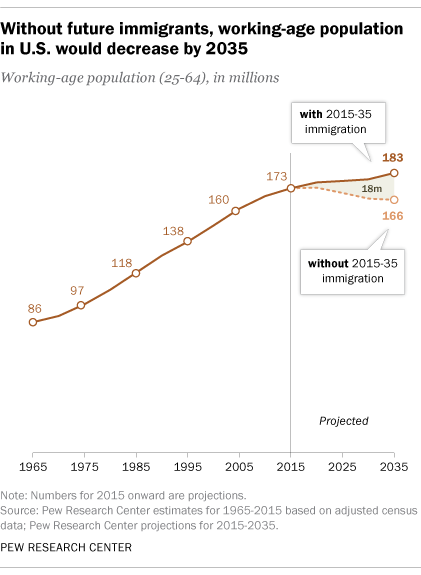
This has been discussed before to great extent. The US, and Europe, both need immigration due to birth rates and death. It isn't a question of IF we should have it, but how.

exactly...right now we are largely inundated with people who can do the jobs that are essentially evaporating...as has been well covered on IE. W/O some selective processes, we do little to help unemployment and dependence. Not saying there isn't a place for some laborers. Am saying they can't all be low-no skilled people if the argument is we need working aged people. They need to be lined up with the knowledge, skills, and abilities of the jobs we have, or will have...that is NOT happening now, and status quo certainly won't resolve that issue.
I don't think you have data to back that up.
Legal immigrants are usually not low-skill. And their entrepreneurial spirit is demonstrably greater than the native-born American average, as they start businesses at a far greater rate. Their economic benefit more than makes up for the cost of legal immigrant programs.
On the illegal front, Illegal immigrants are generally not eligible for welfare. Nor arr they legal permanent residents. Their presence here ultimately responds to the market. When the jobs dry up, they don't work and they go back to Mexico--which is what has been happening for the last decade since the market plummeted in 2007-2009. The modest rise in illegal immigrant numbers, maybe 200k over a decade, aren't from Mexico.

This has been discussed before to great extent. The US, and Europe, both need immigration due to birth rates and death. It isn't a question of IF we should have it, but how.
We're continually told the same by the so-called experts but Japan faces even worse birth rates than western countries yet they refuse to transform their own country/culture via immigration in exchange for an economic boost.
Japan, in spite of their refusal to embrace western open border immigration policies, is a modern country that provides its citizens economic opportunities, safety, stability and has remained a very unified country.
Nothing stops the west from doing the same.

I think most agree that the US has a growing debt problem. Not sure how then to describe Japan......
Wild Bill: "We can grab beers in thirty years and talk about how this one played out."
Family medical history and genetics lead me to believe that I won't be around for the party.
Who would want to deal with an even crankier 94 year old dshans, anyway?
<iframe width="560" height="315" src="https://www.youtube.com/embed/WzC_koWckdY" frameborder="0" allowfullscreen></iframe>

Based on their immigration policies, we'll be describing it as Japanese for the foreseeable future.
I understand they have unresolved economic problems, but they are not willing to gamble on the safety of their citizens or the future of their culture/country on the idea that mass immigration will be the answer to their economic problems.
They seem more interested in fixing their own economic and low birth issues with their own citizens - provide incentives to increase native birth rates and use automation to replace a dying workforce. That strikes me as more reasonable than mass immigration.
We can grab beers in thirty years and talk about how this one played out.
What are they doing? And how is it working? No one has a politically feasible plan to reverse these demographic trends.
Not sure we can afford to just ride out our current policies that long. Things can go downhill in a hurry.
Wild Bill: "We can grab beers in thirty years and talk about how this one played out."
Family medical history and genetics lead me to believe that I won't be around for the party.
Who would want to deal with an even crankier 94 year old dshans, anyway?
What are they doing? And how is it working? No one has a politically feasible plan to reverse these demographic trends.
Not sure we can afford to just ride out our current policies that long. Things can go downhill in a hurry.
Wild Bill: "We can grab beers in thirty years and talk about how this one played out."
Family medical history and genetics lead me to believe that I won't be around for the party.
Who would want to deal with an even crankier 94 year old dshans, anyway?
...