
NorthDakota
Grandson of Loomis
- Messages
- 16,003
- Reaction score
- 6,270
Jenny had Hep,... not AIDS,... damn conspiracy theorists,...
link?

Jenny had Hep,... not AIDS,... damn conspiracy theorists,...
Will this remain true when coronavirus hits its peak in the US? Or is it your belief that it has already peaked in terms of daily casualties?

link?

Diseases that kill more people per day in 2020 than Coronavirus. A surgeon texted me this:
Yellow Fever
Rabies
Whooping Cough
Measels
Seasonal Flu (2,000% more)
Pneumonia (4,000% more)
Meningitis.... Meningitis
Cholera
And about 100 others I've never heard of.
Those death numbers are probably right, but the risks of covid 19 are unique and go beyond just number of deaths. For a lot of the diseases above (yellow fever, cholera, rabies), those are the cost of living in underdeveloped areas so the areas where these deaths occur are relatively isolated (hence why the state department recommends vaccines if you travel there) and the threat of unstoppable spread is minimal.
Others like measles, whooping cough and meningitis have vaccines available so countries like the US with adequate herd immunity are also safer which limits the disease's ability to overwhelm global healthcare institutions.
Covid-19 does not have vaccines or treatments, there is no herd immunity because it's so new, and it spreads in a way that allows it to spread rapidly and across first/second/third world distinction. It also requires isolation protocols that some of the other diseases don't which makes treating these patients incredibly costly, complicated and risky. That's why the risk of overloading the healthcare system is so high, and why they're taking such drastic measures to limit early spread.

You're right that this is unique in that it's new and doesn't have a vaccine, unlike the others. Which makes me very happy to see it's deaths are so low. In ~9 months when we have a vaccine, I believe this will be behind us and we won't hear about it again.
Agree on overloading the health system. Need to keep people out of hospitals. Hard to convince people "just stay home and deal with it unless you're 70".
Hospitals, ER's, UC clinics will not do that. That's a bad look. And that'd be swimming upstream anyway because the media scare will drive everyone in if they think they have it.

But why let that get in the way of a good conspiracy theory?Joe Rogan had someone on his podcast today and they talked about this. He said they can basically tell where viruses come from and old it is (like a carbon copy). He later went on to say that is more than likely came from an animal and spread to a human in November.
I really hope that's true but I am concerned that there is still no effective SARS vaccine since that's from a similar, related virus. OTOH, the fact that this is more contagious probably means there will be more resources dedicated to it.
With respect to COVID-19 deaths, there are indications those have been undercounted too. I'm sure it's a lower ratio than the undiagnosed mild cases but it complicates projections.

My personal conspiracy theory is that COVID-19 is actually hundreds of thousands of years old, and was recently re-introduced to the environment as a result of melting polar ice, along with who knows how many other ancient and dormant viruses and bacterial strains.
Humans have no immunity to strains of diseases that old, because of how different they are than current viruses and diseases, and that's why the transmission rate is so high. It's easy to catch because nobody is equipped to fend it off.
For some reason, it doesn't effect kids as much. Not sure how my conspiracy theory accounts for that... yet.

Italics?Anyone's guessing on when there will be a cure. But Trump acted directly and swiftly and funded $8 Billion for scientists to find a cure.
And he has a knack at pushing performance. We're lucly he's at the helm if this is as serious as SOME say.

So has anybody's company asked them to work from home yet? I know that Dell in town has asked their employees to work remote. I give my company about a week before they make the announcement
So has anybody's company asked them to work from home yet? I know that Dell in town has asked their employees to work remote. I give my company about a week before they make the announcement
I recently changed jobs, and the nature of my work now doesn't allow 'work from home.' I have to be at the point of service for customers.


Italics?
Been away for more than a year. Glad to see nothing's changed; some of you are still idiots. COVID-19 has been, literally, the only thing we've been working on for the last two weeks. Some of you are completely missing the point, the real danger, because you watch too much Fox News. Some of you are probably going to die; it's been nice "knowing" you. Most of you will be fine.
Yes, COVID-19 is basically a cold, but it's a horrendous one because our herd immunity is nil. For most people, it's going to be like having a bad flu. Not a huge issue, normally. The real problem is the strain this is about to put on the healthcare system. The data we're seeing is that 25% of all hospitalized COVID-19 patients require ICU-level care. That's a serious problem. I'll walk you through the Hawaii model, and you can take that and apply it to where ever you are. There are not enough ICU suites, isolation ones at that, to handle that demand.
The two biggest issues we see are the world-wide shortage of PPE and the amount of panic we're seeing in both the general population and front-line medical staff. Much of what we need to combat this disease is made in... the same region in China where COVID-19 started. There is a 3-6 month delay in n95 order-fulfillment. These goddamn masks used to cost less than $1 per. Now they're between $10-15. Ridiculous. There's been a run on everything from gloves, to gowns, to body bags. The lack of PPE leads to employee exposure, which leads to staff shortages, which leads to unnecessary deaths for other patients... you get the picture. Reading the case-files from China, and now Seattle, is depressing. Some of those medical professionals in China died from straight exhaustion. At the Kirkland nursing home, three (3) staff members showed up to work, once the infection started. They were afraid of dying, and self-preservation overrode their professional/para-professional duties. As a hospital administrator, that's what keeps me up at night.
So the public panic is already causing an increase in ED visits for cough/fever symptoms. This year's flu season is bad. It's still going, and it's kept our hospital (and morgue) full. When you add more patients to this mix, you're looking at some serious issues. For one thing, the CDC is still calling for hybrid droplet/airborne precautions with COVID-19 patients. Hospitals only have so many iso rooms; there's not an infinite supply of these. We always think that living in a 1st-world country ensures you access to top-level healthcare. Let me dispel that, right quick.
Using Oahu as a model for COVID-19 infection:
- Oahu population is 1,000,000
- At 10% infection = 100,000 patients
- 20% requires hospitalization = 20,000 patients
- 25% requires ICU = 5000 patients
- Divide by 365 = 14 ICU admits per day, average
Oahu has around 200 ICU beds, and let's say they remain about 65% utilized. That's an average daily census (ADC) of 130. The length of stay for the COVID-19 patient is probably going to be somewhere between 12-18 days, because you're talking about someone who is going to develop pneumonia and/or sepsis. Now let's stack up the patients using the numbers, and see how this builds:
130, 144, 158, 172, 186, 200, 214...
Unless you're discharging your ICU patients at a rate roughly half of the COVID-19 admissions, you're going to run out of space within a week. If you think the media is trying to scare you, you haven't seen anything, yet. This is the kind of shit the professionals are talking about, and this is why they're so tight-lipped with info. The simple truth is that our health system is not set up for a sudden and rapid rise in patients. Some of you may live in rural areas. I feel bad for you, your community better pray this doesn't hit you hard, because a lot of you may die if it does. If you get the flu and COVID-19 at the same time (which is possible), you will die. It won't matter how old you are, that's a real gang-bang on your kidneys. Get your goddamn flu vax, if you haven't already (this coming from a guy who never, ever, got flu shots.)
Here's my advice besides washing your hands: stop trimming your nose hairs. You need to prevent the virus from getting to your mucous membranes, nose hairs are there for that reason. This whole "don't touch your face" thing is unrealistic. Stop scratching your eyes, don't dig your nose, and stop putting fingers in your mouth. Also, if you decide to shove something up your ass, wash your hands both before and after.

But why let that get in the way of a good conspiracy theory?
Sent from my Pixel 4 XL using Tapatalk

Someone rep this for me
I stated earlier that I am far from any conspiracy buff. I have been on the front lines of every health scare (SARS N1H1) etc over the last 20 years. I provide front line medical care. This just has been taken to another level response and panic wise. We have activated IMT teams here. We’ve never done anything to this level which has led me to believe there’s more to this than were being told.
Much of the current discourse on — and dismissal of — the Covid-19 outbreak focuses on comparisons of the total case load and total deaths with those caused by seasonal influenza. But these comparisons can be deceiving, especially in the early stages of an exponential curve as a novel virus tears through an immunologically naïve population.
Perhaps more important is the disproportionate number of severe Covid-19 cases, many requiring hospitalization or weekslong ICU stays. What does an avalanche of uncharacteristically severe respiratory viral illness cases mean for our health care system? How much excess capacity currently exists, and how quickly could Covid-19 cases saturate and overwhelm the number of available hospital beds, face masks, and other resources?
This threat to the health care system as a whole poses the greatest challenge.
As of March 8, about 500 cases of Covid-19 had been diagnosed in the U.S. Given the substantial underdiagnosis at present due to limitations in testing for the coronavirus, let’s say there are 2,000 current cases, a conservative starting bet.
We can expect a doubling of cases every six days, according to several epidemiological studies. Confirmed cases may appear to rise faster (or slower) in the short term as diagnostic capabilities are ramped up (or not), but this is how fast we can expect actual new cases to rise in the absence of substantial mitigation measures.
That means we are looking at about 1 million U.S. cases by the end of April; 2 million by May 7; 4 million by May 13; and so on.
The majority of people with Covid-19 can be managed at home. But among 44,000 cases in China, about 15% required hospitalization and 5% ended up in critical care. In Italy, the statistics so far are even more dismal: More than half of infected individuals require hospitalization and about 10% need treatment in the ICU.
For this exercise, I’m conservatively assuming that only 10% of cases warrant hospitalization, in part because the U.S. population is younger than Italy’s, and has lower rates of smoking — which may compromise lung health and contribute to poorer prognosis — than both Italy and China. Yet the U.S. also has high rates of chronic conditions like cardiovascular disease and diabetes, which are also associated with the severity of Covid-19.

Everyone was like, "This could be good, couple weeks off, check out spring training during the day, watch the CBB and NHL in the evening... let's roll with this..."
now:
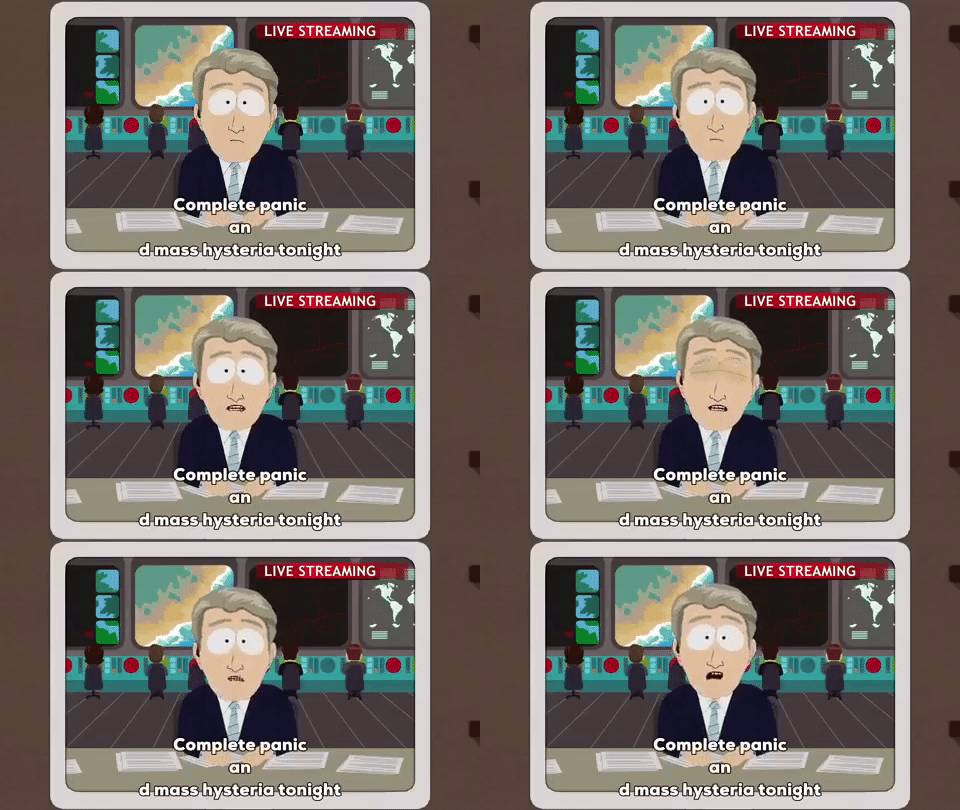

Poor ESPN right now. What will they talk about for ~4 weeks? They are already reaching for material as is.
Poor ESPN right now. What will they talk about for ~4 weeks? They are already reaching for material as is.
