2016 Presidential Horse Race

2016 Presidential Horse Race


  • Total voters
    183

woolybug25

#1 Vineyard Vines Fan
Messages
17,677
Reaction score
3,018
Please stop trying to troll me by taking my posts and mischaracterizing them. I have repeatedly said that I will NOT vote for Trump. I think Clinton would be an absolute disaster for this country. I can't think of another candidate who would be more about special interests than her.

Reaaaallly.... then who are you voting for, big guy?


Just because you don't like a post, doesn't mean its a troll post. I didn't mischaracterize anything. You are blasting on Hillary for something the other candidate does even worse. It's a silly argument.
 
Last edited:

connor_in

Oh Yeeaah!!!
Messages
11,433
Reaction score
1,006
175724_600.jpg
 

kmoose

Banned
Messages
10,298
Reaction score
1,181
Reaaaallly.... then who are you voting for, big guy?


Just because you don't like a post, doesn't mean its a troll post. I didn't mischaracterize anything. You are blasting on Hillary for something the other candidate does even worse. It's a silly argument.

You mischaracterized me as a Trump voter, despite the fact that I have repeatedly said that I will not vote for him.

My plan is to vote for Kasich in the primary. It's looking more and more like Trump will be the Republican nominee. If it comes down to Trump vs. Clinton, I will probably either write in Betty Montgomery (former Attorney General of Ohio and my brother's old neighbor) or I will simply abstain from voting for President. I'm blasting on Hillary for making what I felt was a mockery of the office of the Secretary of State of the United States. Other candidates have displayed similar behaviors, sure.... but none of them were acting as the top diplomat in the country. Context matters.

All I did was post a video of something that I thought exemplified what a shrew she is, and how little she cares about what she is SUPPOSED to be doing. Then others tried to characterize some African guy as sexist because of his question. Even if it was a sexist question, do you think it's ok for someone who is supposed to be a professional diplomat to go right past reasonable and straight into bitch mode? It's not like he told her to get her ass in the kitchen and make him a sandwich.
 

connor_in

Oh Yeeaah!!!
Messages
11,433
Reaction score
1,006
All too true. The type of person who makes a good candidate rarely makes a good president, and the person who'd actually make a good president rarely makes a good candidate. We don't vote for intelligence and honesty and hearing hard truths. We vote for sound bites and lies and being told what we want to hear. Lincoln & Truman wouldn't stand a chance of being elected today. What a poor choice we're going to have this year: a power-hungry, unscrupulous, pathological liar with a chip on her shoulder who would sell her soul to the highest bidder (and frequently has) or a narcissistic, bombastic, misongynistic loon. God help us all.

tumblr_noenylQkFh1s8njeuo1_500.gif


/end thread
 

RDU Irish

Catholics vs. Cousins
Messages
8,622
Reaction score
2,722
To me, odds are 100% Hillary is just in it for herself. With Trump, there is at least a chance he is actually going to "be greedy for the country". As a self absorbed narcissist - legacy means something to him and I could see him going to work with the goal of being the greatest president ever. He has no interest in propping up either party. He is also no dummy - he knows he will need a team to get anything done. I see him selecting a cabinet on ability rather than politics especially VP. Someone like Rubio would be a political choice. Kasich would be a get to work choice. Christie as AG would probably be enough to turn Hillary into an Expat. Solve problems with solving problems as the #1 goal, not pandering to constituencies. Novel concepts that actually have a chance of happening with him.

Of course that has to be weighed against the chance of a complete an utter disaster. I actually think checks and balances are in place to keep him from being able to single handedly destroy us all. Worst case, IMO, gridlock as neither side deals and he battles impeachment for trying to go to nuclear war with someone who offended him. If you think there are not enough adults in the room to prevent a total meltdown then maybe you should reconsider your faith in government.
 

Rack Em

Community Bod
Messages
7,089
Reaction score
2,727
To me, odds are 100% Hillary is just in it for herself. With Trump, there is at least a chance he is actually going to "be greedy for the country". As a self absorbed narcissist - legacy means something to him and I could see him going to work with the goal of being the greatest president ever. He has no interest in propping up either party. He is also no dummy - he knows he will need a team to get anything done. I see him selecting a cabinet on ability rather than politics especially VP. Someone like Rubio would be a political choice. Kasich would be a get to work choice. Christie as AG would probably be enough to turn Hillary into an Expat. Solve problems with solving problems as the #1 goal, not pandering to constituencies. Novel concepts that actually have a chance of happening with him.

Of course that has to be weighed against the chance of a complete an utter disaster. I actually think checks and balances are in place to keep him from being able to single handedly destroy us all. Worst case, IMO, gridlock as neither side deals and he battles impeachment for trying to go to nuclear war with someone who offended him. If you think there are not enough adults in the room to prevent a total meltdown then maybe you should reconsider your faith in government.

I don't have any now. Trump, along with the rest of both fields, isn't inspiring more faith either.

None of the candidates want to reduce the size and power of the government - that's the way to inspire faith in the government...one that is so self-aware that it devolves autonomy back to individuals instead of furtherance on the path to a European, welfare, nanny state.

Novel concept, isn't it?
 

IrishLax

Something Witty
Staff member
Messages
37,544
Reaction score
28,990
<iframe width="640" height="360" src="https://www.youtube.com/embed/DnpO_RTSNmQ?rel=0" frameborder="0" allowfullscreen></iframe>
 

RDU Irish

Catholics vs. Cousins
Messages
8,622
Reaction score
2,722
I don't have any now. Trump, along with the rest of both fields, isn't inspiring more faith either.

None of the candidates want to reduce the size and power of the government - that's the way to inspire faith in the government...one that is so self-aware that it devolves autonomy back to individuals instead of furtherance on the path to a European, welfare, nanny state.

Novel concept, isn't it?

Agree 100%, my comment was a shot at both sides really. Since Rand Paul couldn't get any traction, it seems the electorate has not drawn the same conclusion as you and I. The knee jerk reaction of "not being bought and sold like everyone else" does not take the next logical step of wanting to reduce the power of the corrupt enterprise, thus reducing the value of lobbying.
 

Whiskeyjack

Mittens Margaritas Ante Porcos
Staff member
Messages
20,894
Reaction score
8,126
I don't have any now. Trump, along with the rest of both fields, isn't inspiring more faith either.

None of the candidates want to reduce the size and power of the government - that's the way to inspire faith in the government...one that is so self-aware that it devolves autonomy back to individuals instead of furtherance on the path to a European, welfare, nanny state.

Novel concept, isn't it?

This is a chicken-and-egg problem. Big government is a symptom of an atomized, vice-ridden society. Can't reduce the size and scope of the Federal government without a virtuous, self-reliant citizenry. You've got to change the culture first.
 

ACamp1900

Counting my ‘bet against ND’ winnings
Messages
48,945
Reaction score
11,225
I'd slam my junk in a sliding glass door before I voted for Hilary.

Trump will get my vote. Maybe he makes America great again.

I'll be over here paying taxes either way.

Under no circumstances would I vote for Clinton... the big question is could I vote for Trump... don't think I can.
 

FightingIrishLover7

All troll, no substance
Messages
12,703
Reaction score
7,514
So, Trump RTd a Mussolini quote... (he was set up for it, but he didn't fact the check the source. Lol noob)

But, he obviously got called out on it (from the Today Show)
"So, are you trying to associate yourself with a fascist?"
"No, I'm just trying to associate myself with a quote. "

This MF can do no wrong. Lol.
 

connor_in

Oh Yeeaah!!!
Messages
11,433
Reaction score
1,006
So, Trump RTd a Mussolini quote... (he was set up for it, but he didn't fact the check the source. Lol noob)

But, he obviously got called out on it (from the Today Show)
"So, are you trying to associate yourself with a fascist?"
"No, I'm just trying to associate myself with a quote. "

This MF can do no wrong. Lol.

I do not like Trump, but while Il Duce did say it, he was not the first. There are attributions for it to a Roman proverb, a Tibetan proverb, as well as Sultan Fateh Ali Tipu (20 November 1750 – 4 May 1799), also known as the Tiger of Mysore, was the de facto ruler of the Indian Kingdom of Mysore from 1782 until his death in 1799. Some are slight variations and not exact, but still extremely close.

I am sure Hitler once said bring me some coffee, and so has HRC. That doesn't make HRC a follower of Hitler's ideas.
 

FightingIrishLover7

All troll, no substance
Messages
12,703
Reaction score
7,514
I do not like Trump, but while Il Duce did say it, he was not the first. There are attributions for it to a Roman proverb, a Tibetan proverb, as well as Sultan Fateh Ali Tipu (20 November 1750 &#150; 4 May 1799), also known as the Tiger of Mysore, was the de facto ruler of the Indian Kingdom of Mysore from 1782 until his death in 1799. Some are slight variations and not exact, but still extremely close.

I am sure Hitler once said bring me some coffee, and so has HRC. That doesn't make HRC a follower of Hitler's ideas.
I think you missed my point.

It's not the quote that bothers me, I'm sure Hitler has "quotes" that are probably agreeable.

It's the careless nature of Trump. He fell right for the bait. He was set up (as I mentioned) and he didn't even think twice to see the originator of the quote.

That's amateur hour quality from an "ivy league grad". Trump responds way too instinctively, to the point of recklessness. That is my concern with him... And the fact that he can't "be wrong", he can't say, "I made the mistake of not looking at the source" and leave it there. He feels the need to always defend his actions. He cannot let himself be wrong. That's narcissism.

When he's right, he's right. When he's wrong, he's right.
 

Rack Em

Community Bod
Messages
7,089
Reaction score
2,727
This is a chicken-and-egg problem. Big government is a symptom of an atomized, vice-ridden society. Can't reduce the size and scope of the Federal government without a virtuous, self-reliant citizenry. You've got to change the culture first.

Can we change the culture through allowing the vice-ridden to die without government intervention? Half joking.
 

GoIrish41

Paterfamilius
Messages
9,929
Reaction score
2,119
So, Trump RTd a Mussolini quote... (he was set up for it, but he didn't fact the check the source. Lol noob)

But, he obviously got called out on it (from the Today Show)
"So, are you trying to associate yourself with a fascist?"
"No, I'm just trying to associate myself with a quote. "

This MF can do no wrong. Lol.

This is after refusing to condemn the KKK in the Jake Tapper interview this weekend. Does their heyday coincide with the period he wants to country to rejoin when he says he's going to Make America Great Again? A few months ago, our nation's closest ally had a vote as to whether they would allow him to visit their country. What other president in our country received such a vote from an ally? He has advocated violence to protesters -- in at least on instance claiming he wanted to punch one in the face -- Make America Hate Again! He has made derogatory statements toward women, Mexicans, Muslims, and who knows who else. Is this part of the accepted actions when America was great? His list of behaviors would have disqualified any other candidate in my lifetime, and they continue to stack up. His supporters view this ugliness as a badge of honor, a man finally telling it like it is and dismissing the concept of political correctness. I would characterize his behavior as a fundamental abandonment of civility and an embrace of ignorance. All of that and he seems to lack even a basic understanding of the issues this country faces. How can his supporters not see how destructive he will be to this country? This is absolutely astonishing!
 

connor_in

Oh Yeeaah!!!
Messages
11,433
Reaction score
1,006
I think you missed my point.

It's not the quote that bothers me, I'm sure Hitler has "quotes" that are probably agreeable.

It's the careless nature of Trump. He fell right for the bait. He was set up (as I mentioned) and he didn't even think twice to see the originator of the quote.

That's amateur hour quality from an "ivy league grad". Trump responds way too instinctively, to the point of recklessness. That is my concern with him... And the fact that he can't "be wrong", he can't say, "I made the mistake of not looking at the source" and leave it there. He feels the need to always defend his actions. He cannot let himself be wrong. That's narcissism.

When he's right, he's right. When he's wrong, he's right.


Didn't argue any of that...just brought in further info on the quote itself for those unfamiliar with what happened. FYI, this also:
How We Fooled Donald Trump Into Retweeting Benito Mussolini
 

Whiskeyjack

Mittens Margaritas Ante Porcos
Staff member
Messages
20,894
Reaction score
8,126
Can we change the culture through allowing the vice-ridden to die without government intervention? Half joking.

Can't think of a historical example where that sort of policy has ended well. Seems to either result in government-sanctioned atrocity, or violent revolution.

The Week's Michael Brendan Dougherty just published an article titled, "Donald Trump is the candidate of the future":

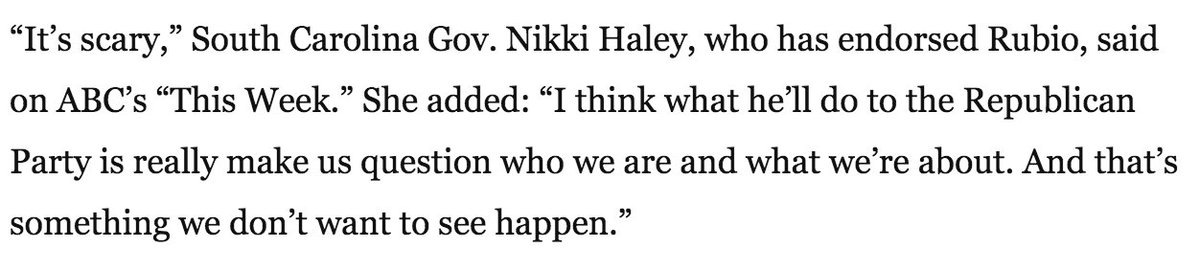
Late last week the Republican primary entered into the height of drama. At the last debate before the set of crucial Super Tuesday primaries, Marco Rubio and Ted Cruz found a way to turn Trump-style insults against Donald Trump.

Rubio looked alive and frisky, and Trump looked tired and annoyed. In campaign rallies the next day, Rubio read and mocked Donald Trump's tweets and said Trump was a sweating mess the night before. "He asked for a full-length mirror. I don't know why, because the podium goes up to here. Maybe he was making sure his pants weren't wet. I don't know," said Rubio.

For the first time in a while, it was Rubio and his supporters smiling, rather than Donald Trump. It was as if, for one moment, the whole polarity of the race were reversed. Instead of Rubio the flibbertigibbet getting flicked away by the Alpha Trump, it was Rubio looking nimble and fresh against a tired old man.

But it's hard to believe this represents a major turn in the race. Later that day, Trump received his first major endorsement from New Jersey governor and Rubio-antagonist Chris Christie, creating a stampede of coverage away from Rubio. Newt Gingrich even began talking up the possibility of the party accepting Trump as its nominee. And in the polls it looks like Donald Trump is likely to win nearly all Super Tuesday states. The absolute firewall for Rubio comes on March 15, when Ohio, Florida, North Carolina, Illinois, and Missouri vote, awarding the winner all their delegates. Rubio trails Trump even in head-to-head matches in Florida.

The rivalry between these two candidates may still turn on what they represent. And things are not as they seem.

Rubio talks about how yesterday is over and how he wants to lead his party in creating the next American century. The press burbles about how he "looks" like the future of the party. But Rubio is really the candidate of the past disguised as the future.

Rubio's membership in the Republican Party does not obviously represent a bold step forward. Cuban immigration and attachment to the Republican Party predated the 1965 immigration act that is transforming the country. Cuban-American loyalty to the GOP was a function of the Republican Party's stout anti-Communism. Rubio constantly invokes America's last Cold War president, Ronald Reagan, as his lodestar. But in his hawkish and assertive foreign policy, his constant leaning on America's values, his support for expanded legal immigration and comprehensive reform of the immigration system, he is a kind of re-tread of George W. Bush.

Donald Trump is the candidate of the future disguised as the candidate of the past. His social base and his campaign themes recall Pat Buchanan. His Archie Bunker-like way of talking about minorities and the poorly educated seems like a throwback to a more racist and xenophobic yesterday. But Trump is really the new wave. He is the celebrity that jumps into politics. He is running a campaign on earned media and social media. He invokes no historical antecedents, most likely because he is innocent of history. He is the Republican who has ditched all but the most symbolic and meaningless connection to the Moral Majority. "We're going to be saying, 'Merry Christmas' during a Trump presidency," he said.

Yes, Trump is the nationalist backlash candidate, and therefore that makes him seems like a fresh import from Europe. In the past I've predicted that political antagonism between a party dominated by white voters and a party that represents America's demographic future would increase racial antagonism generally. And now here it is. Trump is the candidate speaking obsessively about what may be the next century's major issue: how the cheap mass migration of people upsets the existing political order. Allow yourselves to contemplate that history doesn't move in one direction: racialist politics, nationalism, and xenophobia may be the future, not the past.

But even as I expect Trump will put the nominating contest away, there are still challenges for him.

Trump may have trouble maintaining the explosive fission of energy unleashed by his creative destruction of the Republican establishment and its nominating process. As the shattered Republican Party begins to reconstitute itself behind him, the party will urge him to take on all its baggage, adding the worst of the Republican brand to an already noxious Trump brand. Already in last Thursday's debate, Trump began revealing an inner lameness, as he started talking about substantive issues. He said he'd uncover "waste, fraud, and abuse" in America's federal spending — a perennial promise to deliver a nothingburger served lukewarm. His plans for immigration reform involve "touchback" proposals that are hard to credit. If he becomes the nominee, many of Trump's promises to deliver "something better" will in fact turn out to be something more specific and more unpopular: a set of re-heated white papers from the usual conservative think tanks.

Trump promises to unleash all the restraints of the present moment. But the Republican past, in the form of Marco Rubio as an antagonist, and Chris Christie as a partner, threatens to overwhelm him one way or another.

And Slate's Reihan Salam just published an article titled "Folks before Kochs":

Donald J. Trump is laying waste to the conservative movement. His overwhelming lead in Super Tuesday polls stands as further evidence, if further evidence were even necessary, that his appeal among Republicans is deep and durable, even as his campaign makes a mockery of conservative ideals. While conservatives have traditionally emphasized the central importance of limited government, Trump has built his campaign around the promise of an unlimited government that will solve every problem that ails America, provided it is fully under his command.

To many on the right, Trump’s enormous popularity seems particularly galling in light of the failures this election cycle of one conservative true believer after another. No candidate was more ideologically orthodox than Bobby Jindal, the government-slashing, hard-right governor of Louisiana, yet Trump ridiculed his campaign out of existence. Wisconsin Gov. Scott Walker defeated powerful public-sector unions in a state that had long been a citadel of progressivism, and he too exited the race, as Trump stole his populist thunder. Ted Cruz and Marco Rubio were both backed by Tea Party activists in their respective Senate campaigns, and both have made their mark by singing from the Reaganite hymnal. Now both are being bested by a man who praises Planned Parenthood, has warm words for socialized medicine, and seems almost Bernie Sanders–esque in his delight at the prospect of waging class warfare.

Though the rise of Trump has taken almost everyone by surprise, we really should have seen it coming. America has been long overdue for something like Trumpism. In the years since the financial crisis, populist insurgencies have devastated mainstream parties of the center right and center left in virtually every market democracy. Barack Obama’s rhetorical gifts mask the many ways in which he is a deeply conventional political figure, a man who trusts the wisdom of technocrats rather than seeking to overturn the established order. One could argue that the Obama presidency rescued America’s upper classes from a more ferocious post-crisis backlash, at least for a time. The twin insurgencies of Trump and Sanders demonstrate that the anger is still there—that it was just waiting for the right person to conjure it up. What separates the two politicians is that Sanders is in tune with the ideological orthodoxies of the left while Trump has no regard for those of the right. This iconoclasm is one of the sources of his power.

More than anything else, Trump has demonstrated that white working-class voters have minds of their own. They will not simply line up behind the candidates selected for them by hedge-funders and industrialists during the “invisible primary.” If we define working-class voters as those without a college degree, Ronald Brownstein of the Atlantic estimates that this bloc represents 53 percent of Republicans, split almost evenly between those who are conservative Christians and those who are not. The Pew Research Center reports that in 2012, 53 percent of Republicans were part of families that earned less than $75,000 a year. These groups, which tend to overlap, are Donald Trump’s base. Ever since the Nixon era, Republicans have relied on the white working class to achieve political victories. Now, it has revolted against the GOP elite.

Why wouldn’t they be furious? The Republican failure to defend the interests of working-class voters, and to speak to their hopes and fears, has made Trump’s authoritarianism dangerously alluring. Trump recognized that elite Republicans—a group rooted in affluent coastal metropolises and dominated by members of the credentialed upper middle class, which has shielded itself from the social and economic devastation that has wreaked such havoc in less-privileged corners of the country—often fall prey to wishful thinking about the rank-and-file voters who actually elect GOP candidates. They imagine that working- and middle-class conservatives are passionately devoted to the things they care about—tax cuts and entitlement reform—when these voters are far more passionate about other issues: economic nationalism, limits on less-skilled immigration, and minimum-wage hikes.

Having recognized this chasm separating the Republican donor class from the grassroots, Trump has exploited it brilliantly. He has defended entitlement programs, and he has bashed bankers. He has defied the elite consensus on trade and immigration. He is channeling the Republican id, and in doing so he may have already dashed conservative hopes of winning the White House. Why can’t his GOP opponents convince Republican voters that they would do a far better job than Trump of defending middle-class economic interests? The answer is that they are trapped by the delusions of the donor class, and they can’t break free.

In the coming weeks and months, old-school conservatives will do everything they can to defeat a man they consider a charlatan and provocateur. Alexander Burns, Maggie Haberman, and Jonathan Martin of the New York Times report that leading GOP donors and congressional bigwigs are mounting a desperate rearguard action to do just that. But whether or not they succeed, the GOP establishment must acknowledge that the Trump campaign has surfaced important and uncomfortable truths. Those truths can no longer be evaded.

If the Republican Party is to have a future, it must learn from Trump’s rise. By launching a frontal attack on movement conservatism, Trump has demonstrated its weakness and the failure of its stale policy agenda to resonate with voters. In doing so, he is giving conservatives a once-in-a-generation opportunity to change direction.

There is only one way forward in the post-Trump era. The GOP can no longer survive as the party of tax cuts for the rich. It must reinvent itself as the champion of America’s working- and middle-class families. In every campaign, Democrats and Republicans talk about getting the working class and the middle class back on their feet. Those are almost always empty words. The GOP must now become a genuinely populist party, putting the concerns of voters ahead of those of donors. The alternative will be a decade or more of marginalization and defeat, during which the left will have free rein.

Following this path will be uncomfortable for a Republican elite that has grown accustomed to getting its way, and to selling an agenda that’s best suited to the interests of the already well-to-do as an agenda for America. While tossing aside long-held orthodoxies will be difficult, it is absolutely necessary. By embracing populism, this new GOP will have the potential both to speak to Trump’s voters and to grow the party’s base, uniting voters across lines of race, class, and region.

What might a more populist GOP agenda look like? Here is a brief sketch of how the party can change course.

A Pay-Your-Own-Way Immigration Policy

No issue better illustrates the divide between elite Republicans and the party’s base. One recent survey found that a large majority (67 percent) of Republicans favor decreasing immigration levels while only 7 percent of them favor an increase. Nevertheless, leading Republicans, including Marco Rubio and Jeb Bush, have backed proposals that would greatly increase immigration levels in defiance of the Republican grassroots. Trump, meanwhile, has used incendiary language to electrify Republicans who oppose immigration.

What accounts for this divide between the policies prominent Republicans have backed and those favored by rank-and-file GOP voters? For high-income Republicans, skilled immigrants are their colleagues, neighbors, and friends, and less-skilled immigrants provide them with the low-cost child care, restaurant meals, and other services that allow them to lead comfortable lives. These affluent conservatives thus take a more relaxed approach to immigration, which is reflected in the immigration reform proposals they’ve advanced. Less-affluent conservatives, meanwhile, are far more likely to see immigrants as either competitors for scarce public resources or as a burden on hard-pressed taxpayers.

To unite the right, the GOP ought to embrace a simple immigration reform principle: The U.S. will only welcome immigrants who can pay their own way. Immigrants who earn high wages are less likely to need public assistance than those who earn low wages. They are in a better position to provide for their families, and their children are more likely to flourish as adults. Republicans should not shrink from advocating immigration policies that protect the interests of American workers. That means welcoming immigrants who are economically self-sufficient and who can help finance social programs for poor Americans—whether native- or foreign-born, of every racial and ethnic group—rather than relying on those social programs themselves.

Eat China’s Lunch

On more than one occasion, Donald Trump has said that “China’s just eating our lunch,” and that we ought to retaliate. He’s not wrong.

It really is true that Chinese import competition has had a powerfully negative impact on America’s Rust Belt, and that China shields its domestic market from competition while encouraging intellectual property theft on a grand scale. Yet it’s also true that China is experiencing a wave of deindustrialization not unlike what already took place in the U.S., as many of its labor-intensive manufacturers embrace labor-saving technologies. Moreover, the Chinese economy is entering a rocky period, as growth slows and domestic unrest rises. Now might be the perfect time for the U.S. to rethink its relationship with China, and its approach to global economic integration more broadly.

As automation accelerates, labor costs will be of decreasing importance for manufacturers. This could lead to more “insourcing,” or a return of manufacturing jobs to U.S. shores. But even if the U.S. attracts new manufacturing facilities in large numbers, the number of manufacturing jobs created will likely be modest, as these new facilities will make far greater use of machines than factories of the past. Nevertheless, insourcing of this kind would be an economic boon. Republicans ought to offer a comprehensive agenda for making the U.S. more attractive to manufacturers, through corporate tax reform but also through a renewed commitment to investing in infrastructure—in other words, an economic nationalism rooted in substance, not shopworn nostalgia.

More broadly, Republicans ought to put forward specific policy proposals to improve the lives of workers who lose their jobs to outsourcing or automation. One promising idea is a wage insurance program that provides workers with a strong incentive for rapid re-employment. As Lael Brainard, Robert Litan, and Nicholas Warren proposed in 2005, workers who lose their jobs and then find lower-wage work would receive an insurance payout that would cover up to 50 percent of the earnings gap, up to $10,000 a year for no more than two years.

This is exactly the kind of social program that elite Republicans tend to oppose. But a GOP more attuned to the interests of its working-class base must think differently, particularly if the alternative is subjecting American workers to long-term unemployment and all the suffering that comes with it.

Defend the Safety Net

One of the hallmarks of the Trump campaign has been his support for Social Security and Medicare, and his insistence that he would protect these programs from budget cuts. To many conservatives, Trump’s defense of these old-age entitlements is his greatest heresy. What they fail to understand is that conservative voters are very fond of these programs, and their fondness can’t be chalked up to simple hypocrisy.

We saw this dynamic at play during the early days of the Tea Party, the last time elite Republicans faced a serious populist challenge. Many conservative intellectuals viewed the Tea Party movement as the realization of their fondest wishes: a grassroots rebellion demanding fiscal austerity. In fact, as Emily Ekins of the Cato Institute has observed, Tea Party members were chiefly motivated by a theory of economic fairness. They believed, in Ekins’ words, that “everyone should be rewarded in strict proportion to their achievements and failings and that government should not shield people from the consequences of their decisions.” This is why Tea Party conservatives are more favorably disposed toward programs like Social Security and Medicare—to which workers contribute over a lifetime in exchange for benefits when they need them—than they are to programs that lack this contributory element.

Republicans ought to reform old-age entitlements to make them sustainable over the long haul. But in doing so, they must ensure that these programs perform their core functions better than they do today, particularly for the poorest and most vulnerable seniors. To improve Social Security, Republicans might back a package of reforms that would encourage older Americans to work by slashing or eliminating their property taxes and that would ensure that all seniors receive a benefit that would keep them from falling into poverty, which is not currently the case. On Medicare, they could improve the quality of care for seniors while lowering costs by defaulting seniors into Medicare Advantage, a program that allows beneficiaries to access high-quality private insurance coverage.

More controversially, Republicans should follow Trump’s lead and accept that some of the core aspects of Obamacare are here to stay. Trump often seems confused when questioned about health policy, but he does intuitively understand that Americans hate the idea that people with pre-existing medical conditions might be denied care. The best way forward for the right would be to call an Obamacare truce: accept that the exchanges are here to stay, as they’re a guarantee that people with pre-existing conditions will always have access to health insurance they can afford. The GOP should instead focus on reforming Obamacare so that people would have the option to buy lightly regulated plans with their own money. This wouldn’t be as satisfying for Republicans as repealing Obamacare root and branch, but it’s a far more realistic approach that might win over at least some Democrats and independents. And it would demonstrate that all Republicans, like Trump, “won’t let people die in the streets”—a commitment that doesn’t always come across.

Respect, Not Compassion

Republican anti-poverty rhetoric often reeks of condescension. When George W. Bush spoke of compassion for the downtrodden, it was very clear that he meant well. It’s equally clear, though, that for most poor Americans, a hand up is vastly preferable to a shoulder to cry on.

Encouragingly, a number of conservative reformers have proposed using the tax code to help low-income families. Marco Rubio and Jeb Bush, among others, have called for increases in wage subsidies, and their proposals have much to recommend them. One serious challenge, however, is that sliding-scale wage subsidies help workers as they climb the bottom rungs of the job ladder, but they can also discourage them from earning more as they gain experience, because the subsidies taper off as workers earn more income. The Bipartisan Policy Center has proposed solving this problem by replacing the current earned income tax credit with a refundable earnings credit equal to 17.5 percent of the first $20,000 in earnings that would apply to each worker, with or without children. This would make life for low-wage workers much easier, not least by lowering the cost of tax preparation, a huge burden for poor families. Better still, it would remove the disincentive to earn more money.

Republicans should go further and back a more generous refundable per child tax credit. Such a credit would help equalize the tax benefits received by low-income parents and their better-off counterparts, who benefit more from other provisions of the tax code. Conservatives might fear that a program that gives poor parents money with no strings attached will discourage them from working. This is a legitimate concern, but the experience of other market democracies suggests that it is overblown. Indeed, there is some evidence to suggest that a well-designed child credit can lead to increased work hours. Keep in mind that many low-income families with children already receive substantial assistance in the form of food stamps and other benefits. By replacing much of this in-kind assistance with cash, Republicans would give poor parents greater flexibility, and they’d also treat them with greater respect.

No New Tax Cuts for the Rich

If Republicans are to win the trust of working- and middle-class voters who’ve grown deeply skeptical of their economic nostrums, they will have to do something dramatic: It’s time for the GOP to abandon its near-obsessive devotion to tax cuts that disproportionately benefit upper-income households.

Virtually every GOP candidate, Trump included, has offered a tax reform proposal that would slash taxes on America’s richest people. But according to a survey conducted last fall, almost one-third of Republicans (31 percent) would be more likely to support a candidate who favored raising taxes on wealthy Americans compared with one-third (34 percent) who’d be less likely to vote for such a candidate and another one-third (34 percent) who were indifferent. Given these numbers, you’d expect that one or two GOP presidential candidates might run on cutting taxes on the rich while one or two others might call for hiking them. Instead, we see elected Republicans march in lockstep on taxes, as though their voters did the same.

The GOP elite has also yet to grasp that most voters simply don’t care as much about taxes as they did in the Reagan era. Megan McArdle of Bloomberg View has observed that the tax burden on middle-income households has declined since the Reagan presidency. The predictable result is that support for cuts in federal taxes has fallen substantially, and the share of voters who consider their federal tax burden their top priority is a mere 1 percent.

To break out of their tax trap, Republicans ought to embrace a very simple strategy. The GOP should continue to back tax cuts for the middle class, and in particular for middle-class parents. But until the country sees large and sustained budget surpluses, there should be no tax cuts for households earning $250,000 or more.

While there are growth-friendly tax reforms that would preserve or even increase the progressivity of the current tax code, this proposal will still be difficult for supply-siders to bear. And that’s to the good. For too long, Republican have been excessively beholden to voters at the top of the income spectrum, and swearing off tax cuts for the rich would be an excellent way to prove that they’ve turned over a new leaf.

I’m under no illusion that Republicans will embrace this agenda tout court, and there’s no question that some of these ideas are more far-fetched than others. This proposal also isn’t comprehensive: I haven’t touched on same-sex marriage or abortion or foreign and defense policy. The point of this exercise is not to dictate exactly where GOP policymakers should go. Rather, it is to demonstrate that the GOP can speak to the interests of working- and middle-class Americans while maintaining conservative principles.

Conservative reformers of earlier eras recognized that to protect and defend capitalism, they needed to ensure that everyone could share in the wealth it creates. This was true of Theodore Roosevelt in the progressive era, and it was true of Ronald Reagan, who broke with his free-trade convictions to protect vulnerable American industries and backed tax reforms that closed loopholes used only by the richest of the rich. Reagan was a conservative true believer, but he also recognized that rapid economic change could cause chaos and dislocation, and that government had a role to play in smoothing out its rough edges.

What defenders of the Republican status quo fail to realize is that unless the party speaks to the interests of working-class voters, they won’t just face slightly higher capital gains taxes or more wasteful spending under a Hillary Clinton administration. They will face a backlash from within that threatens to profoundly damage a party that, at its best, is a champion of the core social and economic institutions that made America great in the first place.
 
Last edited:

Kaneyoufeelit

Bowl Eligible
Messages
4,440
Reaction score
635
Check out @USATODAY's Tweet: https://twitter.com/USATODAY/status/704419657994911745?s=09

Once again, a narcissist is never wrong.

<blockquote class="twitter-tweet" data-lang="en"><p lang="en" dir="ltr">Donald Trump blames a bad television ear piece for his KKK comments: <a href="https://t.co/GJ1rPBHlKO">https://t.co/GJ1rPBHlKO</a></p>— USA TODAY (@USATODAY) <a href="https://twitter.com/USATODAY/status/704419657994911745">February 29, 2016</a></blockquote>
<script async src="//platform.twitter.com/widgets.js" charset="utf-8"></script>
 

Bishop2b5

SEC Exchange Student
Messages
8,928
Reaction score
6,159
Two explorers were captured by savages who tied them up and dragged them to their village. The chief approached the two and said, "I give you choice. Death or buggaloo."

The first explorer said, "I don't know what this buggaloo thing is, but it can't be worse than death, so I choose buggaloo." The savages all went nuts and began jumping up & down chanting, "Buggaloo! Buggaloo!" then ripped off the explorer's clothes and gang raped him.

The second explorer was terrified by this and decided he'd rather die than go through something like that. When the chief asked him whether he chose death or buggaloo, the explorer said he'd take death. The savages again all went nuts and began jumping up & down chanting, "Buggaloo! Bugaloo!"

"Wait! Wait!" shouted the explorer to the chief. "I said I chose death!"

"Yes" said the chief. "Death by buggaloo!"

Welcome to the 2016 presidential election.
 

tussin

Well-known member
Messages
4,153
Reaction score
1,982
Two explorers were captured by savages who tied them up and dragged them to their village. The chief approached the two and said, "I give you choice. Death or buggaloo."

The first explorer said, "I don't know what this buggaloo thing is, but it can't be worse than death, so I choose buggaloo." The savages all went nuts and began jumping up & down chanting, "Buggaloo! Buggaloo!" then ripped off the explorer's clothes and gang raped him.

The second explorer was terrified by this and decided he'd rather die than go through something like that. When the chief asked him whether he chose death or buggaloo, the explorer said he'd take death. The savages again all went nuts and began jumping up & down chanting, "Buggaloo! Bugaloo!"

"Wait! Wait!" shouted the explorer to the chief. "I said I chose death!"

"Yes" said the chief. "Death by buggaloo!"

Welcome to the 2016 presidential election.

<iframe width="560" height="315" src="https://www.youtube.com/embed/pSgqIR5H0TY" frameborder="0" allowfullscreen></iframe>
 
Top