
GoIrish41
Paterfamilius
- Messages
- 9,986
- Reaction score
- 2,184
This is the view I wake up to every morning in Southern California. Not bad for a gullible rube!


Some day you may get to live in one of those houses if you keep working at it.

This is the view I wake up to every morning in Southern California. Not bad for a gullible rube!

Barack Obama likes to credit himself with getting America to step back from the abyss of the Middle East. When he shops around the story of his legacy, the president says he was proudest of his decision not to follow the "Washington playbook" and commit to toppling the government of Syrian President Bashar al-Assad.
It would be a fitting story to tell of the man who ascended to the presidency while simultaneously winning a Nobel Peace Prize. Obama returns America's sword to its sheath, and earns the praise of his fans and admirers. Just as he passed on a better economy to his successor than the one he inherited from Bush, so he passed on a safer world.
Unfortunately this story is a lie from end to end. The world the next president will inherit is full of traps.
In Afghanistan, Obama has slowed down the pace of withdrawing troops. Corruption is rife, and there seems to be no progress on talks between the Afghan government and the Taliban. The latter has gained momentum and re-captured parts of the countryside. A continued drawdown after Obama's presidency may make his successor appear to be running from the Taliban.
In Iraq, American special forces are back on the ground as the U.S conducts airstrikes against ISIS. Although the U.S. seems to be sending ISIS into a smaller corner of the country, Iraq's political settlement is as shaky as ever, with Shia Muslims threatening to revolt.
In Syria, the U.S. wants to force Assad out of peace negotiations, and so acts to strengthen various rebel groups. The civil war is thus extended indefinitely, leading to increasing death totals. Russia acts to shore up Assad in negotiations, making Syria look more and more like a proxy war between two global nuclear powers.
The Libya conflict is not over either. The American people have even discovered, through simple communiques from the military, that it is engaged in extensive airstrikes there against ISIS — which itself was able to gain a foothold in the country after the Moammar Gadhafi government was toppled by U.S. air power. In the Arabian Peninsula, peace talks between warring Yemeni groups have stalled. The U.S. has aided Saudi Arabia's war against Houthi rebels on behalf of its Yemeni clients.
American special forces are on the ground in four civil wars now, or five if you include Afghanistan. Because these wars would be unpopular if they were put before Congress, the American people are simply not consulted. All four of the civil wars in which America has troops on the ground are carried out through an authorization of military force that was passed in 2001 to strike back at the terrorist groups involved in the September 11 attacks.
How the 2001 authorization enables the U.S. to run the logistics and refuel Saudi planes as they consistently bomb civil targets like hospitals I leave to more creative exegetes of the law. In any case, there is a danger in involving America in so many conflicts that exist beyond the remit of popular opinion. It was precisely America's poorly-understood and not-deeply supported involvement in Somalia in the 1990s that rocked Bill Clinton's first term. The public was curious to know why its military men were being lynched in the streets of a country to which it offered humanitarian help. Men die in circumstances that were not anticipated and the public asks questions: Who authorized this? Why?
And these are just the conflicts in the Middle East. The U.S. will likely witness more provocative acts as Russia continues its military buildup on the border with Ukraine. It has seen China make more aggressive moves that rankle American allies in the South China Sea.
And sometimes these problems can interlock with each other. The Syrian Civil War inspired Angela Merkel to open the doors of Europe, and a refugee wave is re-shaping European politics in a nationalist direction, and possibly led directly to Brexit. Since the largest EU nations effectively constitute the deputy partner in America's NATO alliance, any instability that gets Europe looking for major political rearrangements is serious news. Will fooling around and extending the Syrian civil war have been worth it, if a migrant crime and terror wave in Europe makes Marine Le Pen president of France? How will it look when her party, which has been bailed out by Russian moneymen, comes to destroy the European project?
President Obama was given a very difficult foreign policy situation in Iraq and Afghanistan. But his decisions in the Middle East and elsewhere have set a number of traps for the next president, while weakening our allies. And this in turn has invited other global powers to test America's historic commitments.
Barack Obama likes to credit himself with getting America to step back from the abyss of the Middle East. When he shops around the story of his legacy, the president says he was proudest of his decision not to follow the "Washington playbook" and commit to toppling the government of Syrian President Bashar al-Assad.
It would be a fitting story to tell of the man who ascended to the presidency while simultaneously winning a Nobel Peace Prize. Obama returns America's sword to its sheath, and earns the praise of his fans and admirers. Just as he passed on a better economy to his successor than the one he inherited from Bush, so he passed on a safer world.
Unfortunately this story is a lie from end to end. The world the next president will inherit is full of traps.
In Afghanistan, Obama has slowed down the pace of withdrawing troops. Corruption is rife, and there seems to be no progress on talks between the Afghan government and the Taliban. The latter has gained momentum and re-captured parts of the countryside. A continued drawdown after Obama's presidency may make his successor appear to be running from the Taliban.
In Iraq, American special forces are back on the ground as the U.S conducts airstrikes against ISIS. Although the U.S. seems to be sending ISIS into a smaller corner of the country, Iraq's political settlement is as shaky as ever, with Shia Muslims threatening to revolt.
In Syria, the U.S. wants to force Assad out of peace negotiations, and so acts to strengthen various rebel groups. The civil war is thus extended indefinitely, leading to increasing death totals. Russia acts to shore up Assad in negotiations, making Syria look more and more like a proxy war between two global nuclear powers.
The Libya conflict is not over either. The American people have even discovered, through simple communiques from the military, that it is engaged in extensive airstrikes there against ISIS — which itself was able to gain a foothold in the country after the Moammar Gadhafi government was toppled by U.S. air power. In the Arabian Peninsula, peace talks between warring Yemeni groups have stalled. The U.S. has aided Saudi Arabia's war against Houthi rebels on behalf of its Yemeni clients.
American special forces are on the ground in four civil wars now, or five if you include Afghanistan. Because these wars would be unpopular if they were put before Congress, the American people are simply not consulted. All four of the civil wars in which America has troops on the ground are carried out through an authorization of military force that was passed in 2001 to strike back at the terrorist groups involved in the September 11 attacks.
How the 2001 authorization enables the U.S. to run the logistics and refuel Saudi planes as they consistently bomb civil targets like hospitals I leave to more creative exegetes of the law. In any case, there is a danger in involving America in so many conflicts that exist beyond the remit of popular opinion. It was precisely America's poorly-understood and not-deeply supported involvement in Somalia in the 1990s that rocked Bill Clinton's first term. The public was curious to know why its military men were being lynched in the streets of a country to which it offered humanitarian help. Men die in circumstances that were not anticipated and the public asks questions: Who authorized this? Why?
And these are just the conflicts in the Middle East. The U.S. will likely witness more provocative acts as Russia continues its military buildup on the border with Ukraine. It has seen China make more aggressive moves that rankle American allies in the South China Sea.
And sometimes these problems can interlock with each other. The Syrian Civil War inspired Angela Merkel to open the doors of Europe, and a refugee wave is re-shaping European politics in a nationalist direction, and possibly led directly to Brexit. Since the largest EU nations effectively constitute the deputy partner in America's NATO alliance, any instability that gets Europe looking for major political rearrangements is serious news. Will fooling around and extending the Syrian civil war have been worth it, if a migrant crime and terror wave in Europe makes Marine Le Pen president of France? How will it look when her party, which has been bailed out by Russian moneymen, comes to destroy the European project?
President Obama was given a very difficult foreign policy situation in Iraq and Afghanistan. But his decisions in the Middle East and elsewhere have set a number of traps for the next president, while weakening our allies. And this in turn has invited other global powers to test America's historic commitments.

This is the view I wake up to every morning in Southern California. Not bad for a gullible rube!
The Week's Michael Brendan Dougherty just published an article titled "Obama will leave his successor a ticking time bomb":
In the Middle East specifically, what would you have done differently?
Don't depose Qadaffi, don't destabilize Assad, start shifting away from Saudi Arabia and Turkey in favor of a reset with Iran and Russia, etc. Basically do whatever's possible to encourage regional stability without antagonizing our allies. Avoid putting boots on the ground at all costs, and try to avoid being associated with the deaths of Sunnis as much as possible.

Suburbia is supposed to impress me? Man you haven't read many of my posts.
And yeah Breitbart is complete garbage and I laugh at anyone who reads it thinking they have a shred of integrity. They're a propaganda outlet and nothing more.
So you are saying they are similar to the NY Times and the Washington Post.
No. If you have trouble seeing the difference, that's on you.

No. If you have trouble seeing the difference, that's on you.


Breitbart was great, but I agree that his legacy is being diminished by the website right now. They are good in that they print stuff others are afraid to, and they have some great reporters, but they seem to be aiming at positioning themselves to be players rather than fighting the bullies. They have become a little tabloidy an sensational. Maybe that will change now that Trump has the guy that was driving them in that direction.
You can write off Breitbart like you'd write off Slate or something. But both have good stories sometimes and talk about things that people are thinking about.
WashPost and NYTimes are on a completely different level. Their resources and institutional reach is just light years ahead. They too have become propaganda machines, in that they read and report everything through an ideological lens and push a clear agenda while pretending to be neutral (which Mother Jones, Brietbart, New Republic, etc., don't do), but their content is so different. They try to actually conrol the narrative, not just tell slanted stories or report facts before they are confirmed.
It's like your army being betrayed by the U.S. (NYTimes) or France (Germany), rather than Estonia (Brietbart). The only thing comparable to them that not to the left is the WSJ.
Russia is responsible for their actions. They are the ones who are ratcheting it up here, in my view. The economy is in tatters and Putin is saber-rattling to distract them.
Libya is a tough one for me considering how optimistic the Arab Spring seemed and Europe's desire to lead the way. Surely you recall the conservatives criticizing Obama for "leading from behind," instead of diving in fully in 2011. Given those two options, I'll take Obama's course.
Syria is something they almost certainly regret, but at the same time was the crucial turning point, no? That's when Assad crossed the red line and Obama (thanks to Biden, no?) opted not to go down the same ol' neoconservative course.
I give his foreign policy mixed reviews. Although I think he's miles ahead of Bush and Clinton here.
How do you keep military/defense from overwhelming the budget while reducing debt?

So that means you have no problem with the way the Post conducts business. Anyone with a clue knew this existed, but the DNC email leaks just proved it.
“We [have] been working him for weeks in general on writing up something positive,” Miranda wrote of The Washington Post’s Greg Sargent on May 20. “We think he’d play ball.”
Who here is saying that the Times or Post don't have a bias on that the Clinton machine's influence in them isn't shameful? Please point that person and post out for me.
What I said was that they aren't similar to Breitbart. One might as well post Infowars links while they're at it.


pheww... thank goodness obama just gave iran 400 mil. thanks obama
<iframe width="560" height="315" src="https://www.youtube.com/embed/8jJYdYZA_Ck" frameborder="0" allowfullscreen></iframe>
pheww... thank goodness obama just gave iran 400 mil. thanks obama
<iframe width="560" height="315" src="https://www.youtube.com/embed/8jJYdYZA_Ck" frameborder="0" allowfullscreen></iframe>
Should have blown them out of the water
How do you keep military/defense from overwhelming the budget while reducing debt?


he Pentagon has awarded up to $40 billion worth of small arms and ammunition contracts as part of an effort to arm Iraqi and Afghan security forces, but can account for only a fraction of battle rifles, sniper rifles, machine guns and pistols it purchased, an independent report finds.
Of the total value, the Federal Procurement Database System, or FPDS, shows that about $20 billion was spent by September 2015. That works out to $13 billion on ammunition and upgrades to ammunition factories, $4 billion on small arms attachments and $3 billion on small arms, the report states.
The charity claims that the U.S. government gave about 1.5 million guns to Iraq and Afghanistan as part of $2.2 billion worth of small arms-related contracts, but "only 3 percent of these weapon purchases were detailed on the daily DoD contract publications."
"We know by looking at other US government records, that at least 1,452,910 small arms have been sent to Iraq and Afghanistan in the last 14 years. The DoD contract database appears to list as little as 3% of these. We also know the US government has acknowledged they don't know where many of these weapons now are," he said.

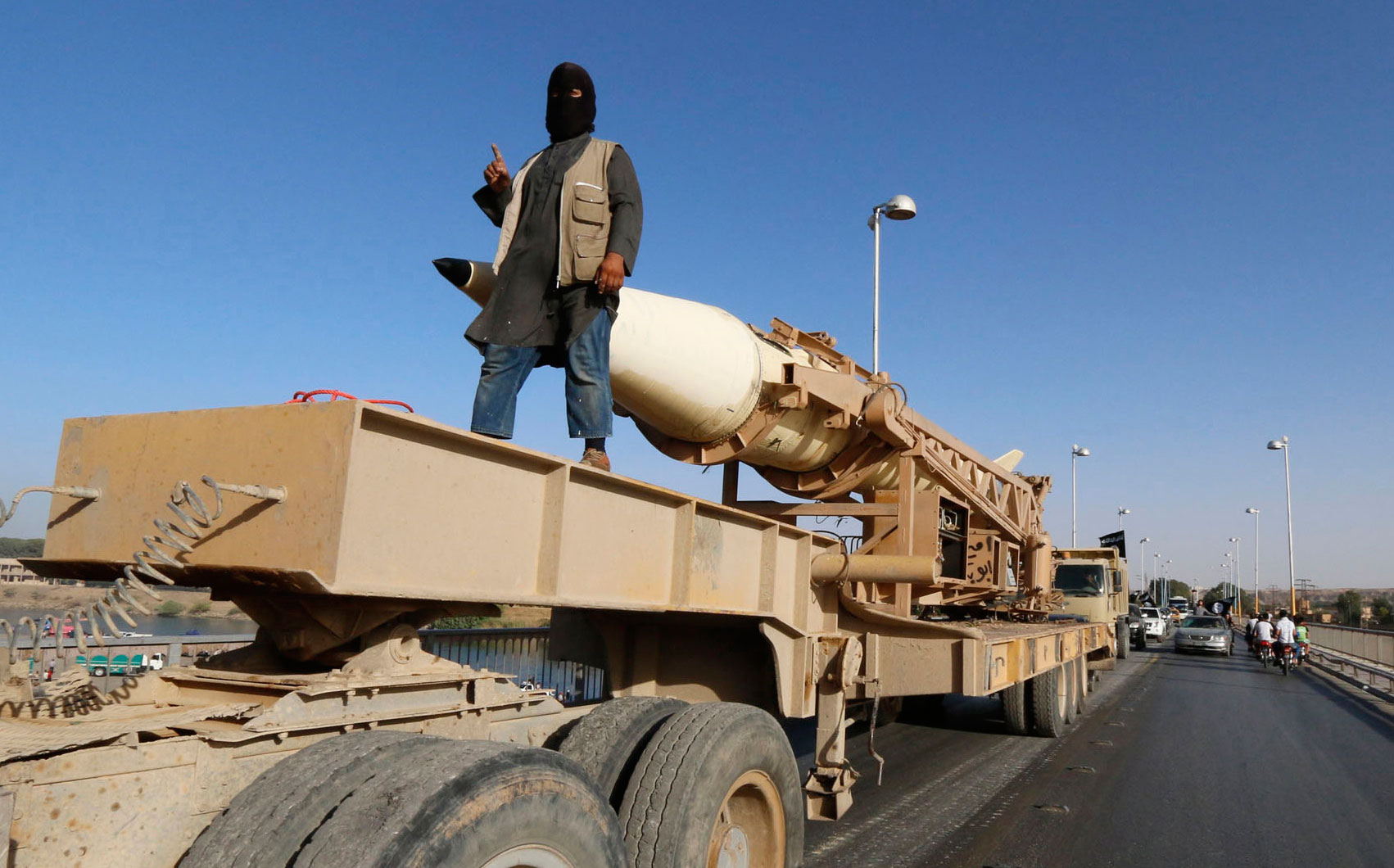
According to Reuters, the U.S.-made weaponry that fell into enemy hands including 2,300 Humvee armored vehicles, at least 40 M1A1 main battle tanks, 74,000 machine guns, and as many as 52 M198 howitzer mobile gun systems, plus small arms and ammunition.
Although al-Abadi and other Iraqi and U.S. officials haven’t attached a dollar sign to the lost weaponry and vehicles, a back-of-the-envelope calculation of those losses might look something like this:
2,300 Humvee armored vehicles @ $70,000 per copy. Total: $161 million
40 M1A1 Abram tanks @ $4.3 million per copy. Total: $172 million
52 M198 Howitzer mobile gun systems @ $527,337 per copy. Total: $27.4 million
74,000 Army machine guns @ $4,000 per copy. Total: $296 million
The grand total comes to $656.4 million, but experts say those losses represent just a portion of the many hundreds of millions of dollars’ worth of U.S.-supplied military equipment that has fallen into ISIS’s hands and is being used against the U.S. and allied forces on the ground in Iraq and neighboring Syria.

Congratulations, you just created multiples news cycles dominated by the fears of an Iranian-American War and therefore sent oil prices up through the roof, which aids the government of Iran...