Foreign Policy

Irish YJ

Southsida
Messages
25,888
Reaction score
1,444
I'm all for the unification of Ireland, and perfectly fine with Scotland gaining its Independence.

As for the US... If both parties don't get their heads out of their asses, I'm OK with the States moving towards independence. I'd happily move to TX if they did, and I'd be more than OK to wave goodbye to CA if they did. It's not what I want, but I don't see either party suddenly starting to embrace a moderate platform. The divide will just grow until we see some extreme shit.
 

Irish YJ

Southsida
Messages
25,888
Reaction score
1,444
You know the Conservatives over there were against Brexit too right?

I think you're absolutely right about politicians taking notice. As podcaster Dan Carlin (among other I'm sure) have pointed out, it doesn't matter if the middle class is actually worse off, it only matters if they think they're worse off. Knowing politicians, I think they will take the easy path and pour gasoline on the fire rather than rework policy.

I think in the future we will wonder "shouldn't it have been fucking obvious?" after reactionaries drive economies off cliffs.

IMO, reactionaries are reacting to stupid shit from both parties. I won't blame the populist or nationalist for sending messages to politicians who have given nothing but deaf ears for so long.
 

zelezo vlk

Well-known member
Messages
18,009
Reaction score
5,047
Pretty sure we already had a big discussion about states leaving the Union in the mid-19th century. If I recall, it wasn't too big of a deal. It was civil.
 

Whiskeyjack

Mittens Margaritas Ante Porcos
Staff member
Messages
20,894
Reaction score
8,126
I think plenty of Europeans desired to openly trade and travel instead of more wars. The Post-World War II European peace, brought about by the United States' role as a superpower and combining the economies of European powers, has done tremendous good for the average European whether they recognize it or not.

Much more the former than the latter. If the EU disappeared tomorrow, the continent would not devolve into war and chaos simply because America would still be the global hegemon, and war within Europe isn't in our interest (let alone their own).

They're going to receive dictates from Brussels whether they like it or not. They simply will not get free trade without agreeing to freedom of movement.

No, they won't. You can't have a common currency without common fiscal policy. Nor can you have freedom of movement without a uniform welfare policy. Those are massive problems within the EU that had (and still have) no obvious solutions. Most Europeans simply aren't willing to give up that much sovereignty to Brussels.

Might I ask, should Britain withdraw from NATO? Surely the UK receives dictates from their American bosses. Should they follow de Gaulle's lead and try to reaffirm their independence in that sense? Thta'd be nonsense, the British quickly realize their best bet was to give up some of that precious sovereignty in return for being best friends with the big dawg on the block. This week they got the chance to choose whether some sovereignty is worth not being a part of the biggest free trade block in the world...

I doubt they'll ever withdraw from NATO, but if Europe truly wants a deeper union, it will need a European military to match its economic clout. And to get deeper, it will likely have to contract. Depth and breadth are not compatible here. Of the major players, Britain has always been the most skeptical of deeper integration, so it makes sense that they'd be the first to bow out (and for those in favor of deeper integration, this actually offers an opportunity).

International treaties are complicated, I'm afraid you're too quickly boiling it down to philosophy and your distaste for liberalism.

Who's more likely guilty of relying on reductive arguments and exaggerating potential consequences? Those who think a mercantilist powerhouse closely allied with the global hegemon will find ways to continue trading advantageously with the Western world, or those who insist the British economy will crash and another European land war is now inevitable...

That doesn't mean it's good, or that the British should encourage them.

There are many types of populism, and not all of them are bad. Those who voted for Leave were not throwing their lot in with Golden Dawn or Donald Trump. The Leave Campaign itself has many different facets to it: high Tory advocates concerned with sovereignty, economic populists who think the EU is threat to working-class jobs and the NHS, as well as immigration skeptics.

On a side note, I'm honestly curious to hear how you (or the Catholic Church) compare nationalism with Christianity. It would seem to me that those two philosophies cannot coexist. Surely a Christian worldview has no regard for arbitrary political boundaries. That's not to say one should sign on for being subdued by bureaucrats, but I can't imagine the Church, or you, see the rise of the far Right in Europe and smiles.

From the Catechism:

2241 The more prosperous nations are obliged, to the extent they are able, to welcome the foreigner in search of the security and the means of livelihood which he cannot find in his country of origin. Public authorities should see to it that the natural right is respected that places a guest under the protection of those who receive him.

Political authorities, for the sake of the common good for which they are responsible, may make the exercise of the right to immigrate subject to various juridical conditions, especially with regard to the immigrants' duties toward their country of adoption. Immigrants are obliged to respect with gratitude the material and spiritual heritage of the country that receives them, to obey its laws and to assist in carrying civic burdens.

I don't smile at the rise of the far right. But it is, in many ways, a reaction to overreach by Progressives. Until the Left comes to terms with the costs and failures of its globalist project, and seriously grapples with how to reconcile it with what people actually want, the far right will continue to surge.

On a somewhat separate note, we've also had a special relationship with Scotland this whole time, do we hurry and back them when they vote for independence? What position do we take if a reunification charge in Ireland leads to terrorism?

I don't think either of those things are likely to happen, but I don't see why we'd need to take a strong stance either way.

So carrying the logic one step further, does Ted Cruz lead a Texas independence movement after Hillary Clinton is elected this fall?

Texas has not been a sovereign nation for 900 years, nor does it have its own language, or one of the five largest militaries in the world.
 
Last edited:

Whiskeyjack

Mittens Margaritas Ante Porcos
Staff member
Messages
20,894
Reaction score
8,126
Here's The Week's Noah Millman arguing that Brexit is a good thing for those seeking deeper integration within Europe:

Britain's vote to exit the European Union has done Europe an enormous favor, no matter whether you think "Europe" is a good or bad idea.

If you think it's a bad idea, then Britain is about to prove that it is possible to leave and survive. The transition is going to be expensive — Britain will enter a recession in the short term, and the long-term transition may be even more painful than the short, particularly if London cannot retain its position as the financial capital of Europe. But if Britain wants to be a country rather than a city-state, it's a transition it will have to make at some point. Merely by proving it can be done, Britain will give heart to any other state reconsidering rule from Brussels.

But if you think Europe is a good idea, then you must think it can be made to work. And the only way Europe can work is by becoming a deeper union. The euro can only function if Europe has a common fiscal policy. Europe can only wield diplomatic clout commensurate with its demographic and economic bulk if it has a common defense policy. And Britain was always going to remain the largest, strongest foot-dragger to further cessions of national sovereignty.

And here's The Week's Michael Brendan Dougherty on why everyone needs to stop freaking out about Brexit:

On Friday morning the consequences of Britain's vote to leave the European Union started to come in quick succession. Prime Minister David Cameron was going to be eased out — no! — he was resigning. Jeremy Corbyn, leader of the opposition Labour Party, was to face a no-confidence vote. The SNP's Nichola Sturgeon demanded a new referendum on Scottish independence. And Sinn Fein's Martin McGuinness called for a border poll in Ireland. Markets roiled. The pound cratered. And pundits declared it the end of the United Kingdom and the resumption of World War II hostilities.

But now it is time to slow down. Much of the panic is just directionless fear.

And here's Tyler Cowen on why Brexit happened and what it means:

Much has been made of the supposed paradox that opposition to immigration is highest where the number of immigrants is lowest. Yes, some of that is the racism and xenophobia of less cosmopolitan areas, but it would be a big mistake to dismiss it as such or even to mainly frame it as such. Most of all it is an endowment effect. Those are the regions which best remember — and indeed still live — some earlier notion of what England was like. And they wish to hold on to that, albeit with the possibility of continuing evolution along mostly English lines.

One way to understand the English vote is to compare it to other areas, especially with regard to immigration. If you read Frank Fukuyama, he correctly portrays Japan and Denmark, as, along with England, being the two other truly developed, mature nation states in earlier times, well before the Industrial Revolution. And what do we see about these countries? Relative to their other demographics, they are especially opposed to very high levels of immigration. England, in a sense, was the region “out on a limb,” when it comes to taking in foreigners, and now it has decided to pull back and be more like Denmark and Japan.

The regularity here is that the coherent, longstanding nation states are most protective of their core identities. Should that come as a huge surprise? The contrast with Belgium, where I am writing this, is noteworthy. The actual practical problems with immigration are much greater here in Brussels, but the country is much further from “doing anything about it,” whether prudently or not, and indeed to this day Belgium is not actually a mature nation-state and it may splinter yet. That England did something is one reflection of the fact that England is a better-run region than Belgium, even if you feel as I do that the vote was a big mistake.

All of the above are well worth reading in full if you're interested in the subject. But the only article I'm going to reproduce in its entirety here is from The Week's Damon Linker, titled "How Brexit shattered progessives' dearest illusions":

It's perfectly reasonable to worry about what will happen after Britain's historic vote to break up with the European Union. Will Brexit provoke Scotland and Northern Ireland to secede from the United Kingdom, leading to its dissolution? Will it embolden other members of the EU to bolt? And will those secessionist movements empower unsavory characters who end up being seduced by Vladimir Putin and modeling themselves on his form of authoritarian populism? Will the dire short-term economic consequences of Brexit create chaos and recession in the long term, too?

As I said, lots of reasons to worry.

But what we've seen from a wide range of writers and analysts in the days since the Brexit vote is not necessarily worry. It is shock. Fury. Disgust. Despair. A faith has been shaken, illusions shattered, pieties punctured. This is what happens when a life-orienting system of belief gets smashed on the rocks of history.

The name of that shattered system of belief? Progressivism.

I used to be a conservative. I now consider myself a liberal. But I have never called myself a progressive. There's a reason why, and it has nothing to do with policy.

Liberals believe in the rule of law; in individual rights to speech, worship, assembly, and private property; in an independent judiciary and civilian control of the military; in representative institutions founded on the consent of the governed; in democratic elections, not as ends in themselves but as checks on the power of government and as a means of gauging and forging popular support for policies pursued by public officials in the name of the common good.

Progressives believe in all of that, too, but they add something else: a quasi-eschatological faith in historical progress that gives the movement its name. This belief has many sources, and it takes many forms. One stream flows from liberal Protestant theology on down through Woodrow Wilson's hopes for moral advances at home and an end to armed conflict abroad — with both of them realized by an elite class of public-spirited experts. The same theologically infused faith informs Barack Obama's frequent invocation of an "arc of history" that "bends toward justice."

A secular variation on these messianic hopes was forged by Immanuel Kant, who insisted it was a necessary "postulate of practical reason" to believe that history is moving toward the realization of "the highest good" (including a future of "perpetual peace"). G.W.F. Hegel went further, transforming Kant's essays on progress into an elaborate philosophy of history that culminated in the realization of absolute self-consciousness and freedom in the modern liberal state.

Hegel's greatest 20th-century student, Alexandre Kojève, pushed even further, to propose that mankind was on the cusp of establishing a "universal, homogeneous state" in which all of humanity's desires would be recognized and fulfilled. (Francis Fukuyama's The End of History and the Last Man was an attempt to update and apply Kojève's progressive insights to the immediate aftermath of the Cold War.)

Whether or not it's expressed in explicitly theological terms, progressivism holds out a very specific moral vision of the future. It will be a world beyond particular attachments, beyond ethnic or linguistic or racial or religious or national forms of solidarity. In their place will be the only acceptable form of solidarity: humanitarian universalism.

And this means that the progressive future will even result in the end of politics itself — at least if politics is understood as encompassing more than the jostling of interest groups, bureaucratic administration, and the management of government benefits. Politics in that narrow sense will remain. But politics in Aristotle's sense — this particular community in this place with this history and heritage, determining its own character for itself, deciding who is and who is not a citizen, who will rule, and in the name of which vision of the good life — that existential form of politics will cease to exist in the progressive future.

Politics in this expansive sense will come to an end in the imagined progressive future because there will be nothing left to debate. The big questions of politics will already be answered, the big disputes settled once and for all. Everyone will understand that all particular forms of solidarity are morally indefensible (just various forms of racism) and that all strong political stands against humanitarian universalism in the political realm are politically unacceptable (just various forms of fascism).

It would be one thing if progressives understood their universalistic moral and political convictions to constitute one legitimate partisan position among many. But they don't understand them in this way. They believe not only that their views deserve to prevail in the fullness of time, but also that they are bound to prevail.

It is this faith in the inevitability of progressive triumph that has led so many commentators to respond so intensely to the rise of Donald Trump. I don't mean reactions that focus on Trump's personal, temperamental shortcomings. Those are real and worthy of serious concern. I mean reactions that take the form of moral indignation and outrage — as if the very fact that millions of voters have cast ballots for a candidate who strongly opposes immigration and free trade is some kind of moral and theological betrayal, or an offense against capital-H History itself.

The progressive response to the outcome of the Brexit vote is remarkably similar.

It's easy to understand its sources. The European Union may well be the purest and most ambitious experiment in progressivism ever attempted — a transnational economic and political entity founded entirely on the moral premises of humanitarian universalism, which is to say on the negation of particularistic attachments. (Kojève was one of the chief planners of the European Common Market, the predecessor to the EU.)

Yes, neoliberal economic policies (as well as fiscal austerity) undoubtedly played a big role in provoking anti-EU sentiment in Great Britain. But I suspect Angela Merkel is the real catalyst behind the outcome of the UK referendum. Not only did the German chancellor insist on admitting well over a million refugees and migrants from the Greater Middle East into the heart of Europe. Supporters of the policy have also made it clear on numerous occasions that they consider racism and xenophobia to be the only possible grounds for opposing her stand.

From the standpoint of progressivism, this makes perfect sense. An open-door policy toward refugees and migrants fleeing unrest in the Levant and North Africa is obviously the only morally acceptable option. It shouldn't matter whether those immigrants are Muslims, or if they're Syrians or Libyans, skilled or unskilled, poor or middle class, literate or illiterate, eager to assimilate or convinced of the need to resist it, looking for freedom and pluralism or hoping to build an enclave of Sharia law within the West. And there's certainly no reason to suspect that any of them might turn toward terrorism, now or a generation from now. They're just placeless people — human beings in need of aid, comfort, and charity. That's all that should matter.

Except that many millions of citizens in EU member countries don't see it this way. It does matter to them, just as it also matters to them whether Turkey is eventually invited to join the union, and they don't appreciate having their concerns about the ethnic, religious, linguistic, and economic character of their political communities dismissed as moral pathologies.

In this way, Merkel's grand progressive-humanitarian gesture has backfired badly — rekindling and potentially intensifying the very nationalistic solidarity that progressives once hoped the EU would dissolve or erase.

If history is moving inexorably toward humanitarian universalism, then giving it a sharp shove forward every now and then might be necessary and even admirable. And it certainly won't meet any significant resistance. It will merely hasten the inevitable.

But what if progressivism isn't inevitable at all? What if people will always be inclined by nature to love their own — themselves, their families, their neighbors, members of their churches, their fellow citizens, their country — more than they love the placeless abstraction of "humanity"? In that case, the act of ignoring or even denigrating this love will have the effect of provoking its defensive wrath and ultimately making it stronger.

It makes perfect sense to be surprised, saddened, and concerned by the outcome of the Brexit vote. But shock? Fury? Disgust? Despair? That's what a person feels when he discovers that his most dearly held fundamental beliefs have led him astray.

Wake up, progressives! You have nothing to lose but your illusions.

Hot damn. Finest thing Linker has ever written. I could cosign on every sentence.
 

dshans

They call me The Dribbler
Messages
9,624
Reaction score
1,181
And yet nobody laughed at my Civil War joke. Damn.

Caught it.

Tossed it back to the pitcher.

Good thing it wasn't crushed into the upper deck.


Hell, I didn't know that neocons had an intentional sense of humor!!!
 
B

Buster Bluth

Guest
Much more the former than the latter. If the EU disappeared tomorrow, the continent would not devolve into war and chaos simply because America would still be the global hegemon, and war within Europe isn't in our interest (let alone their own).

I agree but largely it's impossible to tell. They began to merge the economies simultaneously with the American ascension to superpower status. Britain and France didn't really withdraw from world power status until the Suez Crisis, but years before that the European Coal and Steel Community intentionally merged two of the largest industries necessary for making war. The ECSC, as I'm sure you know, went on to become the EU.

I think this part of the conservation is a dead end, as the USSR has just as much of a hand in it as the US, given that the lack of a threat from the Soviets/communists means they wouldn't have had extra motivation to unite.

No, they won't. You can't have a common currency without common fiscal policy. Nor can you have freedom of movement without a uniform welfare policy. Those are massive problems within the EU that had (and still have) no obvious solutions. Most Europeans simply aren't willing to give up that much sovereignty to Brussels.

Everyone is suggesting they go the Norway or Switzerland route, both of those countries follow EU trade laws, pay the EU fees, and allow freedom of movement per EU rules. Britain will have to do the same if they want to free trade with Europe. Simply saying, they are not done taking orders from Brussels, but what they have done is eliminate the means to have a say there.

I doubt they'll ever withdraw from NATO, but if Europe truly wants a deeper union, it will need a European military to match its economic clout. And to get deeper, it will likely have to contract. Depth and breadth are not compatible here. Of the major players, Britain has always been the most skeptical of deeper integration, so it makes sense that they'd be the first to bow out (and for those in favor of deeper integration, this actually offers an opportunity).

Agreed. And I thought that was a superb article.

Who's more likely guilty of relying on reductive arguments and exaggerating potential consequences? Those who think a mercantilist powerhouse closely allied with the global hegemon will find ways to continue trading advantageously with the Western world, or those who insist the British economy will crash and another European land war is now inevitable...

Mercantilists need markets in which to roam. Yeah Britain will be okay. But maybe they'll just be okay.
Ten years from now their economy looks to be smaller than California's.

In a sense that's not so bad, after all the European lesson of the post-WW2 era is that second place behind the US is still pretty nice.

I don't think anyone is saying there will be war. I hope I didn't insinuate that. If anything, I think the nonexistent threat of war is one of the fruits of the EU's (and its predecessors') success over the last seventy years.

There are many types of populism, and not all of them are bad. Those who voted for Leave were not throwing their lot in with Golden Dawn or Donald Trump. The Leave Campaign itself has many different facets to it: high Tory advocates concerned with sovereignty, economic populists who think the EU is threat to working-class jobs and the NHS, as well as immigration skeptics.

We can talk about the people who voted for Leave, but I think even more interesting is the people who were in charge of Leave. As it turns out, the politicians behind Leave wanted Remain to win but for the voteto be close so it would embarrass Cameron into resigning... so they could gain political favor. What does it say about a movement when it's leaders aren't honestly in it, and who immediately begin to backtrack on promises made during the campaign? That Boris Johnson fellow is an absolute loon.

This looks more and more like the Republicans threatening to not lift the debt limit and shut down the government, only we only walked away with a downgrade (and a middle finger) from S&P. In Britain they unplugged themselves from the global markets.

I don't smile at the rise of the far right. But it is, in many ways, a reaction to overreach by Progressives. Until the Left comes to terms with the costs and failures of its globalist project, and seriously grapples with how to reconcile it with what people actually want, the far right will continue to surge.

I'm inclined to agree with you. I have always loved the analogy (metaphor? haiku?) that liberals are the gas pedal and conservatives are the breaks. We need both to stay on course.

I think at the end of the day it is obviously better to reform than restart in the EU. But I will readily admit that I think Brexit's impact on the continent will encourage Europe to reform itself and may ultimately be a good thing for the continent. But for the many on the island who could be thrown under a (double-decker) bus economically speaking, they have my sympathy.
 

Whiskeyjack

Mittens Margaritas Ante Porcos
Staff member
Messages
20,894
Reaction score
8,126

No need for apologies. I'm happy to debate most anything amicably, even when my positions are labeled pejoratively. But the label has to be somewhat accurate! And I am about as far from a neo-con as one can get. F*ck those guys.

I think at the end of the day it is obviously better to reform than restart in the EU. But I will readily admit that I think Brexit's impact on the continent will encourage Europe to reform itself and may ultimately be a good thing for the continent. But for the many on the island who could be thrown under a (double-decker) bus economically speaking, they have my sympathy.

After an initial Brexit scare, markets have rebounded strongly. Assuming the EU doesn't go out of its way to spite Britain in the upcoming negotiations, I think they'll be just fine.
 
Last edited:

IrishLax

Something Witty
Staff member
Messages
37,544
Reaction score
28,990
No need for apologies. I'm happy to debate most anything amicably, even when my positions are labeled pejoratively. But the label has to be somewhat accurate! And I am about as far from a neo-con as you one can get. F*ck those guys.


After an initial Brexit scare, the Market has rebounded strongly. Assuming the EU doesn't go out of its way to spite Britain in the upcoming negotiations, I think they'll be just fine.

So I was in France for the past two weeks... before, during, and after the Brexit. I spent a few days at really high end ($700 euro/night) place in the south of France... good mix of people there, but a lot of British. A few guys there ran international companies based in the UK.

Talking to them before the vote, they said the following:
-Voting "out" was bad for them and bad for pretty much any person in the UK that values being a "multinational"

-Voting "out" was completely understandable because the UK gets absolutely hosed under the current structure and the EU has become a pooling of political sovereignty when that wasn't the original deal. And the UK loses like 85% (their number) of cases they bring up.

-They had a whole lot of opinion on the EU and politics in general in both the UK/EU. I won't spend paragraphs typing it all out, but one thing that stuck with me was when one guy said "Americans have an America-centric view of things... you think your political system has problems because it produced Donald Trump. Watch the news over the next week here, and you'll see that a Trump wouldn't even factor in the discussion of issues." And oh my god, were they right. Whether in France, the UK, Belgium, wherever our problems look utterly minuscule and irrelevant compared to headlines you see every night over there.

-One guy predicted that Britain would vote out because political leaders are "deaf" to what people are feeling in the UK. He said that after Britain voted out we would see "shock, then anger, then fear mongering... and then everyone will get over themselves and it'll have zero long term impact on the global economy as long as the EU doesn't attempt to be vindictive assholes." This is EXACTLY what has happened... first there was shock, then France and others got all pissy and told Britain to leave quickly and that they would regret the decision, and then came all the opinion pieces and fear mongering and the market depression... which has already course corrected in a matter of days.

So in short, I see most of the "despair" talk as the establishment trying to put fear in other countries of the "disastrous" effects of voting out. They don't want Britain to leave and have it work, because if it does then many of the other countries that have negative public sentiment towards the EU are going to consider doing the same thing. The EU structure completely screws the common white European that grew up in one of the western European countries during the 20th century and rebuilt after WWII... it caters to immigrants willing to be virtually free labor, and the millionaires/billionaires/politicians who profit off of them. Sound familiar?
 

Whiskeyjack

Mittens Margaritas Ante Porcos
Staff member
Messages
20,894
Reaction score
8,126
The EU structure completely screws the common white European that grew up in one of the western European countries during the 20th century and rebuilt after WWII... it caters to immigrants willing to be virtually free labor, and the millionaires/billionaires/politicians who profit off of them. Sound familiar?

Western politics in the 21st century is going to be nationalists versus globalists. And it's going to be a lot nastier than the "culture wars" we've been accustomed to over the last few decades.
 

dshans

They call me The Dribbler
Messages
9,624
Reaction score
1,181
No need for apologies. I'm happy to debate most anything amicably, even when my positions are labeled pejoratively. But the label has to be somewhat accurate!

Not to be pejorative, but sowwy is what I am.

(In oh, so many ways.)

I am stuck in my ways, as are many. For whatever reason.

Endless debate is time consuming and rarely, if ever, leads to true resolution.

It is what it is.

Political/Military noodling tends to result in negative results.


Jut an old Peacenik Hippy spouting,
 

Whiskeyjack

Mittens Margaritas Ante Porcos
Staff member
Messages
20,894
Reaction score
8,126
Jonathan Haidt just published a compelling article in The American Interest titled "When and Why Nationalism Beats Globalism":

What on earth is going on in the Western democracies? From the rise of Donald Trump in the United States and an assortment of right-wing parties across Europe through the June 23 Brexit vote, many on the Left have the sense that something dangerous and ugly is spreading: right-wing populism, seen as the Zika virus of politics. Something has gotten into “those people” that makes them vote in ways that seem—to their critics—likely to harm their own material interests, at least if their leaders follow through in implementing isolationist policies that slow economic growth.

Most analyses published since the Brexit vote focus on economic factors and some version of the “left behind” thesis—globalization has raised prosperity all over the world, with the striking exception of the working classes in Western societies. These less educated members of the richest countries lost access to well-paid but relatively low-skilled jobs, which were shipped overseas or given to immigrants willing to work for less. In communities where wages have stagnated or declined, the ever-rising opulence, rents, and confidence of London and other super-cities has bred resentment.

A smaller set of analyses, particularly in the United States, has focused on the psychological trait of authoritarianism to explain why these populist movements are often so hostile to immigration, and why they usually have an outright racist fringe.

Globalization and authoritarianism are both essential parts of the story, but in this essay I will put them together in a new way. I’ll tell a story with four chapters that begins by endorsing the distinction made by the intellectual historian Michael Lind, and other commentators, between globalists and nationalists—these are good descriptions of the two teams of combatants emerging in so many Western nations. Marine Le Pen, the leader of the French National Front, pointed to the same dividing line last December when she portrayed the battle in France as one between “globalists” and “patriots.”

But rather than focusing on the nationalists as the people who need to be explained by experts, I’ll begin the story with the globalists. I’ll show how globalization and rising prosperity have changed the values and behavior of the urban elite, leading them to talk and act in ways that unwittingly activate authoritarian tendencies in a subset of the nationalists. I’ll show why immigration has been so central in nearly all right-wing populist movements. It’s not just the spark, it’s the explosive material, and those who dismiss anti-immigrant sentiment as mere racism have missed several important aspects of moral psychology related to the general human need to live in a stable and coherent moral order. Once moral psychology is brought into the story and added on to the economic and authoritarianism explanations, it becomes possible to offer some advice for reducing the intensity of the recent wave of conflicts.

Chapter One: The Rise of the Globalists

As nations grow prosperous, their values change in predictable ways. The most detailed longitudinal research on these changes comes from the World Values Survey, which asks representative samples of people in dozens of countries about their values and beliefs. The WVS has now collected and published data in six “waves” since the early 1980s; the most recent survey included sixty countries. Nearly all of the countries are now far wealthier than they were in the 1980s, and many made a transition from communism to capitalism and from dictatorship to democracy in the interim. How did these momentous changes affect their values?

Each country has followed a unique trajectory, but if we zoom out far enough some general trends emerge from the WVS data. Countries seem to move in two directions, along two axes: first, as they industrialize, they move away from “traditional values” in which religion, ritual, and deference to authorities are important, and toward “secular rational” values that are more open to change, progress, and social engineering based on rational considerations. Second, as they grow wealthier and more citizens move into the service sector, nations move away from “survival values” emphasizing the economic and physical security found in one’s family, tribe, and other parochial groups, toward “self-expression” or “emancipative values” that emphasize individual rights and protections—not just for oneself, but as a matter of principle, for everyone. Here is a summary of those changes from the introduction to Christian Welzel’s enlightening book Freedom Rising:

…fading existential pressures [i.e., threats and challenges to survival] open people’s minds, making them prioritize freedom over security, autonomy over authority, diversity over uniformity, and creativity over discipline. By the same token, persistent existential pressures keep people’s minds closed, in which case they emphasize the opposite priorities…the existentially relieved state of mind is the source of tolerance and solidarity beyond one’s in-group; the existentially stressed state of mind is the source of discrimination and hostility against out-groups.

Democratic capitalism—in societies with good rule of law and non-corrupt institutions—has generated steady increases in living standards and existential security for many decades now. As societies become more prosperous and safe, they generally become more open and tolerant. Combined with vastly greater access to the food, movies, and consumer products of other cultures brought to us by globalization and the internet, this openness leads almost inevitably to the rise of a cosmopolitan attitude, usually most visible in the young urban elite. Local ties weaken, parochialism becomes a dirty word, and people begin to think of their fellow human beings as fellow “citizens of the world” (to quote candidate Barack Obama in Berlin in 2008). The word “cosmopolitan” comes from Greek roots meaning, literally, “citizen of the world.” Cosmopolitans embrace diversity and welcome immigration, often turning those topics into litmus tests for moral respectability.

For example, in 2007, former UK Prime Minister Gordon Brown gave a speech that included the phrase, “British jobs for British workers.” The phrase provoked anger and scorn from many of Brown’s colleagues in the Labour party. In an essay in Prospect, David Goodhart described the scene at a British center-left social event a few days after Brown’s remark:

The people around me entered a bidding war to express their outrage at Brown’s slogan which was finally triumphantly closed by one who declared, to general approval, that it was “racism, pure and simple.” I remember thinking afterwards how odd the conversation would have sounded to most other people in this country. Gordon Brown’s phrase may have been clumsy and cynical but he didn’t actually say British jobs for white British workers. In most other places in the world today, and indeed probably in Britain itself until about 25 years ago, such a statement about a job preference for national citizens would have seemed so banal as to be hardly worth uttering. Now the language of liberal universalism has ruled it beyond the pale.

The shift that Goodhart notes among the Left-leaning British elite is related to the shift toward “emancipative” values described by Welzel. Parochialism is bad and universalism is good. Goodhart quotes George Monbiot, a leading figure of the British Left:

Internationalism…tells us that someone living in Kinshasa is of no less worth than someone living in Kensington…. Patriotism, if it means anything, tells us we should favour the interests of British people [before the Congolese]. How do you reconcile this choice with liberalism? How…do you distinguish it from racism?

Monbiot’s claim that patriotism is indistinguishable from racism illustrates the universalism that has characterized elements of the globalist Left in many Western nations for several decades. John Lennon wrote the globalist anthem in 1971. After asking us to imagine that there’s no heaven, and before asking us to imagine no possessions, Lennon asks us to:

Imagine there’s no countries; it isn’t hard to do
Nothing to kill or die for, and no religion too
Imagine all the people living life in peace.
You may say I’m a dreamer, but I’m not the only one.
I hope some day you’ll join us, and the world will be one.

This is a vision of heaven for multicultural globalists. But it’s naiveté, sacrilege, and treason for nationalists.

Chapter Two: Globalists and Nationalists Grow Further Apart on Immigration

Nationalists see patriotism as a virtue; they think their country and its culture are unique and worth preserving. This is a real moral commitment, not a pose to cover up racist bigotry. Some nationalists do believe that their country is better than all others, and some nationalisms are plainly illiberal and overtly racist. But as many defenders of patriotism have pointed out, you love your spouse because she or he is yours, not because you think your spouse is superior to all others. Nationalists feel a bond with their country, and they believe that this bond imposes moral obligations both ways: Citizens have a duty to love and serve their country, and governments are duty bound to protect their own people. Governments should place their citizens interests above the interests of people in other countries.

There is nothing necessarily racist or base about this arrangement or social contract. Having a shared sense of identity, norms, and history generally promotes trust. Having no such shared sense leads to the condition that the sociologist Émile Durkheim described as “anomie” or normlessness. Societies with high trust, or high social capital, produce many beneficial outcomes for their citizens: lower crime rates, lower transaction costs for businesses, higher levels of prosperity, and a propensity toward generosity, among others. A liberal nationalist can reasonably argue that the debate over immigration policy in Europe is not a case of what is moral versus what is base, but a case of two clashing moral visions, incommensurate (à la Isaiah Berlin). The trick, from this point of view, is figuring out how to balance reasonable concerns about the integrity of one’s own community with the obligation to welcome strangers, particularly strangers in dire need.

So how have nationalists and globalists responded to the European immigration crisis? For the past year or two we’ve all seen shocking images of refugees washing up alive and dead on European beaches, marching in long lines across south eastern Europe, scaling fences, filling train stations, and hiding and dying in trucks and train tunnels. If you’re a European globalist, you were probably thrilled in August 2015 when Angela Merkel announced Germany’s open-door policy to refugees and asylum seekers. There are millions of people in need, and (according to some globalists) national borders are arbitrary and immoral.

But the globalists are concentrated in the capital cities, commercial hubs, and university towns—the places that are furthest along on the values shift found in the World Values Survey data. Figure 1 shows this geographic disjunction in the UK, using data collected in 2014. Positive sentiment toward immigrants is plotted on the Y axis, and desire for Britain to leave the EU on the X axis. Residents of Inner London are extreme outliers on both dimensions when compared to other cities and regions of the UK, and even when compared to residents of outer London.
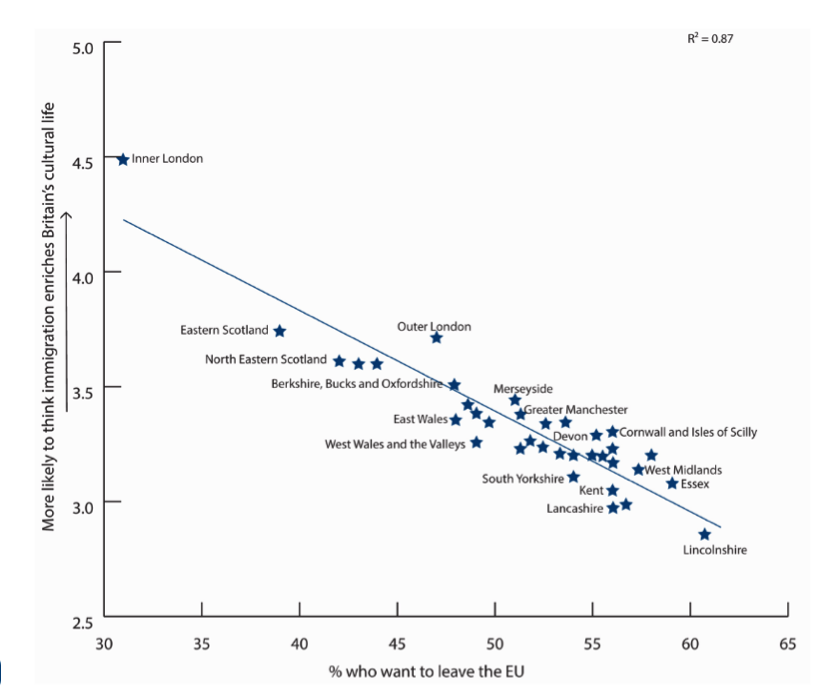
Haidt1-e1468181695424.png


But if you are a European nationalist, watching the nightly news may have felt like watching the spread of the Zika virus, moving steadily northward from the chaos zones of southwest Asia and north Africa. Only a few right-wing nationalist leaders tried to stop it, such as Victor Orban in Hungary. The globalist elite seemed to be cheering the human tidal wave onward, welcoming it into the heart of Europe, and then demanding that every country accept and resettle a large number of refugees.

And these demands, epicentered in Brussels, came after decades of debate in which nationalists had been arguing that Europe has already been too open and had already taken in so many Muslim immigrants that the cultures and traditions of European societies were threatened. Long before the flow of Syrian asylum seekers arrived in Europe there were initiatives to ban minarets in Switzerland and burkas in France. There were riots in Arab neighborhoods of Paris and Marseilles, and attacks on Jews and synagogues throughout Europe. There were hidden terrorist cells that planned and executed the attacks of September 11 in the United States, attacks on trains and buses in Madrid and London, and the slaughter of the Charlie Hebdo staff in Paris.

By the summer of 2015 the nationalist side was already at the boiling point, shouting “enough is enough, close the tap,” when the globalists proclaimed, “let us open the floodgates, it’s the compassionate thing to do, and if you oppose us you are a racist.” Might that not provoke even fairly reasonable people to rage? Might that not make many of them more receptive to arguments, ideas, and political parties that lean toward the illiberal side of nationalism and that were considered taboo just a few years earlier?

Chapter Three: Muslim Immigration Triggers the Authoritarian Alarm

Nationalists in Europe have been objecting to mass immigration for decades, so the gigantic surge of asylum seekers in 2015 was bound to increase their anger and their support for right-wing nationalist parties. Globalists tend to explain these reactions as “racism, pure and simple,” or as the small-minded small-town selfishness of people who don’t want to lose either jobs or benefits to foreigners.

Racism is clearly evident in some of the things that some nationalists say in interviews, chant at soccer matches, or write on the Internet with the protection of anonymity. But “racism” is a shallow term when used as an explanation. It asserts that there are some people who just don’t like anyone different from themselves—particularly if they have darker skin. They have no valid reason for this dislike; they just dislike difference, and that’s all we need to know to understand their rage.

But that is not all we need to know. On closer inspection, racism usually turns out to be deeply bound up with moral concerns. (I use the term “moral” here in a purely descriptive sense to mean concerns that seem—for the people we are discussing—to be matters of good and evil; I am not saying that racism is in fact morally good or morally correct.) People don’t hate others just because they have darker skin or differently shaped noses; they hate people whom they perceive as having values that are incompatible with their own, or who (they believe) engage in behaviors they find abhorrent, or whom they perceive to be a threat to something they hold dear. These moral concerns may be out of touch with reality, and they are routinely amplified by demagogues. But if we want to understand the recent rise of right-wing populist movements, then “racism” can’t be the stopping point; it must be the beginning of the inquiry.

Among the most important guides in this inquiry is the political scientist Karen Stenner. In 2005 Stenner published a book called The Authoritarian Dynamic, an academic work full of graphs, descriptions of regression analyses, and discussions of scholarly disputes over the nature of authoritarianism. (It therefore has not had a wide readership.) Her core finding is that authoritarianism is not a stable personality trait. It is rather a psychological predisposition to become intolerant when the person perceives a certain kind of threat. It’s as though some people have a button on their foreheads, and when the button is pushed, they suddenly become intensely focused on defending their in-group, kicking out foreigners and non-conformists, and stamping out dissent within the group. At those times they are more attracted to strongmen and the use of force. At other times, when they perceive no such threat, they are not unusually intolerant. So the key is to understand what pushes that button.

The answer, Stenner suggests, is what she calls “normative threat,” which basically means a threat to the integrity of the moral order (as they perceive it). It is the perception that “we” are coming apart:

The experience or perception of disobedience to group authorities or authorities unworthy of respect, nonconformity to group norms or norms proving questionable, lack of consensus in group values and beliefs and, in general, diversity and freedom ‘run amok’ should activate the predisposition and increase the manifestation of these characteristic attitudes and behaviors.

So authoritarians are not being selfish. They are not trying to protect their wallets or even their families. They are trying to protect their group or society. Some authoritarians see their race or bloodline as the thing to be protected, and these people make up the deeply racist subset of right-wing populist movements, including the fringe that is sometimes attracted to neo-Nazism. They would not even accept immigrants who fully assimilated to the culture. But more typically, in modern Europe and America, it is the nation and its culture that nationalists want to preserve.

Stenner identifies authoritarians in her many studies by the degree to which they endorse a few items about the most important values children should learn at home, for example, “obedience” (vs. “independence” and “tolerance and respect for other people”). She then describes a series of studies she did using a variety of methods and cross-national datasets. In one set of experiments she asked Americans to read fabricated news stories about how their nation is changing. When they read that Americans are changing in ways that make them more similar to each other, authoritarians were no more racist and intolerant than others. But when Stenner gave them a news story suggesting that Americans are becoming more morally diverse, the button got pushed, the “authoritarian dynamic” kicked in, and they became more racist and intolerant. For example, “maintaining order in the nation” became a higher national priority while “protecting freedom of speech” became a lower priority. They became more critical of homosexuality, abortion, and divorce.

One of Stenner’s most helpful contributions is her finding that authoritarians are psychologically distinct from “status quo conservatives” who are the more prototypical conservatives—cautious about radical change. Status quo conservatives compose the long and distinguished lineage from Edmund Burke’s prescient reflections and fears about the early years of the French revolution through William F. Buckley’s statement that his conservative magazine National Review would “stand athwart history yelling ‘Stop!’”

Status quo conservatives are not natural allies of authoritarians, who often favor radical change and are willing to take big risks to implement untested policies. This is why so many Republicans—and nearly all conservative intellectuals—oppose Donald Trump; he is simply not a conservative by the test of temperament or values. But status quo conservatives can be drawn into alliance with authoritarians when they perceive that progressives have subverted the country’s traditions and identity so badly that dramatic political actions (such as Brexit, or banning Muslim immigration to the United States) are seen as the only remaining way of yelling “Stop!” Brexit can seem less radical than the prospect of absorption into the “ever closer union” of the EU.

So now we can see why immigration—particularly the recent surge in Muslim immigration from Syria—has caused such powerfully polarized reactions in so many European countries, and even in the United States where the number of Muslim immigrants is low. Muslim Middle Eastern immigrants are seen by nationalists as posing a far greater threat of terrorism than are immigrants from any other region or religion. But Stenner invites us to look past the security threat and examine the normative threat. Islam asks adherents to live in ways that can make assimilation into secular egalitarian Western societies more difficult compared to other groups. (The same can be said for Orthodox Jews, and Stenner’s authoritarian dynamic can help explain why we are seeing a resurgence of right-wing anti-Semitism in the United States.) Muslims don’t just observe different customs in their private lives; they often request and receive accommodations in law and policy from their host countries, particularly in matters related to gender. Some of the most pitched battles of recent decades in France and other European countries have been fought over the veiling and covering of women, and the related need for privacy and gender segregation. For example, some public swimming pools in Sweden now offer times of day when only women are allowed to swim. This runs contrary to strong Swedish values regarding gender equality and non-differentiation.

So whether you are a status quo conservative concerned about rapid change or an authoritarian who is hypersensitive to normative threat, high levels of Muslim immigration into your Western nation are likely to threaten your core moral concerns. But as soon as you speak up to voice those concerns, globalists will scorn you as a racist and a rube. When the globalists—even those who run the center-right parties in your country—come down on you like that, where can you turn? The answer, increasingly, is to the far right-wing nationalist parties in Europe, and to Donald Trump, who just engineered a hostile takeover of the Republican Party in America.

The Authoritarian Dynamic was published in 2005 and the word “Muslim” occurs just six times (in contrast to 100 appearances of the word “black”). But Stenner’s book offers a kind of Rosetta stone for interpreting the rise of right-wing populism and its focus on Muslims in 2016. Stenner notes that her theory “explains the kind of intolerance that seems to ‘come out of nowhere,’ that can spring up in tolerant and intolerant cultures alike, producing sudden changes in behavior that cannot be accounted for by slowly changing cultural traditions.”

She contrasts her theory with those who see an unstoppable tide of history moving away from traditions and “toward greater respect for individual freedom and difference,” and who expect people to continue evolving “into more perfect liberal democratic citizens.“ She does not say which theorists she has in mind, but Welzel and his World Values Survey collaborators, as well as Francis Fukuyama’s “end of history” thesis, seem to be likely candidates. Stenner does not share the optimism of those theorists about the future of Western liberal democracies. She acknowledges the general trends toward tolerance, but she predicts that these very trends create conditions that hyper-activate authoritarians and produce a powerful backlash. She offered this prophecy:

[T]he increasing license allowed by those evolving cultures generates the very conditions guaranteed to goad latent authoritarians to sudden and intense, perhaps violent, and almost certainly unexpected, expressions of intolerance. Likewise, then, if intolerance is more a product of individual psychology than of cultural norms…we get a different vision of the future, and a different understanding of whose problem this is and will be, than if intolerance is an almost accidental by-product of simple attachment to tradition. The kind of intolerance that springs from aberrant individual psychology, rather than the disinterested absorption of pervasive cultural norms, is bound to be more passionate and irrational, less predictable, less amenable to persuasion, and more aggravated than educated by the cultural promotion of tolerance [emphasis added].

Writing in 2004, Stenner predicted that “intolerance is not a thing of the past, it is very much a thing of the future.”

Chapter Four: What Now?

The upshot of all this is that the answer to the question we began with—What on Earth is going on?—cannot be found just by looking at the nationalists and pointing to their economic conditions and the racism that some of them do indeed display. One must first look at the globalists, and at how their changing values may drive many of their fellow citizens to support right-wing political leaders. In particular, globalists often support high levels of immigration and reductions in national sovereignty; they tend to see transnational entities such as the European Union as being morally superior to nation-states; and they vilify the nationalists and their patriotism as “racism pure and simple.” These actions press the “normative threat” button in the minds of those who are predisposed to authoritarianism, and these actions can drive status quo conservatives to join authoritarians in fighting back against the globalists and their universalistic projects.

If this argument is correct, then it leads to a clear set of policy prescriptions for globalists. First and foremost: Think carefully about the way your country handles immigration and try to manage it in a way that is less likely to provoke an authoritarian reaction. Pay attention to three key variables: the percentage of foreign-born residents at any given time, the degree of moral difference of each incoming group, and the degree of assimilation being achieved by each group’s children.

Legal immigration from morally different cultures is not problematic even with low levels of assimilation if the numbers are kept low; small ethnic enclaves are not a normative threat to any sizable body politic. Moderate levels of immigration by morally different ethnic groups are fine, too, as long as the immigrants are seen as successfully assimilating to the host culture. When immigrants seem eager to embrace the language, values, and customs of their new land, it affirms nationalists’ sense of pride that their nation is good, valuable, and attractive to foreigners. But whenever a country has historically high levels of immigration, from countries with very different moralities, and without a strong and successful assimilationist program, it is virtually certain that there will be an authoritarian counter-reaction, and you can expect many status quo conservatives to support it.

Stenner ends The Authoritarian Dynamic with some specific and constructive advice:

[A]ll the available evidence indicates that exposure to difference, talking about difference, and applauding difference—the hallmarks of liberal democracy—are the surest ways to aggravate those who are innately intolerant, and to guarantee the increased expression of their predispositions in manifestly intolerant attitudes and behaviors. Paradoxically, then, it would seem that we can best limit intolerance of difference by parading, talking about, and applauding our sameness…. Ultimately, nothing inspires greater tolerance from the intolerant than an abundance of common and unifying beliefs, practices, rituals, institutions, and processes. And regrettably, nothing is more certain to provoke increased expression of their latent predispositions than the likes of “multicultural education,” bilingual policies, and nonassimilation.

If Stenner is correct, then her work has profound implications, not just for America, which was the focus of her book, but perhaps even more so for Europe. Donald Tusk, the current president of the European Council, recently gave a speech to a conclave of center-right Christian Democratic leaders (who, as members of the educated elite, are still generally globalists). Painfully aware of the new authoritarian supremacy in his native Poland, he chastised himself and his colleagues for pushing a “utopia of Europe without nation-states.” This, he said, has caused the recent Euroskeptic backlash: “Obsessed with the idea of instant and total integration, we failed to notice that ordinary people, the citizens of Europe, do not share our Euro-enthusiasm.”

Democracy requires letting ordinary citizens speak. The majority spoke in Britain on June 23, and majorities of similar mien may soon make themselves heard in other European countries, and possibly in the United States in November. The year 2016 will likely be remembered as a major turning point in the trajectory of Western democracies. Those who truly want to understand what is happening should carefully consider the complex interplay of globalization, immigration, and changing values.

If the story I have told here is correct, then the globalists could easily speak, act, and legislate in ways that drain passions and votes away from nationalist parties, but this would require some deep rethinking about the value of national identities and cohesive moral communities. It would require abandoning the multicultural approach to immigration and embracing assimilation.

The great question for Western nations after 2016 may be this: How do we reap the gains of global cooperation in trade, culture, education, human rights, and environmental protection while respecting—rather than diluting or crushing—the world’s many local, national, and other “parochial” identities, each with its own traditions and moral order? In what kind of world can globalists and nationalists live together in peace?

I don't think it's possible to build a stable political regime on anything other than Pietas-- the natural affection one feels toward his family, his community and his nation. Until Progressives and globalists come to terms with that, the far right will continue to surge.
 
Last edited:

zelezo vlk

Well-known member
Messages
18,009
Reaction score
5,047
Jonathan Haidt just published a compelling article in The American Interest titled "When and Why Nationalism Beats Globalism":


I don't think it's possible to build a stable political regime on anything other than Pietas-- the natural affection one feels toward his family, his community and his nation. Until Progressives and globalists come to terms with that, the far right will continue to surge.

I read the article; very informative. How do you suggest we reemphasize Pietas? I don't think we can legislate love of culture into existence. In a society that is increasingly indifferent to religion, and downright hostile sometimes to our heritage, what do we do to show that we should embrace and save what we think of as Western culture?
 

Whiskeyjack

Mittens Margaritas Ante Porcos
Staff member
Messages
20,894
Reaction score
8,126
I read the article; very informative. How do you suggest we reemphasize Pietas? I don't think we can legislate love of culture into existence. In a society that is increasingly indifferent to religion, and downright hostile sometimes to our heritage, what do we do to show that we should embrace and save what we think of as Western culture?

I have thoughts on this, but a proper response will take more time than I currently have to spare. Will return to this later.
 

Whiskeyjack

Mittens Margaritas Ante Porcos
Staff member
Messages
20,894
Reaction score
8,126
The American Interest's Jason Willick just published an article titled "How Samuel Huntington Predicted Our Political Moment":

Samuel Huntington, the professor of government at Harvard University (and member of The American Interest editorial board from its founding until his death in 2008) was a titan of 20th-century social science. Several of his books, including Political Order in Changing Societies, The Third Wave, and The Clash of Civilizations, are classic works that will shape political thought for generations.

Huntington’s final book, however, has been denied a place in that pantheon. Who Are We?—a wide-ranging treatise that argued, among other things, that American elites were dangerously out of touch with the American public when it came to issues of patriotism, foreign policy, and national identity—was panned by most mainstream reviewers in 2004 as an ideological and careless screed that flirted with xenophobia. At 77, the eminent scholar was accused in respectable circles of losing his marbles.

But as the Republican Party prepares to hand its nomination to Donald Trump—a self-described “America First” nationalist, running on a platform of immigration restriction, trade wars, and Jacksonian foreign policy—Huntington’s thesis is looking more prescient than ever before—not as a prescription, but as a way of describing the divisions running through the heart of American society.

Since Trump’s rise, many sharp analysts have identified the clash between nationalism and cosmopolitanism as the fulcrum of American politics and even suggested that our parties are in the process of a long-term realignment driven by these competing understandings of American national identity. But Huntington saw the crucial importance of this fracture more than a decade before the gifted New York demagogue declared his candidacy for president:

The views of the general public on issues of national identity differ significantly from those of many elites. The public, overall, is concerned with physical security but also with societal security, which involves the sustainability–within acceptable conditions for evolution–of existing patterns of language, culture, association, religion and national identity. For many elites, these concerns are secondary to participating in the global economy, supporting international trade and migration, strengthening international institutions, promoting American values abroad, and encouraging minority identities and cultures at home. The central distinction between the public and elites is not isolationism versus internationalism, but nationalism versus cosmopolitanism.

According to Huntington, postwar globalization had given rise to a new class of “global citizens” at the highest echelons of American academia, industry, and (bipartisan) politics—a “de-nationalized” elite whose “attitudes and behavior contrast with the overwhelming patriotism and nationalistic identification of the rest of the American public.” The jet-setting cosmopolitans tended to be far more supportive of free trade, open immigration, and activist foreign policy than most Americans. Huntington described this wide and allegedly growing gap as a major source of the decline in trust in democratic institutions since the 1960s.

The internationalist understanding of America’s place in the world preferred by the ruling class came in two flavors. The first might be called liberal cosmopolitanism. Under this philosophy, Huntington wrote, “America welcomes the world, its ideas, its goods and, most importantly its people. The ideal would be an open society with open borders, encouraging subnational ethnic, racial and cultural identities, dual citizenship, diasporas, and would be led by elites who increasingly identified with global institutions, norms and rules rather than national ones.” This description closely tracks the official view of today’s Democratic Party, which grew increasingly cosmopolitan under President Obama, and seems poised to continue this trajectory during its (still likely) second Clinton era.

Meanwhile, in the wake of the Cold War, conservative intellectuals developed their own distinctive spin on the prevailing internationalist philosophy. Huntington called this “the imperial alternative.” In this view, instead of allowing the world to transform American society, America would transform foreign societies. “At the start of the new millennium conservatives accepted and endorsed the idea of an American empire,” Huntington wrote, “and the use of American power to reshape the world according to American values.” This variety of internationalism might be seen as an effort to accommodate the mass public’s patriotic populism within the elite cosmopolitan vision. The American eagle would bestride the globe.

The imperialist (or, to put it differently, neoconservative) synthesis sufficed to hold the Republican Party together during the Bush years, even though the cosmopolitan-nationalist distinction still manifested itself in a number of ways, including the 2007 derailing of comprehensive immigration reform. By 2016, however, the floor fell out from under the internationalists in the Republican Party altogether. With conservative internationalism vanquished, the 2016 contest pits liberal cosmopolitanism against a vulgar expression of pure nationalism inflected with racial overtones. The gap Huntington warned about now seems very real.
Though he would surely see through Trump’s opportunistic demagoguery if he were alive today, Huntington was rightly concerned about the tendency of the political class to ignore the public’s preferences on issues related to America’s identity, culture, and role in the world. Disillusioned by both liberal internationalism and neoconservatism, he advocated for an alternative approach. “Cosmopolitanism and imperialism attempt to reduce or to eliminate the social, political and cultural differences between America and other societies,” he wrote. “A national approach would recognize and accept what distinguishes America from those societies.”
Huntington is almost certainly right that the internationalists in both parties have gone too far for their own good, and for the country’s. At the same time, the kind of nationalist populism now flaring up across Western democracies is less an alternative approach than a white-hot reaction. And the elite perception that a certain level of globalization and American leadership brings distinctive benefits that the public is slow to recognize will always endure, not only because elites are stubborn and insular, but because their view also contains a significant element of truth. The point is not to kick internationalism to the curb; it is for elites to rediscover the delicate balance between cosmopolitanism and nationalism that they started to lose in the mid-20th century and abandoned altogether as the Cold War came to a close.

As Francis Fukuyama, Huntington’s former student and protege, wrote last month: “The intellectual challenge is to see whether it is possible to back away from globalization without cratering both the national and the global economy, with the goal of trading a little aggregate national income for greater domestic income equality.” Figuring out how to do this should be one of the defining challenges of American politics over the next generation.
 

Whiskeyjack

Mittens Margaritas Ante Porcos
Staff member
Messages
20,894
Reaction score
8,126
Here's an article by an Islamist who publishes under the psuedonym Masked Avenger titled "Yes, Islam is the key to understanding this but reformation is not the answer":

When the Turkish republic abolished the Caliphate in 1924 and exiled the Imperial household, it would be in Nice that the deposed Ottoman Sultan, after a brief sojourn in Switzerland, would eventually take up residence . What Abdul Majid II would have made of Thursday night’s massacre can only be conjectured but I’d hazard a guess he would have been more than a little dismayed, despite France’s pivotal role in the dismemberment of his empire and concomitant downfall of his dynasty.

What lies behind such attacks is the burning question on the lips of millions across Europe and America. Untangling the Gordian knot of religion, political grievance, alienation, economic desperation and ideological indoctrination is a complex task, which partly explains why some prefer to simply cut it at the knot of Islamic theology. While denying that Islam as a faith is a component in the current crisis is disingenuous (or misinformed) it is essential to understand precisely the nature of its contribution before succumbing to the siren call of Islamic reformation.

That Islam is not liberalism is axiomatic. The former surrenders man to the servitude of a divine being knowable only through His revelation, the latter frees him from all constraints save those he voluntarily embraces in his personal pursuit of happiness. The two are as immiscible as oil and water. For sure there are “liberal interpretations” of Islamic scripture but then the demands of Islam’s soi disant reformers far exceed this: nothing less than a complete repudiation of Islam’s core theological tenets (e.g. the inerrancy of the Qur’an and the perfection of the Prophetic example). Whilst reforming Islam so that it resembles the agnostic Anglicanism of modern day Britain might seem an attractive proposition to Western minds, such a “reformation” unfortunately (or fortunately depending on your perspective) has as much likelihood of success as Andorra’s chances of lifting the World Cup in 2018. It simply is a non-starter, no matter the level of funding from neo-conservative foundations, and therefore not a viable solution to the contagion of terrorism we currently face.

Render unto Caesar what is Caesar’s has always been an alien maxim to Muslim minds. The Prophet Muhammad (peace be upon him) was, after all, a head of state, a law giver and a military leader in addition to his role as a spiritual guide. The prescriptions of the Shariah, the law that derives from the Qur’an and the Prophetic traditions (the Hadith) address both the spiritual and temporal exigencies of the believer’s life. A codified version, the Mecelle, was utilised by the Ottoman state in its declining years but as a legal reference the Shariah had always been enforced across the Muslim world. In these respects Islam is sui generis in its relationship to politics. Secularism and the nation state, products of the European enlightenment, were a foreign imposition on the Muslim world, the result of colonialism and the dismemberment of the Ottoman Caliphate after its defeat in the First World War. In the decades that followed, the Middle East became a byword for authoritarianism and instability as its restive populations wrestled to reconcile a political reality many found at odds with their religious convictions.

Peaceful, democratic, attempts in recent decades to restore even a semblance of Islamic governance in the Middle East & North Africa (MENA) have consistently met with violent suppression at the hands of the regions despots, with the tacit (sometimes overt) approval of Western governments. The problem, however, with utilising violent suppression is that there will come a point at which some will inevitably choose violence as a response, and if you happen to be aiding and abetting their oppressors you make yourself a target for their rage. The Islamic concept of Ummah – or global community – means that oppression meted out to Muslims anywhere in the world is suffered (in a spiritual sense at least) vicariously by all, including those living in the relative comfort of the West. It is the same sense of universal brotherhood that inspired the 7/7 bombers to avenge the deaths of their innocent Iraqi co-religionists and what probably, in part at least, inspired Mohamed Lahouaiej Bouhlel’s murderous rampage in Nice.

The rise of virulent jihadism in the Muslim world is inextricably linked to the absence of a legitimate unifying Islamic polity which could claim the allegiance of the world’s 1.5 billion Muslims. In a twist of irony, it is the presence, therefore, not absence, of an Islamic state that is required to successfully eradicate the bane of terrorism. If we want an honest discussion of where the problem lies we must start with the thwarted aspirations of millions of Muslims; aspirations to live in dignity in accordance with their own systems and laws, free from external domination and interference. Equating the wishes of these multitudes with the retrograde barbarity of Islamic State is as bankrupt an argument as tarring all who wish to see a united Ireland as supporters of the Real IRA. Reducing Islam and Shariah to gross caricatures around the Hadd punishments might win plaudits from right-wing commentators and increase the flow of donations from American based foundations but it does little to ameliorate the situation we currently find ourselves in.

If, as so many glibly aver, Islam/Shariah itself is the problem and the root cause of terrorism, it must surely be asked why the world did not witness such attacks at the acme of Islamic power (or even during its period of terminal decline). One might be tempted to cite Ottoman expansionism, the conquest of Spain and so on but if we are to term these “terrorism” then the same would surely have to apply to colonialism and the post-colonial interventionism of the United States. Moreover, if, as polls consistently reveal, millions of Muslims believe in Shariah law and the re-establishment of a Caliphate (or at least some form of Islamic governance) why aren’t these same millions engaging in the sort of murderous behaviour witnessed in Nice and Paris over the last year?

If you’re wondering why I have made no mention of the ideology of Islamic State (and to a lesser degree Al Qaeda) it is simply because in the bigger picture it is irrelevant. It is a reactionary ideology born of frustration and desperation, alloyed with a deviant interpretation of Islamic scripture. The fact that virtually no Muslim (outside of their statistically insignificant membership), scholar or layman, subscribes to it is instructive as to just how otiose it is. Its defeat, however, won’t be achieved by the votaries of “Islamic reform” but rather by those who subscribe to the traditional Islamic interpretations the reformists are so eager to eviscerate.

In summary, Islam “is the problem” in as far as it doesn’t quadrate with secularism and liberalism, nor will it ever – a fact the West needs to come to terms with. To those clamouring at Muslims “to get their house in order” I can only respond that we would love to, in fact we have been attempting to for the better part of the last century, perhaps now it’s time we were allowed to do so.

May the peace and blessings of Allah (swt) be upon sayyidina, Muhammad.

This guy posts some fascinating stuff on Twitter, if you're inclined to followed (@GleamingRazor).

First, I'm sharing this here because it sheds a lot of light on a recent argument between wizards and wooly about the compatibility of Islam and the West (i.e. the civilization formerly known as Christendom). As the article mentions, the idea that temporal and secular power not only can, but should be separated is a uniquely Christian one which can be traced back to Augustine's City of God. Conversely, Islam is congenitally political, and cannot abide being compartmentalized/ "religionized" as Christianity has been since the Enlightenment. So wizards is right in that respect.

But wooly is right in that the many millions of Muslims who have successfully integrated and lived peaceful lives within the West is irrefutable evidence that an immigrant's identification as a Muslim is not an insuperable obstacle to assimilation. But we need to be honest about what such assimilation entails-- a significant conversion, in many ways, with regards to how such immigrants relate to their faith.

Second, his point about the acme of Islamic civilization being under a unified caliphate is compelling. That implies that if we want to both protect ourselves from terrorism and promote stability within the Middle East, the best course of action is not to try to force Muslims to be more like us, but to help them be more faithful to their own religious tradition.
 
Last edited:

Ndaccountant

Old Hoss
Messages
8,370
Reaction score
5,771
Here's an article by an Islamist who publishes under the psuedonym Masked Avenger titled "Yes, Islam is the key to understanding this but reformation is not the answer":


This guy posts some fascinating stuff on Twitter, if you're inclined to followed (@GleamingRazor).

First, I'm sharing this here because it sheds a lot of light on a recent argument between wizards and wooly about the compatibility of Islam and the West (i.e. the civilization formerly known as Christendom). As the article mentions, the idea that temporal and secular power not only can, but should be separated is a uniquely Christian one which can be traced back to Augustine's City of God. Conversely, Islam is congenitally political, and cannot abide being compartmentalized/ "religionized" as Christianity has been since the Enlightenment. So wizards is right in that respect.

But wooly is right in that the many millions of Muslims who have successfully integrated and lived peaceful lives within the West is irrefutable evidence that an immigrant's identification as a Muslim is not an insuperable obstacle to assimilation. But we need to be honest about what such assimilation entails-- a significant conversion, in many ways, with regards to how such immigrants relate to their faith.

Second, his point about the acme of Islamic civilization being under a unified caliphate is compelling. That implies that if we want to both protect ourselves from terrorism and promote stability within the Middle East, the best course of action is not to try to force Muslims to be more like us, but to help them be more faithful to their own religious tradition.

I posted articles in the political correctness thread on the current happenings in Denmark, where there are new laws going in to explicitly attack Shariah. As with any religion, there are many Muslims who are more devout than others. That's all well and good, but in a case where those who are most devout live a life that conflicts (in a major way) with the general populace, how do you govern equitably? You can't. How do you ignore oppression and objectification of women? How do you ignore brutal beatings of women, children and "non-believers"? You can't.

So, in applying what he mentions in the article above, it may be necessary to allow Muslims to live under the blanket of their religious/political laws. To do that, here are the possible outcomes that I see:

1 - Muslims in the West live under Sharia law, instead of local laws - This would be chaotic for the reasons mentioned above

2 - Muslims in the West live under local law - Not substaintially different than today. Could work for some / most of Muslims. However, just like anyone other religion, anyone could have a life event where he/she becomes more devout. Since western law conflicts with religious law, the opportunity exists for calamity

3 - Abandon "policing" in MENA and allow this to be the place where Muslims can live the life they choose - I am not sure how people in the West would deal with this, since it conflicts with core values. Ignore human rights? Doubtful.

There is no answer to this. The fundamental problem at hand is that the most strict interpretation fundamentally contradicts what most people would call human rights. Sure, many Muslims can balance church and state, much like many Christians have done. The most interesting question/ problem is when do civil liberties stop trumping security and/or immigration? Watching the next wave of elections in the EU will be a stern foreshadowing of what we could expect in the US absent course corrections.
 

Whiskeyjack

Mittens Margaritas Ante Porcos
Staff member
Messages
20,894
Reaction score
8,126
1 - Muslims in the West live under Sharia law, instead of local laws - This would be chaotic for the reasons mentioned above

That would essentially mean carving out Islamic statelets within the West. Not politically feasible.

2 - Muslims in the West live under local law - Not substaintially different than today. Could work for some / most of Muslims. However, just like anyone other religion, anyone could have a life event where he/she becomes more devout. Since western law conflicts with religious law, the opportunity exists for calamity

More on this below.

3 - Abandon "policing" in MENA and allow this to be the place where Muslims can live the life they choose - I am not sure how people in the West would deal with this, since it conflicts with core values. Ignore human rights? Doubtful.

There is no answer to this. The fundamental problem at hand is that the most strict interpretation fundamentally contradicts what most people would call human rights. Sure, many Muslims can balance church and state, much like many Christians have done. The most interesting question/ problem is when do civil liberties stop trumping security and/or immigration? Watching the next wave of elections in the EU will be a stern foreshadowing of what we could expect in the US absent course corrections.

Westerners need to understand that things like human rights, separation of Church and State, etc. are uniquely Christian concepts. Accepting them is necessary to successful assimilation within the West, so we're essentially asking Muslim immigrants to repudiate at least part of their own religious tradition.

The conceit that secular liberal values are somehow universal is core to this problem. On the contrary, they're quite obviously post-Christian; so immigrants whose worldviews strongly conflict with Christianity are not likely to assimilate well. A doctor from Ankara or a professor from Islamabad could probably be quite successful as immigrants to the West. But a rural Afghani Pashtun? Much less likely.

Given the current state of MENA, who in the West (other than the most ardent Zionists) wouldn't welcome the return of a stable and united caliphate? That sort of political arrangement led to the Islamic golden age that produced Avicenna and many other cultural treasures. As the author above argues, Islamic is inherently political; so the world's 1.6 billion Muslims will likely not enjoy peace and stability until they are able to live according to the authentic dictates of their faith. Suffice it to say, that rules out both post-colonial states with arbitrary borders ruled by brutal secular dictators, and political arrangements bound by Christian concepts like human rights, church/state separation, etc.
 

zelezo vlk

Well-known member
Messages
18,009
Reaction score
5,047
Whiskey, are you really advocating a caliphate?

Sent from my SAMSUNG-SM-G900A using Tapatalk
 

Whiskeyjack

Mittens Margaritas Ante Porcos
Staff member
Messages
20,894
Reaction score
8,126
Whiskey, are you really advocating a caliphate?

Honestly, I haven't had time to think through it yet. The idea hadn't even occurred to me until I read that article above.

One of my favorite books growing up was Ender's Game, and it involves a MENA reunited under a stable and peaceful caliphate. It's pretty clear that the regional political arrangements of the last century or so are not working (to put it mildly), so I'm trying to think of alternatives.

As I've mentioned in other threads, anything having to do with ultimate values is basically theology, and anything having to do with how values shape public life is politics. Islam, unlike Christianity, makes no distinction between those two spheres; so it's plausible to me (based on the limited time I've spent wrestling with this) that Islamic civilization needs a stable and unified government which reflects that undivided understanding.
 
Top