Everything Soccer

dublinirish

Everestt Gholstonson
Messages
27,329
Reaction score
13,092
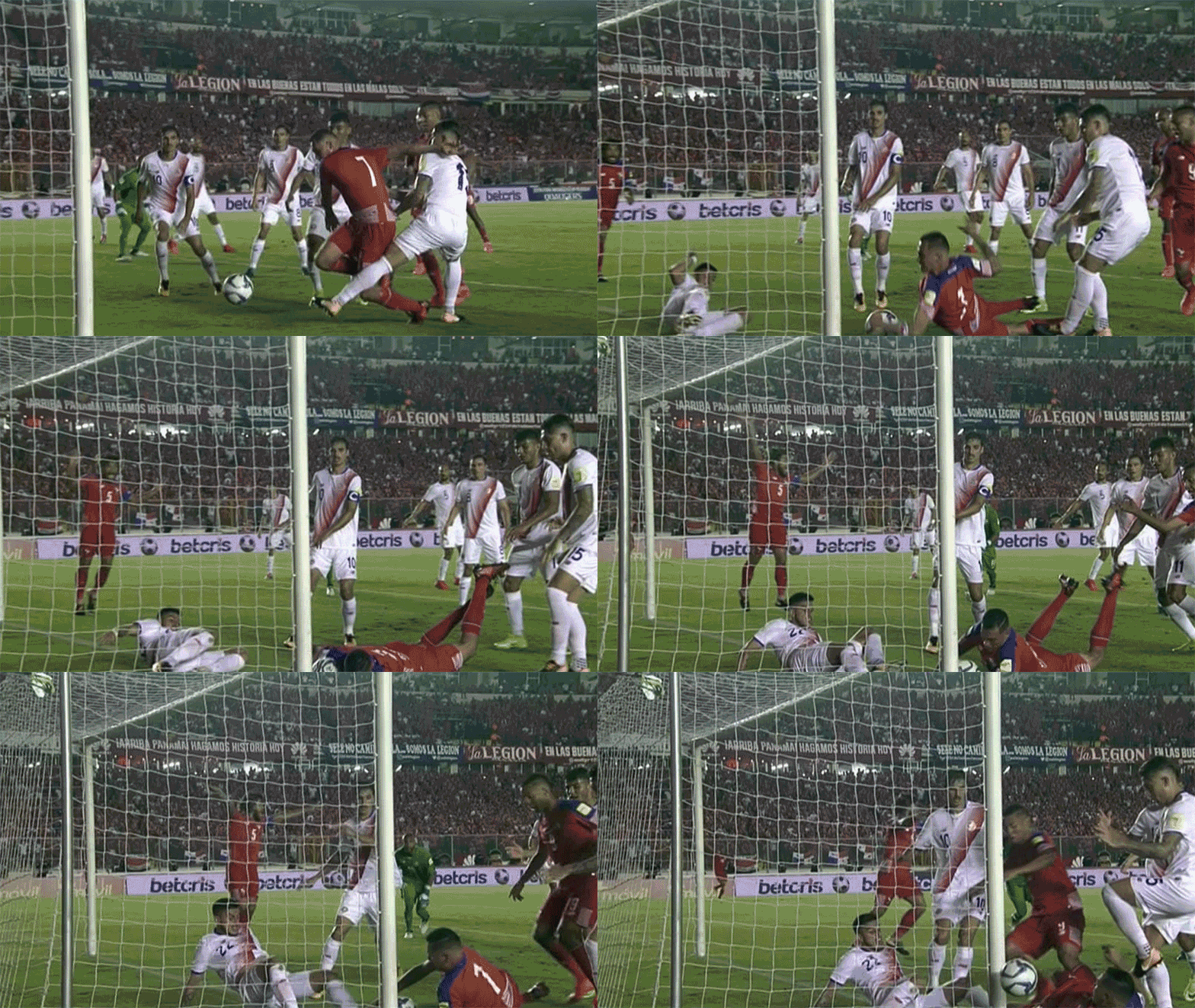
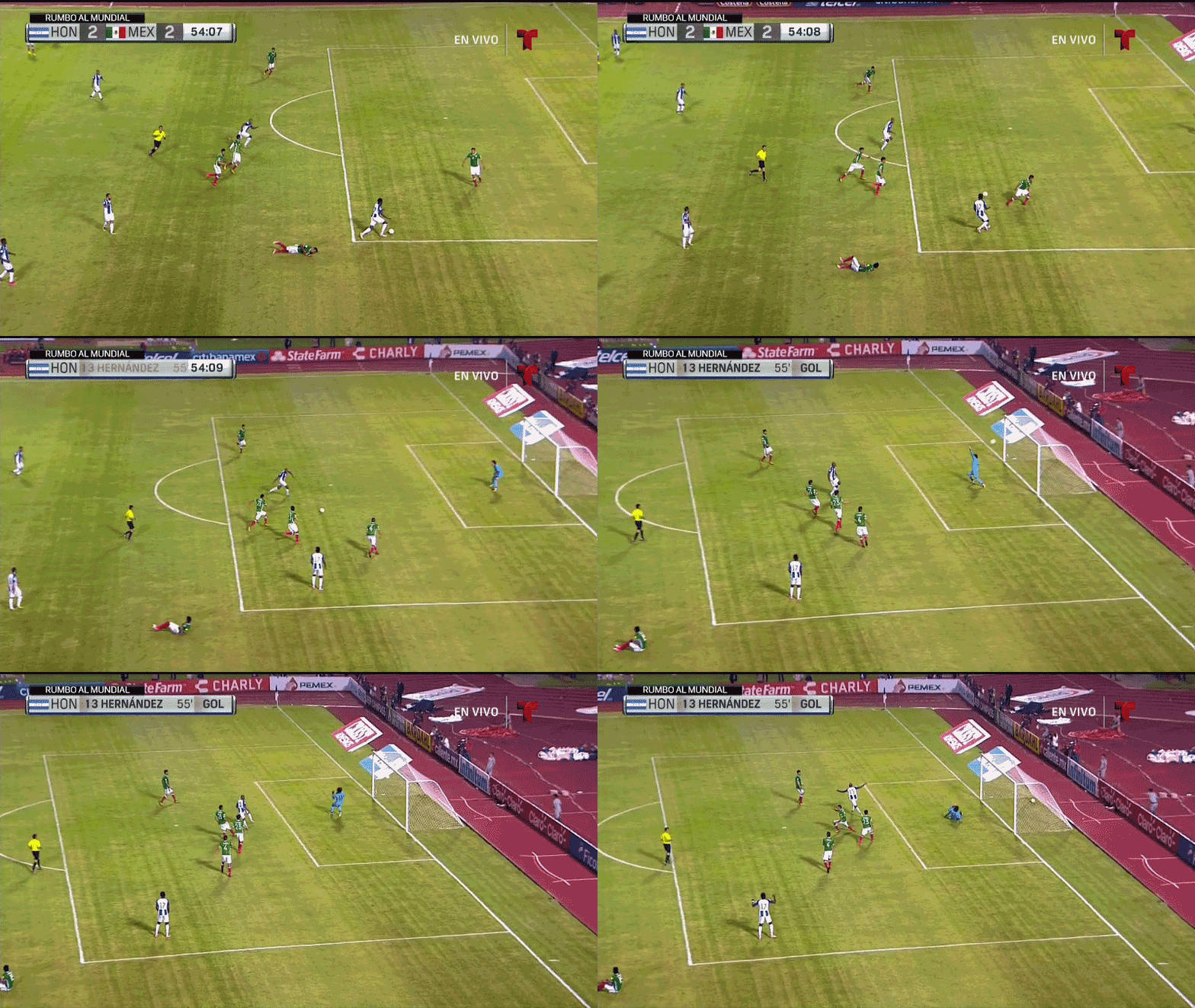
honduras had a shot that hit the bar and cannoned back and hit the mexican goalie on the back of the head, not much he could do. Mexico wanted to win the seal a perfect qualification which has never been done before but Honduras were fighting for their lives.

k9flwozngablhnjaqox3.gif
 

GowerND11

Well-known member
Messages
6,539
Reaction score
3,296
The USMNT didn't deserve to make it to the WC... But I like to think we, the fans, deserved it. Soccer is growing. Development is getting better.

Tough pill to swallow for all of us who are fans.
 

notredomer23

Staph Member
Messages
17,637
Reaction score
17,563
The USMNT didn't deserve to make it to the WC... But I like to think we, the fans, deserved it. Soccer is growing. Development is getting better.

Tough pill to swallow for all of us who are fans.

I don't really agree that we the fans deserved it either. We were begging for a Klinsmann replacement and we (as a whole, obviously not all) were begging for it to be Arena. This is an all around fail.

But like you said, development is light years ahead of where it was. Now it is time to show it, though.
 

GowerND11

Well-known member
Messages
6,539
Reaction score
3,296
I don't really agree that we the fans deserved it either. We were begging for a Klinsmann replacement and we (as a whole, obviously not all) were begging for it to be Arena. This is an all around fail.

But like you said, development is light years ahead of where it was. Now it is time to show it, though.

I may have been in the minority, but I did not want Arena. I have only been following soccer closely for the last 8ish years, so I don't remember the Arena years. However, reading up on the teams he coached, and his tactics, favoritism, etc. plus reading what critics said when he was appointed recently, I was not convinced he would be the best for the job.

I liked Klinsmann, and I thought he brought good to the program... Then he just shit the bed and did some real head scratching things with the team.

I think we deserved this as a validation of our fandom. What I mean is, there are still plenty of people that scoff at the USMNT being anything. "Soccer sucks" "Who watches those foot fairies" and so on are still responses I hear about being a fan of soccer. So I think us being in the World Cup, knowing we have done damage, competed, etc. before AND can do it again, just makes it suck knowing those that hate soccer can troll it up and laugh.
 

IrishLion

I am Beyonce, always.
Staff member
Messages
19,128
Reaction score
11,077
I don't really agree that we the fans deserved it either. We were begging for a Klinsmann replacement and we (as a whole, obviously not all) were begging for it to be Arena. This is an all around fail.

But like you said, development is light years ahead of where it was. Now it is time to show it, though.

I'm a recent fan of the sport, so I have a lot to learn, and I lack any context for the overall development of the sport in the United States outside of the major growth it's seeing now in terms of fans/viewership.

But with the sport growing in a big way at the youth level, with more kids playing soccer than ever before, is it likely that the US can start to catch up to the rest of the world in terms of being competitive on the national stage?

I know the US lacks the uniform/cohesive club structure that other national teams benefit from when they bring up their stars, and the geography of the US will always kind of be a roadblock to making any academy structure truly uniform, but could the simple increase in number of players we are seeing result in finding some talented future stars that can make up for some of the other disadvantages?

Logically, it seems like the simple growth of the pool of players should lead to a situation where we find 3 or 4 Pulisic-type players every few years at some point in the near future. They might not have the technical base that is offered in other countries, but more bodies means a higher chance of finding raw talent, and finding raw talent means those kids can find development at the club level in other countries, thus benefiting the US national team down the road.

Is that realistic? How long until those benefits show up? 10 years? 15? 20?
 

GowerND11

Well-known member
Messages
6,539
Reaction score
3,296
I'm a recent fan of the sport, so I have a lot to learn, and I lack any context for the overall development of the sport in the United States outside of the major growth it's seeing now in terms of fans/viewership.

But with the sport growing in a big way at the youth level, with more kids playing soccer than ever before, is it likely that the US can start to catch up to the rest of the world in terms of being competitive on the national stage?

I know the US lacks the uniform/cohesive club structure that other national teams benefit from when they bring up their stars, and the geography of the US will always kind of be a roadblock to making any academy structure truly uniform, but could the simple increase in number of players we are seeing result in finding some talented future stars that can make up for some of the other disadvantages?

Logically, it seems like the simple growth of the pool of players should lead to a situation where we find 3 or 4 Pulisic-type players every few years at some point in the near future. They might not have the technical base that is offered in other countries, but more bodies means a higher chance of finding raw talent, and finding raw talent means those kids can find development at the club level in other countries, thus benefiting the US national team down the road.

Is that realistic? How long until those benefits show up? 10 years? 15? 20?

If you go back four years, I'd have said we could compete with anyone. We were in the group of death where we beat Ghana (who seemed to have our number), should have beaten Portugal, but had a draw, and we were SO close to a draw with the eventual winners in Germany.

Then in the knockout stage, we play one of the best matches in the whole tournament and lose, in extra time, to a good Belgian side. A game where we win if Wondo doesn't blow his moment to shine.

Now here we are sitting in 5th in the CONCACAF Hex embarrassed. We can compete, we should compete... We just flat out underdeveloped the most important part of this team, the 23-28 year old range as notredomer pointed out.
 

notredomer23

Staph Member
Messages
17,637
Reaction score
17,563
I'm a recent fan of the sport, so I have a lot to learn, and I lack any context for the overall development of the sport in the United States outside of the major growth it's seeing now in terms of fans/viewership.

But with the sport growing in a big way at the youth level, with more kids playing soccer than ever before, is it likely that the US can start to catch up to the rest of the world in terms of being competitive on the national stage?

I know the US lacks the uniform/cohesive club structure that other national teams benefit from when they bring up their stars, and the geography of the US will always kind of be a roadblock to making any academy structure truly uniform, but could the simple increase in number of players we are seeing result in finding some talented future stars that can make up for some of the other disadvantages?

Logically, it seems like the simple growth of the pool of players should lead to a situation where we find 3 or 4 Pulisic-type players every few years at some point in the near future. They might not have the technical base that is offered in other countries, but more bodies means a higher chance of finding raw talent, and finding raw talent means those kids can find development at the club level in other countries, thus benefiting the US national team down the road.

Is that realistic? How long until those benefits show up? 10 years? 15? 20?

The kids are not the problem anymore. We have more kids playing than any country in the world. The problem is the coaching and pay-to-play.

Benefits are already showing in players younger than 22 who were anywhere from 12-16 when Klinsmann took over. He had a vision for development and Gulati was also instrumental in it, along with Don Garber who essentially forced all MLS teams to have an academy and a 2nd team. I think it has to go a step further though. USSF needs to force even the USL teams and the NPSL teams to have academies and coaches that are certified under a certain type of training program or achieve some type of UEFA pro-license. We need more kids with high level training. Because right now, let's say every MLS team has 25 players age eligible (not saying they have the talent) for any given youth WC cycle. We need every MLS team to be able to produce at least 2 players that can play at that quality, and 1 player from every USL academy that can play at that quality. That instantly expands your player pool from essentially 30-35 players to 100-150 players when you count some of the players that slip through the cracks and also those playing abroad.

And out of those 100-150 players, 30-35 will be great enough for one of the youth national teams. And from that 100-150 players, how many will end up being senior international level players? If you are lucky, 4 or 5. But when you are producing that many high level players every 2 years, that is all you need. You can have a dark cycle where you only produce 1 or 2 international level players, but you can never have back to back cycles like that.

So yeah, to your point it is essentially a numbers game, but before that numbers game really matters, there has to be wholesale changes to US Soccer as a whole and that starts with coaching, the elimination of pay to play, and more pro-academies.

Another very small thing that will help is starting a type of scholarship fund in these academies for players that don't ever make it to the pro-level or have short lived careers so that they stop choosing college soccer.

As far as how long til we see the benefits, that 25-28 age cycle will be essentially out by 2022, and certainly gone by 2026. So 2022, there is no excuses to not advance in the WC. In 2026, there is no excuse to make a run to at least the quarters especially on home soil.

Also:

<blockquote class="twitter-tweet" data-lang="en"><p lang="en" dir="ltr">MLS product and strategy committee—with several influential owners—is meeting today in LA. They need to push for change in MLS & US Soccer.</p>— Grant Wahl (@GrantWahl) <a href="https://twitter.com/GrantWahl/status/918111167586951168?ref_src=twsrc%5Etfw">October 11, 2017</a></blockquote>
<script async src="//platform.twitter.com/widgets.js" charset="utf-8"></script>

Not sure if an emergency meeting or scheduled, but regardless, interesting.
 
Last edited:

nlroma1o

Well-known member
Messages
2,077
Reaction score
95
The kids are not the problem anymore. We have more kids playing than any country in the world. The problem is the coaching and pay-to-play.

Benefits are already showing in players younger than 22 who were anywhere from 12-16 when Klinsmann took over. He had a vision for development and Gulati was also instrumental in it, along with Don Garber who essentially forced all MLS teams to have an academy and a 2nd team. I think it has to go a step further though. USSF needs to force even the USL teams and the NPSL teams to have academies and coaches that are certified under a certain type of training program or achieve some type of UEFA pro-license. We need more kids with high level training. Because right now, let's say every MLS team has 25 players age eligible (not saying they have the talent) for any given youth WC cycle. We need every MLS team to be able to produce at least 2 players that can play at that quality, and 1 player from every USL academy that can play at that quality. That instantly expands your player pool from essentially 30-35 players to 100-150 players when you count some of the players that slip through the cracks and also those playing abroad.

And out of those 100-150 players, 30-35 will be great enough for one of the youth national teams. And from that 100-150 players, how many will end up being senior international level players? If you are lucky, 4 or 5. But when you are producing that many high level players every 2 years, that is all you need. You can have a dark cycle where you only produce 1 or 2 international level players, but you can never have back to back cycles like that.

So yeah, to your point it is essentially a numbers game, but before that numbers game really matters, there has to be wholesale changes to US Soccer as a whole and that starts with coaching, the elimination of pay to play, and more pro-academies.

Another very small thing that will help is starting a type of scholarship fund in these academies for players that don't ever make it to the pro-level or have short lived careers so that they stop choosing college soccer.

As far as how long til we see the benefits, that 25-28 age cycle will be essentially out by 2022, and certainly gone by 2026. So 2022, there is no excuses to not advance in the WC. In 2026, there is no excuse to make a run to at least the quarters especially on home soil.

Also:

<blockquote class="twitter-tweet" data-lang="en"><p lang="en" dir="ltr">MLS product and strategy committee—with several influential owners—is meeting today in LA. They need to push for change in MLS & US Soccer.</p>— Grant Wahl (@GrantWahl) <a href="https://twitter.com/GrantWahl/status/918111167586951168?ref_src=twsrc%5Etfw">October 11, 2017</a></blockquote>
<script async src="//platform.twitter.com/widgets.js" charset="utf-8"></script>

Not sure if an emergency meeting or scheduled, but regardless, interesting.

^^^^
THIS X 1000

I actually argue that this is a significant problem.

I keep saying this to people when I talk to them about development issue in US Soccer system. College Soccer is one of the largest detriments to developing domestic talent. Our 13-16 year old stars should have the goal of signing a pro contract by 18, NOT signing a letter of intent to go play soccer in college.
 

NDohio

Well-known member
Messages
5,869
Reaction score
3,060
The kids are not the problem anymore. We have more kids playing than any country in the world. The problem is the coaching and pay-to-play.

Benefits are already showing in players younger than 22 who were anywhere from 12-16 when Klinsmann took over. He had a vision for development and Gulati was also instrumental in it, along with Don Garber who essentially forced all MLS teams to have an academy and a 2nd team. I think it has to go a step further though. USSF needs to force even the USL teams and the NPSL teams to have academies and coaches that are certified under a certain type of training program or achieve some type of UEFA pro-license. We need more kids with high level training. Because right now, let's say every MLS team has 25 players age eligible (not saying they have the talent) for any given youth WC cycle. We need every MLS team to be able to produce at least 2 players that can play at that quality, and 1 player from every USL academy that can play at that quality. That instantly expands your player pool from essentially 30-35 players to 100-150 players when you count some of the players that slip through the cracks and also those playing abroad.

And out of those 100-150 players, 30-35 will be great enough for one of the youth national teams. And from that 100-150 players, how many will end up being senior international level players? If you are lucky, 4 or 5. But when you are producing that many high level players every 2 years, that is all you need. You can have a dark cycle where you only produce 1 or 2 international level players, but you can never have back to back cycles like that.

So yeah, to your point it is essentially a numbers game, but before that numbers game really matters, there has to be wholesale changes to US Soccer as a whole and that starts with coaching, the elimination of pay to play, and more pro-academies.

Another very small thing that will help is starting a type of scholarship fund in these academies for players that don't ever make it to the pro-level or have short lived careers so that they stop choosing college soccer.

As far as how long til we see the benefits, that 25-28 age cycle will be essentially out by 2022, and certainly gone by 2026. So 2022, there is no excuses to not advance in the WC. In 2026, there is no excuse to make a run to at least the quarters especially on home soil.

Also:

<blockquote class="twitter-tweet" data-lang="en"><p lang="en" dir="ltr">MLS product and strategy committee—with several influential owners—is meeting today in LA. They need to push for change in MLS & US Soccer.</p>— Grant Wahl (@GrantWahl) <a href="https://twitter.com/GrantWahl/status/918111167586951168?ref_src=twsrc%5Etfw">October 11, 2017</a></blockquote>
<script async src="//platform.twitter.com/widgets.js" charset="utf-8"></script>

Not sure if an emergency meeting or scheduled, but regardless, interesting.
^^^^
THIS X 1000

I actually argue that this is a significant problem.

I keep saying this to people when I talk to them about development issue in US Soccer system. College Soccer is one of the largest detriments to developing domestic talent. Our 13-16 year old stars should have the goal of signing a pro contract by 18, NOT signing a letter of intent to go play soccer in college.


Both these posts are really good.

There are so many "Select Soccer Clubs" in the US that are stealing money from parents of soccer players that are vying for getting a scholarship to play collegiate soccer. On the men's side, there are only 9.9 scholarships available at the D1 level. Parents' mindsets need to be changed that college soccer is not the ultimate goal and soccer clubs need to look in the mirror and realize they are a big part of the problem. These clubs charge parents thousands and thousands of dollars to "train" these kids and then travel all over the place to tournaments that are also money grabs. I love the game. I coached at one of these big clubs(never took a dime) and stopped coaching at the club level once my daughter went on to college. The youth system is broken and needs a complete overhaul.
 

Emcee77

latress on the men-jay
Messages
7,295
Reaction score
555
Great discussion.

It's funny, I heard Rafa Honigstein on a podcast talking about his "Das Reboot" book, which someone mentioned above, and one of his points was that part of Germany's problem was that it had limited its player pool essentially to the lower socioeconomic classes because there was no way to focus on soccer and still stay on track for higher education. So a part of the great reboot was opening high-level soccer up to the middle and upper classes by finding ways for kids to participate in soccer and still keep up with high school-level work so they could get into college, if they wanted. (Can anyone who has read the book confirm that I have this right?)

I found that fascinating because, as many of you are saying, in the U.S. we have the opposite problem. High-level soccer is something you have to be privileged to participate in, and the GOAL of it is generally getting into college, whether you are hoping to play for your college's varsity team or it's an extracurricular activity for your resume to boost your college app. In the U.S. we have to find a way to open soccer up to less privileged kids and divorce it from the path to college, while still keeping it viable for kids who DO want to go to college.

We're able to get lower-income kids into basketball, and we are able to do dual-track tennis programs for kids who may go to college to play tennis but may also go pro, so I gotta believe this is something we can work out somehow.
 
Last edited:

NDohio

Well-known member
Messages
5,869
Reaction score
3,060
Just saw a stat from Darren Rovell:

People who play soccer in the US:

2013 - 12.9 million
2014 - 12.7 million
2015 - 12.6 million
2016 - 11.9 million

That's shocking.
 

GowerND11

Well-known member
Messages
6,539
Reaction score
3,296
Just saw a stat from Darren Rovell:

People who play soccer in the US:

2013 - 12.9 million
2014 - 12.7 million
2015 - 12.6 million
2016 - 11.9 million

That's shocking.

There could be a lot of variables at play... none of which are probably any good.

You often see a surge in popularity of a sport when good things are happening (Winning the Hex and good play in the WC) and then it levels out when it isn't fresh in everyone's minds. could be a possible reason.
 

dublinirish

Everestt Gholstonson
Messages
27,329
Reaction score
13,092
Great discussion.

It's funny, I heard Rafa Honigstein on a podcast talking about his "Das Reboot" book, which someone mentioned above, and one of his points was that part of Germany's problem was that it had limited its player pool essentially to the lower socioeconomic classes because there was no way to focus on soccer and still stay on track for higher education. So a part of the great reboot was opening high-level soccer up to the middle and upper classes by finding ways for kids to participate in soccer and still keep up with high school-level work so they could get into college, if they wanted. (Can anyone who has read the book confirm that I have this right?)

I found that fascinating because, as many of you are saying, in the U.S. we have the opposite problem. High-level soccer is something you have to be privileged to participate in, and the GOAL of it is generally getting into college, whether you are hoping to play for your college's varsity team or it's an extracurricular activity for your resume to boost your college app. In the U.S. we have to find a way to open soccer up to less privileged kids and divorce it from the path to college, while still keeping it viable for kids who DO want to go to college.

We're able to get lower-income kids into basketball, and we are able to do dual-track tennis programs for kids who may go to college to play tennis but may also go pro, so I gotta believe this is something we can work out somehow.

https://www.amazon.com/No-Hunger-Paradise-Players-Journey-ebook/dp/B01LZDW9IM

No Hunger in Paradise is a good read also. Basically describes the murky world of football academies and how the kids are manipulated and basically treated as commodities and discarded when they don't make it to the top.

There are countries around the world who would die for the US's academic/college based soccer system. You have to be careful what you wish for i guess.

One interesting thing i read before about Iceland, they have a pop of 300K but punch above their weight considerably. They have the best ratio of qualified coaches to players in the world. Apparently this is the key to their success..

Euro 2016: The numbers behind Iceland′s surprise success | Sports | DW | 28.06.2016
 

notredomer23

Staph Member
Messages
17,637
Reaction score
17,563
There could be a lot of variables at play... none of which are probably any good.

You often see a surge in popularity of a sport when good things are happening (Winning the Hex and good play in the WC) and then it levels out when it isn't fresh in everyone's minds. could be a possible reason.

Here is the thing-- It could be half that number of 2016, and the US still has the same player pool size as Germany.

I think if you look at youth sports participation as a whole, they are on the decline
 

GowerND11

Well-known member
Messages
6,539
Reaction score
3,296
Here is the thing-- It could be half that number of 2016, and the US still has the same player pool size as Germany.

I think if you look at youth sports participation as a whole, they are on the decline

Pay for play is a HUGE problem right now, as is early sport specialization. AAU and the like are the driving force totally decimating whats going on.
 

notredomer23

Staph Member
Messages
17,637
Reaction score
17,563
Pay for play is a HUGE problem right now, as is early sport specialization. AAU and the like are the driving force totally decimating whats going on.

Yeah, I should have noted that pay-to-play is not just a problem with soccer, but all sports in this country.

I seem to recall Mark Cuban suggesting the Mavericks wanted to start an academy like Real Madrid has one for basketball and he was quite serious about it for a while. Wants to eliminate AAU.
 

Emcee77

latress on the men-jay
Messages
7,295
Reaction score
555
https://www.amazon.com/No-Hunger-Paradise-Players-Journey-ebook/dp/B01LZDW9IM

No Hunger in Paradise is a good read also. Basically describes the murky world of football academies and how the kids are manipulated and basically treated as commodities and discarded when they don't make it to the top.

There are countries around the world who would die for the US's academic/college based soccer system. You have to be careful what you wish for i guess.

So true.

For example, isn't it the case that Jack Harrison of NYCFC in MLS was in the Man U academy at 14, and his mom decided to move him to the U.S. so that he could play soccer and get an education?

England's 'Golden Boy' Jack Harrison on why he quit Man Utd's academy for America

We have to open up high-level soccer to kids who are not part of the upper-middle-class college prep set, but we have to make sure we don't throw out the baby with the bathwater. It is a good thing that kids in the U.S. stay in school while they work toward their soccer dreams, as the German model recognizes.

We need to take better care of our young athletes' development by striking the right balance between education and soccer development, which is totally out of whack right now. Earnie Stewart, who is now involved with Philly Union and was with DC United while Freddy Adu was the Next Big Thing in U.S. soccer, has been outspoken about the fact that he believes Freddy Adu's development was totally mismanaged:

How do you say this in a nice way?" Stewart said, "but I didn't think too much of (MLS) at that time. I'm not talking from a soccer standpoint or competition, because there is a lot of talent in the United States.

"What we did with the talent, I did not think was necessarily that good. Maybe (failed wunderkind) Freddy Adu was the best example because he was on my team.

"He was 14 years old, very talented but only practiced once a day. That was it. The rest of the time, he was doing interviews or appearances. If there's something you should be doing at 14 years old, it's being on the field the whole time and mastering what you could be very good at. I could not stand those things.

Earnie Stewart behind the Union's culture change

I have heard Stewart put an even finer point on this, when he has said that he just doesn't think you can both go to Harvard and be a world-class footballer. The trick is getting the balance right so kids can put themselves in a position to succeed in one lane or the other without risking everything. It's a hard balance to strike.

One interesting thing i read before about Iceland, they have a pop of 300K but punch above their weight considerably. They have the best ratio of qualified coaches to players in the world. Apparently this is the key to their success..

Euro 2016: The numbers behind Iceland′s surprise success | Sports | DW | 28.06.2016

Yeah, I've read the same thing about Iceland. Too many coaches in the U.S. are just moms and dads who want to help out but don't really know anything about soccer. That's a huge problem.

Here is the thing-- It could be half that number of 2016, and the US still has the same player pool size as Germany.

I think if you look at youth sports participation as a whole, they are on the decline

This. We have more than enough people playing soccer to be a powerhouse. We just aren't training them properly.
 
Last edited:

GowerND11

Well-known member
Messages
6,539
Reaction score
3,296
Anyone else feel like having guys come back to the MLS for playing time over competing in Europe hurt somewhat as well? Or is that merely a symptom of the larger problem of the lack of development in general?
 

Free Manera

Well-known member
Messages
2,949
Reaction score
3,547
As a soccer outsider that only watches when we are in the World Cup, it always feels like the traditional soccer countries blow away the US in pure soccer talent.

I always just figured that is because our best athletes play football, basketball, baseball, and hockey. Then the other kids pick up lacrosse, soccer, wrestling, tennis, golf, etc. depending on regional popularity, parents' background, etc.

Just out of curiosity, does anyone dispute that and believe that the US team has a talent pool on par with the traditional soccer powers?

EDIT: I'm talking talent pool quality, not quantity.
 

notredomer23

Staph Member
Messages
17,637
Reaction score
17,563
As a soccer outsider that only watches when we are in the World Cup, it always feels like the traditional soccer countries blow away the US in pure soccer talent.

I always just figured that is because our best athletes play football, basketball, baseball, and hockey. Then the other kids pick up lacrosse, soccer, wrestling, tennis, golf, etc. depending on regional popularity, parents' background, etc.

Just out of curiosity, does anyone dispute that and believe that the US team has a talent pool on par with the traditional soccer powers?

EDIT: I'm talking talent pool quality, not quantity.

100% dispute. Soccer is a very technical game. Does being athletic help? Sure, but it is not the end all be all. Our coaching from an early age is the problem, not the athleticism. When speaking athleticism, we have one of the more athletic talent pools compared to Europe. In fact, I'd say that in the past the US was too obsessed with being more athletic than everyone which is why we are not as tactically and technically sound.

Look up Luka Modric or Andres Iniesta if you wanna see the epitome of what an athlete is not. They are arguably the greatest central midfielders in the world right now.
 

GowerND11

Well-known member
Messages
6,539
Reaction score
3,296
As a soccer outsider that only watches when we are in the World Cup, it always feels like the traditional soccer countries blow away the US in pure soccer talent.

I always just figured that is because our best athletes play football, basketball, baseball, and hockey. Then the other kids pick up lacrosse, soccer, wrestling, tennis, golf, etc. depending on regional popularity, parents' background, etc.

Just out of curiosity, does anyone dispute that and believe that the US team has a talent pool on par with the traditional soccer powers?

EDIT: I'm talking talent pool quality, not quantity.

I don't think we lack a talent pool per se... It's the lack of quality coaching and academies. Like I said earlier on this page, four years ago there wasn't a lack of talent on that roster, even without Donovan. They could play with any elite team, though some would be worse matchups than others. It's been a development gap for those that should be carrying the team now.

I wouldn't say we have second tier athletes playing soccer because the others play a different sport. We have a big enough population that we can sustain high level athletics across all of the sports. It's all about the infrastructure, money, development, and coaching.
 

Emcee77

latress on the men-jay
Messages
7,295
Reaction score
555
Anyone else feel like having guys come back to the MLS for playing time over competing in Europe hurt somewhat as well? Or is that merely a symptom of the larger problem of the lack of development in general?

I think it's the latter. The problem isn't so much that guys don't want to play abroad as it is that have struggled to get established there. Fortunately, that appears to be changing.

As a soccer outsider that only watches when we are in the World Cup, it always feels like the traditional soccer countries blow away the US in pure soccer talent.

I always just figured that is because our best athletes play football, basketball, baseball, and hockey. Then the other kids pick up lacrosse, soccer, wrestling, tennis, golf, etc. depending on regional popularity, parents' background, etc.

Just out of curiosity, does anyone dispute that and believe that the US team has a talent pool on par with the traditional soccer powers?

EDIT: I'm talking talent pool quality, not quantity.

I do not think the problem is that our players are generally less athletic or less athletically talented than the players of soccer powerhouse nations. We are a HUGE country, with twice as many kids playing soccer as even some of the larger powerhouse nations, and there are plenty of good athletes to go around. Look at Christian Pulisic. He's clearly an explosive athlete. He just blows by defenders.

The problem is (a) the kind of coaching young players get, and (b) the amount of time most soccer players spend actually training and playing. At the highest levels, the difference between great players and mediocre players is mostly down to split-second decision-making, and that only comes with experience, and American players don't get enough of it early enough.
 

nlroma1o

Well-known member
Messages
2,077
Reaction score
95
As a soccer outsider that only watches when we are in the World Cup, it always feels like the traditional soccer countries blow away the US in pure soccer talent.

I always just figured that is because our best athletes play football, basketball, baseball, and hockey. Then the other kids pick up lacrosse, soccer, wrestling, tennis, golf, etc. depending on regional popularity, parents' background, etc.

Just out of curiosity, does anyone dispute that and believe that the US team has a talent pool on par with the traditional soccer powers?

EDIT: I'm talking talent pool quality, not quantity.

Athletically, yes, we have youth players that are athletic enough. I would argue American soccer players are some of the most "Athletic" humans in the United States.

The difference is European youth players are exposed to strong "technical" training specific to soccer at an early age. They are getting higher quality instruction, more training repetition, and stronger competitive matches on a regular basis at an earlier age then here in the US.
 

Emcee77

latress on the men-jay
Messages
7,295
Reaction score
555
<blockquote class="twitter-tweet" data-lang="en"><p lang="en" dir="ltr">The first two articles anyone entertaining the idea of leading US Soccer into the future should read. <a href="https://t.co/z2OlcKrctV">https://t.co/z2OlcKrctV</a></p>— Kyle Martino (@kylemartino) <a href="https://twitter.com/kylemartino/status/918195282881413120?ref_src=twsrc%5Etfw">October 11, 2017</a></blockquote>
<script async src="//platform.twitter.com/widgets.js" charset="utf-8"></script>

<blockquote class="twitter-tweet" data-lang="en"><p lang="und" dir="ltr"><a href="https://t.co/MLYrplIv3L">https://t.co/MLYrplIv3L</a>?amp=1</p>— Kyle Martino (@kylemartino) <a href="https://twitter.com/kylemartino/status/918195499538231298?ref_src=twsrc%5Etfw">October 11, 2017</a></blockquote>
<script async src="//platform.twitter.com/widgets.js" charset="utf-8"></script>
 

NDohio

Well-known member
Messages
5,869
Reaction score
3,060
Athletically, yes, we have youth players that are athletic enough. I would argue American soccer players are some of the most "Athletic" humans in the United States.

The difference is European youth players are exposed to strong "technical" training specific to soccer at an early age. They are getting higher quality instruction, more training repetition, and stronger competitive matches on a regular basis at an earlier age then here in the US.


I believe it goes beyond that. IMO what separates the Europeans from the US is that they get the technical side down at an early age AND THEN they learn to be creative by playing a LOT more games than US kids do. A lot of those games are simply pick-up games. Soccer in the US is so structured that kids don't just play it for fun - that is where the creativity and fluidity of the game come into play. US players lack that part of the game.
 

NDMIA

Well-known member
Messages
2,333
Reaction score
202
2022 WC (WC Age)

GK - Ethan Horvath (27) Club Brugge
GK - Bill Hamid (31) DC United -- Free agent, Europe?
GK - William Yarbrough (33) Club Leon

LB - Greg Garza (31) Atlanta United
LB - ???

CB - John Brooks (29) VfL Wolfsburg
CB - Matt Miazga (27) Vitesse Arnhem -- Chelsea Loannee
CB - Cameron Carter-Vickers (24) Sheffield United -- Tottenham Loannee
CB - Walker Zimmerman (29) FC Dallas -- Europe?

RB - Deandre Yedlin (29) Newcastle United
RB - Desevio Payne (26) Excelsior Rotterdam

This assumes we cut ties with Tim Howard (43), Brad Guzan (38), Fabian Johnson (34), Jorge Villafana (33), Geoff Cameron (37), Omar Gonzalez (34), Matt Besler (35), Graham Zusi (36), Eric Lichaj (34), etc. Lots of young talent with a lot more work to do before they are shoe-ins to be on the roster.
 

notredomer23

Staph Member
Messages
17,637
Reaction score
17,563
2022 WC (WC Age)

GK - Ethan Horvath (27) Club Brugge
GK - Bill Hamid (31) DC United -- Free agent, Europe?
GK - William Yarbrough (33) Club Leon

LB - Greg Garza (31) Atlanta United
LB - ???

CB - John Brooks (29) VfL Wolfsburg
CB - Matt Miazga (27) Vitesse Arnhem -- Chelsea Loannee
CB - Cameron Carter-Vickers (24) Sheffield United -- Tottenham Loannee
CB - Walker Zimmerman (29) FC Dallas -- Europe?

RB - Deandre Yedlin (29) Newcastle United
RB - Desevio Payne (26) Excelsior Rotterdam

This assumes we cut ties with Tim Howard (43), Brad Guzan (38), Fabian Johnson (34), Jorge Villafana (33), Geoff Cameron (37), Omar Gonzalez (34), Matt Besler (35), Graham Zusi (36), Eric Lichaj (34), etc. Lots of young talent with a lot more work to do before they are shoe-ins to be on the roster.

Sergino Dest for LB will be 21 and Danilo Acosta of RSL will be 23 I think.

I posted this on my soccer board:

Forwards: Altidore (31), Wood (28), Morris (26), Wright (21), Josh Sargent (21)

Midfielders: Johnson (33), Nagbe (31), Lletget (29), Saief (27), Acosta (26), Arriola (26), Roldan (26), Hyndman (25), Gooch (25), Zelalem (24), de la Torre (24), Pulisic (23), Adams (22), McKennie (22), (Carleton (20)

CBs: Brooks (28), Miazga (26), Palmer-Brown (24), Carter-Vickers (23), Zimmerman (28)

FBs: Villafana (32), Chandler (31), Garza (30), Yedlin (28), D. Acosta (21) S. Dest (20)

Goalkeepers: Hamid (30), Horvath (26) Zach Steffen (25) Johnson (31)
 
Top