Economics

RDU Irish

Catholics vs. Cousins
Messages
8,622
Reaction score
2,722
can't get the image to post so the graph is in the link...obviously a LateStageCapitalism reddit isn't the best source but the graph is cited. You already sound scared, this might not help.
https://www.reddit.com/r/LateStageCapitalism/comments/i79oab/til_there_is_a_bigger_gap_in_wealth_distribution/

This has been the case for most of human history. Back to the FACT that humans around the globe living on less than $2/day has dropped from 42% in 1980 to 8.6% today is an astounding success story that should be celebrated. Who gives a shit what the top .001% are worth, if that is the byproduct we are winning bigly. And upward mobility in the USofA is very much alive and well. Most people in poverty today do not stay there. Biggest fallacy out there.

$500 Xboxes selling out in hours on pre-order is probably well over half going on credit cards that are never fully paid off every month and have $0 in savings accounts, let alone retirement accounts. Government going to regulate that somehow? What, not allowed to buy a video game system unless you put at least that much money away for retirement the prior year? People, en masse, make crappy short term decisions at the expense of their long term success.
 

Ndaccountant

Old Hoss
Messages
8,370
Reaction score
5,771
Does Jeff Bezos apply principled free market economics when it comes to his competition or other people in general?

He built a business and that's great. I give him a lot of credit. Should we just let him do what he wants now, even if it's objectively bad for the rest of us?

If I'm really good at banking should society give me the freedom to lend my neighbors money at a 250% APR? I could make a killing. Of course, I wouldn't peddle those loans to my neighbors b/c I know the consquences, and I'd pay the price myself. But I can peddle them in other places that have no affect on me and that's good bc I built a business and employed people?

I remember vividly one my professors saying "the role of government in business is to prevent the devil from showing his hideous face". His point was that, if everyone were angels, and everyone did the right thing, there would be no need for business oversight. But one of the biggest problems of capitalism is the temptation to crush to thrive. The role of government is to protect against that. Now, that can be applied numerous ways, whether you are talking about labor, monopoly, environmental, etc. Everyone who has ever studied economic philosophy would agree. So does the fact that Amazon is what it is today mean that capitalism doesn't work? Or does it mean the people we entrust to defend us from the known economic temptations have failed us? I think the fact amazon is what is today is no different than the question on how/why someone like Trump could pay 750 in taxes in a year. The system is flawed, we all know that. But the issue at hand is the political elite are failing and have failed for some time. They feast at the teets of these machines.
 

Ndaccountant

Old Hoss
Messages
8,370
Reaction score
5,771
That's fair, and I didn't mean to oversimplify the motives that lead to our current situation. But it seems clear that the last time Americans enjoyed widespread prosperity, we were largely manufacturing our own stuff, grew our own food, and our monetary policy was based on something more than wishful thinking. Moving in that direction again would solve many other issues by generating lots of dignified well-paying jobs. So while corporate greed may have only been a contributing factor in getting us here, it's likely to be the most significant obstacle to fixing things.

Its interesting. I think its fair to say that the last 50 years of economic activity has been focused on maximising shareholders value. But that is changing, probably more abruptly than most think. As it has throughout history, the younger generations shape their own societal future with how they conform, or not conform. Based on my experience, the next generation of graduates have embraced the role of stakeholder improvement v shareholders maximisation. It's slower than most people would probably like, but it is changing and I have witnessed some rather significant changes over the last 10 years. America is staring not only at a potential debt crisis, but a potential talent crisis as the impact of the shrinking nuclear family impacts the size of the workforce. Especially in the face of retiring boomers. To survive, companies will be forced to change. The smart ones will define it before others define it for them. And as with most things in the US, government will be the last one to catch on. The change will be led by the people, as it should.
 

tussin

Well-known member
Messages
4,153
Reaction score
1,982
Its interesting. I think its fair to say that the last 50 years of economic activity has been focused on maximising shareholders value. But that is changing, probably more abruptly than most think. As it has throughout history, the younger generations shape their own societal future with how they conform, or not conform. Based on my experience, the next generation of graduates have embraced the role of stakeholder improvement v shareholders maximisation. It's slower than most people would probably like, but it is changing and I have witnessed some rather significant changes over the last 10 years. America is staring not only at a potential debt crisis, but a potential talent crisis as the impact of the shrinking nuclear family impacts the size of the workforce. Especially in the face of retiring boomers. To survive, companies will be forced to change. The smart ones will define it before others define it for them. And as with most things in the US, government will be the last one to catch on. The change will be led by the people, as it should.

I’ve had a few conversations with Ed Freeman about stakeholder theory and I’ve come to the conclusion that it’s essentially a different means to maximizing shareholder value. IMO, any effort from corporate giants to reach out to non-typical stakeholders (typically disenfranchised communities or environment activists) is just a low risk play to increase goodwill from consumers. None of these initiatives would be pursued if there was any real threat of negative impacts shareholder value. To Whiskey’s point, this is why we continually see corporate giants shit all over their lowest paid employees (minimal risk to shareholders despite employees being arguably the most important stakeholders to a company).
 

Ndaccountant

Old Hoss
Messages
8,370
Reaction score
5,771
I’ve had a few conversations with Ed Freeman about stakeholder theory and I’ve come to the conclusion that it’s essentially a different means to maximizing shareholder value. IMO, any effort from corporate giants to reach out to non-typical stakeholders (typically disenfranchised communities or environment activists) is just a low risk play to increase goodwill from consumers. None of these initiatives would be pursued if there was any real threat of negative impacts shareholder value. To Whiskey’s point, this is why we continually see corporate giants shit all over their lowest paid employees (minimal risk to shareholders despite employees being arguably the most important stakeholders to a company).

I understand completely where you are coming from on this, especially given history.

But I think where things are a bit different is that this isn't just a photo op of CEO hammering a nail at Habitat for Humanity. This is activist investors demanding balance and publicly scoring the companies they own. This is the new labor force judging the company based on their actions and giving their approval or disapproval thru their employment status. This is about access to capital as nobody will want to be accused of "getting theirs" in a non-conforming way.

You are correct in that the corporations will only do this based on their own economic interests. But that is why in my post I was deliberate in saying this isn't corporation led. This is generational. Corporations will be forced to adopt for their own economic interests. That is why I said the smart ones (corporations) will be the ones leading the shift and defining it in ways that suits their needs, as well as the needs of stakeholders. The poorly managed ones will trail and will always be playing catch-up, presumably enacting policies that will give them a disadvantage versus their peers who acted sooner.
 
Last edited:

RDU Irish

Catholics vs. Cousins
Messages
8,622
Reaction score
2,722
My view of the problem with corporations is that stockholders are increasingly passive owners. CEOs and such elect eachother to boards that rubberstamp exec comp plans that get more and more lavish. Essentially voting eachother pay raises and dishing out posh figurehead jobs and stock to eachother. Its almost as filthy as the lobbying game, IMO.

Stockholders need to be more active, meaning the Vanguards and Fidelitys of the world need to promote actual activist board members who look out for stockholders. Unless it is a very high profile issue, mutual funds and ETFs just vote along with the board. Shareholder activism isn't dead but it is on life support.
 

snoopdog

New member
Messages
1,346
Reaction score
55
My view of the problem with corporations is that stockholders are increasingly passive owners. CEOs and such elect eachother to boards that rubberstamp exec comp plans that get more and more lavish. Essentially voting eachother pay raises and dishing out posh figurehead jobs and stock to eachother. Its almost as filthy as the lobbying game, IMO.

Stockholders need to be more active, meaning the Vanguards and Fidelitys of the world need to promote actual activist board members who look out for stockholders. Unless it is a very high profile issue, mutual funds and ETFs just vote along with the board. Shareholder activism isn't dead but it is on life support.

100% agree. Shareholders own the company, start acting like owners
 

Legacy

New member
Messages
7,871
Reaction score
321
In order to generate future federal tax revenue...

The SECURE Act: Trust Planning for Inherited IRAs (National Law Review)

A common estate planning technique for clients with substantial retirement plan assets is to name a trust as the beneficiary of those assets. Trusts holding an inherited IRA, for example, can provide the typical controls and protections that make trusts desirable: asset protection from creditors, centralized asset management, and ensuring that a beneficiary (such as a child or grandchild) does not receive a substantial and immediate outright gift. The SECURE Act may upend a number of these goals where IRAs are directed to existing trusts.

Under previous law, a non-spouse beneficiary could take distributions from an inherited IRA over the beneficiary’s life expectancy, resulting in favorable income tax deferral (the “stretch”). Under the SECURE Act, however, the “stretch” for most non-spouse beneficiaries has been reduced to a 10-year term. Put simply, the SECURE Act requires that most retirement assets inherited in 2020 and beyond be distributed at the end of a 10-year period. (cont)

The SECURE Act Top Ten (ABA)

Americans have over $30 trillion in retirement accounts as of September 2019. Investment Company Institute, http://www.ici.org. The Individual Retirement Account (IRA) was created on September 2, 1974. Forty-five years later, over 35 percent of American households have an IRA, with a total value of $10 trillion. Naturally, much more will shift into IRAs as participants retire and roll their other retirement assets to them. The size and proliferation of IRAs make an understanding of the applicable rules imperative for every planner. cont)
 

Whiskeyjack

Mittens Margaritas Ante Porcos
Staff member
Messages
20,894
Reaction score
8,126
Matt Bruenig just published an article titled "Now Is the Time for an American Child Benefit":

In this paper, I argue that the US government should eliminate the Earned Income Tax Credit (EITC), the Child Tax Credit (CTC), and Additional Child Tax Credit (ACTC) and replace them with a monthly $374 check paid out to every child in the country. This move would radically simplify the US child benefit system, nearly wipe out child poverty in the country, and provide income-smoothing to all families whenever they have children.

Tax Credit Mess (On Paper)

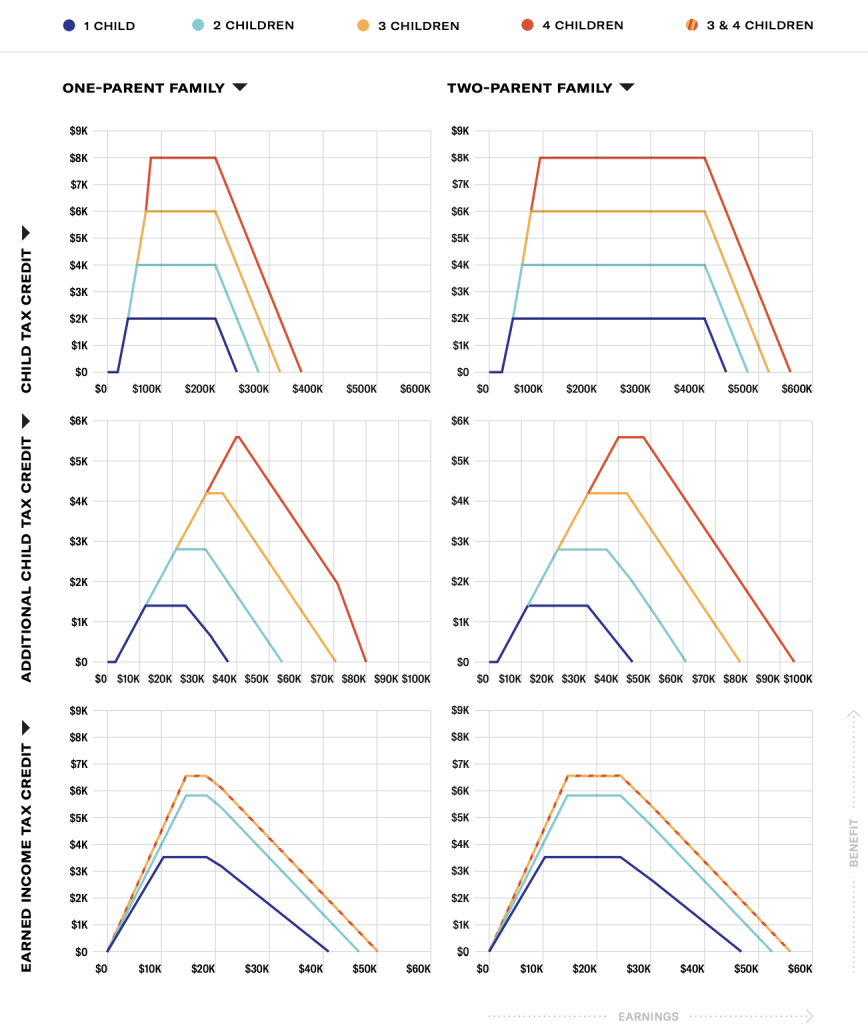
The US child benefit regime currently consists of three duplicative and bizarre tax credit programs that all do the exact same thing: provide a benefit that phases in based on a family’s income and then phases out based on a family’s income. This phase-in/phase-out pattern is sometimes called a trapezoid benefit because that is the shape it makes when depicted on a graph.

In the six graphs below, we can see how much money families are supposed to receive from each of these programs, based on their tax-filing status, earnings level, and number of children.

Screen-Shot-2021-01-13-at-3.14.20-PM-868x1024.png


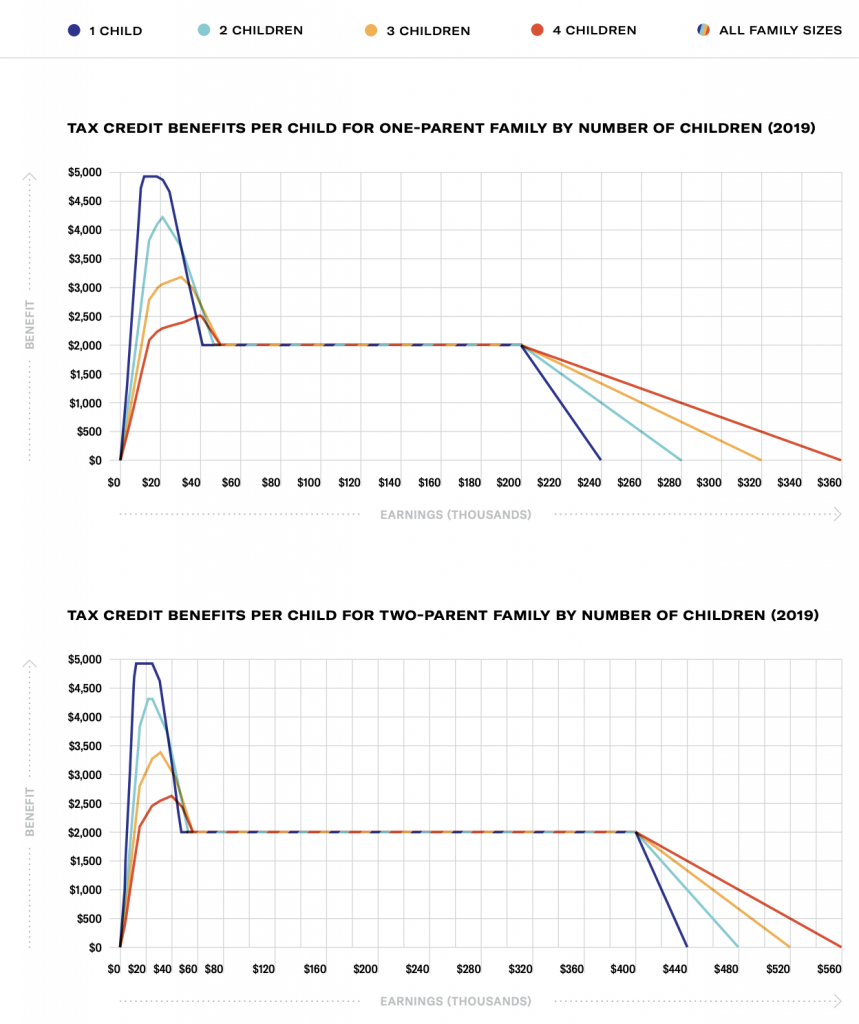
In the next two graphs, I add all these credits together and then divide by the number of children to produce a depiction of what the scheme looks like overall.

Screen-Shot-2021-01-13-at-3.18.30-PM-859x1024.png


The graphs I have presented so far illustrate how much money a family at a particular earnings level should receive from these programs. But it does not illustrate how many kids actually live in families at each earnings level. This means that these graphs do not provide much insight into the overall distribution of these benefits across low-income, middle-income, and high-income families.

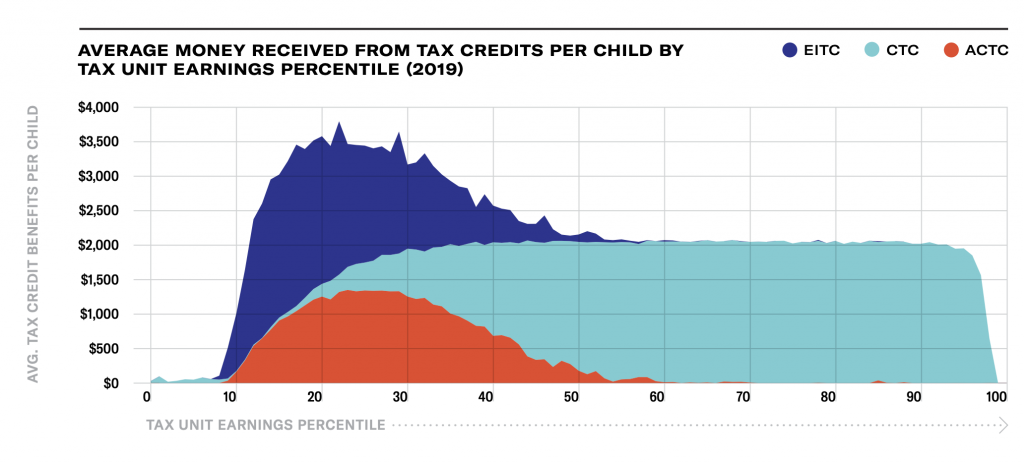
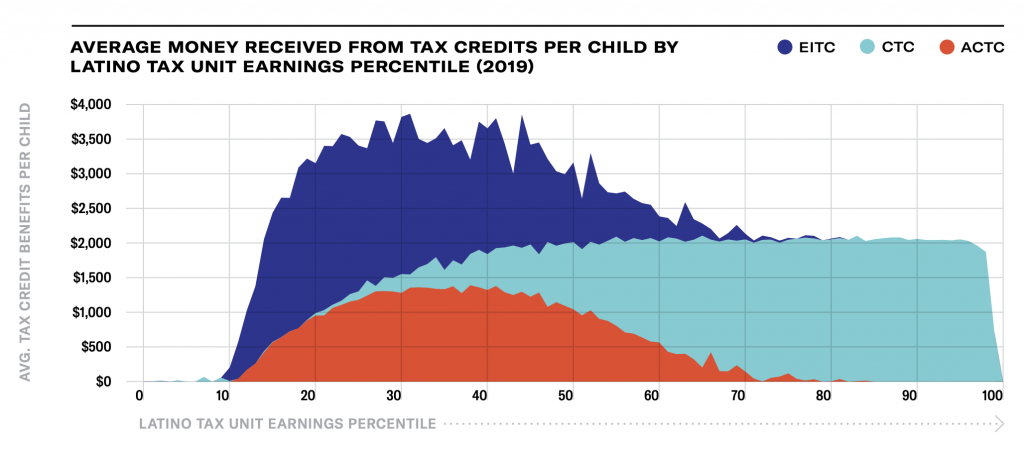
To see how these benefits are distributed overall, we can look at the next graph, which was produced using the Annual Social and Economic Supplement of the Current Population Survey. This graph shows how much money kids receive from these various programs, on average, at every percentile of the earnings distribution.

Screen-Shot-2021-01-13-at-3.20.05-PM-1024x463.png


This analysis shows that the poorest 9 percent of children receive essentially nothing from these tax credit programs while the next poorest 11 percent of children receive less than the maximum amount. Overall then, the country’s child benefit regime partially or entirely excludes the poorest fifth of American children.

Remarkably, even though these tax credits phase out on those with very high incomes, the vast majority of rich people are still eligible for significant benefits. As a result of this, children at the 95th percentile of the earnings distribution receive 40 times as much money from these programs as children at the 5th percentile do.

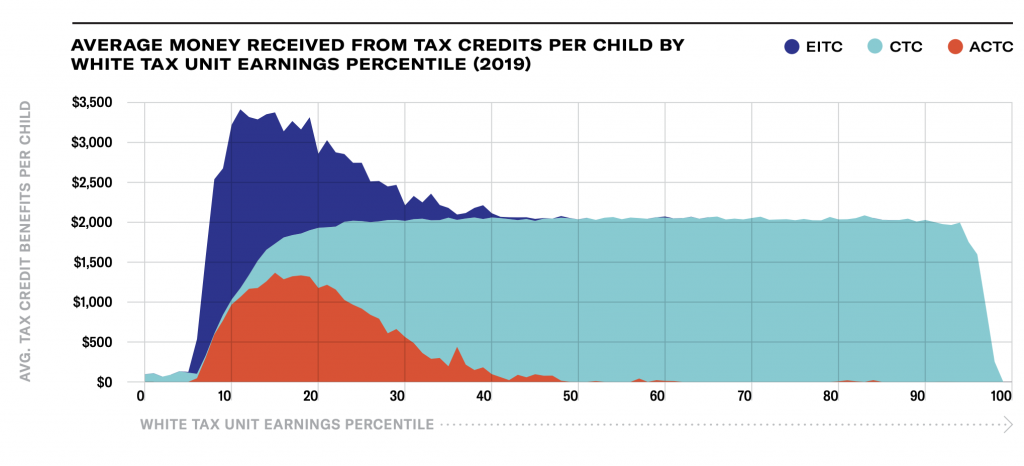
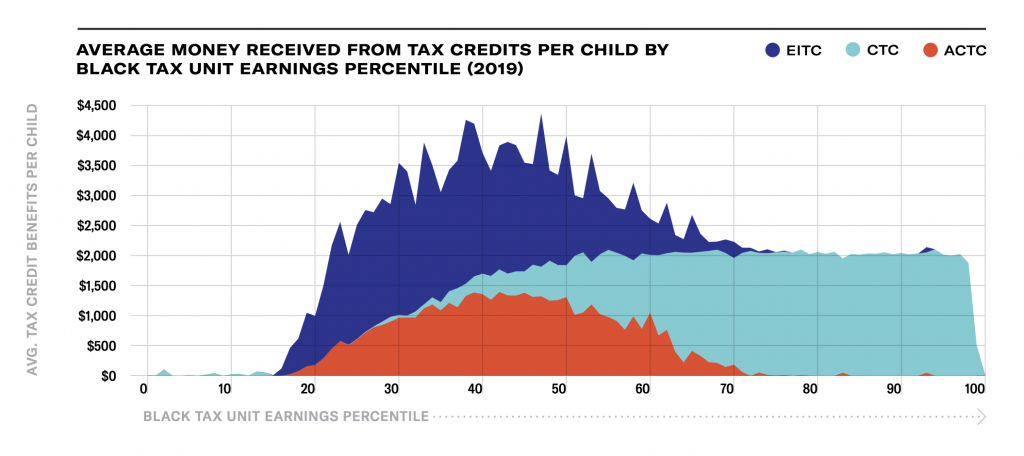
We can reproduce this same graph for each racial group as well, which is what I do in the next three graphs.

Screen-Shot-2021-01-13-at-3.22.19-PM-1024x466.png


Screen-Shot-2021-01-13-at-3.22.24-PM-1024x462.png


Screen-Shot-2021-01-13-at-3.22.28-PM-1024x456.png


The poorest 7 percent of children in white tax units are almost entirely excluded from these benefits. For Latino children, it is the poorest 10 percent. For black children, it is the poorest 16 percent. Thus, as with any program designed to exclude the poor, the current tax credit regime disproportionately leaves out nonwhite people.

Tax Credit Mess (In Reality)

As bad as these tax credits look on paper, the real-life versions of them are even worse. The statistics I have presented so far assume that all eligible children receive the benefits that they are entitled to. But we know from IRS and Census data that this is not true.

According to the IRS, only 78 percent of eligible tax units receive the EITC benefits that they are entitled to. And, according to the Census, nonparticipation in the EITC is skewed towards lower-income families with children. Indeed, if you look at who actually gets the EITC based on IRS administrative data, rather than simply assuming everyone who is eligible gets it, you discover that conventional estimates of how much money the EITC provides to poor families are vastly overstated. For example, in 2014, the tax models tell us that the EITC lifted 4.8 million people over the federal poverty line while the actual IRS data tells us the real number was just 3.2 million people. This means that most estimates of the EITC’s impact—including the estimates used in the graphs above and the figures published frequently by the Census and other think tanks—overstate the EITC’s antipoverty impact by 50 percent.

As far as I know, nobody has conducted similar research into the real-life versions of the CTC and ACTC, but it is hard to imagine why they would be any different than the EITC, seeing as the three programs are identical in all relevant respects. The low-income families who are failing to claim the EITC are also almost certainly failing to claim the CTC and the ACTC.

Tax Credit Deception

The policy community has consistently misled policymakers and the media about the effectiveness of tax credits. They do this in two ways:

  1. They present estimates about the antipoverty effects of tax credits that assume everyone who is eligible get the benefits even though that is demonstrably false. As noted already, the Census has cautioned that this kind of assumptive modeling is overstating the effect of these programs by 50 percent.
  2. They use the headcount poverty measure to determine how effective a program is at reducing poverty. The problem with the headcount poverty measure is that it does not distinguish between someone whose income is $1 below the poverty line and someone whose income is $10,000 below the poverty line. A program that provided $1 to the former person would count as reducing poverty while a program that provided $9,999 to the latter person would not. As we see in the graphs above, tax credits exploit this weakness by intentionally skipping the poorest 9 percent of kids and then sprinkling a relatively modest amount of money on those with incomes just below the poverty line. This does not provide much in the way of genuine poverty relief, but it allows dishonest operators to claim it does.

Once you account for how many poor people are excluded from tax credits — either by the rules of the program or by the difficulty of applying for the program — it is very clear that these are not very good programs.

The $374 Alternative

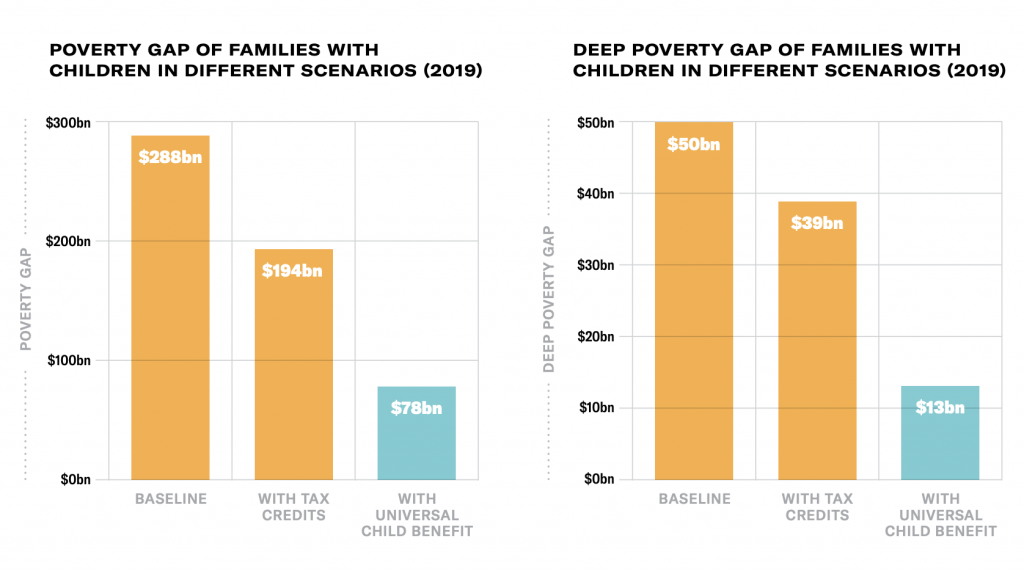
To replace this mess, I argue that we should have the Social Security Administration simply send out $374 every month to every child in the country. The $374 figure is chosen because, under the federal poverty guidelines, this is the amount it would take to ensure that no family ever slips into poverty solely because they added a child to their family.

The lack of a benefit phase-in will ensure that all poor families (and rich families) are eligible for the program. The lack of a benefit phase-out will ensure that poor people do not wind up excluded from the program by the paperwork burden that means-testing always comes with and ensure that all families benefit from income-smoothing when they have a child. These features of the program would make the program vastly more effective at reducing poverty and guarantee that all families with minor children benefit in a tangible way that they can see in their bank account every 30 days.

Screen-Shot-2021-01-13-at-3.41.16-PM-1024x574.png


Conclusion

When the government provided two series of checks to nearly every family in the country last year, the typical family of four received $5,800 in direct cash assistance from the government. These checks were wildly popular, so much so that even the great majority of Republican voters tell pollsters that they want to see more of them.

Democrats should learn the lesson of this success: clear and simple programs that provide salient benefits to everyone are both effective and politically beneficial.

What to do about our child benefit regime is likely to be a topic of much interest to politicians over the next two years. Democrats have already shown an interest in reforming the system, but so far have ignored the wisdom revealed by the stimulus checks and gravitated towards doubling down on these failed tax credit programs.

If something is worth doing, it is worth doing right, and the objectively superior way to organize child benefits is through a universal check paid out monthly to every family.
 

TorontoGold

Mr. Dumb Moron
Messages
7,347
Reaction score
5,703
Whiskey, this is an incredible article (not just because it validates my economics degree...) When I was studying the social/tax economics areas, the main takeaway I got was that when you means test someone on the initial application for the government relief many are hesitant to apply and only those with means will apply. Making it so that only the wealthy will take advantage of these credits. Anyways, I think a democrat/republican/conservative/liberal would do well to simplify the tax code both in the US/CA if they removed personal tax credits and instead a general government payout that is means tested upon tax filing. Obviously it's oversimplifying the situation due to any number of factors - access to tax prep services or general tax knowledge, income swings, etc.
 

Irish#1

Livin' Your Dream!
Staff member
Messages
44,577
Reaction score
20,027
Let me know if this comes to fruition. I'm putting Grandma back into production mode to get me some of them checks.
 

Irishize

Well-known member
Messages
4,531
Reaction score
461
Great post Whiskey. I just heard an economist professor named Melissa Carney discuss something similar with her point being that children are under represented in DC (compared to say the elderly...AARP, etc). Her point was that if we just gave every kid in this country who lives in poverty the avg SS benefit that it would essentially eradicate childhood poverty at a price tag around $180B. Still a ton of money she notes but small compared to what we spend on SS ins & disability. But it’s not a political priority. It wouldn’t be hard to move money around in federal budget. There’s no real lobbying group for kids and of course they can’t vote, so cynically she noted that may be why they’re under-represented.
 

Old Man Mike

Fast as Lightning!
Messages
8,964
Reaction score
6,453
Anything which begins to get all children started on level potential grounds (and this alone won't do it, but it's a start) is vital to raising a full new generation of all citizens who have at least the possibility of not hating one anothers guts.

We have a MONSTER problem of decades long entrenched antipathy in the US. We are going to have to own that and spend several presidencies (of ANY damm parties) seriously working at this. ONLY the federals have enough muscle and money to create the necessary facilitation ---> THEN HAND IT OVER TO THE STATES. And THEN states must hand most of the "power" over to the locals, who must hand it over to real people (teachers, helpers, and the families.)

Oversight? OK. But generally GET OUT OF THE WAY.
 

RDU Irish

Catholics vs. Cousins
Messages
8,622
Reaction score
2,722
I think the concept is great - stop splitting hairs over when you yank any financial support to kids - cut a monthly check for every US citizen under 18. Tax the benefit so you get 40% of it back in the case of the 1%ers. Kids are expensive and our system is structured to encourage fewer kids the more money you make - should be the opposite.
 

IrishLax

Something Witty
Staff member
Messages
37,544
Reaction score
28,990
Matt Bruenig just published an article titled "Now Is the Time for an American Child Benefit":

100% agree with the premise here, but then again I also support UBI for similar reasons. The simplest way to mitigate poverty and many other societal issues is streamline/eliminate current social programs and move away from "means testing." If you're worried about people who "don't need" the money getting it, then it's extremely easy to claw it back retroactively through marginal tax rates on high earners.
 

RDU Irish

Catholics vs. Cousins
Messages
8,622
Reaction score
2,722
100% agree with the premise here, but then again I also support UBI for similar reasons. The simplest way to mitigate poverty and many other societal issues is streamline/eliminate current social programs and move away from "means testing." If you're worried about people who "don't need" the money getting it, then it's extremely easy to claw it back retroactively through marginal tax rates on high earners.

If someone earning $25,000 a month gets an extra 1000/month combined for their three kids it is kind of made up in their +$5000/month tax bill.

I can get on board with the UBI but you have to eliminate the minimum wage and a bunch of other social programs. KISS method in my book.
 

Rack Em

Community Bod
Messages
7,089
Reaction score
2,727
I think the concept is great - stop splitting hairs over when you yank any financial support to kids - cut a monthly check for every US citizen under 18. Tax the benefit so you get 40% of it back in the case of the 1%ers. Kids are expensive and our system is structured to encourage fewer kids the more money you make - should be the opposite.

The system should encourage more children from those who vote Republican and encourage zero children to anyone who votes Democrat.
 

NorthDakota

Grandson of Loomis
Messages
15,693
Reaction score
5,993
Anything which begins to get all children started on level potential grounds (and this alone won't do it, but it's a start) is vital to raising a full new generation of all citizens who have at least the possibility of not hating one anothers guts.

We have a MONSTER problem of decades long entrenched antipathy in the US. We are going to have to own that and spend several presidencies (of ANY damm parties) seriously working at this. ONLY the federals have enough muscle and money to create the necessary facilitation ---> THEN HAND IT OVER TO THE STATES. And THEN states must hand most of the "power" over to the locals, who must hand it over to real people (teachers, helpers, and the families.)

Oversight? OK. But generally GET OUT OF THE WAY.

Define level potential grounds.

Are you proposing raising the floor for poor communities to get them to a level where its not a complete long shot for them to compete or are you thinking make their schools as good as wealthier communities? I would think the former is more attainable than the latter.
 

RDU Irish

Catholics vs. Cousins
Messages
8,622
Reaction score
2,722
Might as well be. I’m done holding back how I truly feel. I’m gonna get canceled anyway so might as well make some waves on the way out.

I won't be far behind you. Gotta love policy that encourages poor to have more children and discourages middle class and up from having more.
 

sixstar

Well-known member
Messages
1,144
Reaction score
2,064


Inflation is over.


You can't just look at overall CPI and assert that inflation is over. Overall CPI is a volatile number that depends on rapidly changing food and energy prices. The reason that overall CPI is coming down is because food and energy prices rose so much in 2021 and 2022.

Other metrics don't look as rosy.

Core inflation excludes food and energy prices and, as such, is less impacted by daily rate changes.

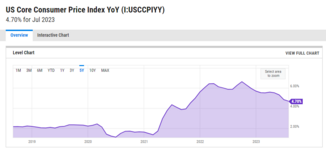
Here's core CPI inflation rates over the last 5 years:
1692018381459.png

Target core inflation is 2%. we are still more than double that. Yes, core inflation is down from a peak of 6.6%, but 4.7% is still atrocious compared to the 2% target. Core CPI says that we aren't out of the woods yet. More data is needed to claim that "inflation is over"

Rates have declined due in large part to the Fed Reserve raising interest rates to slow the economy. I moved all of my retirement holdings into inflation backed treasury bonds in 2021. I felt like sustained inflation was inevitable, and I'm not sure why more people didn't see it coming.

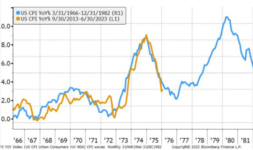
Also, I've seen this graph floating around. The trend is similar for many other countries as well. I can't help but wonder if history will repeat itself.

1692019122950.png
 

ACamp1900

Counting my ‘bet against ND’ winnings
Messages
48,944
Reaction score
11,225
The thing that never gets discussed is that while inflation has subsided most goods still cost 15-20% more than they did 2 years ago. The impacts don't go away and workers are still making less in real dollars than they did at the beginning of 2019.

That said, this is good news!
Yeah I was just talking to my wife yesterday about this,… we got basic groceries for the next couple weeks over the weekend. What easily would have been ~100 bucks a couple years ago cost us over 200 this weekend. Everything is so much more than it used to be and it’s not going to get cheaper,…
 

Blazers46

Adjectives: wise/brilliant/handsome.
Messages
8,105
Reaction score
5,458
County fair an elephant ear was $15. What's a young redneck to do?
Eating out with a family of 5 has almost become too expensive. Even fast food I have found myself spending over $50. Hard to find a decent “value meal” under $10. Im that old guy that if I see a “Kids Eat Free Monday” sign I’m taking a picture and sending it to my wife.
 

zelezo vlk

Well-known member
Messages
18,009
Reaction score
5,047
Eating out with a family of 5 has almost become too expensive. Even fast food I have found myself spending over $50. Hard to find a decent “value meal” under $10. Im that old guy that if I see a “Kids Eat Free Monday” sign I’m taking a picture and sending it to my wife.
Something my uncle told me a few years back is that a lot of the deals at Fast Food places are now tied into their apps. Might be worth downloading one or two of your family's favorite places and look for deals every once in a while. I got a couple free meals from Chickfila this summer from stuff they were doing (just free nuggets and a sandwich, but hey that's pricey part of the combo anyways).
 

Blazers46

Adjectives: wise/brilliant/handsome.
Messages
8,105
Reaction score
5,458
Something my uncle told me a few years back is that a lot of the deals at Fast Food places are now tied into their apps. Might be worth downloading one or two of your family's favorite places and look for deals every once in a while. I got a couple free meals from Chickfila this summer from stuff they were doing (just free nuggets and a sandwich, but hey that's pricey part of the combo anyways).
Yeah, I have found the apps to be helpful but so inconvenient with my cloud space and the physical man hours it takes to download every app 😂

Reminds me of one of many hilarious scenes from Hangover

 
Top