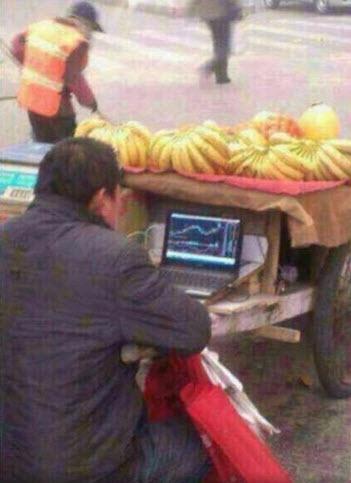
China looking at a potential crash?

connor_in

Oh Yeeaah!!!
Messages
11,433
Reaction score
1,006
Over the last couple years or so, I have been hearing more and more rumblings about problems percolating within China's economy. There have been more and more stories of late of how they are about to experience a lot of trouble, but Greece has taken more of the spotlight with their problems that what is happening in China.

I thought I would start this thread as a news point/discussion of the events that are unfolding and will continue to do so.

The really worrying financial crisis is happening in China, not Greece - Telegraph

The Chinese Government's Attempt To Fix Its Stock Market Will Fail - Forbes

China stock market turmoil explained - CNN.com

Stock Slump Casualty: The Myth of Chinese Exceptionalism - China Real Time Report - WSJ

China stock market freezing up as sell-off gathers pace | Reuters
 

edgesofsanity

Active member
Messages
667
Reaction score
57
Eh...their market has been overvalued for some time now. Lot of day trading goes on within the country.

China-banana-salesman-trading-stocks-shanghai.jpg

A little market correction was overdue.
 

IrishLax

Something Witty
Staff member
Messages
37,546
Reaction score
29,007
Yeah, it's happening. I'm skeptical that it'll have any serious effect on the US... but I don't have time to type up a long post explaining why.
 

Irish#1

Livin' Your Dream!
Staff member
Messages
44,620
Reaction score
20,108
Life was so much more simple when China kept to themselves instead of opening up their Great Wall.
 

IrishJayhawk

Rock Chalk
Messages
7,181
Reaction score
464
Life was so much more simple when China kept to themselves instead of opening up their Great Wall.

<iframe width="560" height="315" src="https://www.youtube.com/embed/afnJbdT4t5g" frameborder="0" allowfullscreen></iframe>
 

IrishLax

Something Witty
Staff member
Messages
37,546
Reaction score
29,007
The most important thing to note is that Chinese-American is largely one way. China just slashed tariffs to try to change this dynamic, but that's largely irrelevant.

If China's economy crashes, that does not affect the United State's ability to continue to manufacture or otherwise import goods from that country.

However, the big risk is that our country's laughably irresponsible deficit is currently buoyed in large part by Chinese continuing to purchase US Treasury Bonds. And if that fact were to be compromised for any reason, it could get a little harry.
 

IrishinTN

Well-known member
Messages
1,898
Reaction score
355
The thing I find troubling is this, Greece, Spain, Ireland and the downfall of the Euro all happening at the same time. Do you guys think this really wont affect us?
 

connor_in

Oh Yeeaah!!!
Messages
11,433
Reaction score
1,006
The most important thing to note is that Chinese-American is largely one way. China just slashed tariffs to try to change this dynamic, but that's largely irrelevant.

If China's economy crashes, that does not affect the United State's ability to continue to manufacture or otherwise import goods from that country.

However, the big risk is that our country's laughably irresponsible deficit is currently buoyed in large part by Chinese continuing to purchase US Treasury Bonds. And if that fact were to be compromised for any reason, it could get a little harry.

6tbFBP4R.jpeg


or

Prince_Harry_1642875a.jpg


or

harry-styles3.jpg


or

33_harry_s_truman.jpg


or

harry-connickjpg-af7e61038ada0a87.jpg
 

Rizzophil

Well-known member
Messages
2,431
Reaction score
579
The thing I find troubling is this, Greece, Spain, Ireland and the downfall of the Euro all happening at the same time. Do you guys think this really wont affect us?

We have a 19.5 trillion debt. Of course it's going to affect us. We have been buying our own debt. It will surely catch up to us.
 

woolybug25

#1 Vineyard Vines Fan
Messages
17,677
Reaction score
3,018
The most important thing to note is that Chinese-American is largely one way. China just slashed tariffs to try to change this dynamic, but that's largely irrelevant.

If China's economy crashes, that does not affect the United State's ability to continue to manufacture or otherwise import goods from that country.

However, the big risk is that our country's laughably irresponsible deficit is currently buoyed in large part by Chinese continuing to purchase US Treasury Bonds. And if that fact were to be compromised for any reason, it could get a little harry.

This is what i'm worried about. Not the stock market itself, but what factors could lead to them ending the practice of suppressing the value of their currency vs the US Dollar. If there is no need to keep their currency low (and in turn making their goods attractive to the US) then it would make the "nuclear option" viable. Which is a massive dump of US Treasuries. Crippling our economy.
 

GoldenToTheGrave

Well-known member
Messages
1,907
Reaction score
772
We have a 19.5 trillion debt. Of course it's going to affect us. We have been buying our own debt. It will surely catch up to us.

When there's financial catastrophe worldwide people pile into the dollar, it should push up the dollar and have people buy more treasuries.
 

pkt77242

IPA Man
Messages
10,805
Reaction score
719
Not if China dumped trillions of dollars of our treasuries.

Very true, though there is a chance that if the Chinese market crashes that the Chinese will buy even more US treasuries, viewing them as a safe haven.
 

mgriff

Useful idiot
Messages
3,525
Reaction score
307
The data suggests it's similar to our crash starting the Great Depression, but many with skin in the game think the government is going to do enough to cause the bubble to deflate over time. They really screwed the average people when they told them it was nationalistic to buy into the market at the high.
20150706_shcomp_1_0.jpg
 

Whiskeyjack

Mittens Margaritas Ante Porcos
Staff member
Messages
20,894
Reaction score
8,126
From The Economist:

CHINA is certainly not the first country to try to prop up a falling stockmarket. The central banks of America, Europe and Japan have all shown form in buying shares after crashes and cutting interest rates to cheer up bloodied investors. But the circumstances and the manner of China’s intervention of the past ten days make it an outlier, worryingly so.

The trigger in China’s case is perplexing. Yes, the stockmarket is down a third over the past month, but that has simply taken it back to March levels; it is still up 80% over the last year. Growth, though slowing, has stabilised recently. Other asset markets are performing well. Property, long in the doldrums, is turning up. Money-market rates are low and steady, suggesting calm in the banking sector. The anticipated correction of over-valued stocks hardly seems cause for much anguish.

Yet China’s intervention has screamed of panic. Had the central bank stopped at cutting interest rates—justifiable support for the economy when inflation is so low—that would have been reasonable. Instead, there has been a spectacle of ever-more drastic actions to save the market. Regulators capped short selling. Pension funds pledged to buy more stocks. The government suspended initial public offerings, limiting the supply of shares to drive up the prices of those already listed. Brokers created a fund to buy shares, backed by central-bank cash. All the while, state media played cheerleader. Far from saving the market from drowning, the succession of life buoys only pushed it further under water. The CSI 300, an index of China’s biggest-listed companies, fell almost 10% over seven trading days after the rate cut. ChiNext, an index of high-growth companies that is often described as China's Nasdaq, fell by 25%.

Theories have flourished about why the government has waded in so heavily. The apparent desperation is, some believe, a sign that officials see a looming economic collapse, and are trying to staunch the wound before social upheaval ensues. That story is intriguing, but it is not the most likely.

Lost in all the drama about the stockmarket is that it still plays a surprisingly small role in China. The free-float value of Chinese markets—the amount available for trading—is just about a third of GDP, compared with more than 100% in developed economies. Less than 15% of household financial assets are invested in the stockmarket: which is why soaring shares did little to boost consumption and crashing prices will do little to hurt it. Many stocks were bought on debt, and the unwinding of these loans helps explain why the government has been unable to stop the rout. But this financing is not a systemic risk; it is just about 1.5% of total assets in the banking system.

If economic stability is not in peril, why then the panic? The most compelling explanation is politics. The government has staked much credibility and prestige on the stockmarket. When the going was still good, the official press was chock-a-block with articles about how the rally reflected the economic reforms that Xi Jinping, China’s top leader, was set to push. Li Keqiang, the premier, said repeatedly that he wanted equity markets to provide a bigger share of corporate financing—comments, from punters' perspective, not unlike waving a red cape in front of a bull. The sudden end to the rally is the first major dent in the public standing of the Xi-Li team. The botched attempts to stabilise the market only make them look weaker, giving succour to their critics.

But the biggest concern about the panicked policy response is what it says about the government's agenda. The economic hopes invested in Messrs Xi and Li stemmed from their pledge in late 2013 to let market forces play a “decisive role” in allocating resources. The actions of the past ten days have made abundantly clear that it is still the other way around: the Chinese government wants a decisive role in markets.

The failure of share prices to do their bidding is, in that respect, welcome. It shows that the Communist Party, powerful though it may be, cannot indefinitely bend markets to its will. Chinese leaders should heed that lesson and get on with the challenges of liberalising their economy. A relapse towards statism will not just set China back. It also will not work.
 

ND NYC

New member
Messages
3,571
Reaction score
209
"sell when they're all buying and buy when they're all selling"
takes some balls but pays off....
 
Top