Economics

gkIrish

Greek God
Messages
13,184
Reaction score
1,004
A few considerations:
- 45% of Americans pay no personal income tax. You would raise rates on the other 55% to eliminate corporate income taxes?

- How do you stimulate personal growth, prosperity and encourage upward mobility by raising personal taxes?

- Would you retain tax breaks that allow CEOs to lower or eliminate their taxes or have them pay a minimum flat tax of 15%?

- America is a consumer driven economy. Raising personal income taxes on the 55% of us who do pay taxes would be counter-productive.

Taxes are not a zero-sum game. Decreasing the corporate tax rate does not mean you have to increase some other tax rate.

Spending is out of control across the board. Cut spending and you can decrease the corporate rate. More money in the hands of consumers also means more economic stimulation and less need for government handouts.
 

Legacy

New member
Messages
7,871
Reaction score
321
Taxes are not a zero-sum game. Decreasing the corporate tax rate does not mean you have to increase some other tax rate.

Spending is out of control across the board. Cut spending and you can decrease the corporate rate. More money in the hands of consumers also means more economic stimulation and less need for government handouts.

I agree. My questions to wiz were responding to his proposal to eliminate all corporate taxes and raising personal income taxes. I, too, would cut spending first.

We need to address these tax avoidance schemes by MNCs to make it costly for them to hide or move revenue, amounting to trillions, outside of the countries from which that revenue is generated.

Also,
The Legacy of Debt: Interest Costs Poised to Surpass Defense and Nondefense Discretionary Spending (Wall Street Journal)
 

Ndaccountant

Old Hoss
Messages
8,370
Reaction score
5,771
I agree. My questions to wiz were responding to his proposal to eliminate all corporate taxes and raising personal income taxes. I, too, would cut spending first.

We need to address these tax avoidance schemes by MNCs to make it costly for them to hide or move revenue, amounting to trillions, outside of the countries from which that revenue is generated.

Also,
The Legacy of Debt: Interest Costs Poised to Surpass Defense and Nondefense Discretionary Spending (Wall Street Journal)

so are you ignoring the data I posted that showed, as a % of GDP, total tax revenue coming from all taxes corporations pay has been more or less flat for 30+ years (swings usually coincide with economic cycles and NOL's and depreciation acceleration, but on balance, it is flat)?
 
Last edited:

IrishinSyria

In truth lies victory
Messages
6,042
Reaction score
1,920
http://www.nytimes.com/2016/11/06/u...cy-hillary-clintons-agenda.html?emc=eta1&_r=0

The talk of monopsony is part of a shift in the policy tools that many left-of-center economic thinkers see as most promising for addressing the economic challenges of poor and middle-class Americans. Rather than focusing on policies that amount to redistribution — tax rates, the social welfare system — they are looking at how the rules of the economic game shape people’s outcomes.

Some use a term for this set of policies coined by the Yale political scientist Jacob Hacker: predistribution policy. This is policy that shapes how the market works in the first place, as opposed to redistribution policy, which assumes a free market will generate growth and then uses taxes and spending to give a lift to the economy’s losers.
 

Legacy

New member
Messages
7,871
Reaction score
321
so are you ignoring the data I posted that showed, as a % of GDP, total tax revenue coming from all taxes corporations pay has been more or less flat for 30+ years (swings usually coincide with economic cycles and NOL's and depreciation acceleration, but on balance, it is flat)?

No. I did not see your post with that data, but will review it.

For now, I'll ask others to compare our data. Have taxes from personal revenue as a percent of GDP remained the same too?
 

Ndaccountant

Old Hoss
Messages
8,370
Reaction score
5,771
No. I did not see your post with that data, but will review it.

For now, I'll ask others to compare our data. Have taxes from personal revenue as a percent of GDP remained the same too?

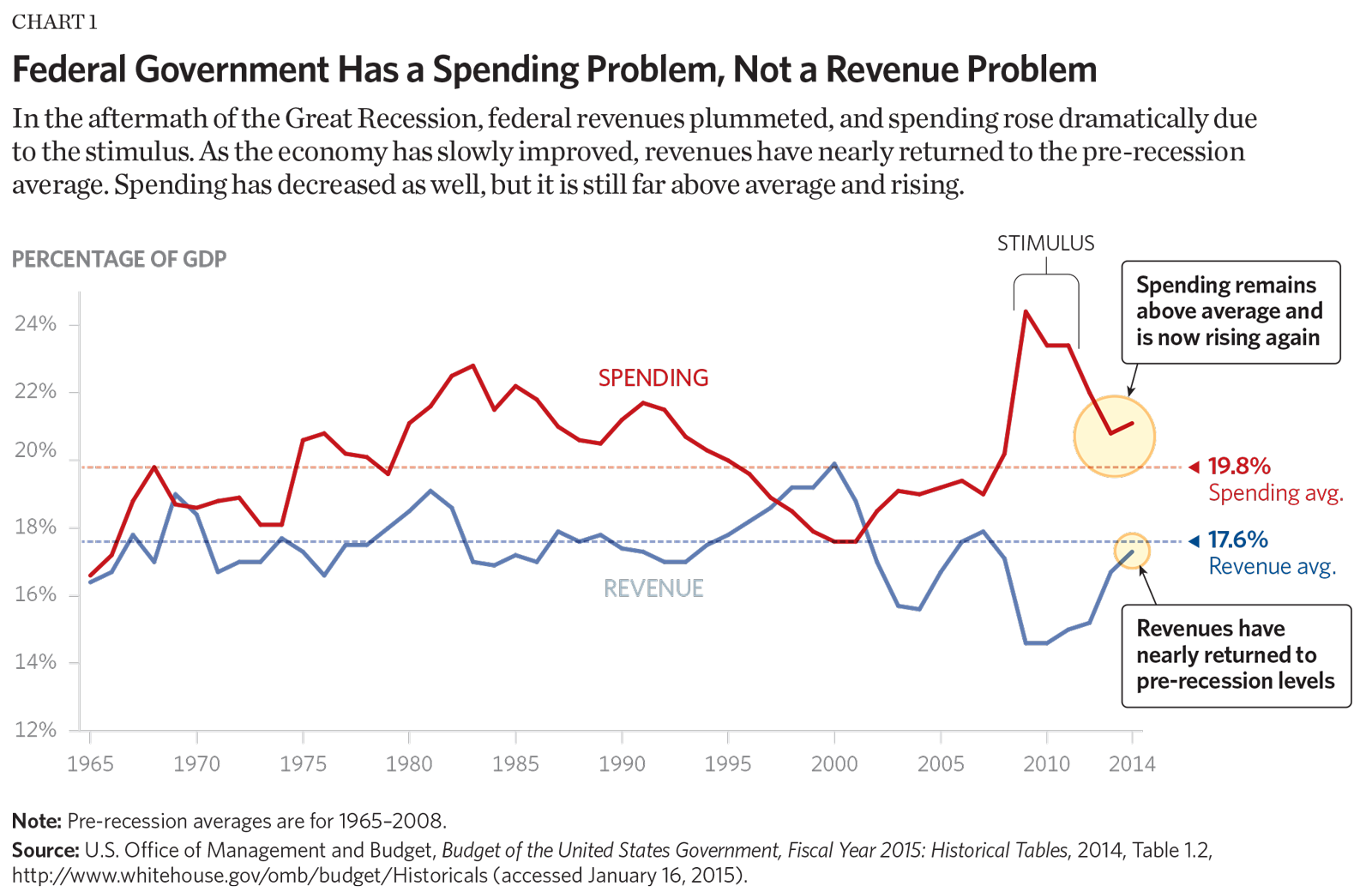
In effect, no, they have increased due to payroll taxes. Individual income taxes have fluctuated over time, but have generally been around the 8% mark. However, payroll has increased during that time period as well, for both employer and employee. In some cases, the payroll taxes are hitting people that pay no income taxes.

Back to the main point here though.....spending as a % of GDP has not normalized since the recession, while revenues have.

SR-budget-book-2015-chart-1-1600.png
 

Legacy

New member
Messages
7,871
Reaction score
321

Interesting article, InS, ("A New Movement in Liberal Economics That Could Shape Hillary Clinton’s Agenda"). As indicated, the Admin turned to predistribution policies when the more direct approaches were politically non-starters.

(Conclusion)
And adjusting taxes and spending has the advantage of directness, even if it is a political nonstarter. It is much less certain just what policies focused on predistribution would do. Tweaking overtime rules or preventing mega-mergers might help reduce inequality, in other words. But raising taxes on the wealthy and using the money to increase benefits for the working class definitely would.

Here's the policy article that was linked to it (long).
Rewriting the Rules of the American Economy
(Roosevelt Institute)

One Excerpt (much more of course):
Page 70
REBALANCE THE TAX AND TRANSFER SYSTEM
Changes to the U.S. tax structure hold enormous potential for reducing inequality and improving the equality of opportunity for Americans—in no small part because the United States ranks among the least redistributive countries in the OECD.

Taxes are not only an important way to raise revenue for critical public services and growth-enhancing investments, but they can also improve incentives for economic behavior. Snowballing changes to the tax code under supply-side rationale over the past 35 years, however, have prioritized tax cuts and subsidies focused on those at the top, placing a greater tax burden on the rest and causing neglect of critical public investments. We propose an agenda that would use the tax code to structure incentives that reward work, not rent-seeking or speculation.

By eliminating the special provisions that distort the economy and increase inequality, we can raise substantial amounts of revenue that can be used for public investments, like education, infrastructure, and technology, that would create a stronger economy, reduce inequalities and increase opportunity. The most clear-cut changes require raising the top marginal income tax rate, ending preferential treatment of capital gains, cutting the step-up basis at death and improving enforcement.

As we saw in our analysis of the current rules, lower marginal tax rates at the top not only reduce public revenue, but also can distort the economy by actively encouraging rent-seeking. Cuts to the highest marginal tax rate not only increase post-tax and transfer inequality, but also raise the incentive to bargain for more income at the higher end of the income distribution and evade taxes by disguising labor income as capital income. Improving the incentives thus not only raises more revenue, but will improve the equity of pre-tax incomes. Further, at the highest incomes, many pay much less than the nominal tax rate due to provisions of the tax code that favor the rich. The current tax policy gives favorable treatment to the forms of income received by the wealthiest Americans. Other taxes like sales and payroll taxes are regressive.

Finally, many tax deductions, like the mortgage deduction on second or third homes, favor the rich.Increasing the marginal tax rate at the top, converting all deductions into tax credits, and limiting the ability to use tax credits would go a long way to restoring progressivity. A 5 percent increase on the top 1 percent’s current income tax rate would raise between $1 trillion and $1.5 trillion of additional revenue over 10 years.

To put this in perspective: for an extra $50,000 taxed on every $1 million of a wealthy individual’s income, the United States could make all public college education free and fund universal pre-K.

A Graph in the Appendix (p 94) also shows the "Falling Labor Share of Income Most Pronounced in Bottom 99 Percent" from 78% in 1980 to 63% in 2010. (Excludes the Share of Income of the Top 1%)

This may address the topic of this thread.
 
Last edited:
B

Buster Bluth

Guest
In effect, no, they have increased due to payroll taxes. Individual income taxes have fluctuated over time, but have generally been around the 8% mark. However, payroll has increased during that time period as well, for both employer and employee. In some cases, the payroll taxes are hitting people that pay no income taxes.

Back to the main point here though.....spending as a % of GDP has not normalized since the recession, while revenues have.

SR-budget-book-2015-chart-1-1600.png

LOLOL at "stimulus" being the reason for that spike.
 

yankeehater

Well-known member
Messages
2,197
Reaction score
774
. Congress is full of people who would cut corporate tax rates to 15%.


I recently attended an economic summit dinner where Dr. Autry Professor of Economics at USC spoke and stated he meets and speaks to Congress frequently. There is a bipartisan belief that cutting the corporate tax rate would improve the economy yet they never move on it.
 

Legacy

New member
Messages
7,871
Reaction score
321
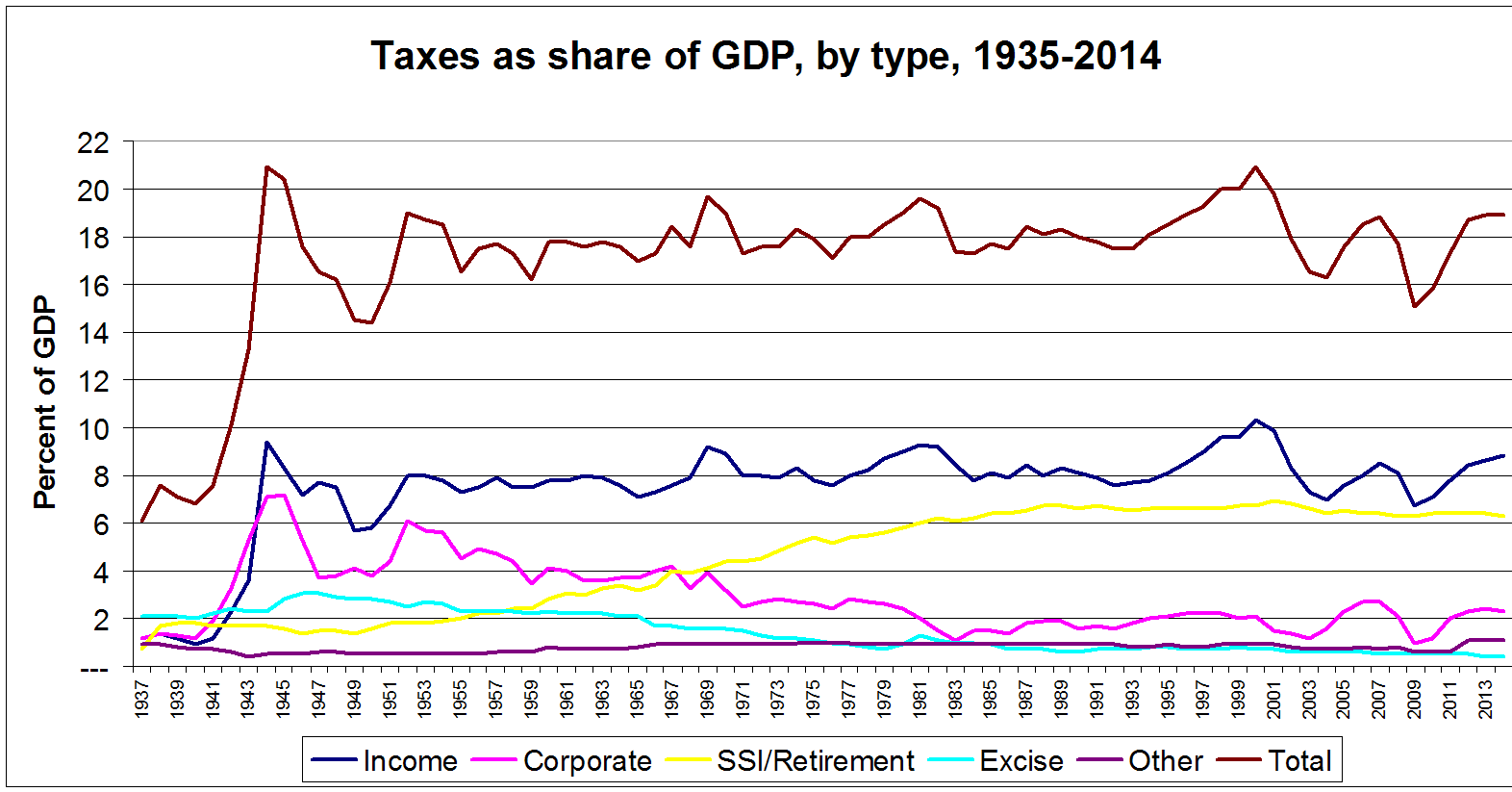
That last statistic is a bit misleading. In 1965 payroll taxes changed substantially with the creation of Medicare and the associated payroll tax. Today, payroll taxes account for ~35% of all federal revenue, where in 1950's it was less than 10%. Remember, payroll taxes are paid by both employer and employee. When taking that into consideration, you see something much different (see below). The fact of the matter is that corporate income taxes have been essentially flat for the last 30 years, when measuring it as a % of GDP.

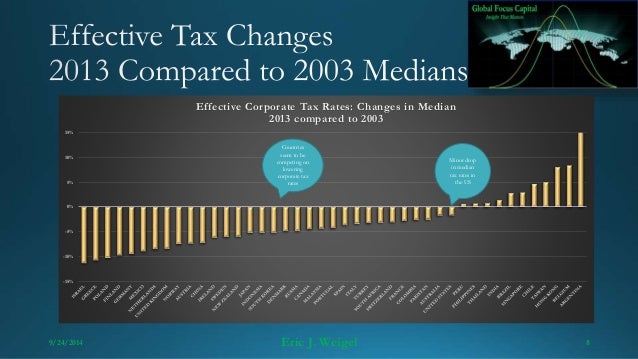
The problem of coarse is that corporations have options today like they never have before. So, the US may be lower than what they were 40 years ago or even 10 years ago for that matter. But it's all relative and as the image below shows, the US has lagged behind. Now, we can argue whether or not that is good for the world. But in the end, that is the playing field and the US can be in the game or on the sidelines. I personally think broadening the base and lowering the rate (including allowing deductions for foreign income taxes paid to help offset bringing that home) makes the most sense for everyone.

corporate-vs-employer-payroll-vs-combined-taxes-as-percent-share-of-gdp-1960-2010.png


taxes+share+gdp.PNG


effective-corporate-tax-rates-a-global-comparison-8-638.jpg

I agree we have a spending problem, as you pointed out, in relationship to revenues in a prolonged period of prosperity and productivity. (We are talking about discretionary spending, right?) Low inflation, low unemployment, good GDP. Federal debt and the interest on it keeps going up due to spending with anticipation of increasing mandatory spending as our population ages.

Military/defense is by far the biggest contributor to (discretionary) spending and the debt with contracts which will continue that binge spending.

On the revenue side, without the Bush tax cuts, revenue would be above pre-recession level. Plus the U.S. is deprived of the revenue of Multinational Corps who've used the tax avoidance schemes to keep that revenue offshore. I imagine what the corporate tax revenue to the GDP ratio would be if those trillions had been booked. Our revenue average would be above normal and, without those tax cuts, would have equaled our spending average. We could have lowered personal and corporate tax rates and minimized the debt with corresponding wise spending choices.

Globalization has brought us an "open system" of corporate income extending across borders, while tax laws are historically based on a "closed system" of taxation. The only ways Congress has considered as (temporary) solutions are "Tax holidays" and "Repatriation taxes".

We require global solutions to this global problem of MNCs' tax avoidance. Corporations that are generally limited to within our borders are those that suffer most from corporate tax imbalance due to the MNCs tax avoidance. Rather than joining the race to lower corporate tax rates, we should work with other countries to require a flat tax on corporate revenue within each country.

Cutting corporate tax rates would lower total taxes paid by corporations to below their historical averages (related to GDP). Combined with allowing deductions for foreign tax credits would lower that tax percentage further, while lowering revenue. We would need to be sure that increased productivity as well as would not contribute to a rising debt.

The Biggest Military Budgets As A Percentage Of GDP [Infographic] (Forbes)

Military expenditure (% of GDP) (World Bank) (world militray expenditures per GDP and broken down by country and region)
 
Last edited:

IrishinSyria

In truth lies victory
Messages
6,042
Reaction score
1,920
In effect, no, they have increased due to payroll taxes. Individual income taxes have fluctuated over time, but have generally been around the 8% mark. However, payroll has increased during that time period as well, for both employer and employee. In some cases, the payroll taxes are hitting people that pay no income taxes.

Back to the main point here though.....spending as a % of GDP has not normalized since the recession, while revenues have.

SR-budget-book-2015-chart-1-1600.png

Just eyeballing that chart it looks like Reagan and Bush really screwed us. #analysis.
 

RDU Irish

Catholics vs. Cousins
Messages
8,622
Reaction score
2,722
. Congress is full of people who would cut corporate tax rates to 15%.


I recently attended an economic summit dinner where Dr. Autry Professor of Economics at USC spoke and stated he meets and speaks to Congress frequently. There is a bipartisan belief that cutting the corporate tax rate would improve the economy yet they never move on it.

My MAGA Magic Eight Ball says "all signs point to yes"

They also know this policy reduces the value of lobbyists and political influence - Trump can hammer this one home in short order.
 

Whiskeyjack

Mittens Margaritas Ante Porcos
Staff member
Messages
20,894
Reaction score
8,126
Moody's just published an article titled "Helping Struggling Places":

Some of the strongest support for Donald Trump on Tuesday came from rural and post-manufacturing areas that have struggled economically. An important question for politicians and social scientists is what can be done for these areas? However, elections do not change the rules of economic welfare, so as economists we must also ask whether from an economic standpoint it make sense to do more.

Here is the central paradox: Areas that are struggling are usually less productive, and have seen a decline in the demand for the goods and services that they provide. Trying to help these areas means shoveling resources into less productive places. What's more, some policies that attempt to do this are zero sum. Giving tax breaks to movie studies for filming in one place means they won’t film in another. Other taxes will have to go up to pay for these costly tax breaks, which means the breaks are likely economically destructive.

Concerns like these have led many to conclude that we should not help these places, and instead should just help people. And one of the best ways to help people, many have concluded, is to help them leave struggling places. Oddly, the opposite tends to be true when we talk about economic development for nations: Out-migration receives little attention relative to other policy options.

That said, there are good economic reasons to think about how to make struggling areas better and not just focus on moving people out of them.

The first is that we can look around and see places that have suffered significant losses of blue-collar jobs and yet thrived. I have a list of them here, but I’ll add my own county of Lancaster PA as an example. In 1990, 30% of jobs there were in manufacturing. The metro area has since lost half of those jobs. But over this same time the population has grown 26%, and today unemployment is below the U.S. level and even dipped below 4% earlier this year. Lancaster is not without its problems. For example, median household income is below average for the U.S. But the loss of a manufacturing core has not been insurmountable. Lancaster is not alone in this.

Another reason to help struggling places is that there are positive spillovers from helping them improve.

One relates to high-skilled, high-income residents. Economists love to cite agglomeration economies—where putting lots of high-skilled people together boosts everyone's productivity—as a reason that it is beneficial for high-skilled people to pack into dense cities. However, there are also positive spillovers when highly educated, high-paid people locate in struggling places.

Having more higher-income people around helps the low-income people in the same area. For example, in a landmark study, Raj Chetty and Nathaniel Hendren argued that growing up in income-segregated areas causes lower economic mobility.

This result is not too surprising. Most directly, segregating low-income families reduces local tax revenues, which means lower government and school spending. And it’s not just about incomes. Higher levels of income are associated with higher levels of human capital. Economist Garett Jones provides a persuasive case for multiple channels for positive spillovers from having a high IQ population:

  1. Higher savings, which provides funds for investment;
  2. More cooperation, which is a key ingredient for creating high-quality government and productive businesses;
  3. More support for market-oriented policies;
  4. More success at using so-called o-ring technologies, which are highly productive team-based technologies; and
  5. Human tendencies to conform generate positive peer effects.

Jones mostly discusses how these factors apply at the national level, but the reasoning applies to places within the U.S. as well. Importantly, many of these channels would likely have diminishing returns, and could imply big gains to increasing the high-skilled population of struggling areas. When a place goes from 0% of the population having PhDs to 1%, there are a lot of benefits that you don't get when you go from 30% to 31%. This deserves more attention from economists than it currently receives, so let me state it succinctly in economist-speak: Agglomeration is not the only human capital non-linearity that matters.

Another area where you will find positive spillovers is the creation and maintenance of consumer amenities. Ed Glaeser, Jed Kolko and Albert Saiz have drawn attention to the importance of cities not just as centers of goods production, but as centers of consumption. There are obvious economies of scale and diminishing returns here too: The first Indian restaurant in a town is more consequential than the 101st. Creating these kinds of amenities are crucial to attracting and retaining high-skilled populations and the spillovers they bring. An added bonus is that these amenities can help spur tourism demand, an export industry that has helped ease the transition from manufacturing and natural resources in some places.

This has policy implications for states. While they tend to focus economic development efforts on drawing in big manufacturers, finding ways to help in the creation of amenities could be more important.

A broader policy agenda, and a federal agenda in particular, for how we help struggling places is beyond the scope of this piece, and it is undeniably a challenging and underdeveloped policy task. However, despite this challenge, in the broader world of economic development research, the discussion has not been reduced to figuring out how to empty developing nations. Nor should this be the case for within-nation economic development. Indeed, the existing evidence suggests that having high-ability and high-income people around has important spillovers.

The level of nihilism espoused by economists about what we can do to help struggling places in the U.S. is, quite frankly, strange. Whenever the issue of helping places is raised, critics jump straight to the most extreme examples, such as former mining towns. But the fact that some places need to shrink, and the costs of helping some places sometimes outweighs the benefits, is a far less powerful point than these critics imagine. Other places have survived the loss of major industries and gone on to thrive. Understanding why this happens sometimes and doesn't happen other times, and what policymakers can do to help replicate the successes, are crucial policy issues that cannot be pushed aside by pointing out the impossibility or desirability of saving every place.

Finally, it’s important to note that the competition between thriving metropolises and the now-struggling parts of the country need not be zero sum. Increasing the human, social and physical capital of struggling places in this country can reduce the need for economic transfers at the federal level and can help make an overall more tolerant and open society that is better able adjust to the dynamism and globalism needed for a growing modern economy. It may help prevent residents in these places from desperately voting for policies that will only make things worse, like a trade war or immigration restrictions. These policies don’t make any economic sense, but when the best ideas for helping struggling communities consists of getting their most able residents to move away, it becomes a little easier to understand.

It will be difficult to reverse the tendency of liberalism to "strip mine" the best and brightest minds from across the country, only to deposit them within a handful of cosmopolitan cities. But it's one of several crucial steps necessary to revitalize our Republic. Brings to mind one of my favorite Chesterton quotes:

Let us suppose we are confronted with a desperate thing-- say Pimlico. If we think what is really best for Pimlico we shall find the thread of thought leads to the throne or the mystic and the arbitrary. It is not enough for a man to disapprove of Pimlico: in that case he will merely cut his throat or move to Chelsea. Nor, certainly, is it enough for a man to approve of Pimlico: for then it will remain Pimlico, which would be awful. The only way out of it seems to be for somebody to love Pimlico: to love it with a transcendental tie and without any earthly reason. If there arose a man who loved Pimlico, then Pimlico would rise into ivory towers and golden pinnacles; Pimlico would attire herself as a woman does when she is loved. For decoration is not given to hide horrible things: but to decorate things already adorable. A mother does not give her child a blue bow because he is so ugly without it. A lover does not give a girl a necklace to hide her neck. If men loved Pimlico as mothers love children, arbitrarily, because it is THEIRS, Pimlico in a year or two might be fairer than Florence. Some readers will say that this is a mere fantasy. I answer that this is the actual history of mankind. This, as a fact, is how cities did grow great. Go back to the darkest roots of civilization and you will find them knotted round some sacred stone or encircling some sacred well. People first paid honour to a spot and afterwards gained glory for it. Men did not love Rome because she was great. She was great because they had loved her.
 

Legacy

New member
Messages
7,871
Reaction score
321
Nine New Findings About Inequality in the United States (NY Times)

1. The bottom half of the country has been shut out from income growth for 40 years.
2. Government spending has helped lift lower incomes, but only a little.
3. Increased health care spending on the elderly consumes most of the gains.
4. The top 1% and the bottom 50% have swapped their relative shares of the national income.
5. Taxes in the United States are much less progressive than they used to be.
6. More women in the work force also helped mitigate rising inequality.
7. But there’s still a spectacular glass ceiling.
8. Since 1999, any upper-middle-class income growth has been after-tax.
9. Taxes and spending helped blunt the effects of inequality and income stagnation.

Each point with findings and graphs.

Despite this, the study argues that more redistribution won’t fix the problem.

Because the labor income of the bottom 50 percent of Americans has weakened so drastically, Mr. Piketty, Mr. Saez and Mr. Zucman write, “there are clear limits to what redistributive policies can achieve.”

They argue that future policy should focus more on raising the primary income of the American working class. They would prefer to see policies focus on improving education and job training, equalizing distribution of human and financial capital, and increasing labor bargaining power, combined with a return to steeply progressive taxation.
 
Last edited:

Whiskeyjack

Mittens Margaritas Ante Porcos
Staff member
Messages
20,894
Reaction score
8,126
The Atlantic's Victor Tan Chen recently published an article titled "The Spiritual Crisis of the Modern Economy":

What is happening to America’s white working class?

The group’s important, and perhaps decisive, role in this year’s presidential election sparked a slew of commentary focused on, on the one hand, its nativism, racism and sexism, and, on the other, its various economic woes. While there are no simple explanations for the desperation and anger visible in many predominantly white working-class communities, perhaps the most astute and original diagnosis came from the rabbi and activist Michael Lerner, who, in assessing Donald Trump’s victory, looked from a broader vantage point than most. Underneath the populist ire, he wrote, was a suffering “rooted in the hidden injuries of class and in the spiritual crisis that the global competitive marketplace generates.”

That cuts right to it. The modern economy privileges the well-educated and highly-skilled, while giving them an excuse to denigrate the people at the bottom (both white and nonwhite) as lazy, untalented, uneducated, and unsophisticated. In a society focused on meritocratic, materialistic success, many well-off Americans from across the political spectrum scorn the white working class in particular for holding onto religious superstitions and politically incorrect views, and pity them for working lousy jobs at dollar stores and fast-food restaurants that the better-off rarely set foot in. And when other sources of meaning are hard to come by, those who struggle in the modern economy can lose their sense of self-worth.

This system of categorizing Americans—the logical extension of life in what can be called an extreme meritocracy—can be pernicious: The culture holds up those who succeed as examples, however anecdotal, that everyone can make it in America. Meanwhile, those who fail attract disdain and indifference from the better-off, their low status all the more painful because it is regarded as deserved. As research has shown, well-educated white-collar workers also sink into despair if they cannot find a new job, but among the working class, the shame of low status afflicts not just the unemployed, but also the underemployed. Their days are no longer filled with the dignified, if exhausting, work of making real things. Rather, the economy requires—as a white former factory worker I talked to described it—“throwing on a goofy hat,” dealing with surly customers who are themselves just scraping by, and enduring a precarious working life of arbitrary rules and dead-end prospects.

And the work people do (or don’t do) affects their self-esteem. When I was talking to laid-off autoworkers in Michigan for my book about long-term unemployment, I met a black man in Detroit who told me his job at the plant had helped heal a wound—one going back to his parents’ choice, when he was a baby, to abandon him. (As is standard in sociological research, my interviewees were promised confidentiality.) “My job was like my mother and father to me,” he said. “It’s all I had, you know?” Then the plant shut down. Now in his 50s, he was back on the job market, scrambling for one of the few good jobs left for someone without a college degree. In his moments of weakness, he berated himself. He should have prepared more. He should have gotten an education. “It’s all my fault,” he said—the company was just doing what made business sense.

For less educated workers (of all races) who have struggled for months or years to get another job, failure is a source of deep shame and a reason for self-blame. Without the right markers of merit—a diploma, marketable skills, a good job—they are “scrubs” who don’t deserve romantic partners, “takers” living parasitically off the government, “losers” who won’t amount to anything. Even those who consider themselves lucky to have jobs can feel a sense of despair, seeing how poorly they stand relative to others, or how much their communities have unraveled, or how dim their children’s future seems to be: Research shows that people judge how well they’re doing through constant comparisons, and by these personal metrics they are hurting, whatever the national unemployment rate may be.

When faced with these circumstances, members of the working class often turn inward. I witnessed this coping mechanism among the workers I got to know in Michigan. One of them, a white former autoworker, lost her home and had to move to a crime-infested neighborhood, where she had a front-row view of the nightly drug deals and fistfights. “I just am not used to that anymore,” said the woman, who grew up in poverty. “I want out of here so bad.” Interestingly, she dismissed any sort of collective solution to the economic misery that she and others like her now confront. For instance, she had no kind words to say about the union at her old plant, which she blamed for protecting lousy workers. She was also outraged by what she called the “black favoritism” at her Detroit plant, whose union leadership included many African Americans.

This go-it-alone mentality works against the ways that, historically, workers have improved their lot. It encourages workers to see unions and government as flawed institutions that coddle the undeserving, rather than as useful, if imperfect, means of raising the relative prospects of all workers. It also makes it more likely that white workers will direct their frustration toward racial and ethnic minorities, economic scapegoats who are dismissed as freeloaders unworthy of help—in a recent survey, 64 percent of Trump voters (not all of whom, of course, are part of the white working class) agreed that “average Americans” had gotten less they they deserved, but this figure dropped to 12 percent when that phrase was replaced with “blacks.” (Among Clinton voters, the figure stayed steady at 57 percent for both phrases.) This is one reason that enacting good policies is, while important, not enough to address economic inequality. What’s needed as well is a broader revision of a culture that makes those who struggle feel like losers.

One explanation for why so many come to that conclusion in the first place has to do with the widening of the gulf between America’s coasts and the region in between them. Cities that can entice well-educated professionals are booming, even as “flyover” communities have largely seen good-paying factory work automated or shipped overseas, replaced to a large extent with insecure jobs: Walmart greeters, independent-contractor truck drivers, and the like. It is easy to see why white voters from hard-hit rural areas and hollowed-out industrial towns have turned away from a Democratic Party that has offered them little in the way of hope and inspiration and much in the way of disdain and blame.

It should here be emphasized that misogyny, racism, and xenophobia played a major role in the election, helping whip up more support for Trump—as well as suppress support for Clinton—among the white working class. To be sure, those traits are well represented among other groups, however savvier they are about not admitting it to journalists and pollsters (or to themselves). But the white working class that emerged in the 19th century—stitched together from long-combative European ethnic groups—strived to set themselves apart from African Americans, Chinese, and other vilified “indispensable enemies,” and build, by contrast (at least in their view), a sense of workingman pride. Even if it’s unfair to wholly dismiss the white working class’s cultural politics as reactionary and bigoted, this last election was a reminder that white male resentment of “nasty” women and “uppity” racial and other minorities remains strong.

That said, many Americans with more stable, better-paid jobs have blind spots of their own. For all of their professed open-mindedness in other areas, millions of the well-educated and well-off who live in or near big cities tend to endorse the notion, explicitly or implicitly, that education determines a person’s value. More so than in other rich nations, like Germany and Japan, which have prioritized vocational training to a greater degree, a college degree has become the true mark of individual success in America—the sort of white-picket-fence fantasy that drives people well into their elder years to head back to school. But such a fervent belief in the transformative power of education also implies that a lack of it amounts to personal failure—being a “stupid” person, as one of the white Michigan workers I talked to put it. In today’s labor market, it is no longer enough to work hard, another worker, who was black, told me: “It used to be you come up and say, ‘Okay, I’ve got a strong back,’ and all that,” but nowadays a “strong back don’t mean shit. You gotta have dedication and you’ve gotta have some kind of smartness, or something.”

This change in society’s understanding of merit has debased the worth of the working class, in ways that Richard Sennett and Jonathan Cobb first described in The Hidden Injuries of Class, a 1972 book that Lerner alluded to in his essay. Clinton—going beyond her campaign’s focus on the travails of the middle class and the array of unfair advantages held by “people at the very top”—spoke explicitly about the problems with judging others based on their (lack of) degrees, which she characterized as “educationalist elitism.” (There was some irony to Clinton’s position on this latter issue, given her husband’s success in pushing for job-retraining vouchers, lifetime-learning credits, and other measures predicated on the notion that America could and should educate everyone for the good jobs of the future.)

Her point about elitism may have been delivered as a matter of politics, but it is a practical concern too: As much as both liberals and conservatives have touted education as a means of attaining social mobility, economic trends suggest that this strategy has limits, especially in its ability to do anything about the country’s rapidly growing inequalities. Well into the 21st century, two-thirds of Americans age 25 and over do not have a bachelor’s degree. The labor market has become more polarized, as highly paid jobs for workers with middling levels of education and skill dwindle away. And as many have argued, advances in artificial intelligence threaten a net loss of employment (even for the well-educated) in the not-so-far-off future.

Surprisingly, even some workers I spoke to—all former union members—said they felt that people without a good education did not deserve to make a good living. How was it fair, one of them, a black former union official, asked me, that factory workers who didn’t finish high school could—thanks to their union-won wages—live alongside doctors and lawyers in the city’s wealthiest suburbs? “Here’s a guy that says, ‘I’m a doctor and I spent … $100,000 … for an education, for me to get this doctor degree,’” he said. “And you got a guy that moved out here that can’t speak plain English—he’s still barbecuing on the front porch. You know, it’s like, this has got to cease.”

There is a glaring contradiction at the heart of this viewpoint. The rules of meritocracy that these blue-collar workers say they admire barely apply to the very top levels of the economy. Groups of elite workers—professionals, managers, financial workers, tenured professors—continue to wall themselves off from competition. They still organize collectively, through lobbying, credentialing, licensing, and other strategies. But fewer ordinary workers have the same ability to do so: Unions have been crushed, the government steps in less often on their behalf, and local political machines—a traditional pathway for many poor immigrants to political power and even employment—have faded away. What has emerged in the new economy, then, is a stunted meritocracy: meritocracy for you, but not for me.

Where do people turn when left to the dictates of an economic system like this? One white worker in Madison Heights, Michigan, described himself as a conservative, but added that he didn’t care about party labels when choosing whom to vote for. “I want to see change. … I could care less if you’re a Republican or whatever,” he told me when I talked to him not long before the 2010 midterm election swept Tea Party candidates into office across the country. In any case, he no longer had the luxury of worrying much about politics. When I met him, he had lost his $11-an-hour job at a solar-panel manufacturer. His wife had left him soon afterward. She was working a low-wage job of her own, and, as he explained, “She’s tired of struggling, and she can do better by herself.” The man told me he was ashamed about having to rely on food stamps. “I’m dependent on the government right now. … That’s degrading, but I gotta eat.” As for unions, he’d become disillusioned with them years ago after a strike at the car-parts plant where he’d been working cost him and his coworkers their jobs.

One of the few things he could really depend on was his church. He volunteered on their Sunday-school bus, leading the kids in singing songs. “It helps to be around young people,” he said. For many of the jobless workers I interviewed, religion and tradition provided a sense of community and a feeling that their lives had purpose. No wonder, then, that a sizable proportion of white working-class America is skeptical of the faithless, lonely, and uncertain world that the cultural left represents to them. However exaggerated by stereotypes, the urbane, urban values of the well-educated professional class, with its postmodern cultural relativism and its rejection of old dogmas, are not attractive alternatives to what the working class has long relied on as a source of solace.

In turn, some well-off Americans show their contempt for working-class whites in particular by calling them deluded—zombies under the sway of right-wing myths, zealots obsessed with pointless cultural symbols like flags and guns, or captives of other myriad forms of false consciousness. Indeed, in trying to diagnose their predicament, Democratic politicians have sometimes trivialized it—President Obama, in recorded comments at a 2008 fundraiser about how working-class voters from small towns “cling to guns or religion,” and Clinton, in her leaked remarks to donors suggesting that half of Trump’s supporters were a bigoted “basket of deplorables.” (Mitt Romney, of course, also wrote off a wide swath of Americans in his 2012 presidential run when—speaking at yet another private fundraiser—he expressed disdain for the “47 percent” of Americans who were “dependent upon government” and felt “entitled” to assistance.) Even if Obama and Clinton’s words in context were more nuanced and empathetic than is often acknowledged, statements of this sort can feed the long-held view among the white working class that those preaching economic enlightenment from up high do not take their concerns seriously.

In 1981’s The Next America, the leftist intellectual Michael Harrington recognized this problem. “We radicals had mocked the old verities and preached a new freedom, only our negatives were more powerful than our creativity,” he wrote:

We proposed that men and women find their purpose within themselves, that they disdain all the traditional crutches, like God and flag. But were we then to blame because many seemed to have heard only that the old constraints had been abolished and ignored the call to find new obligations on their own?

In the absence of other sources of meaning, Americans are left with meritocracy, a game of status and success, along with the often ruthless competition it engenders. And the consequence of a perspective of self-reliance—Americans, compared to people in other countries, hold a particularly strong belief that people succeed through their own hard work—is a sense that those who fail are somehow inferior.

One possible answer to the question Harrington posed about how to ease his own generation’s populist rage is the notion of grace—a stance that puts forward values that go beyond the “negatives” of the narrow secular creed and connect with individuals of diverse political viewpoints, including those hungry for more in the way of meaning than the meritocratic race affords. It moves people past the hectoring that so alienates the white working class—and, to be sure, other groups as well—who would otherwise benefit from policies that favor greater equality and opportunity.

The concept of grace comes from the Christian teaching that everyone, not just the deserving, is saved by God’s grace. Grace in the broader sense that I (an agnostic) am using, however, can be both secular and religious. In the simplest terms, it is about refusing to divide the world into camps of deserving and undeserving, as those on both the right and left are wont to do. It rejects an obsession with excusing nothing, with measuring and judging the worth of people based on everything from a spotty résumé to an offensive comment.

While it has its roots in Christianity, grace is prized by many other religions—from Buddhism’s call to accept suffering with equanimity, to the Tao Te Ching’s admonishment to treat the good and bad alike with kindness, to the Upanishads’ focus on the eternal and infinite nature of reality. Grace can thrive outside religious faith, too: not just in the abstract theories of philosophers such as Martin Heidegger, but also in the humanism of scientists like Carl Sagan, who, inspired by Voyager 1’s photograph of Earth as a tiny speck, wrote that this “pale blue dot” underscored the “folly of human conceits” and humans’ responsibility to “deal more kindly with one another.” Unlike an egalitarian viewpoint focused on measuring and leveling inequalities, grace rejects categories of right and wrong, just and unjust, and offers neither retribution nor restitution, but forgiveness.

With a perspective of grace, it becomes clearer that America, the wealthiest of nations, possesses enough prosperity to provide adequately for all. It becomes easier to part with one’s hard-won treasure in order to pull others up, even if those being helped seem “undeserving”—a label that today serves as a justification for opposing the sharing of wealth on the grounds that it is a greedy plea from the resentful, idle, and envious.

At the same time, grace reminds the well-educated and well-off to be less self-righteous and less hostile toward other people’s values. Without a doubt, opposing racism and other forms of bigotry is imperative. There are different ways to go about it, though, and ignorance shouldn’t be considered an irremediable sin. Yet many of the liberal, affluent, and college-educated too often reduce the beliefs of a significant segment of the population to a mash of evil and delusion. From gripes about the backwardness and boredom of small-town America to jokes about “rednecks” and “white trash” that are still acceptable to say in polite company, it’s no wonder that the white working class believes that others look down on them. That’s not to say their situation is worse than that of the black and Latino working classes—it’s to say that where exactly they fit in the hierarchy of oppression is a question that leads nowhere, given how much all these groups have struggled in recent decades.

Obama, a Christian, has hinted at his belief in grace quite frequently, mostly in urging people to be more tolerant of outlooks different from their own. After the Charleston church shooting in the summer of 2015, however, he was more explicit. In praising the parishioners who welcomed their alleged killer into their Bible study, and the victims’ family members who forgave him in court, Obama invoked grace—the “free and benevolent favor of God,” bestowed to the sinful and saintly alike. “We may not have earned it, this grace, with our rancor and complacency, and short-sightedness and fear of each other,” he said. “But we got it all the same.”

Indeed, as plagued by doubts and regrets as he was, the unemployed man I spoke to in Detroit could, in his moments of strength, find comfort in a perspective of grace. “I feel I ain’t got what I used to have,” he told me. “But I know I got God on my side. And maybe the stuff ain’t meant for me … I thank God for what I have, and that’s it.”

Really, though, the people who could learn from grace are the prosperous and college-educated, who often find it hard to empathize with those—both white and nonwhite—who live outside their sunny, well-ordered worlds. When people are not so intent on blaming others for their sins—cultural and economic—they can deal more kindly with one another. Grace is a forgiving god.
 

Whiskeyjack

Mittens Margaritas Ante Porcos
Staff member
Messages
20,894
Reaction score
8,126
The Atlantic's Victor Tan Chen recently published an article titled "The Spiritual Crisis of the Modern Economy":

What is happening to America’s white working class?

The group’s important, and perhaps decisive, role in this year’s presidential election sparked a slew of commentary focused on, on the one hand, its nativism, racism and sexism, and, on the other, its various economic woes. While there are no simple explanations for the desperation and anger visible in many predominantly white working-class communities, perhaps the most astute and original diagnosis came from the rabbi and activist Michael Lerner, who, in assessing Donald Trump’s victory, looked from a broader vantage point than most. Underneath the populist ire, he wrote, was a suffering “rooted in the hidden injuries of class and in the spiritual crisis that the global competitive marketplace generates.”

That cuts right to it. The modern economy privileges the well-educated and highly-skilled, while giving them an excuse to denigrate the people at the bottom (both white and nonwhite) as lazy, untalented, uneducated, and unsophisticated. In a society focused on meritocratic, materialistic success, many well-off Americans from across the political spectrum scorn the white working class in particular for holding onto religious superstitions and politically incorrect views, and pity them for working lousy jobs at dollar stores and fast-food restaurants that the better-off rarely set foot in. And when other sources of meaning are hard to come by, those who struggle in the modern economy can lose their sense of self-worth.

This system of categorizing Americans—the logical extension of life in what can be called an extreme meritocracy—can be pernicious: The culture holds up those who succeed as examples, however anecdotal, that everyone can make it in America. Meanwhile, those who fail attract disdain and indifference from the better-off, their low status all the more painful because it is regarded as deserved. As research has shown, well-educated white-collar workers also sink into despair if they cannot find a new job, but among the working class, the shame of low status afflicts not just the unemployed, but also the underemployed. Their days are no longer filled with the dignified, if exhausting, work of making real things. Rather, the economy requires—as a white former factory worker I talked to described it—“throwing on a goofy hat,” dealing with surly customers who are themselves just scraping by, and enduring a precarious working life of arbitrary rules and dead-end prospects.

And the work people do (or don’t do) affects their self-esteem. When I was talking to laid-off autoworkers in Michigan for my book about long-term unemployment, I met a black man in Detroit who told me his job at the plant had helped heal a wound—one going back to his parents’ choice, when he was a baby, to abandon him. (As is standard in sociological research, my interviewees were promised confidentiality.) “My job was like my mother and father to me,” he said. “It’s all I had, you know?” Then the plant shut down. Now in his 50s, he was back on the job market, scrambling for one of the few good jobs left for someone without a college degree. In his moments of weakness, he berated himself. He should have prepared more. He should have gotten an education. “It’s all my fault,” he said—the company was just doing what made business sense.

For less educated workers (of all races) who have struggled for months or years to get another job, failure is a source of deep shame and a reason for self-blame. Without the right markers of merit—a diploma, marketable skills, a good job—they are “scrubs” who don’t deserve romantic partners, “takers” living parasitically off the government, “losers” who won’t amount to anything. Even those who consider themselves lucky to have jobs can feel a sense of despair, seeing how poorly they stand relative to others, or how much their communities have unraveled, or how dim their children’s future seems to be: Research shows that people judge how well they’re doing through constant comparisons, and by these personal metrics they are hurting, whatever the national unemployment rate may be.

When faced with these circumstances, members of the working class often turn inward. I witnessed this coping mechanism among the workers I got to know in Michigan. One of them, a white former autoworker, lost her home and had to move to a crime-infested neighborhood, where she had a front-row view of the nightly drug deals and fistfights. “I just am not used to that anymore,” said the woman, who grew up in poverty. “I want out of here so bad.” Interestingly, she dismissed any sort of collective solution to the economic misery that she and others like her now confront. For instance, she had no kind words to say about the union at her old plant, which she blamed for protecting lousy workers. She was also outraged by what she called the “black favoritism” at her Detroit plant, whose union leadership included many African Americans.

This go-it-alone mentality works against the ways that, historically, workers have improved their lot. It encourages workers to see unions and government as flawed institutions that coddle the undeserving, rather than as useful, if imperfect, means of raising the relative prospects of all workers. It also makes it more likely that white workers will direct their frustration toward racial and ethnic minorities, economic scapegoats who are dismissed as freeloaders unworthy of help—in a recent survey, 64 percent of Trump voters (not all of whom, of course, are part of the white working class) agreed that “average Americans” had gotten less they they deserved, but this figure dropped to 12 percent when that phrase was replaced with “blacks.” (Among Clinton voters, the figure stayed steady at 57 percent for both phrases.) This is one reason that enacting good policies is, while important, not enough to address economic inequality. What’s needed as well is a broader revision of a culture that makes those who struggle feel like losers.

One explanation for why so many come to that conclusion in the first place has to do with the widening of the gulf between America’s coasts and the region in between them. Cities that can entice well-educated professionals are booming, even as “flyover” communities have largely seen good-paying factory work automated or shipped overseas, replaced to a large extent with insecure jobs: Walmart greeters, independent-contractor truck drivers, and the like. It is easy to see why white voters from hard-hit rural areas and hollowed-out industrial towns have turned away from a Democratic Party that has offered them little in the way of hope and inspiration and much in the way of disdain and blame.

It should here be emphasized that misogyny, racism, and xenophobia played a major role in the election, helping whip up more support for Trump—as well as suppress support for Clinton—among the white working class. To be sure, those traits are well represented among other groups, however savvier they are about not admitting it to journalists and pollsters (or to themselves). But the white working class that emerged in the 19th century—stitched together from long-combative European ethnic groups—strived to set themselves apart from African Americans, Chinese, and other vilified “indispensable enemies,” and build, by contrast (at least in their view), a sense of workingman pride. Even if it’s unfair to wholly dismiss the white working class’s cultural politics as reactionary and bigoted, this last election was a reminder that white male resentment of “nasty” women and “uppity” racial and other minorities remains strong.

That said, many Americans with more stable, better-paid jobs have blind spots of their own. For all of their professed open-mindedness in other areas, millions of the well-educated and well-off who live in or near big cities tend to endorse the notion, explicitly or implicitly, that education determines a person’s value. More so than in other rich nations, like Germany and Japan, which have prioritized vocational training to a greater degree, a college degree has become the true mark of individual success in America—the sort of white-picket-fence fantasy that drives people well into their elder years to head back to school. But such a fervent belief in the transformative power of education also implies that a lack of it amounts to personal failure—being a “stupid” person, as one of the white Michigan workers I talked to put it. In today’s labor market, it is no longer enough to work hard, another worker, who was black, told me: “It used to be you come up and say, ‘Okay, I’ve got a strong back,’ and all that,” but nowadays a “strong back don’t mean shit. You gotta have dedication and you’ve gotta have some kind of smartness, or something.”

This change in society’s understanding of merit has debased the worth of the working class, in ways that Richard Sennett and Jonathan Cobb first described in The Hidden Injuries of Class, a 1972 book that Lerner alluded to in his essay. Clinton—going beyond her campaign’s focus on the travails of the middle class and the array of unfair advantages held by “people at the very top”—spoke explicitly about the problems with judging others based on their (lack of) degrees, which she characterized as “educationalist elitism.” (There was some irony to Clinton’s position on this latter issue, given her husband’s success in pushing for job-retraining vouchers, lifetime-learning credits, and other measures predicated on the notion that America could and should educate everyone for the good jobs of the future.)

Her point about elitism may have been delivered as a matter of politics, but it is a practical concern too: As much as both liberals and conservatives have touted education as a means of attaining social mobility, economic trends suggest that this strategy has limits, especially in its ability to do anything about the country’s rapidly growing inequalities. Well into the 21st century, two-thirds of Americans age 25 and over do not have a bachelor’s degree. The labor market has become more polarized, as highly paid jobs for workers with middling levels of education and skill dwindle away. And as many have argued, advances in artificial intelligence threaten a net loss of employment (even for the well-educated) in the not-so-far-off future.

Surprisingly, even some workers I spoke to—all former union members—said they felt that people without a good education did not deserve to make a good living. How was it fair, one of them, a black former union official, asked me, that factory workers who didn’t finish high school could—thanks to their union-won wages—live alongside doctors and lawyers in the city’s wealthiest suburbs? “Here’s a guy that says, ‘I’m a doctor and I spent … $100,000 … for an education, for me to get this doctor degree,’” he said. “And you got a guy that moved out here that can’t speak plain English—he’s still barbecuing on the front porch. You know, it’s like, this has got to cease.”

There is a glaring contradiction at the heart of this viewpoint. The rules of meritocracy that these blue-collar workers say they admire barely apply to the very top levels of the economy. Groups of elite workers—professionals, managers, financial workers, tenured professors—continue to wall themselves off from competition. They still organize collectively, through lobbying, credentialing, licensing, and other strategies. But fewer ordinary workers have the same ability to do so: Unions have been crushed, the government steps in less often on their behalf, and local political machines—a traditional pathway for many poor immigrants to political power and even employment—have faded away. What has emerged in the new economy, then, is a stunted meritocracy: meritocracy for you, but not for me.

Where do people turn when left to the dictates of an economic system like this? One white worker in Madison Heights, Michigan, described himself as a conservative, but added that he didn’t care about party labels when choosing whom to vote for. “I want to see change. … I could care less if you’re a Republican or whatever,” he told me when I talked to him not long before the 2010 midterm election swept Tea Party candidates into office across the country. In any case, he no longer had the luxury of worrying much about politics. When I met him, he had lost his $11-an-hour job at a solar-panel manufacturer. His wife had left him soon afterward. She was working a low-wage job of her own, and, as he explained, “She’s tired of struggling, and she can do better by herself.” The man told me he was ashamed about having to rely on food stamps. “I’m dependent on the government right now. … That’s degrading, but I gotta eat.” As for unions, he’d become disillusioned with them years ago after a strike at the car-parts plant where he’d been working cost him and his coworkers their jobs.

One of the few things he could really depend on was his church. He volunteered on their Sunday-school bus, leading the kids in singing songs. “It helps to be around young people,” he said. For many of the jobless workers I interviewed, religion and tradition provided a sense of community and a feeling that their lives had purpose. No wonder, then, that a sizable proportion of white working-class America is skeptical of the faithless, lonely, and uncertain world that the cultural left represents to them. However exaggerated by stereotypes, the urbane, urban values of the well-educated professional class, with its postmodern cultural relativism and its rejection of old dogmas, are not attractive alternatives to what the working class has long relied on as a source of solace.

In turn, some well-off Americans show their contempt for working-class whites in particular by calling them deluded—zombies under the sway of right-wing myths, zealots obsessed with pointless cultural symbols like flags and guns, or captives of other myriad forms of false consciousness. Indeed, in trying to diagnose their predicament, Democratic politicians have sometimes trivialized it—President Obama, in recorded comments at a 2008 fundraiser about how working-class voters from small towns “cling to guns or religion,” and Clinton, in her leaked remarks to donors suggesting that half of Trump’s supporters were a bigoted “basket of deplorables.” (Mitt Romney, of course, also wrote off a wide swath of Americans in his 2012 presidential run when—speaking at yet another private fundraiser—he expressed disdain for the “47 percent” of Americans who were “dependent upon government” and felt “entitled” to assistance.) Even if Obama and Clinton’s words in context were more nuanced and empathetic than is often acknowledged, statements of this sort can feed the long-held view among the white working class that those preaching economic enlightenment from up high do not take their concerns seriously.

In 1981’s The Next America, the leftist intellectual Michael Harrington recognized this problem. “We radicals had mocked the old verities and preached a new freedom, only our negatives were more powerful than our creativity,” he wrote:

We proposed that men and women find their purpose within themselves, that they disdain all the traditional crutches, like God and flag. But were we then to blame because many seemed to have heard only that the old constraints had been abolished and ignored the call to find new obligations on their own?

In the absence of other sources of meaning, Americans are left with meritocracy, a game of status and success, along with the often ruthless competition it engenders. And the consequence of a perspective of self-reliance—Americans, compared to people in other countries, hold a particularly strong belief that people succeed through their own hard work—is a sense that those who fail are somehow inferior.

One possible answer to the question Harrington posed about how to ease his own generation’s populist rage is the notion of grace—a stance that puts forward values that go beyond the “negatives” of the narrow secular creed and connect with individuals of diverse political viewpoints, including those hungry for more in the way of meaning than the meritocratic race affords. It moves people past the hectoring that so alienates the white working class—and, to be sure, other groups as well—who would otherwise benefit from policies that favor greater equality and opportunity.

The concept of grace comes from the Christian teaching that everyone, not just the deserving, is saved by God’s grace. Grace in the broader sense that I (an agnostic) am using, however, can be both secular and religious. In the simplest terms, it is about refusing to divide the world into camps of deserving and undeserving, as those on both the right and left are wont to do. It rejects an obsession with excusing nothing, with measuring and judging the worth of people based on everything from a spotty résumé to an offensive comment.

While it has its roots in Christianity, grace is prized by many other religions—from Buddhism’s call to accept suffering with equanimity, to the Tao Te Ching’s admonishment to treat the good and bad alike with kindness, to the Upanishads’ focus on the eternal and infinite nature of reality. Grace can thrive outside religious faith, too: not just in the abstract theories of philosophers such as Martin Heidegger, but also in the humanism of scientists like Carl Sagan, who, inspired by Voyager 1’s photograph of Earth as a tiny speck, wrote that this “pale blue dot” underscored the “folly of human conceits” and humans’ responsibility to “deal more kindly with one another.” Unlike an egalitarian viewpoint focused on measuring and leveling inequalities, grace rejects categories of right and wrong, just and unjust, and offers neither retribution nor restitution, but forgiveness.

With a perspective of grace, it becomes clearer that America, the wealthiest of nations, possesses enough prosperity to provide adequately for all. It becomes easier to part with one’s hard-won treasure in order to pull others up, even if those being helped seem “undeserving”—a label that today serves as a justification for opposing the sharing of wealth on the grounds that it is a greedy plea from the resentful, idle, and envious.

At the same time, grace reminds the well-educated and well-off to be less self-righteous and less hostile toward other people’s values. Without a doubt, opposing racism and other forms of bigotry is imperative. There are different ways to go about it, though, and ignorance shouldn’t be considered an irremediable sin. Yet many of the liberal, affluent, and college-educated too often reduce the beliefs of a significant segment of the population to a mash of evil and delusion. From gripes about the backwardness and boredom of small-town America to jokes about “rednecks” and “white trash” that are still acceptable to say in polite company, it’s no wonder that the white working class believes that others look down on them. That’s not to say their situation is worse than that of the black and Latino working classes—it’s to say that where exactly they fit in the hierarchy of oppression is a question that leads nowhere, given how much all these groups have struggled in recent decades.

Obama, a Christian, has hinted at his belief in grace quite frequently, mostly in urging people to be more tolerant of outlooks different from their own. After the Charleston church shooting in the summer of 2015, however, he was more explicit. In praising the parishioners who welcomed their alleged killer into their Bible study, and the victims’ family members who forgave him in court, Obama invoked grace—the “free and benevolent favor of God,” bestowed to the sinful and saintly alike. “We may not have earned it, this grace, with our rancor and complacency, and short-sightedness and fear of each other,” he said. “But we got it all the same.”

Indeed, as plagued by doubts and regrets as he was, the unemployed man I spoke to in Detroit could, in his moments of strength, find comfort in a perspective of grace. “I feel I ain’t got what I used to have,” he told me. “But I know I got God on my side. And maybe the stuff ain’t meant for me … I thank God for what I have, and that’s it.”

Really, though, the people who could learn from grace are the prosperous and college-educated, who often find it hard to empathize with those—both white and nonwhite—who live outside their sunny, well-ordered worlds. When people are not so intent on blaming others for their sins—cultural and economic—they can deal more kindly with one another. Grace is a forgiving god.
 

Legacy

New member
Messages
7,871
Reaction score
321
The world’s eight richest people have same amount of money as half the world's poor: Oxfam (CNBC)

Eight billionaires from around the globe are as rich as the 3.6 billion people who make up the poorest half of the world's population, according to a report published by Oxfam on Monday.

The report is timely as the global political and business elite gather in snow-clad Davos for the annual World Economic Forum's annual meeting which aims to look at responsive and responsible leadership this year.

The report, "An Economy for the 99 percent", highlights the gap between rich and poor is far greater than had been feared.

"In 2015 the world's richest one percent retained their share of global wealth and still own more than the other 99 percent combined. This concentration of wealth at the top is holding back the fight to end global poverty," the report found.

The eight billionaires mentioned in the report, according to the Forbes billionaires list published in March 2016, are veteran investor Warren Buffett, Microsoft's Bill Gates, Inditex founder Amancio Ortega, Mexico's Carlos Slim, Amazon chief executive Jeff Bezos, Facebook's Mark Zuckerberg, Oracle's Larry Ellison and former New York City mayor Michael Bloomberg.
 
Last edited:

Legacy

New member
Messages
7,871
Reaction score
321
Why Trump's Potential $500 Billion Tax Holiday Could Make Apple and Microsoft Huge Winners (The Street)

Fortune 500 companies could reap a more than $500 billion windfall if President Donald Trump gets his way on tax reform.

Major corporations including Apple (AAPL) , Microsoft (MSFT) and Oracle (ORCL) will save billions of dollars in taxes if Trump is able to enact the repatriation holiday he promised on the campaign trail, according to a new analysis from the Institute on Taxation and Economic Policy (ITEP), a Washington, D.C.-based think tank. Instead of taxing U.S. corporations at the current 35% rate, Trump's proposal would offer them a one-time repatriation rate of 10%, representing a 70% discount.

Sweet deal. Pay 10% instead of 35%. One the other end of the stick, Europe and Australia are implementing laws to recover back tax monies lost through tax avoidance schemes by multinational companies.

Hefty tax bill sees Apple Australia 2016 profit drop by AU$119m (zdnet, Jan 30, 2017)

It was revealed last month that for the 2014-15 financial year, Apple -- as well as Samsung, Microsoft, and Google -- upped the amount of tax they paid in Australia over the year prior.

According to the Australian Taxation Office (ATO) 2014-15 Corporate Tax Transparency report, Apple coughed up AU$146 million in tax -- which was up from the AU$72 million it paid a year prior.

Under Australia's multinational anti-avoidance laws, companies operating with an annual global income of more than AU$1 billion in Australia are now required to lodge their general purpose financial statements to the ATO -- as of July 1, 2016 -- if they are not already doing so with ASIC.

The implementation of the laws by the Australian government was part of recommendations that were made by the Organisation for Economic Cooperation and Development (OECD) from its G20-commissioned base erosion and profit-shifting (BEPS) project.
OECD-BEPS project and
BEPS final report and actions


The 'Google tax' starts next January (2016) and Joe Hockey wants to make it global
(Business Insider Australia, May, 2015))

“We simply want people or companies who are avoiding their tax to pay their fair share,” Hockey told parliament.

“Everyday Australians rightly believe that if a dollar of profit is earned here, then you should pay tax here. Unfortunately this is not always the case for some multinationals. Many have the capacity to aggressively minimise their tax.”

Hockey says the new Multinational Anti Avoidance Law will stop multinationals using complex schemes to escape paying tax.

“Under this new law, when we catch companies cheating, they will have to pay back double what they owe, plus interest,” Hockey says.
 
Last edited:

Whiskeyjack

Mittens Margaritas Ante Porcos
Staff member
Messages
20,894
Reaction score
8,126
Commonweal's David Cloutier just published an article titled "Missing the Mark on Capitalism":

America has published a lengthy essay by Arthur Brooks, defending the compatibility of capitalism and Catholic social teaching. Brooks is a writer worth reading, even if one disagrees. And Brooks is not wrong to say that sometimes progressive Catholics are excessively anti-market or anti-capitalism. The point should be taken, and a more productive conversation could be had if sloganeering critiques of capitalism per se were more carefully developed. But the essay also displays the limitations of the argument Brooks is trying to make, and does so with immense clarity.

Three images do considerable work in this essay, and each of them mislead. (Each of them can also be found throughout standard defenses of capitalism.) The first is the story of life as “nasty, brutish, and short” before the coming of free market capitalism, which then emerges and lifts billions out of poverty. The second is the appeal to the televisions and air conditioners of the poor as evidence that capitalism in fact makes everyone better off, and so we should worry less about inequality. And the third is the the defense of the status quo by pointing to certain examples – so, for example, defending American equality by comparing it to China and Argentina – while ignoring other examples that might be more helpful in developing a capitalism compatible with human flourishing.

The first image should be accepted, but with significant qualifications. What has actually created a sustainable widespread prosperity is not simply the free market, but the free market circumscribed by strong institutions infused with moral convictions. Now, that’s still market entrepreneurship and exchange driving things forward, but one that is managed and guided by a social process. By conjuring up images of crony capitalism and command economies as the dreaded alternative, Brooks ignores the fact that a strongly-regulated economy – as America had increasingly from the early to late 20th century – is the correct model. This is stated quite clearly in a well-known passage from John Paul II’s Centesimus Annus, which should more often function as the baseline in these sorts of discussions:

“Can it perhaps be said that, after the failure of Communism, capitalism is the victorious social system, and that capitalism should be the goal of the countries now making efforts to rebuild their economy and society? Is this the model which ought to be proposed to the countries of the Third World which are searching for the path to true economic and civil progress?

The answer is obviously complex. If by "capitalism" is meant an economic system which recognizes the fundamental and positive role of business, the market, private property and the resulting responsibility for the means of production, as well as free human creativity in the economic sector, then the answer is certainly in the affirmative, even though it would perhaps be more appropriate to speak of a "business economy", "market economy" or simply "free economy". But if by "capitalism" is meant a system in which freedom in the economic sector is not circumscribed within a strong juridical framework which places it at the service of human freedom in its totality, and which sees it as a particular aspect of that freedom, the core of which is ethical and religious, then the reply is certainly negative.” (#42)

But, Brooks might ask, what caused the prosperity? Isn’t it the market? This is like asking whether capital or labor caused a business to grow. The fact is capital without labor is useless, and labor without capital is not very productive. So government regulations of anemic enterprises (or perhaps government enterprise itself) won’t necessarily help things, but simple unrestrained enterprise is destructive on multiple levels and in short order.

Catholic free market defenders like Brooks would be well-advised to spend more time articulating with precision the “strong juridical framework which places [the market] at the service of human freedom in its totality.” If conservatives took this responsibility with seriousness, then perhaps we could get past the canard that government regulation is always and everywhere a hindrance to business and prosperity.

The second image, of the poor whose lifestyles benefit from material goods unavailable to the richest kings of two centuries ago, also has some merit, but ignores the key point that Brooks himself makes later on about real prosperity. Real prosperity does not consist in TV’s and air conditioning and smartphones, but in other things that the market not only does not provide readily, but in fact endangers. Secure employment, reliable and efficient health care, good schools – these were, as Robert Putnam displays vividly in his example of his hometown, available to rich and poor in Port Clinton, Ohio in the 1950’s. But now they are gone.

As with the first image, Brooks’s case ignores complexity. It imagines some kind of easy distinction between the acquisition of possessions and some other set of non-material goods. In fact, a good like secure employment at a job which embodies what John Paul II calls “the subjective value of work” is something that is simultaneously material and immaterial. These sorts of mixed goods very frequently have what economists Fred Hirsch and Robert Frank call “positional” qualities, since both their production and consumption are to some degree relative to that of others. Because the “miracle” of simply increasing productivity does not suddenly make millions more good schools or secure jobs, the market at the very least can’t solve this problem of inequality. But often enough, by subjecting these things to market competition, they make things worse. Thus, as schooling becomes more competitive and positional, wealthier actors respond (rationally) by allocating more and more of their incomes to buying houses in “the best” school districts.

Thus, the third problem is that Brooks authorizes his perspective by referring to other examples – the old stock example of command economies, and then the new stock examples of crony capitalism. Why doesn’t Brooks refer to, say, Canada or Germany or Japan? I am not saying that these nations are perfect. But they are much more interesting as comparisons in which the US may fall short. Of course, as Brooks would be right to point out, they are all capitalist countries. But none are the too-often-cited small “utopias” of Scandinavia, either in terms of size or socialism. Again, the image Brooks uses to make his case needs to be complexified.

At bottom, Brooks reproduces the fundamental dualism of material and spiritual that Christian defenders of capitalism always seem to rely on. Perhaps the most objectionable portion of Brooks’s article is at the end, where, after worrying that capitalism (for all its good effects) may be bad for the soul, claims it is not… because we can be “detached” from our wealth. This is an almost entirely fallacious argument. I am sure Brooks can cite many Church Fathers who recommend detachment, but I can cite others who are much more forthright in denouncing specific possessions. Call it a draw. The real issue is not citing this or that ancient authority, but the issue of how “detachment” is supposed to exist for those who live in contemporary capitalist economies. It is simply false to imagine a psychology where one can, on the one hand, have a system that encourages maximum competition and maximum consumption from as much of the population as possible, and on the other, be “detached” from this and put faith and family first. One has to imagine a powerful system which reshapes society by encouraging acquisitiveness and luxury, and then turn around and claim that the problem is with these vices, not with the system itself. At best, this is something possible for a few people of immense privilege in a market economy, most notably (a) those fortunate enough to be shielded quasi-monopolist industries where there is security to make grand gestures of generosity along with pots of money, and (b) those fortunate enough to receive and live off of some of the largesse of these gestures. But for the middle manager at Walmart, the franchisee on the Indiana highway, the swing shifter in a factory barely hanging on, the taxi driver going under – this is just absurd. And it is even more absurd to think that we can have a culture of relentless overconsumption of absurdities (on which the current economy depends) by agents who are, at the same time, detached and responsible and sober Christians. The social encyclical tradition agrees with me on this point about consumerism, and Brooks conveniently ignores it.

Still, if Brooks is serious about this claim, then at least he should be leading the charge to name and call out (in the Church) those who are in fact clearly not at all “detached” from their possessions, but spend enormous time and energy on their luxuries. Who can deny that such economic promiscuity is probably even more widespread in our parishes than the sexual promiscuity with which moralists are often obsessed? Addressing this would be a good thing.

But it would not be adequate to the gospel. It would be like those whom Pope Benedict critiques in Caritas in Veritate for believing that charity and generosity are simply supposed to go on “after” the “neutral” market transactions take place. Benedict, by contrast, wants to infuse markets themselves with “quotas of gratuitousness,” a phrase which if taken seriously would require a radically altered Econ 101 that assumed different things about agents and about the sort of economy that would be optimal. That is, what Brooks should be aiming for is a different sort of market economy – not “defending” the market, but transforming it by embedding it in a moral ecology of persons, groups, and institutions that actually calculate a maximization of the flourishing of the person and (I might add) the natural ecology on which that flourishing depends.
 

Whiskeyjack

Mittens Margaritas Ante Porcos
Staff member
Messages
20,894
Reaction score
8,126
JD Vance just published an article in the NYT titled "Why I'm Moving Home":

COLUMBUS, Ohio — In recent months, I’ve frequently found myself in places hit hard by manufacturing job losses, speaking to people affected in various ways. Sometimes, the conversation turns to the conflict people feel between the love of their home and the desire to leave in search of better work.

It’s a conflict I know well: I left my home state, Ohio, for the Marine Corps when I was 19. And while I’ve returned home for months or even years at a time, job opportunities often pull me away.

Experts have warned for years now that our rates of geographic mobility have fallen to troubling lows. Given that some areas have unemployment rates around 2 percent and others many times that, this lack of movement may mean joblessness for those who could otherwise work.

But from the community’s perspective, mobility can be a problem. The economist Matthew Kahn has shown that in Appalachia, for instance, the highly skilled are much likelier to leave not just their hometowns but also the region as a whole. This is the classic “brain drain” problem: Those who are able to leave very often do.

The brain drain also encourages a uniquely modern form of cultural detachment. Eventually, the young people who’ve moved out marry — typically to partners with similar economic prospects. They raise children in increasingly segregated neighborhoods, giving rise to something the conservative scholar Charles Murray calls “super ZIPs.” These super ZIPs are veritable bastions of opportunity and optimism, places where divorce and joblessness are rare.

As one of my college professors recently told me about higher education, “The sociological role we play is to suck talent out of small towns and redistribute it to big cities.” There have always been regional and class inequalities in our society, but the data tells us that we’re living through a unique period of segregation.

This has consequences beyond the purely material. Jesse Sussell and James A. Thomson of the RAND Corporation argue that this geographic sorting has heightened the polarization that now animates politics. This polarization reflects itself not just in our voting patterns, but also in our political culture: Not long before the election, a friend forwarded me a conspiracy theory about Bill and Hillary Clinton’s involvement in a pedophilia ring and asked me whether it was true.

It’s easy to dismiss these questions as the ramblings of “fake news” consumers. But the more difficult truth is that people naturally trust the people they know — their friend sharing a story on Facebook — more than strangers who work for faraway institutions. And when we’re surrounded by polarized, ideologically homogeneous crowds, whether online or off, it becomes easier to believe bizarre things about them. This problem runs in both directions: I’ve heard ugly words uttered about “flyover country” and some of its inhabitants from well-educated, generally well-meaning people.

I’ve long worried whether I’ve become a part of this problem. For two years, I’d lived in Silicon Valley, surrounded by other highly educated transplants with seemingly perfect lives. It’s jarring to live in a world where every person feels his life will only get better when you came from a world where many rightfully believe that things have become worse. And I’ve suspected that this optimism blinds many in Silicon Valley to the real struggles in other parts of the country. So I decided to move home, to Ohio.

It wasn’t an easy choice. I scaled back my commitments to a job I love because of the relocation. My wife and I worry about the quality of local public schools, and whether she (a San Diego native) could stand the unpredictable weather.

But there were practical reasons to move: I’m founding an organization to combat Ohio’s opioid epidemic. We chose Columbus because I travel a lot, and I need to be centrally located in the state and close to an airport. And the truth is that not every motivation is rational: Part of me loves Ohio simply because it’s home.

I recently asked a friend, Ami Vitori Kimener, how she thought about her own return home. A Georgetown graduate, Ami left a successful career in Washington to start new businesses in Middletown, Ohio. Middletown is in some ways a classic Midwestern city: Once thriving, it was hit hard by the decline of the region’s manufacturing base in recent decades. But the town is showing early signs of revitalization, thanks in part to the efforts of those like Ami.

Talking with Ami, I realized that we often frame civic responsibility in terms of government taxes and transfer payments, so that our society’s least fortunate families are able to provide basic necessities. But this focus can miss something important: that what many communities need most is not just financial support, but talent and energy and committed citizens to build viable businesses and other civic institutions.

Of course, not every town can or should be saved. Many people should leave struggling places in search of economic opportunity, and many of them won’t be able to return. Some people will move back to their hometowns; others, like me, will move back to their home state. The calculation will undoubtedly differ for each person, as it should. But those of us who are lucky enough to choose where we live would do well to ask ourselves, as part of that calculation, whether the choices we make for ourselves are necessarily the best for our home communities — and for the country.
 

ACamp1900

Counting my ‘bet against ND’ winnings
Messages
48,947
Reaction score
11,225
I would have gone from Southern California to, Southern California... all while suddenly being in a different state than Los Angeles??... the things people think of when high in California.
 

Legacy

New member
Messages
7,871
Reaction score
321
Apple’s cash hoard set to top $US250bn (Originally from the Wall Street Journal)

A few points:
- Apple's quarter of a trillion dollars in cash reserves exceeds the market value of both Wal-Mart and Procter & Gamble and exceeds the combined foreign-currency reserves held by the UK and Canada combined.

- more than 90 per cent of those reserves are stockpiled outside of the US. President Trump has proposed slashing business taxes and a one-time tax holiday on corporate cash brought home.

- Apple's cash reserves after subtracting debt would be left with more cash than the total stockpile of Microsoft Corp., the next richest tech company, not accounting for debt.

- Apple, like many big American companies, parks most of that cash offshore rather than paying US taxes on its overseas profits. Apple like many American mulitinationals, also avoids paying taxes on its American revenue with tax avoidance schemes.

- Additionally, Apple's net worth is three quarters of a trillion dollars. About half of Americans have investments in the stock market.

- If much of that wealth is "repatriated" to the U.S. (much of it is in U.S. banks however), Apple's choices would include buy back stock, increase dividends, acquire companies, boost research and development expenses and maybe even hire more workers. Billionaires who have invested heavily in Apple stock such as President Trump's adviser Carl Icahn would reap windfalls.

- Apple's cash pile is worth more than all but 13 companies in the S&P 500.
 
Last edited:

Whiskeyjack

Mittens Margaritas Ante Porcos
Staff member
Messages
20,894
Reaction score
8,126
The NYT's Matthew Desmond just published an article titled "How Homeownership Became the Engine of American Inequality". It's a long read, so I'll simply share the conclusion here:

In February, Diaz’s landlord increased her rent by $65 a month, to $1,450. The timing couldn’t have been worse: Diaz had recently taken a new job as a leasing consultant at a small property management firm. The pay wasn’t better, but she had reduced her commute to 30 minutes from two hours. “I get to see my kids before it gets dark,” she said. But transitioning between the jobs caused her to go without income for a couple of weeks. With no savings to fall back on, she couldn’t pay the increased rent and was summoned to eviction court. A month later, Diaz walked through the metal detector at the Quincy District Courthouse. “Where do you go for evictions?” she asked a clerk, who pointed to a crowd of tenants shuffling toward the same room. Some wore heavy-heeled work boots and worn jeans; some leaned on canes and walkers; some bounced babies. Diaz took a seat on a long wooden bench and looked at the clock. She had had to use her lunch break to make court and only had 45 minutes.

Once a rarity in America, eviction has become commonplace in our cities, disrupting families, schools and entire neighborhoods. Forty people a day are evicted in Milwaukee; each day in New York City brings 60 marshal evictions. An eviction could plunge Diaz and her boys into homelessness and poverty. Studies have found that evicted families lose not only their homes but their jobs, possessions and neighbors too; they relocate to substandard housing in distressed communities; they have higher rates of depression and suicide. Even if poor families avoid eviction, they still suffer, because so much of their money goes to housing costs, forcing them to buy fewer school supplies, clothes, books — and food.

In some markets, there are virtually no affordable units left. The median annual rent for a two-bedroom apartment is currently $39,600 in Boston, $49,200 in New York City and $54,720 in San Francisco. Families priced out of large cities have moved to smaller ones, and now those cities are experiencing some of the steepest rent increases in the nation. The poor used to live on the other side of the tracks. Now they live in different towns and counties entirely.

And yet we continue to give the most help to those who least need it — affluent homeowners — while providing nothing to most rent-burdened tenants. If this is our design, our social contract, then we should at least own up to it; we should at least stand up and profess, “Yes, this is the kind of nation we want.” Before us, there are two honest choices: We can endorse this inequality-maximizing arrangement, or we can reject it. What we cannot do is look a mother like Diaz in the face and say, “We’d love to help you, but we just can’t afford to.” Because that is, quite simply, a lie.

After her name was called, Diaz stepped outside the courtroom to talk with her landlord’s attorney, a white man in wire glasses. She had secured emergency assistance from the state. It wasn’t enough. But the lawyer told Diaz that if she “zeroed out” by next month, paying all her back rent and April’s rent in full, he would dismiss the case. Diaz wrote out a check for $583 — a start, and what amounted to $357 less than what Asare and Jean-Charles receive from the MID in two months — and raced back to work. In April, she was let go.

Thinking about the long, hard road ahead for Diaz, I remembered a conversation I had with her six months earlier. Around her small dining table, Diaz and I had calculated her monthly budget, which left her with -$221 after all the bills were paid. The process seemed to reduce her to a sadder, emptied-out version of herself. “Eventually I’m going to have to figure something out,” she said softly, “whether it’s a second job or a third job. I don’t know.”

I looked down at my empty plate, smeared with tomato sauce from the meatball sub Diaz had made me. “Do you know what the mortgage-interest deduction is?” I asked.

“I don’t,” she said. “I’m sorry.”

After I explained what it is, she asked, “Why don’t they spend it on lower-income housing?” I shrugged. After a moment, I asked, “What would you do if you only had to pay 30 percent of your income on rent?”

Diaz looked around. Her eyes paused on one of Zay’s homework assignments stuck to the refrigerator. Titled “Someone Special,” its words wiggled forward in a child’s handwriting: “My mom is special because she helps me figure out addition and subtraction. We always cook together. We cook some spaghetti.” On the other side of the fridge, held up by a clown-fish magnet, was a bill from the Massachusetts Registry of Motor Vehicles.

“That would be life,” she said.
 

wizards8507

Well-known member
Messages
20,660
Reaction score
2,661
The NYT's Matthew Desmond just published an article titled "How Homeownership Became the Engine of American Inequality". It's a long read, so I'll simply share the conclusion here:
Absolute complete and utter bullshit. The "tax benefit" of home ownership is a complete myth. I'll use real numbers from my own mortgage.

This year, I'll pay roughly $11,000 in interest to the bank. At a marginal tax rate of 25%, this will save me $2,750 in federal income tax. So I sent $11,000 to the bank in exchange for $2,750 less that I have to send to the IRS, meaning I'm $8,250 WORSE off with my mortgage than I would be without it.

Also, the implication that this policy drives housing costs up implies that people are actually doing the calculation before purchasing a home. I assure you, they're not. It just so happens that I did. On my 30-year, $322,000 mortgage, the net present value of all future tax benefits is something like $20,000, meaning it's responsible for about 5% of my home's value. Clearly not the stuff that prices families out of cities.

Know what does inflate home prices though? Artificially low interest rates. #EndTheFed

ETA: Also, what the hell are these people doing? I don't make $300,000 per year so guess what? I didn't buy a $650,000 home.
 
Last edited:

Whiskeyjack

Mittens Margaritas Ante Porcos
Staff member
Messages
20,894
Reaction score
8,126
The Claremont Institute's Christopher Caldwell just published an article titled "Sending Jobs Overseas":

Globalization used to be called a “miracle.” It resembled one. It showered certain people with blessings they had not expected, in ways that could not be explained by logic. How could Nike be the world’s most successful shoemaker when it owned scarcely any shoe factories? Globalization’s cheerleaders, from Columbia University economist Jagdish Bhagwati to New York Times columnist Thomas Friedman, made arguments from classical economics: by buying manufactured products from people overseas who made them cheaper than we did, the United States could get rich concentrating on product design, marketing, and other lucrative services. That turned out to be a mostly inaccurate description of how globalism would work in the developed world, as mainstream politicians everywhere are now discovering.

Certain skeptics, including polymath author Edward Luttwak and Harvard economist Dani Rodrik, put forward a better account. In his 1998 book Turbo-Capitalism, Luttwak gave what is still the most succinct and accurate reading of the new system’s economic consequences. “It enriches industrializing poor countries, impoverishes the semi-affluent majority in rich countries, and greatly adds to the incomes of the top 1 percent on both sides who are managing the arbitrage.” Left unexplained was what had happened to make trade suddenly produce consequences so widely divergent from those it had produced for centuries.

* * *

In The Great Convergence, Richard Baldwin, an economist at the Graduate Institute in Geneva, gives us an idea why, over the past generation, globalization’s benefits have been so hard to explain and its damage so hard to diagnose. It is a great book: elegant, subtle, simple enough for a child to understand, and free of any political or polemical agenda. Baldwin’s argument is that information and communications technology has changed trade in its very essence. We have had “globalization,” in the sense of far-flung trade, for centuries now. The United States has been putting all its diplomatic and military muscle behind it since Congress passed the Reciprocal Trade Agreements Act of 1934. But around 1990, the cost of sharing information at a distance fell dramatically. Workers on complex projects no longer had to cluster in the same factory, mill town, or even country. Other factors entered in. Tariffs fell. The rise of “Global English” as a common language of business reduced the cost of moving information (albeit at an exorbitant cost in culture). “Containerization” (the use of standard-sized shipping containers across road, rail, and sea transport) made packing and shipping predictable and helped break the world’s powerful longshoremen’s unions. Active “pro-business” political reforms did the rest.

But computers were the key. Once a complex manufacturing process could be supervised from afar, it could be broken up into the simplest constituent tasks, and those could be done almost anywhere. Why not do them in those economies that paid workers a pittance? Far-flung “global value chains” replaced assembly lines. Corporations came to do some of the work of governments, because in the free-trade climate imposed by the U.S., they could play governments off against one another. Globalization is not about nations anymore. It is not about products. And the most recent elections showed that it has not been about people for a long time. No, it is about tasks.

* * *

This means a windfall for what used to be called the Third World. More than 600 million people have been pulled out of dire poverty. Full-scale industrialization, which had proved impossible for all but a handful of places in East Asia, is a hurdle that countries no longer need to jump. They can get richer by building parts of things. We should bear in mind, though, that even this project is beyond most countries. To join a “global value chain” a country must not be too far from one of the world economy’s “headquarter economies”: the United States, Europe, or Japan. The most shocking statistic in Baldwin’s book is that almost all of the manufacturing uptake and poverty reduction has gone on in just six countries emerging from either Communism or post-revolutionary authoritarianism: China, Korea, India, Poland, Indonesia, and Thailand. The manufacturing revolution of the past generation has largely passed South America and sub-Saharan Africa by. Of the countries geographically able to join the value-chain revolution, the ones that succeeded have agreed to low tariffs, introduction of Western-style peripheral services (express delivery, broadband, etc.), and a business-friendly legal regime, including submission to the Investor-State Dispute Settlement, which permits corporations to seek arbitration before multi-national bodies. (The prospect that the United States would wind up answerable to these bodies was the strongest argument against the Obama Administration’s Trans-Pacific Partnership [TPP], which the Trump Administration has now scuttled.)

How do Western countries benefit from this trade system? It is not clear that they do. When you measure world GDP and manufacturing income, the share of the G-7 industrialized countries peaked at around 70% in 1990 and has since fallen to well under 50%. China’s share of world manufacturing has gone from under 2% in 1985 to around 20% now. This growth has in turn sparked a boom among commodity-producing countries, such as Nigeria, Russia, and Venezuela.

We keep being told that the West’s tumbling share of production shouldn’t matter. The world economy is growing. We’ve got about the same absolute amount of wealth as before, even if the world is catching up and even overtaking us. Baldwin lays out the classic explanation (it is called the “smile curve,” named for its shape) of why we shouldn’t panic. The competition that globalization has created for manufacturing has driven the value-added in manufacturing down close to what we would think of as zilch. The lucrative work is in the design and the P.R.—the brainy, high-paying stuff that we still get to do.

* * *

But only a tiny fraction of people in any society is equipped to do lucrative brainwork. In all Western societies, the new formula for prosperity is inconsistent with the old formula for democracy. And there is a less obvious but more serious problem: the most lucrative parts of the “smile curve” might also be the most volatile, the least robust. Consider the way Tommy Hilfiger uses the Hong Kong-based “supply-chain manager” Li & Fung to make its clothes. In Baldwin’s description it is hard to say in what way Tommy Hilfiger can really be described as a clothier or haberdasher at all:

The final product, say, a $150 pair of Tommy Hilfiger khakis, is a thorough mix of the sources of competitive advantage. It includes the market and retail knowledge of the U.S. retailer; the logistics, quality control, and supply management knowledge of the Hong Kong intermediate; and the manufacturing capacities of, say, a Malaysian factory.

The U.S. contribution, however well compensated, seems like the most inessential part of this setup. The global economy is a fair-weather economy. If there is a slight rise in tariffs, a subtle judicial reinterpretation of regulation, a tiny change of attitude—in short, if there is any exercise of what we think of as normal democracy anywhere along the supply chain—the model that links companies like Hilfiger and Li & Fung to producers will fall apart. Should that happen, which is more likely? That Asian manufacturing powerhouses will learn to market their own products, or that Western P.R. spivs and window-treatment consultants and professional espresso-tasters will learn to rebuild an industrial base from scratch?

Because, after all, there are many equally good ways to design clothes, decorate office spaces, or structure corporate hierarchies. Other countries’ elites are willing to pay for the American way of doing those things because it shows them to be tied to wealth, power, and chic. A lot of what Americans think of as valuable service-sector know-how is actually mere prestige.

Western countries got pulled into this system because economists and policymakers accepted certain platitudes about trade that were growing less true over time. One of these platitudes is that all nations gain from trade. Baldwin singles out Harvard professor and former George W. Bush Administration economic adviser Gregory Mankiw, who urged passage of the Obama Administration mega-trade deals TPP and Transatlantic Trade and Investment Partnership (TTIP) on the grounds that America should “work in those industries in which we have an advantage compared with other nations, and we should import from abroad those goods that can be produced more cheaply there.”

* * *

That was a solid argument 200 years ago, when the British economist David Ricardo developed modern doctrines of trade. In practical terms, it is not always solid today. What has changed is the new mobility of knowledge. (Baldwin more often uses the word “ideas.”) “[T]he amount of information transmitted by telecommunications during the whole of 1986,” he notes, “could be transmitted in just two-thousandths of a second in 1996.” Such transformations are fascinating but not unprecedented. Between 1830 and 1850, trains went from non-existent to linking much of Europe and the United States. Between 1945 and 1960, commercial television went from non-existent to omnipresent.

But knowledge is a special commodity. It can be reused. Several people can use it at the same time. It causes people to cluster in groups, and tends to grow where those groups have already clustered. In discussing these matters Baldwin draws on the work of his MIT mentor Paul Krugman, who won his Nobel Prize for work done in this area before he gave up economics for journalism. Knowledge is why, in the old days, we had factories. A foreman responsible for the team of men who spend the day screwing part A onto part B depends on reliable knowledge that parts A and B are ready. That knowledge is more easily obtained when the whole process is taking place on the same shop floor.

Knowledge also causes us to cluster in cities. When an engineering company must be hired to develop a new machine to screw A onto B, the process of exchanging blueprints and making adjustments and running tests works best if the engineering company is just across town. Useful expertise grows around such relationships, and this expertise spills over into the society at large. Other businesses come to the area. And that, most importantly, drives up wages. High tech companies used to have to pay them. Baldwin hammers this point home with a metaphor he returns to again and again: labor and knowledge had no choice but to work on the same team.

The computer changed that. Baldwin, with a gift for anecdote, asks us to think about arthroscopic surgery. When surgeries involved opening the patient up like a lobster or a peapod, the doctor had to be in physical contact with a patient. New arthroscopic processes require the surgeon to guide cutting and cauterizing tools by computer. That computer did not have to be in the same room. And if it did not, why did it have to be in the same country? In 2001, a doctor in New York performed surgery on a patient in Strasbourg. In a similar way, the foreman on the American factory floor could now coordinate production processes in Mexico. Each step of the production process could now be isolated, and then offshored. This process, Baldwin writes, “broke up Team America by eroding American labor’s quasi-monopoly on using American firms’ know-how.”

* * *

That was a windfall for the corporation—even more of a windfall than it looked. With offshoring, there is, as Baldwin puts it, “a much weaker wage-industry link.” Since tasks get offshored one by one, rival manufacturers, capable of coordinating similar operations, do not arise locally to bid up wages. But this does not erode altogether the logic that causes industrial agglomeration. Once underway, offshoring tends to produce more offshoring. The most efficient configuration is still to reassemble the entire operation elsewhere. And since wages do not immediately rise, the process can continue until the industrial base of the mother country is cleaned out.

To explain why the idea that all nations win from trade isn’t true any longer, Baldwin returns to his teamwork metaphor. In the old Ricardian world that most policymakers still inhabit, the international economy could be thought of as a professional sports league. Trading goods and services resembled trading players from one team to another. Neither team would carry out the deal unless it believed it to be in its own interests. Nowadays, trade is more like an arrangement by which the manager of the better team is allowed to coach the lousier one in his spare time. “If the firms from a nation, say Austria, transfer technology abroad in a way that increases the international competition facing Austrian exports,” Baldwin writes, “then the Austrians working in Austria may well lose.” The stakes of protecting the West’s intellectual property are high. It is the only purely economic advantage the West has left. China’s recent industrialization (the politics of which Baldwin does not go into) is thus a very special case—because its 1.3 billion customers have given it the leverage other countries don’t have to demand technology transfers.

* * *

In the old days, the Western workforce’s wages were relatively secure, Baldwin explains, because competition in the market for goods was “the only way international competition could get into an economy.” Foreign auto-workers could not threaten American auto-workers’ wages until factories in lower-wage countries learned to pump out American-quality cars. Until recently, that had happened only in Japan and Korea, and American policymakers back in the 1970s and ’80s found it unsettling enough. Malaysia has tried to follow the Japanese and Korean model and develop a new car (the Proton) from scratch. Baldwin believes that a more effective strategy is the one followed in Thailand, which is content to serve as the factory hub in Japan’s automotive value chain, and Vietnam, which does low-level assembly of wire harnesses for Honda. This does not mean Vietnam has industrialized, but nations like it no longer have to. “The developing nation,” Baldwin writes, “can exploit its specific edge in mufflers.”

This particular way of describing the problem risks misleading. There is no such thing as a nation of geniuses lying low in the jungles of Southeast Asia, nurturing its “specific edge in mufflers” and dreaming of the day when it might strut its muffler-making stuff on the world stage. No. Muffler-making (or what have you) is a role conferred on some poor country by a first-world corporation with one goal and one goal only.

That goal is to flee high Western wages. Almost all “global value chains” were set up to acquire the same good—a waiver from accumulated obligations to Western workers. In the work of Thomas Friedman and other boosters you find value chains described as kaleidoscopic, complex, operating in a dozen different countries. Those are rare. There is less to “global value chains” than meets the eye. Most of them, Baldwin shows, are actually regional value chains. As noted, they exist on the periphery of the United States, Europe, or Japan. In this, offshoring resembles the elaborate international transactions that Florentine bankers under the Medicis engaged in for the sole purpose of avoiding church strictures on moneylending. Their purpose is not to seek value in the earth’s far corners but to get across the border to where the customs, expectations, and regulations that arose in the industrial age regarding compensation of the workforce don’t apply.

* * *

People’s attitudes towards globalization depend largely on their attitudes towards those customs, expectations, and regulations. One way of describing outsourcing is as a verdict on the pay structure that had arisen in the West by the 1970s: on trade unions, prevailing-wage laws, defined-benefit pension plans, long vacations, and, more generally, the power workers had accumulated against their bosses. Although these were in most people’s minds excellent things—the highest achievements of American and European business, in fact—there was a growing sense by the 1980s that the economy, alas, could not carry them.

But the economic calamity that has struck entire regions of the United States in the years since has led dissenters to revisit certain bedrock questions assumed solved 30 years ago. Do businessmen have an obligation to ensure that their neighbors get first crack at the job opportunities their enterprises generate? Should businessmen deny such obligations, are lawmakers justified in imposing them? High and relatively egalitarian compensation served a number of social purposes. Society owed a debt to modest workers who steadied the constitutional compact in peace and shed blood for it in war. The “family wage” that many corporations paid reflected that debt. It also partially compensated the at-home work of wives and mothers that made it possible to reproduce the society. Corporate executives giddily discovered, once they got to Mexico or Southeast Asia, that they no longer had to think about such things. They were now dealing with a workforce to whom they didn’t owe jack.

Viewed this way, the “prosperity” of globalization is just a transfer. It rests on a broken implicit contract. Globalization seems to have delivered up to private parties hard-won competitive advantages that were really the common property of American society. Some are quantifiable things like taxpayer-funded research and development, of the sort that the Carrier air conditioner company benefited from before it announced it was moving jobs from Indianapolis to Mexico. Others are advantages that can be grasped only conceptually, like economies of scale. The process of Western Bloc globalization that began in the 1990s differs in degree but not in kind from the contemporaneous Eastern Bloc looting of state assets. Globalization comes to seem a con game.

* * *

In the United States and the United Kingdom this more cynical view has in recent months prevailed over the rosy official account that had been elaborated over decades. In 1993, during the first month of his presidency, Bill Clinton outlined some of the promise of a world in which “the average 18-year-old today will change jobs seven times in a lifetime.” How could anyone ever have believed in, tolerated, or even wished for such a thing? A person cannot productively invest the resources of his only life if he’s going to be told every five years that everything he once thought solid has melted into air. Far from being a promise, this much-touted side of globalization would be worth a great deal of hardship to avoid.

The more so since globalization undermines democracy, in the ways we have noted. Global value chains are extraordinarily delicate. They are vulnerable to shocks. Terrorists have discovered this. In order to work, free-trade systems must be frictionless and immune to interruption, forever. This means a program of intellectual property protection, zero tariffs, and cross-border traffic in everything, including migrants. This can be assured only in a system that is veto-proof and non-consultative—in short, undemocratic. That is why it is those who have benefited most from globalization who have been leading the counterattack against the democracy movements arising all over the West.

Sheltered from democracy, the economy of the free trade system becomes more and more a private space. Baldwin cites, mostly in a positive light, the case of Dyson, the English engineering company, which, after a bout of offshoring, promised to create thousands of jobs in Britain. “We hope to create the space for them here in Malmesbury,” a spokesman said, “but with a shortfall of 61,000 engineers every year in the U.K., finding them is difficult.” If the English people were better, they could have had those jobs, but they have proved unworthy—they have failed the global supply chain. Any sense that the economy should serve the citizenry and not vice-versa tends to get lost.

* * *

Global supply chains are big, closed systems. “The manufacturing revolution,” Baldwin writes, “only happened in developing nations that high-tech firms decided to invite into their production networks.” International corporations are constantly threatening and laying down the law to backward societies. The United States has frequently succumbed to the temptation to marshal corporate power to wreck, through boycotts and blockades, the economies of countries with which it has even minor disagreements. One of the alarming innovations of the Obama years was the way the president’s aides enlisted corporations of various kinds—from Wal-Mart to the NCAA—to discipline recalcitrant American states in the same way. Indiana was going to have gay marriage and North Carolina was going to let conflicted males use ladies’ restrooms, or the administration would rally corporate friends to destroy their economies.

It is hard to say whether we were right to go down this road. Prosperous people tend to think their material advantages are innate, but of course they never are. They rest on history and hard work. What is interesting is that the engineers of globalization have come to see themselves as champions of civil rights for all mankind, job creators, heroes willing to force the West to stop hogging an artificial and contingent advantage. In the West itself, citizens more and more see the same globalizers as a bunch of unscrupulous actors who have broken promises and seized a good deal of hard-won public property. The situation does not promise a resolution that will satisfy all concerned.
 

RDU Irish

Catholics vs. Cousins
Messages
8,622
Reaction score
2,722
Absolute complete and utter bullshit. The "tax benefit" of home ownership is a complete myth. I'll use real numbers from my own mortgage.

This year, I'll pay roughly $11,000 in interest to the bank. At a marginal tax rate of 25%, this will save me $2,750 in federal income tax. So I sent $11,000 to the bank in exchange for $2,750 less that I have to send to the IRS, meaning I'm $8,250 WORSE off with my mortgage than I would be without it.

Also, the implication that this policy drives housing costs up implies that people are actually doing the calculation before purchasing a home. I assure you, they're not. It just so happens that I did. On my 30-year, $322,000 mortgage, the net present value of all future tax benefits is something like $20,000, meaning it's responsible for about 5% of my home's value. Clearly not the stuff that prices families out of cities.

Know what does inflate home prices though? Artificially low interest rates. #EndTheFed

ETA: Also, what the hell are these people doing? I don't make $300,000 per year so guess what? I didn't buy a $650,000 home.

People do not look at the delta and assume the entire interest amount is deductible. Only after you exceed you Standard Deduction does it make sense to itemize and most people don't come close. Then you have the issue of AMT getting triggered if you itemize too much. The generalizations for these calcs are rarely anywhere close to accurate.

In your case, high state income taxes plus property taxes plus charity plus mortgage interest likely combine for the entirety of your itemized deductions. In 2017 a married standard deduction is $12,700.

I disagree also with your lack of opportunity cost calculated against your mortgage. Lower payment may allow you to contribute to your 401k to save taxes and (hopefully) get more than 3.5% over 30 years. You have to live somewhere and the cost of rent should be put against the cost of home ownership (which nobody ever includes the cost of upkeep amortized monthly). The larger point I think you are making is that so much of home ownership falls into the discretionary category - nobody "needs" a 4000 sqft McMansion or granite countertops.
 

woolybug25

#1 Vineyard Vines Fan
Messages
17,677
Reaction score
3,018
People do not look at the delta and assume the entire interest amount is deductible. Only after you exceed you Standard Deduction does it make sense to itemize and most people don't come close. Then you have the issue of AMT getting triggered if you itemize too much. The generalizations for these calcs are rarely anywhere close to accurate.

In your case, high state income taxes plus property taxes plus charity plus mortgage interest likely combine for the entirety of your itemized deductions. In 2017 a married standard deduction is $12,700.

I disagree also with your lack of opportunity cost calculated against your mortgage. Lower payment may allow you to contribute to your 401k to save taxes and (hopefully) get more than 3.5% over 30 years. You have to live somewhere and the cost of rent should be put against the cost of home ownership (which nobody ever includes the cost of upkeep amortized monthly). The larger point I think you are making is that so much of home ownership falls into the discretionary category - nobody "needs" a 4000 sqft McMansion or granite countertops.

Whoa whoa whoa.... we're not a bunch of poors around here, buddy...
 

RDU Irish

Catholics vs. Cousins
Messages
8,622
Reaction score
2,722
Whoa whoa whoa.... we're not a bunch of poors around here, buddy...

Poors look to tax breaks to validate home purchases - without realizing they aren't getting any tax benefits anyway #irony #ThanksObama
 
Top