Economics

RDU Irish

Catholics vs. Cousins
Messages
8,622
Reaction score
2,722
Any thoughts on the practicality of buying a home when you are in early stages of a career. The likelihood of needing to move to advance is very real and when you are closer to entry level you are not looking at relocation packages that bail you out of your house. I see a lot of this as practicality and optionality - a logical reaction to the way today's work force operates. If I am unemployed/underemployed living with my parents I have full flexibility to move to whatever better job opportunity I track down (while keeping my expenses to a minimum in the meantime).

Family economic efficiency of multigenerational households is a big factor in escaping poverty and moving up the economic ladder. Pooling resources and focusing your efforts on providing a better opportunity for your children/grandchildren is what pretty much every immigrant class has done - the trend away from this brings us back to why so many are unable to escape poverty.
 

woolybug25

#1 Vineyard Vines Fan
Messages
17,677
Reaction score
3,018
Ah, I think we're talking about two different things. You're addressing the motiviations of millennials who choose to stay home. I'm addressing the behaviors of millennials other than where millennials choose to live that are inhibiting their ability to save.

Millennials who stay home are doing so for financial reasons: agree.

Millennials who rent are unable to save to buy a house becasuse the rent is too damn high: disagree.

What's the material difference? The end result is that they both end up saving. I would think that a big supply v demand fella like yourself would get that.

Hey, I got promoted. I'm now a mid-level bookkeeper at a media company. But for real, I work in finance, not accounting. Bankers are just accountants who couldn't pass the CPA exam.

I would say quite the opposite. Finance guys are bankers you can't put in front of people.

That's great. I think community building is a noble goal and you seem to have made great decisions for yourself. However, it's irrelevant in the context of this discussion. The millennials we're talking about don't have good jobs, they hate the "traditional family structure," they're not having kids at all, they're not getting married, and they're not purchasing homes. So the reason Wooly brood lives in the woods near grandma and grandpa has nothing to do with why millennial Mason lives in his high school bedroom.

Crazy to think what parents that stress community and culture to their kids instead of individuality and materialism would do, eh? Seems like your blaming the mouse for walking into the trap here.

I've never advocated for any such thing. I have a lot of problems with New Urbanism but none of that should be construed to be in favor of the kinds of "neighborhoods" that exist in places like Florida, Arizona, and Texas. My neighborhood in Florida was a pastel hellscape. Most of my neighbors rich old British people who lived there part-time. I went to Florida because that's where I got a great paying job out of undergrad. It was absolutely the correct decision for me to go there temporarily before coming back closer to home.

The thing you don't understand is that there's no difference between "suburbs" and "small towns" in this part of the country. They're one in the same. I had never even heard of a homeowner's association until I moved to Orlando.

You seem to think that no one here has ever been to New England or Florida. We fully understand the dynamics and apparently you do not. I could go on Zillow and find a community like I'm talking about within an hour of you. Promise.


Right. But living with your parents is not indicative of any of that. Move next door to your parents for all I care. But leeching off of them is not "care for family and community."

I know as an individualist this must be hard to understand, but not every interaction with others leaching. Most people use their family as support, encouragement, wisdom and nurturing. All things that strong communities thrive on.
 

wizards8507

Well-known member
Messages
20,660
Reaction score
2,661
You seem to think that no one here has ever been to New England or Florida. We fully understand the dynamics and apparently you do not. I could go on Zillow and find a community like I'm talking about within an hour of you. Promise.
That's your standard? I could be in seven different states in under two hours. So yeah, you could probably find a community like you're talking about in the entire state of Connecticut. I'm not sure what your point is.

I know as an individualist this must be hard to understand, but not every interaction with others leaching. Most people use their family as support, encouragement, wisdom and nurturing. All things that strong communities thrive on.
An able-bodied adult who lives with his parents and pays no rent is a leech. Spare me the shit about "support and encouragement."
 

woolybug25

#1 Vineyard Vines Fan
Messages
17,677
Reaction score
3,018
That's your standard? I could be in seven different states in under two hours. So yeah, you could probably find a community like you're talking about in the entire state of Connecticut. I'm not sure what your point is.


An able-bodied adult who lives with his parents and pays no rent is a leech. Spare me the shit about "support and encouragement."

I'll leave your argument of there being zero suburbs in CT alone, as you're not fooling anyone.

What I will address is your completely ignorant comment regarding leaching. First of all, nobody has mentioned that adults should live with their family rent free. But that rent also doesn't always mean paying the mortgage. I know it must be tough for you to conceptualize, but families have wide arrays of socioeconomic levels. One family may own their house and the adult kid provides hours of healthcare to their ailing mother. Another may work on their parent's ranch and their housing is part of their payment. Another may be a single expectant mother that doesn't have the resources to have a child on her own and the parents want to be part of the child's upbringing. There are literally uncountable living scenarios where making mortgage payments aren't a prerequisite to living with family.

The entire point of why guys like me and Whiskey advocate for this, is because everyone should be involved in the family unit. Everyone should be working together, supporting eachother and providing. This idea that everyone should fend for themselves is the same selfish belief system that you claim to be against. Same cause, Just the other side of the coin for result.
 

wizards8507

Well-known member
Messages
20,660
Reaction score
2,661
What I will address is your completely ignorant comment regarding leaching. First of all, nobody has mentioned that adults should live with their family rent free. But that rent also doesn't always mean paying the mortgage. I know it must be tough for you to conceptualize, but families have wide arrays of socioeconomic levels. One family may own their house and the adult kid provides hours of healthcare to their ailing mother. Another may work on their parent's ranch and their housing is part of their payment. Another may be a single expectant mother that doesn't have the resources to have a child on her own and the parents want to be part of the child's upbringing. There are literally uncountable living scenarios where making mortgage payments aren't a prerequisite to living with family.
I'm not arguing with any of that. Those are cute little examples to make your point, but they're the exception, not the rule. The trend of "millennials living at home" is not driven by family-oriented kids caring for sick parents or working on the ranch. We're talking about arrested development, failure to launch spoiled kids with no discipline and no work ethic. Of course there are loads of exceptions that are not only legitimate but good. But you can't honestly look around at the current generation of 20-somethings and think your examples are the drivers of the trend we're seeing.

The entire point of why guys like me and Whiskey advocate for this, is because everyone should be involved in the family unit. Everyone should be working together, supporting eachother and providing. This idea that everyone should fend for themselves is the same selfish belief system that you claim to be against. Same cause, Just the other side of the coin for result.
You just finished arguing that the reason millennials are staying home is so they can "save money and focus on their careers," which is exactly the selfish behavior that I'm denouncing and you're defending. Millennials are either "saving money and focusing on their careers" or they're staying home for the altruistic reasons you outlined above. I happen to believe that the most common scenario is the former. Millennials are staying home (see: leeching), pocketing the money they would otherwise spend on rent, and not giving two shits about community-building family-bonding time.
 

woolybug25

#1 Vineyard Vines Fan
Messages
17,677
Reaction score
3,018
I'm not arguing with any of that. Those are cute little examples to make your point, but they're the exception, not the rule. The trend of "millennials living at home" is not driven by family-oriented kids caring for sick parents or working on the ranch. We're talking about arrested development, failure to launch spoiled kids with no discipline and no work ethic. Of course there are loads of exceptions that are not only legitimate but good. But you can't honestly look around at the current generation of 20-somethings and think your examples are the drivers of the trend we're seeing.

Assume much? You really think that every millennial that either chooses to live at home or is forced to live at home are entitled leaches? That they don't have goals and discipline? Those scenarios I presented are real examples. They are people I know. But please, continue using factless hyperbole as evidence to your argument.


You just finished arguing that the reason millennials are staying home is so they can "save money and focus on their careers," which is exactly the selfish behavior that I'm denouncing and you're defending. Millennials are either "saving money and focusing on their careers" or they're staying home for the altruistic reasons you outlined above. I happen to believe that the most common scenario is the former. Millennials are staying home (see: leeching), pocketing the money they would otherwise spend on rent, and not giving two shits about community-building family-bonding time.

I made no such argument. I said that it was a benefit of it and ONE of the reasons. Go read my posts.

I don't even give a shit if a millennial understands community building if that is in fact what they are doing. There are tons of parents encouraging their kids to stay at home so they can save. It's called parenting. Not everyone kicks their kids to the curb when they turn 18. Many families work together to better eachother's lives. Your rugged individualism is what has caused this entire "me first" philosophy to begin with. Yet you are suggesting that same cause as a solution to the problem. Excuse us if we're suggesting the same solution that has healed society since the dawn of time.
 

wizards8507

Well-known member
Messages
20,660
Reaction score
2,661
Assume much? You really think that every millennial that either chooses to live at home or is forced to live at home are entitled leaches? That they don't have goals and discipline? Those scenarios I presented are real examples. They are people I know. But please, continue using factless hyperbole as evidence to your argument.
No, I never said "every" or "all." I'm talking about general trends. And the general trend is that baby boomers have been overly indulgent parents which has fostered in their children a self-centered attitude prone to leeching. Again, IN GENERAL. Not all.

I made no such argument. I said that it was a benefit of it and ONE of the reasons. Go read my posts.

I don't even give a shit if a millennial understands community building if that is in fact what they are doing. There are tons of parents encouraging their kids to stay at home so they can save. It's called parenting. Not everyone kicks their kids to the curb when they turn 18. Many families work together to better eachother's lives. Your rugged individualism is what has caused this entire "me first" philosophy to begin with. Yet you are suggesting that same cause as a solution to the problem. Excuse us if we're suggesting the same solution that has healed society since the dawn of time.
Rugged individualism has nothing to do with it. My objection to millennials living at home is because I firmly believe that it ultimately harms both families and communities in the long run. Young men especially are encouraged to identify as children of their parents much more strongly than husbands of their future wives or fathers of their future children. We've infantilized manhood into a quasi-adolescent guyhood. What you see as strengthening the familial bonds between Generation 1 and Generation 2, I see as the destruction of the familial bonds between Generation 2 and Generation 3 before they even begin.

http://www.nytimes.com/2008/09/07/books/review/Yang-t.html?_r=0

Back in 1960, 77 percent of women and 65 percent of men under 30 had attained the five milestones that mark a transition to adulthood: "leaving home, completing one’s education, starting work, getting married and becoming a parent." In 2000, those figures had declined to 46 percent of women and 31 percent of men. One-fifth of all 25-year-olds live with their parents. "The passage between adolescence and adulthood," Kimmel concludes, "has morphed from a transitional moment to a separate life stage."
 

Whiskeyjack

Mittens Margaritas Ante Porcos
Staff member
Messages
20,894
Reaction score
8,126
My "community" didn't do shit. I'm successful despite my community, not because of it. My hometown is a pit of misery, poverty, and addiction. They didn't prepare me for success, they motivated me to escape. Kindly refrain from speaking of things about which you know nothing.

I sincerely doubt that your parents were the only positive adult influences in your life growing up. There were surely grandparents, at least a few good teachers, scout troop leaders, etc. The "self-made man" is a myth.

As I've supported with my own story, the two are not mutually exclusive. We were "alone" for approximately three years, which sharpened our ability to provide for ourselves so that we could become assets to ourselves as well as others. It was temporary, and we always knew it would be.

Glad you turned it into an opportunity for personal growth. But not everyone can legitimately aspire to become the sole bread-winner of an autonomous family. That doesn't mean they can't find ways to give back.

I also think you overvalue physical proximity in 2016.

It's necessary for most types of meaningful community.

I think we're dancing around the same preferred outcome but coming at it from opposite sides. Some millennials are moving all across the country chasing the next big job or promotion. Other millennials are staying so close to home that they're literally not leaving it. I think we agree that the ideal scenario would be somewhere in between... adults living in their own homes (whether renter or purchased) but in close enough proximity to maintain family and community ties. That seems to be the only option millennials aren't taking.

From my perspective, it looks like those Millennials with marketable skill-sets run off chasing their next raise/ promotion, and end up largely miserable and isolated; while those without marketable skill-sets end up at home in their parents basement, addicted to porn and video games, and settling into a permanent adolescence. Both sorts are being selfish, and they ultimately suffer for it.

The issue is not selfishness over sacrifice, it's the perversion of self-interest to mean selfishness, as if the two were the same thing. It is in my self-interest to see my daughter grow up having a strong relationship with her grandparents because it brings me fulfillment to watch that relationship develop, thus I sacrifice time and money to develop that relationship. There's only tension between self-interest and sacrifice when you conflate self-interest and selfishness as you always do.

The classic example of this is Mother Theresa, who often talked of the joy she derived from sacrificing herself for others. In the derivation of that joy, her sacrifices were also in her self-interest. Somewhere along the lines, the "enlightened" dropped off of Adam Smith's enlightened self-interest. That's where liberalism jumped the shark.

No, wizards. Pointing out that altruistic behavior can feel rewarding does not somehow turn it into "self-interest". What you've just described is the same utility-maximizing worldview that leads Peter Singer to argue for the legalization of infanticide, and it is wholly incompatible with Catholic doctrine.

Sacrifice doesn't come "naturally" to anyone. It has to be taught and reinforced through cultural norms.
 
Last edited:

Legacy

New member
Messages
7,871
Reaction score
321

Thanks, Wiz.

Some interesting articles, too.

The Role of the U.S. Federal Reserve (Council on Foreign Relations)

(Finance and Economics Discussion Series
Divisions of Research & Statistics and Monetary Affairs
Federal Reserve Board, Washington, D.C.)
Monetary Policy 101: A Primer on the Fed’s Changing Approach
to Policy Implementation
(Fed Reserve)

The 10 States That Contribute Most to the $1 Trillion Pension Disaster
(Fiscal Times)
 

Whiskeyjack

Mittens Margaritas Ante Porcos
Staff member
Messages
20,894
Reaction score
8,126
Larry Summers just published a blog post predicting that 1/3 of all men between 25-54 will be out of work by mid-century:

Men-Without-Work-610x443.png
 

RDU Irish

Catholics vs. Cousins
Messages
8,622
Reaction score
2,722
If you correlate that to the rise in SSDI recipients you might appreciate the chance that paying alternatives to work have been on the rise too. Causation would be speculating of course.
 

wizards8507

Well-known member
Messages
20,660
Reaction score
2,661
Interesting. To the extent that this linear trend is driven by automation, it can almost be viewed as a derivative of the exponential Moore's Law. Since Moore's Law is effectively dead due to the physical limitations of the silicon chip, I think it's likely that we see a reversal of this trend in the coming years, at least until quantum computing becomes viable (if ever).

Some more reading on the topic, some of it referencing Larry Summers:

Moore's law and the productivity paradox - AEI | Economics Blog » AEIdeas

After Moore's law | Technology Quarterly | The Economist

MIT Technology Review - Moore's Law Is Dead. Now What?
 

gkIrish

Greek God
Messages
13,184
Reaction score
1,004
I haven't followed this tax return stuff that closely but if people are arguing Trump is not a good businessman or person because he didn't pay a lot of taxes or whatever then LOL.

My job is literally to minimize taxes for my clients. Show me one person in America that WANTS to pay as much tax as possible.
 

RDU Irish

Catholics vs. Cousins
Messages
8,622
Reaction score
2,722
That is literally the dumbest shit I've ever read on the internet. This entire issue is nothing but exploitation of the ignorance of the American voter to make a non-story into a great big scandal.

And it is too bad because I enjoy reading Forbes normally.
 

MJ12666

New member
Messages
794
Reaction score
60

You seem fixated on this issue. I wonder if you can tell me why the NY Times and Forbes when writing about the tax returns of Clinton never mention that in 2008 the Clinton's reported a loss in the amount of $726,761 for the "Disposition of Yucaipa Partnership." Because of the tax regs related to this loss they can only use this loss to offset capital gains and if they don't have enough gains to offset the entire loss they can use $3,000 to avoid tax on $3,000 of their other reported income. Further they can carry forward the remaining "unused" loss to avoid paying taxes on future income. As of the Clinton's 2015 tax return the unused loss they are carrying forward to 2016 was approximately $700,000. Why isn't this being reported?


https://m.hrc.onl/secretary/10-documents/01-health-financial-records/WJC_HRC_2008_Form_1040.pdf
 

Legacy

New member
Messages
7,871
Reaction score
321
You seem fixated on this issue. I wonder if you can tell me why the NY Times and Forbes when writing about the tax returns of Clinton never mention that in 2008 the Clinton's reported a loss in the amount of $726,761 for the "Disposition of Yucaipa Partnership." Because of the tax regs related to this loss they can only use this loss to offset capital gains and if they don't have enough gains to offset the entire loss they can use $3,000 to avoid tax on $3,000 of their other reported income. Further they can carry forward the remaining "unused" loss to avoid paying taxes on future income. As of the Clinton's 2015 tax return the unused loss they are carrying forward to 2016 was approximately $700,000. Why isn't this being reported?


https://m.hrc.onl/secretary/10-documents/01-health-financial-records/WJC_HRC_2008_Form_1040.pdf

Posted here due to the subject of this thread. Are these sort of tax breaks for either candidate - and others who can benefit from these - stimulating economic growth? What did you think of the tax law changes on real estate the author proposed?

Do you think NYC's 421-a tax abatements which the developer had to sue to apply to his luxury apartment building construction mostly benefit the developer and the apartment buyers over the city and its residents - or overall were a benefit in terms of economic stimulation? (NYC did stop the program.) Both articles are IMO worth a read.

As Bogs says in Post 1,
So the basic ethical, moral, and scientific question is : "Is putting more earned wealth into the hands of more people the solution to the economic problems faced by America today?" If not, what is?
 
Last edited:

Legacy

New member
Messages
7,871
Reaction score
321
Ten Corporations Would Save $97 Billion in Taxes Under "Transition Tax" on Offshore Profits

(Excerpts)
Apple, Microsoft, Citigroup, Amgen And Six Other Tax Avoiders Would See Even Bigger Tax Breaks Under Republican Alternative Plan

Read Report as a PDF.

Earlier this week, President Barack Obama released details of his proposed federal budget for the fiscal year ending in 2017. The proposal includes a one-time “transition tax” on the offshore profits of all U.S.-based multinational corporations. The President’s plan would tax these profits at a 14 percent rate immediately, rather than at the 35 percent rate that should apply absent the “deferral” loophole. This proposal, like an alternative Republican plan that would tax these profits at an even lower 8.75 percent rate, would lavish huge tax cuts on the many corporations currently holding such profits, often actually earned in the U.S., in low-rate foreign tax havens. Ten of the biggest offshore tax dodgers would receive a collective tax break of $97 billion under Obama’s plan, and $121 billion under the Republican alternative.

The fiscal cost of allowing a special low tax rate on unrepatriated profits goes well beyond the tax breaks that would accrue to these ten companies: a 2015 CTJ report estimated that Fortune 500 companies overall have avoided $620 billion in federal income taxes on their offshore profits. Taxing these profits at anything less than the 35 percent statutory tax rate would give hundreds of companies a tax reward for hiding their profits offshore—and would mean that a substantial share of this $620 billion in unpaid taxes would remain that way permanently.
 

IrishinSyria

In truth lies victory
Messages
6,042
Reaction score
1,920

Haven't read the full article but part of the problem is that companies will just never repatriate the cash at current rates. Makes more sense to borrow at super low interest rates than it does to pay 35% tax or whatever. It sucks, but there's not really a great way to encourage corporations to bring cash back into the US that doesn't give them a huge theoretical windfall.
 

Legacy

New member
Messages
7,871
Reaction score
321
Haven't read the full article but part of the problem is that companies will just never repatriate the cash at current rates. Makes more sense to borrow at super low interest rates than it does to pay 35% tax or whatever. It sucks, but there's not really a great way to encourage corporations to bring cash back into the US that doesn't give them a huge theoretical windfall.

I agree that allowing Multinationals (MNCs), who used tax inversions and other tax schemes to avoid U.S. corporate income taxes of 35%, to repatriate that money at 14% (Obama), 10% (Trump's) or giving the MNCs a "tax holiday" as Congress did in 2004 at a 5% tax rate really sucks.

That's a quick solution to generating revenue and allowing MNCs to escape international pressures to collect their taxes, but benefiting only U.S. banks and the MNCs.

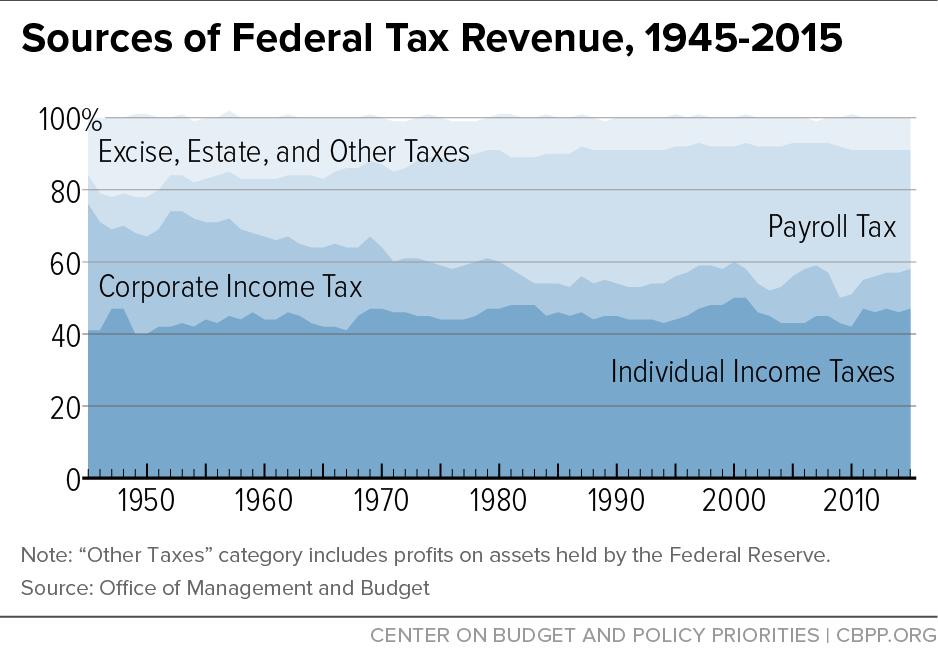
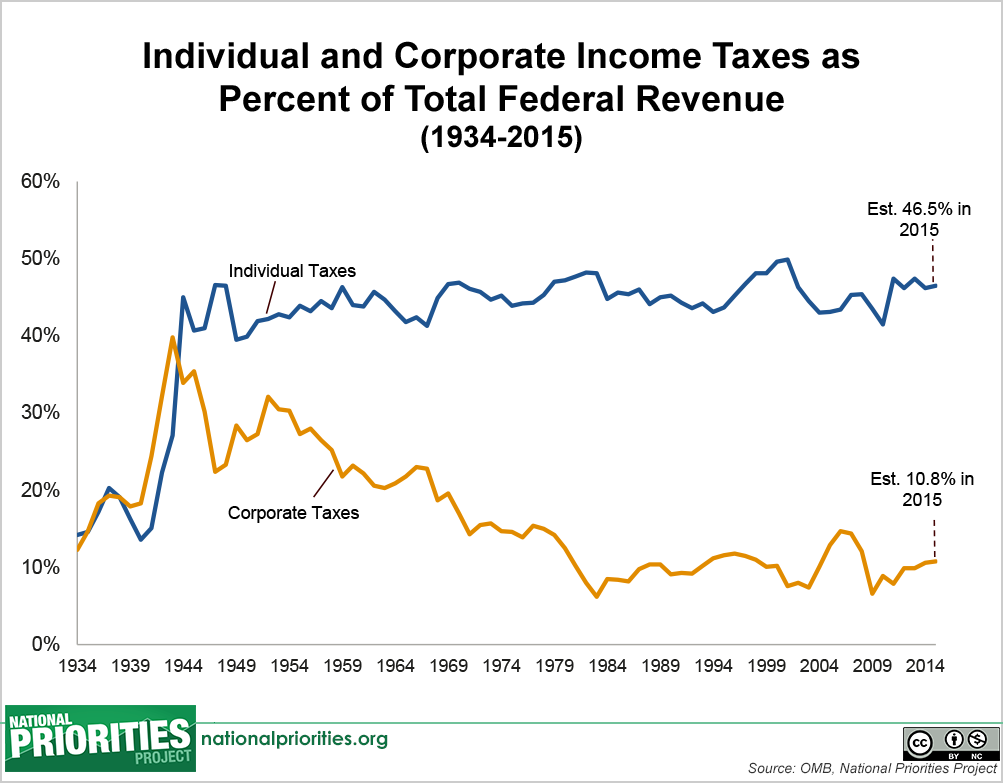
Corporate taxes as share of total tax revenue has dropped from about 45% post WWII to 11% despite our corporate growth in those seventy years while our personal income tax's share has increased slightly from 40% to 46%. Congress is full of people who would cut corporate tax rates to 15%.

3-4-16tax-policybasics-f2.png


sources-of-federal-tax-revenue-1945-2015


ind_and_corpo_tax_line_chart%2C_enacted_2015.png


When you get a chance,
The biggest loophole of all
Having launched and led the battle against offshore tax evasion, America is now part of the problem
(The Economist)

DEVIN NUNES raised eyebrows in 2013 when, as chairman of a congressional working group on tax, he urged reforms that would make America “the largest tax haven in human history”. Though he was thinking of America’s competitiveness rather than turning his country into a haven for dirty money, the words were surprising: America is better known for walloping tax-dodgers than welcoming them. Its assault on Swiss banks that aided tax evasion, launched in 2007, sparked a global revolution in financial transparency. Next year dozens of governments will start to exchange information on their banks’ clients automatically, rather than only when asked to. The tax-shy are being chased to the world’s farthest corners.

And yet something odd is happening: Mr Nunes’s wish may be coming true. America seems not to feel bound by the global rules being crafted as a result of its own war on tax-dodging. It is also failing to tackle the anonymous shell companies often used to hide money. The Tax Justice Network, a lobby group, calls the United States one of the world’s top three “secrecy jurisdictions”, behind Switzerland and Hong Kong. All this adds up to “another example of how the US has elevated exceptionalism to a constitutional principle,” says Richard Hay of Stikeman Elliott, a law firm. “Europe has been outfoxed.”
 
Last edited:

wizards8507

Well-known member
Messages
20,660
Reaction score
2,661
Congress is full of people who would cut corporate tax rates to 15%.
The corporate tax rate should be zero. A corporation is nothing more than a pass-through entity and all those taxes are ultimately borne by individuals anyways. That means employees, customers, and shareholders (i.e. pension and 401(k) holders). The people who are the most screwed by corporate taxes are the California Public Employees, California State Teachers, New York State Common Retirement Fund, New York City Retirement Fund, Florida State Board, etc.
 

Ndaccountant

Old Hoss
Messages
8,370
Reaction score
5,771
I agree that allowing Multinationals (MNCs), who used tax inversions and other tax schemes to avoid U.S. corporate income taxes of 35%, to repatriate that money at 14% (Obama), 10% (Trump's) or giving the MNCs a "tax holiday" as Congress did in 2004 at a 5% tax rate really sucks.

That's a quick solution to generating revenue and allowing MNCs to escape international pressures to collect their taxes, but benefiting only U.S. banks and the MNCs.

Corporate taxes as share of total tax revenue has dropped from about 45% post WWII to 11% despite our corporate growth in those seventy years while our personal income tax's share has increased slightly from 40% to 46%. Congress is full of people who would cut corporate tax rates to 15%.

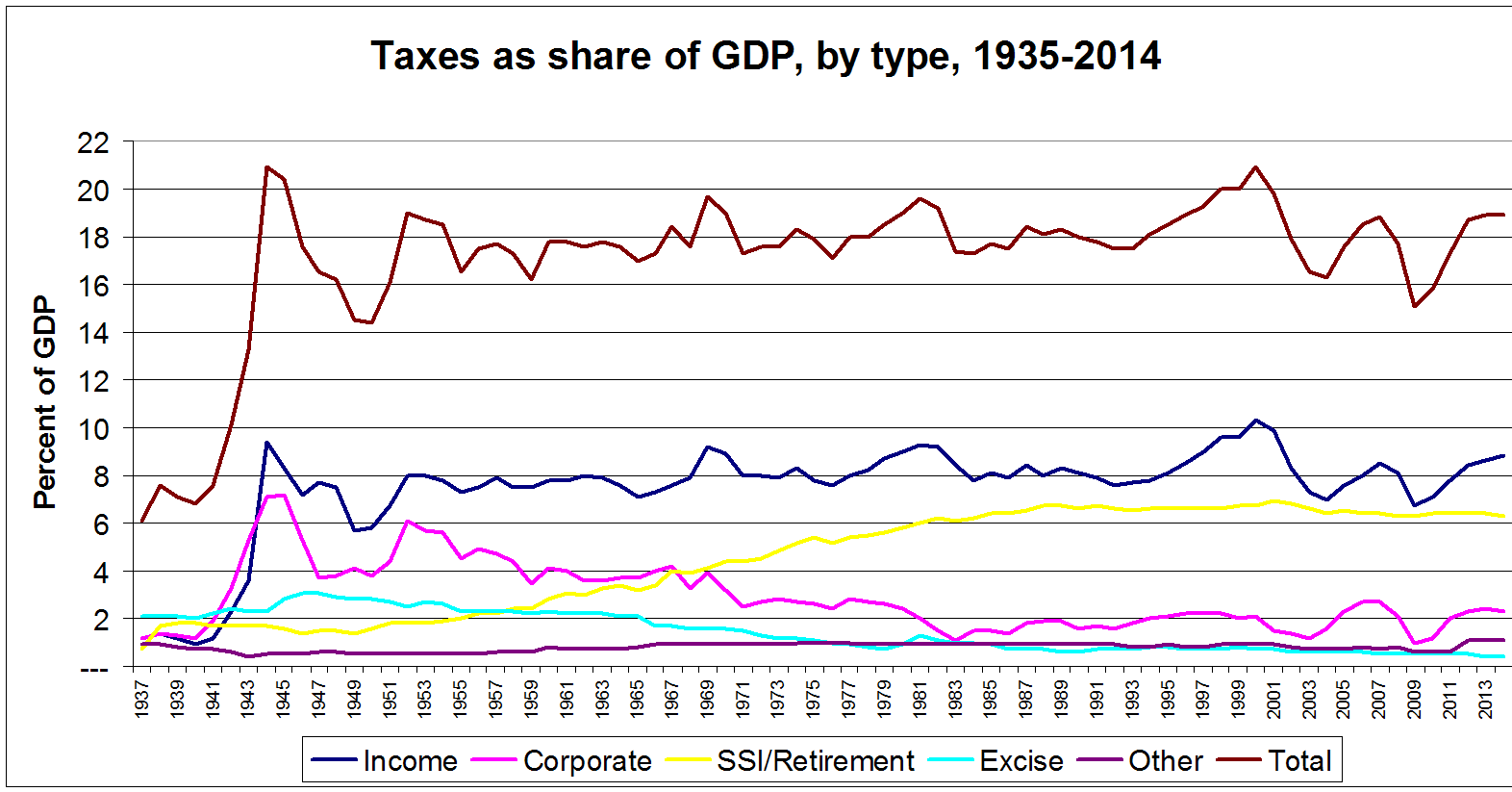
That last statistic is a bit misleading. In 1965 payroll taxes changed substantially with the creation of Medicare and the associated payroll tax. Today, payroll taxes account for ~35% of all federal revenue, where in 1950's it was less than 10%. Remember, payroll taxes are paid by both employer and employee. When taking that into consideration, you see something much different (see below). The fact of the matter is that corporate income taxes have been essentially flat for the last 30 years, when measuring it as a % of GDP.

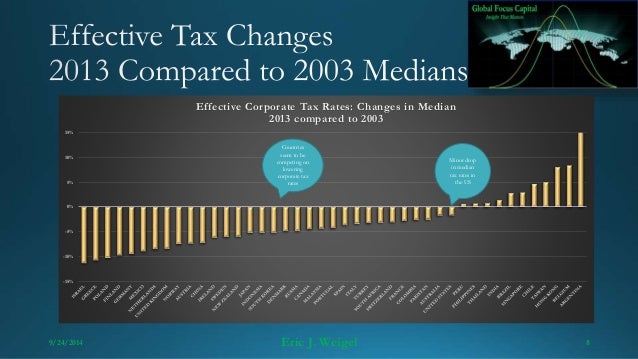
The problem of coarse is that corporations have options today like they never have before. So, the US may be lower than what they were 40 years ago or even 10 years ago for that matter. But it's all relative and as the image below shows, the US has lagged behind. Now, we can argue whether or not that is good for the world. But in the end, that is the playing field and the US can be in the game or on the sidelines. I personally think broadening the base and lowering the rate (including allowing deductions for foreign income taxes paid to help offset bringing that home) makes the most sense for everyone.

corporate-vs-employer-payroll-vs-combined-taxes-as-percent-share-of-gdp-1960-2010.png


taxes+share+gdp.PNG


effective-corporate-tax-rates-a-global-comparison-8-638.jpg
 

Legacy

New member
Messages
7,871
Reaction score
321
The corporate tax rate should be zero. A corporation is nothing more than a pass-through entity and all those taxes are ultimately borne by individuals anyways. That means employees, customers, and shareholders (i.e. pension and 401(k) holders). The people who are the most screwed by corporate taxes are the California Public Employees, California State Teachers, New York State Common Retirement Fund, New York City Retirement Fund, Florida State Board, etc.

That would leave Congress without $500 billion in revenue. Over the next decade...(Amount of Revenue by Source)

Interest on the current federal debt now costs each Americans $16,000. Would you raise personal income taxes, borrow more money, slash military spending, trash Social Security and Medicare?

Corporate_Income_Tax_as_a_Share_of_GDP%2C_1946_-_2009.png
 

wizards8507

Well-known member
Messages
20,660
Reaction score
2,661
That would leave Congress without $500 billion in revenue. Over the next decade...(Amount of Revenue by Source)

Interest on the current federal debt now costs each Americans $16,000.

Corporate_Income_Tax_as_a_Share_of_GDP%2C_1946_-_2009.png
I'd like to reach a point where "federal spending as a percentage of GDP" follows a similar trend. There's no reason why we need more military, social security, Medicare, or infrastructure spending to go along with increased GDP. The trendline should be negative. As GDP increases, so does prosperity. As prosperity increases, government spending should decrease at least in relative terms if not absolute terms. With more prosperity and less spending, there's no problem with decreased revenue (again, in relative terms if not absolute terms).

Would you raise personal income taxes
I would accept that as a compromise to eliminate the corporate income tax. The problem with the corporate income tax is that most people don't understand it. Lots of people honestly don't understand what a "corporation" even is, and in their mind they have a vague notion that it's a tax on CEOs and other executives. By eliminating the corporate income tax and raising the individual rates, it would at least give the average citizen a more realistic frame of reference in which to discuss (and vote on) the issue.

...borrow more money...
No.

...slash military spending...
Yes.

...trash Social Security and Medicare?
I prefer "reform," but yes.
 
Last edited:

Legacy

New member
Messages
7,871
Reaction score
321
I'd like to reach a point where "federal spending as a percentage of GDP" follows a similar trend. There's no reason why we need more military, social security, Medicare, or infrastructure spending to go along with increased GDP. The trendline should be negative. As GDP increases, so does prosperity. As prosperity increases, government spending should decrease at least in relative terms if not absolute terms. With more prosperity and less spending, there's no problem with decreased revenue (again, in relative terms if not absolute terms).


I would accept that as a compromise to eliminate the corporate income tax. The problem with the corporate income tax is that most people don't understand it. Lots of people honestly don't understand what a "corporation" even is, and in their mind they have a vague notion that it's a tax on CEOs and other executives. By eliminating the corporate income tax and raising the individual rates, it would at least give the average citizen a more realistic frame of reference in which to discuss (and vote on) the issue.

A few considerations:
- 45% of Americans pay no personal income tax. You would raise rates on the other 55% to eliminate corporate income taxes?

- How do you stimulate personal growth, prosperity and encourage upward mobility by raising personal taxes?

- Would you retain tax breaks that allow CEOs to lower or eliminate their taxes or have them pay a minimum flat tax of 15%?

- America is a consumer driven economy. Raising personal income taxes on the 55% of us who do pay taxes would be counter-productive.

- Eliminating corporate taxes would decrease federal revenue by $5 trillion over the next decade, if my calculations are correct. How much would the average tax-paying American see his taxes go up, if spending remained the same? Or military spending be slashed?
 
Last edited:
Top