Airstrikes

palinurus

New member
Messages
2,406
Reaction score
192
You don't think religion is playing a huge part in ISIS' existence and growth?

Regardless of a particular religion being correct, the world history of religions is largely one of endless bloodshed.

This an overbroad statement. You are taking a history with a lot of aspects and reducing it to violence done in the names of those religions. And it's more true of some religions than others, and is more true at some times than other. And it's mushing together immoral things done in the name of religion and religion itself.

The level of violence done in the name of religion depends on the religion itself and the interpretation of it. For example, Christianity, properly understood, in my opinion, would lead to intended bloodshed of only those who threaten freedom and peace. Not to say it's always been used that way, but I'd never say that "the world history of Christianity is largely one of endless bloodshed." That ignores way too much.

ps -- I do agree with your ISIS statement, though.
 

IrishLion

I am Beyonce, always.
Staff member
Messages
19,127
Reaction score
11,073
I think this is pretty stupid. Do we think there are no satellites or televisions in the middle east. Nothing like sending an announcement to the enemy, "Now is a good time to get away from any sites that might be targeted!"

That was my mistake, the video was not a live feed of missiles being launched. It was a 15 second clip of a missile launching from a ship and trailing into the sky that was put on a loop, and only after the airstrikes concluded (if the timeline I saw is correct).
 

ginman

shut your pie hole leppy
Messages
643
Reaction score
166
That was my mistake, the video was not a live feed of missiles being launched. It was a 15 second clip of a missile launching from a ship and trailing into the sky that was put on a loop, and only after the airstrikes concluded (if the timeline I saw is correct).

Thanks- that makes more sense
 

palinurus

New member
Messages
2,406
Reaction score
192
I do believe there is a benefit to us here to attacking ISIS over there. Sure, we're never completely safe here as long as this ideology is rampant, but there have been times since 9/11 when threats have been lower here and higher here. They were lower when we were going full tilt in Iraq and Afghanistan; they became and are) higher when we pulled out and the president presented a desire to recede from the successes of Iraq.

I prefer to kill some of them there, rather than leave them the opportunity to plan to come here and kill us there. Those are not exclusive, but it stands to reason, more dead terrorists over there, is fewer terrorists to come here.

As far as boots on the ground, I don't really want that, but I don't hear a lot of people who I respect telling us we can be successful there without some of that. As much as I hate to do it..... This is an evil ideology and it has to be opposed, and that's a multi-faceted effort. And it's sure true we can't do it without the support of those nearest to it in the Mideast. But we also can't sit around and wait from them to act. Most won't.

Finally, I agree Saddam was worse than ISIS in his capacity for achieving evil; I think ISIS is worse in it's desire to achieve terrorist evil that directly affects us; that is a matter of capacity. I think they're both evil.
 
B

Buster Bluth

Guest
This an overbroad statement. You are taking a history with a lot of aspects and reducing it to violence done in the names of those religions. And it's more true of some religions than others, and is more true at some times than other. And it's mushing together immoral things done in the name of religion and religion itself.

The level of violence done in the name of religion depends on the religion itself and the interpretation of it. For example, Christianity, properly understood, in my opinion, would lead to intended bloodshed of only those who threaten freedom and peace. Not to say it's always been used that way, but I'd never say that "the world history of Christianity is largely one of endless bloodshed." That ignores way too much.

ps -- I do agree with your ISIS statement, though.

The old "doesn't count, that's not what I believe; someone is twisting the religious concepts" remark. I think that's largely irrelevant, the history of the US must include atrocities (eg slavery, Tuskegee Experiment, Japanese Interment, etc), even when they are obviously incongruent with American values.

When someone kills someone in the name of a religion, that's an effect of the religion. A side effect, some might say, but I don't believe in side effects.

I will amend my statement, which was too broad. The history of the Abrahamic (is that a term?) religions is largely one of bloodshed. I only say that because I don't know jack about Eastern religions.
 
Last edited:
C

Cackalacky

Guest
Whiskeyjack provided this input in the "Politics" thread which I think everyone should toss around a bit. I don't think that I agree that it is entirely a myth, but the undeniable association of religion with the formation and operation of states in any form is quite obvious.
You might be interested in a book called "The Myth of Religious Violence: Secular Ideology and the Roots of Modern Conflict." The author, William Cavanaugh, currently teaches at DePaul, but he's an ND alum and has deep ties to the University. Here's a review from Bleeding Heart Libertarians (which is a great blog in its own right):

Calm down. You might like this post.

I’ve just finishing reading William Cavanaugh’s very bold and challenging new book, The Myth of Religious Violence. For Cavanaugh, the myth of religious violence, roughly, is “the idea that religion has a dangerous tendency to promote violence.” Against this claim, Cavauangh makes three core claims:
There is no transhistorical and transcultural essence of religion. What counts as religious or secular in any given context is a function of political configurations of power.
Such a transhistorical and transcultural concept of religion as non-rational and prone to violence is one of the foundational legitimating myths of Western society.
This myth can be and is used to legitimate neo-colonial violence against non-Western others, particularly the Muslim world.

I think Cavanaugh’s arguments should be of great interest to libertarians, but let me explain the view first before I say why.

First, Cavanaugh does not deny that religious motives often lead to violence. Instead, again, he denies that there is any adequate social scientific definition of religion that is sufficiently transhistorical and universal to sustain the thesis that religion is somehow a unique cause of violence. Many of you will find this point at least a bit familiar from libertarian debates about whether Marxism is a religion (or Objectivism for that matter). The question is whether we even have a family resemblance notion of religion that includes Christianity, Judaism, Islam, Buddhism, Confucianism, Daoism, Hinduism, Shintoism and various ancestral religions which also excludes political ideologies like secular nationalism.

Cavanaugh analyzes – at great length – several attempts to defend the myth of religious violence and carefully deconstructs the definitions of religion at work in each case. For a historian, Cavanaugh is an exceptional logic-chopper. While reading the book, I often found myself forgetting that I wasn’t reading analytic philosophy.

Importantly, Cavanaugh is a theologically orthodox Roman Catholic and somewhat sympathetic to Catholic strains of socialist anarchism, like Dorothy Day. (See his talk criticizing Milton Friedman and defending that old an-soc saw, Mondragon). So his perspective as a critic of the modern liberal state is one that I suspect even very secular libertarians, who might otherwise believe the myth of religious violence, can at least appreciate.

The second chapter of the book argues that the very concept of “religion” as a generic category was a social and political invention that historically served to separate the stuff that power elites liked from stuff they didn’t like. The “secular” became the universal, the rational, the peaceful and, critically, the power and violence justifying. The “religious” became the private, the irrational, the dangerous and, critically, the stuff that could never justify power and violence.

Perhaps the most interesting chapter is Chapter 3, which argues that the “wars of religion” were not about religion as distinct phenomena in the West from politics, economics and other social domains. The Thirty Years War was about a great many things, for instance, and concluded with battles between Catholic France and Catholic Hapsburgs.

What the myth of religious violence does, Cavanaugh claims, is sanctify and justify the violence endemic and characteristic of the liberal democratic nation-state. Liberals since Locke have presented the liberal state as a solution to violent religious conflict. But Cavanaugh argues that the liberal state was not the early modern solution to religious wars. Instead, power grabs by monarchist absolutists were a critical cause of the “wars of religion.”

Cavanaugh argues that a review of historical scholarship of wars in 16th century Europe shows that many violent conflicts were caused by the project of European state building by attempting to collect taxes from an unwilling populace. He claims, interestingly, that this view has gained general acceptance among historians of the period. I like this line: “the rise of the state was one of the principal causes of the wars. The so-called wars of religion were the birth pangs of the state, not simply the crisis which required the state to step in as savior.”

So, the myth of religious violence serves to obscure that fact and incline us to relax in the presence of a dangerous concentration of power, namely the liberal state and the secular nationalism that socially sustains it.

Perhaps most importantly for present-day politics, the myth of religious violence is used to justify American imperialism in Muslim nations. Cavanaugh reviews works by Sam Harris, Chris Hitchens, Paul Berman and Andrew Sullivan, who claim that the Muslim obsession with irrational theocracy is a reason they cannot be reasoned with, but must be the subject of rational, modest liberal military violence. The myth of religious violence is thus used to justify military violence by distracting us from the dangerous violence of the liberal state and convincing us, tacitly, that Muslims in Iran, Iraq, etc. could have no rational grievance with the US government. As Cavanaugh writes:

Quote:
Their violence—being tainted by religion—is uncontrolled, absolutist, fanatical, irrational, and divisive. Our violence—being secular—is controlled, modest, rational, beneficial, peace-making, and sometimes regrettably necessary to contain their violence.
Consider a line from Sam Harris’s The End of Faith about Muslims:

Quote:
Certain beliefs place their adherents beyond the reach of every peaceful means of persuasion, while inspiring them to commit acts of extraordinary violence against others. There is, in fact, no talking to some people. If they cannot be captured, and they often cannot; otherwise tolerant people may be justified in killing them in self-defense.
Or Hitchens’s attitude towards Muslim terrorists:

Quote:
We can’t live on the same planet as them, and I’m glad because I don’t want to. I don’t want to breathe the same air as these psychopaths and murders [sic] and rapists and torturers and child abusers. It’s them or me. I’m very happy about this because I know it will be them. It’s a duty and a responsibility to defeat them. But it’s also a pleasure. I don’t regard it as a grim task at all.
Note the role of the myth of religious violence here: it makes Muslims an incomprehensible alien species that cannot only be handled with the power of the liberal state. Their violence is irrational. It has no rational source. Were the violence to come from non-religious actors, Hitchens would almost certainly have given a more sober analysis. Instead, he said the following: “Cluster bombs are perhaps not good in themselves, but when they are dropped on identifiable concentrations of Taliban troops, they do have a heartening effect.” In God is Not Great, Hitchens repeatedly blames religion for violence – religion kills – but as Cavanaugh says, “The problem with religion is that it kills for the wrong reasons. Killing for the right reasons can be not only justifiable but pleasing.”

Cavanaugh’s conclusion is this:

Quote:
The myth of religious violence should finally be seen for what it is: an important part of the folklore of Western societies. It does not identify any facts about the world, but rather authorizes certain arrangements of power in the modern West. It is a story of salvation from mortal peril by the creation of the secular nation-state.
What are the advantages of abandoning the myth? Several: (1) it would free valuable empirical work on the nature of violence and its connection to ideological systems from bad scientific categories, (2) it would help us see that “Western-style secularism is a contingent and local set of social arrangements and not the universal solution to the universal problem of religion.” (3) It would rid the West of “one significant obstacle to understanding the non-Western, especially Muslim, world.” (4) It would “help to eliminate one of the justifications for military action against religious actors.” And finally: (5) It would aid in ridding Americans of ‘one of the principal obstacles to having any serious public dialogue over the causes of opposition to U.S. policies abroad.”

I figure libertarians will like (2), (4) and (5). So I recommend engaging Cavanaugh’s work.

The book will cause cognitive dissonance for secular libertarians. You typically want to both demystify the liberal state and adopt the myth of religious violence. Cavanaugh isn’t saying you can’t do both. However, given that many secular libertarians believe the myth of religious violence, Cavanaugh’s work will challenge you to revise this belief. While you may want to resist, at least becoming aware of a significant challenge to the myth of religious violence will help you see past one more rationale for irresponsible state power.

If you don’t have time to read the book, go here to see Cavanaugh talk about them
 
Last edited:

palinurus

New member
Messages
2,406
Reaction score
192
The old "doesn't count, that's not what I believe; someone is twisting the religious concepts" remark. I think that's largely irrelevant, the history of the US must include atrocities (eg slavery, Tuskegee Experiment, Japanese Interment, etc), even when they are obviously incongruent with American values.

When someone kills someone in the name of a religion, that's an effect of the religion. A side effect, some might say, but I don't believe in side effects.

I will amend my statement, which was too broad. The history of the Abrahamic (is that a term?) religions is largely one of bloodshed. I only say that because I don't know jack about Eastern religions.


This is a strawman. It is not an issue of "what I believe." It's an issue of what the religion is and/or holds and teaches.
 
B

Buster Bluth

Guest
This is a strawman. It is not an issue of "what I believe." It's an issue of what the religion is and/or holds and teaches.
And religious teachings are the most malleable thing on the planet, which goes right back to the point of atrocities committed under the religion count whether one deems them legitimate within the religion or not.
 

GO IRISH!!!

Nashville Livin'!
Messages
3,695
Reaction score
428
My problem with this whole situation has nothing to do with whether or not ISIL needs to get got or about whether or not my god is better than their god. I am more concerned with what happens when the Assad regime is toppled. And it WILL be toppled. I firmly believe that is part of the agenda.

We are putting arms in the hands of the rebels who will supposedly fight ISIL, but they are also fighting Assad. ISIL is also fighting Assad. So, at least in some instances, this will be a "the enemy of my enemy" argument and the rebels will be fighting with the same agenda as ISIL against Assad.

Once the Assad regime is taken out, that will leave quite a gaping hole in that region and we have no idea who will win that fight. Who knows if the rebels will continue to fight ISIL or if they will just continue to consolidate their forces with our guns and rockets in their hands.

As terrible as Assad is, I am not sure I like the alternatives either. This situation is going to get much, much worse before it gets any better.

ISIL is here in our country right now. Make no mistake about it. They may not be hiding under every bed as someone else quipped above, but they are definitely here and also in the other countries of our allies as well. With our borders being so open right now, they can just walk across. They are also actively recruiting in the U.S. which is terrifying to me.

I don't know what the answers are, but if attacks start happening here, I think we are going to see this country shaken like we have never seen before.
 

no.1IrishFan

Well-known member
Messages
6,279
Reaction score
421
This is a strawman. It is not an issue of "what I believe." It's an issue of what the religion is and/or holds and teaches.

If anyone, evenly closely followed the Bible in the way it actually instructs us to live, they'd be thrown in jail.
 

palinurus

New member
Messages
2,406
Reaction score
192
And religious teachings are the most malleable thing on the planet, which goes right back to the point of atrocities committed under the religion count whether one deems them legitimate within the religion or not.

Okay, sure, anyone can argue anything. But that's not the same as saying that, because the actor claims to be acting under the tenets of his religious faith, he is acting under the tenets of his religious faith.

I can say my Catholic religion, which teaches Christian mercy, permits me (maybe even, I might say, requires me) to kill my elderly mother because it's merciful and charitable to put her out of her senility, but that's not really what the Church teaches about mercy, no matter how malleable I want to argue the teaching is. My arguing it, doesn't make my crime the fault of the Catholic Church.

My definition of what "counts" begins with "is that really what the teachings of the religion in question admit or require?" That may be debatable -- apparently, it's really debatable among muslims -- but it is not "just anything." If it is, then all actions are the result of religion, depending on how I define "religion." And if everyone is all star, then no one's an all star.

Anyway, no desire to go around and around. I think we just disagree on what religion should get blamed for.
 
Last edited:

Veritate Duce Progredi

A man gotta have a code
Messages
9,358
Reaction score
5,352
Flipped the script? Are you 15?

Where did I advocate for oppressing people?
How does anything I've said come across as an attempt to start some new religion?

My age isn't important but I'd be interested in what other terms you ascribe to 15 year olds. Are you 80+?

You believe you have it figured out (just a bunch of silly monkeys looking for god). What does any religion purport? To know "the way"?

You don't think religion is playing a huge part in ISIS' existence and growth?

Regardless of a particular religion being correct, the world history of religions is largely one of endless bloodshed.

I'm not advocating for a religion being correct but I could just as easily surmise that the history of religions is that of helping the oppressed and poor. It's about the creation of hospitals and tending to the sick when there was no money involved.

It seems a bit simplistic, perhaps even shortsighted to believe all fighting comes from 'relgiion'.

The old "doesn't count, that's not what I believe; someone is twisting the religious concepts" remark. I think that's largely irrelevant, the history of the US must include atrocities (eg slavery, Tuskegee Experiment, Japanese Interment, etc), even when they are obviously incongruent with American values.

When someone kills someone in the name of a religion, that's an effect of the religion. A side effect, some might say, but I don't believe in side effects.

I will amend my statement, which was too broad. The history of the Abrahamic (is that a term?) religions is largely one of bloodshed. I only say that because I don't know jack about Eastern religions.

The old "anything tangentially related to religion is automatically included, you don't get to draw the line" remark.

You don't believe in side effects? I'd be interested in hearing more about this. I imagine it's some unique twist on everything is a derivative of something before it, so all effects have a cause?
 

Whiskeyjack

Mittens Margaritas Ante Porcos
Staff member
Messages
20,894
Reaction score
8,126
The Russian flag is not flying over vast amounts of the area..........

Nor is it flying over most of the post-Soviet bloc. To be clear, I wasn't criticizing our policy toward the ME during the Cold War.

Oil & gas !

There's likely some truth to that, but we're much less reliant on Arab oil than we used to be. I'd attribute most of it to the out-sized influence of a few ME client states who have grown much too accustomed to using the US as their hired muscle. And our corrupt politicians are always happy to indulge them, despite the fact that there's virtually no benefit for the American people involved.

Regardless of a particular religion being correct, world history is largely one of endless bloodshed.

FTFY

See Cacky's/my post above regarding The Myth of Religious Violence. Some choice bits:

First, Cavanaugh does not deny that religious motives often lead to violence. Instead, again, he denies that there is any adequate social scientific definition of religion that is sufficiently transhistorical and universal to sustain the thesis that religion is somehow a unique cause of violence.

Perhaps the most interesting chapter is Chapter 3, which argues that the “wars of religion” were not about religion as distinct phenomena in the West from politics, economics and other social domains. The Thirty Years War was about a great many things, for instance, and concluded with battles between Catholic France and Catholic Hapsburgs.

Similarly, the current conflicts in Syria and Iraq are about a great many things. Anyone who claims that they can be simplified down to something like "religion" is selling something.

Perhaps most importantly for present-day politics, the myth of religious violence is used to justify American imperialism in Muslim nations. Cavanaugh reviews works by Sam Harris, Chris Hitchens, Paul Berman and Andrew Sullivan, who claim that the Muslim obsession with irrational theocracy is a reason they cannot be reasoned with, but must be the subject of rational, modest liberal military violence. The myth of religious violence is thus used to justify military violence by distracting us from the dangerous violence of the liberal state and convincing us, tacitly, that Muslims in Iran, Iraq, etc. could have no rational grievance with the US government.

How ironic that two of IE's most aggressive secularists are attempting to paint Islamists as a dangerous alien "Other" that must be eradicated with extreme prejudice.
 
Last edited:

Whiskeyjack

Mittens Margaritas Ante Porcos
Staff member
Messages
20,894
Reaction score
8,126
TAC's Scott McConnell just published an article titled "Obama Bombs Blind":

By bombing ISIS units in Syria, the United States has turned a new page in its long-running conflict with the Arab world. I share the pessimism of those who predict the bombing won’t work, in which case this president or the next will come under intense pressure to commit ground troops in order to avoid a humiliating defeat. American allies in the region, who might be expected to contribute ground troops to the fight, have all refused—though jet planes from “several Arab allies” did strike targets in Syria. Presumably that’s an improvement over the Iraq invasion: the regional disdain for “Operation Iraqi Freedom” was perhaps best captured in a priceless scene from Oliver Stone’s “W.”, in which the Condoleeza Rice character tells the President that Morocco has promised to contribute thousands of monkeys to aid the American war effort.

Nathan Brown’s article in Monday’s Washington Post conveys a sense of the region’s ideological and political complexity in a period of great flux and despair—and how little it is understood in Washington. But armed with our ignorance, we are embarking on a multi-billion dollar campaign that will kill thousands of people—most of them, quite innocent—for reasons we have not thought through at all. Indeed, there seems to be something like an official government policy on not asking too many questions. For instance, we all seem to understand the thread leading from 9/11 to the Iraq invasion, to the creation of ISIS from the remnants of Saddam’s army. But where does the thread actually begin?

I recently read The Eleventh Day, a gripping book by Anthony Summers and Robbyn Swann on the 9/11 attacks. It’s a detailed account of what happened that day, based on painstaking analysis of the known record, including hundreds of interviews carried out by the authors and others. (For what it’s worth, it’s not a “truther”-friendly book.) One point which emerges very powerfully is the many layers of interaction between our Mideast ally Saudi Arabia and bin Laden, al-Qaeda, and the 9/11 hijackers. A substantial part of the Saudi ruling family is “bin Ladenist”—perhaps not surprising for a group with piles of money and no responsibility, almost invariably a recipe for bad behavior. Not only were most of the hijackers Saudis, but Bin Laden raised most of his money through Saudi charities and individuals. These observations are included in the publicly released 9/11 Commission report. Not included are some more specific points, including facts which raise the possibility that two of the hijackers were in rather more direct contact with and given substantial assistance by officials affiliated with the Saudi embassy. Many of the loose threads are gathered up and detailed in a 28-page segment of the 9/11 Commission report.

Curiously, President Bush ordered those 28 pages classified, so that no one without extremely rare security clearances could read them. Former Senator Bob Graham of Florida is one person who has read them, and who then pressed hard for deeper investigation of the Saudi role. Said Graham, pondering Bush’s role in keeping the Saudi information under wraps: “It’s as if the President’s loyalty lay more with Saudi Arabia than with America’s safety.” Obama promised to release the classified material shortly after his inauguration, but has not done so. One official who read the classified material is quoted by Summers and Swann: “If the twenty-eight pages were to be made public, I have no question that the entire relationship with Saudi Arabia would change overnight.”

There is a presently a House bill to declassify the 28 pages, introduced by Walter Jones and Stephen Lynch; it is bipartisan and now has 17 cosponsors. Perhaps the ISIS crisis will generate some curiosity about what those pages say.

The boots on the ground component of Obama’s anti-ISIS campaign involves the training of “vetted” Syrian rebels in Saudi Arabia. Clearly the Saudis are playing a complicated game—training the anti-ISIS rebels, perhaps out of fear that their own population might be attracted by ISIS. Is it possible, or likely, that Saudi princes have been helping to finance ISIS? It would be hard to see why not. But while Americans know the crux of the president’s current anti-ISIS strategy involves close cooperation with the Saudi regime, might they also ask whether this involves cooperation with Saudis whom some (those who have seen the classified report) believe were engaged in financing and assisting the 9/11 hijackers? That’s what this administration, like the last one, doesn’t want you to speculate about.

The famous Founding Fathers’ warnings against entangling alliances are often considered pertinent for America’s ties to Israel, and of course they are: one point Summers and Swann make is that all of Saudi Arabia—from the top government ministers to the 9/11 hijackers—was enraged and repulsed by Israel’s treatment of the Palestinians and America’s complicity in it. (This fact was considered but watered down in the 9/11 official report, out of fear that it might cause some to question the value of the “special relationship” with Israel.) But it seems obvious that a Saudi “special relationship” may be just as detrimental to America’s real interests. In any case, it should be up for discussion. For starters, before we bomb anyone, let’s unclassify the 28 pages of the 9/11 report, and discuss the nature of our ties to Saudi Arabia. Then we can decide how much to rely on Saudi Arabia as our principle Muslim ally in combatting ISIS.

Or perhaps we should just go ahead and bomb first, then ask questions about who or why later. The Obama administration has already made its choice.
 
Last edited:

T Town Tommy

Alabama Bag Man
Messages
6,278
Reaction score
2,768
The bombing campaign has as much to do with the upcoming mid term elections as the "immenent" threat ISIS poses to the US.

Obama was talked in to it, more from members of his own party facing tough mid terms, than from the usual list of war mongering suspects like L. Graham and McCain.

We still have to deal with ISIS, and if it takes killing them to do it, then so be it. I would rather fight them there than here, but I would rather have a coherent plan on how to go about doing it. Right now, what I see is a President that has thought out how to try and salvage his political future by somehow retaining the Senate. It's a plan... not likely feasible... but damnit... it's a plan.
 
B

Buster Bluth

Guest
I 110% agree with that article Whiskey. The other stuff will get a response when I have time.

Right now, what I see is a President that has thought out how to try and salvage his political future by somehow retaining the Senate. It's a plan... not likely feasible... but damnit... it's a plan.

I see an administration using American air power as a bargaining chip to encourage Arabs to get their act together.
 

T Town Tommy

Alabama Bag Man
Messages
6,278
Reaction score
2,768
I 110% agree with that article Whiskey. The other stuff will get a response when I have time.


I see an administration using American air power as a bargaining chip to encourage Arabs to get their act together.

How's that working out? About like the mid terms.
 

Whiskeyjack

Mittens Margaritas Ante Porcos
Staff member
Messages
20,894
Reaction score
8,126
We still have to deal with ISIS, and if it takes killing them to do it, then so be it. I would rather fight them there than here, but I would rather have a coherent plan on how to go about doing it. Right now, what I see is a President that has thought out how to try and salvage his political future by somehow retaining the Senate. It's a plan... not likely feasible... but damnit... it's a plan.

Someone will have to deal with ISIS, but our involvement is far from necessary. We're far down the list of nations threatened by a small violent group of Islamists aspiring to regional control.

But you're likely correct that cynical domestic politics factored significantly in the timing of this new war. Everyone wants to look tough. Why isn't there a constituency for saving money and lives by not engaging in needless wars of choice?
 

kmoose

Banned
Messages
10,298
Reaction score
1,181
Someone will have to deal with ISIS, but our involvement is far from necessary. We're far down the list of nations threatened by a small violent group of Islamists aspiring to regional control.

As a nation, America's existence is not threatened by Islamic fanatics. However, as individuals, Americans are the preferred target of those same groups. America is, after all, The Great Satan. Striking blows against the Great Satan is the quickest path to respect in the Middle East. With that respect comes money and power; the two greatest vices of all men.
 

ACamp1900

Counting my ‘bet against ND’ winnings
Messages
48,944
Reaction score
11,225
As a nation, America's existence is not threatened by Islamic fanatics. However, as individuals, Americans are the preferred target of those same groups. America is, after all, The Great Satan. Striking blows against the Great Satan is the quickest path to respect in the Middle East. With that respect comes money and power; the two greatest vices of all men.

Oh Really???..

miami-vice-13-jpg.177
 
C

Cackalacky

Guest
Someone will have to deal with ISIS, but our involvement is far from necessary. We're far down the list of nations threatened by a small violent group of Islamists aspiring to regional control.

But you're likely correct that cynical domestic politics factored significantly in the timing of this new war. Everyone wants to look tough. Why isn't there a constituency for saving money and lives by not engaging in needless wars of choice?

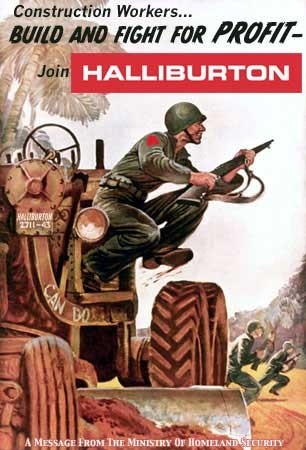
halliburton3.jpg
 

Ndaccountant

Old Hoss
Messages
8,370
Reaction score
5,771
Someone will have to deal with ISIS, but our involvement is far from necessary. We're far down the list of nations threatened by a small violent group of Islamists aspiring to regional control.

But you're likely correct that cynical domestic politics factored significantly in the timing of this new war. Everyone wants to look tough. Why isn't there a constituency for saving money and lives by not engaging in needless wars of choice?

Why????

JMO, but b/c everyone believes, whether right or wrong, that at a moments notice an average looking Joe sitting next to them can blow himself up. The odds of something like that occurring means nothing when people turn on the TV and see a bombing during the Boston Marathon or a story on how a ex-NC cop became a fanatical Muslim. The reminders are there and the focus and blame is often put on Muslims.

If people in Washington can't stand up and admit white lies b/c it will be plastered across media for two days, trying being the first person to stand up and proclaim fighting a radical group in the ME isn't worth it (especially after the youtube beheadings). It's emotional and it strikes the publics core feeling of security.

Here is an interesting read if you have a moment:
https://www.schneier.com/essays/archives/2008/01/the_psychology_of_se.html
 

greyhammer90

the drunk piano player
Messages
16,820
Reaction score
16,080
Why????

JMO, but b/c everyone believes, whether right or wrong, that at a moments notice an average looking Joe sitting next to them can blow himself up. The odds of something like that occurring means nothing when people turn on the TV and see a bombing during the Boston Marathon or a story on how a ex-NC cop became a fanatical Muslim. The reminders are there and the focus and blame is often put on Muslims.

If people in Washington can't stand up and admit white lies b/c it will be plastered across media for two days, trying being the first person to stand up and proclaim fighting a radical group in the ME isn't worth it (especially after the youtube beheadings). It's emotional and it strikes the publics core feeling of security.

Here is an interesting read if you have a moment:
https://www.schneier.com/essays/archives/2008/01/the_psychology_of_se.html

Your avatar is very appropriate for this discussion.
 

kmoose

Banned
Messages
10,298
Reaction score
1,181
Right now, what I see is a President that has thought out how to try and salvage his political future

What political future? He's the f'in President! It's not like he can move on to a bigger office, like Pope...
 
M

Me2SouthBend

Guest
What political future? He's the f'in President! It's not like he can move on to a bigger office, like Pope...

I'm quite sure there are those that believe he'll change the laws to give himself an opportunity to run for a 3rd term. They may be wearing tinfoil hats, but they are indeed out there.
 

Wild Bill

Well-known member
Messages
5,518
Reaction score
3,260
My problem with this whole situation has nothing to do with whether or not ISIL needs to get got or about whether or not my god is better than their god. I am more concerned with what happens when the Assad regime is toppled. And it WILL be toppled. I firmly believe that is part of the agenda.

We are putting arms in the hands of the rebels who will supposedly fight ISIL, but they are also fighting Assad. ISIL is also fighting Assad. So, at least in some instances, this will be a "the enemy of my enemy" argument and the rebels will be fighting with the same agenda as ISIL against Assad.

Once the Assad regime is taken out, that will leave quite a gaping hole in that region and we have no idea who will win that fight. Who knows if the rebels will continue to fight ISIL or if they will just continue to consolidate their forces with our guns and rockets in their hands.

As terrible as Assad is, I am not sure I like the alternatives either. This situation is going to get much, much worse before it gets any better.


ISIL is here in our country right now. Make no mistake about it. They may not be hiding under every bed as someone else quipped above, but they are definitely here and also in the other countries of our allies as well. With our borders being so open right now, they can just walk across. They are also actively recruiting in the U.S. which is terrifying to me.

I don't know what the answers are, but if attacks start happening here, I think we are going to see this country shaken like we have never seen before.

Agree. This has disaster written all over it.
 

Whiskeyjack

Mittens Margaritas Ante Porcos
Staff member
Messages
20,894
Reaction score
8,126
My problem with this whole situation has nothing to do with whether or not ISIL needs to get got or about whether or not my god is better than their god. I am more concerned with what happens when the Assad regime is toppled. And it WILL be toppled. I firmly believe that is part of the agenda.

We are putting arms in the hands of the rebels who will supposedly fight ISIL, but they are also fighting Assad. ISIL is also fighting Assad. So, at least in some instances, this will be a "the enemy of my enemy" argument and the rebels will be fighting with the same agenda as ISIL against Assad.

Once the Assad regime is taken out, that will leave quite a gaping hole in that region and we have no idea who will win that fight. Who knows if the rebels will continue to fight ISIL or if they will just continue to consolidate their forces with our guns and rockets in their hands.

As terrible as Assad is, I am not sure I like the alternatives either. This situation is going to get much, much worse before it gets any better.

I missed this post originally, and only saw it after Bill quoted it. Agreed completely with the above. Hussein and Qaddafi were both brutal dictators, but no one in Washington bothered to wonder what would fill the power vacuum in their absence. Ironically, Dick Cheney had this to say in 1993 about why the US didn't depose Hussein during the Gulf War:

If we'd gone to Baghdad we would have been all alone. There wouldn't have been anyone else with us. It would have been a U.S. occupation of Iraq; none of the Arab forces that were willing to fight with us in Kuwait were willing to invade Iraq. Once you got to Iraq and took it over, and took down Saddam Hussein's government, then what are you going to put in its place? That's a very volatile part of the world, and if you take down the central government in Iraq, you can easily end up seeing pieces of Iraq fly off. Part of it the Syrians would like to have to the west. Part of eastern Iraq, the Iranians would like to claim, fought over for eight years. In the north you've got the Kurds; if the Kurds spin loose and join with the Kurds in Turkey, then you've threatened the territorial integrity of Turkey. It's a quagmire if you go that far and try to take over Iraq.

The other thing was casualties. Everyone was impressed with the fact that we were able to do our job with as few casualties as we had. But for the 146 Americans killed in action and for their families it wasn't a cheap war. And the question for the president, in terms of whether or not we went on to Baghdad, and took additional casualties in an effort to get Saddam Hussein, was how many additional dead Americans is Saddam worth?

And our judgment was not very many, and I think we got it right.

Makes you wonder what changed in the last 20 years regarding the value of American lives and the danger of power vacuums in the Middle East. The evidence implies not much, but our political elites clearly don't think this way anymore.

ISIL is here in our country right now. Make no mistake about it. They may not be hiding under every bed as someone else quipped above, but they are definitely here and also in the other countries of our allies as well. With our borders being so open right now, they can just walk across. They are also actively recruiting in the U.S. which is terrifying to me.

I don't know what the answers are, but if attacks start happening here, I think we are going to see this country shaken like we have never seen before.

Setting aside homegrown threats for a moment (which is irrelevant to the "fight them over there instead of here" argument), how many foreign terrorists have successfully attacked the US since 9/11? I can't think of any. The underwear bomber probably came closest, which tells you something about the seriousness of the "threat".

The odds of being killed in a terrorist attack are absurdly low. Yet we allow our politicians to demagogue us into shredding the Constitution and spending insane amounts of blood and treasure on military adventures to address it. Orwellian absurdity.

As a nation, America's existence is not threatened by Islamic fanatics. However, as individuals, Americans are the preferred target of those same groups. America is, after all, The Great Satan. Striking blows against the Great Satan is the quickest path to respect in the Middle East. With that respect comes money and power; the two greatest vices of all men.

Of course. A few Americans will be killed by Islamists over seas every year. Are we obligated to start a new war every time that happens? Mobilizing our military is a massively expensive endeavor, not only in terms of money, but also of American and (mostly innocent) foreign lives. Ideally we'd only doing that when our nation faces a serious and imminent threat; not individual Americans who have knowingly accepted the risk of working in dangerous parts of the world.


It was a rhetorical question (though that was a great article). I'm well-aware of the cognitive biases at work in why we exaggerate certain risks and downplay others. I just don't understand why politicians so frequently get away with abusing them. When a salesman starts making an appeal to emotion or fear, that's a huge red flag that: (1) he can't present a rationally-compelling case for his product; and (2) he thinks you're dumb enough not to realize it.

Politicians do this sh!t all the time, and no one ever calls them on it. For instance, the costs involved in going to war are massive, tangible, and easily quantified. But if you ask about the benefits, the most you'll get is hand-waving bullsh!t about world order and fear-mongering over risks that are objectively trivial. In other words, the American people are regularly being sold a bill of goods, and yet so few end up questioning the product.
 
Last edited:

Ndaccountant

Old Hoss
Messages
8,370
Reaction score
5,771
It was a rhetorical question (though that was a great article). I'm well-aware of the cognitive biases at work in why we exaggerate certain risks and downplay others. I just don't understand why politicians so frequently get away with abusing them. When a salesman starts making an appeal to emotion or fear, that's a huge red flag that: (1) he can't present a rationally-compelling case for his product; and (2) he thinks you're dumb enough not to realize it.

Politicians do this sh!t all the time, and no one ever calls them on it. For instance, the costs involved in going to war are massive, tangible, and easily quantified. But if you ask about the benefits, the most you'll get is hand-waving bullsh!t about world order and fear-mongering over risks that are objectively trivial. In other words, the American people are regularly being sold a bill of goods, and yet so few end up questioning the product.

I hear ya and I see this everyday in my work.

You can easily quantify what something will cost, like a war. You can point to the troops, lives at stake, billions or trillions spent, etc. But often times, "winning" the war means the absence of threat. People can't wrap their heads around it because much of it is theoretical to begin with (salesmanship aside).

I get that is the point here, that fighting threats is rarely worth it. But our leaders aren't inclined to tell the masses what they need to hear, just what they want to hear. It all gets back to what most people articulated in the politics thread and that is Washington is full of political figure heads instead of national leaders. Unfortunately, I don't see that subsiding anytime soon.
 
Top