2016 Presidential Horse Race

2016 Presidential Horse Race


  • Total voters
    183

Polish Leppy 22

Well-known member
Messages
6,594
Reaction score
2,009
Yes, I worked several jobs at minimum wage. And I worked harder at some of those jobs than people who made far more money than I. I also understand that $15.00 per hour only adds up to about $30,000 per year before taxes. That's hardly an excessive amount for a full-time worker. If you were taking home approximately $20,000 per year after taxes, you'd still be living at home with mom and dad or you'd be making a lot of sacrifices to stay afloat.

As far as fast-food workers not being worth $15.00 per hour, there are plenty of people making money way beyond what you or I think their job is worth. Are you comfortable with the fact that even lousy professional athletes earn in excess of $1,000,000 per year or that executives who spend 2 to 3 hours on the golf course every day earn in excess of half a billion dollars?

Didn't Seattle raise the minimum wage to $15.00 per hour? Last I heard Seattle was doing fine. The local economy hasn't collapsed because people were being paid more. People spending money stimulates the economy. Who spends a larger portion of their wages, the minimum wage earner or the CEO? The minimum wage earner, out of necessity, spends pretty close to 100% of what they earn. That, in turn, creates jobs for someone else. The Bush tax cuts for the wealthy prove that the wealthy save most of their money. They aren't out there creating new jobs. They can live pretty d*** well spending as little as 10% of their income. The rest of their money sits and accumulates interest making them even wealthier, but it does little to create more jobs.

What stimulates the economy about as well as anything? Spending on infrastructure. And those jobs pay far more than $15.00 per hour. The initial spending goes to those who work in construction, but the net effect is more spending and an increase in jobs that goes way beyond the construction industry. Henry Ford had the right idea. He said you have to pay your workers enough so that they, too, can afford to buy whatever it is you are selling.

Just...wow. First, many of these fast food workers are being replaced with automation due to the $15 minimum wage. These jobs were NEVER meant for someone providing for a family of 4. Second, yes I'm perfectly fine with subpar athletes making $1 million a year. Why? Because the market, not you, determines their value. Crazy right?
 

NDohio

Well-known member
Messages
5,869
Reaction score
3,060
When I think of Progressive Democrats, I think of Bernie Sanders, not the Clintons. The Clintons sold out the Progressives in the 1990's with deals like NAFTA. The Clintons are actually more Republican in their thinking than some Republicans. I only support Hillary, because she is the best of two very bad options. I think the policies proposed by Bernie Sanders offer a good start. I know you don't like a $15.00 per hour minimum wage, but that is a step in the right direction. Low wage earners spend every dollar they earn. that in turn creates more jobs. I also favor his proposal for a free college education. That way the poor would have an opportunity to train for jobs that pay more, something they can't afford now. How about a business tax cut for those businesses paying $15.00 an hour to their hourly employees? Isn't it funny how Bush's tax cut for the rich never created the boom in jobs as intended? Instead of spending the money to create jobs, the rich just pocketed the money. There should have been no tax cut for the rich unless the money was used to create jobs.


If you are a poor minority, this is available now. My wife teaches in a poor southern school district that is ~60% black. We have taken several of her students under our wings to work with them to get into college and get out of the cycle their families have been stuck in. Every one of them has been able to get a free or almost free education. The biggest problem is that most of these students didn't know the first place to start in looking for ways to go to college free. What it truly takes is for people that have the wherewithal to help these students get involved in their lives.
 

connor_in

Oh Yeeaah!!!
Messages
11,433
Reaction score
1,006
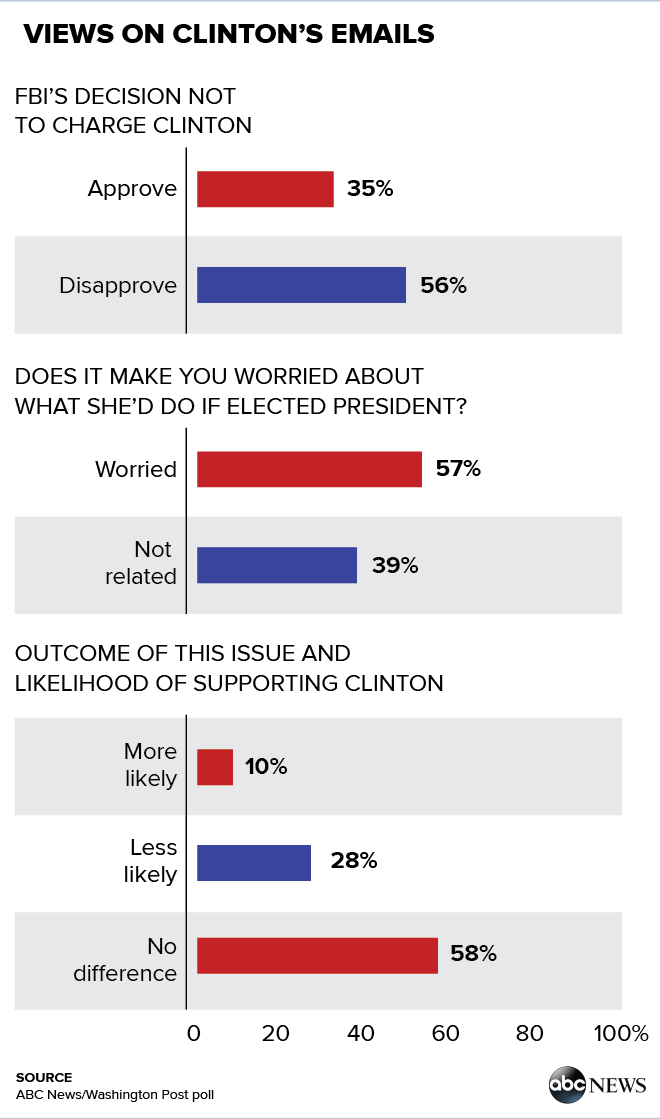
Majority Disapproves of Decision Not to Charge Clinton on Emails (POLL) - ABC News


ABC_Clinton_Emails_v02.png


Methodology
 

wizards8507

Well-known member
Messages
20,660
Reaction score
2,661
I was suggesting that given the same opportunities (good paying jobs, good schools, safe neighborhoods, etc.) Blacks would over time raise their standard of living in the same manner that poor whites had been able to do.
With the exception of the generationally wealthy, absolutely nobody is GIVEN good paying jobs, good schools, or safe neighborhoods. I was GIVEN a shitty high school and I EARNED my way into an elite university where I busted my ass and EARNED a good paying job so I could EARN enough money to purchase a house in a safe neighborhood.

To your separate point about free school, school is already very close to free if you pick the right school. The student loan crisis is not from poor kids graduating from state schools with STEM degrees because those kids are going to school on grants and graduating close to debt-free. The student loan crises is due to middle class kids who are going to overpriced liberal arts schools and majoring in things with zero income potential to ever pay those loans back, then going to graduate school for even more debt when they realize their bachelors degrees are worthless.
 

GoIrish41

Paterfamilius
Messages
9,929
Reaction score
2,120
Just...wow. First, many of these fast food workers are being replaced with automation due to the $15 minimum wage. These jobs were NEVER meant for someone providing for a family of 4. Second, yes I'm perfectly fine with subpar athletes making $1 million a year. Why? Because the market, not you, determines their value. Crazy right?

Who cares what these jobs were "meant" for? The reality of the world we live in is that most of the higher paying manufacturing jobs have been shipped overseas, and we have become much more of a service economy. What our economy is now is a whole lot of people working in low-paying service jobs -- not because it is their choice, but because that is what is available to them. Many of these displaced workers have families. Your all-knowing market -- the arbiter of what everyone is worth -- has failed citizens in favor of corporations, whose leaders profit when people are "worth less." Good deal if you are a CEO, a shit sandwich if you are anyone else. The fact that the stock markets have risen to records over the past several years and more and more Americans are falling out of the middle class or making less than they did a decade ago should give us all pause. We certainly shouldn't be defending the status quo that has left millions of families in the dust.
 

EddytoNow

Vbuck Redistributor
Messages
1,481
Reaction score
235
I think you have yourself confused. Not everyone is guaranteed a good paying job but a good paying job is a basic human right?

Maybe my wording is too strong by calling it a basic human right, which implies the same importance as the right to life, liberty, etc. Let's rephrase it as a basic human opportunity. So fire away at this one. Everyone should have access to opportunities that enable them to improve their lot in life. One of those opportunities is the chance to succeed or fail at a good paying job. If you show up for work, perform your job satisfactorily, etc. you will be compensated well enough to rise out of poverty. If you don't come to work or fail to do your job, etc. you've wasted the opportunity. No guarantees, just equal opportunities. My contention is that most of the poor are locked into minimum wage jobs with so few opportunities to work hard and earn their way out of an impoverished lifestyle that few ever make it out.

Now with that premise better defined, I still contend that the poor (of all races) would take advantage of the opportunities if they were presented with them. For the most part, the poor aren't poor because they are lazy or have some inherent cultural characteristics that doom them to failure. They are poor because their parents were poor and they have few opportunities to rise out of poverty. A few representatives of the poor are given opportunities and grasp the opportunities and run with them. They are not somehow an example that shows that those who remain poor are somehow responsible for their own condition. Rather, they are an example of what could be if everyone living in poverty was provided with opportunities to leave a life of impoverishment.

The Irish, who are frequently cited in this thread as a group to imitate, had far more opportunities than today's poor. Good-paying factory jobs were there for anyone who wanted one. As late as 1970 my high school graduate friends, could graduate on a Friday night and be earning good pay at one of the auto-related factories starting Monday morning. My grandmother's generation began the process. They worked long, hard hours in local factories. My father took advantage of the opportunities available to him and became a successful insurance salesman, a job he was able to get despite not even graduating from high school. Myself and my brothers and sisters were able to go to college because the two succeeding generations had opportunities that enabled them to earn good pay. It was in that manner that my own family rose from poverty to middle class, but it took three generations to make it happen. My family (of Irish and French-Canadian ancestry) was blessed with opportunities and took advantage of them.

Today's poor do not have those same opportunities. It's true that an individual may still find an opportunity here or there, but the vast majority of the poor (of all races) are being left out.
 
Last edited:

kmoose

Banned
Messages
10,298
Reaction score
1,181
Didn't Seattle raise the minimum wage to $15.00 per hour? Last I heard Seattle was doing fine.

Oh really?

From: How the $15 wage is already killing Seattle jobs | New York Post

Seattle passed its $15 law in June 2014. Starting last April, it raised the minimum from $9.32 (the state minimum wage) to $10 for certain business, $11 for others.

Increases to $12, $12.50 and $13 an hour began taking effect for most employers this Jan. 1. The jumps will continue until the minimum hits the full $15 an hour in 2017 for some before it’s universal in 2019.

Yet even the early impact is harsh.

The AEI study, worked up from Bureau of Labor Statistics’ monthly surveys, shows that, between April and December last year, Seattle saw the biggest employment drop in any nine-month period since 2009 — a full year into the Great Recession.

The city unemployment rate rose a full percentage point.

Before the minimum-wage hikes begin, Seattle employment tracked the rest of the nation — slowly rising from the 2008-09 bottom. But it started to plunge last spring, as the new law began to kick in.

Furthermore, Seattle’s loss of 10,000 jobs in just the three months of September, October and November was a record for any three-month period dating back to 1990.

Meanwhile, employment outside the city limits — which had long tracked the rate in Seattle proper — was soaring by 57,000 and set a new record high that November.

Bottom line: A $15 law in New York is guaranteed to destroy jobs here — and boost employment in New Jersey, Connecticut, Pennsylvania and even Vermont.

Seattle is learning that it can’t unilaterally ignore basic economics. Businesses adapt to government dictates. To survive mandated pay hikes, they lay off employees, or avoid new new hires to control costs.

It hasn't killed the economy in Seattle but it certainly has had a negative effect.
 

Veritate Duce Progredi

A man gotta have a code
Messages
9,358
Reaction score
5,352
Yes, I worked several jobs at minimum wage. And I worked harder at some of those jobs than people who made far more money than I. I also understand that $15.00 per hour only adds up to about $30,000 per year before taxes. That's hardly an excessive amount for a full-time worker. If you were taking home approximately $20,000 per year after taxes, you'd still be living at home with mom and dad or you'd be making a lot of sacrifices to stay afloat.

As far as fast-food workers not being worth $15.00 per hour, there are plenty of people making money way beyond what you or I think their job is worth. Are you comfortable with the fact that even lousy professional athletes earn in excess of $1,000,000 per year or that executives who spend 2 to 3 hours on the golf course every day earn in excess of half a billion dollars?

Didn't Seattle raise the minimum wage to $15.00 per hour? Last I heard Seattle was doing fine. The local economy hasn't collapsed because people were being paid more. People spending money stimulates the economy. Who spends a larger portion of their wages, the minimum wage earner or the CEO? The minimum wage earner, out of necessity, spends pretty close to 100% of what they earn. That, in turn, creates jobs for someone else. The Bush tax cuts for the wealthy prove that the wealthy save most of their money. They aren't out there creating new jobs. They can live pretty d*** well spending as little as 10% of their income. The rest of their money sits and accumulates interest making them even wealthier, but it does little to create more jobs.

What stimulates the economy about as well as anything? Spending on infrastructure. And those jobs pay far more than $15.00 per hour. The initial spending goes to those who work in construction, but the net effect is more spending and an increase in jobs that goes way beyond the construction industry. Henry Ford had the right idea. He said you have to pay your workers enough so that they, too, can afford to buy whatever it is you are selling.

That's great. You likely developed a healthy work habit and a yearning to do something more because no matter how hard you worked, there was a ceiling to how much you could make in that position. I'm sure you know this but working hard is only the first half of the equation.

Which executives are capable of keeping that kind of salary and golfing every day? I don't think you understand the stress and work volume associated with most of the C-level jobs.
 

Ndaccountant

Old Hoss
Messages
8,370
Reaction score
5,771
Who cares what these jobs were "meant" for? The reality of the world we live in is that most of the higher paying manufacturing jobs have been shipped overseas, and we have become much more of a service economy. What our economy is now is a whole lot of people working in low-paying service jobs -- not because it is their choice, but because that is what is available to them. Many of these displaced workers have families. Your all-knowing market -- the arbiter of what everyone is worth -- has failed citizens in favor of corporations, whose leaders profit when people are "worth less." Good deal if you are a CEO, a shit sandwich if you are anyone else. The fact that the stock markets have risen to records over the past several years and more and more Americans are falling out of the middle class or making less than they did a decade ago should give us all pause. We certainly shouldn't be defending the status quo that has left millions of families in the dust.

America's upper middle class is thriving - Jun. 21, 2016

It's interesting and paints a bit of a different picture. Largely though, it isn't just "executives" that have flourished.
 

EddytoNow

Vbuck Redistributor
Messages
1,481
Reaction score
235
Oh really?

From: How the $15 wage is already killing Seattle jobs | New York Post


It hasn't killed the economy in Seattle but it certainly has had a negative effect.

According to studies cited in the article below, a $15.00 minimum wage for fast-food workers would require only a 4% increase in operating costs. So let's see, that would mean my McDonald's sandwich would cost about 16 cents more. I guess you'd quit going to McDonald's if your Big Mac cost 16 cents more. I doubt many others would join you.

Seattle's $15 Minimum Wage Law, Explained - Eater

On an anecdotal note, the price of a senior coffee at my local McDonald's has risen from 50 cents to 80 cents in the past year, an increase of 60%. The employees are still making $8.50 an hour and the seniors are still sitting at the same table every morning drinking their coffee. I suspect if the cost of a large sandwich increased from $4.00 to $4.16 you would see the same result. Now, that's not saying the local management or corporate manager won't raise the cost even more to benefit their bottom line, but that will not be caused by raising wages to $15.00 per hour.

And some businesses that were doomed to fail for other reasons will have no problem blaming the increase in wages for their problems. The bottom line is that if your business can't absorb a 4% increase in operating costs, it will fail on its own when other costs rise. And the cost to consumers overall would be far less than 4%, because a minimum wage law would only effect those jobs being paid a minimum wage. The vast majority of your expenses would not be effected by an increase in the minimum wage, because those employees are already earning more than $15.00 per hour.
 

Ndaccountant

Old Hoss
Messages
8,370
Reaction score
5,771
According to studies cited in the article below, a $15.00 minimum wage for fast-food workers would require only a 4% increase in operating costs. So let's see, that would mean my McDonald's sandwich would cost about 16 cents more. I guess you'd quit going to McDonald's if your Big Mac cost 16 cents more. I doubt many others would join you.

Seattle's $15 Minimum Wage Law, Explained - Eater

On an anecdotal note, the price of a senior coffee at my local McDonald's has risen from 50 cents to 80 cents in the past year, an increase of 60%. The employees are still making $8.50 an hour and the seniors are still sitting at the same table every morning drinking their coffee. I suspect if the cost of a large sandwich increased from $4.00 to $4.16 you would see the same result. Now, that's not saying the local management or corporate manager won't raise the cost even more to benefit their bottom line, but that will not be caused by raising wages to $15.00 per hour.

And some businesses that were doomed to fail for other reasons will have no problem blaming the increase in wages for their problems. The bottom line is that if your business can't absorb a 4% increase in operating costs, it will fail on its own when other costs rise. And the cost to consumers overall would be far less than 4%, because a minimum wage law would only effect those jobs being paid a minimum wage. The vast majority of your expenses would not be effected by an increase in the minimum wage, because those employees are already earning more than $15.00 per hour.

Eatsa fully automated restaurant chain - Business Insider

How long until more fast food joints look like this? In the end, the restaurants are about both food and service. The problem is that what constitutes good service is changing, particularly with Millennials. 25 years ago, people would have balked at the idea of not having to interact with a human. Now, many millennials prefer it. Couple that with rising labor costs, you have a problem.
 

IrishLax

Something Witty
Staff member
Messages
37,545
Reaction score
28,995
According to studies cited in the article below, a $15.00 minimum wage for fast-food workers would require only a 4% increase in operating costs. So let's see, that would mean my McDonald's sandwich would cost about 16 cents more. I guess you'd quit going to McDonald's if your Big Mac cost 16 cents more. I doubt many others would join you.

Seattle's $15 Minimum Wage Law, Explained - Eater

On an anecdotal note, the price of a senior coffee at my local McDonald's has risen from 50 cents to 80 cents in the past year, an increase of 60%. The employees are still making $8.50 an hour and the seniors are still sitting at the same table every morning drinking their coffee. I suspect if the cost of a large sandwich increased from $4.00 to $4.16 you would see the same result. Now, that's not saying the local management or corporate manager won't raise the cost even more to benefit their bottom line, but that will not be caused by raising wages to $15.00 per hour.

And some businesses that were doomed to fail for other reasons will have no problem blaming the increase in wages for their problems. The bottom line is that if your business can't absorb a 4% increase in operating costs, it will fail on its own when other costs rise. And the cost to consumers overall would be far less than 4%, because a minimum wage law would only effect those jobs being paid a minimum wage. The vast majority of your expenses would not be effected by an increase in the minimum wage, because those employees are already earning more than $15.00 per hour.

They're actually just going to fire people and move more towards automation. That "4%" is masking the actual impact by lumping it in with a host of other expenses related to operation but completely unrelated to labor.
 

Polish Leppy 22

Well-known member
Messages
6,594
Reaction score
2,009
Who cares what these jobs were "meant" for? The reality of the world we live in is that most of the higher paying manufacturing jobs have been shipped overseas, and we have become much more of a service economy. What our economy is now is a whole lot of people working in low-paying service jobs -- not because it is their choice, but because that is what is available to them. Many of these displaced workers have families. Your all-knowing market -- the arbiter of what everyone is worth -- has failed citizens in favor of corporations, whose leaders profit when people are "worth less." Good deal if you are a CEO, a shit sandwich if you are anyone else. The fact that the stock markets have risen to records over the past several years and more and more Americans are falling out of the middle class or making less than they did a decade ago should give us all pause. We certainly shouldn't be defending the status quo that has left millions of families in the dust.

1) Who cares? We're talking about jobs at places like Wendy's that were filled with high school and college kids trying to earn a few bucks, not feed a family. The fact that you would feel better if we had $15 or $25 minimum wage...is irrelevant. Take the emotion out of it and put the numbers into it. Look at what's happening to fast food workers now due to $15 minimum wage. They're being replaced.

2) The market hasn't failed people who work in healthcare, education, IT, accounting/ finance, staffing, supply chain, hell even government, etc. It has failed, more than anyone, families who relied on US manufacturing for decades. How we bring that back is another conversation.

3) I'm not saying I like it or it's perfect. But I will side with the free market over a government program every day.
 

GoIrish41

Paterfamilius
Messages
9,929
Reaction score
2,120
In 1979, the year before I worked at a diner as a dishwasher after school, minimum wage was $2.90. That equated to $9.60 an hour in today's dollars. So, today, a worker who makes $7.25 an hour has approximately $2.35 less purchasing power per hour than I had as a HS sophomore. In that time, manufacturing jobs have exited our economy, leaving millions of people to try to make ends meet in low-paying service sector jobs. A worker who is on the job for 40 hours, makes $94 a week less in real dollars than he would have in 1979. At the low end of the scale, that makes a huge difference. And given that alternatives are few and far between in many cases. The reduced "value" of workers means that employers are getting the same results from employees at a reduced real cost. Setting the minimum wage at a level that a person can live on and adjusting annually to inflation is the only way to stop wages from continuing to sink for American workers at the low end. It's time that they share in the rewards of an economy that is booming for those at the top. It's been 7 years since the minimum wage has gone up, and each year prices have risen.
 

irishroo

The CNN of Irish Envy
Messages
572
Reaction score
44
According to studies cited in the article below, a $15.00 minimum wage for fast-food workers would require only a 4% increase in operating costs. So let's see, that would mean my McDonald's sandwich would cost about 16 cents more. I guess you'd quit going to McDonald's if your Big Mac cost 16 cents more. I doubt many others would join you.

Seattle's $15 Minimum Wage Law, Explained - Eater

On an anecdotal note, the price of a senior coffee at my local McDonald's has risen from 50 cents to 80 cents in the past year, an increase of 60%. The employees are still making $8.50 an hour and the seniors are still sitting at the same table every morning drinking their coffee. I suspect if the cost of a large sandwich increased from $4.00 to $4.16 you would see the same result. Now, that's not saying the local management or corporate manager won't raise the cost even more to benefit their bottom line, but that will not be caused by raising wages to $15.00 per hour.

And some businesses that were doomed to fail for other reasons will have no problem blaming the increase in wages for their problems. The bottom line is that if your business can't absorb a 4% increase in operating costs, it will fail on its own when other costs rise. And the cost to consumers overall would be far less than 4%, because a minimum wage law would only effect those jobs being paid a minimum wage. The vast majority of your expenses would not be effected by an increase in the minimum wage, because those employees are already earning more than $15.00 per hour.

What planet are you living on where a 4% annual increase in operating expenses is an insignificant change?
 

wizards8507

Well-known member
Messages
20,660
Reaction score
2,661
In 1979, the year before I worked at a diner as a dishwasher after school, minimum wage was $2.90. That equated to $9.60 an hour in today's dollars. So, today, a worker who makes $7.25 an hour has approximately $2.35 less purchasing power per hour than I had as a HS sophomore. In that time, manufacturing jobs have exited our economy, leaving millions of people to try to make ends meet in low-paying service sector jobs. A worker who is on the job for 40 hours, makes $94 a week less in real dollars than he would have in 1979. At the low end of the scale, that makes a huge difference. And given that alternatives are few and far between in many cases. The reduced "value" of workers means that employers are getting the same results from employees at a reduced real cost. Setting the minimum wage at a level that a person can live on and adjusting annually to inflation is the only way to stop wages from continuing to sink for American workers at the low end. It's time that they share in the rewards of an economy that is booming for those at the top. It's been 7 years since the minimum wage has gone up, and each year prices have risen.
You kind of refuted your entire post in the third sentence. The people working minimum wages jobs are HIGH SCHOOL SOPHOMORES.

True story, the McDonald's closest to my parents house has been hiring at $10.50 an hour for several years since they've opened and they still can't find people willing to take those shifts. The minimum wage doesn't need to be set at a level for people to live on because nobody should be living on it. Minimum wage jobs are for people to acquire some money and learn basic job skills that they can apply to future career-type jobs. Raising the minimum wage does nothing but price low-skilled workers out of the market. If an employee can only deliver $7.00 per hour of value to an employer, the employer is just going to lay him off if the minimum wage goes to $15.00. There's no world other than your lib fantasyland where current minimum wage workers keep their jobs if the minimum wage were raised to a "living wage." If someone is worth $15 per hour, then they'd already be making it.

Ben Shapiro is my spirit animal.

"Who are you to tell the 17 year old black kid who wants to work for $7.50 an hour that he is forbidden by law from taking a job at $7.50 an hour? ... This makes you a totalitarian."

<iframe width="560" height="315" src="https://www.youtube.com/embed/_PIoTuBjGII" frameborder="0" allowfullscreen></iframe>
 
Last edited:

woolybug25

#1 Vineyard Vines Fan
Messages
17,677
Reaction score
3,018
What planet are you living on where a 4% annual increase in operating expenses is an insignificant change?

The real world? There are tons of industries that would love to have had a 4% average increase in operating expenses over the last twenty years. Every industry is different and 4% could be extremely high for one industry and extremely low for another.

US inflation rates are over 3%.
 

wizards8507

Well-known member
Messages
20,660
Reaction score
2,661
The real world? There are tons of industries that would love to have had a 4% average increase in operating expenses over the last twenty years. Every industry is different and 4% could be extremely high for one industry and extremely low for another.

US inflation rates are over 3%.
Nobody is talking about an average increase in operating expenses. Roo was talking about an incremental increase in operating expenses. Meaning if opex is already increasing at 4%, you add an additional 4% on top of that for a total of 8%.
 

woolybug25

#1 Vineyard Vines Fan
Messages
17,677
Reaction score
3,018
Nobody is talking about an average increase in operating expenses. Roo was talking about an incremental increase in operating expenses. Meaning if opex is already increasing at 4%, you add an additional 4% on top of that for a total of 8%.

I didn't read it wrong. An increase of 4% isn't abnormal for a ton of industries. Many industries have 4% incremental increases all of the time. Industries reliant on oil, overly subjected to government regulation or simply in developing industries almost expect those types of "surprises".

Saying that 4% increases in average operating expenses is abnormal is ignoring the great disparity in industry margins. An apple's business climate is not the same as an orange's. Acting like one specific number is encompassing of both is just as silly as acting like one number is too low for both as well.

It's not as simple as saying one number is appropriate for all industries.
 

NorthDakota

Grandson of Loomis
Messages
15,701
Reaction score
6,002
If you are a poor minority, this is available now. My wife teaches in a poor southern school district that is ~60% black. We have taken several of her students under our wings to work with them to get into college and get out of the cycle their families have been stuck in. Every one of them has been able to get a free or almost free education. The biggest problem is that most of these students didn't know the first place to start in looking for ways to go to college free. What it truly takes is for people that have the wherewithal to help these students get involved in their lives.

I dated a girl in college from a poor white family. Not a very smart girl either. Free education. Education expenses seem to hit the middle class the hardest.... Or upper middle class whose parents will not pay for their children's education.
 

Ndaccountant

Old Hoss
Messages
8,370
Reaction score
5,771
I didn't read it wrong. An increase of 4% isn't abnormal for a ton of industries. Many industries have 4% incremental increases all of the time. Industries reliant on oil, overly subjected to government regulation or simply in developing industries almost expect those types of "surprises".

Saying that 4% increases in average operating expenses is abnormal is ignoring the great disparity in industry margins. An apple's business climate is not the same as an orange's. Acting like one specific number is encompassing of both is just as silly as acting like one number is too low for both as well.

It's not as simple as saying one number is appropriate for all industries.

I can buy what you are selling. However, to fast food, 4% is huge.

f1add12a7101463ea5d1207818727ce4.ashx
 

irishroo

The CNN of Irish Envy
Messages
572
Reaction score
44
I didn't read it wrong. An increase of 4% isn't abnormal for a ton of industries. Many industries have 4% incremental increases all of the time. Industries reliant on oil, overly subjected to government regulation or simply in developing industries almost expect those types of "surprises".

Saying that 4% increases in average operating expenses is abnormal is ignoring the great disparity in industry margins. An apple's business climate is not the same as an orange's. Acting like one specific number is encompassing of both is just as silly as acting like one number is too low for both as well.

It's not as simple as saying one number is appropriate for all industries.

This is true, but fast food is not one of those industries. McDonalds' average annual opex growth over the past 5 years is -0.2%.
 

woolybug25

#1 Vineyard Vines Fan
Messages
17,677
Reaction score
3,018
I can buy what you are selling. However, to fast food, 4% is huge.

f1add12a7101463ea5d1207818727ce4.ashx

Of course, and by no means did my comments intend to say they were appropriate for the fast food industry. Frankly, they are not. I'm in agreement with most people that a $15 min wage would have a disastrous ripple effect of executed across the United States. But that is actually to my point. The restaurant industry, and who it employs, is drastically different in every part of the country.

For instance, a waitress job in Key West is an adult job. One that employs people as a primary income producer. Their other options are nominal and the industry has far higher profit margins. An increase of 4% for them could very well be an acceptable increase. But the American public shouldn't act like that is the same situation as someone flipping burgers in Dallas. A surprise 4% increase in operating expense could force them to raise prices, hire less people or even close their doors.

But to my original point. Incremental increases of 4% or higher happen all of the time in a variety of industries. A 20% increase in oil prices will do that for a lot of industries, for instance.
 

dshans

They call me The Dribbler
Messages
9,624
Reaction score
1,181
To all the "Free Market Is God" theists: "The Market" can, at times, be as bat-shit crazy as any one individual – you know, that cat lady or the hoarder or the person insisting that the Rapture is nigh.

In 1968 I was paid $1.00 an hour at a part time job. The minimum wage soon catapulted to $1.25 an hour! I was not laid off and Colonial Drugs did not fold. It continued to prosper. In fact, sales in non drug related items increased since some felt that the added income "justified" purchases of Jean Naté and such.

At one point in my life I decided to go "straight" and get an MBA. I took the necessary micro and macro economics classes. When the prevailing concepts of Derived Demand and the proposition that 3% unemployment was "full" employment were presented as de facto rather than de jure to rationalize and justify a perceived need to balance that whole supply and demand cant, I lost interest.

All "demand" is derived. Whether it be derived from a need to breathe clean air, drink non-toxic water, have an affordable roof over one's head or piss away mucho dineros on a car, house, travel, etc.; they are all derived.

Clearly the nation and the world's economy have adjusted to, and survived, increases in wages.

In fact, they have thrived, in spite of greedy, air-headed and (foolishly) unregulated "blips."
 

Ndaccountant

Old Hoss
Messages
8,370
Reaction score
5,771
Of course, and by no means did my comments intend to say they were appropriate for the fast food industry. Frankly, they are not. I'm in agreement with most people that a $15 min wage would have a disastrous ripple effect of executed across the United States. But that is actually to my point. The restaurant industry, and who it employs, is drastically different in every part of the country.

For instance, a waitress job in Key West is an adult job. One that employs people as a primary income producer. Their other options are nominal and the industry has far higher profit margins. An increase of 4% for them could very well be an acceptable increase. But the American public shouldn't act like that is the same situation as someone flipping burgers in Dallas. A surprise 4% increase in operating expense could force them to raise prices, hire less people or even close their doors.

But to my original point. Incremental increases of 4% or higher happen all of the time in a variety of industries. A 20% increase in oil prices will do that for a lot of industries, for instance.

Absolutely. And on top of that, the Seattle legislation was one that factored in the impact of employer health care, if provided and tipping. IIRC, the increase was much less pronounced for those getting health care benefits (marginal change) and those getting tips were limited by older legislation (which was not changed) where tips counted towards the minimum wage. This is just another way location, industry type and actual job make all the difference.
 

ND NYC

New member
Messages
3,571
Reaction score
209
This is wrong on both fronts. Kmoose never said that, and a "good paying job" is not a human right for any of us. The market determines the value of our skill set, labor, and compensation.

That's why a minority who is a cyber security IT architect makes more than a white plumber. Get it?

i wouldn't be so sure about that
 
Last edited by a moderator:

GoIrish41

Paterfamilius
Messages
9,929
Reaction score
2,120
You kind of refuted your entire post in the third sentence. The people working minimum wages jobs are HIGH SCHOOL SOPHOMORES.

True story, the McDonald's closest to my parents house has been hiring at $10.50 an hour for several years since they've opened and they still can't find people willing to take those shifts. The minimum wage doesn't need to be set at a level for people to live on because nobody should be living on it. Minimum wage jobs are for people to acquire some money and learn basic job skills that they can apply to future career-type jobs. Raising the minimum wage does nothing but price low-skilled workers out of the market. If an employee can only deliver $7.00 per hour of value to an employer, the employer is just going to lay him off if the minimum wage goes to $15.00. There's no world other than your lib fantasyland where current minimum wage workers keep their jobs if the minimum wage were raised to a "living wage." If someone is worth $15 per hour, then they'd already be making it.

Ben Shapiro is my spirit animal.

"Who are you to tell the 17 year old black kid who wants to work for $7.50 an hour that he is forbidden by law from taking a job at $7.50 an hour? ... This makes you a totalitarian."

<iframe width="560" height="315" src="https://www.youtube.com/embed/_PIoTuBjGII" frameborder="0" allowfullscreen></iframe>

Perhaps it is you who is mistaken: Top Four Misconceptions about Fast Food Workers | Groundswell

"Myth: Employees at fast-food restaurants are high school kids making a little side cash.
The days of high school kids flipping burgers after school to earn a little extra spending cash are long gone. Today, 40 percent of the workforce in the fast food industry is 25 or older, and the average fast-food worker is 29 years old. 26 percent of fast food workers are parents with children. 31 percent of workers at fast-food restaurants have at least attempted college.
"

I've seen multiple argue in this thread that the market sets the value of employee compensation. You seem to be arguing around the edges of that statement as well. So, if that is true your local McDonald's cannot get people to fill shifts because the market has dictated that they should be compensated at a higher rate.
 
Last edited:

wizards8507

Well-known member
Messages
20,660
Reaction score
2,661
"Myth: Employees at fast-food restaurants are high school kids making a little side cash.
The days of high school kids flipping burgers after school to earn a little extra spending cash are long gone. Today, 40 percent of the workforce in the fast food industry is 25 or older, and the average fast-food worker is 29 years old. 26 percent of fast food workers are parents with children. 31 percent of workers at fast-food restaurants have at least attempted college.
"
That's exactly my point. When you price entry-level kids out of the workplace, nobody is going to hire them.

I've seen multiple argue in this thread that the market sets the value of employee compensation. You seem to be arguing around the edges of that statement as well. So, if that is true your local McDonald's cannot get people to fill shifts because the market has dictated that they should be compensated at a higher rate.
Yes. They should and are compensated at a higher rate. When was the last time you were in any proximity to a minimum wage job? I was in food service five years ago and my sister is in fast food now, and nobody we've ever worked with has earned a minimum wage. If someone is earning minimum wage, it's because they're cosmically inept.
 

wizards8507

Well-known member
Messages
20,660
Reaction score
2,661
To all the "Free Market Is God" theists: "The Market" can, at times, be as bat-shit crazy as any one individual – you know, that cat lady or the hoarder or the person insisting that the Rapture is nigh.

In 1968 I was paid $1.00 an hour at a part time job. The minimum wage soon catapulted to $1.25 an hour! I was not laid off and Colonial Drugs did not fold. It continued to prosper. In fact, sales in non drug related items increased since some felt that the added income "justified" purchases of Jean Naté and such.

At one point in my life I decided to go "straight" and get an MBA. I took the necessary micro and macro economics classes. When the prevailing concepts of Derived Demand and the proposition that 3% unemployment was "full" employment were presented as de facto rather than de jure to rationalize and justify a perceived need to balance that whole supply and demand cant, I lost interest.

All "demand" is derived. Whether it be derived from a need to breathe clean air, drink non-toxic water, have an affordable roof over one's head or piss away mucho dineros on a car, house, travel, etc.; they are all derived.

Clearly the nation and the world's economy have adjusted to, and survived, increases in wages.

In fact, they have thrived, in spite of greedy, air-headed and (foolishly) unregulated "blips."
At best, your argument, inasmuch as it is an argument, supports the premise that the minimum wage is not bad. It does nothing to further the premise that the minimum wage is good.
 
Top