C
Cackalacky
Guest
True. The earth is swimming in a sea of debris and we are constantly passing through this debris in our orbit around the sun. Most of it is small and burns up before we see it. Sometimes we see them in "showers". Then there are the ones of the size of a basketball to car size. These are harder to see and can make it to the earth. It is my understanding the some objects are too small to track anddetect but big enough to do what happened.my guess is that this one in russia was probably slightly bigger than a medicine ball. they just cant see all of that stuff. and yes, hitting any major city would be devastating. the universe is unstoppable.
cool site
Near-Earth Object Program
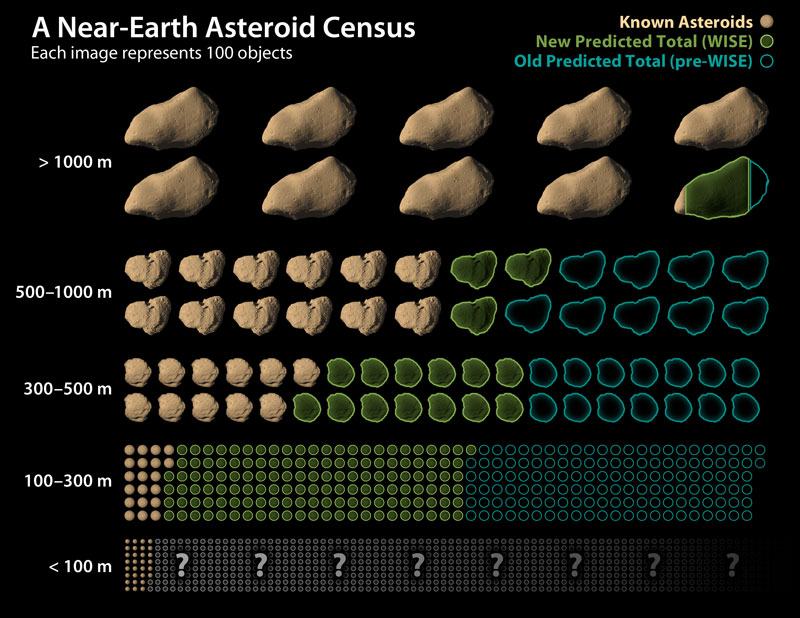
These are the ones we known about.
"Since most NEAs do not have a known reflectivity, or albedo, this albedo must be estimated before the H values, representing intrinsic brightness, can be converted to an approximate diameter. Pravec et al (2012) determined that, for their sample of 583 main-belt asteroids and NEAs, the mean albedos and their standard deviations are 0.057 (±0.013) for the Tholen/Bus/DeMeo C/G/B/F/P/D types and 0.197 (±0.051) for the S/A/L types. Since the albedos for NEAs are most likely to be either approximately 6% for asteroids of the C-type and associated taxonomic classes or 20% for asteroids of the more populous S-type and associated taxonomic classes, we have used an approximate mean value of 14% albedo and an H value of 17.75 to represent a one kilometer spherical NEA. Since the determined H values are uncertain, and likely biased by a few tenths (see Pravec et al., 2012, Icarus) and the single 14% albedo is only a rough mean representing a bimodal albedo distribution, the estimated numbers of one kilometer and larger sized objects in the tables below are very rough. However, these statistics are useful for monitoring the annual NEA discovery progress."

Thus objects with low observable albedo (reflectivity) are difficult to spot and track.
Last edited: