Politics

Politics

  • Obama

    Votes: 4 1.1%
  • Romney

    Votes: 172 48.9%
  • Other

    Votes: 46 13.1%
  • a:3:{i:1637;a:5:{s:12:"polloptionid";i:1637;s:6:"nodeid";s:7:"2882145";s:5:"title";s:5:"Obama";s:5:"

    Votes: 130 36.9%

  • Total voters
    352

Whiskeyjack

Mittens Margaritas Ante Porcos
Staff member
Messages
20,894
Reaction score
8,126
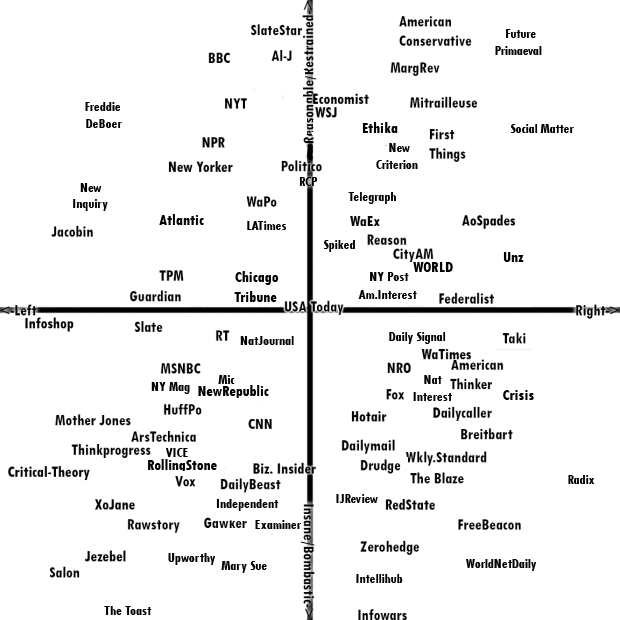
Found this chart on the alignment of political media:

political-grid-new7.png


Could quibble with where he placed a few of the outlets, but overall it looks pretty accurate to me.
 

Legacy

New member
Messages
7,871
Reaction score
321
Texas is the most recent state to pass a law requiring that the aborted remains be buried or cremated. The law does not affect any miscarriages or abortions that occur at home, but people are raising an outcry over the law's passing. The costs will be covered by the health centers and is supposed to be offset by eliminating some of the current methods of disposing the remains. Texas Governor Greg Abbott has made no effort to hide his support is contingent upon his belief that being human, the remains of the aborted and miscarried children have the right to a proper burial instead of being disposed with discarded appendix and tonsils in a biomedical waste landfill.

Again, we see abortion supporters outraged and claiming that pro-life policies and views are traumatizing women. This comes in the same year as Planned Parenthood's vocal disgust at a Doritos Super Bowl ad for having the gall to show an ultrasound of a fetus with anthropomorphic features. How dare that chip company! Most recently, France had banned the "Dear Future Mom" video that had the guts to show that Down Syndrome children may be happy. This law was only brought to my attention today because I had the misfortune to browse r/Austin and see all of the hate and vitriol spewed by people who claim that proper burial of the dead is "inhumane" and "misogynistic".

https://www.texastribune.org/2016/11/28/texas-moves-forward-rules-requiring-burial-or-crem/

I assume you are not against Big Government legislating these kinds of onerous costs?

Here is a fetal growth chart. Note that a 8 week old fetus weighs 0.04 ounces and a 12 week old fetus weighs 0.49 ouces. Obviously, the Superbowl ad with the ultrasound was not portraying any fetus of this size.

In Texas in 2014, out of 54,126 total abortions, 50,751 were done at 12 weeks or less (42,654 for 8 weeks or less and 8,097 for 8-12 weeks). 2,489 abortions were done when the fetus was 13-16 weeks. (Source)

At these points in a woman's pregnancy, it is difficult to determine the fetus among tissue and blood. If someone can, cremation or funeral costs in Texas run $700 to $1000 or more. I don't think that cost multiplied times 54,000 abortions would be "offset by eliminating some of the current methods of disposing the remains."

What can be the rationale behind the funeral abortion law intending "miscarried or aborted childrens' right to a proper burial" exempting those that happen at home? Why do those aborted or miscarried children not have the same right?

So, the law clearly targets health care providers - doctors and hospitals - while some would paint the picture of "baby parts" "disposed with discarded appendix and tonsils in a biomedical waste landfill."

This is a good example of Big Government imposing unreasonable and costly restrictions with thinly-veiled, absurd rationales within an emotionally-charged atmosphere with strong opinions on both sides. At worst, some would label providers as murderers.
 
Last edited:

Quinntastic

IE's Microbiologist
Messages
1,036
Reaction score
111
Thank you, Legacy, for interjecting some much needed perspective into this argument. Most abortions happen before 13 weeks, with most of those actually occuring before week 8. The "fetus" is little more than a cluster of cells/tissue at that point. I have seen plenty of miscarried fetuses and they barely look humanoid until about week 20.

Also, outlawing abortions don't stop them from happening - only stops them from happening safely.

Double also, no one gets to argue that the government should be able to make medical decisions on behalf of people but also de-cry "death panels" and medically assisted euthanasia. That level of hypocrisy is laughable. Especially the "you can't abort that fetus, you have to keep it" and then when that person can't afford to keep it and ends up asking the government for food/medical assistance to help raise it say, "Look at all these people sponging off the government. I'm not paying taxes to support your kids. If you can't afford kids, don't have them" while also arguing to de-fund planned parenthood because people don't "deserve" subsidized/low-cost birth control?? So what exactly IS the solution? News flash: poor people exist. In every society. And abstinence is NOT a proper answer here, by the way. It goes against human nature and we definitely don't want to go down the road of the government saying who can and cannot procreate...
 
Last edited:

Whiskeyjack

Mittens Margaritas Ante Porcos
Staff member
Messages
20,894
Reaction score
8,126
Earlier this week, the WSJ's Bret Stephens published an article titled "The System Didn't Work":

Leo Tolstoy wrote that all happy families are alike, while each unhappy family is unhappy in its own way. Among the lessons of 2016 is that, politically speaking, Tolstoy was wrong.

This was the year in which everything that couldn’t, shouldn’t and wouldn’t happen, happened. In May, Filipinos elected a man who said he’d be happy to slaughter millions of drug addicts the way Hitler slaughtered millions of Jews. In June, the British tossed out the European Union, along with the toffs who had told them to stay in it. In October, Colombians rejected a deal with the FARC for which their president was awarded the Nobel Peace Prize. A month later: President-elect Donald Trump.

Now Italians have overwhelmingly rejected proposed constitutional changes that were supposed to make their political system functional and economic reform possible. Beppe Grillo, the populist politician who led the charge against the changes, crowed on his blog Sunday that “times have changed.” Yes, they have.

The Philippines, Britain, Colombia, America and Italy are big unhappy families. So is France, where the incumbent president doesn’t dare stand for re-election; and Brazil, which impeached its president in August; and South Korea, which is expected to impeach its president later this week. Nobody should think that Angela Merkel is a shoo-in for re-election next year, or that Marine Le Pen won’t be the next president of the Fifth Republic. One thing unhappy families often have in common is that their members aren’t averse to smashing the plates.

What happened? In 2014, Daniel Drezner, a professor at Tufts, published a book extolling the International Monetary Fund and other institutions of “economic global governance” for putting out the fires of the 2008 financial crisis. The global economy had been teetering on the brink of another Great Depression, but it didn’t fall in. Ergo, success.

The book was called “The System Worked.” Except it didn’t. The system did more to mask problems than it did to solve them.

Government statistics can show a drop in the unemployment rate, but they give scant indication of whether the jobs available now have the status or pay of the jobs available previously. Giving unlimited credit to a panicked patient will always have a narcotic effect; it can also have an addictive one. Near-zero (or sub-zero) interest rates will goose stock markets to the delight of sophisticated investors—and the dismay of savers. Bank bailouts may make “systemic” sense. But they divorce behavior from consequence. Pushing economic management from elected officials into the hands of unelected central bankers and regulators flatters the vanity of the intelligentsia while offending the normal person’s sense that his vote should count toward his own livelihood.

In other words, the “system,” with its high-toned rationale and its high-handed maneuvers, struck millions of people as unaccountable and unjust. It might have been a good thing that the sky didn’t fall on everybody, but shouldn’t it at least have fallen on somebody? Bernie Sanders got remarkably close to winning the Democratic nomination by calling Wall Street a fraud and demanding prosecutions. Hillary Clinton lost the White House by so perfectly typifying the system that supposedly worked so well. Donald Trump is what he is, and readers know what I think of that. But Mrs. Clinton’s unforgivable sin was her outsized—and unearned—sense of entitlement.

Look again at this year’s other big political surprises.

Colombians rejected the peace deal because they would not abide having terrorists lightly let off for their crimes. Filipinos elected Rodrigo Duterte because they wanted to exact moral justice against drug dealers, never mind the finer details of legal justice. Britons disregarded dire warnings about the consequences of leaving the EU because the powers of Brussels violated their sense of democratic sovereignty. Italians told Prime Minister Matteo Renzi to shove off because they weren’t sympathetic to plans they see as having been made in Berlin for the benefit of Germans.

The populist wave now cresting across much of the world is sometimes described as a revolt against globalization: immigrants failing to assimilate the values of their hosts, poorer countries drawing jobs from richer ones, and so on. But the root complaint is not about economics. It’s about justice. Why does the banker get the bailout while the merchant goes bankrupt? Why does the illegal immigrant get to jump the citizenship queue? What right does a foreign judge have to tell us what punishments our criminals deserve? Why do our soldiers risk their lives for the defense of wealthy allies?

Those of us who believe in the liberal international order (now derisively called “globalism”) ought to think about this. There are powerful academic arguments to be made for the superiority of free trade over mercantilism, or of Pax Americana over America First. But liberalism’s champions will continue to lose the argument until we learn to make our case not in the language of what works, but of what’s right.
 

Whiskeyjack

Mittens Margaritas Ante Porcos
Staff member
Messages
20,894
Reaction score
8,126
The Week's Damon Linker published an article recently titled "How conservatives out-intellectualized progressives":

The vital center is imploding throughout the Western world. Liberal norms and institutions face a greater challenge than at any time since the end of the Second World War. And so defenders of the liberal order seek, often desperately, to remind themselves of what principles they stand for and the premises that underlie their deepest political and moral convictions.

That's what I take Molly Worthen to be doing in her recent, admirable essay in The New York Times. Worthen writes as a liberal who admires the way the American right has built an infrastructure of programs and institutes where young conservatives receive instruction in the history of political philosophy from Aristotle and Xenophon on down to James Madison, Adam Smith, and beyond.

Worthen thinks liberals should do something similar:

Liberals have their own activist workshops and reading groups, but these rarely instruct students in an intellectual tradition, a centuries-long canon… [Great Books] are powerful tools for preparing the next generation of activists to succeed in the bewildering ideological landscape of the country that just elected Mr. Trump. [The New York Times]

Indeed. So why don't liberals follow the lead of their conservative counterparts in reading classic texts?

Though Worthen never says so explicitly, the germ of an explanation can be found in her essay when she writes, somewhat defensively, that liberals "can't afford to dismiss Great Books as tools of white supremacy." And why would they be tempted to do that? Because most so-called liberals today aren't liberals at all. They're progressives — and progressivism is an ideology that has little if any interest in learning from the greatest books, ideas, and thinkers of the past. And that's because, as the name implies, progressivism is a theory of historical progress. It doesn't see itself as an ideological project with premises and goals that had to be established against alternative views. Rather, at any given moment it identifies itself with empiricism, pragmatism, and the supposedly neutral, incontestable examination of facts and data, which it marshals for the sake of building a future that is always self-evidently superior (in a moral sense) to everything that came before.

The past, for a progressive, is something to be sloughed off, jettisoned, moved beyond, transcended. That doesn’t mean progressive-minded scholars don't study the past. Many do. But when they do, it is often in a spirit of antiquarian curiosity about how the oppressor classes and benighted masses of past ages managed to defend the indefensible — the atavistic prejudices about race, gender, and other forms of identity that permeated the past and that "we" have now come to see as obviously, indisputably repulsive.

Whereas conservatives look to the past in search of wisdom, inclined as they are to presume that the greatest writers of past ages may well have been wiser than we are — and displayed greater understanding about morality and politics than we do — progressives tend to see that same past as a graveyard packed with justly dead ideas.

No wonder they don't spend time reading Great Books.

Like a physicist who is too busy pushing the boundaries of scientific knowledge to study the history of past errors and halting advances (now surpassed) within his own field, most progressives would rather continue their project of expanding the administrative-welfare state of which they consider themselves the rightful guardians (while stigmatizing its opponents) than turn back to examine the origins of and strongest case for their own most cherished ideas.

That's why conservatives are much better placed than progressives to do the work of examining the intellectual foundations of the liberal political order. But that doesn't mean liberals who are willing to distance themselves from progressive assumptions couldn’t follow Worthen's advice and do something similar.

There are already tentative signs that some are doing just that. Liberal Bill Galston has recently gotten together with conservative Bill Kristol to encourage precisely this kind of rethinking and defense of liberal premises in the face of the populist challenge. Even more promising might be the efforts of classical liberal political theorist Jacob Levy and liberaltarian author Will Wilkinson, who will be pursuing their own similar projects through the libertarian Niskanen Center.

Maybe these efforts will even spawn the kind of Great Books programs for liberals that Worthen pines for. If they do, liberalism will be much the better for it — not least because it would be a sign that liberals had begun to separate themselves and their ideas from the powerful but pernicious ideology of progressivism.

The above touches on some important reasons for why I send my kids to a Great Books-oriented charter school and why, short of some drastic overhauls in public education, I can't see myself ever sending them to a district school.
 

wizards8507

Well-known member
Messages
20,660
Reaction score
2,661
<iframe width="560" height="315" src="https://www.youtube.com/embed/s6D471mkNas" frameborder="0" allowfullscreen></iframe>
 

Whiskeyjack

Mittens Margaritas Ante Porcos
Staff member
Messages
20,894
Reaction score
8,126
<blockquote class="twitter-tweet" data-lang="en"><p lang="en" dir="ltr"><a href="https://twitter.com/hashtag/Russia?src=hash">#Russia</a>'s Ambassador to <a href="https://twitter.com/hashtag/Turkey?src=hash">#Turkey</a> has been shot in <a href="https://twitter.com/hashtag/Ankara?src=hash">#Ankara</a>.<br><br>His condition is unclear. Unconfirmed reports suggest he may have been killed.</p>— Charles Lister (@Charles_Lister) <a href="https://twitter.com/Charles_Lister/status/810881555723911169">December 19, 2016</a></blockquote>
<script async src="//platform.twitter.com/widgets.js" charset="utf-8"></script>

And the blood of St. Januarius failed to liquify on December 16th, which usually portends global catastrophe in the following year. Might want to go to confession soon.
 

zelezo vlk

Well-known member
Messages
18,011
Reaction score
5,049
<blockquote class="twitter-tweet" data-lang="en"><p lang="en" dir="ltr"><a href="https://twitter.com/hashtag/Russia?src=hash">#Russia</a>'s Ambassador to <a href="https://twitter.com/hashtag/Turkey?src=hash">#Turkey</a> has been shot in <a href="https://twitter.com/hashtag/Ankara?src=hash">#Ankara</a>.<br><br>His condition is unclear. Unconfirmed reports suggest he may have been killed.</p>— Charles Lister (@Charles_Lister) <a href="https://twitter.com/Charles_Lister/status/810881555723911169">December 19, 2016</a></blockquote>
<script async src="//platform.twitter.com/widgets.js" charset="utf-8"></script>

And the blood of St. Januarius failed to liquify on December 16th, which usually portends global catastrophe in the following year. Might want to go to confession soon.

It's only been like, a century since Fatima. Nothing ominous. Stop being an alarmist, sin-obsessed, patriarchy-supporting shitlord, Whiskey. Goll.
 

Whiskeyjack

Mittens Margaritas Ante Porcos
Staff member
Messages
20,894
Reaction score
8,126
The Atlantic's Emma Green just published a brief interview with Michael Wear, Obama's director of faith-outreach efforts in 2012, titled "Democrats Have a Religion Problem". The following two snippets stood out to me:

Some of his colleagues also didn’t understand his work, he writes. He once drafted a faith-outreach fact sheet describing Obama’s views on poverty, titling it “Economic Fairness and the Least of These,” a reference to a famous teaching from Jesus in the Bible. Another staffer repeatedly deleted “the least of these,” commenting, “Is this a typo? It doesn’t make any sense to me. Who/what are ‘these’?”

One of the things I found at the White House and since I left is this class of people who aren’t driving the political decisions right now, and have significant forces against them, but who are not satisfied with the political tribalism that we have right now. I think we’re actually in a time of intense political isolation across the board. I’ve been speaking across the country for the year leading up to the election, and I would be doing these events, and without fail, the last questioner or second-to-last questioner would cry. I’ve been doing political events for a long time, and I’ve never seen that kind of raw emotion. And out of that, I came to the conclusion that politics was causing a deep spiritual harm in our country. We’ve allowed politics to take up emotional space in our lives that it’s not meant to take up.

The former blurb describes a shocking level of cultural illiteracy.

And here's Ryan Cooper, a writer for The Week, on why he now identifies as a democratic socialist:

This year I finally decided to stop beating around the bush and start calling myself a democratic socialist. I think the reason for the long hesitation is the very long record of horrifying atrocities carried out by self-described socialist countries. Of course, there is no social system that doesn't have a long, bloody rap sheet, capitalism very much included. But I've never described myself as a capitalist either, and the whole point of socialism is that it's supposed to be better than that.

So of course I cannot be a tankie — Stalin and Mao were evil, terrible butchers, some of the worst people who ever lived. There are two basic lessons to be learned from the failures of Soviet and Chinese Communism, I think. One is that Marxism-Leninism is not a just or workable system. One cannot simply skip over capitalist development, and any socialist project must be democratic and preserve basic liberal freedoms.

The second, perhaps more profound lesson, is that there is no social project that cannot be corrupted by human frailty and viciousness. Many people looked to Karl Marx as a sort of pope whose words might save them from disaster. Doesn't work like that. But on the other hand, one cannot dismiss socialism merely because some people calling themselves such were or are monsters. That's human beings for you and it applies to any political ideology.

So that said, my vision of socialism is fairly loose and freewheeling. I've read quite a bit of Marx and gotten a lot of out him, but I think it's a great error to treat anyone as a prophet. I like Polanyi's definition of socialism, but precisely because it is broad and not a highly detailed program:

Socialism is, essentially, the tendency inherent in an industrial civilization to transcend the self-regulating market by consciously subordinating it to a democratic society. It is the solution natural to the industrial workers who see no reason why production should not be regulated directly and why markets should be more than a useful but subordinate trait in a free society.

For me, that is the animating instinct of socialism: conscious decisions and policies to adjust the institutions of society so that they serve the common interest, broadly defined as a rough and ready egalitarianism. (One can slot in some Rawls or Sen as a more sophisticated moral justification for this, but Jesus Christ might serve equally well.) Those least well-off get the greatest moral priority, and inequality is acceptable only insofar as it necessary to generate a sufficiently large economic product so that everyone can have a decent standard of living and pursue what they have reason to value.

By this view, capitalism is problematic because it only distributes income to the factors of labor and capital. Its engine is the coercion of labor from people who don't own anything, because they would otherwise starve. In its early days capitalism was insanely brutal about this, shredding the social fabric with its voracious demand for work. It is better today — though still terrible for many people, especially in the US — but insofar as it is has improved, the reason is precisely the basic instinct of socialism, which produced the welfare state.

The weak and vulnerable poor, which in a capitalist system means those who own nothing but find it impossible to work, must be protected. Capitalist institutions are only useful insofar as they serve broad human needs — they are not ends in themselves.

The polar opposite of socialism, then, is classical liberalism (or libertarianism today) — which says that capitalist institutions are ends in themselves. This view holds that property rights should be sacrosanct, and all social relations should operate through capitalist market mechanisms. Not many people are full libertarians these days, but the ideology was and is extraordinarily influential — just witness the titanic effort that went into badly simulating a market in the Obamacare exchanges.

Polanyni notes a deep irony — capitalism was developed along highly utopian, planned lines, to which elites clung so hard during the Great Depression that the entire thing almost came apart. A large part of the initial socialist impulse was a fundamentally conservative, then: a desire to preserve existing society as capitalism ripped up the social contract. But mature socialism — an approximation of which can be seen in the Nordic countries today — is more forward-looking than this. The damage of capitalism has already been done, and there is basically no going back. The key is to harness the machinery and technology built up under capitalism to create a better society that works for everyone, without exception.
 
B

Buster Bluth

Guest

Comparing an electronic trail in the game of hacking and the Bush Administration intentionally ignoring evidence and allies to conjure up support for a war is quite a stretch.

The article depends on the fact that the intelligence agencies haven't declassified/shown how they know. Which makes sense, given that showing our adversaries how we function in cyber security is a legitimate and obvious matter of national security.

Is there political motivation for Obama and Co to hurry up and get reports done before Trump takes office? You betcha. Was is known during the election that Russia was likely behind the DNC hacking? Yes, from what we know about briefings to the Senate Intelligence Committee (iirc), a bipartisan group that isn't making shit up for political gain.
 

Woneone

New member
Messages
1,445
Reaction score
125
Comparing an electronic trail in the game of hacking and the Bush Administration intentionally ignoring evidence and allies to conjure up support for a war is quite a stretch.

The article depends on the fact that the intelligence agencies haven't declassified/shown how they know. Which makes sense, given that showing our adversaries how we function in cyber security is a legitimate and obvious matter of national security.

Is there political motivation for Obama and Co to hurry up and get reports done before Trump takes office? You betcha. Was is known during the election that Russia was likely behind the DNC hacking? Yes, from what we know about briefings to the Senate Intelligence Committee (iirc), a bipartisan group that isn't making shit up for political gain.

https://drive.google.com/file/d/0B89hD3L6p3oySVdzXzhkZG1YeDQ/view

THat's the DHS / FBI joint report on the "hack".

It's a joke. It's like they ripped off a Cyber Security 101 syllabus and just filled in the definitions. If that is the type of report that they're "getting done" to try to prove some point, then they should just stop.

The idea that a Russian group is behind the hacks is basically taking the most likely actor and shouting "THEY DID IT". There is evidence that points to a Russian group, sure, I guess. There are tendencies (and apparently one of the most elite hacking groups in the world was sloppy, but whatever). But the leap is the Russian government being implicated. That's not a rational conclusion based on the evidence presented so far.

Although, maybe we should just go with they know something we don't? Although, I remember reading someone very recently chastising Trump for saying something similar (he knew something the public didn't) and his supports being criticized for it. I wonder who that poster was.....
 

NorthDakota

Grandson of Loomis
Messages
15,701
Reaction score
6,001
https://drive.google.com/file/d/0B89hD3L6p3oySVdzXzhkZG1YeDQ/view

THat's the DHS / FBI joint report on the "hack".

Although, maybe we should just go with they know something we don't? Although, I remember reading someone very recently chastising Trump for saying something similar (he knew something the public didn't) and his supports being criticized for it. I wonder who that poster was.....

I wonder why people are reluctant to believe anything these guys have to say?

They could very well be telling the truth, but the Feds have next to no credibility anymore to many Americans.
 
B

Buster Bluth

Guest
Although, maybe we should just go with they know something we don't? Although, I remember reading someone very recently chastising Trump for saying something similar (he knew something the public didn't) and his supports being criticized for it. I wonder who that poster was.....

A little context:

The claim that the Russian government was behind the hacking of the DNC in an effort to influence the election is a conclusion reached by prominent members of both parties. Not only is Barack Obama saying this, the Republican who is most vocal on the matter is the guy nominated by Republicans to run against Obama, John McCain.

So you're choosing to not only disregard Obama's administration and the rather independent CIA/FBI/NHS/NSA, you're also choosing to disregard John McCain, Paul Ryan, Lindsey Graham, etc.

In light of this bipartisan conclusion to agree with the work of the nonpartisan intelligence agencies, Donald Trump then stated "It could be somebody else. And I also know things that other people don't know, and so they cannot be sure of the situation," which is a somewhat different than what you're painting and what I'm predicting Donald Trump is going to do. If and when Donald Trump says "well, the info points to X" and his political opponents agree with him because it's a matter of national security, I will of course give him the benefit of the doubt. When Donald Trump makes a habit of saying "well, the info points to X" and his conclusion doesn't have bipartisan support and it looks like he's hiding behind a classified curtain, he won't be receiving the benefit of the doubt.

See the difference? It's pretty clear.

Russians behind the hacking: prominent Republicans, intelligence agencies, Obama administration
It's up for debate: Donald Trump, a small amount of speculating journalists, Trump supporters

Hmmmmmm I wonder who I'm going to go with...
 

irishfan

Irish Hoops Mod
Messages
7,205
Reaction score
607
A little context:

The claim that the Russian government was behind the hacking of the DNC in an effort to influence the election is a conclusion reached by prominent members of both parties. Not only is Barack Obama saying this, the Republican who is most vocal on the matter is the guy nominated by Republicans to run against Obama, John McCain.

So you're choosing to not only disregard Obama's administration and the rather independent CIA/FBI/NHS/NSA, you're also choosing to disregard John McCain, Paul Ryan, Lindsey Graham, etc.

In light of this bipartisan conclusion to agree with the work of the nonpartisan intelligence agencies, Donald Trump then stated "It could be somebody else. And I also know things that other people don't know, and so they cannot be sure of the situation," which is a somewhat different than what you're painting and what I'm predicting Donald Trump is going to do. If and when Donald Trump says "well, the info points to X" and his political opponents agree with him because it's a matter of national security, I will of course give him the benefit of the doubt. When Donald Trump makes a habit of saying "well, the info points to X" and his conclusion doesn't have bipartisan support and it looks like he's hiding behind a classified curtain, he won't be receiving the benefit of the doubt.

See the difference? It's pretty clear.

Russians behind the hacking: prominent Republicans, intelligence agencies, Obama administration
It's up for debate: Donald Trump, a small amount of speculating journalists, Trump supporters


Hmmmmmm I wonder who I'm going to go with...

Also:

Assange saying that the Podesta emails they received did not come from the Russian government
 

Woneone

New member
Messages
1,445
Reaction score
125
A little context:

The claim that the Russian government was behind the hacking of the DNC in an effort to influence the election is a conclusion reached by prominent members of both parties. Not only is Barack Obama saying this, the Republican who is most vocal on the matter is the guy nominated by Republicans to run against Obama, John McCain.

So you're choosing to not only disregard Obama's administration and the rather independent CIA/FBI/NHS/NSA, you're also choosing to disregard John McCain, Paul Ryan, Lindsey Graham, etc.

In light of this bipartisan conclusion to agree with the work of the nonpartisan intelligence agencies, Donald Trump then stated "It could be somebody else. And I also know things that other people don't know, and so they cannot be sure of the situation," which is a somewhat different than what you're painting and what I'm predicting Donald Trump is going to do. If and when Donald Trump says "well, the info points to X" and his political opponents agree with him because it's a matter of national security, I will of course give him the benefit of the doubt. When Donald Trump makes a habit of saying "well, the info points to X" and his conclusion doesn't have bipartisan support and it looks like he's hiding behind a classified curtain, he won't be receiving the benefit of the doubt.

See the difference? It's pretty clear.

Russians behind the hacking: prominent Republicans, intelligence agencies, Obama administration
It's up for debate: Donald Trump, a small amount of speculating journalists, Trump supporters

Hmmmmmm I wonder who I'm going to go with...

"It's up for debate" - You may want to include any IT Security firm OUTSIDE of those in a government or contracted by the Democrats. Or anyone who has any semblance of cyber security knowledge (based on what's been provided).

This isn't even up for debate at this point. The "declassified" report was just released. I just read most of it.

Here is a "Too Long Didn't Read" version of the report:

- Russia Doesn't Like Hillary
- They didn't hack our voting machines
- Russian Propaganda networks dispensed Russian Propaganda

Riveting.

But, that is a huge step from accusing a state actor of hacking (which I'm sure they have, many times over) and then releasing said information in some massive cyber-warfare campaign.

Podesta's email password was password. No, I didn't type that incorrectly. It was password (maybe he capitalized a letter or two for securities sake. Maybe, to be ultra secure, he used @).

Good freaking lord, my neighbor could have been the leak based on that level of stupidity. But because of the biblical level of butt-hurt, some people need someone to blame.

Did they try to influence the election? Sure? But in the EXACT same way many MSM outlets tried, through propaganda. That's all they've proven and released so far.

Oh, and from on the trustworthiness scale in regards to these matters, you taking Assange or Clapper? That should answer this entire question.

Edit: Oh, and John McAfee, he's sorta famous in this cyber security stuff:

“The hack on the DNC used a piece of malware a year and a half old and there have been many updates since then, McAfee said. “This was done by an independent one person kid that downloaded the software. Please, this is not an organized hack and certainly not a nation-state that did this.”

You take Clapper and McCain - I'll take Assange and McAfee.
 
Last edited:

brick4956

Active member
Messages
579
Reaction score
225
Actually the hack metadata was written in Russian u may want to rethink your position as true facts take precedence over an opinion
 
Last edited:

Woneone

New member
Messages
1,445
Reaction score
125
Actually the hack metadata was written in Russian u may want to rethink your position as true facts take precedence over an opinion

"The metadata was written in Russian"?

Me thinks your using a word that you're not quite familiar with.

Care to elaborate on what specific metadata proves a state-sponsored attack?
 

ulukinatme

Carr for QB 2025!
Messages
31,518
Reaction score
17,384
So, we're going to sanction Russia or something over the leaking of Hillary facts?
When do we start sanctioning Hillary for those very things?
 

GATTACA!

It's about to get gross
Messages
15,105
Reaction score
12,943
"It's up for debate" - You may want to include any IT Security firm OUTSIDE of those in a government or contracted by the Democrats. Or anyone who has any semblance of cyber security knowledge (based on what's been provided).

This isn't even up for debate at this point. The "declassified" report was just released. I just read most of it.

Here is a "Too Long Didn't Read" version of the report:

- Russia Doesn't Like Hillary
- They didn't hack our voting machines
- Russian Propaganda networks dispensed Russian Propaganda

Riveting.

But, that is a huge step from accusing a state actor of hacking (which I'm sure they have, many times over) and then releasing said information in some massive cyber-warfare campaign.

Podesta's email password was password. No, I didn't type that incorrectly. It was password (maybe he capitalized a letter or two for securities sake. Maybe, to be ultra secure, he used @).

Good freaking lord, my neighbor could have been the leak based on that level of stupidity. But because of the biblical level of butt-hurt, some people need someone to blame.

Did they try to influence the election? Sure? But in the EXACT same way many MSM outlets tried, through propaganda. That's all they've proven and released so far.

Oh, and from on the trustworthiness scale in regards to these matters, you taking Assange or Clapper? That should answer this entire question.

Edit: Oh, and John McAfee, he's sorta famous in this cyber security stuff:

“The hack on the DNC used a piece of malware a year and a half old and there have been many updates since then, McAfee said. “This was done by an independent one person kid that downloaded the software. Please, this is not an organized hack and certainly not a nation-state that did this.”

You take Clapper and McCain - I'll take Assange and McAfee.

Isn't it also true that the DNC wouldn't give access to the FBI to investigate the server? If there was proof of a russian hacker don't you think the DNC would be gung ho to get to the bottom of it and have some actual facts to back up their accusations?
 
Top