Politics

Politics

  • Obama

    Votes: 4 1.1%
  • Romney

    Votes: 172 48.9%
  • Other

    Votes: 46 13.1%
  • a:3:{i:1637;a:5:{s:12:"polloptionid";i:1637;s:6:"nodeid";s:7:"2882145";s:5:"title";s:5:"Obama";s:5:"

    Votes: 130 36.9%

  • Total voters
    352

wizards8507

Well-known member
Messages
20,660
Reaction score
2,661
My summer wedding schedule just filled up. I got 12 events sent to me on FB yesterday.
Gay or straight, a Facebook wedding invitation is absolutely pathetic.

Separately, what was stopping your gay friends from renting a hall and hiring an officiant and saying some vows in front of family and friends prior to this decision? If it's all about "love" and not political bullshit, they could have gone right ahead regardless of what the state of South Carolina had to say on the matter. My wife and I sure as hell didn't need Indiana's blessing to make our sacrament.
 

Bluto

Well-known member
Messages
8,146
Reaction score
3,979
Good thing, because now that they have this happy power, the floodgates are open. They can make you buy a gun, a gym membership, a Prius, life insurance, or a vasectomy. You've conceded in principle that the government can FORCE you to buy things "for the greater good" and there's nothing unique to limit that to health insurance. They have you and me by the balls on whatever crackpot scheme they come up with in the future.

So what your saying is that if my wife gets pissed about me buying a 1964 Impala SS with green and gold flake I can blame Obama and the Feds as a cover?
 

wizards8507

Well-known member
Messages
20,660
Reaction score
2,661
If you can't understand how health insurance is different, then I don't know what to tell you.

The best analogy is that breathing is like driving, if you are doing either you need insurance.
Your clever analogy is not a legal argument. The federal government absolutely CAN now force you to buy any good or service they want under the taxing authority, as established in the first ACA case.
 

wizards8507

Well-known member
Messages
20,660
Reaction score
2,661
The government (federal, state, and local/Republican, Democrat, and Independent) has been forcing its citizens to buy things ever since the first tax or fee was imposed. I grew up during the Vietnam War. I opposed the war, but my first paycheck back in 1969 included tax money that financed that war. I am now in my sixties. My children no longer attend public schools, yet I pay sales taxes and property taxes that support the local schools. The roads in Michigan are a mess. We recently turned down a tax increase that would have provided money to repair those roads. The Republican legislature is going to repair the roads anyhow, using money taken from education and child tax credits. I am forced to buy automobile insurance and have proof of such before I can renew my automobile registration. There are many more examples. My point is that I am forced to buy these things even if I personally don't support the way my tax dollars are going to be used. Yes, it is "for the better good". The alternative would be to let each taxpayer decide what public programs they wish to support. The result would be a disfunctional government with the military and multiple other government functions shutting down completely for lack of funds. In effect, we could all be "Ted Cruz" and shut the government down completely when we don't get our way.
You pay taxes when you choose to participate in the economy. You buy car insurance when you choose to buy a car. The health insurance mandate applies to you no matter what you do. There's no way out of it whatsoever. That's very different from a legal perspective than any of the examples you mention.
 

IrishJayhawk

Rock Chalk
Messages
7,181
Reaction score
464
Gay or straight, a Facebook wedding invitation is absolutely pathetic.

Separately, what was stopping your gay friends from renting a hall and hiring an officiant and saying some vows in front of family and friends prior to this decision? If it's all about "love" and not political bullshit, they could have gone right ahead regardless of what the state of South Carolina had to say on the matter. My wife and I sure as hell didn't need Indiana's blessing to make our sacrament.

I'm sure many did. Maybe that's when they did invitations that you'd prefer.

I don't know why it's so odd to think that people would want to have the same rights and privileges as their straight neighbors. My gay friends were very emotional yesterday. It wasn't a political agenda item for them. They simply no longer felt like second class citizens in their own country.
 

wizards8507

Well-known member
Messages
20,660
Reaction score
2,661
I don't know why it's so odd to think that people would want to have the same rights and privileges as their straight neighbors. My gay friends were very emotional yesterday. It wasn't a political agenda item for them. They simply no longer felt like second class citizens in their own country.
That's all fine and good. John Roberts nailed it in his dissent:

If you are among the many Americans—of whatever sexual orientation—who favor expanding same-sex marriage, by all means celebrate today's decision. Celebrate the achievement of a desired goal. Celebrate the opportunity for a new expression of commitment to a partner. Celebrate the availability of new benefits. But do not celebrate the Constitution. It had nothing to do with it.

Emotion and love and feelz are not legal arguments, but they're what decided this case.
 

IrishJayhawk

Rock Chalk
Messages
7,181
Reaction score
464
That's all fine and good. John Roberts nailed it in his dissent:

If you are among the many Americans—of whatever sexual orientation—who favor expanding same-sex marriage, by all means celebrate today's decision. Celebrate the achievement of a desired goal. Celebrate the opportunity for a new expression of commitment to a partner. Celebrate the availability of new benefits. But do not celebrate the Constitution. It had nothing to do with it.

Emotion and love and feelz are not legal arguments, but they're what decided this case.

I disagree. It's nice verbiage, but I disagree.

States make laws about marriage. They were applying those laws unequally. That violates the 14th Amendment.
 

IrishLax

Something Witty
Staff member
Messages
37,544
Reaction score
28,990
4. And how many of those plans would have left people bankrupt if they would have actually gotten sick? Republicans don't need to apologize to the millions who now have healthcare who didn't before? How about those who have pre-existing conditions that now have coverage?

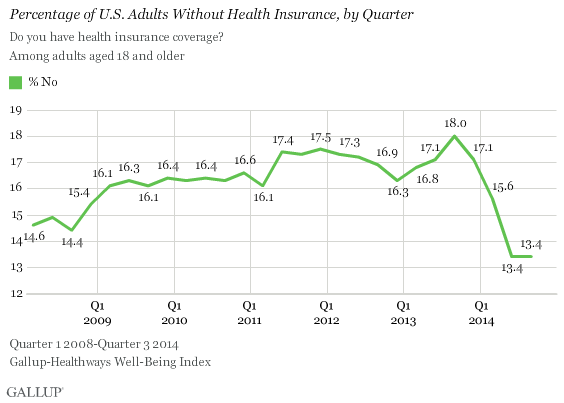
tiokvwh0cuopbz1n_gqvqg.png


Millions have health coverage who did not have it before. This law will save many many lives.

Dude... I'm sorry, but what that graph actually shows is that there has been a negligible increase in coverage from pre-ACA (2009... 14.4%) to now (13.4%). Whatever point you're trying to make, that graph illustrates the opposite. It shows that following the ACA being passed in 2010 companies started cutting people back from being full time employees (or not offering healthcare plans period) because they couldn't afford it, and that slowly but surely certain insurance companies started discontinuing coverage of other plans.

The best thing the ACA did was allow young people to stay on their parent's plans until 25. Besides that, the law didn't address the biggest issue with medical costs in this country... malpractice lawsuits and their corresponding insurance costs which gets passed on the patient. The fact that there was no tort reform in a bill that big is inexcusable. And it increased the deficit while lying about decreasing the deficit because all of the taxes to pay for it were deferred for years (a typical politician move).

In no way, shape, or form was it a good law. It's inefficient, bloated, and doesn't have a big impact at all except cost passed on to citizens... sorry... "1%" with "Cadillac plans", who aren't real people or something.
 

IrishinSyria

In truth lies victory
Messages
6,042
Reaction score
1,920
Dude... I'm sorry, but what that graph actually shows is that there has been a negligible increase in coverage from pre-ACA (2009... 14.4%) to now (13.4%). Whatever point you're trying to make, that graph illustrates the opposite. It shows that following the ACA being passed in 2010 companies started cutting people back from being full time employees (or not offering healthcare plans period) because they couldn't afford it, and that slowly but surely certain insurance companies started discontinuing coverage of other plans.

The best thing the ACA did was allow young people to stay on their parent's plans until 25. Besides that, the law didn't address the biggest issue with medical costs in this country... malpractice lawsuits and their corresponding insurance costs which gets passed on the patient. The fact that there was no tort reform in a bill that big is inexcusable. And it increased the deficit while lying about decreasing the deficit because all of the taxes to pay for it were deferred for years (a typical politician move).

In no way, shape, or form was it a good law. It's inefficient, bloated, and doesn't have a big impact at all except cost passed on to citizens... sorry... "1%" with "Cadillac plans", who aren't real people or something.

This seems wrong, or at least willfully pessimistic. The individual mandate -one of the "three legs" of the ACA- didn't come into effect until 2014 and there was a tiny little recession that started in late 2008 that explains the decline in % insured starting then better than passage of the ACA. Not to mention, the number is artificially high because so many states turned down federal money to expand Medicaid for purely political reasons.

I (and most liberals) agree that the ACA is not a great law. It is bloated, it is inefficient, and it is not the obvious single payer solution. It's based on the discredited idea that the free market can work in the healthcare industry (where demand is completely disconnected from cost). That being said, it has- and that graph does show- made things better on the margins.

Even if your explanation for the graph is 100% correct, it's still an absolute fact that people with low-quality plans today are in a better position than they were. Their plans are higher quality. They're less likely to get dropped by their insurance company if they get sick or hurt. And people in general are more free to take risks regarding employment because their health insurance isn't as coupled to their employment status (an absolutely absurd system).

Anyone criticizing Obamacare has to start from the point that the American healthcare system was an absolute disaster before it was passed. There is very little evidence that things have gotten worse.
 
Last edited:

IrishLax

Something Witty
Staff member
Messages
37,544
Reaction score
28,990
This seems wrong, or at least willfully pessimistic. The individual mandate -one of the "three legs" of the ACA- didn't come into effect until 2014 and there was a tiny little recession that started in late 2008 that explains the decline in % insured starting then better than passage of the ACA. Not to mention, the number is artificially high because so many states turned down federal money to expand Medicaid for purely political reasons.

Maybe I phrased it poorly to not explicitly state that the Great Recession was directly responsible for an initial uptick, but I didn't think that was necessary... it's irrelevant to the point I made, and it also doesn't serve as an explanation for the numbers in the slightest.

The recession in the United States officially lasted from Q3 2008 through Q2 2009. That 14.4% is right before the recession, and it's 16.1% by the time the recession is over. In terms of unemployment, that rate always lags behind the financial recession. Unemployment is a delayed response to market contractions. The peak unemployment was 10% in Q3 2009. At the time the maximum uncovered % on the graph (18% in Q3 2014) the unemployment rate was down to 7.2%.

You cannot explain the % of people uncovered by insurance continuing to climb while the unemployment rate decreases by 30% of it's value as being a product of the recession and unemployment. That is counterfactual and illogical.

My entire point is that the pre-recession number (14.4%) is very close to the post-full recovery and post-ACA number (13.4%) at both times the unemployment rate was roughly the same (roughly 6.1% in both Q3 2008 and Q3 2014... the two numbers I listed).

All numbers I just used are taken directly from the Bureau of Labor Satistics or the graph in question.

I (and most liberals) agree that the ACA is not a great law. It is bloated, it is inefficient, and it is not the obvious single payer solution. It's based on the discredited idea that the free market can work in the healthcare industry (where demand is completely disconnected from cost). That being said, it has- and that graph does show- made things better on the margins.

Even if your explanation for the graph is 100% correct, it's still an absolute fact that people with low-quality plans today are in a better position than they were. Their plans are higher quality. They're less likely to get dropped by their insurance company if they get sick or hurt. And people in general are more free to take risks regarding employment because their health insurance isn't as coupled to their employment status (an absolutely absurd system).

Anyone criticizing Obamacare has to start from the point that the American healthcare system was an absolute disaster before it was passed. There is very little evidence that things have gotten worse.

The first bolded is completely true. I agree with you.

The second bolded is patently false. The American healthcare system was NOT a disaster. First of all, American healthcare and Biotech is the seat for 95%+ of medical innovations and people from around the world wouldn't travel here for top-of-the-line care if it was "bad" or a "disaster."

The problem was access for an over-stated portion of the population, and cost to a large portion of the population. Towards access... those that think European universal healthcare (or in general, healthcare around the world) is "better" are out of touch with how those citizens feel. I can only speak intelligently on Italy, but over there the "public" healthcare doesn't work... so you end up needing to purchase private health insurance anyways if you want any kind of timely or quality care. Seems a bit redundant, no? And stats that simply look at mortality rates as indication that their healthcare alone is responsible for them living marginally longer ignore the dozens of other contributing factors to why Americans don't live as long... such as poor nutrition leading to diseases, dangerous jobs that don't exist in those countries, higher murder rates, black people with higher risk of heart disease, etc.

So while "access" is an easy issue to solve, access to good and timely healthcare is not.

And the ACA addressed prohibitive cost for some people, which was a step in the right direction. But the biggest reason our healthcare costs are stupid high is that our legal system allows anyone to sue for malpractice and win millions of dollars... which in turn require absurd cost of service to Joe Public to pay for these lawsuits. In no universe should someone be able to sue a doctor for $500k for "insulting" them while they were sedated... but in America you can. No tort reform in a bill that is 100s of pages long meant to address cost of healthcare for Americans is downright crazy.
 

IrishinSyria

In truth lies victory
Messages
6,042
Reaction score
1,920
Re: Tory reform, I absolutely agree with you. However, you want to talk about a nightmare project politically...
 

IrishLax

Something Witty
Staff member
Messages
37,544
Reaction score
28,990
Re: Tory reform, I absolutely agree with you. However, you want to talk about a nightmare project politically...

Yeah seriously... almost as untouchable as social security or guns... so easy to spin against someone who supports it.
 

IrishJayhawk

Rock Chalk
Messages
7,181
Reaction score
464
The main piece of the law is the health insurance exchange. They opened in October of 2013. At that time, the uninsured rate had peaked at 18%. So from the third quarter of 2013 (when people could officially start enrolling in the exchanges), the uninsured rate has dropped by 6.1%, or more than a third.

That's not a coincidence or just a sign of economic recovery (which is certainly happening as well). That's directly attributable to the law.

There's certainly a place to discuss tort reform. But it's not the panacea that many think. In 2009, the CBO estimated that we could save about 54 billion dollars over the next decade with tort reform...using my quick math skills, I'd guess that's about 5.4 billion a year. Worth pursuing? Sure.

But we spend about 3 trillion dollars on health care in a year. 5.4 billion is a drop in the bucket.

Additional Info:
It’s still an open question whether limiting liability saves lives. "Some recent research has found that tort reform may adversely affect such outcomes, but other studies have concluded otherwise," CBO said. The new UCLA/Rand study mentioned earlier found that a 10 percent reduction in costs related to medical malpractice liability would increase the nation’s overall mortality rate by 0.2 percent. It concluded that the savings in money would not be worth the cost in lives. But another study published in the March issue of the Journal of Health Economics, by health economists from Duke University and the University of North Carolina at Chapel Hill, concluded that "tort reforms" don’t have any significant effect on patient outcomes.
So while there is now clear evidence that limiting malpractice liability can save money, it’s not nearly as much as some proponents have claimed. And on the question of whether patients would suffer, the jury is still out.
–by Brooks Jackson

Malpractice: Savings Reconsidered
 
Last edited:

IrishLax

Something Witty
Staff member
Messages
37,544
Reaction score
28,990
The main piece of the law is the health insurance exchange. They opened in October of 2013. At that time, the uninsured rate had peaked at 18%. So from the third quarter of 2013 (when people could officially start enrolling in the exchanges), the uninsured rate has dropped by 6.1%, or more than a third.

Again, this just isn't an accurate way to look at the ACA and how it has/has not provided coverage to uninsured Americans relative to the old system.

The correct way to consider it is pre-recession coverage rate to current, post-ACA rate. They are within 1% of each per your graph. Phrased another way, the difference in covered Americans BEFORE Obama introduced his ACA plan and AFTER full rollout of exchanges is 1%. I haven't independently verified that your graph is accurate, but assuming it is then these facts are inarguable.

So either you consider 1% (or, in raw numbers, 3 million-ish people) now covered as a success... or you don't. Either opinion is fine.

But the opinion that the ACA has decreased the number of uninsured by 10s of millions is not valid.

That's not a coincidence or just a sign of economic recovery (which is certainly happening as well). That's directly attributable to the law.

The drop down from 18% to the 13% shown on the graph after the opening of the exchanges is completely attributable to the law. The continued rise in uncovered Americans following the persistent decline in unemployment in the country is only explicable through people losing their insurance for another reason... ergo, the 18% is an artificial number achieved only because companies started cutting health benefits or reducing hours to comply with the ACA; or people otherwise lost their coverage. So of course there is a raid drop from this artificial peak (18%) to the 13% number as soon as these people pushed off their previous plans enrolled on the exchanges.

The facts bear out that the "uncovered by insurance" rate from before Obama took office to post-ACA (per that graph) is very, very close.

There's certainly a place to discuss tort reform. But it's not the panacea that many think. In 2009, the CBO estimated that we could save about 54 billion dollars over the next decade with tort reform...using my quick math skills, I'd guess that's about 5.4 billion a year. Worth pursuing? Sure.

But we spend about 3 trillion dollars on health care in a year. 5.4 billion is a drop in the bucket.

Additional Info:


Malpractice: Savings Reconsidered

It's kind of strange looking at how the ACA has covered 1% more Americans from the "old system" is considered a significant victory, but a 2% drop in healthcare costs is somehow considered irrelevant or not a big deal.

If you took that 2% and just gave the poorest 2% of Americans (who couldn't afford coverage) free coverage paid for that by 2% it would be double as effective in providing people with healthcare as the ACA.

So if tort reform is a "drop in the bucket"... then the ACA is half a drop.
 
Last edited:
B

Buster Bluth

Guest
If we can agree that one of the biggest problems with our country is that Congress simply cannot pass a bill without the approval of their corporate/union donor daddies, couldn't we all quickly come to the conclusion that tort reform would resemble the wishes of the corporate elite and thus probably not a good idea? It's one thing to want reform, it's another to want corporations via their congressmen to be the ones reforming it. No?

I used to be in favor of tort reform until I read the views of guys like Ralph Nader. Now I think there are about a millions more important issues.
 

IrishJayhawk

Rock Chalk
Messages
7,181
Reaction score
464
It's kind of strange looking at how the ACA has covered 1% more Americans from the "old system" is considered a significant victory, but a 2% drop in healthcare costs is somehow considered irrelevant or not a big deal.

If you took that 2% and just gave the poorest 2% of Americans (who couldn't afford coverage) free coverage paid for that by 2% it would be double as effective in providing people with healthcare as the ACA.

So if tort reform is a "drop in the bucket"... then the ACA is half a drop.

5.4 billion is .18% of 3 trillion, not 2%.

Yes. 54 billion is a drop in the bucket. I didn't say it wasn't worth talking about. In fact, I said just the opposite. But it's a drop in the bucket.

The uninsured rate has dropped by 17.4%.

17.4 / .18 = 96.7 drops in the bucket. ;)
 
Last edited:

Bluto

Well-known member
Messages
8,146
Reaction score
3,979
If we can agree that one of the biggest problems with our country is that Congress simply cannot pass a bill without the approval of their corporate/union donor daddies, couldn't we all quickly come to the conclusion that tort reform would resemble the wishes of the corporate elite and thus probably not a good idea? It's one thing to want reform, it's another to want corporations via their congressmen to be the ones reforming it. No?

I used to be in favor of tort reform until I read the views of guys like Ralph Nader. Now I think there are about a millions more important issues.

This (money in politics) is the crux of just about every issue in the US right now. More people should look into Nader's work. It was quite pathetic how democrats demonized and attacked him during the 2000 and 2004 presidential campaigns.
 

Bishop2b5

SEC Exchange Student
Messages
8,928
Reaction score
6,159
I've long been in favor of term limits because of the effect that corporate money has on our elected officials. Too many of them, maybe most, from both sides of the aisle spend most of their time and base most of their votes on getting reelected, not doing what's best for the country or representing their constituency. Take away the incentive of reelection and the need to vote the way the money men who'll finance their campaigns want them to, and maybe we get better from our elected officials.

The founding fathers never meant for politics to be a profession. They meant for elected officials to be actual representatives of their community or state, do a few years of service/civic duty, and then go the hell back home. Being a senator or congressman for life leaves you very out of touch with the people you represent and too focused on doing what your big money backers tell you to do so you can win reelection instead of serving your constituency.
 

IrishLax

Something Witty
Staff member
Messages
37,544
Reaction score
28,990
5.4 billion is .18% of 3 trillion, not 2%.

Yes. 54 billion is a drop in the bucket. I didn't say it wasn't worth talking about. In fact, I said just the opposite. But it's a drop in the bucket.

The uninsured rate has dropped by 17.4%.

17.4 / .18 = 96.7 drops in the bucket. ;)

I was going off your article haha... you said in #16268 "here's a more recent study: http://www.latimes.com/business/hiltzik/la-fi-mh-another-study-shows-why-tort-reform--20140919-column.html"

In that article it says in the opening sentences
The notion has lived on despite copious evidence that that the so-called defensive medicine practiced by doctors merely to stave off lawsuits accounts for, at best, 2% to 3% of U.S. healthcare costs.... The researchers' conclusion is that defensive medicine accounts for about 2.9% of healthcare spending. In other words, out of the estimated $2.7-trillion U.S. healthcare bill, defensive medicine accounts for $78 billion.

I guess I should've multi-quoted that in my response as well, but that's the link I read and where I grabbed 2% from.

So where are we at now? 14.4 to 11.9 = 2.5% of the population = 8 million-ish people now covered under ACA than were covered under "old system"?

And 2.7 trillion dollars/320 million people = average of cost of $8,400 a person in this country for healthcare => $78 billion (from your article)/$8400 a head => 9.2 million people worth of healthcare cost could be saved through tort reform.

So the system-value of the ACA versus tort reform and just using the savings to subsidize poor people are pretty close.

Imagine if the ACA included tort reform? You're talking about substantially increasing the impact, reach, and overall good effect of the bill, IMO.
 

IrishJayhawk

Rock Chalk
Messages
7,181
Reaction score
464
I was going off your article haha... you said in #16268 "here's a more recent study: http://www.latimes.com/business/hiltzik/la-fi-mh-another-study-shows-why-tort-reform--20140919-column.html"

In that article it says in the opening sentences

I guess I should've multi-quoted that in my response as well, but that's the link I read and where I grabbed 2% from.

So where are we at now? 14.4 to 11.9 = 2.5% of the population = 8 million-ish people now covered under ACA than were covered under "old system"?

And 2.7 trillion dollars/320 million people = average of cost of $8,400 a person in this country for healthcare => $78 billion (from your article)/$8400 a head => 9.2 million people worth of healthcare cost could be saved through tort reform.

So the system-value of the ACA versus tort reform and just using the savings to subsidize poor people are pretty close.

Imagine if the ACA included tort reform? You're talking about substantially increasing the impact, reach, and overall good effect of the bill, IMO.

Heh. This is fun math.

You left out a few important parts of the study though. $78 billion is the total estimate for all defensive procedures.

However...

Any "tort reform" stringent enough to make that go away would likely create other costs, such as a rise in medical mistakes generated by the elimination of the oversight exercised by the court system.

...and...

The prevalence of defensive medicine may be overestimated by doctors themselves, Rothberg and his colleagues found, because many procedures are ordered in part defensively, but partially or mostly for legitimate diagnostic or therapeutic reasons. "Tort reform" would only eliminate orders made purely because of fear of litigation -- that is, 100% defensively -- and that's a tiny percentage of the total.

So only a "tiny percentage" of the $78 billion would be recovered through tort reform (maybe close to the 5 billion from the previous estimate?).

It's worth pursuing but it wouldn't reduce costs all that much.

CBO has also estimated that about 6 million more people will be covered in the next few years.

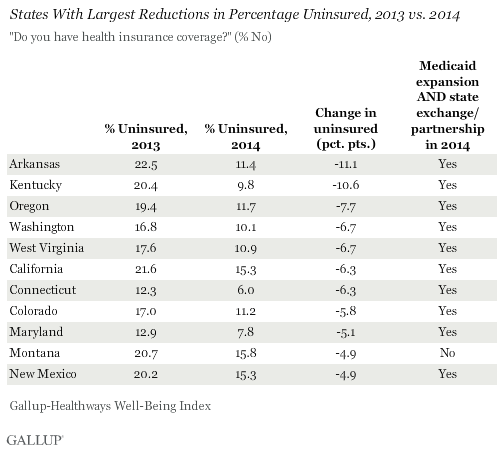
It's also worth noting that the states who have adopted exchanges and medicaid expansions have seen the largest drops. The ones who have fought the president have seen more modest reductions.

Arkansas, Kentucky See Most Improvement in Uninsured Rates

iathq3hfseoylghstlbfjg.png
 

IrishinSyria

In truth lies victory
Messages
6,042
Reaction score
1,920
I've long been in favor of term limits because of the effect that corporate money has on our elected officials. Too many of them, maybe most, from both sides of the aisle spend most of their time and base most of their votes on getting reelected, not doing what's best for the country or representing their constituency. Take away the incentive of reelection and the need to vote the way the money men who'll finance their campaigns want them to, and maybe we get better from our elected officials.

The founding fathers never meant for politics to be a profession. They meant for elected officials to be actual representatives of their community or state, do a few years of service/civic duty, and then go the hell back home. Being a senator or congressman for life leaves you very out of touch with the people you represent and too focused on doing what your big money backers tell you to do so you can win reelection instead of serving your constituency.

I have mixed feelings about term limits. At the end of the day, I think that senior politicians can accomplish a lot- they develop expertise in niche issues that a newcomer simply isn't going to have, and they have to be concerned with the log term effects of their actions. I think there are better ways to impose accountability on our politicians without using term limits.
 
B

Buster Bluth

Guest
I used to be big on term limits, but not anymore. California's state legislature is a shining example of how bad term limits can be.
 

pkt77242

IPA Man
Messages
10,805
Reaction score
719
Does anyone have info on whether or not doctors are accepting patients with Obamacare?

Why wouldn't they? How would a doctor even know?

You don't have "Obamacare" you have insurance through an insurance company.
 
Last edited:
Top