Politics

Politics

  • Obama

    Votes: 4 1.1%
  • Romney

    Votes: 172 48.9%
  • Other

    Votes: 46 13.1%
  • a:3:{i:1637;a:5:{s:12:"polloptionid";i:1637;s:6:"nodeid";s:7:"2882145";s:5:"title";s:5:"Obama";s:5:"

    Votes: 130 36.9%

  • Total voters
    352

Whiskeyjack

Mittens Margaritas Ante Porcos
Staff member
Messages
20,894
Reaction score
8,126
The NYT's Ross Douthat just published an article titled "Two Premises on Poverty and Culture":

The last time I followed certain of my colleagues into an argument about poverty, economics and culture, it took several thousand words to find my way back out. This time I’m going to try a briefer intervention, stressing again that I think conversations about policing are a more productive response to what’s happened in Baltimore than leaping up a level to the persistent right-left argument about the welfare state. But since that debate is happening no matter what, it might be helpful to describe a framework in which I think these arguments should take place, because quite often the two sides can’t even decide on where the argument should start. So here, for your consideration, are two premises about the last fifty years of American history.

1.) The modern welfare state has succeeded in substantially cutting our country’s poverty rate. This is a point that both right and left sometimes obscure, the right because it complicates a simple “we fought poverty, and poverty won” narrative about the Great Society, the left because it complicates claims that Reagan or Gingrich gutted welfare spending and crushed the fortunes of the poor. But the basic evidence seems very convincing: Whether it’s Scott Winship analyzing the numbers from the center-right or Harvard’s Christopher Jencks doing the same from the center-left, you can see dramatic reductions in the poverty rate since the 1960s, with various public programs, means-tested and otherwise, pretty clearly playing a substantial role. Per Jencks’ calculation, accounting for benefits and inflation correctly yields an estimated poverty rate of 19 percent in ’64 and just 5 percent in 2013; other adjusted calculations yield higher specific numbers, but pretty similar percentage declines. The details of how this decline happened and which programs mattered most obviously matter a great deal for policy. (Winship, for instance, argues pretty convincingly that the decline was more significant after the mid-’90s welfare reform). But overall the evidence that spending money on the poor can reduce poverty seems strong.

2.) The modern welfare state has not succeeded in producing clear improvements in opportunity, mobility and human flourishing. Recall that the hope for the Great Society’s social programs, from the vantage point of 1964, was not merely to raise the incomes of poorer Americans. Their architects also aspired (to quote the chief of them) to make America “a place where every child can find knowledge to enrich his mind and to enlarge his talents … where leisure is a welcome chance to build and reflect, not a feared cause of boredom and restlessness … where the city of man serves not only the needs of the body and the demands of commerce but the desire for beauty and the hunger for community.” And if you try to translate these soaring hopes to quantifiable indicators, the impact of public spending has not been at all what was hoped. The poor have more money, but their chances at upward mobility are persistently weak and basically unchanged relative to several generations ago. Schools have more money, but academic performance looks stagnant and big racial gaps endure. Cities have more money, but crime rates are only now returning to the levels of the early 1960s, and today’s peace has been purchased by incarceration on a scale that would have seemed horrific (because it is) a half-century ago. Low-income families are more likely to have health insurance, work supports, food stamps, housing assistance, and so on, but the families themselves are far more fragmented and the children are more likely to grow up fatherless than they were before the 1960s. And along other indicators of human flourishing suggested by L.B.J.’s soaring vision — community bonds, religious involvement, social trust, workforce participation, more — you can find a considerable amount of plausible evidence that everyday life in the lower classes is less “great” than it was when the poverty rate was higher.

These two realities, taken together, do not necessarily point toward either a left-wing or a right-wing diagnosis of our situation. You can acknowledge both realities and believe that the key issues are all economic, that the welfare state just needed to be even stronger still (and various other economic policies more worker-friendly) to make up for the devastating impact of global capitalism on wages and job security and the devastating social impact of rising inequality. Or you can acknowledge both and believe that the programs themselves are often part of the problem, that they raise incomes but also increase dependency, encourage idleness, crowd out the basic institutions of civil society, and so on through the libertarian critique. Or you can acknowledge both and argue (as I have, occasionally) that the cultural revolutions of the 1960s go a long way toward explaining how the poor in our era can have more money but less access to other basic human goods. (And therefore, because those goods are connected to economic advancement, less money than they might have had absent those revolutions.) Or you can talk, reasonably and non-ideologically, about the multiplicity of causes behind all broad-based social trends.

But I think just getting to the point where we could all agree that 1) public spending can make people less poor and 2) public spending hasn’t delivered on the Great Society’s social promises would be a big win for reasonable debate. Because that combination of realities, and the various questions that it raises, is why this argument exists, why it’s genuinely interesting, and why it isn’t going away anytime soon.
 

phgreek

New member
Messages
6,956
Reaction score
433
It couldn't have been that bad- they still had time to hassle conservative groups.

...and maybe I'm off, but it seems like everything I've read shows DoD among other organizations were CLOBBERED by sequestration...however others do a thing called prioritize...seems to me the IRS did some shuffling of funding, but seems not to have done a very thorough analysis regarding where to invest the time of agents...as pointed out earlier, a little thought and some process improvement could generally make fraud detection more effective w/o a huge manpower hit.

Its not that people aren't smart enough to do the process improvement...its that they thought they were so smart they'd make everyone feel the pain...I can only guess they thought people would rally to their representatives and clamor for the IRS to get more money...ERRRRR. Not going that way at all...and I have to laugh.

If a Republican gets elected President...look for Serious restructuring...the kind you do when you know the culture in an organization is basically shot.
 

dshans

They call me The Dribbler
Messages
9,624
Reaction score
1,181
Senate Dems block key Obama priority - CNNPolitics.com

I cannot believe Senate Democrats could be so racist!

UPDATE: Obama apparently overcoming racist Dems...

Obama trade bill revived after bipartisan deal sets new votes - Washington Times

I have a general policy of avoiding comment on matters such as this. I'm a raging lib'ral in no need of the aggravation and often petty tit and then tat that tends to ensue. Nothing is accomplished.

This has become fucking silly.

I'm more likely than not to support Democrats, but I am by no means "blinded by love." I like and appreciate much of what Obama has done but do not slavishly support each and every one of his decisions. TPP is one I think is ill-advised. As is his decision to green flag oil drilling off the coast of Alaska.

Some of his less-than-liberal moves are understandable in light of the practicality of "compromise politics." Bare, blind and banal intransigence can be a bitch. Considered opposition can be a boon when appropriately considered.

Let the the brickbats, slurs and Fox News parroted snippets begin ...
 

connor_in

Oh Yeeaah!!!
Messages
11,433
Reaction score
1,006
Just for the record, I took no stance on TPP. I merely decided to poke fun. As R's have opposed President Obama in the past it has been blamed simply on racism. By continuing that logic, it would follow that as D's oppose him, then they too must be racist.
 

connor_in

Oh Yeeaah!!!
Messages
11,433
Reaction score
1,006
<blockquote class="twitter-tweet" lang="en"><p lang="en" dir="ltr">The <a href="https://twitter.com/WhiteHouse">@WhiteHouse</a> just came out against ObamaCare. Wow. <a href="https://t.co/Oof5LbWFlw">https://t.co/Oof5LbWFlw</a></p>— RB (@RBPundit) <a href="https://twitter.com/RBPundit/status/598625470888976385">May 13, 2015</a></blockquote>
<script async src="//platform.twitter.com/widgets.js" charset="utf-8"></script>
 

irishff1014

Well-known member
Messages
26,509
Reaction score
9,284
Dumbass democrat rep alcee hastings said congress needs a raise. Because 174,000 isn't enough. Shm the people have lost their minds in DC.
 

pkt77242

IPA Man
Messages
10,805
Reaction score
719
Dumbass democrat rep alcee hastings said congress needs a raise. Because 174,000 isn't enough. Shm the people have lost their minds in DC.

While I don't love the idea of congressional pay raises, I am for the staff getting raises especially if this is true

Staffers are paid considerably less, with the average staff assistant on the Hill earning roughly $35,000 per year.
Congress wants a pay raise - CNNPolitics.com
How do you live in DC on 35K a year.
 

irishff1014

Well-known member
Messages
26,509
Reaction score
9,284
While I don't love the idea of congressional pay raises, I am for the staff getting raises especially if this is true


Congress wants a pay raise - CNNPolitics.com
How do you live in DC on 35K a year.


That's no different then me taking my dispatch job with the salary and benefits that I have. I knew that and took the job anyways same goes for them they knew what they were getting when the signed up.
 

Bishop2b5

SEC Exchange Student
Messages
8,927
Reaction score
6,157
While I don't love the idea of congressional pay raises, I am for the staff getting raises especially if this is true


Congress wants a pay raise - CNNPolitics.com
How do you live in DC on 35K a year.

The vast majority of those $35K staffers are student interns/flunkies, sons & daughters of rich supporters looking to fluff up their resume and make connections before applying to major law firms, people looking to make a career in politics and using those entry level jobs to make connections and move on soon to MUCH better paying positions, etc., etc., not secretaries and permanent office wonks struggling to live in DC on low pay.
 

Irish YJ

Southsida
Messages
25,888
Reaction score
1,444
The vast majority of those $35K staffers are student interns/flunkies, sons & daughters of rich supporters looking to fluff up their resume and make connections before applying to major law firms, people looking to make a career in politics and using those entry level jobs to make connections and move on soon to MUCH better paying positions, etc., etc., not secretaries and permanent office wonks struggling to live in DC on low pay.

This

I know 3 folks that took those low paying jobs. They are all disgustingly wealthy now.
 

phgreek

New member
Messages
6,956
Reaction score
433
The war that's been going on since the 80's that no one talks about:

http://www.nytimes.com/2015/05/20/t...heft-of-code-from-us-tech-companies.html?_r=0

6 Chinese Men Indicted in Theft of Code From U.S. Tech Companies

...having to tie it to the chinese government is a stupid requirement. It is theft, that theft has a significant impact to this country's economy...who gives a flying fuck if China can be tied in....BURN 'EM. They need to go to jail, and the assets of the joint venture need to be seized/demanded from China.
 

pkt77242

IPA Man
Messages
10,805
Reaction score
719
Study: Nearly 20% of college freshmen victims of rape - CNN.com

There is some limitations to the study as it only looks at one college, but unlike similar studies it follows them through their freshmen year instead of asking them about it a few years later.

This is the part that gets me

A stunning 28% of the women said they had been a victim of either an attempted or completed forcible or incapacitated rape before college, from the age of 14 through 18, according to the study. That number jumps to 37% for all women surveyed from the age of 14 through the start of their sophomore year.

That is a stunning number. Not only do our Universities need to do a better job at preventing and prosecuting rape but we as a country need to do a better job at raising our young men.
 
Last edited:

ACamp1900

Counting my ‘bet against ND’ winnings
Messages
48,944
Reaction score
11,225
I have to be honest, and I know this is a hard subject that I am absolutely taking serious, but again, in full honesty, those numbers are hard to believe... that's just crazy high, more than 1 in 4??
 

phgreek

New member
Messages
6,956
Reaction score
433
Pope's pronouncements making trouble for GOP Catholics - Ben Schreckinger - POLITICO

I thought this was fascinating just in a general religion-and-politics way. The Pope used to be a political liability, at least vis-a-vis certain types of voters, for Democratic Catholic politicians; increasingly, the current Pope is creating difficulties for Republican Catholic politicians.

"Earlier this month, Francis recognized Palestinian statehood. This summer, he’s going to issue an encyclical condemning environmental degradation. And in September, just as the GOP primary race heats up, Francis will travel to Washington to address Congress on climate change."

As a conservative, I don't see much here that puts my undies in a bunch. I disagree with the Pope making pronouncements not necessarily related to following the faith, but they do anyway...oh well. Point is, None of the stuff cited has any bearing on faith-related, doctrinal-type interpretation like Democrat "departures"...so much not even close to comparable IMHO.
 

EddytoNow

Vbuck Redistributor
Messages
1,481
Reaction score
235
Ireland Legalizes Same-Sex Marriage - Will the U.S.A. Follow Suit?

Ireland Legalizes Same-Sex Marriage - Will the U.S.A. Follow Suit?

Now that Ireland, one of the most conservative countries in the world and a country dominated by the teachings of the Catholic Church, has seen fit to legalize same-sex marriages, can the United States be far behind?

I suspect that Americans would vote the same way if given the opportunity. The Supreme Court should put an end to discrimination based upon who one chooses to love.
 

wizards8507

Well-known member
Messages
20,660
Reaction score
2,661
I suspect that Americans would vote the same way if given the opportunity. The Supreme Court should put an end to discrimination based upon who one chooses to love.
People don't vote on same sex marriage the way they poll. Even California voted not to allow it.

This should be a complete non-issue. The government should just delete the word "marriage" from its memory banks. Take judges and legislatures out of it entirely. Everyone wins.

Marriage privatization - Wikipedia, the free encyclopedia

Privatize Marriage | Cato Institute

In the debate over whether to legalize gay marriage, both sides are missing the point. Why should the government be in the business of decreeing who can and cannot be married? Proponents of gay marriage see it as a civil-rights issue. Opponents see it as another example of minority “rights” being imposed on the majority culture. But why should anyone have—or need to have—state sanction for a private relationship? As governments around the world contemplate the privatization of everything from electricity to Social Security, why not privatize that most personal and intimate of institutions, marriage?

“Privatizing” marriage can mean two slightly different things. One is to take the state completely out of it. If couples want to cement their relationship with a ceremony or ritual, they are free to do so. Religious institutions are free to sanction such relationships under any rules they choose. A second meaning of “privatizing” marriage is to treat it like any other contract: The state may be called upon to enforce it, but the parties define the terms. When children or large sums of money are involved, an enforceable contract spelling out the parties’ respective rights and obligations is probably advisable. But the existence and details of such an agreement should be up to the parties.

And privatizing marriage would, incidentally, solve the gay-marriage problem. It would put gay relationships on the same footing as straight ones, without implying official government sanction. No one’s private life would have official government sanction—which is how it should be.

Andrew Sullivan, one of the leading advocates of gay marriage, writes, “Marriage is a formal, public institution that only the government can grant.” But the history of marriage and the state is more complicated than modern debaters imagine, as one of its scholars, Lawrence Stone, writes: “In the early Middle Ages all that marriage implied in the eyes of the laity seems to have been a private contract between two families. … For those without property, it was a private contract between two individuals, enforced by the community sense of what was right.” By the 16th century the formally witnessed contract, called the “spousals,” was usually followed by the proclamation of the banns three times in church, but the spousals itself was a legally binding contract.

Only with the Earl of Hardwicke’s Marriage Act of 1754 did marriage in England come to be regulated by law. In the New England colonies, marriages were performed by justices of the peace or other magistrates from the beginning. But even then common-law unions were valid.

In the 20th century, however, government has intruded upon the marriage contract, among many others. Each state has tended to promulgate a standard, one-size-fits-all formula. Then, in the past generation, legislatures and courts have started unilaterally changing the terms of the marriage contract. Between 1969 and 1985 all the states provided for no-fault divorce. The new arrangements applied not just to couples embarking on matrimony but also to couples who had married under an earlier set of rules. Many people felt a sense of liberation; the changes allowed them to get out of unpleasant marriages without the often contrived allegations of fault previously required for divorce. But some people were hurt by the new rules, especially women who had understood marriage as a partnership in which one partner would earn money and the other would forsake a career in order to specialize in homemaking.

Privatization of religion—better known as the separation of church and state—was our founders’ prescription for avoiding Europe’s religious wars. Americans may think each other headed for hell, but we keep our religious views at the level of private proselytizing and don’t fight to impose one religion by force of law. Other social conflicts can likewise be depoliticized and somewhat defused if we keep them out of the realm of government. If all arts funding were private (as 99 percent of it already is), for instance, we wouldn’t have members of Congress debating Robert Mapplethorpe’s photographs or the film The Watermelon Woman.

So why not privatize marriage? Make it a private contract between two individuals. If they wanted to contract for a traditional breadwinner/homemaker setup, with specified rules for property and alimony in the event of divorce, they could do so. Less traditional couples could keep their assets separate and agree to share specified expenses. Those with assets to protect could sign prenuptial agreements that courts would respect. Marriage contracts could be as individually tailored as other contracts are in our diverse capitalist world. For those who wanted a standard one-size-fits-all contract, that would still be easy to obtain. Wal-Mart could sell books of marriage forms next to the standard rental forms. Couples would then be spared the surprise discovery that outsiders had changed their contract without warning. Individual churches, synagogues, and temples could make their own rules about which marriages they would bless.

And what of gay marriage? Privatization of the institution would allow gay people to marry the way other people do: individually, privately, contractually, with whatever ceremony they might choose in the presence of family, friends, or God. Gay people are already holding such ceremonies, of course, but their contracts are not always recognized by the courts and do not qualify them for the 1049 federal laws that the General Accounting Office says recognize marital status. Under a privatized system of marriage, courts and government agencies would recognize any couple’s contract—or, better yet, eliminate whatever government-created distinction turned on whether a person was married or not.

Marriage is an important institution. The modern mistake is to think that important things must be planned, sponsored, reviewed, or licensed by the government. The two sides in the debate over gay marriage share an assumption that is essentially collectivist. Instead of accepting either view, let’s get the government out of marriage and allow individuals to make their own marriage contracts, as befits a secular, individualist republic at the dawn of the information age.
 
Last edited:

IrishJayhawk

Rock Chalk
Messages
7,181
Reaction score
464
People don't vote on same sex marriage the way they poll. Even California voted not to allow it.

This should be a complete non-issue. The government should just delete the word "marriage" from its memory banks. Take judges and legislatures out of it entirely. Everyone wins.

Not sure the voting would be the same now, though I can't recall when the CA vote happened (EDIT: It was 2008. A lot has changed in the public view since then). This issue has really changed since Karl Rove used it as a wedge issue in 2004.

That said, I generally agree that marriage can be a religious institution and civil union can be a governmental institution. But we're not going to un-ring the bell. The state issues marriage licenses. I think they'll continue to do so.
 
B

Buster Bluth

Guest
"Earlier this month, Francis recognized Palestinian statehood. This summer, he’s going to issue an encyclical condemning environmental degradation. And in September, just as the GOP primary race heats up, Francis will travel to Washington to address Congress on climate change."

As a conservative, I don't see much here that puts my undies in a bunch. I disagree with the Pope making pronouncements not necessarily related to following the faith, but they do anyway...oh well. Point is, None of the stuff cited has any bearing on faith-related, doctrinal-type interpretation like Democrat "departures"...so much not even close to comparable IMHO.

There's plenty there to piss off the GOP's mainline though. They're freakishly pro-Israel, want to remove the EPA, and call climate change a hoax propagated by liberal scientists. Those positions are so entrenched that moderates in the party simply cannot criticize Israel for anything and must dodge global warming questions.
 

wizards8507

Well-known member
Messages
20,660
Reaction score
2,661
"Earlier this month, Francis recognized Palestinian statehood. This summer, he’s going to issue an encyclical condemning environmental degradation. And in September, just as the GOP primary race heats up, Francis will travel to Washington to address Congress on climate change."

As a conservative, I don't see much here that puts my undies in a bunch. I disagree with the Pope making pronouncements not necessarily related to following the faith, but they do anyway...oh well. Point is, None of the stuff cited has any bearing on faith-related, doctrinal-type interpretation like Democrat "departures"...so much not even close to comparable IMHO.
Agreed. It would be like the Pope saying he was a Dodgers fan and then Giants fans getting all pissed off about it. His infallibility doesn't extend to domains outside the Faith.
 

NDgradstudent

Banned
Messages
2,414
Reaction score
165
Now that Ireland, one of the most conservative countries in the world and a country dominated by the teachings of the Catholic Church, has seen fit to legalize same-sex marriages, can the United States be far behind?

Are you talking about Ireland from 30 years ago, or Ireland today? It has completely secularized, like the rest of the Europe. As Damian Thompson notes, hatred of the Church is a central feature of modern Ireland. It is not a particularly conservative nor important country these days. Europe as a region is engaged in spectacular self-immolation, and generally serves a model of what not to do.

I suspect that Americans would vote the same way if given the opportunity.

We will never know, will we? Americans have voted in most states, and in most cases have voted to reject same-sex marriage. But you want the Supreme Court to foist it upon the country. Is the Court supposed to guess the future, and read some public opinion polls, and make decisions on that basis? Why have a legislature at all, if that is the Court's function?

The Supreme Court should put an end to discrimination based upon who one chooses to love.

If I choose to "love" a sibling, or parent, or under-age person, or multiple people, etc., the government "discriminates" against me. How sustainable is that discrimination? Expect those lawsuits the day after the Supreme Court installs same-sex marriage.
 

dshans

They call me The Dribbler
Messages
9,624
Reaction score
1,181
Anecdotal I know, but here's a rundown of events that took place in Minnesota within a (roughly) one year span:

A Minnesota Same-Sex Marriage Amendment, Amendment 1, was on the November 6, 2012 ballot in Minnesota as a legislatively-referred constitutional amendment, where it was defeated.[1] The measure would have defined marriage in the Minnesota Constitution as between one man and one woman in the state.[2]
Unlike previous, unsuccessful attempts to place a marriage amendment on the ballot, the 2012 measure may leave open the possibility of same-sex civil unions.[3]

Following the public's defeat of the amendment, the legislature renewed a push to repeal the state's existing statutory ban on same-sex marriage. On May 14, 2013, Gov. Mark Dayton signed into law a bill that allows same-sex couples to officially marry beginning in August. The governor's signature came just one day after it was passed by the Senate, and about a week after the House's approval.

The turn around surprised and pleased the hell out of me.

My son (soon to be 27) and the vast majority of his friends, acquaintances over the years don't really understand the kerfuffle. I don't either as an old fart. It's the old "Live and let live" credo.

I like to think that I passed some of the better traits of my hippiedom along. Who knows?
 

wizards8507

Well-known member
Messages
20,660
Reaction score
2,661
My son (soon to be 27) and the vast majority of his friends, acquaintances over the years don't really understand the kerfuffle. I don't either as an old fart. It's the old "Live and let live" credo.
But it's not "live and let live." "Live and let live" is marriage privatization. A law mandating that gay marriage be legal is just as much an overreach as one banning it. "Live and let live" is not "live and endorse, authorize, and promote by force of law."
 
B

Buster Bluth

Guest
Are you talking about Ireland from 30 years ago, or Ireland today? It has completely secularized, like the rest of the Europe. As Damian Thompson notes, hatred of the Church is a central feature of modern Ireland. It is not a particularly conservative nor important country these days.

And yet poll after poll sets them distinctly apart from their northern European brethren when it comes to belief in god. They're among the most religious in Europe.

10-03-29_belief3.png


And when has Ireland ever been an "important country?"

Europe as a region is engaged in spectacular self-immolation, and generally serves a model of what not to do.

Uh huh. Nothing quite like generalizing a diverse group of cultures and countries totaling more than half a billion people with a GDP that exceeds the US.

Save the response. Yes, I know Europe has serious issues. Who doesn't? I'm sure you'll overstate the issues that fit your world view. Save your finger strength.

We will never know, will we? Americans have voted in most states, and in most cases have voted to reject same-sex marriage. But you want the Supreme Court to foist it upon the country. Is the Court supposed to guess the future, and read some public opinion polls, and make decisions on that basis? Why have a legislature at all, if that is the Court's function?

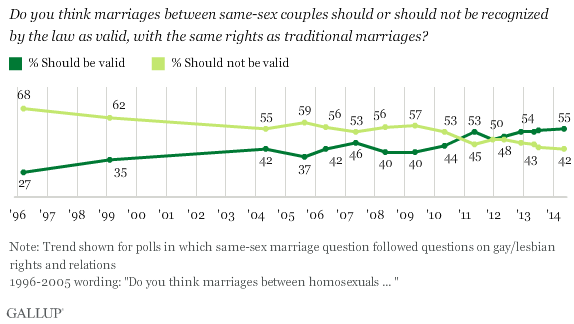
As I've previously shown you, those votes were largely when the public wasn't in favor of gay marriage and those stances are changing rapidly. It's also rather irrelevant considering the court is considering the law under equal protection (no?) and so the people can be wrong (see: slavery, Jim Crow, etc).

y0ffodnhgeejsgoevfw40w.png


If I choose to "love" a sibling, or parent, or under-age person, or multiple people, etc., the government "discriminates" against me. How sustainable is that discrimination? Expect those lawsuits the day after the Supreme Court installs same-sex marriage.

Those aren't even remotely the same thing, and those lawsuits wouldn't stand a chance in court.
 
Last edited:

phgreek

New member
Messages
6,956
Reaction score
433
There's plenty there to piss off the GOP's mainline though. They're freakishly pro-Israel, want to remove the EPA, and call climate change a hoax propagated by liberal scientists. Those positions are so entrenched that moderates in the party simply cannot criticize Israel for anything and must dodge global warming questions.

I think you could say I live in a conservative bastian/fly-over state.

I hear no one seriously discussing disbanding the EPA or the IRS for that matter. I do hear alot of discussions regarding how to balance decent environmental stewardship w/ business concerns. I also hear alot of discussion about establishing a new IRS. IRS is a far bigger problem from a cultural perspective than the EPA...I still know a number of Scientists within the EPA, and they are still in pursuit of science.

The IRS has a cultural problem necessitating wholesale dismissals and realignments. No question in my mind, however there would still be an IRS. Again most people I know see it that way...although many want a chunk of Lerner's scalp.

As for Israel, again my sense is, they are supposed to be an ally...and that seems not to be clear. Yes I've read the info about the Israel lobby, and no I don't believe the issues of influence are as extensive as many believe. Most conservatives here, that I know share that sentiment.

As for climate change... As I've said before I'm not a denier, but I'm not freakin Al Gore either. I am largely concerned because the money goes to those supporting climate change narratives, and not to those with a hypothesis ranging from "not Armageddon" to "not true at all". So there is a natural selection occurring that stifles scientific pursuits that explore the possibility climate change is exaggerated or false. Most conservative people here believe there is some level of human impact, but do not drink the Koolaid.

Maybe Utah isn't representative of other conservatives, but I just don't experience this GOP mainline as you describe it. I guess I need to get out more.
 

pkt77242

IPA Man
Messages
10,805
Reaction score
719
I think you could say I live in a conservative bastian/fly-over state.

I hear no one seriously discussing disbanding the EPA or the IRS for that matter. I do hear alot of discussions regarding how to balance decent environmental stewardship w/ business concerns. I also hear alot of discussion about establishing a new IRS. IRS is a far bigger problem from a cultural perspective than the EPA...I still know a number of Scientists within the EPA, and they are still in pursuit of science.

The IRS has a cultural problem necessitating wholesale dismissals and realignments. No question in my mind, however there would still be an IRS. Again most people I know see it that way...although many want a chunk of Lerner's scalp.

As for Israel, again my sense is, they are supposed to be an ally...and that seems not to be clear. Yes I've read the info about the Israel lobby, and no I don't believe the issues of influence are as extensive as many believe. Most conservatives here, that I know share that sentiment.

As for climate change... As I've said before I'm not a denier, but I'm not freakin Al Gore either. I am largely concerned because the money goes to those supporting climate change narratives, and not to those with a hypothesis ranging from "not Armageddon" to "not true at all". So there is a natural selection occurring that stifles scientific pursuits that explore the possibility climate change is exaggerated or false. Most conservative people here believe there is some level of human impact, but do not drink the Koolaid.

Maybe Utah isn't representative of other conservatives, but I just don't experience this GOP mainline as you describe it. I guess I need to get out more.

It is hard to know how many people actually want to get rid of the EPA and IRS but Ted Cruz has publicly stated that he wants to get rid of the IRS and this article from 2011 talks about the then Republican Presidential candidates and the EPA (http://www.nytimes.com/2011/08/18/us/politics/18epa.html?_r=0). I don't think that those positions are necessarily representative of how the majority of Republicans feel.
 
Top