Foreign Policy

Legacy

New member
Messages
7,871
Reaction score
321
U.S. Military Budget: Components, Challenges, Growth
There's $250 Billion in Hidden Military Spending


The U.S. military budget is $773.5 billion. That's the budget for Fiscal Year 2017 (October 1, 2016 through September 30, 2017). There are four components. First is the Department of Defense (DoD) base budget ($523.9 billion). Second is the Overseas Contingency Operations (OCO) for DoD to fight ISIS ($58.8 billion).

But there's more to military spending than the Department of Defense. Many other agencies are involved with protecting our nation.

These expenses total $175.9 billion. They include the Department of Veterans Affairs ($75.1 billion), the State Department ($37.8 billion), Homeland Security ($40.6 billion), FBI and Cybersecurity in the Department of Justice ($9.5 billion), and the National Nuclear Security Administration in the Department of Energy ($12.9 billion). There is also $14.9 billion in OCO funds for the State Department and Homeland Security to fight ISIS. (Source: "Mid-Session Review Fiscal Year 2017, Table S-10." "2017 Budget, Summary Tables, Table S-11," Office of Management and Budget.)

Defense Department Base Budget

DoD requested $523.9 billion, slightly higher than last year's $521.7 billion appropriation. It seeks to:

1. Continue retirement and healthare (TRICARE) reforms. If you include subsidized housing, free healthcare, and the other benefits military personnel receive, the average compensation works out to $59,000 for enlisted personnel and more than $108,000 for officers. ....
 
Last edited:

MJ12666

New member
Messages
794
Reaction score
60

So to reduce DoD spending the author states in the article that the DoD "must reduce pay and benefits costs for each soldier".

Great idea, have the DoD charge military personnel rent for staying in a barracks or tents when deployed and have them purchase their own healthcare insurance to cover the cost of medical expenses that may be incurred as a result of getting shot or injured by an exploding IED.

Personally I think the author should volunteer to spend 6 months on the front lines in Iraq and see what they have to say about getting "subsidized housing and free healthcare".

Honestly, what an idiot.
 

Legacy

New member
Messages
7,871
Reaction score
321
From article linked above:
DoD Tries to Save Money, But Congress Won't Let It
The Defense Department knows it needs to become more efficient. It now spends a third of its budget on personnel and maintenance. That will rise to 100% by 2024, thanks to retirement and medical costs. That leaves no funds for procurement, research and development, construction, or housing. These necessary support programs now take up more than a third of DoD's budget. (Source: "Pay Will Swallow DoD Budget by 2024," Center for Strategy and Budgetary Assessments, April 8, 2013.)

How could the DoD become more efficient? First, it needs to rationally reduce its civilian workforce, which grew by 100,000 in the last decade, instead of resorting to hiring freezes and unpaid furloughs. Second, it must reduce pay and benefits costs for each soldier. Instead, it plans to raise both.

Third, and most important, it should close unneeded military bases. By its own estimates, the DoD is operating with 21% excess capacity in all its facilities. However, Congress won't allow it. The Bi-Partisan Budget Act of 2013 blocked future military base closings. Few elected officials are willing to risk losing local jobs caused by base closures in their states. The Pentagon will be forced to reduce the number of actual soldiers so it can afford these benefits. (Source: "Pentagon Lays Out Way to Slash Spending," The Wall Street Journal, August 1, 2013.)

As noted in Post 371, President-elect Trump would increase troops by 108,000 in addition to increases in military spending in other categories. As noted in posts on costs increases in VA diasability and VA spending with future projections, these will have real impacts on future spending, ability to counter threats to security and the economy.
 
Last edited:

Legacy

New member
Messages
7,871
Reaction score
321
If one was looking to save taxpayers, which amounts to $16,000 per person since 1996, you would look at waste in the military.

Waste, Greed, and Fraud: The Business that Makes the World’s Greatest Army (Harvard Political Review, Feb 2016)

Lockheed Martin’s C-130 Hercules aircraft has been used by the U.S. Military for four decades. The spacious transport plane can accommodate utility helicopters and six-wheeled armored vehicles and can airdrop up to 42,000 pounds. The company boasts that “there is no aircraft in aviation history … that can match the flexibility, versatility and relevance of the C-130J Super Hercules.” Four of these $30 million planes have been gifted to the Afghan Air Force (AAF) with Pentagon dollars to aid the Americans in protecting the region. There’s only one problem: according to the Special Inspector for Afghan Reconstruction, General John Sopko, the planes are underutilized and ridden with support problems due to lack of training, spare parts, and maintenance.

The narrative of mass waste and a misallocation of American taxpayer dollars runs deep throughout post-9/11 military spending. Of the billions that have been poured into bolstering the United States and allied militaries, much has gone towards a broken military contracting system that is riddled with fraud and authoritative negligence. Now that the United States is once again becoming more involved in the Middle East in order to combat the threat of ISIS, it is unclear when or if the leaky contracting system will be plugged in the near future.

The Middle Eastern Money Pit

Although Department of Defense officials provided some documents to show that the Department consulted experts and performed analyses to identify the aircraft best suited for medium airlift operations, they provided no documentation to Sopko to explain why they chose the C-130. In fact, one of the U.S. Air Force’s analytical teams that assists in choosing equipment for the AAF highlighted the C-130’s cost and complexity as reasons why the aircraft would not be appropriate for the AAF, calling it an “empty asset” for the Afghans.

Further investigations into military spending in the Middle East shed light on similar stories that underscore the depth of the waste that permeates the system. In an interview with the HPR, William Hartung, the Center for International Policy’s Arms and Security Project Director, stated that there is an “excess of usable military equipment relative to any possible need.” In addition to unused aircrafts and helicopters rusting on tarmacs in Afghanistan, parts ripped from working equipment and sold at junkyards, and about 410 tons of functional equipment incinerated in burn pits daily, Hartung said that authorities and contractors have been reckless with their own products. “They’re doing things like destroying perfectly useful items,” he explained. “They also lose track of things. They destroy ammunition that is still functional, and they retire things early.”

How did we get to this point? In the years following the 9/11 attacks, the United States and its allies have fought a continuous war on terror. The taxpayer tab for the war totals about $5 trillion, or $16,000 per person, according to Brown University’s Watson Institute for International Studies. This was, according to Hartung, the “biggest Pentagon spending buildup in history since World War II.” This spending has not only gone into strengthening the U.S. military itself, but also to improving the allied Afghan, Iraqi, and neighboring Middle Eastern security forces. The idea has been to arm Middle Eastern countries to enable them to secure their own territories...

With $8.5 Trillion Unaccounted for, Why Should Congress Increase the Defense Budget? (Fiscal Times, March 2015)

The U.S. military is good at fighting wars, but it sucks at managing money. Partly because of its convoluted bookkeeping systems, $8.5 trillion—yes, trillion—taxpayer dollars doled out by Congress since 1996 has never been accounted for.

That was also the first year that Congress passed a law requiring the Defense Department to be audited, which it has failed to do. In 2009, Congress passed another law requiring the DOD to be audit-ready by 2017. After spending—no wasting—billions on failed accounting software, the department is likely to miss that deadline, too.

So how does the military handle their books for the U.S. Treasury department? They cheat.

A scathing investigative report by Reuters in November 2013 described how an accountant at DOD in Cleveland would face the same monthly problem: Missing numbers, wrong numbers -- numbers with no explanation of where they came from or what they were for. To rectify the problem, the accountant was instructed to “plug” in false numbers in the DOD’s books...
 
Last edited:

Legacy

New member
Messages
7,871
Reaction score
321
The new scramble for Africa: how China became the partner of choice (The Guardian)

Addis Ababa has a surprise in store for those who haven’t visited in two years. Cutting through the heart of this booming city, where construction cranes are the most persistent feature of the skyline, is the Addis Ababa Light Rapid Transit (AALRT) network. It rears up suddenly at Meskel Square, which until 2013 gazed out onto an expanse of chaotic traffic. The traffic now bustles beneath the shadow of what is only the second metro ever built south of the Sahara.

On the back of the green and white trains that trundle up and down the line are not one, but two logos: the Ethiopian Railways Corporation, and, next to it, the logo of the giant state-owned China Railway Group (CREC).

How did China get involved in developing an African metropolis that westerners tend to associate with famine and death? And this is just one project among many across the continent. In 2014 alone, China signed more than £56bn in construction contracts across Africa. Since the turn of the century, Chinese firms have built stadiums, highways, airports, schools, hospitals and, in Angola, an entire city that still stands empty. China has pumped hundreds of billions of dollars into African governments and infrastructure. In return, it has reaped hundreds of billions in commodities.

How and Why China Became Africa’s Biggest Aid Donor (Huffington Post)

China pledged to invest $60 billion in Africa. Here’s what that means. (Washington Post)

China’s President Xi Jinping pledged $60 billion to African states. What does that mean exactly?

This isn’t aid in the traditional sense. Most of the announced $60 billion will come in loans and export credits. Only $5 billion is to arrive as grants and interest-free loans.

Right now, outsiders know very little about just how that committed $55 billion will be spent. China has announced the general outline of its commitments. For instance, $35 billion will go towards preferential loans, export credits, and concessional loans. Another $5 billion will go to the China-Africa Development Fund, a private equity and venture capital investment arm of the China Development Bank that has a lot of problems finding bankable projects.There’s $5 billion for the Special Loan for the Development of African SMEs, another financial vehicle implemented by the China Development Bank that operates on a commercial basis. Finally, $10 billion will create and offer the initial capital for the China-Africa production capacity cooperation fund, which might be an entirely new project — but we are not completely sure.As others have explained in the Monkey Cage before, Chinese aid differs from OECD-defined official development assistance and is often tangled with other financial commitments.


Massive €6.8bn investment quota grant from China to Ireland 'key milestone in economic relations' (Business Irish)

China set to rescue Australia's economy at just the right time (Financial Times)
 
Last edited:

Legacy

New member
Messages
7,871
Reaction score
321
The Navy's littoral combat ships

The Navy's littoral combat ships

The Navy accepted delivery of the USS Gabrielle Giffords, named after the former congresswoman, which is one of the littoral combat ships built by Lockheed Corp and Austal Ltd. Congress has spent $12.4 billion on the littoral ship program, which was expected to be able to counteract mines in offshore waters by 2008. Congress has bought 26 ships, which have been plagued by cost overruns, design failures and changes, breakdowns and mishaps. Originally slated to cost $220 million per ship, the Gifford and the others now cost $475 million per ship.

Of first four littoral ships, the USS Freedom, and USS Coronado (LCS 4) had breakdowns. The Coronado, for instance, had a failure of a part in its propulsion system while in transit from Hawaii to Singapore later identified “shaft misalignment”. The USS Fort Worth (LCS 3) and USS Milwaukee (LCS 5) also had mechanical failures due to design.
The US Navy recently announced a major overhaul of the program that will include designating the first four of the ships as testing vessels and limiting their overseas deployments to emergencies. Navy attributed the series of engineering casualties on delivered LCS to shortfalls in crew training, seaframe design, and construction quality.

Sen McCain has called the littoral ship program as the most egregious example of what he calls "America's Most Wasted: Indefensible" and "an unfortunate and classic example" of defense acquisition gone awry." McCain said that we "simply cannot afford to waste our precious defense dollars on unnecessary or poorly performing programs".

The Navy is asking Congress to buy twelve more littoral ships in a frigate block buy prior to further review of redesign changes and demonstration of combat capabilities. In a recent report, the GAO has warned that
Soon, Congress will be asked to make key decisions that have significant
funding and oversight implications, but without having important information. The
Navy plans to request fiscal year 2018 authorization for its frigate block buy
approach. Of note, the pricing the Navy intends to seek from the shipyards will
be for 12 basic LCS. Only later will the shipyards submit their proposals for
adding frigate capabilities to the LCS hulls. Congress will be asked to authorize
this approach many months before the Department of Defense (DOD) prepares
an independent cost estimate. Further, there is no industrial base imperative to
continue with the Navy’s planned pace for the frigate acquisition.
LCS workload
backlogs, when combined with 2 LCS awarded earlier in 2016 and 2 more
planned for award in fiscal year 2017, will take construction at both shipyards
into 2021.

Also, congressional investigators (GAO) recently determined that the Navy, not the builders, must pay “for the vast majority of defects” on its Littoral Combat Ship
because the Navy didn’t require warranties that would force contractors to pay many of the costs, as the U.S. Coast Guard does, the Government Accountability Office said in a statement delivered at a congressional hearing Thursday.

Navy Vice Adm. Thomas Rowden, commander of Naval Surface Forces, defended the program to the House Armed Services Committee earlier this month, said:
"We're learning about the issues. We're learning about how to maintain it, and going forward, I am 100 percent confident that we'll tackle those issues and we'll defeat them. There is still much work to be done to fully unlock the significant potential of these ships."

Sen McCain says the ships "may yet deliver some capability," but as currently configured it has "no proven combat capability."

The Navy's $21 Billion Littoral Combat Ship Program Is Taking on Water (Fiscal Times)

With engineering problems dogging the U.S. Navy’s newest class of combat vessel, the $21 billion littoral combat ship (LCS) program, the brass first had the multimillion-dollar ships and their crews stand down and now has ordered retraining and an overall design review.
 
Last edited:

phgreek

New member
Messages
6,956
Reaction score
433
The Navy accepted delivery of the USS Gabrielle Giffords, named after the former congresswoman, which is one of the littoral combat ships built by Lockheed Corp and Austal Ltd. Congress has spent $12.4 billion on the littoral ship program, which was expected to be able to counteract mines in offshore waters by 2008. Congress has bought 26 ships, which have been plagued by cost overruns, design failures and changes, breakdowns and mishaps. Originally slated to cost $220 million per ship, the Gifford and the others now cost $475 million per ship.

Of first four littoral ships, the USS Freedom, and USS Coronado (LCS 4) had breakdowns. The Coronado, for instance, had a failure of a part in its propulsion system while in transit from Hawaii to Singapore later identified “shaft misalignment”. The USS Fort Worth (LCS 3) and USS Milwaukee (LCS 5) also had mechanical failures due to design.
The US Navy recently announced a major overhaul of the program that will include designating the first four of the ships as testing vessels and limiting their overseas deployments to emergencies. Navy attributed the series of engineering casualties on delivered LCS to shortfalls in crew training, seaframe design, and construction quality.

Sen McCain has called the littoral ship program as the most egregious example of what he calls "America's Most Wasted: Indefensible" and "an unfortunate and classic example" of defense acquisition gone awry." McCain said that we "simply cannot afford to waste our precious defense dollars on unnecessary or poorly performing programs".

The Navy is asking Congress to buy twelve more littoral ships in a frigate block buy prior to further review of redesign changes and demonstration of combat capabilities. In a recent report, the GAO has warned that


Also, congressional investigators (GAO) recently determined that the Navy, not the builders, must pay “for the vast majority of defects” on its Littoral Combat Ship

Navy Vice Adm. Thomas Rowden, commander of Naval Surface Forces, defended the program to the House Armed Services Committee earlier this month, said:


Sen McCain says the ships "may yet deliver some capability," but as currently configured it has "no proven combat capability."

The Navy's $21 Billion Littoral Combat Ship Program Is Taking on Water (Fiscal Times)

I'll keep pointing to the impact of forcing these companies to structure their delivery in a certain way coupled with having acquisition "professionals" who have no fucking common sense.

Pull the award and I'll bet you dollars to donuts there is AT LEAST a 25% small and small disadvantaged business requirement. When you force that issue, you build in failure..PERIOD. As well I'll also bet you if you do a full, comprehensive audit of pre-aquistion, you will find people developing requirements were heavily influenced by lobyists...ie you should want what I can do, not what you need. Also, I would bet in an audit (Hillary email style) you'd find engineers who indicated they saw failures coming as they evaluated proposals...but that feedback was stomped on because it is LEGAL for congress to meddle like that in these major acquisitions.

Look, this is real easy...Hire aquisition staff and pay them extraordinarily well. BUT, make sure they understand ALL communications will be monitored (no lobyists). Next make the requirements locked down upon RFP. Next, forbid ANY congressional interface until LRIP is complete. Next, SCHEDULE system modernization as its own "spiral" before you go production. No change orders and chasing technology advancements until your shit at least meats the initial requirements. The thing is, you cannot deliver engineering excellence when polititions and lobyists influence so many of the key factors defining success...John McCain knows this, and will not just fucking say it.
 

Legacy

New member
Messages
7,871
Reaction score
321
Along phgreek's recommendations,

Donald Trump wants to start the biggest Navy build-up in decades (Navy Times)

Donald Trump has pledged that he'll lead the biggest U.S. Navy build-up since the Reagan administration, but the details on what's likely to be an expensive and potentially decades-long effort remain to be seen.

Trump vowed to build the 350-ship fleet Republican defense hawks have long sought and reverse decades of fleet contraction which has yielded today's battle force of 272 ships. And while the politics of large increases to the defense budget are dicey in the best of times, Trump sees a naval build-up as part of his agenda to create jobs, according to an October internal Trump campaign memo obtained by Navy Times.

Trump Would Get the 350 Ships He Wants Under Navy’s New Plan (Bloomberg)

Cost remains the biggest impediment: The nonpartisan Congressional Research Service estimates a 350-ship Navy would cost an average $4 billion extra annually over the current forecast of about $16.3 billion a year for new ship construction through 2021. The current budget calls for eight new vessels in fiscal 2018; seven in fiscal 19; and eight each in 2020 and 2021.

Defense budget caps that remain in place for fiscal 2018 to 2021 under the 2011 Budget Control Act would constrain a naval build-up. The Pentagon faces about $106.6 billion in potential cuts from its current budget projections -- starting with $33.6 billion in fiscal 2018.

I've previously posted on the military hawks in Congress wanting to remove the military from the Balanced Budget cap restraints. (Post 345)

Pentagon Tells Congress to Stop Buying Equipment it Doesn't Need (Military.com)
 
Last edited:

Legacy

New member
Messages
7,871
Reaction score
321
McCain fires opening shot in Pentagon budget wars with buildup plan(Politico)

Sen. John McCain is set to propose a military buildup that would add nearly half a trillion dollars to the defense budget over the next five years and blow past current limits on Pentagon spending, according to a copy of the blueprint drafted by the chairman of the Armed Services and obtained by POLITICO.

The proposal, which is set to be unveiled early this week, is the opening salvo of Republican hawks as they seek to leverage GOP majorities in the House and Senate and seize upon the surprise victory of President-elect Donald Trump, who campaigned on a pledge to rebuild the armed forces.

The 21-page plan advocates boosting the Pentagon budget as well as nuclear weapons spending in the Department of Energy by approximately $430 billion over budget projections between fiscal 2018 and 2022 — including to finance a bigger Army and significantly more new warships and fighter jets.

It would also bust through the spending caps now mandated by the 2011 Budget Control Act, which are not set to expire until after 2021 and would have to be overturned...

Yes we can - lower taxes, spend half a trillion on defense, borrow more money to pay for it, and lower the debt while we pay off the interest due.
 
Last edited:

Whiskeyjack

Mittens Margaritas Ante Porcos
Staff member
Messages
20,894
Reaction score
8,126
The Week's Michael Brendan Dougherty just published an article titled "How NATO grew fat and Russia took advantage":

Why are we so panicked about Russia? Not long after Mitt Romney was dismissed as a Cold War nostalgist for calling Russia the top geostrategic foe of the United States, elite paranoia about the Kremlin is back.

Some of it is just the Vladimir Putin scare-stories that Americans are telling themselves. Much of the respectable American news media has fallen for embarrassing rumors of Russian interference and hacking in recent weeks. A story spread that Russia had hacked C-Span, replacing it with Kremlin-funded Russia Today. It was false. A week earlier thousands of outlets repeated the claim that Russian hackers had penetrated the American electrical grid. The hacked computer wasn't even tied to the electrical grid. Last year an email marketing system was confused with some imagined digital leash that Putin had around the neck of Donald Trump's campaign.

Some of the unease is inspired by the real dread of watching the Russian military thwart American ambitions. A protest movement in Kiev that was cheered and funded by the West inspired a Russian reaction. The Russian Army crossed the border into Crimea, as Ukrainian nationalists watched a portion of their country lopped off in horror.

We saw how easily Russia escalated its involvement in Syria, effectively saving the Assad regime from years of U.S.-backed rebellion. Russia even parodied the American playbook, claiming to intervene to stop ISIS, while in fact taking firm sides in the main theater of the Syrian civil war.

And some of the Russia panic is the fear that the post-Cold War unipolar moment is ending, that we've somehow passed "Peak America." But that may just be a more prosaic way of saying that the actual ideological and psychological costs of NATO expansion over the last 17 years are finally coming home, likely to be followed by real financial costs.

NATO expansion in 1999, 2004, and beyond meant issuing nearly a dozen new permanent war guarantees throughout the part of Europe that was the charnel house of the 20th century.

Western policymakers buck themselves up by saying Russia's military mostly went into scrapyards at the end of the Cold War. The Russian economy is primitive. It's a "gas station" that generates as much wealth for its 140 million citizens as the Italian economy generates for 60 million. That's all true. But what might be a remote threat becomes more urgent if you are overexposed to it.

The problem is, America's NATO war guarantee is wrapped up in a larger ideological status quo across the West. Trade liberalization, political liberalization, increased migration, sexual and cultural liberation from Christian traditionalism, the further political integration of the E.U., and the expansion of the Western alliance to the borders of Russia are all wrapped together in the minds of policymakers. And so, every reversal for any part of that project is seen by the guardians of the policy consensus as a demoralizing reversal for the Western alliance and, consequently, a gain for revisionist Putinism.

Knowing this, all political discontent in the West becomes of interest to Putin. And so he extends loans to parties like France's Front Nationale that question the post-Cold War consensus. The Kremlin-funded news network highlights all dissident political movements in the United States.

And consequently, the West frets about every party that comes to power that is wobbly on any one of the planks of the status quo. Hence the small panic about Poland's Law and Justice. As if questions about the size of a majority needed on Poland's constitutional court were of grave importance to the whole project of liberal governance.

Beyond that, the position of U.S. military assets and potential war materiel is still largely the way it was at the end of the Cold War, much of it in Germany and Italy. And the promise of mutual protection amounts to little more than the extension of a promise to fire nuclear missiles at Russia in the event of a challenge to NATO. That makes it trivially easy for Russia to put America's premise to the test. Would Americans really want to respond to a conventional military threat in the Baltic countries that separate Russia from its exclave in Kaliningrad with an ICBM?

The NATO alliance is the basis of America's post-war global strategy. But it's undergone significant revision since the end of the Cold War. These expansions were carried on with little debate because there was no cost.

But the price is starting to come in. Americans have to worry about what, say, a collapse of the government in Belarus could mean if Russia and Poland both respond to it militarily. Preserving this larger, baggier NATO may require huge new financial and military investments. And it may require decoupling some of the total package of ideological values from each other so that the project doesn't flounder on Poland's Catholicism or France's desire to protect its remaining industry.

Is that really so crazy?
 

Legacy

New member
Messages
7,871
Reaction score
321
The right way to cut wasteful defense spending:
Instead of threatening defense contractors on Twitter, Trump should adopt a comprehensive plan to cut bloat at the Pentagon. Here's how.


President-elect Donald Trump has made cutting wasteful defense spending a top priority, specifically targeting federal defense contracts. He called defense industry leaders to the proverbial woodshed to protest costly projects, including threatening on Twitter to cancel Lockheed Martin’s F-35 Joint Strike Fighter and Boeing’s contract to build two new Air Force Ones.

These tweets send a strong message, and both Boeing and Lockheed have said they intend to work with Trump to reduce program costs. But significantly reducing bloat in the defense budget will require much more than tweets.

It’s a huge challenge, but Trump can draw on a set of policy proposals that enjoy broad, bipartisan support within the think tank community, including two letters signed by respected scholars from 16 institutions. They include eliminating excess overhead, modernizing the military’s pay and benefits system and overhauling its weapons acquisitions process....
 
Last edited:

phgreek

New member
Messages
6,956
Reaction score
433

Legacy

New member
Messages
7,871
Reaction score
321
Yea...focus on acquisition first, and get congress the hell out of it beyond approval of funds, and stop using extensively technical and complex acquisitions as Jobs programs for pet small businesses...then we could get somewhere...

Having discussed numerous aspects of the cost of military/defense spending in previous posts, phgreek's comment with the link I provided on the right way to cut defense spending provides a good segue to another aspect of defense spending that we do not think of when we think of bureaucracy associated with a Department spending, but intimately tied to Congressional decision-making on defense allocations - contracts for military spending in states.

MILITARY’S IMPACT ON STATE ECONOMIES (National Conference on State Legislatures)

The Department of Defense (DoD) operates more than 420 military installations in the 50 states, the District of Columbia, Guam and Puerto Rico.
These installations—which may also be referred to as bases, camps, posts, stations, yards or centers—sustain the presence of U.S. forces at home and abroad. Installations located within the United States and its territories are used to train and deploy troops, maintain weapons systems and care for the wounded. Installations also support military service members and families by providing housing, health care, childcare and on-base education.
The DoD contributes billions of dollars each year to state economies through the operation of military installations. This spending helps sustain local communities by creating employment opportunities across a wide range of sectors, both directly and indirectly.

Impacts generally include salaries and benefits paid to military personnel and retirees, defense contracts, local business activity supported by military operations, tax revenues and other military spending. In 2015, for example, military installations in North Carolina supported 578,000 jobs, $34 billion in personal income and $66 billion in gross state product. This amounts to roughly 10 percent of the state’s overall economy.

The table below is a representation of military economic impact studies done on behalf of each of the 50 states. Most of the studies were done internally or commissioned by state organizations, while others were sourced from regional or national analyses or other publications. At least 23 states – Arizona, California, Colorado, Connecticut, Delaware, Florida, Georgia, Illinois, Kansas, Kentucky, Maryland, Massachusetts, Michigan, Missouri, Nebraska, Nevada, New Jersey, North Carolina, Oklahoma, South Carolina, Texas, Virginia and Washington – utilize numbers that were gathered by internally commissioned studies.

The impact of military spending in Texas, also:
-- $136 billion in total economic impact
-- More than 232,000 personnel at 15 military installations
-- $16.64 billion in total defense contract funds
-- $13.8 billion in DoD military expenditures

With the Congress about to lift balanced budgetary caps on military spending and Trump's commitment to increase military spending dramatically, this quote from Pres. Eisenhower's farewell address in 1961 is worth remembering:

A vital element in keeping the peace is our military establishment. Our arms must be mighty, ready for instant action, so that no potential aggressor may be tempted to risk his own destruction...

This conjunction of an immense military establishment and a large arms industry is new in the American experience. The total influence—economic, political, even spiritual—is felt in every city, every statehouse, every office of the federal government. We recognize the imperative need for this development. Yet we must not fail to comprehend its grave implications. Our toil, resources and livelihood are all involved; so is the very structure of our society. In the councils of government, we must guard against the acquisition of unwarranted influence, whether sought or unsought, by the military–industrial complex. The potential for the disastrous rise of misplaced power exists, and will persist. We must never let the weight of this combination endanger our liberties or democratic processes. We should take nothing for granted. Only an alert and knowledgeable citizenry can compel the proper meshing of the huge industrial and military machinery of defense with our peaceful methods and goals so that security and liberty may prosper together.

At this point, I have not found a good resource that qualifies how many civilians are employed in federal defense contracts, comprising a quasi- military "bureaucracy". If anyone finds a good link, feel free to post it.

I recall that, the research on the F-35 showed that parts were made in forty states, although Lockheed's main manufacturing location is in Texas. Pratt and Whitney for the engiine, software from two or three other companies, etc., etc. This is only one weapons acquisition system contract.

Lockheed Martin Locations Map (specific to L-M divisions only)
 
Last edited:

Grahambo

Varsity Club Member
Messages
4,259
Reaction score
2,606
At this point, I have not found a good resource that qualifies how many civilians are employed in federal defense contracts, comprising a quasi- military "bureaucracy". If anyone finds a good link, feel free to post it.

I don't have a link to provide but I can tell you that its a lot more then it should be. I used to be a contractor so I understand how the game is played.
 

Legacy

New member
Messages
7,871
Reaction score
321
Trump wants to raise military spending — but cut everywhere else (Politico)

In a speech at the Conservative Political Action Conference on Friday, Trump pledged to oversee “one of the greatest military buildups in American history.”

“We will be substantially upgrading all of our military, all of our military, offensive, defensive, everything. Bigger and better and stronger than ever before,” Trump said. “And hopefully we'll never have to use it, but nobody's going to mess with us, folks. Nobody.”

The background for this historic military buildup is the federal debt, which is now $19.9 Trillion, an increase of $1.8 Trillion in seventeen months with Balanced Budget limits constraining spending. Trump and the Reps would remove those limits for military spending. Total military/defense spending now is $773 Billion a year (Base Budget, OCO (the slush fund for the Middle East wars), VA, Homeland, State). CIA is not included in that total, nor is the EPA cost of cleanup of superfund sites at closed military bases. The State department is allocated money each year earmarked for specific military uses, e.g. funding MidEast governments or providing them with revenue to buy our military equipment are two examples.

Military/Defense spending is 67% of all federal discretionary spending.

Trump's stated goals included:
- Increasing naval ship strength to 350, which will cost $4 billion a year for the next thirty years to reach that goal
- Increasing Army troop strength by 90,000, which would cost between $35 to $50 billion during the four-year Trump term.
- For the Marine Corps, Trump advocates increasing the size of the active-duty force to 200,000 from the current target of 182,000. That would run at least $12 billion over four years.
- For the Air Force, the plan is to grow the fighter fleet by about 900 planes to 1,200 combat aircraft. The quickest way to do so would likely be to increase purchasing of the long-troubled and over-budget F-35A fighter, for which the Air Force would need an extra $30 billion over the next four years.
- Trump will partner with a defense industrial base to rebuild the nation's infrastructure of yards, depots, and support facilities
- Trump wants a "top of the pack" nuclear arsenal, which is estimated to cost another $400 billion over the next decade for modernizing strategic forces. Some of that spending would be allocated to the Department of Energy budgets.

Keep in mind that operations and personnel expenditures account for a third to a half of the entire discretionary budget for the military, so increasing troop strengths by 100,000 will impact that as well as with subsequent commitments to veterans benefits, retirements, and medical car through the VA budgets. That VA budget has increased by $10 Billion over the last two years (15%).

Trump’s team has called for cutting non-defense spending by about 1 percent a year, a move that the Center on Budget and Policy Priorities said would strangle entitlements and all other government programs by as much as 37 percent by 2026. (Non-defense accounts for 33% of all federal discretionary spending, though)

Trump will probably minimize all these hugh increases in spending in an atmosphere of the debt growing by more than $1.5 Trillion a year, because this can also be painted as a job growth program. Keep in mind that that Debt growth is with current Balanced Budget limits in place. One could easily see the Military discretionary spending quickly approach $1 Trillion per year from the $773 Billion as the Budget caps are removed.

Then, we'll have massive tax cuts in addition to the huge spending increases for “one of the greatest military buildups in American history.”
 
Last edited:

Legacy

New member
Messages
7,871
Reaction score
321
Trends in U.S. Military Spending (Council on Foreign Relations, 2014)

Military budgets are only one gauge of military power. A given financial commitment may be adequate or inadequate depending on the number and capability of a nation's adversaries, how well a country invests its funds, and what it seeks to accomplish, among other factors. Nevertheless, trends in military spending do reveal something about a country's capacity for coercion. Policymakers are currently debating the appropriate level of U.S. military spending given increasingly constrained budgets and the winding down of wars in Iraq and Afghanistan. The following charts present historical trends in U.S. military spending and analyze the forces that may drive it lower.

Of course, in 2014 military spending was decreasing with the withdrawal of troops from Iraq and Afghanistan. The article does not address the factors that in 2017 would drive military spending higher.

Lots of analysis of factors with charts. One shows that the U.S. has 4% of the world's population, 22% of world's GDP, and spends 37% of the world's military spending. Trump has said his budget "calls for one of the largest increases in national defense spending in American history." without any budget cuts.

While most military spending at that time was headed down due to downsizing in the Middle East, Obama's budgeting and Congressional Balanced Budget Amendment, one spending factor was headed up - Military and Civilian Personnel Payroll Outlays
In the base budget, the cost of military pay and benefits has risen almost 80 percent since FY 2001, while the active-duty and reserve personnel count has declined by almost 6 percent.
Trump has promised to add 90,000 military personnel.
 
Last edited:

Whiskeyjack

Mittens Margaritas Ante Porcos
Staff member
Messages
20,894
Reaction score
8,126
Libyan refugees report that public slave auctions are regularly taking place. Another Middle Eastern country successfully liberated... mission accomplished!
 

Whiskeyjack

Mittens Margaritas Ante Porcos
Staff member
Messages
20,894
Reaction score
8,126
<blockquote class="twitter-tweet" data-lang="en"><p lang="en" dir="ltr">Boots on the ground are getting pricey (new Rand report), p. 221. <a href="https://t.co/riBsVgLWeN">https://t.co/riBsVgLWeN</a> <a href="https://t.co/UcOQY0EbKb">pic.twitter.com/UcOQY0EbKb</a></p>— Micah Zenko (@MicahZenko) <a href="https://twitter.com/MicahZenko/status/855091923434045441">April 20, 2017</a></blockquote>
<script async src="//platform.twitter.com/widgets.js" charset="utf-8"></script>

Annual cost per soldier was $2.1 million last year.
 

Legacy

New member
Messages
7,871
Reaction score
321
<blockquote class="twitter-tweet" data-lang="en"><p lang="en" dir="ltr">Boots on the ground are getting pricey (new Rand report), p. 221. <a href="https://t.co/riBsVgLWeN">https://t.co/riBsVgLWeN</a> <a href="https://t.co/UcOQY0EbKb">pic.twitter.com/UcOQY0EbKb</a></p>— Micah Zenko (@MicahZenko) <a href="https://twitter.com/MicahZenko/status/855091923434045441">April 20, 2017</a></blockquote>
<script async src="//platform.twitter.com/widgets.js" charset="utf-8"></script>

Annual cost per soldier was $2.1 million last year.

I was only able to find these figures ($2.1 million per soldier) in an article dated Oct 25th, 2013. The report in this one is from the Center for Strategic and Budgetary Assessments (CSBA).

So what's the cause of the dramatic spike?

The number of troops deployed has been falling steadily. In 2011, there were nearly 100,000 troops in Afghanistan. In 2014, that number is expected to be roughly 40,000. Despite a 39 percent reduction in troops from 2013 to 2014, the budget is being reduced by only 10 percent, according to Todd Harrison, who authored the report for the CSBA.

Defense Department officials claim the increased cost is due to the high cost of sending troops and equipment home during the drawdown, according to Defense One.

Rand does have an analysis from 2007 that details their methodology and how they calculated the cost. (153 pages)
The Cost of a Military Person-Year
 

Legacy

New member
Messages
7,871
Reaction score
321
U.S. Military Budget: Components, Challenges, Growth
Here's the $250 Billion in Hidden Military Spending


Updated March 22, 2017
The U.S. military budget is $824.1 billion. That's the budget for Fiscal Year 2018 which covers the period October 1, 2017 through September 30, 2018. Military spending is the second largest federal government expenditure, after Social Security at $1 trillion. U.S. military spending is larger than the next nine countries combined.

There are four components. First is the $574 billion base budget for the Department of Defense.

Second is the Overseas Contingency Operations for DoD to fight ISIS ($64.6 billion).

There's more to military spending than the Department of Defense. Many other agencies are involved with protecting our nation. These expenses are the third component, totaling $173.5 billion. They include the Department of Veterans Affairs ($78.9 billion), the State Department ($27.1 billion), Homeland Security ($44.1 billion), FBI and Cybersecurity in the Department of Justice ($9.5 billion) and the National Nuclear Security Administration in the Department of Energy ($13.9 billion).

The last component is $12 billion in OCO funds for the State Department and Homeland Security to fight ISIS. (Source: "Mid-Session Review Fiscal Year 2017, Table S-10." OMB, July 15, 2016. "2018 Budget, Table 2," OMB, March 16, 2017.)

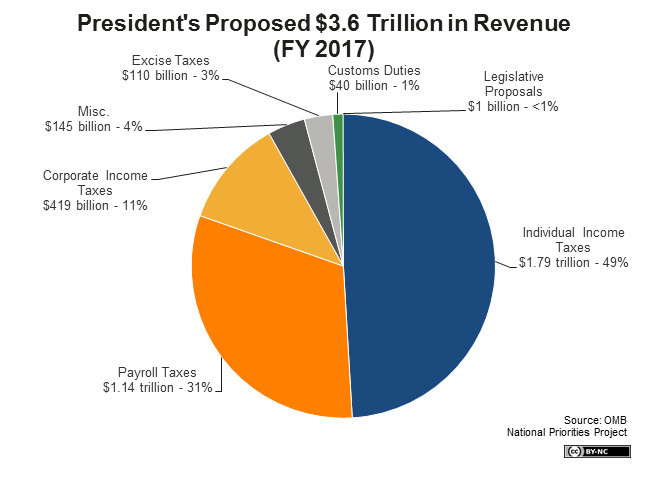
Total Military Spending is $1 trillion. Federal Individual Income Tax Revenue is $1.79 Trillion. Other Federal Revenue (Proposed by President Obama):

pres_budg_revenue_pie.png
 
Last edited:
B

Buster Bluth

Guest
I know we talked about why it's a bad idea to be friends with Russia given that they won't be a serious player in a generation, but this article elaborates on how aging will impact US foreign policy and then some...

http://www.belfercenter.org/sites/default/files/files/publication/is3201_pp112-147.pdf

In coming decades, the most powerful states in the international system will face a challenge unlike any other experienced in the history of great power politics: significant aging of their populations. Due to steep declines in birthrates over the last century and substantial increases in life expectancies, all of the current great powers are growing older—in most cases at a substantial rate and extent. By 2050 at least 15 percent of the citizens in these states will be over 65. In Japan more than one out of every three people will be over this age. China alone in 2050 will have more than 329 million people over 65, which is equal to the entire current populations of France, Germany, Japan, and the United Kingdom combined. As social aging progresses over the next half century, the populations in Germany, Japan, and Russia are expected to shrink significantly. Russia’s population is already decreasing by nearly 700,000 people per year, and Japan, too, is currently experiencing absolute population decline. Russia’s aging problem is so severe that President Vladimir Putin asserted in 2006 that demography is “Russia’s most acute problem today.” Global aging has key ramifications for the future of international relations. This article concentrates on the effects of this variable for the future of U.S. security.
 

zelezo vlk

Well-known member
Messages
18,009
Reaction score
5,048
Just a tweet that I saw

<blockquote class="twitter-tweet" data-lang="en"><p lang="en" dir="ltr">.<a href="https://twitter.com/StateDept">@StateDept</a> WOW: <a href="https://twitter.com/StateDept">@StateDept</a>’s Stu Jones:<br><br>- ‘We now believe the <a href="https://twitter.com/hashtag/Assad?src=hash">#Assad</a> regime has installed a crematorium at Sednaya prison, to dispose of bodies.' <a href="https://t.co/VpzHsTa3d2">pic.twitter.com/VpzHsTa3d2</a></p>— Charles Lister (@Charles_Lister) <a href="https://twitter.com/Charles_Lister/status/864144053796995072">May 15, 2017</a></blockquote>
<script async src="//platform.twitter.com/widgets.js" charset="utf-8"></script>
 

Legacy

New member
Messages
7,871
Reaction score
321
Xi Pushes Chinese-Led Globalization After Pledging $78 Billion (Bloomberg)

President Xi Jinping on Monday will shed more light on his push for Chinese-style globalization, wrapping up an inaugural summit to lay out the vision for his cornerstone diplomatic trade initiative.

Xi on Sunday described the Belt and Road Initiative as a "project of the century" that had its inspiration in the ancient trade routes linking the country with the world. He pledged 540 billion yuan ($78 billion) in financing, including 100 billion yuan for China’s Silk Road Fund, 380 billion yuan in new lending for participating nations, and 60 billion yuan in coming years to developing countries and international organizations that join the program.

Xi repeated his call for multilateral trade, describing his initiative as a force for peace in "a world fraught with challenges." He told the almost two dozen world leaders gathered at the forum that countries should "uphold and grow an open world economy."

The speech built on an image of Xi as a champion of global free trade that he’s sought to hone since President Donald Trump’s election, most notably in a January speech in Davos. It set the tone for a major two-day forum starting Sunday to discuss the Belt and Road plan, which aims to connect China with Europe, Asia and Africa through infrastructure and investment......
 
Last edited:

connor_in

Oh Yeeaah!!!
Messages
11,433
Reaction score
1,006
wasn't sure where to put this...

‘WW3’? Ukraine takes aim at Russia with ‘the gif heard round the world’ – twitchy.com

<blockquote class="twitter-tweet" data-lang="en"><p lang="en" dir="ltr">When <a href="https://twitter.com/Russia">@Russia</a> says Anne de Kiev established Russia-France relations, let us remind the sequence of events <a href="https://t.co/nBKhQdyKql">pic.twitter.com/nBKhQdyKql</a></p>— Ukraine / Україна (@Ukraine) <a href="https://twitter.com/Ukraine/status/869433723867062272">May 30, 2017</a></blockquote>
<script async src="//platform.twitter.com/widgets.js" charset="utf-8"></script>

<blockquote class="twitter-tweet" data-lang="en"><p lang="en" dir="ltr"><a href="https://twitter.com/Ukraine">@Ukraine</a> We are proud of our common history. 🇷🇺, 🇺🇦 & 🇧🇾 share the same historical heritage which should unite our nations, not divide us. <a href="https://t.co/hdmkuGy22p">pic.twitter.com/hdmkuGy22p</a></p>— РоссиЯ 🇷🇺 (@Russia) <a href="https://twitter.com/Russia/status/869518732615352320">May 30, 2017</a></blockquote>
<script async src="//platform.twitter.com/widgets.js" charset="utf-8"></script>

<blockquote class="twitter-tweet" data-lang="en"><p lang="en" dir="ltr"><a href="https://twitter.com/Russia">@Russia</a> You really don't change, do you? <a href="https://t.co/HDfS9A8jWZ">pic.twitter.com/HDfS9A8jWZ</a></p>— Ukraine / Україна (@Ukraine) <a href="https://twitter.com/Ukraine/status/869532150760165377">May 30, 2017</a></blockquote>
<script async src="//platform.twitter.com/widgets.js" charset="utf-8"></script>
 

Whiskeyjack

Mittens Margaritas Ante Porcos
Staff member
Messages
20,894
Reaction score
8,126
<blockquote class="twitter-tweet" data-lang="en"><p lang="en" dir="ltr">Watch as Stuart Jones, a high-level acting official in the State Dept, is asked why they criticize Iranian elections but never Saudi Arabia: <a href="https://t.co/RLkKGn48Z7">pic.twitter.com/RLkKGn48Z7</a></p>— Alex Emmons (@AlexanderEmmons) <a href="https://twitter.com/AlexanderEmmons/status/869649552617463808">May 30, 2017</a></blockquote>
<script async src="//platform.twitter.com/widgets.js" charset="utf-8"></script>
 

dshans

They call me The Dribbler
Messages
9,624
Reaction score
1,181
<blockquote class="twitter-tweet" data-lang="en"><p lang="en" dir="ltr">Watch as Stuart Jones, a high-level acting official in the State Dept, is asked why they criticize Iranian elections but never Saudi Arabia: <a href="https://t.co/RLkKGn48Z7">pic.twitter.com/RLkKGn48Z7</a></p>— Alex Emmons (@AlexanderEmmons) <a href="https://twitter.com/AlexanderEmmons/status/869649552617463808">May 30, 2017</a></blockquote>
<script async src="//platform.twitter.com/widgets.js" charset="utf-8"></script>

The rabbit hole gets wider and deeper every day.
 

IrishLax

Something Witty
Staff member
Messages
37,545
Reaction score
28,991
Qatar being isolated by their neighbors over claims of "funding terrorism":
https://www.bloomberg.com/politics/...ance-cuts-qatar-ties-as-gulf-crisis-escalates

Reminder that:
-Qatar is set to host a world cup in a few years, and have been building the stadiums with slave labor.
-Qatar is a longstanding US ally and has the largest US military base in the ME.
-Qatar has a problematic relationship with the Clintons: Clinton Foundation admits it didn't notify State Department of $1 million Qatar gift | Fox News

I'm sure Donald "Art of the Deal" Trump will smooth things over no problem.
 

Rack Em

Community Bod
Messages
7,089
Reaction score
2,727
Qatar being isolated by their neighbors over claims of "funding terrorism":
https://www.bloomberg.com/politics/...ance-cuts-qatar-ties-as-gulf-crisis-escalates

Reminder that:
-Qatar is set to host a world cup in a few years, and have been building the stadiums with slave labor.
-Qatar is a longstanding US ally and has the largest US military base in the ME.
-Qatar has a problematic relationship with the Clintons: Clinton Foundation admits it didn't notify State Department of $1 million Qatar gift | Fox News

I'm sure Donald "Art of the Deal" Trump will smooth things over no problem.

giphy.gif
 
Top