
zelezo vlk
Well-known member
- Messages
- 18,619
- Reaction score
- 5,792
Love the last line of her bio. "Beauty will save the world". Great line from a better book


All I need to really know about PP... according to their own 'fun with math' an aspirin and a child are of equal value.

Well you took the editor for the National Review's quote that just happened to be in a WaPo article haha
But again, that's why I posted the information saying only 13% of Planned Parenthood patients receive an abortion in a given year.
Per your article:
Good thread:
<blockquote class="twitter-tweet" data-lang="en"><p lang="en" dir="ltr">I'm getting even more pushback than usual from Planned Parenthood apologists tonight in response to this statement, so a few quick points on PP and its "services." (I feel like I have to do this a lot.)</p>— Alexandra DeSanctis (@xan_desanctis) <a href="https://twitter.com/xan_desanctis/status/980601768076857344?ref_src=twsrc%5Etfw">April 2, 2018</a></blockquote>
<script async src="https://platform.twitter.com/widgets.js" charset="utf-8"></script>
Right, and 13% is a fuck ton of patients. It's 4x the "3%" number. The 13% inflates the 3% by 400%+ of its represented value.
My gripe is with you providing a chart that shows the 3% number... largely debunked by anyone with half a brain as total misleading hogwash... at all. As if it somehow is of any value whatsoever. It is, at best, smoke and mirrors.
If you had only said "87% of Planned Parenthood patients don't get an abortion" while omitting everything else it'd be intellectually honest. The truth is claiming Planned Parenthood is "primarily a contraception and STD clinic" when they alone carry out over one third of the total abortions in this country is lunacy.
Planned Parenthood is responsible for 35% of total abortions in this country. Planned Parenthood is responsible for less than 1% of total STD treatment/contraception disbursement in this country. Their business has been and always will be abortion first.

I think it's also worth noting that 75% of Planned Parenthood's patients are at 150% or lower of the poverty line. That shouldn't go unmentioned.
"We don’t want the word to go out that we want to exterminate the Negro population..."
-- Letter to Dr. Clarence J. Gamble, December 10, 1939, p. 2
“All of our problems are the result of overbreeding among the working class... Knowledge of birth control is essentially moral. Its general, though prudent, practice must lead to a higher individuality and ultimately to a cleaner race.”
-- Margaret Sanger, "Morality and Birth Control," Feb-Mar 1918.
Augusta National Golf Club opened its competitive doors to women on Wednesday, announcing it would host an amateur championship in another sign attitudes are changing at one of the world’s most exclusive clubs.
A few weeks ago, The Washington Post’s deputy editorial page editor, Ruth Marcus, wrote two columns explaining why, had either of her children been diagnosed with Down syndrome in utero, she would have accepted the “ghastly” nature of a second-trimester abortion and terminated the pregnancy. She conceded that people with Down syndrome can be happy and fulfilled, that both they and their parents might be understandably disturbed by the way abortion can effectively cull them from the world. But she concluded with self-acknowledged bluntness: “That was not the child I wanted.”
I know Marcus a little, having chatted with her amiably a few times many years ago. She seemed like a lovely person, like so many of my pro-choice friends; indeed, people who believe firmly in an absolute or near-absolute right to an abortion are effectively my people in a certain tribal way, given that I’m a Connecticut Yankee raised by Bill Clinton-voting boomers and educated in the modern meritocracy. I like these folks; I think they mean well; I try to listen to their arguments with the respect that the sincere and intelligent deserve.
But I also think that they are deceived by a cruel ideology that has licensed the killing of millions of innocents for almost 50 years. In the language that the respectable use to banish views without rebuttal, I regard them — friends and colleagues and faithful readers — as essentially extremists, for whom the distinctive and sometimes awful burdens that pregnancy imposes on women have become an excuse to build a grotesque legal regime in which the most vulnerable human beings can be vacuumed out or dismembered, killed for reasons of eugenics or convenience or any reason at all.
I am sharing these reflections in the context of the latest media war over whether a particular conservative columnist should be hired by a particular establishment publication — in this case Kevin Williamson, a National Review scribe with a brilliant pen and a long paper trail of insults and wild opinions, who was boldly hired by The Atlantic and then quickly jettisoned, after it came to light that he had not only suggested hanging as a penalty for abortion in a since-deleted tweet but also more carefully defended the idea of someday prosecuting women who obtain abortions the way we prosecute other forms of homicide.
From my own anti-abortion perspective, this opinion makes Williamson an extremist as well. When American laws restricted abortion they generally did not impose such penalties, and today’s pro-life movement likewise generally rejects the idea of prosecuting women. This position often gets cast as inconsistent by pro-choicers, but I think it represents the incorporation by pro-lifers of the points that my pro-choice friends actually get right — that pregnancy is unique in ways that mitigate culpability and make it unwise to treat abortion like a normal homicide, that the government can only go so far in restriction without becoming a reproductive police state — without making the literally fatal mistake of believing these things also require a civil right to kill your unborn child.
Now: The fact that Williamson is an extremist doesn’t change the fact that to hire him for his pen and then fire him for having expressed an extreme opinion was stupid and gutless — akin to hiring Christopher Hitchens and then firing him for antireligious bigotry (and yes, Hitch was a bigot, but worth publishing anyway), or adding Hunter S. Thompson to your masthead and then dropping him because it’s pointed out that he writes under the influence of drugs. But still there is a part of me, as someone whose goal is to persuade liberal readers to reconsider their pro-abortion views, that’s glad Williamson won’t be carrying the pro-life flag at The Atlantic, out of fear that his extremities could make the work of persuasion harder.
Another part of me, though — the more important one — thinks that this is a case study in exactly the problem establishment editors are trying to address by widening their pool of writers: the inability of contemporary liberalism to see itself from the outside, as it looks to the many people who for some reason, class or religion or historical experience, are not fully indoctrinated into its increasingly incoherent mix of orthodoxies.
By this I mean that my pro-choice friends endorsing Williamson’s sacking can’t see that his extremism is mirrored in their own, in a system of supposedly “moderate” thought that is often blind to the public’s actual opinions on these issues, that lionizes advocates for abortion at any stage of pregnancy, that hands philosophers who favor forms of euthanasia and infanticide prestigious chairs at major universities, that is at best mildly troubled by the quietus of the depressed and disabled in Belgium or the near-eradication of Down syndrome in Iceland or the gendercide that abortion brought to Asia, that increasingly accepts unblinking a world where human beings can be commodified and vivisected so long as they’re in embryonic form.
All this extremism has its reasons, as those tenured philosophers will be happy to explain. But everyday liberalism is sufficiently muddled between semi-Christian ideas and a utilitarian materialism that mostly the system is defended by euphemism and evasion, and by a failure to imagine oneself as all of us once were: tiny and dependent and hidden, and yet still essentially ourselves.
Williamson, who was put up for adoption in poor-white Texas just before Roe. v. Wade was decided, had personal reasons to make that imaginative leap, and it carried him all the way to an eye-for-an-eye impulse in response. His views are not common among pro-life writers, they rather deliberately give offense, and I have no doubt they would make inter-office events more uncomfortable than, say, my interactions with Ruth Marcus.
But if they are “callous and violent,” to use the pursed-lip language of Williamson’s firing, they reflect back an essential fact about our respectable reproductive rights regime — which is justified with the hazy theology of individualism, but implemented with lethal violence against the most vulnerable of human bodies every single day.
Augusta National to host women's tournament ahead of Masters
Where would women's amateur golf be without Title IX?


Not satire!
Hookers' rights are women's rights and women's rights are human rights. Whores of the world unite so that ye may be worthy of this historic hour!


Last week there was a story in the Hollywood press about a lawsuit filed by a surrogate mother against the television channel Bravo. The woman had been paid to carry a child by two of the network’s reality-television stars, Jeffrey Lewis and Gage Edward, of the renovation show “Flipping Out.” Now with the birth accomplished and the season on the air, she claims that the network filmed and broadcast her delivery without permission, while humiliating her by airing Lewis’s quips about the horror of the female anatomy in labor.
The “Flipping Out” lawsuit, sad and sordid, falls 31 years after a far more consequential surrogacy debate: The “Baby M” case, in which a surrogate mother, Mary Beth Whitehead, changed her mind after the birth and sued — ultimately unsuccessfully — for the right to keep her child. I was 7 during the case but I remember it vividly, mostly because my mother was obsessed with it. We were not Catholics then, or any kind of conservative, but opposing commercial surrogacy seemed like a natural extension of her feminist and liberal principles, which would of course oppose a system in which the rich paid poorer women to bear their children.
At the time this was not an eccentric view. There were wide differences of opinion among feminist intellectuals about surrogacy (as about every other issue) in the 1980s, but there was enough consensus to produce an amicus brief in the Baby M case, endorsed by Betty Friedan and Gloria Steinem among others. The brief argued that surrogacy violates essential parent-child relations, runs afoul of laws against trafficking in human lives and threatens the dignity of the women being rented. “As technology develops,” its feminist authors warned, “the ‘surrogate’ becomes a kind of reproductive technology laboratory … In short, she has been dehumanized and has been reduced to a mere ‘commodity’ in the reproductive marketplace.”
That was a long time ago. There are still feminist thinkers who question commercial surrogacy, and still states that restrict it; in Europe, a feminist critique of commercialized reproduction still shapes law and policy. But in America the practice has been completely culturally normalized, liberal opinion generally accepts it as a positive good, and any residual opposition usually comes from social conservatives. The commodification involved is obvious (“I guess we won’t be using her again,” Jeff Lewis tweeted about the woman who bore his daughter) and predictably class-mediated — wealthy families paying lower-middle-class women (often military wives), Americans looking abroad for cheaper wombs — even when reality-television stars aren’t involved, and it’s part of precisely the kind of eugenic economy that the feminist brief warned against in 1987. But for their successors today, the ubiquity of commercial reproduction doesn’t rate as a major cultural or political concern.
You can tell a number of stories about why this happened. Defending the legal logic of abortion rights — my body, my choice — pushed feminism in a libertarian direction. The benefits of in vitro fertilization made a lively trade in eggs and embryos seem desirable or at least inevitable. The gay rights movement created strong social pressure in favor of allowing male same-sex couples to have children as close to the old-fashioned way as possible. And biotechnology advanced to a point where most commercial surrogacy became “gestational,” meaning that the surrogate carries someone else’s child rather than her own — which reduces the particularly agonizing aspect of the Whitehead case, where it was her own biological child that she had sold and wanted back.
But perhaps the simplest way to describe what happened with the surrogacy debate is that American feminists gradually went along with the logic of capitalism rather than resisting it. This is a particularly useful description because it’s happened so consistently across the last few decades: Whenever there’s a dispute within feminism about a particular social change or technological possibility, you should bet on the side that takes a more consumerist view of human flourishing, a more market-oriented view of what it means to defend the rights and happiness of women.
A little while ago I wrote a much-derided column about sex robots, which was misread (no doubt through my own writerly errors) as making a case that misogynistic “incels” have a natural right to some sort of Atwoodian redistribution of nubile handmaids, or at least a robotic substitute. My actual point was roughly the reverse. Sex robots and other virtual substitutes for intercourse are bad and deadly and dehumanizing, but in one of the ironies that our society’s evolution regularly delivers, I suspect enlightened liberal opinion will end up welcoming them. The logic will be egalitarian but ultimately consumerist: It’s not just toxic incels who want sexual intimacy they can’t achieve, and if a technological substitute is available for the more sympathetic sort of unhappy celibate, well, it’s their body and their money and their choice.
We obviously don’t know that this is where the sex-robot debate will end up. (Though just a week after my ill-fated column, the useful barometer of New York Magazine offered up a sex robot cover story, in which the intrepid female reporter concluded by contemplating some future intimacy with a prototype named “Henry.”)
But we do know how previous debates like this have gone, or how they’re going. Feminists were divided over surrogacy and commercialized fertility, but the opposition to both practices gradually dissolved, and now only eccentric conservatives notice the weird resemblances between California-style surrogacy practices and the handmaids and econowives of Gilead. They were divided over pornography, often bitterly — but over time the sex-positive side increasingly won out over the Andrea Dworkinish dissenters, even as the online realm was overrun with images and videos that more than justified her arguments. They were, and are, divided over prostitution, but it’s pretty clear that the version of feminism that supports the rights of sex workers to sell their bodies in the marketplace has the intellectual momentum.
Then, too, in a broader sense the most culturally important strands of American feminism have been the ones devoted to making women’s lives safe for market capitalism rather than the other way around — with “lean in” and egg freezing for Silicon Valley elites and the temporary sterilization of I.U.D.s and LARCs for the working class, both together encouraging the idea that professional goals are the heart of personal fulfillment, for the sake of which other female realities and aspirations must be managed or give way. (The rather important female reality of motherhood, a Guardian essayist noted recently, “comes up in less than 3 percent of papers, journal articles or textbooks on modern gender theory.”)
I know that coming from a conservative columnist much of this reads like a long exercise in trolling. (Did you know, feminists, that you’re all just slaves of capital? That you need less cultural Marxism and more of the genuine economistic article?) But the most serious form of cultural conservatism has always offered at most two cheers for capitalism, recognizing that its great material beneficence can coexist with dehumanizing cruelty, that its individualist logic can encourage a ruthless materialism unless curbed and checked and challenged by a moralistic vision.
For most conservatives this reforming vision is assumed to be religious — the Christian moralism that attacked the vicious capitalism of slavers and gentled the ruthless capitalism of robber barons and sustained nonmarket institutions like the family and the church across the long ascent of global wealth. But I am not under any illusions about the cultural position of my own faith in the late-modern West. At best, Christians may hope to build a counterculture, but in the wider landscape our ability to shape trends or resist them is at a historical low ebb.
Whereas feminism in this age of #MeToo inquisitions (I mean that in a good way) and “the future is female” ambition does have real capital to burn. So as feminists look around for places to turn their moral energy, the consumerist trajectory of their movement is worth contemplating, and the suspicious gaze that 1980s feminism once turned on the flesh trade in all its forms might be worth recovering.
At the very least it is a grave mistake for feminists to assume that because the moralism of the past was often patriarchal and sexist, they must always choose “consenting adults” individualism over a more holistic morality, a presumption for choice over a defense of human dignity, the logic of the market over more communitarian alternatives, a consumerist interchangeability of the sexes over a social architecture that respects their differences.
Something needs to pull our society back from its dehumanizing and commodifying drift. It might yet be a form of feminism — if feminists can stop going with a current that their foremothers wisely attempted to resist.
Now do IVF if you're really feeling courageous, Douthat.The NYT's Ross Douthat just published an article titled "The Handmaids of Capitalism":


https://www.dailywire.com/news/37066/may-be-looniest-anti-male-op-ed-ever-written-and-ben-shapiro
This is one of the most ridiculous, irrational things ever.
I’d say that article is a pretty good case as to why women in leadership roles is maybe a bad idea........
Women's winning streak in this year's elections has extended to statehouses across the country.
More than 2,000 women will serve in state legislatures when those chambers convene for their upcoming sessions, representing roughly a quarter of all state lawmakers across the country. That mark will eclipse the record of 1,875 who served this year, according to reports Thursday from the Center for American Women and Politics at Rutgers University.
The number could rise as ballot-counting concludes in close contests across the country. The Associated Press has not yet called 216 state legislative elections, races that include about 185 female candidates, according to the center.
In another first, women could end up holding the majority in two state legislative chambers at the same time — the Colorado House and Nevada Assembly — according to tallies by the center and the National Conference of State Legislatures.
"It's about time," said Lisa Cutter, a Democrat who won a Colorado House seat in her first bid for office.
Her victory came in a state with a long history of electing women. In 1894, Colorado became the first state to have women in its state legislature, when three were elected to the House.
The only previous time women made up the majority in a state legislative chamber was in 2009 and 2010 in New Hampshire's state Senate.
The state lawmakers are part of a wave of women who ran and won this year for state and federal offices. They campaigned amid a spotlight on sexual harassment cast by the #MeToo movement, although polls showed that gender was only a minor concern for most voters.
Improving access to health care, expanding early childhood development and boosting funding for K-12 education were cited as top priorities by many female candidates during this year's campaigns.
Doreen Gallegos, a Democrat who was easily elected to a fourth term representing a Las Cruces-area district in the New Mexico House, said she believes those topics will get increased attention by having more women in state legislatures.
"There are certain issues that are closer to our hearts and our minds, maybe more than our male counterparts," Gallegos said.
Forty years ago, Phyllis Schlafly hosted a gala for 1,100 guests at the Shoreham Hotel in Washington to celebrate the expiration of the deadline to ratify the Equal Rights Amendment. A bomb threat was not enough to dampen the evening’s festivities, which included not only dinner and speeches but a musical revue featuring parodies of “The Impossible Dream” and “Old-Fashioned Girl” with lyrics adapted for the occasion by Schlafly herself. The celebration did not just mark the end of the E.R.A., Schlafly later said, but “the end of an era, the era of conservative defeats.”
Not in women’s rights, it didn’t. In the 40 years since that banquet, nearly everything that Schlafly warned that E.R.A. would bring about has been achieved by other means, from coeducation at military academies to gay marriage.
Schlafly and her organization Stop E.R.A. won the battle but lost the war. Hardly surprising when you consider that they were the underdogs. Politicians in both parties initially assumed that voting for the amendment was the safe option because its supporters were passionate and organized, whereas its opponents were politically inert — which they were, until Schlafly, who had run for Congress and worked as a researcher for what would become the American Enterprise Institute, turned masses of women who had never been involved in politics into an army of effective lobbyists.
Today there are many times more women in the conservative movement than there were when a 21-year-old named Phyllis Stewart first arrived in Washington in 1945. And yet none of those brilliant and articulate women have stepped in to fill her role as America’s foremost anti-feminist.
Those who attack feminist orthodoxy today do so because they are committed feminists themselves, as in the case of the A.E.I.’s Christina Hoff Sommers, who calls her position “equity feminism” as opposed to “victim feminism.” Dissenters from the feminist line are more likely to be motivated by a libertarian commitment to equal treatment of the sexes than a socially conservative commitment to gender roles as an affirmative good. Four decades after the death of the E.R.A., Schlafly has many descendants, but no heirs.
To some, the question of why a new Schlafly hasn’t emerged is as absurd as it would have been to ask in 1972 why no woman had appeared to lead the opposition to the E.R.A. Why would a woman sign up to defend her own oppression? Of course, that’s not what Schlafly thought she was doing. She believed she was protecting women from having a feminist agenda they did not agree with imposed on them against their will.
Today, much of that agenda has prevailed. The obstacles to expanding women’s options and empowering them to make the choices they want are now, in many areas, precisely the products of that egalitarian revolution. By making it easier for women to pursue success in the workplace, we have made it harder for them to do anything else. Pressing the brake on the trends set in motion by the feminist revolution would leave women more free to follow a diversity of paths. In that case, another Phyllis Schlafly may be just what America needs.
The worst thing about the “mommy wars” used to be their suffocating sameness. The essays that went round and round about whether women can “have it all” were often well written, but the repetitiveness of the arguments was enough to make a person believe in eternal recurrence. Not anymore. Now, the worst thing about the mommy wars is that they are about to enter a new phase and the conservative side is unprepared for it.
The American family is once again in crisis. The statistical bellwether this time is not family breakdown but failure of families to form in the first place. In 1960, 82 percent of Americans between 25 and 34 were married. Even as late as 2000, 55 percent were. In 2013, for the first time, a majority of that age bloc had never married, and the downward trend shows no sign of stopping. Even allowing for the likelihood that some of this cohort will marry in their 40s or 50s, a 2014 Pew report predicts that “today’s young adults will experience the lowest marriage rate in modern history.”
Marriage has become less appealing in part because of the “two-income trap,” as Senator Elizabeth Warren, now a 2020 presidential candidate, christened it in 2003, when she was a Harvard professor. Marriage simply no longer offers the financial security it once did. The consumer goods that singles buy have gotten cheaper, but the things that middle-aged parents spend the most money on — houses, education, health care — have gotten more expensive, while wages have stagnated. It has become difficult for a family with one breadwinner to afford a middle-class standard of living. “Mom’s paycheck has been pumped directly into the basic costs of keeping the children in the middle class,” Ms. Warren’s book “The Two-Income Trap” explained.
The mass entry of women into the work force is one reason for this financial insecurity. Ms. Warren said as much in her book, although she has since backed away from such a politically explosive suggestion. Those of us who don’t have a Democratic primary ahead of us can say what she won’t: When mothers started entering paid employment in large numbers in the 1970s, it led to a bidding war over middle-class amenities that left everyone paying more for the privilege of being no better off than before.
The result is a two-tiered system that isn’t working for anybody. In the bottom tier, marriage is disappearing as lower-income women have too few men with solid jobs to choose from and as the growing number of men without regular work — by one analysis, 20 percent of prime-age males were not working full time at the start of 2018 — are being cut out of the marriage market altogether.
In the top tier, college-educated women feel they can’t afford to take time off from their careers to raise their children even when they want to, as many of them do. According to an analysis of American Community Survey data by the Institute for Family Studies, only 17 percent of mothers with children 3 or younger say they prefer to work full time. Many career moms manage their stressful work-life balance thanks only to low-wage immigrant labor to take care of their children, clean their houses and deliver their takeout. Even with hired help, working women still spend nearly as much time on household tasks as their stay-at-home mothers and grandmothers did. The result is stress, frustration — and cries for national action.
The response of the conservative establishment to this crisis has been to double down on shoveling women into the work force. In 2018, the American Enterprise Institute released a report on paid family and medical leave in collaboration with the Brookings Institution that specifically cited a recent dip in the number of American women working as a problem needing to be solved. “Research shows that the proportion of working women in the U.S. has fallen behind that of other countries,” the A.E.I. website lamented. “Access to paid leave has been shown to promote labor force attachment, especially for women, which is vital for economic growth.”
In this fixation on economic growth, even when it means nudging into the work force women who would have preferred to stay home, all sides of the political spectrum are in agreement, from the conservative A.E.I. and the centrist Brookings to the liberal Center for American Progress, which crows that if child care assistance and other family-friendly policies became the norm, “the United States would see an additional five million women in the labor force and $500 billion in increased G.D.P.” It is precisely this cross-ideological consensus that has allowed the problem of the two-income trap to get worse for so long.
What is needed are dissenting voices. The conservative Independent Women’s Forum has had some success promoting the idea of “Social Security earned leave,” which would give new parents up to 12 weeks of paid leave in exchange for delaying their retirement benefits by weeks or months. The plan has the benefit of being budget-neutral over the long term, because parents borrow against their own retirement benefits, leaving everyone else unaffected. Senators Joni Ernst and Mike Lee, and separately Senator Marco Rubio, have turned this plan into proposed legislation, making it an excellent example of policy entrepreneurship on the part of the Independent Women’s Forum. However, this laudable plan seems to respond to the last era’s Republican worries about paid leave — that it was anti-business or too expensive or would promote long-term government dependency — and doesn’t address the fundamental issues that families are facing.
There is interesting work being done on what it would mean to make the happiness and stability of America’s families a policy goal on par with G.D.P. growth. There is Oren Cass of the Manhattan Institute, whose book “The Once and Future Worker” criticizes the single-minded focus on expanding the economic pie regardless of other considerations as “economic piety” (get it?). “If, historically, two-parent families could support themselves with only one parent working outside the home, then something is wrong with ‘growth’ that imposes a de facto need for two incomes,” he writes.
There is also Samuel Hammond at the Niskanen Center, who has written incisively on the benefits and drawbacks of various child tax credit plans and “the false promise of universal child care,” which would impose a one-size-fits-all model on America’s families.
Earlier this year, National Review published an essay by Patrick T. Brown, a graduate student at Princeton, called “Leaning Out,” which argues that public policy should make it easier for one parent to stay home. He proposes a “grand bargain — expanded child-care subsidies, with payments equivalent to the value of those subsidies to parents who choose not to pay for care” Mr. Brown says he got the idea for the essay during the year he was a stay-at-home dad for his two children while his wife pursued her Ph.D. studies. “I realized being a stay-at-home parent is really hard,” he said.
These innovative thinkers all have something in common: They’re men. That’s a difficulty, because there are some arguments that it’s easier for a woman to make. Phyllis Schlafly, who died in 2016, herself said, “I always did feel that the leaders of the effort to beat E.R.A. had to be women.” The optics have only become more important in an age of identity politics.
Consider the example of Tucker Carlson’s opening monologue on his Fox News show on Jan. 2, which went viral. One of the passages that got him into trouble was on the unintended consequences of rising women’s wages.
Mr. Carlson noted that manufacturing, “a male-dominated industry,” has declined, while female-dominated fields like education and health care have remained strong. “In many areas, women suddenly made more than men. Now, before you applaud this as a victory for feminism, consider the effects,” he said. “Study after study has shown that when men make less than women, women generally don’t want to marry them. Maybe they should want to marry them, but they don’t.”
He went on to list the problems with low marriage rates: out-of-wedlock births and the “familiar disasters that inevitably follow — more drug and alcohol abuse, higher incarceration rates, fewer families formed in the next generation.”
The liberal journalist Judd Legum tweeted that Mr. Carlson was “arguing there’s a moral responsibility to pay women less than men” and called for Red Lobster to drop its ads on his show, which the company did a few hours later.
As it happens, there is an abundance of data on Mr. Carlson’s side. Wendy Wang is the director of research at the Institute for Family Studies, and before that she worked at the Pew Research Center, where she co-wrote a report about unmarried Americans. “The number of employed men per 100 women dropped from 139 in 1960 to 91 in 2012” among never-married Americans 25 to 34, her report found. “In other words, if all never-married young women in 2012 wanted to find a young employed man who had also never been married, 9 percent of them would fail, simply because there are not enough men in the target group.”
Ms. Wang also confirmed that men and women prioritize different things when looking for a partner, with women more likely to want someone with a steady job. That’s not a stereotype, she said, but “what single Americans are telling us.” David Autor of M.I.T. and his fellow researchers found that in the regions of the country hardest hit by competition from Chinese manufacturing, marriage rates declined only when men’s wages went down. When women’s wages went down relative to men’s, marriage and fertility actually went up.
For all the statistical ammunition at their disposal, there was a distinct lack of rhetorical cover from women for Mr. Carlson. That seems to be a chronic problem for male wonks trying to think through the challenges of the two-income trap.
“If you’re on Twitter, the energy behind broadly pro-natal politics tends to be male, for reasons I’m not sure of,” Mr. Brown said. He also said he got some pushback on the medium over his National Review article, “accusing me of having an excessively gendered view of parenting.” Considering that women, as a rule, get harsher criticism online than men, this pushback may be one of the things keeping them from the debate.
At the height of the E.R.A. push, polling on the amendment was split with virtually no gender gap, just as there is no gender gap today on the question of whether having more women in the work force affects marriage and child rearing.
There is, however, a gender gap on the concrete question of whether a given parent would prefer to stay home, with few fathers saying they would rather work part time and a large majority of mothers saying they would rather work part time or not at all. The division-of-labor advantages of having one breadwinner and one caregiver apply regardless of which parent stays home, so a new Schlafly wouldn’t need to agree with her predecessor on gender essentialism. Just endorse the basic principle that healthy families are the foundation of every other political good.
Perhaps the reason no Schlafly has emerged is the same reason Schlafly was such a singular figure in her own time: The sorts of women who agreed with her aren’t those whose voices make it into the national conversation. Just as the housewives of Stop E.R.A. would never have made an impact if Schlafly hadn’t organized them, today’s political conversation tends to overlook those women who would prefer to raise their children in one-breadwinner families like the ones they grew up in.
A modern-day Schlafly would give voice to these women. Imagine another banquet at the Shoreham, 40 years after Schlafly’s victory celebration, where a woman stood up and said: “If the two-income trap has created a situation that’s making everyone miserable, maybe the answer isn’t to double down on the model that got us here in the first place.”
If there is going to be some kind of federal paid parental leave program, as seems likely, it shouldn’t disadvantage stay-at-home parents and certainly shouldn’t take increasing female work force participation as a goal in itself. Subsidizing day care does disadvantage parents who want to stay at home, by its nature. It further entrenches the mandatory two-earner model we are moving toward.
It also distorts the economic signals families need to make informed choices about whether it’s worth it to send a second parent into paid employment. There’s no point paying someone $11 an hour to raise a woman’s children so she can go out and earn $11 an hour if that woman would be happier staying home and raising her children herself.
Women want equal pay for equal work, and they should get it, but they also want men they can marry. Women were responsible for almost the entire increase in labor force participation between 2015 and 2017. Isn’t it time to focus on helping male workers specifically, their wages and their industries? If you asked the women in the David Autor study — the ones in places where the wage gap widened but marriage rates went up — which they’d rather have, a few extra cents an hour or a husband and a child, what do you think they would say?
These are policy choices that are going to be confronting us in the imminent future, and if we choose badly our social crisis is only going to get worse. An heir to Phyllis Schlafly, a socially conservative female voice who can galvanize others, could help us. She just has to step up.
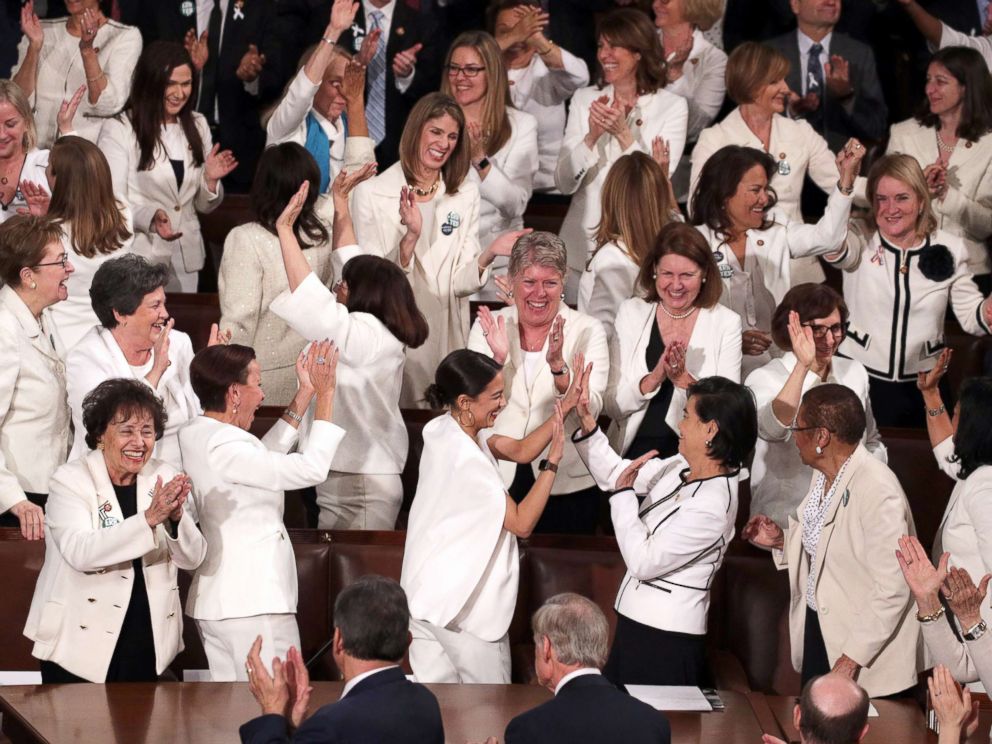
"No one has benefited more from our thriving economy than women, who have filled 58 percent of the newly created jobs last year. You weren’t supposed to do that. Thank you very much. Thank you very much."
"All Americans can be proud that we have more women in the workforce than ever before -- Don’t sit yet. You’re gonna like this! And exactly one century after Congress passed the constitutional amendment giving women the right to vote, we also have more women serving in Congress than ever before. That's great, really great. And congratulations, that's great."
In a new Pew Research Center survey, nearly six-in-ten women (58%) say they prefer a bigger government providing more services to a smaller government providing fewer services (36%). Among men, the balance of opinion is nearly the reverse: 59% of men prefer a smaller government (37% prefer bigger).
The gender differences on this measure are as wide as at any point in more than a decade. The change is largely attributable to an increase in the share of women expressing a preference for bigger government, while men’s attitudes on this question are little changed.
Trump’s job approval rating has been more deeply divided along partisan lines – and across generations – than for other recent presidents. This also is the case when it comes to gender: There are wider differences between men and women in views of Trump’s job performance than for any president dating to George H.W. Bush.
Currently, 47% of men say they approve of how Trump is handling his job as president, with an equal share saying they disapprove (47%). By contrast, 32% of women say they approve of how Trump is handling his job as president; 63% say they disapprove.
Looking more broadly, over his first two years in office, Trump’s average approval rating was much higher among men (44%) than among women (31%). This 13-percentage-point gender gap is wider than for any of his recent predecessors, dating back to George H.W. Bush.

Trump in State of the Union address:
Gender gap widens in views of government’s role – and of Trump (Pew, April 11, 2019)
Outside of these statistics mattering very little. Do you work for CNN by chance? Your mudslinging is comical.
The answer is simple. Who benefits the most from universal healthcare? Who reaps the most benefits from government assistance? Lastly, you sure this has nothing to do with women being manipulated by the media to believe that Trump is a sexual harassing monster? I kind of think it does.
/https://public-media.si-cdn.com/filer/10/55/105516f3-6179-4812-9684-865192651dfa/01062015-suffragette-hero-image.jpg)


I have absolutely no problem with a woman working and making as much or more than a man. The fact of the matter is that the number of women who work will always be less than the number of men. It goes back to the biological makeup. Females are more nurturing and feel closer to their offspring because of their biological makeup which will draw some to stay home or work less which will affect their wages.
Some people have a hard time acknowledging that fact.

I have absolutely no problem with a woman working and making as much or more than a man. The fact of the matter is that the number of women who work will always be less than the number of men. It goes back to the biological makeup. Females are more nurturing and feel closer to their offspring because of their biological makeup which will draw some to stay home or work less which will affect their wages.
Some people have a hard time acknowledging that fact.
I, for one, celebrate women's biological makeup. Notre Dame's choice to go co-ed provided advantages to many women and has made the environment a better place. Many of us may know families whose primary breadwinner is female and the father stays at home with the reward of taking care of the children - or in situations where the wife's job is the primary factor in pursuit of careers or job security or even as more of us are self-employed and working at home. It's hard to deny anyone the choice or opportunity of pursuing career ambitions based on their biology.
Perhaps tangentially,
Tom Brady on salary: 'My wife makes a lot of money'