Economics

B

Buster Bluth

Guest
Worth watching..

<iframe width="560" height="315" src="//www.youtube.com/embed/ibfmz0lknmM" frameborder="0" allowfullscreen></iframe>

Every day I'm more convinced that a Guaranteed Minimum Income is the way to go.
 
C

Cackalacky

Guest
Worth watching..

<iframe width="560" height="315" src="//www.youtube.com/embed/ibfmz0lknmM" frameborder="0" allowfullscreen></iframe>

Every day I'm more convinced that a Guaranteed Minimum Income is the way to go.

Totally agree. Whiskeyjack brought this to my attention a while ago and I have been reading up on it more and more. I really like this idea.
 
C

Cackalacky

Guest
Albert-Einstein-Quote.jpg
 
B

Buster Bluth

Guest
I see things similarly...but the rub is...wait for it...PARENTS. No parent wants to let their kids do it...to MOST, its some sort of defeat if their kid learns a trade and goes to work...I think the perception of trades comes from the shrinkage of Detroit, and other industrial/manufacturing areas from the 70s on. I guess it is assumed that is the fate of all tradesman...and those folks are generally the parents and grandparents of these kids...so, trades get a real bad rep. Its a hrd stigma to break...

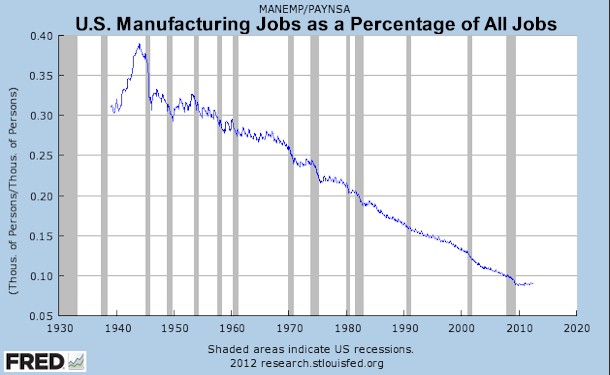
I don't think of factory/manufacturing workers when I think of tradesmen. Manufacturing is its own different animal, and has been shrinking since before the 70s.

manufacturingjobs-as-percentage.jpg


I think learning a trade has held its value because it's been impossible to automate (so far) or outsource. You will need plumbers, carpenters, electricians, pipefitters, etc...and they can't be dialed up from India. And the money can be absolutely absurd too, that's what most people don't realize. Have you heard what people make up in the Dakotas or Alberta? Shiiiiiiiiit. I was talking to a guy in oil during the ND-FSU game and he was talking about how pipefitters up in Alberta make ~$120k/yr, with a $60k signing bonus. If they stay three years they get a $250k bonus and if they stay seven years they get a $1,000,000 bonus. He said guys leave there with $2,000,000+ in the bank and go back to being a pipefitter in their home city, making solid money the rest of their lives, but drive new Corvettes around while doing so. haha And he says they still can't fill the spots. (He also said the prostitute situation was out of control up there due to the lack of women hahah)

I wholeheartedly agree that the stigma is there. I'm dealing with it now personally. After I graduated from Ohio State I decided to take a year or two off before I start my masters, so I'm working at my family's road contracting company full-time right now. The number of "wait....road construction?" moments I've been a part of since I graduated is just absurd. The reactions are predictable when you tell them what people make in road construction in Ohio: $38/hr regular, $57/hr OT, more if you operate equipment. It's immediately "WHAT?! That just makes me angry! They shouldn't make that much! They didn't have to go through four years of college!" Yeah, but you aren't willing to work 80-hour weeks for 40 weeks and break a sweat sooo....

This pseudo Kid A makes substantially more than any of his friends (not that I care, for the record) but the current "social status" of the job is absolutely the lowest. It defies logic really. I absolutely loathe what I do (at one point I tweeted the irony: "I'm paving unsustainable suburban strip malls to pay for a graduate degree in how to prevent unsustainable suburban strip malls.." haha) but I respect the position. Trades are awesome and really should be the route for a much larger portion of people. Mike Rowe has done this country a great service with his shows/speaking tours bringing attention and respect to blue collar jobs again.
 
Last edited:

phgreek

New member
Messages
6,956
Reaction score
433
I don't think of factory/manufacturing workers when I think of tradesmen. Manufacturing is its own different animal, and has been shrinking since before the 70s.

manufacturingjobs-as-percentage.jpg


I think learning a trade has held its value because it's been impossible to automate (so far) or outsource. You will need plumbers, carpenters, electricians, pipefitters, etc...and they can't be dialed up from India. And the money can be absolutely absurd too, that's what most people don't realize. Have you heard what people make up in the Dakotas or Alberta? Shiiiiiiiiit. I was talking to a guy in oil during the ND-FSU game and he was talking about how pipefitters up in Alberta make ~$120k/yr, with a $60k signing bonus. If they stay three years they get a $250k bonus and if they stay seven years they get a $1,000,000 bonus. He said guys leave there with $2,000,000+ in the bank and go back to being a pipefitter in their home city, making solid money the rest of their lives, but drive new Corvettes around while doing so. haha And he says they still can't fill the spots. (He also said the prostitute situation was out of control up there due to the lack of women hahah)

I wholeheartedly agree that the stigma is there. I'm dealing with it now personally. After I graduated from Ohio State I decided to take a year or two off before I start my masters, so I'm working at my family's road contracting company full-time right now. The number of "wait....road construction?" moments I've been a part of since I graduated is just absurd. The reactions are predictable when you tell them what people make in road construction in Ohio: $38/hr regular, $57/hr OT, more if you operate equipment. It's immediately "WHAT?! That just makes me angry! They shouldn't make that much! They didn't have to go through four years of college!" Yeah, but you aren't willing to work 80-hour weeks for 40 weeks and break a sweat sooo....

This pseudo Kid A makes substantially more than any of his friends (not that I care, for the record) but the current "social status" of the job is absolutely the lowest. It defies logic really. I absolutely loathe what I do (at one point I tweeted the irony: "I'm paving unsustainable suburban strip malls to pay for a graduate degree in how to prevent unsustainable suburban strip malls.." haha) but I respect the position. Trades are awesome and really should be the route for a much larger portion of people. Mike Rowe has done this country a great service with his shows/speaking tours bringing attention and respect to blue collar jobs again.

I should have generalized to "Blue collar". I agree with the bolded in reality...there is a difference. However I think thats where the blue collar work got its stigma...I don't think people would otherwise look down on it or steer their kids a different way unless blue collar work had a bad result in their history...or that they knew someone with issues. I think the greatest secret in the world is the plumbing guys who find a way to continue the work but expand into supply and government/commercial...OH MY Goodness. The Other one is diesel mechanic...WOW!. And yes North Dakota...wile I did not know the pipe fitter deal...I am aware that their Bonus structure for heavy equipment drivers put the squeeze on the military's ability to find civilian operators for the desert, and that was paying ~200K / Year. Point is, if you want to follow the money you can make serious bank. Trust me, I laugh at myself for the decisions I made...when you weigh the "people" grief I deal with every day against the money, driving a water truck or becoming a pimp (unless I have to dress like one) in North Dakota doesn't seem like a bad deal...but I'm old and embedded in what I do.

You Younger guys...seriously...follow the money.
 

pumpdog20

Well-known member
Messages
4,741
Reaction score
3,153
Worth watching..

<iframe width="560" height="315" src="//www.youtube.com/embed/ibfmz0lknmM" frameborder="0" allowfullscreen></iframe>

Every day I'm more convinced that a Guaranteed Minimum Income is the way to go.

What's the difference between an economic system where everyone starts with $30k and one where everyone starts with zero?
 

GowerND11

Well-known member
Messages
6,536
Reaction score
3,287
What's the difference between an economic system where everyone starts with $30k and one where everyone starts with zero?

But not everyone starts with zero in the US. Having that $30k also allows those that are poor to obtain all that welfare money they get, access cards, healthcare, SS, etc, in one lump type of money to use as they see fit. It eliminates the massive amount of bureaucracy that comes with a welfare state. It eliminates welfare abuse, and those that use their children as an excuse to obtain more money from the government. It allows young people fresh out of school (whether high school or college) some money to get themselves settled in their adult life. Student loans could see a drastic decrease, along with the debt associated with them. It affords more discretionary spending from the citizens which will stimulate the economy. More people can buy houses, cars, take vacations, etc, which again can help the economy.
 
Last edited:

Whiskeyjack

Mittens Margaritas Ante Porcos
Staff member
Messages
20,894
Reaction score
8,126
Mark Regnerus just published an article in First Things titled "Minecraft over Marriage":

I don’t often write book reviews, because it’s not often that this sociologist digests a readable academic book that begs wider discussion. Some books have compelling ideas that deserve promotion, but require too much slogging along the way to commend. Others seem too parochial to promote a wider reading. Still others deal too much in “dialogues,” “diasporas,” and “intersectionalities” ever to merit a second look.

Yuval Harari’s book Sapiens: A Brief History of Humankind involves little slogging and is anything but narrow. An interview with him, entitled “Death is Optional,” circulated widely in early March, prompting enough curiosity for me to acquire the book. While I prefer two hundred pages to Harari’s 416, it was nevertheless a quick read. Why such praise in this venue for a book by a secular, gay, Jewish professor of history? Because unlike many scholars of human society, Harari seems less committed to wielding his pen to win something than he is to wrestling over gritty realities.

Reader be warned: Harari holds that religion is a fiction—but he doesn’t single it out. Religion is no more of a fiction, he holds, than is the notion of law, human rights, money, justice, liberal humanism, the nation, or limited liability companies. His is not an equal-opportunity shellacking of sacred things, but rather an assertion that no one has ever been able to navigate life apart from what he calls inter-subjective myths or stories, without which human community simply cannot work. But he makes a more interesting observation than that one. Harari holds that big ideas like religion have enabled Homo sapiens to accomplish things that were impossible without it:

Imagined orders are not evil conspiracies or useless mirages. Rather, they are the only way large numbers of humans can cooperate effectively.

We take for granted that our sociality and our communities will continue ad infinitum. But we shouldn’t, and Harari doesn’t. Instead, he holds, religion is one of the great unifiers of humankind. So is money, faith in which transcends faiths: “whereas religion asks us to believe in something, money asks us to believe that other people believe in something.”

For all its hatred of Christianity and America, ISIS trusts in greenbacks because we do, too. And yet Harari recognizes that money has a dark side:

When everything is convertible . . . it corrodes local traditions, intimate relations and human values, replacing them with the cold laws of supply and demand. Human communities and families have always been based on belief in ‘priceless’ things, such as honor, loyalty, morality and love.

Indeed, global financial interdependence is upon us. From Russian natural gas, Saudi oil, American debt, to Greece’s dependence on the Euro, states’ abilities to operate independently have diminished profoundly. This has positive byproducts, including fewer wars and battle deaths, as states’ internal affairs become vulnerable to external pressure. Indeed, Harari observes, global power is consolidating:

Immensely powerful currents of capital, labor, and information turn and shape the world, with a growing disregard for the borders and opinions of states . . . Much like the Late Roman Empire, it is ruled by a multi-ethnic elite.

Any mention of oligarchy or the last days of the Roman Empire will doubtlessly attract readership among social conservatives. There is more to woo them, including frank talk about the growing chasm between liberal humanist talk and action in the domain of the health sciences. This, the author predicts, is ground zero of future inequalities. Nazi-like ideals of “upgrading” the best (meaning the wealthiest) human beings are on their way, and talk of restricting them is ineffectual.

It’s depressing, but I think Harari is right. The global community is too diverse to forbid elite wishes for access to ethically dubious cutting-edge health technology. Judicial and political systems will comply, if not in one country then another. And it won’t even be difficult, because here too an inter-subjective myth—Big Science—paves the way. There is now “an almost religious belief in technology and in the methods of scientific research, which have replaced to some extent the belief in absolute truths,” Harari states. I observe it in the Facebook conversations of very different types of friends. The scientists reinforce the superiority of their thoughts and interpersonal norms with regular assaults on soft targets—like creationism—that are then morally equated with harder targets, such as differences over abortion or the science of vaccinations. The normative implication is that science, if unconstrained, would act more justly in the world because science is different.

Not so, argues Harari:

In academic circles, many are naïve enough to believe in pure science. They believe that government and business altruistically give them money to pursue whatever research projects strike their fancy. But this hardly describes the realities of science funding. Most scientific studies are funded because somebody believes they can help attain some political, economic, or religious goal.

All this from a scholar who would self-identify as liberal.

But it’s Harari’s discussion of the collapse of the family and the territorial grab of state and market that garnered my quickest attention. We’ve become a nation of isolated individuals, and we are voting against marriage and families:

With the individual wielding unprecedented power to decide her own path in life, we find it ever harder to make commitments. We thus live in an increasingly lonely world of unraveling communities and families.

Harari attributes the collapse in family authority to the active colonization of state and market, going where even I would fear to tread:

Over time, states and markets used their growing power to weaken the traditional bonds of family and community. . . . In order to really break the power of family and community, they needed the help of a fifth column. The state and market approached people with an offer that could not be refused. ‘Become individuals,’ they said. ‘Marry whomever you desire, without asking permission from your parents’. . . . You are no longer dependent on your family or your community. We, the state and the market, will take care of you instead.

We family conservatives can cry foul all we want but it’s possible that what we really want is what we cannot have—a marrying culture, together with all the desired fruit of its destruction: greater freedom, security (from family violence), a social safety net, and economic and educational opportunity. We know well the undesirable consequences of the flight from marriage. But it’s a mixed bag, for sure.

Harari speculates that the marriageability of men, already deteriorating, will be further hamstrung by a future that will require fewer workers of higher skill. (He makes a compelling case—software increasingly surveils, polices, trades, and orders.) What to do with so many excess underemployed adults, especially men? Harari speculates that drugs—legal and illegal—and computer games are the probable go-to solutions to the problem of less work. Before you roll your eyes, open them. We’re already there. Neither Minecraft nor marijuana is a very marriageable quality, and both are popular and increasingly normative. Socially acceptable. I’ve observed Rooster Teeth, an Austin-based company that focuses on the convergence of gaming and “Internet culture,” explode in popularity in a few short years. A convention they hosted in Austin in 2011 drew six hundred enthusiasts. Last year? 30,000.

Conservatives often hold that the current situation is simply unsustainable, though the timetable for the depletion of social, emotional, and economic “capital” long accrued by the sacrifices—and difficult lives, no doubt—of so many stably married households is anything but clear. But just because the current situation doesn’t appear sustainable doesn’t mean it cannot be sustained. Or that we won’t make adjustments, because we can, we have, and we probably will again.

I've read some compelling arguments recently that the Sexual Revolution continues to advance not because it somehow better comports with human nature, but because it makes us easier to control and profit off of.

Marx's critique of capitalism may also apply to culture. If true, it has interesting implications for both the Left and the Right.
 
Last edited:

Veritate Duce Progredi

A man gotta have a code
Messages
9,358
Reaction score
5,352
Mark Regnerus just published an article in First Things titled "Minecraft over Marriage":


I've read some compelling arguments recently that the Sexual Revolution continues to advance not because it somehow better comports with human nature, but because it makes us easier to control and profit off of.

Marx's critique of capitalism may also apply to culture. If true, it has interesting implications for both the Left and the Right.

Good read, I've forwarded it to a few friends.
 

Bluto

Well-known member
Messages
8,146
Reaction score
3,979
Mark Regnerus just published an article in First Things titled "Minecraft over Marriage":


I've read some compelling arguments recently that the Sexual Revolution continues to advance not because it somehow better comports with human nature, but because it makes us easier to control and profit off of.

Marx's critique of capitalism may also apply to culture. If true, it has interesting implications for both the Left and the Right.

You should check out Thomas Frank's book The Conquest of Cool; How Counter Culture Became Consumer Culture.

Also, it's funny you mention Marx because in all of the discussions on liberalism vs conservatism I have a found the dicussion of power (what it is and how does it manifest in societies) lacking. I think this discussion is key if you are engaging in critiques of political philosophies and or society in general.
 

Irish YJ

Southsida
Messages
25,888
Reaction score
1,444
Good read Whiskey.

A lot of good points, and interesting slants.
Honestly as I get older, I try to be less of "thinker" as even great ideas, and absolute truths seem get lost and trampled in those "gritty realities".

Depressing opinion, but I feel it's best to concentrate on what I can do individually than what the collective is going to do. I certainly vote, but I use my core values when voting. And those have not changed much over the years.
 

Whiskeyjack

Mittens Margaritas Ante Porcos
Staff member
Messages
20,894
Reaction score
8,126
The New Republic's Elizabeth Stoker Bruenig just published an article titled "Gods and Profits: How Capitalism and Christianity Aligned in Modern America":

Capitalism is a system braced by stories. Consider the rise of the liberal individual, a kind of atomistic personhood, distinct from all other persons. It seems the whole Enlightenment had a hand in creating this particular view of man—yet the concept was unknown to the people of the medieval and ancient worlds. The idea was not intentionally developed as a thread in capitalism’s web of self-justification, but it has been recruited for such purposes, where it underwrites much free-market discourse about the primacy of the individual over the collective. This is only one of the many accounts which have been absorbed into the vast narrative support structure of capitalism—that is, the series of stories that make life under capitalism seem plausible, positive, and even necessary. In the United States, Christianity might be capitalism’s most impressive conscription so far.

In Kevin Kruse’s One Nation Under God: How Corporate America Invented Christian America, the author lays out a deftly detailed history of Christianity’s service to capitalism in the United States. Christianity was brought into the service of laissez-faire economics in Puritan devotion to work and thrift, but the decisive moment at which Christianity fused with free enterprise in the American psyche occurred, Kruse argues, in the middle of the twentieth century. Nicole Aschoff’s The New Prophets of Capital, on the other hand, offers a series of case studies on the storytellers whose narratives about free enterprise and well-being are shouldering capitalism along today. Kruse’s investigation begins around the time of the New Deal and follows the emergence of our distinctly American capitalist Christianity through its zenith in the 1980s. Aschoff picks up this story with a close look at today’s charismatic capitalists: Sheryl Sandberg, Whole Foods CEO John Mackey, Bill Gates, and Oprah Winfrey, among others.


But in the gap between these two books—between the late ’70s and early ’80s, where the bulk of Kruse’s narrative leaves off, and the postmillennial world we know today—the ground has shifted. The preoccupation with Christian doctrine that animated the ardent pro-capitalists of yesteryear has subsided to a vaguely spiritual moralism. We now live in the age of “moral therapeutic deism,” where the shapes and colors of religion are imported into mass-market self-help schemes. And while the Christian right persists in the same old political battles (sexuality, marriage, education, et cetera), its strength appears to be waning: The once coherent evangelical voting bloc is splintering, and titans of industry intent on fostering a pro-capitalist politics no longer seem reliant upon it to bolster their project. Our most ardent pro-capitalists, as Aschoff demonstrates, don’t generally speak in terms of Christ and country any longer, but rather in modes of self-improvement and actualization.

Will the fates of Christianity and capitalism depart, or have they been too tightly interwoven in American thought to adopt diverging paths? What will become of Christianity in the United States once capitalism is done with it, and vice versa? This is where Kruse and Aschoff, with their careful surveys of the past, offer guidance to the future.

Kruse’s One Nation Under God opens with a moment of widespread anti-capitalist sentiment. Following the desolation of the Great Depression, Kruse reports, mistrust of financiers and their associates was at a perilous high. In the early years of the twentieth century, a large population of people depended not upon the abstract dealings of people and assets, but upon the tangible fluctuations of earth, weather, and disease. Famines, pestilences, and storms all had their own narratives, but the Great Depression was a new kind of plague, and it produced a new kind of story, with the greed and pride of the rich as the catalyst for destruction.

Concerned that populist politics might endanger their wealth, America’s monied interests did what they do best: They bought a solution. It came in the form of James W. Fifield Jr., a Congregationalist pastor who made his fortune in Southern California by preaching to the fabulously wealthy and accepting their patronage. Fifield, Kruse notes, was especially gifted at assuring wealthy Christians that their riches were evidence of virtue rather than vice. A philosophical descendant of Max Weber, Fifield married Christian thought with a new era of economic development, and spread the gospel through his organization, Spiritual Mobilization. Its mission was simple: to stamp out Christian support for a generous welfare state—which paired naturally with New Deal concern for the poor, elderly, and vulnerable—and to advance a new theory of Christian libertarianism.

Spiritual Mobilization sought to influence ministers across the country, and with its bottomless monetary resources, it was doomed to success. Kruse’s account is startling in part because of just how vulgar the whole affair was: Christianity was rented out, quite consciously, to buttress a shambling narrative about the continued dominance of the monied class in a performance that even Marx would have found blunt.

As the middle of the twentieth century approached, Spiritual Mobilization circulated literature touting the righteousness of the libertarian-Christian gospel, and, in 1951, decided to host a series of events celebrating the newly minted notion of “freedom under God.” A turn of phrase coined by Fifield himself, the rhetoric was a hit, and private companies voraciously reproduced it; the Utah Power & Light Company, among others, printed ads and funded festivities to advance the notion that Christian deference to industry is a vital part of the American Way. This stew of supply-side economics, small government, hard-core U.S. patriotism, and Christian rhetoric was entirely novel, and smashingly effective. When we look back now on the McCarthy era and find Christian verses interwoven with tirades against communism, this is the carefully engineered blend we are revisiting.

Proponents of this newly constructed ideology were manifold, powerful, and well funded: Kruse names Billy Graham as a spiritual inheritor to the early efforts of Christian libertarians like Fifield. Graham’s preaching was sensational, and won the support of tycoons like Texas oilman Sid Richardson, who helped launch Graham’s career in Washington, D.C. Graham’s ascent opened the way for other pastors with political aspirations, like Jerry Falwell and his Moral Majority cohort, to wax passionate about the gospel while raking in cash from committed capitalists delighted by the arranged marriage of God and mammon. Kruse deftly outlines how the arteries of money and power that we now take for granted—between the progenitors of the Christian right on one side, and preachers, industrialists, and politicians on the other—were built.

If there is one underlying argument in Kruse’s book, it is that free-market economics and Christianity were not always the twin pillars of a uniquely American gospel. And yet here we are: Ted Cruz kicked off the long election season by spinning a free-market yarn to the student body of the world’s largest Christian college, also lamenting that most born-again Christians stay home on voting days, robbing him of votes and leaving the economy in the hands of wealthy financiers. Thanks to the tireless efforts of the pastors and politicians Kruse profiles, the disparity between the Christian ethos and the spirit of capitalism is now little more than a periodic left-Christian cri de coeur.

What happened to the anti-capitalist Christianity of yesteryear? Consider the robust Christian socialist movements of the late nineteenth century, which flourished under Victorians like John Ruskin and William Morris. It’s a question worth pursuing because, as Aschoff demonstrates in her new journalistic set of case studies, the narratives that prop up capitalism are not stable.

Aschoff opens with a somewhat startling revelation that helps place Kruse’s historical account in the context of capitalism’s broader story. Narratives, both critical and supportive, are necessary for capitalism, because criticism forces it “to evolve and temporarily resolve some of its contradictions ... thus preserving it as a system for the long haul.” “Indeed,” Aschoff notes, “capital’s ability to periodically present a new set of legitimating principles that facilitate the willing participation of society accounts for its remarkable longevity despite periodic bouts of deep crisis.” Capitalism, therefore, is a system that is in a constant state of re-explaining itself, producing stories that present it as necessary despite its failures and stories that cast it in a positive light despite shifts in popular sentiment.

By “prophets” of capital, Aschoff means the old-fashioned sociological sense of the term, as used by Max Weber and as distinct from “priests.” While priests, Weber argued, maintain old practices and enforce stable norms, prophets renew old stories or produce novel ones, building bases out of sheer charisma. Priests deal in the mundane problems of daily life, applying static premises to failing marriages, financial upsets, illness, anxiety, death; prophets, meanwhile, insist upon abstraction, detest minutiae, and push dizzyingly powerful narratives. Aschoff’s prophets of capital, which she considers in a series of wry and adroit case studies of people like Gates, Sandberg, and Mackey, have become famous for being rich and successful. Each of them, Aschoff argues, tells a different story with the same outcome: to patch up leaks in capitalism and advance its shuddering bulk for one more day. If in midcentury America it was Christianity that was deployed to offer this endorsement, now it is Oprah.

But in each of Aschoff’s careful considerations of capitalism’s storytellers, glimmers of the past pro-capitalist Christian crusades shine through. She traces Mackey’s capitalist ethos of responsible entrepreneurship to the Physiocrats, for example, a set of eighteenth-century French philosophers including Anne-Robert-Jacques Turgot and François Quesnay, both Catholics and fathers of libertarian economics. Mackey, like his Catholic forebears, senses a natural order to the world; you can resolve all matters between men simply by leaving them alone. Just as Turgot and Quesnay co-opted pieces of Catholic natural-law theory to advance economic liberalism, Mackey borrows from Physiocratic commentary on natural order to press for a lifestyle of organic-therapeutic consumption that takes the place of a genuinely revolutionary politics. We will be healed, to hear Mackey tell it, by eating right and being kind to one another. No need for any intervention from states or unions.

Capitalism’s narratives, Aschoff implicitly reveals, always cannibalize their predecessors, repackaging old stories to shore up discontent. While Oprah’s lifestyle branding is mostly about how to achieve happiness through a vague mix of nondescript spirituality, bootstraps-hoisting, and endless therapeutic introspection, her schema is new only in its styling. Long before Oprah took to the airwaves and pages to proclaim her own story of self-invention, the prosperity gospel preachers of the ’70s and ’80s—folks like prolific televangelists Jim Bakker, Creflo Dollar, and Kenneth Copeland—had brought self-improvement testimonials sprinkled with holy water to rapt middle Americans. The spiritual inheritors of these televangelists are, according to Kate Bowler’s 2013 book, Blessed: A History of the American Prosperity Gospel, self-help ministers like Joel Osteen, who has unsurprisingly enjoyed plenty of time on Oprah’s stage. Oprah’s version of spirituality is similar enough to Osteen’s, but nonspecific. While Osteen and his overtly Christian ilk minister to their flocks, Oprah’s message is broad enough to be enjoyed by all: a better business decision, at any rate.

In other words, the prophets of capitalism have a way of using the workable parts of older pro-capitalist narratives to meet the needs of changing audiences, while shedding the vestigial bits. As religiosity drops off in the United States, replaced either by faithlessness or individual spirituality, capitalism will have to reformat its defenses to match those proclivities, rather than catering purely to committed Christians. And that may ultimately be the best possible thing for Christianity in the United States.

After all, if the Christian ethos has suffered any great harm from its recruitment in support of capitalism, it has been the tamping down of a uniquely anti-capitalist, revolutionary sentiment in the Gospel. Pope Francis, being from the global South, has repeatedly criticized trickle-down economics from a Christian perspective, an approach that registers as baffling to a certain segment of his American audience. But within the Catholic tradition, criticism of capitalism is perfectly common: It is only in the U.S. context, beset by a curious interlude of manufactured hypercapitalist Christianity, that the Pope’s economics seem jarring. Capital, Aschoff observes, is inclined to glide from one narrative to the next as its needs change. If the Christian story is the latest to be shucked aside by capital, then Christianity might find itself slipping the grip of a rather oppressive relationship.

American Christians would then be free to offer up a genuinely revolutionary Christian politics: one that neither seeks to bolster capitalism blatantly nor offer meager patches for its systemic problems. Having a historical perspective on the ways in which Christianity was co-opted in service of each of those purposes could help new Christian activists avoid the pitfalls of the recent past. Perhaps Christianity’s long rendezvous with capitalism has been a necessary crucible, and one that may be sputtering toward its end.

Sharing this here since Bruenig touches on Weber and several other points I discussed in my first post on page 1 of this thread.
 
Last edited:

ND NYC

New member
Messages
3,571
Reaction score
209
what do you guys think...

what % of the US population "votes their pocketbooks" vs "votes their values"
 

Wild Bill

Well-known member
Messages
5,518
Reaction score
3,262
what do you guys think...

what % of the US population "votes their pocketbooks" vs "votes their values"

I would guess a majority of voters if by "votes their pocketbooks" you were referring to both the voters who are trying to keep more of what they earn AND voters that are trying to keep what they haven't earned.
 

phork

Raining On Your Parade
Messages
9,863
Reaction score
1,019
Doesn't matter who you vote for. Lobbyists win.
 
B

Bogtrotter07

Guest
what do you guys think...

what % of the US population "votes their pocketbooks" vs "votes their values"

I will couch my opinion this way; "I believe the majority of American voters do not know, acknowledge, or show any interest in the fact that their pocketbooks are not their values, and vice versa!"

I further believe there is more than anecdotal evidence to back this. (See any of Whiskey's articles.)
 

Whiskeyjack

Mittens Margaritas Ante Porcos
Staff member
Messages
20,894
Reaction score
8,126
ND profressor Patrick Deneen just published an article in First Things titled "The Power Elite":

As the dust from the recent explosion over Indiana’s Religious Freedom Restoration Act begins to settle, one thing is clear: Republicans and Christians lost, Democrats and gay activists won. Republican leaders initially supported the legislation for what was likely a combination of strategic political reasons and the belief that religious freedom is a positive good. Passage of RFRA laws was an intensifying demand in conservative Christian circles. Having concluded that the culture war was lost, conservative Christians retreated to the castle keep of American political order: the right to the free exercise of religion, a right that had been bolstered by the bipartisan passage of the federal RFRA law in 1993. Governor Mike Pence no doubt thought he was practicing good politics: giving his base something they dearly wanted, while only potentially alienating committed members of the opposition party.

Mike Pence, Asa Hutchinson, and the Republican party were not blindsided by opposition to RFRA by gay rights activists. What knocked them back were major corporations, such as Apple, Walmart, and Angie’s List, and organizations such as the NCAA that denounced the law, in many cases announcing boycotts of Indiana. Had the only appreciable opposition to RFRA come from gay rights activists, RFRA would have been a smashing political success for Republicans. It would have made the right enemies while generating gratitude and energy in the base. They did not expect their usual friends in corporate America to join the opposition, which was an idiotic miscalculation given the fact that establishment outrage scuttled the Arizona RFRA last year.

The decision by corporate leaders to take a political stand over a controversial issue is therefore of great interest. Corporations and business leaders almost always avoid political statements and announcements, recognizing that such declarations have the effect of unnecessarily alienating potential customers. Corporations live in constant fear of bad publicity that can ruin a brand carefully erected through millions of dollars of advertising and publicity. Why step into a heated political debate and unnecessarily turn half of your customers away? Corporations exist to make money, not to advance political and social causes—except for those that help them make money, of course.

And that’s just the point: The decision by Apple, Walmart, Eli Lilly, Angie’s List, and so on was a business decision—even more, a marketing decision. Coming out in opposition to the Indiana RFRA law was one of the shrewdest marketing coups since E.T. followed a trail of Reese’s Pieces. The decision to #BoycottIndiana was not made because it was the politically courageous thing to do; it was made because it was the profitable thing to do. The establishment could express support for a fashionable social norm while exerting very little effort, incurring no actual cost, and making no sacrifice to secure the goal. It had the further advantage of distracting most people from the fact that corporations like Apple have no compunction doing business in places with outright oppression of gays, women, and Christians. Those real forms of repression and discrimination didn’t matter; Indiana’s purported oppression of gays did.

The public statements, often hyperbolic propaganda about the dire consequences of the Indiana law, were cost-free because gay rights activists have successfully argued that opposition to gay marriage is tantamount to racism. Through a powerful and concerted effort, gay activists have succeeded in convincing the establishment that gays are the equivalent of blacks in Selma, and that their opponents—particularly their Christian opponents—are Bull Connors. There can simply be no brooking bigotry! Democrats like Barack Obama and Hillary Clinton conveniently forget their previous support for conjugal marriage, and none of their supporters seek to hold them to account. All that matters is that one now deny that there can be reasonable opposition to gay marriage, and affirm that those who maintain that view are rank bigots. Companies like Apple and Walmart eagerly joined the bandwagon once it was clear that the tactic had worked.

There is a deeper reason for corporate support, however. Today’s corporate ideology has a strong affinity with the lifestyles of those who are defined by mobility, ethical flexibility, liberalism (whether economic or social), a consumerist mentality in which choice is paramount, and a “progressive” outlook in which rapid change and “creative destruction” are the only certainties. The response to Indiana’s RFRA law shows very clearly that corporations have joined forces with Republicans on economic matters and Democrats on social ones. Corporate America is aligned with the ascendant libertarian portion of each party, ensuring a win for the political, economic, and social preferences of libertarianism. In effect, there is only one functional party in America today, seemingly parceled between the two notional parties but in reality unifying them in its backing by financial and cultural elites.

What this means is that today’s cultural power elite is entirely aligned with the economic power elite, and they’re ready to steamroll anyone in their way. In the case of Indiana’s RFRA, corporate and gay activists combined to bring to heel conservative Christians in a rural, Rust Belt state that struggles at the margins of America’s global economy. The threat to demolish Indiana’s economy is only a more explicit expression of a project that corporations like Apple and Walmart have been carrying out with the assistance mainly of Republicans (as well as free-trade Democrats) for a generation.

To see the glee with which liberals joined forces with corporations revealed the deepest fact about the American ruling class: politicians and corporations will join forces to effect the change preferred by corporations, change that too often damages the working class and benefits society’s elites. Corporate America is willing to join any coalition that advances its financial interests and deeper philosophic commitments, at the expense of Americans on the wrong side of history, especially those Americans living in places like Indiana who aren’t part of the meritocratic global elite.

There was no more vivid picture of this project than the journalistic hit-job targeting Memories Pizza in Walkerton, Indiana. Searching for a “smoking gun” that Indiana’s RFRA was nothing more than a cover for “bigotry,” an enterprising young reporter travelled to the downtrodden small town of Walkerton, where she claims to have walked into Memories Pizza to ask its owners about their views of RFRA. While stating clearly that they would not deny service to anyone, a young woman in the family declared that, as Christians, they wouldn’t want to cater a gay wedding. Never mind that no one had requested catering from this restaurant. Never mind that were this to come to pass, RFRA would merely give the courts a means of balancing the legal claims of Memories Pizza against a gay couple that might—in some bizarro world—order pizza for their wedding. And never mind that the employee said that they wouldn’t discriminate against any customer who came into the restaurant and that the entire “story” was manufactured. The outpouring of fury and denunciation on the various websites connected to the restaurant was relentless, vicious, and devastating.

Here, then, is a family that has seen corporate America and both parties throw them to the wolves. Corporate powers, in combination with the globalizing ideology in both parties, advanced economic policy that helped gut America’s manufacturing heartland in favor of low-wage labor markets abroad. Corporate powers, in combination with Democrats, have advanced the belief that this family is the face of bigotry and racism in America today, and that the ravening hordes have descended to drive them from a place that one poster on Yelp (who I am sure is the very picture of concern for economic inequality in America) described as “BFE, Indiana between WhoGivesASh!t and AintNobodyGahtTime4Dat.”

Meanwhile, Republicans and Democrats vie for the votes of the likes of the owners of Memories Pizza, with Republicans touting their support for family values and opposition to abortion, and Democrats insisting upon their commitment to equality and social justice. However, when the chips are down, the parties are only and ultimately successful when the corporate powers join their respective camps—forcing Christian commitments back into the catacombs and relentlessly widening the chasm of inequality that divides the “in-breds” (again, quoting from Yelp!) living in Walkerton, Indiana, from the Most Enlightened People who left violent and obscene reviews, aided by vocabularies picked up at the best universities in America.

When Democrats criticize the role of corporate money and influence in politics, they (rightly, in my view) point out the disfiguring effects of wealth and power on the political process. Typically the role of money ends up skewing the legislative process in favor of corporate interests, and results in legislation that favors especially wealthy elites over citizens who do not have the same access and influence in politics. We have come to expect that those corporate interests work almost always hand-in-glove with Republicans.

This past spring, we saw something quite different and revealing and worrying. With the imprimatur of American elites, which was clearly given in the furor over Indiana’s RFRA, religiously based opposition to gay marriage is now more than ever likely to be treated by our society as tantamount to a hate crime. This elite-sanctioned attack on “bigotry” will not stop at Memories Pizza. It will be extended first to religious nonprofit institutions that insist upon the view that marriage is between a man and a woman—the schools, the colleges, the adoption services—and then will reach inevitably into the sanctuaries of the churches themselves. The narrative of bigotry will demand nothing less, and the protection that might have been afforded by RFRA and the First Amendment has been shown to be a parchment barrier in comparison with the might and power of cultural and financial elites.

Americans of both parties once believed that no center of power in America should become so concentrated that it could force its views on every other citizen. What we saw in Indiana was not just a “miscalculation” by Republicans. We saw fully unmasked just who runs America, and the kind of America that they are bringing more fully into reality every passing day. It will be an America where the powerful will govern completely over the powerless, where the rich dictate terms to the poor, where the strong are unleashed from the old restraints of culture and place, where libertarian indifference—whether in respect to economic inequality or morals—is inscribed into thenational fabric, and where the unburdened, hedonic human will reign ascendant. No limits reflected in political, social, or religious norms can be permitted: All are allowed except those who would claim the legitimacy of restraint.

I made this argument several times while we were debating the merits of Indiana's RFRA, but the fact that Progressives find themselves on the same side as amoral multi-national corporations on this issue should give them serious pause.
 
Last edited:

Bluto

Well-known member
Messages
8,146
Reaction score
3,979
ND profressor Patrick Deneen just published an article in First Things titled "The Power Elite":


I made this argument several times while we were debating the merits of Indiana's RFRA, but the fact that Progressives find themselves on the same side as amoral multi-national corporations on this issue should give them serious pause.

Great article. Thanks for posting.
 
B

Bogtrotter07

Guest
'Record gap' between rich and poor

Paris (AFP) - The gap between the rich and poor in most of the world's advanced economies is at record levels, according to an OECD study that also found glaring differences between men and women.

In most of the 34 countries in the Organisation for Economic Cooperation and Development the income gap is at its highest level in three decades, with the richest 10 percent of the population earning 9.6 times the income of the poorest 10 percent.

In the 1980s this ratio stood at 7 to 1, the OECD said in a report.

The wealth gap is even larger, with the top 1 percent owning 18 percent and the 40 percent only 3 percent of household wealth in 2012.

"We have reached a tipping point. Inequality in OECD countries is at its highest since records began,” said OECD Secretary-General Angel Gurria.

As high inequality harms growth prospects, there are economic as well as social arguments for governments to try to address the issue, he said.

"By not addressing inequality, governments are cutting into the social fabric of their countries and hurting their long-term economic growth," said Gurria.

The study found that the rise in inequality between 1985 and 2005 in 19 OECD countries knocked an estimated 4.7 percentage points off cumulative growth between 1990 and 2010.

An increase in part-time and temporary work contracts as well as self-employment was seen as an important driver of increased inequality, with half of all jobs created in OECD countries between 1995 and 2013 falling into these categories.

The report also found that as inequality rose, there were significant falls in educational attainment and skills among families in lower income groups, thus implying large amounts of wasted potential and lower social mobility.
As wages for women are 15 percent less than for men, ensuring gender equality in employment is one way to reduce inequality.

Redistributive taxes and transfers is another effective option, said the OECD as it noted that existing mechanisms have been weakened in many countries.

"To address this, policies need to ensure that wealthier individuals, but also multinational firms, pay their share of the tax burden," said the OECD, which has been playing a key role in an international effort to crack down on tax avoidance.

It also encouraged countries to broaden access to better jobs and and encourage greater investment in education and skills throughout working life.

The report found inequality to be highest in Chile, Mexico, Turkey, the United States and Israel among OECD countries.

It was lowest in Denmark, Slovenia, Slovak Republic and Norway.

'Record gap' between rich and poor

Pretty much what has been expected, but it is still a shame.

We could turn it around with education, for both future careers and showing the path to successful contributions for those capable.
 
Last edited:

Ndaccountant

Old Hoss
Messages
8,370
Reaction score
5,771
'Record gap' between rich and poor

Pretty much what has been expected, but it is still a shame.

We could turn it around with education, for both future careers and showing the path to successful contributions for those capable.

An increase in part-time and temporary work contracts as well as self-employment was seen as an important driver of increased inequality, with half of all jobs created in OECD countries between 1995 and 2013 falling into these categories.

Would love for them to divulge why that occurred. There are probably numerous reasons, ranging from government related initiatives (health care, taxes, etc) as well as companies looking to expand margins. It certainly is complicated and there is no silver bullet and it varies by country. Read this about France.....

http://www.nytimes.com/2013/11/08/w...ench-grapple-with-their-safety-nets.html?_r=0
 
B

Bogtrotter07

Guest
Would love for them to divulge why that occurred. There are probably numerous reasons, ranging from government related initiatives (health care, taxes, etc) as well as companies looking to expand margins. It certainly is complicated and there is no silver bullet and it varies by country. Read this about France.....

http://www.nytimes.com/2013/11/08/w...ench-grapple-with-their-safety-nets.html?_r=0

Interesting read, thanks!

But I know a number of people who live (currently) in France. And whatever Frances problems are, they are not the same as those facing the US. From my experience the article does not portray the comfort and ease of well-being known in the life of almost all French citizens. With that said, the French have some of the same problems that Americans do, politicians making promises, while robbing Peter to pay Paul.

The number of workers with (relatively) high paying jobs with benefits in America has plummeted :

  • Outsourcing - Ostensibly a way to mobilize labor to rapidly changing needs, the duration of the popularity of this shell game has not resulted in a workforce with more training and skills, in fact the opposite is true. First hitting the IT industry over a dozen years ago, this method of labor saving has captured many industries, and has broken the wage rate in many fields.
  • Employer reduction in full time jobs, in lieu of more than one lower paying part time job. Also seen in the IT field with (Zero [day] initiative), etc., this concept has swept through the food service and retail industries, and also the health care industry, reducing many former full time employees to part time employees holding more than one job, working longer hours, making less with fewer if any benefits. The clearest example of how this has undermined the work force is the new "Nursing Assistant" programs. Often state certified, employees who gain these credentials now provide the majority of front line health care in our health care industry!

Contrary to popular myth all of this cannot be blamed on any one source, but if a number of sources, all looking to increase their wealth, without providing anything of substance in return, would cease their efforts, I cannot think that this wouldn't go far to solving many of the problems identified.
 
Top