Politics

Politics

  • Obama

    Votes: 4 1.1%
  • Romney

    Votes: 172 48.9%
  • Other

    Votes: 46 13.1%
  • a:3:{i:1637;a:5:{s:12:"polloptionid";i:1637;s:6:"nodeid";s:7:"2882145";s:5:"title";s:5:"Obama";s:5:"

    Votes: 130 36.9%

  • Total voters
    352

MJ12666

New member
Messages
794
Reaction score
60
501c4 groups are not "charities" per say but they are social welfare groups which are supposed to me non political. The line between social welfare and political is real blury.

Anyway the accountant who is processing our request said that all 501 status rather it be c3 or c4 is processed in order they are received. So there was a backlog from the increase in 501c4s as well as the government shutdown. Maybe it is bull but that is what we (our organization) where told.

The way I see a social welfare group should be able to advocate for or against a certain issue or potentially issues such as the healthcare policies, taxes, climate, guns, immigration, etc. However once the group goes beyond advocacy of issues becomes directly involved with supporting or attacking candidates directly I see it as crossing a line to being an unofficial political campaign and should no longer be subject to special tax privileges.

Simple solution is to eliminate the corporate income tax. There would be three obvious benefits if this were to occur.

First we could significantly reduce the budget of the IRS as those individuals who work in the corporate and non-profit areas would not longer be required and could be let go. This will help reduce the current budget gap; and future budgets as we the taxpayers would no longer accrue pension and healthcare benefits for these employees.

The second and third benefits are related. Corporations would see an immediate positive impact to earning as federal tax expense would be eliminated and some very high paying tax positions would be eliminated. With the increased profits, bonuses for the remaining bonus eligible employees would increase, which would make us very happy.
 

wizards8507

Well-known member
Messages
20,660
Reaction score
2,661
501c4 groups are not "charities" per say but they are social welfare groups which are supposed to me non political. The line between social welfare and political is real blury.
It's not that blurry when you read the regulation.

Anyway the accountant who is processing our request said that all 501 status rather it be c3 or c4 is processed in order they are received. So there was a backlog from the increase in 501c4s as well as the government shutdown. Maybe it is bull but that is what we (our organization) where told.
You're witnessing government incompetence firsthand. You call Amazon with an issue and they resolve it in 10 minutes while you're on the phone. The government takes six months. The government sucks at DOING things. Period.

The way I see a social welfare group should be able to advocate for or against a certain issue or potentially issues such as the healthcare policies, taxes, climate, guns, immigration, etc. However once the group goes beyond advocacy of issues becomes directly involved with supporting or attacking candidates directly I see it as crossing a line to being an unofficial political campaign and should no longer be subject to special tax privileges.
The problem with "the way you see it" is that it becomes a judgment call. Once things are open to interpretation, they're subject to the biases of the interpreter. You end up with situations like the IRS targeting Tea Party groups. It would be equally wrong if a Republican administration were targeting environmental or pro-gay groups. You either need to allow everything or ban everything.
 

GoIrish41

Paterfamilius
Messages
9,929
Reaction score
2,119
Simple solution is to eliminate the corporate income tax. There would be three obvious benefits if this were to occur.

First we could significantly reduce the budget of the IRS as those individuals who work in the corporate and non-profit areas would not longer be required and could be let go. This will help reduce the current budget gap; and future budgets as we the taxpayers would no longer accrue pension and healthcare benefits for these employees.

The second and third benefits are related. Corporations would see an immediate positive impact to earning as federal tax expense would be eliminated and some very high paying tax positions would be eliminated. With the increased profits, bonuses for the remaining bonus eligible employees would increase, which would make us very happy.

I'm not sure if you were serious about this proposal. If you were not, disregard the rest of this post. If you were: Your simple solution would remove hundreds of millions of dollars of federal revenue that is used to fund programs that help sustain the poor, educate middle class students, defend the country, lead the nation toward an increased understanding of the world around us, monitor and regulate air, water, and food quality, etc. etc. Since the 1940s, corporations have paid a smaller and smaller percentage of federal taxes and individuals have paid more and more. Your suggestion to simply relieve corporations of their ever shrinking burden would hurt millions of people in this country to benefit a relatively small number of people. I hope this is what the Republicans push for in the coming elections because it is fairly emplematic of the distain the GOP has for the average American.
 

IrishLax

Something Witty
Staff member
Messages
37,544
Reaction score
28,990
I hope this is what the Republicans push for in the coming elections because it is fairly emplematic of the distain the GOP has for the average American.

Had a good post going... and then decide to close it with this gem. SMH. I strongly doubt that the Republican Party wants to discolor the average American, because that wouldn't really fit with their whole MO of "hating minorities."
 

wizards8507

Well-known member
Messages
20,660
Reaction score
2,661
I'm not sure if you were serious about this proposal. If you were not, disregard the rest of this post. If you were: Your simple solution would remove hundreds of millions of dollars of federal revenue that is used to fund programs that help sustain the poor, educate middle class students, defend the country, lead the nation toward an increased understanding of the world around us, monitor and regulate air, water, and food quality, etc. etc. Since the 1940s, corporations have paid a smaller and smaller percentage of federal taxes and individuals have paid more and more. Your suggestion to simply relieve corporations of their ever shrinking burden would hurt millions of people in this country to benefit a relatively small number of people. I hope this is what the Republicans push for in the coming elections because it is fairly emplematic of the distain the GOP has for the average American.
Once again, you're joining your buddy chicago51 with your failure to understand the most BASIC economic principles. People bear the burden of taxation, regardless of whether it's nominally at the individual or corporate level. Taxation on corporations is equivalent to taxation on individuals, it just gets masked because it's one step removed. Corporate taxes mean lower wages, higher prices, and less profit (i.e. retarded 401(k) and pension growth). The people hurt most by corporate taxation are the "little people" (employees and consumers) that you care the most about.

Ironically, raising corporate income taxes would also lead to increased compensation for top executives. Compensation is an expense that reduces taxable income, so by increasing executive compensation, companies are able to lower their taxable income and reduce their tax liability.
 

chicago51

Well-known member
Messages
3,658
Reaction score
387
Once again, you're joining your buddy chicago51 with your failure to understand the most BASIC economic principles. People bear the burden of taxation, regardless of whether it's nominally at the individual or corporate level. Taxation on corporations is equivalent to taxation on individuals, it just gets masked because it's one step removed. Corporate taxes mean lower wages, higher prices, and less profit (i.e. retarded 401(k) and pension growth). The people hurt most by corporate taxation are the "little people" (employees and consumers) that you care the most about.

Ironically, raising corporate income taxes would also lead to increased compensation for top executives. Compensation is an expense that reduces taxable income, so by increasing executive compensation, companies are able to lower their taxable income and reduce their tax liability.

The bolded is complete bull. As not so much this post which I actually agree with quiet a bit but alot of what you have brought up regarding economics works in a competitive marketplace but ignores the fact that we really don't have one.

Okay I'll say this about the corporate income tax. Maybe it is time to reduce or eliminate it.

First off nobody pays that much in corporate taxes anyway because it is so easy to shift money offshore much easy than it is for individuals for sure. For example if Apple makes its IPads in say India and sells them in the US they can easily manipulate things to show high profits in the overseas branch and not in the US. If they are selling for $250 retail for instance in the US Apple (or any transnational) can say the US branch purchased them for $249 and they only made a $1 profit on it while the overseas branch only manufactured it for $100 made all the profit. We have a 35% corporate tax rate but only gain $120 billion annually from corporate taxes not an effective return.

What I do would do from by left point of view is revenue neutral tax switches. Eliminate the corporate tax rate but hit the super rich say $2-$3 million range and above regardless of how they earn their money with a surtax of 5% to 10% (what ever gets us to revenue neutral). So if executives are gonna get hit with a tax for taking a very large salary but are not gonna pay corporate tax wouldn't the incentive be to leave the money in the corporation?

So in theory eliminating the corporate tax has freed alot of money. Now executives can in theory pay their employees higher wages, offer better health care plans, etc. They could still take even bigger salaries for themselves but at least now they would get hit by a surtax and the government would actually get that money as opposed being able to easily shift it to another branch of the corporation.
 
Last edited:

Ndaccountant

Old Hoss
Messages
8,370
Reaction score
5,771
The bolded is complete bull. As not so much this post which I actually agree with quiet a bit but alot of what you have brought up regarding economics works in a competitive marketplace but ignores the fact that we really don't have one.

Okay I'll say this about the corporate income tax. Maybe it is time to reduce or eliminate it.

First off nobody pays that much in corporate taxes anyway because it is so easy to shift money offshore much easy than it is for individuals for sure. For example if Apple makes its IPads in say India and sells them in the US they can easily manipulate things to show high profits in the overseas branch and not in the US. If they are selling for $250 retail for instance in the US Apple (or any transnational) can say the US branch purchased them for $249 and they only made a $1 profit on it while the overseas branch only manufactured it for $100 made all the profit. We have a 35% corporate tax rate but only gain $120 billion annually from corporate taxes not an effective return.

What I do would do from by left point of view is revenue neutral tax switches. Eliminate the corporate tax rate but hit the super rich say $2-$3 million range and above regardless of how they earn their money with a surtax of 5% to 10% (what ever gets us to revenue neutral). So if executives are gonna get hit with a tax for taking a very large salary but are not gonna pay corporate tax wouldn't the incentive be to leave the money in the corporation?

So in theory eliminating the corporate tax has freed alot of money. Now executives can in theory pay their employees higher wages, offer better health care plans, etc. They could still take even bigger salaries for themselves but at least now they would get hit by a surtax and the government would actually get that money as opposed being able to easily shift it to another branch of the corporation.

You do realize that the US has the most progressive tax structure in the developed world?
 

chicago51

Well-known member
Messages
3,658
Reaction score
387
You do realize that the US has the most progressive tax structure in the developed world?

You are correct in theory.

Other countries don’t have a “47%”

direct_porgressivity_oecd.jpg


all_progressivity_oecd.jpg


oecd_country_comparison2.jpg


progressivity_redistribution.jpg


This article suggest that are inequality stems from spending money in an unprogressive matter as oppose to taxing in an unprogressive manner.

So if we are gonna money on a huge military empire to among many things protect exxon mobile's oil supply in various parts of the world. If we are gonna give subsidies to corporations. If we are gonna do all these things to help the rich then shouldn't the rich pay for it?

If we actually spent the money on things like a world class healthcare system for everyone, and having access to affordable post high school education then you could justify having a less progressive tax system. This nation of welfare queens argument is crap and doesn't pan out as we are the most regressive country in the world in terms of our spending benefits. Now we have corporate welfare queens but that is a whole different story.
 
Last edited:

Ndaccountant

Old Hoss
Messages
8,370
Reaction score
5,771
You are correct in theory.

In theory?

The data is pretty clear. The rich in America pay a greater percentage of US taxes relative to their percentage of overall US income compared to any other developed country. Doesn't mean it that it's perfect or that people have to like it. But, it's a fact.
 

ACamp1900

Counting my ‘bet against ND’ winnings
Messages
48,944
Reaction score
11,225
I have never felt right with the notion of getting up in arms over what other people are paying in taxes. It just feels dirty to me… such a ‘what’s yours is mine” way of thinking.
 
Last edited:

chicago51

Well-known member
Messages
3,658
Reaction score
387
I have never felt right with the notion of getting up in arms over what other people are paying it taxes. It just feels dirty to me… such a ‘what’s your is mine” way of thinking.

I tend to be up in arms because the drop in top tax rates seem to have corrallated with wages not rising with productivity. If wages had continued to rise and if cutting the top rates had some how been show to correllate into better economic growth and higher wages I'd be all for it. It hasn't it.

compensation_productivity.jpg


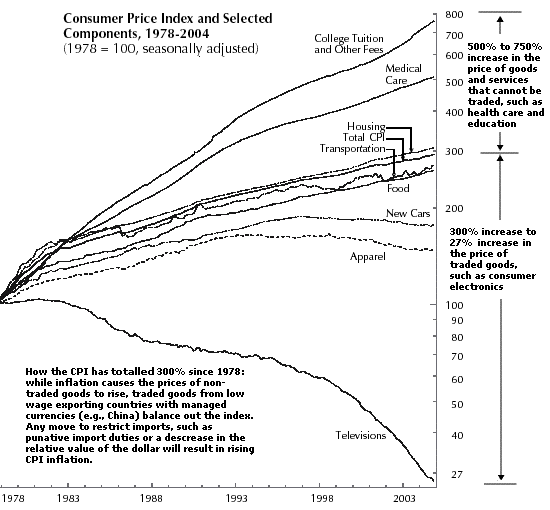
Now you'll get the arguement that stuff cost less. Well it depends on which what things you are talking about. Alot of stuff that really matters cost more.

cpi1978-2004.gif


In theory?

The data is pretty clear. The rich in America pay a greater percentage of US taxes relative to their percentage of overall US income compared to any other developed country. Doesn't mean it that it's perfect or that people have to like it. But, it's a fact.

Depends on what you mean by rich? If you mean the top 1 percent, the top 2-3 percent sure they do a pay great percentage of their income. I would adovocate raising tax on that group at all.

If you mean the top 0.1 % who paid off Congress to change the tax code to their benefit then no it is not progressive. Hence you have Romney who isn't a bad guy by any means paying a 14% tax rate.
 

wizards8507

Well-known member
Messages
20,660
Reaction score
2,661
Do you notice that all the shit that has risen in cost is the same shit in which the government meddles?

Federal student loans are supposed to help the lower classes attend school, but in reality they artificially prop up the demand for higher education. Consumers don't even consider price when they "shop" for schools so the schools themselves can charge whatever they want. A federally guaranteed loan is "free money" in the mind of a 17 year old.

Medicaid is supposed to help the poor pay for medical treatment, but in reality it artificially drives demand for healthcare. People are going to the emergency room for the sniffles because Uncle Sam is footing the bill. Again, people don't "shop" with price in mind so insurance companies, doctors, and hospitals can charge whatever they want. (Just imagine what's going to happen now that you're MANDATED to buy insurance.)

Housing subsidies are supposed to help the poor buy property, but in reality... do you see where this is going?
 

Wild Bill

Well-known member
Messages
5,518
Reaction score
3,262
If you mean the top 0.1 % who paid off Congress to change the tax code to their benefit then no it is not progressive. Hence you have Romney who isn't a bad guy by any means paying a 14% tax rate.

Dude I'm a CPA. If I know anything, it's taxation.

Mitt Romney did not work (in the traditional sense) in 2011. When Mitt Romney earned a salary at Bain Capital (in 1998 or whenever), he paid 39.6%. He then invested THAT money and paid an ADDITIONAL 15% capital gains tax on its growth, meaning those dollars have essentially been taxed at .396 + .15 * (1 - .396) = 48.66%.
.
 

wizards8507

Well-known member
Messages
20,660
Reaction score
2,661
I have never felt right with the notion of getting up in arms over what other people are paying in taxes. It just feels dirty to me… such a ‘what’s yours is mine” way of thinking.

Chicago thinks that the only way Person A can have more than Person B is by screwing Person B. The CEO is a plantation owner and the workers are his wage slaves. In the Progressive mind, redistribution isn't taking Person A's money to give to Person B, it was Person B's money all along.

It's a perversion of the Robin Hood character. Robin Hood was supposed a grand progressive who stole from the rich and gave to the poor, but it wasn't the Capitalist that Robin Hood held in disdain, it was (spoiler alert) the oppressive government.
 

Whiskeyjack

Mittens Margaritas Ante Porcos
Staff member
Messages
20,894
Reaction score
8,126
I just read a review of Thomas Piketty's Capital in the Twenty-First Century which touches on some of these issues:

Why is capital re-establishing dominance over income? Because, Piketty writes, r > g.

In plain English: The return on capital (r) almost always exceeds economic growth (g). Piketty calls r > g an “inequality” rather than a formula because it isn’t “an absolute logical necessity.” Rather, it’s “the result of a confluence of forces, each largely independent of the others.” These include demographics (a rapidly growing population boosts g); the extent to which a country’s economy has matured (China has much higher g than the U.S. and Western Europe because it’s still catching up); and various “technological, psychological, social, and cultural factors” (all of which can cause r to fall). Typically, r is four to five times g, but the ratio gets larger as capital accumulates across generations. The dead—though worse off in most obvious respects than the rest of us—are wealthier than the living. “The past,” Piketty writes, “tends to devour the future.”

Piketty comes to this ghoulish conclusion after more than a decade spent meticulously compiling statistical data about wealth and income all over the world, often with Berkeley economist Emanuel Saez. (Together, the two economists wrote what is without question the most influential U.S. inequality study in a generation, which found that the top one percent had doubled its income share since 1979. Occupy Wall Street’s vocabulary came directly from Piketty and Saez.) France, Piketty observes patriotically, has the most precise records, dating to the French Revolution, when new taxes were imposed on nobles and clergy who’d been exempt from levies under the Ancien Regime. Much of Capital’s analysis, consequently, concerns France. But Piketty also provides extensive historical data from Great Britain, Germany, and the United States. Most of the pleasure in reading Capital lies in following the elaborate wealth and income patterns that Piketty traces through the centuries, blending economic, literary, and historical research. The clearest such pattern is that r really was, at most points in history, greater than g, if only because g was seldom much to write home about, especially back when economies were primarily agricultural. (Inflation, I learned from reading this book, didn’t really exist before the 20th century.)

Why, then, is it news to contemporary readers that r > g? Because for most of the 20th century that wasn’t true: Economic growth surpassed capital accumulation. That happy outcome, Piketty argues, was mainly because of the turmoil that began during the summer of 1914 and didn’t end until the summer of 1945. From the 1930s through the 1970s (and in some instances into the 1980s) the advanced industrial democracies saw their incomes grow more equal, even as the economy took off in the 1950s and 1960s. This is a trend many of us would like to find a way to recreate. But Piketty says it was brought to you by the Kaiser and the Führer, with an assist from some maladroit bankers—circumstances only a lunatic would wish to resurrect...

The big driver of income inequality, Piketty says, isn’t labor income. It’s capital. A series of charts demonstrates this by comparing the extremely high inequality in the U.S. circa 2010 with the extremely low inequality in Scandinavia circa 1970-1990. If you just look at labor income, then income share for the middle class (defined as the middle 40 percent) differs by only five percentage points. Only when you add in capital income does the gap widen to 15 percentage points. Thus far, that probably doesn’t reflect inheritance so much as the tendency of America’s one percent—really, the 0.01 percent, a cohort Piketty dubs “supermanagers”—to receive much of its remuneration in the form of stock options and other capital holdings. Still, the relative consistency of the middle class’ share of labor income was news to me. (It’s still getting smaller, though.)...

It’s always dangerous to project current trends into the future, but here’s one extrapolation I’ll subscribe to: predictions about the future will usually prove wrong. With regard to r > g, lets remember that most of Piketty’s evidence comes from the pre-industrial economy. The industrial and post-industrial economies are only about 150 years old, and for nearly half that time g was greater than r. That almost certainly means we lack sufficient data to determine how, or whether, capital accumulation goes haywire in the coming years.
 

Ndaccountant

Old Hoss
Messages
8,370
Reaction score
5,771
I tend to be up in arms because the drop in top tax rates seem to have corrallated with wages not rising with productivity. If wages had continued to rise and if cutting the top rates had some how been show to correllate into better economic growth and higher wages I'd be all for it. It hasn't it.

compensation_productivity.jpg


Now you'll get the arguement that stuff cost less. Well it depends on which what things you are talking about. Alot of stuff that really matters cost more.


Depends on what you mean by rich? If you mean the top 1 percent, the top 2-3 percent sure they do a pay great percentage of their income. I would adovocate raising tax on that group at all.

If you mean the top 0.1 % who paid off Congress to change the tax code to their benefit then no it is not progressive. Hence you have Romney who isn't a bad guy by any means paying a 14% tax rate.

You make it sound like this is some sort of wide-spread issue and it isn't. Here is the effective tax rate of the top 1%:

Average_Federal_Tax_Rates_Top_1_Percent-thumb-615x480-109671.png


The CBO estimates that 2013 will be the highest year for overall tax rate for the top 1% since 1979. Are things like carried interest a problem? Yes. But according to Obama's last budget proposal, eliminating carried interest would generate an astounding $16B over ten years. It really should be taken care of, but let's not pretend here that there are not bigger fish to fry.
 
Last edited:

IrishLax

Something Witty
Staff member
Messages
37,544
Reaction score
28,990
I love the discussion of taxation, it's fascinating to me. I started learning about it when a visited Dartmouth in HS and my host gave me the FairTax Book. There is an awful lot of literature out there on taxation theory, and while there are competing points and no "right" answer, there are a couple obvious truths:
1. Our tax system is incredibly inefficient and poorly constructed.
2. The main issue with tax reform is that taxes are the ultimate political football.

When I get more time later I'll post some coherent thoughts, but I'm firmly convinced that some sort of seamlessly integrated VAT and/or sales tax combined with the elimination of most other taxes would do absolute wonders for the economy on a number of levels. You're talking billions and billions of dollars of waste/evasion/inefficiency that you'd get rid of.

PS. It's really interesting how you can tell someone's profession by their posting. Like it was beyond obvious that wizard was an accountant, and that GoIrish works for the Government or something para-Government.
 

IrishLax

Something Witty
Staff member
Messages
37,544
Reaction score
28,990
And I'll just drop this West Wing clip right here as some food for thought...

<object width="420" height="315"><param name="movie" value="//www.youtube.com/v/716qbOv3a4M?hl=en_US&version=3&rel=0"></param><param name="allowFullScreen" value="true"></param><param name="allowscriptaccess" value="always"></param><embed src="//www.youtube.com/v/716qbOv3a4M?hl=en_US&version=3&rel=0" type="application/x-shockwave-flash" width="420" height="315" allowscriptaccess="always" allowfullscreen="true"></embed></object>
 

wizards8507

Well-known member
Messages
20,660
Reaction score
2,661
You make it sound like this is some sort of wide-spread issue and it isn't. Here is the effective tax rate of the top 1%
It's not a "wide-spread" issue because it's hardly an issue at all. Mitt Romney is effectively RETIRED. He doesn't even have a job and he STILL payed 14% in taxes. For someone with NO earned income, anything more than zero taxes seems a bit absurd to me. People bitch about "capital gains" without even knowing what "capital gains" actually means.
 

Ndaccountant

Old Hoss
Messages
8,370
Reaction score
5,771
It's not a "wide-spread" issue because it's hardly an issue at all. Mitt Romney is effectively RETIRED. He doesn't even have a job and he STILL payed 14% in taxes. For someone with NO earned income, anything more than zero taxes seems a bit absurd to me. People bitch about "capital gains" without even knowing what "capital gains" actually means.

You are right.

Speaking of absurd, you see the latest Obama proposal where 401K contribution deductions would max out at 28%? So, effectively, for those in a marginal tax bracket higher that 28%, they would be taxed on the income going into the 401K as well as then being taxed on the withdrawals in retirement.

In the words of Angie Tracy from 30 Rock,

What.....that's double taxation.

30RockQueenofJordan_post.jpg
 

BGIF

Varsity Club
Messages
43,946
Reaction score
2,922
I love the discussion of taxation, it's fascinating to me. I started learning about it when a visited Dartmouth in HS and my host gave me the FairTax Book. There is an awful lot of literature out there on taxation theory, and while there are competing points and no "right" answer, there are a couple obvious truths:
1. Our tax system is incredibly inefficient and poorly constructed.
2. The main issue with tax reform is that taxes are the ultimate political football.


When I get more time later I'll post some coherent thoughts, but I'm firmly convinced that some sort of seamlessly integrated VAT and/or sales tax combined with the elimination of most other taxes would do absolute wonders for the economy on a number of levels. You're talking billions and billions of dollars of waste/evasion/inefficiency that you'd get rid of.

PS. It's really interesting how you can tell someone's profession by their posting. Like it was beyond obvious that wizard was an accountant, and that GoIrish works for the Government or something para-Government.

Regarding the bold text:

Two solid points.

Billions of waste are somebody else's soup bowl and they and their congressperson are not about to let go of it.

I've never understood how anyone with a job other than for government could spend so much each day time posting during working hours and still have a job. We have several here that must spend a couple hours of hours of each work day formulating responses and posting. I'm not talking one liners or quick hitters but the detailed or lengthy responses like religious exchanges, the political threads, and even the 64 team football playoff this morning. I find it fascinating to read a post about increased worker productivity or ethics in real time from someone posting on the job.
 

wizards8507

Well-known member
Messages
20,660
Reaction score
2,661
Speaking of absurd, you see the latest Obama proposal where 401K contribution deductions would max out at 28%? So, effectively, for those in a marginal tax bracket higher that 28%, they would be taxed on the income going into the 401K as well as then being taxed on the withdrawals in retirement.
My guess is that those people would cease using 401(k)s entirely. They'd move to straightforward investing where they'd just buy mutual funds and whatnot directly through their broker.
 

RallySonsOfND

All-Snub Team Snubbed
Messages
2,106
Reaction score
91
Flat tax. Only deductions are mortgage interest and charitable contributions. Should be able to file income tax on a post card.
 

Ndaccountant

Old Hoss
Messages
8,370
Reaction score
5,771
My guess is that those people would cease using 401(k)s entirely. They'd move to straightforward investing where they'd just buy mutual funds and whatnot directly through their broker.

Yep.

Sad part is, major companies wouldn't be impacted. But what about small companies where the owner now has incentive to forgo 401K's all together? Considering the tax situation as well as the compliance issues, I would imagine retirement saving could get that much harder for some.
 

wizards8507

Well-known member
Messages
20,660
Reaction score
2,661
I find it fascinating to read a post about increased worker productivity or ethics in real time from someone posting on the job.
Burn on me, I guess?

Not to get too "inside baseball" here, but busy time for CPAs is largely cyclical. You won't see me posting at all from roughly March 27 to April 9, for example, because that's quarter-end close. Those are the days when I work 8:00 AM - 10:00 PM plus weekends and holidays. Exempt employees are paid to accomplish a task, not to work a certain number of hours. I put in long hours when I need to, and I have the freedom to talk to you fine people when things are slower.

Not that I need to defend myself to you, but why the hell not?
 

EddytoNow

Vbuck Redistributor
Messages
1,481
Reaction score
235
Do you notice that all the shit that has risen in cost is the same shit in which the government meddles?

Federal student loans are supposed to help the lower classes attend school, but in reality they artificially prop up the demand for higher education. Consumers don't even consider price when they "shop" for schools so the schools themselves can charge whatever they want. A federally guaranteed loan is "free money" in the mind of a 17 year old.

Medicaid is supposed to help the poor pay for medical treatment, but in reality it artificially drives demand for healthcare. People are going to the emergency room for the sniffles because Uncle Sam is footing the bill. Again, people don't "shop" with price in mind so insurance companies, doctors, and hospitals can charge whatever they want. (Just imagine what's going to happen now that you're MANDATED to buy insurance.)

Housing subsidies are supposed to help the poor buy property, but in reality... do you see where this is going?

The demand for a higher education is driven by the lack of opportunity for those without one, not by the availability of student loans. Student loans just equal the playing field slightly. The fact that graduating students can no longer find decent paying jobs after getting their degrees is a whole new problem facing this country.

People with the sniffles go to the emergency room for care because they don't have health insurance, can't afford private medical care, and the emergency room is one place that can't turn them away because of their inability to pay. The vast majority of the poor go without medical care until their health has deteriorated into something painful or debilitating.

Someone needs to get out into the real world, the world in which the poor actually live on a daily basis. I guess if one lives in a world where they don't have to see the poor, it is easy to make blanket statements that imply they are all lazy, dirty, and unmotivated. After all, if we can deceive ourselves into believing the poor are singularly responsible for their present living conditions, we can avoid any moral responsibility to help them.
 
Top