Economics

Whiskeyjack

Mittens Margaritas Ante Porcos
Staff member
Messages
20,894
Reaction score
8,126
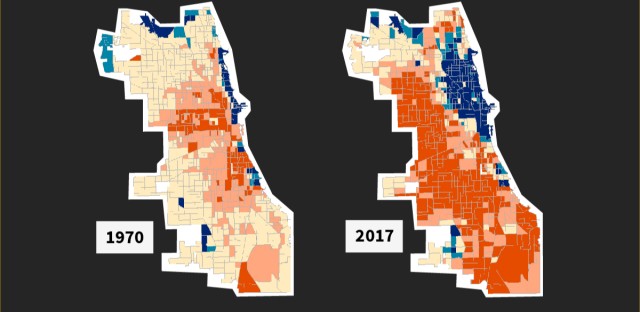
Here's a short article showing how Chicago's middle class has virtually disappeared.

bd120dbe-b37a-4ecf-964a-f1142ffd2b1d.jpg
 

zelezo vlk

Well-known member
Messages
18,010
Reaction score
5,048
And they have nothing to show for it either. Suburbia sucks, but it's a straight up swamp up there. Not even Francis Cardinal George could make it better
 

Legacy

New member
Messages
7,871
Reaction score
321
Homelessness

Homelessness

HUD annually awards states grants to fight homelessness. One is called the Continuum of Care grant, which awarded over $2 billion in Jan, 2018 with Illinois receiving $109 million. Texas received $88 million but also received $5.2 billion in disaster relief funding for those temporarily displaced. States with high housing costs like California have higher rates of homelessness and therefore received more - $382 million - with this grant.

HUD AWARDS RECORD $2 BILLION TO THOUSANDS OF LOCAL HOMELESS ASSISTANCE PROGRAMS ACROSS U.S. (with breakdown by state)

HUD's report on the status of homelessness for 2018.

Including all of HUD's Homeless Assistance Grants and Affordable Housing Appropriations is around $40 billion with FY 2019 appropriations in negotiations for the relatively smalll differences. The House and Senate bills are for $6+ billion more than the Admin requested.

The annual $40 billion is for the HUD grants to community assistance programs, etc. and does not include any appropriations for Food Stamps (CHIP) or any federal medical programs, etc. for the homeless.
 
Last edited:

Circa

Conspire to keep It real
Messages
8,000
Reaction score
818
I'm guessing banks are often closed due to the Federal Reserve system being shut down.

Just because It's called the Fed. It doesn't have a right to be broadcast itself as part of our Government. Presidents Day should go to the working class people whether you agree or not. Banks have a way of making the kids feel like they are apart of government policy.
It's treasonous, and definitely not anything that should represent our government.
I'm pretty sure you know these things and I don't need to try to look it up myself to make it easier....

Next thing I'll hear Is that Facebook has a right to follow our every move and Lyft should be an IPO because It's an American way.
The Federal Reserve Is within a snowballs throw to the White House. Yes, That WH....
It still gives It no reason to affiliate itself with the people that pay the bills... With hard work and integrity.
 
Last edited:

Circa

Conspire to keep It real
Messages
8,000
Reaction score
818
HUD shouldn't exist.

Yes. Please send our Women and children on to the streets like they do in foreign country's.... Or maybe they don't do that in foreign countries any longer.... I don't know. We worry so much about the things we can't afford we tend to blame the poor.
I was poor and still prey... I mean Pray for the poorest people to find their way out and find a good decent paying job.

HUD. It is an excellent program.
What kind of country wants the poorest of the poor to litter our streets with children.?
 
Last edited:

Circa

Conspire to keep It real
Messages
8,000
Reaction score
818
It makes me sick at the stomach to have to post this. In this day and age people still wanting to affiliate my money with politics.
https://www.facts-are-facts.com/news/the-federal-reserve-is-privately-owned
BTW. Our National Debt..... It's a scam.
Take 10 minutes and read about the treason we all want.....
I'm actually surprised about the article posted above's existence. Google, with all their might, may delete It.


and to all the 'Tin Foil hat' hear sayers. If your wife or husband ever tells you that first lie. Will you question everything from then on out? Or will ya just keep on keeping on.....
 
Last edited:

NorthDakota

Grandson of Loomis
Messages
15,700
Reaction score
5,996
Yes. Please send our Women and children on to the streets like they do in foreign country's.... Or maybe they don't do that in foreign countries any longer.... I don't know. We worry so much about the things we can't afford we tend to blame the poor.
I was poor and still prey... I mean Pray for the poorest people to find their way out and find a good decent paying job.

HUD. It is an excellent program.
What kind of country wants the poorest of the poor to litter our streets with children.?

Women and children? Why you leaving the men out of this?

I am not blaming "the poor" for HUD. I think it's probably unnecessary to have a FEDERAL department dedicated to something that state and local governments could probably absorb.
 

Irish#1

Livin' Your Dream!
Staff member
Messages
44,583
Reaction score
20,035
7 million truckers vs every single company that relies on long haul trucking, that have billions of dollars to gain by its implementation? I know who I'd put my money on.

Besides they won't be doing it all at once. There won't be a national fire your truckers day. It will start slow with giant companies adding one or two AI trucks to their fleet. Slowly as they see how superior their ROI is on those, they will phase out the traditional drivers. The ball will be rolling before anyone knows what's happening and it will be too late.


There's no such thing as fool proof in this case. The trucks will be sharing the road with millions of fools every day. There's far too many variables for it to ever be perfect. There will be crashes and people will die. All the trucks have to do is be better than their human counterpart, which I believe they will be quickly.

As of July last year Tesla alone had amassed over 1.2 billion miles of autopilot data.

That number is only going to continue to rise. With every mile they put on their proverbial treds the AI gets better and better.

I don't disagree with what you're saying. They can't program for every scenario and it may never be foolproof. I just think this won't happen quite as soon as you do, unless they make some requirement where semis can only drive in the far right lane.
 

Circa

Conspire to keep It real
Messages
8,000
Reaction score
818
Women and children? Why you leaving the men out of this?

I am not blaming "the poor" for HUD. I think it's probably unnecessary to have a FEDERAL department dedicated to something that state and local governments could probably absorb.

I have no real numbers to alleviate the question you asked me.
I do know that In most states the waiting list Is incredibly long and If the man of the house is around he has to work and provide for his family long before the acceptance letter is ever received. If he doesn't then It comes down to a survival technician.
Now,... I do know that SSI, and other old or mentally disturbed people will get an invite quicker.
If the politicians we elect put discriminating laws in place in order to keep things absurd, then I can tell you we as a public constantly look for a loophole to survive, just like big money finds them lawyers to push difficult agendas down our throat. Lawyers In politics....<iframe src="https://giphy.com/embed/3og0ISJ9FAHG8uyqAg" width="480" height="270" frameBorder="0" class="giphy-embed" allowFullScreen></iframe><p><a href="https://giphy.com/gifs/animalshbo-animation-animated-3og0ISJ9FAHG8uyqAg">via GIPHY</a></p>

and to add to your question. Of course, poor people didn't invent HUD. Our world in all it's magnificent glory created unequal people.... hence HUD
 
Last edited:

Whiskeyjack

Mittens Margaritas Ante Porcos
Staff member
Messages
20,894
Reaction score
8,126
<blockquote class="twitter-tweet" data-lang="en"><p lang="en" dir="ltr">Milllenials now carry $1 trillion worth of debt.<br><br>Since 2009, their mortgage debt has increased by just 3%, while their student loan debt has grown by over 100%<a href="https://t.co/2mHeHMC9NN">https://t.co/2mHeHMC9NN</a></p>— Joe Weisenthal (@TheStalwart) <a href="https://twitter.com/TheStalwart/status/1100084699396034562?ref_src=twsrc%5Etfw">February 25, 2019</a></blockquote>
<script async src="https://platform.twitter.com/widgets.js" charset="utf-8"></script>
 

Circa

Conspire to keep It real
Messages
8,000
Reaction score
818
<blockquote class="twitter-tweet" data-lang="en"><p lang="en" dir="ltr">Milllenials now carry $1 trillion worth of debt.<br><br>Since 2009, their mortgage debt has increased by just 3%, while their student loan debt has grown by over 100%<a href="https://t.co/2mHeHMC9NN">https://t.co/2mHeHMC9NN</a></p>— Joe Weisenthal (@TheStalwart) <a href="https://twitter.com/TheStalwart/status/1100084699396034562?ref_src=twsrc%5Etfw">February 25, 2019</a></blockquote>
<script async src="https://platform.twitter.com/widgets.js" charset="utf-8"></script>

Clickbait later...
Student loans are now over 1 trillion because of the way they were raised. Got to go to college. Be Soft, and gentle, and always argue to the point of exhaustion....
Then argue when your 50 why the roads/infrastructure...wages... are so shitty and why nobody wants to work in construction because the right to work was more important in the eyes of my professor.
 

Circa

Conspire to keep It real
Messages
8,000
Reaction score
818

Some Irish Bloke

Five foot nothin', a hundred and nothin'
Messages
6,346
Reaction score
5,922
Clickbait later...
Student loans are now over 1 trillion because of the way they were raised. Got to go to college. Be Soft, and gentle, and always argue to the point of exhaustion....
Then argue when your 50 why the roads/infrastructure...wages... are so shitty and why nobody wants to work in construction because the right to work was more important in the eyes of my professor.

While your point on the decline in tradesmen is valid, I'm not going to agree with you that millennials are at fault because they chose to go to college. Can we talk about how millennials are in debt to the FEDERAL GOVERNMENT to the tune of tens of thousands of dollars with interest rates that reach as high as 8%? How is that okay? They are the largest asset on the Fed Govs' balance sheet, and it's not even close. Student loan receivables. Crippling the financial future of the future of the country, what an asset....

http://www.thefiscaltimes.com/2018/09/28/US-Government-s-Biggest-Financial-Asset-Student-Debt

And everyone wonders why so many in their mid-20s still have to live at home post-graduation or why late 20's to early 30's are renting instead of buying. Many are already paying out the equivalent of a mortgage payment just to hit the principal portion of their loan because 8% interest on 50k in loans isn't going to be covered by minimum payments. How many can afford two "mortgage" payments per month?

But sure, they're young and can't balance a budget. Those damn lazy millennials...
 

GowerND11

Well-known member
Messages
6,536
Reaction score
3,287
Clickbait later...
Student loans are now over 1 trillion because of the way they were raised. Got to go to college. Be Soft, and gentle, and always argue to the point of exhaustion....
Then argue when your 50 why the roads/infrastructure...wages... are so shitty and why nobody wants to work in construction because the right to work was more important in the eyes of my professor.

Wait, are you saying this stuff, or saying that's what others will argue?
 

Some Irish Bloke

Five foot nothin', a hundred and nothin'
Messages
6,346
Reaction score
5,922
Wait, are you saying this stuff, or saying that's what others will argue?

I read it as that's what he was saying, but if that's not the case and he was being sarcastic, I redact my above post.

But I can't stand anyone who thinks student loans, and how tough and crippling they are, is just another excuse to slam the younger generation.
 
Last edited:

RDU Irish

Catholics vs. Cousins
Messages
8,622
Reaction score
2,722
While your point on the decline in tradesmen is valid, I'm not going to agree with you that millennials are at fault because they chose to go to college. Can we talk about how millennials are in debt to the FEDERAL GOVERNMENT to the tune of tens of thousands of dollars with interest rates that reach as high as 8%? How is that okay? They are the largest asset on the Fed Govs' balance sheet, and it's not even close. Student loan receivables. Crippling the financial future of the future of the country, what an asset....

http://www.thefiscaltimes.com/2018/09/28/US-Government-s-Biggest-Financial-Asset-Student-Debt

And everyone wonders why so many in their mid-20s still have to live at home post-graduation or why late 20's to early 30's are renting instead of buying. Many are already paying out the equivalent of a mortgage payment just to hit the principal portion of their loan because 8% interest on 50k in loans isn't going to be covered by minimum payments. How many can afford two "mortgage" payments per month?

But sure, they're young and can't balance a budget. Those damn lazy millennials...

The number of people taking max loans to take minimal class loads at community colleges is obscene. So many start with the maximum loan and are happy to avoid working to reduce their need. There is no scale of loan eligibility relative to tuition costs or room and board - if you are taking enough credits you are eligible for the maximum federal loan no matter if it is only $500 of tuition for six credits part time - you still get your $5k/semester for 10 semesters. No excuse for that person not to be bootstrapping - but you know, feds want to promote opportunity and all.

And stop it with the "full mortgage" - 8% on $50k is $333/month of interest. If you are not putting yourself in position to make $333/month more after school you are doing it wrong. More like an extra car payment than an extra mortgage payment (5 years 0% interest on a $20,000 car). Hell, pick up an 8 hour shift on weekends at Subway and you can make that payment - is that really too much sacrifice for a college degree?

The fraud is the country club schools, their skyrocketing costs and BS degrees. Tie the loans to the schools so they are on the hook for bad loans. Watch support for STEM and trades skyrocket - want some loans then at least minor in an area of actual workforce demand. Very easy free(er) market solution to the whole student loan debacle.

And this ties in to ND's push to REQUIRE kids stay on campus - at $20k/year room and board you can easily save $10k/year living off campus and they want to remove that option?
 

Irish YJ

Southsida
Messages
25,888
Reaction score
1,444
While your point on the decline in tradesmen is valid, I'm not going to agree with you that millennials are at fault because they chose to go to college. Can we talk about how millennials are in debt to the FEDERAL GOVERNMENT to the tune of tens of thousands of dollars with interest rates that reach as high as 8%? How is that okay? They are the largest asset on the Fed Govs' balance sheet, and it's not even close. Student loan receivables. Crippling the financial future of the future of the country, what an asset....

http://www.thefiscaltimes.com/2018/09/28/US-Government-s-Biggest-Financial-Asset-Student-Debt

And everyone wonders why so many in their mid-20s still have to live at home post-graduation or why late 20's to early 30's are renting instead of buying. Many are already paying out the equivalent of a mortgage payment just to hit the principal portion of their loan because 8% interest on 50k in loans isn't going to be covered by minimum payments. How many can afford two "mortgage" payments per month?

But sure, they're young and can't balance a budget. Those damn lazy millennials...

To me it's about choice. Just like the housing bust. Don't make the choice to take a loan knowing the terms if you're going to bitch about it afterwards. I could have got loans and went to ND. Instead I worked myself through IU and had zero student loan debt. Just like when I bought my first house. I bought a house that was half of the loan value I could have taken. And I paid it off in half the time. Too many people are just making the wrong choices my friend.
 

ACamp1900

Counting my ‘bet against ND’ winnings
Messages
48,947
Reaction score
11,225
The number of people taking max loans to take minimal class loads at community colleges is obscene. So many start with the maximum loan and are happy to avoid working to reduce their need. There is no scale of loan eligibility relative to tuition costs or room and board - if you are taking enough credits you are eligible for the maximum federal loan no matter if it is only $500 of tuition for six credits part time - you still get your $5k/semester for 10 semesters. No excuse for that person not to be bootstrapping - but you know, feds want to promote opportunity and all.

And stop it with the "full mortgage" - 8% on $50k is $333/month of interest. If you are not putting yourself in position to make $333/month more after school you are doing it wrong. More like an extra car payment than an extra mortgage payment (5 years 0% interest on a $20,000 car). Hell, pick up an 8 hour shift on weekends at Subway and you can make that payment - is that really too much sacrifice for a college degree?

The fraud is the country club schools, their skyrocketing costs and BS degrees. Tie the loans to the schools so they are on the hook for bad loans. Watch support for STEM and trades skyrocket - want some loans then at least minor in an area of actual workforce demand. Very easy free(er) market solution to the whole student loan debacle.

And this ties in to ND's push to REQUIRE kids stay on campus - at $20k/year room and board you can easily save $10k/year living off campus and they want to remove that option?

I’ve seen this a lot,... then when the student is serious and wantsa degree that actually impacts their future,... they run out of FA funds....
 

Ndaccountant

Old Hoss
Messages
8,370
Reaction score
5,771
To me it's about choice. Just like the housing bust. Don't make the choice to take a loan knowing the terms if you're going to bitch about it afterwards. I could have got loans and went to ND. Instead I worked myself through IU and had zero student loan debt. Just like when I bought my first house. I bought a house that was half of the loan value I could have taken. And I paid it off in half the time. Too many people are just making the wrong choices my friend.

TBF, I am not how many freshman understand the difference between subsidized or unsubsidized, let alone cost of deferment. The general population's financial incompetence is crippling.
 

RDU Irish

Catholics vs. Cousins
Messages
8,622
Reaction score
2,722
To me it's about choice. Just like the housing bust. Don't make the choice to take a loan knowing the terms if you're going to bitch about it afterwards. I could have got loans and went to ND. Instead I worked myself through IU and had zero student loan debt. Just like when I bought my first house. I bought a house that was half of the loan value I could have taken. And I paid it off in half the time. Too many people are just making the wrong choices my friend.

Bingo - I see too many people turn a blind eye to college costs in their selection process. But that's what Johnny or Janie wants so we have to make it happen! Parents taking on huge private loan debts leading in to retirement is just financial suicide. All because they can't tell their kid no or make them work while in school. Same kids that come out complaining about their Stafford Loans that are half the private loans their parents are wrestling. All for the same education that is available for less than half the price elsewhere. If you don't have the dough - why not hit the local CC and work through your first two years and actually save money without loans while prepping to transfer to a four year school? Such an efficient path to the same end.
 

Some Irish Bloke

Five foot nothin', a hundred and nothin'
Messages
6,346
Reaction score
5,922
And stop it with the "full mortgage" - 8% on $50k is $333/month of interest. If you are not putting yourself in position to make $333/month more after school you are doing it wrong. More like an extra car payment than an extra mortgage payment (5 years 0% interest on a $20,000 car). Hell, pick up an 8 hour shift on weekends at Subway and you can make that payment - is that really too much sacrifice for a college degree?

$333 per month of interest with many of these kids, to ND Accountant's point about financial literacy, paying a minimum payment of, say, $250, causes that additional $88 gets tacked back on the principal at the end of the year unless you cut a check to the loan service to the tune of $1k to pay off your required interest. Many of these kids don't realize they aren't actually paying off their loan; they aren't even paying off their interest obligations.

My point of comparing it to a "mortgage" is that in order to actually have an aggressive amortization on a loan, say 10 years on that $50k, you are actually paying $607 per month to hit the principal on a 10 year repayment.

Anyone who tells me 8%, from the federal government, expected to be paid at an entry level wage, isn't a criminal rate is off their rocker. That's twice the prime rate.
 
Last edited:

GowerND11

Well-known member
Messages
6,536
Reaction score
3,287
I feel like all of you are slightly victim blaming... The cost of all schools has skyrocketed over the last 30 years, including public schools. States are also providing less money to those higher education institutions than before, meaning the burden is passed on to the student/parent.

Many high school aged kids do not understand student loans, and I'm willing to bet that most of them are not involved in the process. I can also see parent, many parents, that did not go to college, are not exactly understanding of the costs and the burden when they sign for these loans.

There is no one finger to point in one direction here, there's many at fault, but I would say that a student shouldn't be crippled because they decided to go right to a 4 year institution instead of community college.
 

Some Irish Bloke

Five foot nothin', a hundred and nothin'
Messages
6,346
Reaction score
5,922
To me it's about choice. Just like the housing bust. Don't make the choice to take a loan knowing the terms if you're going to bitch about it afterwards. I could have got loans and went to ND. Instead I worked myself through IU and had zero student loan debt. Just like when I bought my first house. I bought a house that was half of the loan value I could have taken. And I paid it off in half the time. Too many people are just making the wrong choices my friend.

If only every 18 year old who wants the dream of a higher education is as bright as the guys on this board.

I agree with you and RDU in principal that there are extremely affordable ways to get a degree, especially if you knock out your prerequisites through CC and work through college and avoid as much loan debt as possible.

But let's not act like the Fed Govt. is free of blame here. When you're largest asset is the individuals who are the future of this country, and you're charging asinine rates at 2x the prime rate, that's not okay.

I'm not in camp "college should be free", but I think reform could go a long way in helping out.
 

Irish YJ

Southsida
Messages
25,888
Reaction score
1,444
TBF, I am not how many freshman understand the difference between subsidized or unsubsidized, let alone cost of deferment. The general population's financial incompetence is crippling.

It's as much about lack of accountability, lack of common sense, and entitlement, as it is financial incompetence. When I was in college, like many others, I made bad choices with credit cards. I knew what I was doing though. And I didn't bitch or blame CC companies for making it easy to make bad choices as I knew it was my fault. I hunkered down and paid them off and started living within my means lol.

These days people want the easiest path...., they want gov to make it simple and easy, all laid out for them.... and then they want to lay blame once they take that "easy" path. They want the biggest house, the fanciest car, etc. the bank will loan them money for. They don't want to save or live within their means. I mean why do that when we are victims and the gov will save us.
 

Legacy

New member
Messages
7,871
Reaction score
321
I’m a Doctor and Even I Can’t Afford My Student Loans
When the highest earners struggle with the cost of education, the nation needs to get serious about the problem.

(NYT)

Average Medical School Debt in 2018 (Nerd Wallet)

Average medical school debt
Medical school graduates tend to have larger student loan balances than people whose highest level of education is a bachelor’s degree. But doctors aren’t the only professionals with outsized student debt.

Here’s how the average medical school debt compares to other fields for the class of 2017, the most recent year all of the data is available:

Average medical school debt: $190,694.
Average bachelor’s degree debt: $28,650.
Average dental school debt: $287,331.
Worker visas in doubt as Trump immigration crackdown widens
(AP)
Immigrants with specialized skills are being denied work visas or seeing applications get caught up in lengthy bureaucratic tangles under federal changes that some consider a contradiction to President Donald Trump’s promise of a continued pathway to the U.S. for the most talented foreigners.

For American businesses, there is a bottom-line impact.

Link Wilson, an architect who co-founded a firm in Bloomington, Minnesota, said finding enough qualified workers within the U.S. has been a problem for years. That’s due to a shortage of architects, but also because his firm needs people with experience developing senior housing. He said employers who turn to international applicants do so as a last resort, putting up with legal fees and ever-expanding visa approval times because they have no other choice.

“We’re just at the point where there’s no one else to hire,” said Wilson, who hired an architect under an H-1B visa last year after enduring a long wait. He estimates his firm turned away about $1 million in projects in 2018 because it didn’t have enough staff to handle them.

Why Enrollment Is Shrinking At Many American Colleges
(Forbes)
Will some of these colleges go out of business?

Here’s why that scholarship might not be free after all
(CNBC)

Imagine pursuing a teaching or nursing job with student loan debt. In teaching more states are not funding their pension systems adequately. These are areas of need.

These problems are worsening with an aging workforce, too.
 
Last edited:

Irish YJ

Southsida
Messages
25,888
Reaction score
1,444
I’m a Doctor and Even I Can’t Afford My Student Loans
When the highest earners struggle with the cost of education, the nation needs to get serious about the problem.

(NYT)

Average Medical School Debt in 2018 (Nerd Wallet)


Worker visas in doubt as Trump immigration crackdown widens
(AP)


Why Enrollment Is Shrinking At Many American Colleges
(Forbes)
Will some of these colleges go out of business?

Here’s why that scholarship might not be free after all
(CNBC)

Imagine pursuing a teaching or nursing job with student loan debt. In teaching more states are not funding their pension systems adequately. These are areas of need.

These problems are worsening with an aging workforce, too.

so paying ~$200K for an average yearly earnings of ~$200K is a bad deal.
got it. poor doctors.
 

Legacy

New member
Messages
7,871
Reaction score
321
Interesting read from CNBC.

Trump and GOP promised economic growth much better than Obama's. That's not what happened

- Throughout the 2016 campaign and since, the president and his party have vowed to kick-start tepid Obama-era economic growth.
- New government data show that Trump, too, has failed to reach the 3 percent promised land, according to one major metric.
- The Commerce Department's Bureau of Economic Analysis measured 2018 growth at 2.9 percent, matching the peak Obama enjoyed in 2015.
- For the rest of the president's term, economic forecasters agree, that number will decline.
 

Whiskeyjack

Mittens Margaritas Ante Porcos
Staff member
Messages
20,894
Reaction score
8,126
The Institute for Family Studies just published an interview with Oren Cass:

Tucker Carlson’s recent monologue on the “Market and the Family,” in which he argued that the contemporary economy has undercut the strength and stability of working-class families, has sparked a major debate among conservatives. Some conservatives—including David French and Ben Shapiro—have taken issue with his argument. IFS senior fellow W. Bradford Wilcox recently spoke to Oren Cass, a senior fellow at The Manhattan Institute and author of the new book, The Once and Future Worker: A Vision for the Renewal of Work in America, about this important debate. The following interview has been edited for clarity.

W. Bradford Wilcox: What is your take on Tucker’s argument about the economy and the working class, and how does your book speak to this debate?

Oren Cass: I agree with a lot of the points Tucker made. We’ve built an economy and a society that just isn’t very conducive to stable families, especially for people with less education who are likely to struggle in the modern labor market. What frustrates me about the response is that they seem to view the debate as either/or. Either the challenges facing the working class can be explained by failure to take personal responsibility or they are the result of policy choices and economic factors. Thus, talking about economics gets interpreted as renouncing the importance of personal responsibility.

But there’s no reason we have to choose between those explanations; to the contrary, the explanations are complementary. Obviously, a lot of people are making bad choices. And we have plenty of examples of people facing similar circumstances who make better choices, which goes to show that personal agency plays a critical role. But I think that the set of choices available to a lot of people has gotten worse and that we’ve made it harder to make good choices. Observing that doesn’t absolve people of responsibility. That said, neither does observing that people need to take responsibility absolve policymakers of responsibility for considering how policies affect people and whether different policies could yield better outcomes.

And note the asymmetry in this debate. Only one side is demanding that we choose one explanation at the exclusion of the other. Folks like me and Tucker, who argue that policy and economic conditions play a role, are not saying that personal responsibility is unimportant or that structural forces have deprived people of all opportunity. We’re just arguing that alongside the traditional conservative emphasis on personal responsibility, we need also to acknowledge that the economic formula of recent decades has not been a good one for a lot of people and that we should hold do better on that front, too. Conservatives need to be able to hold both ideas at the same time.

The argument in my book is that our public policy has overlooked one important factor: work. Our economic models and our policies are built on a premise that the goal is to maximize “consumer welfare” without reference to what happens in the labor market—whether people are able to participate as productive contributors to society and support themselves and their families. So, for instance, we’ve assumed that taxing some person who is getting ahead and then mailing a check to the person who has lost his job can substitute for that person having a job. But that’s not right.

When it comes to the foundation of our society, our families and communities, consumption levels just aren’t as important as engagement in productive work and self-sufficiency. Many of our public policies have transformed the labor market in ways that make it much harder for less educated people to find work and support their families. I think we have to acknowledge the role that has played in the challenges we face and focus our public policy conversations toward strengthening the labor market, so people have more good choices and are more likely to make them.

Wilcox: Most people would agree that work is important, but it also seems widely available—especially with the unemployment rate below 4 percent. In his most recent article on the topic, David French writes, “If a person exercises the most basic degree of self-discipline and industry, completes an education, gets married, and has kids, then his or her odds of being poor are vanishingly low.” That doesn’t seem like too much to ask, does it?

Cass: It’s something of an empirical question, whether that’s easily achievable or not. If we have large numbers of people failing to hit those milestones, we should inquire as to why and what has changed. David chalks it up to self-discipline and industry, implying that people who fail to achieve those goals must lack those characteristics and, I suppose, that we’ve seen a collapse in discipline and industry among the population. I believe he attributes this to our national “libertinism.”

Here’s the problem: we all swim, generally speaking, in the same cultural pond. If you want to see some real libertinism in this country, go visit a college campus. Yet somehow, for the minority of Americans who demonstrate the academic aptitude to complete college, the model of stable marriage and steady work remains almost entirely intact. It’s only the people swimming in the portion of the cultural pond with a stagnant labor market who are experiencing these challenges. So, you could say, if you want, that it’s just the people who don’t have college degrees who have lost self-discipline and industry, that it’s happened for cultural reasons, and only by irrelevant coincidence are they the ones facing the economic pressures. But I think it takes an almost willful blindness to assert that.

Wilcox: How have recent shifts in policy undercut wages and stable work among less-educated men (or the working class)? Can you give a specific example?

Cass: It’s not so much that we have seen recent shifts as that we made a series of choices—most dating back to the 1970s—that have imposed ever greater costs over time. In the book, I cover a wide range of examples but let’s take a couple.

For instance, we have built a “college-for-all” system that pushes people as far through the pipeline as they can go, but then pretty much abandons them if they don’t make it out the end. Fewer than one-in-five young people move smoothly from high school to college to career. Yet that’s pretty much the exclusive focus of our high schools, and it’s where we put all of our post-high-school support. We spend more than $150 billion annually subsidizing higher education, but for people not pursuing college degrees, we offer pretty much zero.

Contrast that to how the rest of the world does things. The OECD has shown that in nearly every other developed economy, 40 to 70% of high school students are in some kind of vocational or technical program. Their report actually excludes the U.S. from its chart because we are so out of line. And then we wonder why outcomes are so bad for people who don’t complete college. Non-college pathways into the workforce should be the top priority for our education system and the primary target of subsidies.

A completely different example is international trade. Let’s get this out of the way first: trade can be great. Even when trade causes layoffs and factories moving overseas, it can be a major boost to the economy if it allows us to specialize and gain scale in the things we do best. So, you lose one set of jobs to foreigners who now send some products into America, but you gain another set of jobs as foreigners start buying more of some other product from America.

The problem arises when the trade is imbalanced. If we start importing massive amounts of stuff that we used to make or could make here, and the countries making that stuff don’t reciprocate by importing massive amounts of stuff that we start making here, then the effect on our labor market is sharply negative. Even worse, if other countries start picking and choosing the most attractive industries to dominate, and we let the expertise and supply chain in those industries vanish overseas, our economy becomes far weaker.

That’s exactly what happened with China. We lost literally millions of jobs as Chinese imports replaced things we used to make domestically, and we got very little offsetting increase in things that China could buy from us. The seminal research on this is from David Autor, but others like Peter Schott have found similar effects. And I highly recommend reading the recent report from by Senator Rubio and the Senate Small Business Committee, documenting the extraordinary challenge posed by the “Made in China 2025” program.

This is actually a pretty obvious point—that trade deficits are bad for workers—but it’s one that our policymakers overlooked for a very long time because they were focused only on consumer welfare. From that perspective, a trade deficit was great: China sent us lots of cheap electronics, and we didn’t even have to make anything to send back in return! But if we care about workers, that sentiment is absurd.

Wilcox: How and why have changes in contemporary work affected working-class families?

Cass: First and foremost, our economy has become one in which it is much harder for less-educated men to support their families as traditional breadwinners. The Census Bureau reports that in the 1970s, only one-quarter of young men were earning less than $30,000 per year. Now that figure is above 40 percent. Among those without a college degree, the picture is even more dire. Joining the workforce at all becomes less attractive, so we have a much higher share of men who aren’t working full time. And even among those who are, we have many more who can’t achieve the financial security to build a family around.

Men who can’t play the breadwinner role are less attractive as marriage partners, and under those conditions, fewer marriages form. That’s partly for straightforward economic reasons, but also because with declining economic prospects comes higher rates of destructive behaviors like substance abuse. Likewise, unemployment for men is an incredibly strong predictor of divorce.

Meanwhile, from the other direction, our ever-expanding safety net has made what one can assemble from government benefits come closer to approximating what one can achieve by working. That has a concrete economic effect because getting married and attaining self-sufficiency seems less worthwhile, and it also has a cultural effect because doing those things now seems like less of achievement.

And then there’s the intergenerational effect: kids do better when they grow up with role models who are working, both in their own families and their communities. The data point I found most striking in Charles Murray’s Coming Apart was that, among the working-class households he studied, only half had even one full-time worker by 2010. Which gets back to the earlier question of why we can’t just expect everyone to exhibit some purportedly simple level of self-discipline and industry? Where and how do people learn those things? If desirable cultural norms and expectations have economic underpinnings, then what looks like a cultural problem can turn out to be an economic one as well.

Wilcox: What specific public policies would help to revive the economic fortunes of the working class, and connect working-class men to the labor force?

Cass: There are lots of things we could be doing better. Folks who argue that the problem is entirely cultural seem to fear that any discussion of our economic problems marches us irrevocably toward “big government.” That’s not true. Our problems haven’t arisen because we lacked big government programs, nor are such programs the solution. What we’ve done is made a series of policy choices that biased our economy against less-educated workers who are struggling the most. We choose the conditions in which our labor market operates, and we’ve chosen some bad ones.

We talked already about how our education system focuses exclusively on college completion. We should instead offer a non-college pathway that, for less than we spend on trying to get someone through college, could get him to age 20 with on-the-job experience, an industry credential, and earnings in the bank. As far as I know, no one is saying we should get rid of our education system. So, if we all agree we should have one, I’d hope we could all agree that the one we have is ill-serving exactly the population in need of investment, and it is within our power to change that.

I also think we should reorient our safety net toward work, by creating what’s called a “wage subsidy.” Just like we have payroll taxes that take money out of every paycheck on that line labeled “FICA,” we should have a wage subsidy that puts money into low-wage paychecks on a line labeled “Work Credit.” So, someone working a $9-per-hour job, say, could get an additional $3 per hour from the government. This would make entry-level jobs more attractive to workers. Some portion of the subsidy would end up benefiting the employer, but that’s a good thing, too—it would make employing entry-level workers more attractive. And then finally, it would boost take-home pay for low-income households in a way that is attached to work.

We could fund this by reallocating a portion of the money we already spend on our safety net that we’re spending today in ways that ignore or discourage work. Of course, we still need our traditional safety net for those who can’t work. But if we could shift some portion of our poverty alleviation efforts toward getting people into jobs and earning a paycheck, that could go a long way toward addressing short-term economic problems and rebalancing the equation so that working to support your family becomes, not just a good choice, but an easier one.
 

wizards8507

Well-known member
Messages
20,660
Reaction score
2,661
Whiskey, if you start a podcast where you simply narrate the articles you share into audio form so that I have time to listen to them, I promise I'll join your Patreon at the Johnnie Walker Blue Label tier or whatever.
 
Top