Culture

zelezo vlk

Well-known member
Messages
18,012
Reaction score
5,053
And they wonder why people don't want to sit (and stand and kneel) through Mass

That's just because y'all are lazy Papists! True Mackerel Snappers like me and all other converts are just much holier than thou, so y'all need to listen up
 

Whiskeyjack

Mittens Margaritas Ante Porcos
Staff member
Messages
20,894
Reaction score
8,126
TFW Whiskey uses ten times the number of words that are necessary to make the point I already made.

Had you made the point, I would have repped you and moved on. I had to elaborate on "What is best for children" and "We need more babies!" because you seemed to be arguing for little more than bourgeois morality. It's more than that.

Teach them to get married.

Who's going to teach them that? And how do we get that lesson to stick when all this other stuff-- contraception, no-fault divorce, etc.--is normative and completely unquestioned?
 

wizards8507

Well-known member
Messages
20,660
Reaction score
2,661
Had you made the point, I would have repped you and moved on. I had to elaborate on "What is best for children" and "We need more babies!" because you seemed to be arguing for little more than bourgeois morality. It's more than that.

Who's going to teach them that? And how do we get that lesson to stick when all this other stuff-- contraception, no-fault divorce, etc.--is normative and completely unquestioned?
I agree with you, I was just contrasting your writing style with my own. We're saying the same things, but you're saying it as an academic and I'm saying it as a flaming #HotTake.
 

Whiskeyjack

Mittens Margaritas Ante Porcos
Staff member
Messages
20,894
Reaction score
8,126
I agree with you, I was just contrasting your writing style with my own. We're saying the same things, but you're saying it as an academic and I'm saying it as a flaming #HotTake.

[webm]https://i.imgur.com/E0l6vsB.mp4[/webm]
 

Whiskeyjack

Mittens Margaritas Ante Porcos
Staff member
Messages
20,894
Reaction score
8,126
Speaking of flaming #HotTakes... pets are liberalism. Here's Matthew Schmitz in First Things with an article titled "Beware of Dog":

Pets are replacing America’s children. According to the marketing research firm Mintel, two-thirds of American pet owners treat their pets as “part of the family.” One-third say that their pets understand their feelings better than most humans. Half care as much about the health of their pet as about any family member. (Pet owners who have actual children are less likely to speak of their pets in these terms.) Forty-four percent of young pet owners see their pets as “starter children.” Seventeen percent of pet owners bought pet costumes last year, and 10 percent bought pet strollers. First comes love, then comes marriage, then comes Fido in the baby carriage.

We are sentimental about pets because we are unwilling to welcome human life—or so says Pope Francis. In 2014, he condemned those who choose not to have children because they fear poverty and sickness. Such people think, “It’s better . . . more comfortable—to have a dog, two cats, and the love goes to the two cats and the dog.” But their love of animals shows their indifference to man.

The conflict between love of pets and love of children is most obvious in gentrifying neighborhoods, where sterile, secular, dog-loving whites are displacing poor, fecund minorities. In 2011, Marshall Brown, a veteran D.C. political activist, criticized the gentrifiers: “The new people believe more in their dogs than they do in people. They go into their little cafes . . . they don’t connect at church . . . they don’t volunteer in the neighborhood school.”

For daring to make this remark, Brown was fired from his position on a city council campaign—but his sociology was sound. In 2008, D.C.’s Shaw Dog Park was built on a section of a public playground where a canchita used for pickup soccer games by members of the local Latino community had previously stood. The Shaw Dog Park Association meets monthly at Commodore Public House, a “five-star dive” specializing in craft cocktails and local beers.

Earlier this year, a man named Carlton Knight told the Washington Post that a dog park illegally erected on public land in Columbia Heights was “good for the dogs . . . but to be straight up . . . it makes you feel you’re not welcome because you’re not white.” The Friends of Columbia Heights Dog Park was founded by a Planned Parenthood “clinic escort” whose father is the former head of the National Family Planning and Reproductive Health Association. Construction of dog parks is a new closing of the commons, the seizure of public land by a select class.

Those who insist that the adoration of animals is compatible with the love of children will sometimes invoke St. Guinefort, a greyhound venerated as a martyr after he died protecting an infant. Guinefort belonged to a lord and lady who one day left him alone with their child, then came home to find the crib upset and blood splattered around the room. Thinking the dog the attacker, they killed him and threw him in a well. Only then did they see a dead snake in the room, and realize that the dog had in fact saved their child. Struck by remorse, they filled the well with stones and planted trees beside it. Peasant mothers began to bring their sick children to the shrine in hopes that the dog might intercede for them.

Guinefort’s story was first documented in the thirteenth century by Stephen of Bourbon, an inquisitor, but it had many literary precedents. It is hard to find a tale so ancient and so broadly attested as that of the pet unjustly slain after protecting a child. It first appears in the Pañcatantra, a Sanskrit text compiled in the third century b.c.; it reappears in Arabic, Persian, Hebrew, Greek, Latin, Chinese, and all the languages of modern Europe.

In the oldest version of the tale, we encounter a striking anticipation of modern pet ownership. The couple adopt the pet as their “all-in-all, their younger son, their elder daughter—their elder son, their younger daughter, so fondly did they regard that little creature.” The mother suckles it at her breast. Her raptures of tenderness toward the pet do not preclude neglect of her human child, whom she and her husband leave alone.

Though the Church attempted to suppress it, Guinefort’s cult lasted well into the twentieth century (Jean-Claude Schmitt found evidence of its practice as late as 1940) and is now enjoying a revival. Last year, The Inquisitor’s Tale: Or, The Three Magical Children and Their Holy Dog became a bestseller. The children’s novel imagines the child saved by Guinefort reuniting with the sainted dog in order to confound church authorities. And no one has done more to spread the cult than Disney. Lady and the Tramp is simply a secular retelling of Guinefort’s legend.

Yet fans of Guinefort tend to overlook the cruel reality of his cult. The women seeking Guinefort’s help believed that spirits had stolen their real, healthy children, leaving behind sickly impostors—“changelings.” Guinefort would restore the true child if the mother and a witch tossed the changeling nine times between two trees planted over the well. After placing the child on a bed of straw and lighting candles by its head, the mother would go out of sight and earshot. If the child did not die in the fire, as often happened, it was to be dunked nine times in a nearby stream. If the child survived this ordeal, it was recognized as the mother’s healthy, human child. If it died, the mother was rid of a sickly and troublesome devil. Stephen of Bourbon rightly called this cult infanticidal.

In August, Elizabeth Harman, a philosopher at Princeton, gave an interview to James Franco explaining her view of unborn life. “Among early fetuses there are two very different kinds of beings,” she said. She and Franco, for instance, “had moral status in virtue of our futures.
. . . But some early fetuses will die in early pregnancy due to abortion or miscarriage. And in my view, that is a very different kind of entity. That’s something that doesn’t have a future as a person and it doesn’t have moral status.” This means that “if you do abort, abortion is okay, but if you don’t abort, abortion would have been wrong.”

Harman’s view is a revival of medieval belief in changelings. It reassures us that we, like the women who worshipped Guinefort, need not mourn the children we have killed. We seek such reassurance to quiet a guilty conscience. Sixty million American children have been aborted since 1973. Eighty-five percent of those diagnosed with Down syndrome are now killed in the womb. Harman’s argument may sound absurd, but judging by our lack of protest, our absence of mourning, we quietly share her judgment. The victims of abortion are not our dead; they must be creatures of another kind.

It is no coincidence that in the thirteenth century and the twenty-first, veneration of dogs arises alongside contempt for burdensome children. Pets permit us to enjoy companionship without commitment and tenderness without sacrifice. They are bred to our liking. They arrive on our terms and live at our pleasure. Human at one moment but not at another, objects of adoration that we can “put down” without sin, pets are more perfect versions of what children become when we refuse to welcome human life that is weak or strange. As playgrounds become dog parks and pets are put into strollers, the symbolism is hard to miss. Dogs are stalking horses of the culture of death.

One woman described by Stephen of Bourbon was unlike the others. After leaving her infant son at Guinefort’s shrine, she saw a wolf stealing toward him. According to the customs of her time and place, she should have done nothing. The dog was simply the devil come to reclaim his burdensome changeling. But the woman did not stand on custom. Though the world denied his worth, she ran to save her child.

Segues nicely from the last topic.
 

Legacy

New member
Messages
7,871
Reaction score
321
Teach them to get married.

Trump administration suddenly pulls plug on teen pregnancy programs (Reveal)

The Trump administration has quietly axed $213.6 million in teen pregnancy prevention programs and research at more than 80 institutions around the country, including Children’s Hospital of Los Angeles and Johns Hopkins University.

The decision by the U.S. Department of Health and Human Services will end five-year grants awarded by the Obama administration that were designed to find scientifically valid ways to help teenagers make healthy decisions that avoid unwanted pregnancies.

Funds loss could lead to more unplanned teen pregnancies (Enid News)
If we want to make sure every Oklahoman has the chance to become a productive, healthy adult, then preventing teen pregnancies is one of the most important things we can do. While some teen mothers and their children manage to beat the odds, giving birth before completing one’s education and being prepared to parent greatly increases the likelihood of being trapped in a cycle of misfortune.

Research finds that only about 50 percent of women who become teenage mothers earn a high school diploma by age 22 and only around 10 percent will graduate from college. Two in five mothers who give birth before age 20 are living in poverty within the first year of their child’s birth. The children of teen parents have a higher risk for low birth weight and infant mortality, have lower school achievement and more behavioral problems, and are more likely to be incarcerated at some time during adolescence.

The good news is that great progress has been made in recent years in reducing teen pregnancies. Since the early 1990s, the national teen pregnancy rate is down by 55 percent, according to the National Campaign to Prevent Teen and Unplanned Pregnancy.

But there is still much more work to be done, especially in Oklahoma. In 2015, Oklahoma’s teen birth rate — 34.8 births per 1,000 females ages 15-19 — remained the second highest among the states and was more than 50 percent higher than the national rate of 22.3 births per 1,000 female teenagers. There were 4,802 births to teenage Oklahoma mothers in 2014. Public spending on teen pregnancies tops $150 million per year in Oklahoma.

This is why the recent announcement that the Trump Administration plans to abruptly terminate the national Teen Pregnancy Prevention Program (TPP) is so concerning. The five-year program was expected to run through 2020; however, in July, all the grantees received letters informing them that they would not be funded past June 2018.

TPP funds three large programs in the state: one in Tulsa, led by Youth Services of Tulsa, one in Oklahoma City, led by the Oklahoma City-County Health Department, and one in Choctaw, McCurtain and Pushmataha counties led by the Choctaw Nation. Together, the programs serve some 15,000 teens annually.

The Administration has justified eliminating the Teen Pregnancy Prevention Program by stating that there is “very weak evidence of positive impact of these programs.” However, the success seen in reducing teen pregnancy rates refutes the claim that the programs are not working. In reality, it’s widely believed that the decision reflects the influence of Trump Administration appointees who are outspoken advocates of abstinence-only education and opponents of more comprehensive approaches. Yet, extensive research over the past 15 years has established that abstinence-only programs are ineffective, often medically inaccurate, and even harmful.

By contrast, comprehensive teen pregnancy prevention programs that include both abstinence and contraception information lead to reductions in “sexual activity, the number of sex partners, the frequency of unprotected sexual activity, and sexually transmitted infections,” according to a comprehensive analysis by the Centers for Disease Control. The programs being eliminated all include abstinence education, along with information on contraception and healthy relationships.

Cutting off funding for teen pregnancy prevention will lead to more unplanned pregnancies and more young Oklahomans struggling to raise babies, when they should be completing their education and entering the workforce. It’s a short-sighted decision that should be reversed.
 
Last edited:

Ndaccountant

Old Hoss
Messages
8,370
Reaction score
5,771
Had you made the point, I would have repped you and moved on. I had to elaborate on "What is best for children" and "We need more babies!" because you seemed to be arguing for little more than bourgeois morality. It's more than that.


Who's going to teach them that? And how do we get that lesson to stick when all this other stuff-- contraception, no-fault divorce, etc.--is normative and completely unquestioned?

People act on incentive, no? Give married people more gov't helicopter money.

I say that in jest, but it's true. It's quite ironic that we are here talking about people wanting to have sex (b/c it offers up an emotional and/or physical pleasure for the self) and the consequence of unplanned children when it's the eternal search of a "soul mate" is, perhaps, one of the biggest drivers against marriage in the last 40 years.

The 1960 & 70's were rife with prosperity, which allowed people to focus on more "intangible" ideas, including divorce. No fault divorce was, at the time, viewed as a virtue because it freed up the individual to pursue inner happiness and consensus was that the children would be better off with happy parents that were divorced rather than unhappy parents together.

Research is clear that children who are exposed to divorce are two to three times more likely than their peers in intact marriages to suffer from serious social or psychological pathologies. Remarriage doesn't change squat. Taking into account both divorce and non-marital childbearing, sociologist Paul Amato estimates that if the United States enjoyed the same level of family stability today as it did in 1960, the nation would have 750,000 fewer children repeating grades, 1.2 million fewer school suspensions, approximately 500,000 fewer acts of teenage delinquency, about 600,000 fewer kids receiving therapy, and approximately 70,000 fewer suicide attempts every year. This, in the face of the fact that more than 2/3rds of divorce are not the result of "conflict" marriages. Parents leave b/c they are "unhappy", or "fall out of love". How is a children supposed to believe in the permanency of marriage and invest appropriately emotionally and financially when their time comes? It's a nasty cycle.
 

Ndaccountant

Old Hoss
Messages
8,370
Reaction score
5,771
Speaking of flaming #HotTakes... pets are liberalism. Here's Matthew Schmitz in First Things with an article titled "Beware of Dog":


Segues nicely from the last topic.

Zz1jYTA2Y2M3NjE4YWJkMmQ5MzdhOTgyYzJlZjlkYzkyMw==
 

zelezo vlk

Well-known member
Messages
18,012
Reaction score
5,053
"Dogs are the best people". I see this online a lot and it makes me very worried for the future of our culture
 

Whiskeyjack

Mittens Margaritas Ante Porcos
Staff member
Messages
20,894
Reaction score
8,126
The 1960 & 70's were rife with prosperity, which allowed people to focus on more "intangible" ideas, including divorce. No fault divorce was, at the time, viewed as a virtue because it freed up the individual to pursue inner happiness and consensus was that the children would be better off with happy parents that were divorced rather than unhappy parents together.

One of the worst aspects of liberalism. Chasing "happiness" is a mug's game. Appetites change, some people want unobtainable things, some people simply want the wrong things, etc. Make purpose/ meaning your goal, and you'll do much more good and feel much better about yourself than if you focus on some abstract nonsense like happiness.

Research is clear that children who are exposed to divorce are two to three times more likely than their peers in intact marriages to suffer from serious social or psychological pathologies. Remarriage doesn't change squat. Taking into account both divorce and non-marital childbearing, sociologist Paul Amato estimates that if the United States enjoyed the same level of family stability today as it did in 1960, the nation would have 750,000 fewer children repeating grades, 1.2 million fewer school suspensions, approximately 500,000 fewer acts of teenage delinquency, about 600,000 fewer kids receiving therapy, and approximately 70,000 fewer suicide attempts every year. This, in the face of the fact that more than 2/3rds of divorce are not the result of "conflict" marriages. Parents leave b/c they are "unhappy", or "fall out of love". How is a children supposed to believe in the permanency of marriage and invest appropriately emotionally and financially when their time comes? It's a nasty cycle.

Very true. Our culture prioritizes the desires of selfish adults over the wisdom of our forebears and the needs of our children. A healthy culture ties past to present in the form of tradition and prioritizes the future over the present. Ours currently does neither of those things.
 

MNIrishman

Well-known member
Messages
2,532
Reaction score
481
Speaking of flaming #HotTakes... pets are liberalism. Here's Matthew Schmitz in First Things with an article titled "Beware of Dog":


Segues nicely from the last topic.

Dude, dog popularity is on the rise largely because modern economic realities make it difficult for young people to have children responsibly. The solution in part to the population crisis is to massively restrict access to burdensome student loans such that far fewer people are unnecessarily going to college and chaining themselves to majors and schools that can't pay off the debt undertaken. People have a need to nurture and a need for companionship. Pets help fill those roles economically, but you're right that they're not a replacement for children. Indeed, as a person raised with many animals in the house, I think they're a great complement to children. In fact, studies show that being raised with pets reduces a person's likelihood of developing allergies later in life.

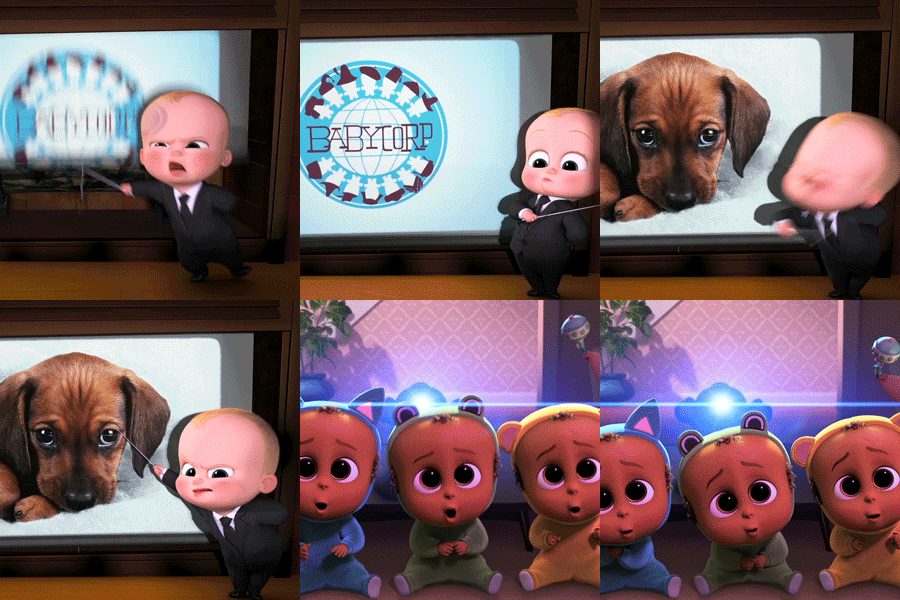
The "pets vs. children" narrative is misguided. These are not mutually exclusive things, a fact which was lampooned in "Boss Baby," as has already been pointed out. Increasing costs (or, in this case, large-scale poorly-chosen personal debt overhead) force people to lower cost substitutes. It's just economics.
 

Whiskeyjack

Mittens Margaritas Ante Porcos
Staff member
Messages
20,894
Reaction score
8,126
Dude, dog popularity is on the rise largely because modern economic realities make it difficult for young people to have children responsibly. The solution in part to the population crisis is to massively restrict access to burdensome student loans such that far fewer people are unnecessarily going to college and chaining themselves to majors and schools that can't pay off the debt undertaken. People have a need to nurture and a need for companionship. Pets help fill those roles economically, but you're right that they're not a replacement for children. Indeed, as a person raised with many animals in the house, I think they're a great complement to children. In fact, studies show that being raised with pets reduces a person's likelihood of developing allergies later in life.

I'm open to being convinced on this, but Schmitz and others who take this position tend to be condemning the wealthy sterile urbanites who pour embarrassing amounts of resources into a beast instead of the next generation. Do you have a cite for the rise in pet ownership being primarily due to economic hardship?

Livestock is good. Working animals are good. Family pets that serve no purpose are less defensible, but probably fine as long as there's a clear hierarchy of parent > child > animal. But the wealthy and childless who spend exorbitantly on their "fur babies" are clearly degenerates.
 

Domina Nostra

Well-known member
Messages
6,251
Reaction score
1,388
The "pets vs. children" narrative is misguided. These are not mutually exclusive things, a fact which was lampooned in "Boss Baby," as has already been pointed out. Increasing costs (or, in this case, large-scale poorly-chosen personal debt overhead) force people to lower cost substitutes. It's just economics.

Not true because lampooned in Boss Baby, and not a replacement, but a lower-cost, more economical substitute. Check.
 

MNIrishman

Well-known member
Messages
2,532
Reaction score
481
I'm open to being convinced on this, but Schmitz and others who take this position tend to be condemning the wealthy sterile urbanites who pour embarrassing amounts of resources into a beast instead of the next generation. Do you have a cite for the rise in pet ownership being primarily due to economic hardship?

Livestock is good. Working animals are good. Family pets that serve no purpose are less defensible, but probably fine as long as there's a clear hierarchy of parent > child > animal. But the wealthy and childless who spend exorbitantly on their "fur babies" are clearly degenerates.

I'll see if I can find where I read that in a bit. I don't necessarily agree with your implication (and forgive me if I'm misreading you) that pets serve no purpose if they're not specifically working animals. Our shared evolution over tens of thousands of years has driven us into a unique symbiotic and emotional relationship with dogs and to a lesser degree, cats. Just because I concede that these are not replacements for children does not mean that I'll accept that they don't enrich our lives and our connection to our Creator. Shifting a bit, I've got a devil's advocate argument for you I'd like you to address...

Our population cannot increase indefinitely. There is a limit to the carrying capacity of human life on Earth. We can increase this capacity to a point (and we are not near this point yet, given near-term changes in environmental and energy responsibility), but ultimately, we will reach a point where the human population will begin running into physical limitations on growth. What's your view on the appropriately moral approach to that horizon?
 
Last edited:

Whiskeyjack

Mittens Margaritas Ante Porcos
Staff member
Messages
20,894
Reaction score
8,126
I'll see if I can find where I read that in a bit. I don't necessarily agree with your implication (and forgive me if I'm misreading you) that pets serve no purpose if they're not specifically working animals. Our shared evolution over tens of thousands of years has driven us into a unique symbiotic and emotional relationship with dogs and to a lesser degree, cats. Just because I concede that these are not replacements for children does not mean that I'll accept that they don't enrich our lives and our connection to our Creator. Shifting a bit, I've got a devil's advocate argument for you I'd like you to address...

I'm not willing to go to the mat against family pets, but allow me to share a brief anecdote about myself. My family had two dogs (not simultaneously) while I was growing up. I remember being deeply affected--crying bitterly--when each one died, far more so than when my paternal grandfather died during my junior year of high school. Which still bothers me to this day. So it makes intuitive sense to me that the growing preoccupation with pets at a time when the total fertility rate is collapsing across much of the Western world are both connected and signs of a deep social pathology.

Our population cannot increase indefinitely. There is a limit to the carrying capacity of human life on Earth. We can increase this capacity to a point (and we are not near this point yet, given near-term changes in environmental and energy responsibility), but ultimately, we will reach a point where the human population will begin running into physical limitations on growth. What's your view on the appropriately moral approach to that horizon?

Every prediction of Malthusian doom has been proven utterly misguided. And even if we grant their premises, the issue has much more to do with the unsustainability of modern technology and liberal lifestyles than it does with the planet's ability to support a certain number of humans. So you can add "more local, communitarian and sustainable farming and building practices" to the list of things we ought to do but currently aren't because #Liberalism.
 

IrishSteelhead

All Flair, No Substance
Messages
11,114
Reaction score
4,686
Few things make me want to punch someone more than when they use the term "fur baby." Be the weirdo with 10 cats, don't care, but PLEASE don't call them "fur babies" people!!!!
 

MNIrishman

Well-known member
Messages
2,532
Reaction score
481
I'm not willing to go to the mat against family pets, but allow me to share a brief anecdote about myself. My family had two dogs (not simultaneously) while I was growing up. I remember being deeply affected--crying bitterly--when each one died, far more so than when my paternal grandfather died during my junior year of high school. Which still bothers me to this day. So it makes intuitive sense to me that the growing preoccupation with pets at a time when the total fertility rate is collapsing across much of the Western world are both connected and signs of a deep social pathology.


Every prediction of Malthusian doom has been proven utterly misguided. And even if we grant their premises, the issue has much more to do with the unsustainability of modern technology and liberal lifestyles than it does with the planet's ability to support a certain number of humans. So you can add "more local, communitarian and sustainable farming and building practices" to the list of things we ought to do but currently aren't because #Liberalism.

I'm afraid I'm not sure I'm clear on what you mean. If I understand your point correctly, you maintain that the moral compass of mankind points us in the direction of procreating above the replacement rate, which is also sound economically. However, that's a trend that cannot be indefinitely sustained. At best, we will asymptotically approach the replacement rate of procreation. At worst, we'll overshoot the equilibrium and oscillate about it like a Lotka-Volterra simulation, alternating between rapid growth and starvation. That math is logically incontrovertible---no amount of consumptive reduction can reconcile that indefinite exponential growth and finite carrying capacity are at odds in the long run. So what's the Catholic answer?
 

Whiskeyjack

Mittens Margaritas Ante Porcos
Staff member
Messages
20,894
Reaction score
8,126
Alcohol consumption is bad because some people are alcoholics and take it too far.

Who argued that "animals are bad because some people are weird"? Alcohol is good when used properly, but bad when abused. Animals are no different. Schmitz's argument is that the rise of "fur baby" culture alongside the collapse of TFR in the West is similar to alcoholism--the abuse of an otherwise good thing.
 

Whiskeyjack

Mittens Margaritas Ante Porcos
Staff member
Messages
20,894
Reaction score
8,126
I'm afraid I'm not sure I'm clear on what you mean. If I understand your point correctly, you maintain that the moral compass of mankind points us in the direction of procreating above the replacement rate, which is also sound economically. However, that's a trend that cannot be indefinitely sustained. At best, we will asymptotically approach the replacement rate of procreation. At worst, we'll overshoot the equilibrium and oscillate about it like a Lotka-Volterra simulation, alternating between rapid growth and starvation. That math is logically incontrovertible---no amount of consumptive reduction can reconcile that indefinite exponential growth and finite carrying capacity are at odds in the long run. So what's the Catholic answer?

Trust in providence? No one can project all ends. War, disease, famine, natural disaster, extraterrestrial colonization, etc. can turn that mathematical model on its head quite easily.

The Malthusians have always been wrong. And the Church has always been right. I'll stick with the latter.
 

zelezo vlk

Well-known member
Messages
18,012
Reaction score
5,053
(whispers) encourage celibacy

Sent from my SAMSUNG-SM-G900A using Tapatalk
 

MNIrishman

Well-known member
Messages
2,532
Reaction score
481
Trust in providence? No one can project all ends. War, disease, famine, natural disaster, extraterrestrial colonization, etc. can turn that mathematical model on its head quite easily.

The Malthusians have always been wrong. And the Church has always been right. I'll stick with the latter.

I mean, I suppose I don't disagree in that the necessary end of unlimited population growth is likely to be catastrophic. As far as I can tell, the trust in science and luck to bring eventual deliverance from a lack of societal foresight is the dominant counter-argument to Malthus.

However, as a scientist, I must argue that there is an upper bound to the efficiency we can derive from the soil, a limit to the density we can pack people onto land. At present investment levels in science, we will reach those limits long before we reach the ability to extend our reach into space. We'd need to flip our financial priorities away from the military and onto research, an event that isn't likely to come about. Ironically, our emphasis on defense may ultimately doom us all.

The Malthusian argument derives from a long-term view. It's more accurate to say it's always been wrong so far. I hope you're right about Providence. Because without it, limits on procreation will be the only thing to save the species.
 

Whiskeyjack

Mittens Margaritas Ante Porcos
Staff member
Messages
20,894
Reaction score
8,126
Because without it, limits on procreation will be the only thing to save the species.

We've seen what "limits on procreation" looks like in the 20th century, and it's monstrous cruelty. Not to mention that it creates worse and more immediate problems than those it's seeking to avoid (see China). You're basically advocating for a clear and present evil because a 19th century mathematical model, which to date has been consistently wrong, indicates we might have a bigger problem at some indeterminate point in the future.

I'd much rather encourage fertility and improve sustainability at the same time. Seems to be the only humane option.
 

MNIrishman

Well-known member
Messages
2,532
Reaction score
481
We've seen what "limits on procreation" looks like in the 20th century, and it's monstrous cruelty. Not to mention that it creates worse and more immediate problems than those it's seeking to avoid (see China). You're basically advocating for a clear and present evil because a 19th century mathematical model, which to date has been consistently wrong, indicates we might have a bigger problem at some indeterminate point in the future.

I'd much rather encourage fertility and improve sustainability at the same time. Seems to be the only humane option.

Barring a quantum leap in technology, our growth will ultimately (and to be clear, this is long-run and not something I'm hoping for or advocating in the present day) be limited by our choice of either societal convention or physical carrying capacity. The latter option is famine, genocide, or war. Faced with those options, I think I'd error on the side of the former.

Of course, in our current situation, I agree with you. We're not yet at that point but eventually continuous growth must stop. I have regrettably not yet heard a moral answer to that end which doesn't center around hoping for a vague and undefined deliverance, since technology has always provided in the past.
 
Top