
Bishop2b5
SEC Exchange Student
- Messages
- 9,305
- Reaction score
- 6,555
Shots fired at a dorm at Central Michigan University this morning, suspect still at large
UPDATE: Suspect at large at CMU, school on lockdown
News is reporting 2 dead so far. Geez.

Shots fired at a dorm at Central Michigan University this morning, suspect still at large
UPDATE: Suspect at large at CMU, school on lockdown

News is reporting 2 dead so far. Geez.
Illinois Lawmakers Vote to License Gun Dealers (Chicago Tonight)Under the proposed rules for gun retailers, anyone who sells, leases or transfers firearms would have to be licensed by the Illinois Department of Financial and Professional Regulation, a cost that would be limited to $1,000 every five years. Dealers and their employees would have to take training to make sure they know how to properly conduct background checks, store guns, prevent thefts and thwart straw purchases, in which someone buys a gun on behalf of someone who is barred from doing so.
“They can stop saying that they will pray for victims and uphold family values, if that is their only response to these tragedies. The time for words is over. Our children are telling us what is required now is action. Our elected officials may not be able to do everything all at once. And they may not be able to save everyone. But in the name of those murdered children, they must act in a bipartisan way to begin the process of walking away from the moral compromises that doom our society into inaction. I say it again, the youth of our nation are shaming the adult world into action.”
A new bill that honors Chicago Police Cmdr. Paul Bauer will be introduced Tuesday in Springfield. The legislation would ban the sales of body armor and high-capacity ammunition magazines to anyone except police officers, licensed security guards and members of the military. The new bill would also require Illinois gun dealers to be licensed.
Bauer was shot and killed Feb. 13 while chasing a man who was wearing body armor and had an extended magazine in his handgun.
The handgun used to kill Chicago police Cmdr. Paul Bauer began its tragic path in December 2011 at a small shop in south-central Wisconsin.
The 9 mm Glock passed through several owners over the next six years — first through a private transaction at a rustic gun club, then peddled over the internet to a Milwaukee man with an arrest record, a law enforcement source told the Chicago Tribune. It finally surfaced in Chicago, allegedly winding up in the hands of Shomari Legghette, a four-time felon now charged with murder in Bauer’s slaying.
The familiar but disastrous storyline has emerged amid a sprawling gun trace investigation by the U.S. Bureau of Alcohol, Tobacco, Firearms and Explosives. Federal authorities raided the Wisconsin homes of two of the gun’s sellers earlier this month and found dozens of firearms at each, as well as evidence of a Chicago connection, the source said.
The gun’s trail was facilitated by looser Wisconsin regulations that allow private sales with no background checks and a controversial online gun marketplace that critics say makes it easy for felons to acquire weapons illegally, according to evidence uncovered in the probe.

"The shooting happened Friday morning on the dorm's fourth floor. The deceased are not students, and campus police said they believe the shootings stemmed from a domestic dispute. There were no other injuries."
What does that even mean? Why would there be a non-student domestic dispute in a college dorm?

Of course, but the Antifa types assaulting those they don't agree with and the crudeness and over-the-line behavior of many anti-Trump protesters is as bad or worse and contributes to the problem just as much. All of that is still just a small part of a much larger problem with discourse, culture, and our society in general. Popular culture has glorified vulgarity and crudeness, we've stopped teaching or demanding civility and respect to and from others, and there's such a widening gap and polarization between camps that I don't see a way back any longer. Changes in society and culture can often be good, but we've thrown the baby out with the bathwater.
This is exactly my thought and frustration with so many of the approaches or suggestions for solutions from the Left. Actual automatic weapons and assault weapons were legal and quite available a generation or two ago and yet mass shootings were dramatically more rare. Access to guns was significantly higher then, yet again, nowhere near as many problems. It's not that restricting access to certain weapons can't contribute to a solution now, but clearly isn't addressing or solving the underlying main cause. It's like saying the solution to alcohol related traffic fatalities is to lower the speed limit. Yeah, that might help just a bit, but a person who drives drunk isn't obeying the law anyway, won't likely obey the lower speed limits, and it all fails to address the actual issue: alcohol abuse and driving while intoxicated.

Bravo
<blockquote class="twitter-tweet"><p lang="en" dir="ltr">Delta CEO defends choice to end NRA partnership in the wake of Georgia legislature killing the company's coveted tax break: "Our decision was not made for economic gain and our values are not for sale."</p>— Alex Wagner (@alexwagner) <a href="https://twitter.com/alexwagner/status/969602602383048706?ref_src=twsrc%5Etfw">March 2, 2018</a></blockquote> <script async src="https://platform.twitter.com/widgets.js" charset="utf-8"></script>
So, let's take the bold of your two statements. Civilization has gone to hell, with no chance of recovering, but we should continue with the same gun rules we had before civilization went to hell?
I'm playing devil's advocate here as I know you don't really believe that but this is just the perfect example of how both sides on this issue have circular conversations about it.
Reality? Our country is in a place that can't handle the amount of weapons that are readily available at the moment and something has to change...

We'll see...coming from an airline, this makes me think this had exactly nothing to do with "values" and decency
It's like saying the solution to alcohol related traffic fatalities is to lower the speed limit. Yeah, that might help just a bit, but a person who drives drunk isn't obeying the law anyway, won't likely obey the lower speed limits, and it all fails to address the actual issue: alcohol abuse and driving while intoxicated.
Sooo didn't they raise the age restrictions for purchasing alcohol from 18 to 21 and reduce the amount of alcohol you could drive around with in your system?
Seems like a pretty great comparison for policies from people who want to raise the age of gun purchases to 21+ and reduce the lethality of the weapon on can carry around.

Sooo didn't they raise the age restrictions for purchasing alcohol from 18 to 21 and reduce the amount of alcohol you could drive around with in your system?
Seems like a pretty great comparison for policies from people who want to raise the age of gun purchases to 21+ and reduce the lethality of the weapon on can carry around.
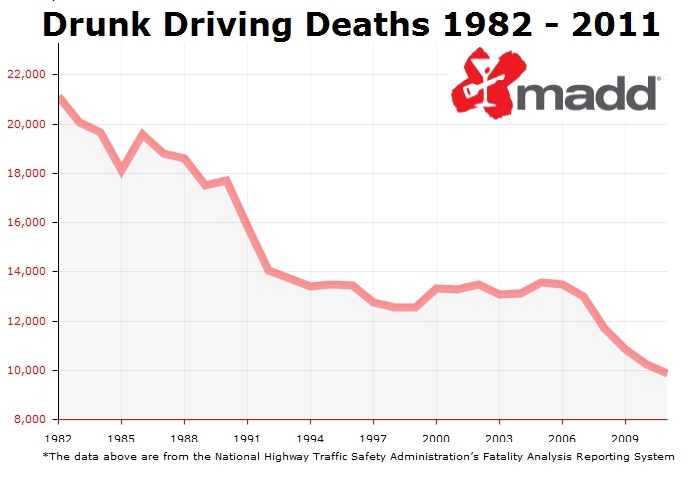
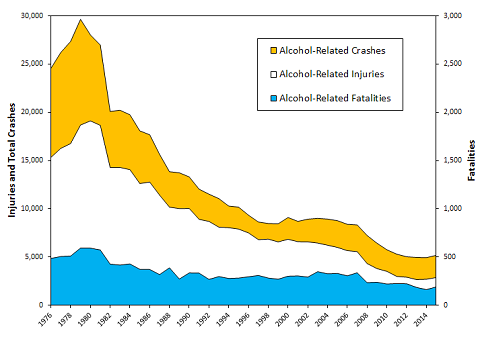
It’s Doubly hilarious because most drunk people actually drive at or below the speed limits the majority of the time to avoid trouble because they aren’t fully inebriated but relatively coherent enough to understand they shouldn’t actually be driving.It's always fun when someone makes the argument for you without realizing it.
etc. etc. etc.
Laws generally started getting tighter in the late 70s through the 80s. Age of consumption was raised to 21 in 1984.
It’s Doubly hilarious because most drunk people actually drive at or below the speed limits the majority of the time to avoid trouble because they aren’t fully inebriated but relatively coherent enough to understand they shouldn’t actually be driving.
weird...fatalities...bout the same though...lmao
I'll let you guys work out the implications.
Looks like a 50% drop to me.
I'll let you work out the calculations.
weird...fatalities...bout the same though...lmao
I'll let you guys work out the implications.

Sooo didn't they raise the age restrictions for purchasing alcohol from 18 to 21 and reduce the amount of alcohol you could drive around with in your system?
Seems like a pretty great comparison for policies from people who want to raise the age of gun purchases to 21+ and reduce the lethality of the weapon one can carry around.
Implication is that million miles driven per year, if graphed would rise exponentially over time. So Fatalities per million miles driven (a common measure of vehicle safety) would have decreased significantly as well in the same manner as the items graphed there. The implication being that more people driving more miles on more miles of road with consistent fatalities indicates massive improvement in road safety. Fatalities were increasing prior to the implementation of highway safety features and alcohol related regulations. According to the chart there is an inverse correlation probably on the order of 0.8 of VMT in billions to deaths per billion VMT. That’s no where near break even
"People don't think," Charlie tells me. He's a trim guy, 51, full lips and a thin goatee, and he likes to wear three-piece suits. They fit loose, so the overall effect is awkward innocence, like an eighth grader headed to his first formal. " I get e-mails even from police saying, 'Can you type in the serial number and tell me who the gun is registered to?' Every week. They think it's like a VIN number on a car. Even police. Police from everywhere. 'Hey, can you guys hurry up and type that number in?' "
So here's a news flash, from Charlie: "We ain't got a registration system. Ain't nobody registering no damn guns."
There is no national database of guns. We have no centralized record of who owns all the firearms we so vigorously debate, no hard data regarding how many people own them, how many of them are bought or sold, or how many even exist.
"It's a shoestring budget," says Charlie, who runs the center. "It's not 10,000 agents and a big sophisticated place. It's a bunch of friggin' boxes. All half-ass records. We have about 50 ATF employees. And all the rest are basically the ladies. The ladies that live in West Virginia—and they got a job. There's a huge amount of labor being put into looking through microfilm."
I want to ask about the microfilm—microfilm?—but it's hard to get a word in. He's already gone three rounds on the whiteboard, scribbling, erasing, illustrating some of the finer points of gun tracing, of which there are many, in large part due to the limitations imposed upon this place. For example, no computer. The National Tracing Center is not allowed to have centralized computer data.
"That's the big no-no," says Charlie.
That's been a federal law, thanks to the NRA, since 1986: No searchable database of America's gun owners. So people here have to use paper, sort through enormous stacks of forms and record books that gun stores are required to keep and to eventually turn over to the feds when requested. It's kind of like a library in the old days—but without the card catalog. They can use pictures of paper, like microfilm (they recently got the go-ahead to convert the microfilm to PDFs), as long as the pictures of paper are not searchable. You have to flip through and read. No searching by gun owner. No searching by name.
The Gun Control Act of 1968 was an attempt to impose order. It set up the Federal Firearms License (FFL) system; gun stores would have to become licensed and they would have to follow certain rules. Felons, illegal immigrants, and crazy people would be prohibited from buying guns. People would have to sign a document, Federal Form 4473, also called the Firearms Transaction Record, swearing that they were none of these things. (Background checks to prove you weren't didn't come until 1993.)
President Lyndon Johnson, who signed the act into law, was at once jubilant and depressed. He had wanted the law to establish a national gun registry, too, but Congress wouldn't agree to that part. "If the criminal with a gun is to be tracked down quickly, then we must have registration in this country," Johnson said. "The voices that blocked these safeguards were not the voices of an aroused nation. They were the voices of a powerful lobby, a gun lobby, that has prevailed for the moment in an election year."
Figuring out who bought a gun from a dealer does not always reveal the information police most want. They want to know who ultimately used it, in a shooting or some other type of crime.
In the majority of states, only licensed dealers are required to track sales. Fifteen states require some form of documentation of private gun sales to be kept by a dealer or sent to the government. That information can then be used by the ATF in a trace.
Private sales have been particularly troublesome in Chicago, where police solved only about a quarter of its 479 murders last year, a clearance rate much lower than other large cities. “We see oftentimes with these crime guns that they changed hands multiple times, and sometimes they’ve crossed the country a couple of times,” says Special Agent Tom Ahern, the ATF’s spokesman in Chicago.
Making the ATF’s task more cumbersome is the fact that the bureau is legally prohibited from creating a database to search the trove of paperwork at its disposal. The National Rifle Association and other pro-gun groups have blocked efforts to create that database, saying such a step would bring the country too close to a national registry. That means the ATF must scan documents and search them manually, slowing down police investigations.
Some dealers simply don’t keep records at all. In 2015, an ATF inspection found that an unnamed firearms dealer in Arkansas neglected to record the sale of thousands of guns. That dealer, the bureau said, was responsible for 98 percent of the state’s 2,951 missing guns that year.
Tracing guns is helpful in other ways, too. Traces help law enforcement figure out where criminals are getting their guns, and crack down on gun trafficking. In Chicago, police found that more than half of the guns used to commit crimes in the city were bought in states with less restrictive laws.
Traces can also lead law enforcement officers to dealers who unwittingly or intentionally supply straw purchasers or other criminals. One gun shop near Milwaukee in 1999 stopped selling particular types of guns that were popular among criminals after it was linked to more than half of the recoveries in that city, according to a study in the Journal of Urban Health. That change shrunk the flow of newly trafficked guns to Milwaukee by 44 percent, the study found.
While many of Chicago’s guns come from across the Illinois border, the city has also encountered problems with gun stores nearby. Between 2009 and 2013, more than 1,500 crime guns were traced to Chuck’s Gun Shop in Riverdale, a 30-minute drive from the city.
I gotta go hang with my kids...this is kinda not as important ass it used to be.
I owe you aresponse, so...
great...didn't look at a chart, went off memory regarding the reductions in fatalities due to highway safety...however, fatalities tied to drunk driving going down could have little to do with legislation targeted at drunk drivers and most to do with seatbelts, and engineering.
You have a personal issue with Bishop, so whatever...seems to me, you did not give this "data" your normal thought or scrutiny because it was conveniently being used to flog someone you don't like.
https://www.google.com/amp/s/amp.livescience.com/43605-drinking-age-21-saves-lives.htmlIn the meantime, this law has saved tens of thousands of lives on our roads. According to the National Highway Traffic Safety Administration (NHTSA), the minimum drinking age laws have saved 29,292 lives and some consider that number conservative. The National Minimum Drinking Age Act was proposed as a traffic safety bill, and as a traffic safety law, it has lived up to its promise. 30 years later the number of lives saved on our roads is staggering, and it is still happening. Thousands of people are alive today because of this law
owever, the new review found that since the legal drinking age was set at 21, young people have been drinking less, and are less likely to get into traffic accidents.
In fact, the age 21 laws have saved up to 900 lives yearly on the road, according to estimates from the National Highway Transportation Safety Administration.
Teen drinking and driving rates have dropped by 54 percent over the last two decades, and the biggest declines were seen between 1982 and 1995, a period which included changes in the Federal law that pushed all states to increase their drinking age to 21.
During that period, the number of fatally-injured drunk drivers decreased by 57 percent among those ages 16 to 20, compared with 39 percent for those ages 21 to 24, and 9 percent for those older than 25.
Looking at whether setting the age at 21 has driven teenagers to drink more, researchers found that psychological and social studies on drinking motivations have not supported this idea.
On the other hand, many studies have found that a higher legal drinking age led to less alcohol consumption. In one of the most recent studies, researchers found that in 2011, 36 percent of college students said they'd engaged in binge drinking in the past two weeks, compared with 43 percent of students in 1988, the first year that the age 21 law was adopted by all states.
Perhaps the second amendment provided Americans with a false sense of security for a couple hundred years, and then at some point in the 90s it became the cause of school shootings across the country.
Or maybe there is a deeper explanation. What if these mass shootings are somehow connected to the cultural decline we've experienced in my lifetime and the complete lack of social cohesion?
Given the cultural decline and lack of social cohesion, do you think it's realistic that law abiding citizens are going to willingly disarm themselves at the request of our country's media and elites? We're not that naive.

Yes, they did raise the age and lower the limits, and it had some positive effects, but was far from ending the problem. Kids under 21 find it harder to get into bars, but probably not much more difficult to actually get alcohol and drink. Lowering the legal BAC limit helped some too, but still not the complete answer (and in all fairness, there probably isn't any one complete answer).
I'm not against gun laws that will keep them out of the hands of people too young to responsibly own one, people with a history of violence, people with mental health issues that make them more likely to use one to commit violence, or people with a significant criminal history. I'm all for background checks and even a reasonable waiting period. All those things will help... some. They don't really address the underlying root cause of gun violence and if you put all your focus and efforts on just limiting guns, not much focus & effort will be put on solving the real issues.
If you think it's all about guns, then explain the following:
1. Chicago has an almost complete ban on guns, yet the number of gun-related murders there is staggering.
2. A couple of generations ago, guns were MUCH more readily available and even automatic weapons were still legal, yet we had significantly fewer school/public/mass shootings.
3. In the military, actual assault/fully automatic weapons (as opposed to the AR-15 which is nothing but a semi-automatic deer rifle dressed up in a scary Halloween costume) are readily available, yet how often have you heard of a soldier using one of them to go on a shooting rampage? Has it happened ever? Probably, but I can't recall any particular incident.
I'm all for doing what will actually work to eliminate nutjobs from doing something like what happened in FL a couple of weeks ago and reduce gun violence. I'm just not naïve enough to believe more gun laws will have anything more than a very minor effect on achieving that goal.

Just popping in to address item 1. Statistically, the vast majority of gun related crimes in Chicago involve a gun purchased legally in Indiana. This is true across the country where one City/State with strict laws neighbors one City/State with lax laws. It paves way for a decent argument to be made that this should be a Federal issue, not a state-by-state one. But I will agree, it's far more complicated than just using a one-size-fits-all model with gun regulation, and ultimately won't be a cure all if they don't also address many many other areas that feed into this problem.
Abused women are five times more likely to be killed if their abuser owns a firearm, and domestic violence assaults involving a gun are 12 times more likely to end in death than assaults with other weapons or physical harm. The numbers speak for themselves—to save lives, it is essential that federal and state gun laws keep deadly weapons out of domestic abusers’ hands.
BACKGROUND
Domestic abusers with guns pose a severe and deadly threat to their intimate partners.1 Domestic violence assaults involving a gun are 12 times more likely to result in death than those involving other weapons or bodily force.2 Research has repeatedly shown that domestic abusers with guns inflict a disproportionate amount of lethal violence on their spouses and partners:
Abused women are five times more likely to be killed by their abuser if the abuser owns a firearm.3
More than two-thirds of spouse and ex-spouse homicide victims between 1980 and 2008 were killed with firearms.4
In 2011, nearly two-thirds of women killed with guns were killed by their intimate partners.5
DOMESTIC VIOLENCE FUELS MASS SHOOTINGS AND ASSAULTS
Domestic violence also fuels mass shootings, defined as a shooting in which four or more people are murdered. A study by Everytown for Gun Safety of every identifiable mass shooting between January 2009 and July 2014 found that 57% of them involved the killing of a family member, or a current or former intimate partner of the shooter.6
The role of guns in domestic assaults is not limited to homicides. A 2004 survey of female domestic violence shelter residents in California found that more than one third (36.7%) reported having been threatened or harmed with a firearm.7 In nearly two thirds (64.5%) of cases in which a gun was present in a household shared by a domestic abuser and victim, the abuser had used the firearm against the victim, usually threatening to shoot or kill her.8
As the national debate on gun control rages anew, Dallas leaders are trying to enforce an existing program to disarm thousands of violent offenders.
So far, the effort has floundered.
Fewer than 100 guns have been retrieved from domestic abusers in the county since 2015 — a fraction of the thousands of firearms county officials expected abusers to turn over.
Guns and Domestic Violence (Everytown Research)State and federal laws prohibit convicted abusers and anyone subject to a protective order from owning a gun.
The Dallas County program allows abusers to turn over their guns to the Sheriff's Department, which stores them at its shooting range.
But enforcement has been the program's undoing.
Police officers and prosecutors rely on the abusers themselves to report whether they have a firearm. There's no incentive for them to tell the truth, and it's up to them to surrender the weapons.
Guns and domestic violence are a deadly–and all too common–combination.
The presence of a gun in a domestic violence situation makes it five times more likely that a woman will be killed.1
Women in the U.S. are 16 times more likely to be killed with a gun than women in other high-income countries, making this country the most dangerous in the developed world when it comes to gun violence against women.2 Every year American women suffer from 5.3 million incidents of intimate partner violence.3
In an average month, 50 American women are shot to death by intimate partners,4 and many more are injured. Nearly 1 million women alive today have been shot, or shot at, by an intimate partner.5
Background checks and other laws that keep guns out of the hands of domestic abusers save lives.
States that require background checks on all handgun sales see 47 percent fewer women shot to death by intimate partners than states that do not have this requirement.13
Cities in states that restrict access to guns by people subject to domestic violence restraining orders see a 25 percent reduction in intimate partner gun homicides.14