Police State USA

Blazers46

Adjectives: wise/brilliant/handsome.
Messages
8,107
Reaction score
5,459
I love how we’re told we have to solve centuries of societal ills, income equality, and racial division while training police to not shoot people who run away is some impossible Herculean task that can’t be accomplished.

stats do not back up this sarcastic fake statement.
 

Bishop2b5

SEC Exchange Student
Messages
8,933
Reaction score
6,160
Your class is the easiest thing to implement? And what does this class teach that wasn't previously known by the public? Everything you posted is what I've been told my whole life and I'd guess that info is understood by 95% of Americans. So what is this class going to do? Help potential bad actors be good actors? And it'll do that by saying, "Don't be an idiot"? I believe you're serious but it's like when my kids discuss things with me and they say, "well why don't all people just choose to do the good thing?". You appear to be bordering on the naivete of a child.

I'm borderline mesmerized that after posting the numbers/stats above, your entire reply is "Nope, the public should learn better".

You might be surprised at how many teens DON'T really know this, or at least don't really understand why it's important. My sister taught at a juvenile detention facility for two years and she was constantly dumbfounded by how uninformed many of those kids were. Stuff most of us take for granted and have been taught day in and day out since we were preschoolers are often NOT something many of those kids have ever been taught. Some of it leaves you shaking your head and asking, "How can you NOT know this???" but they don't. Some basic facts of life, critical thinking skills, good decision making, actions & consequences, how the world works, and just basic common sense are all too often something teenagers don't have, especially those from some poorer segments of society where there isn't a stable, two parent home and someone taking the time to teach and guide the kids. When there's no dad in the picture, mom was 13 when she had you, and grandma is raising you, there are likely to be problems and a distinct lack of basic life knowledge. There's a reason Chris Rock said, "If a kid calls his grandma "Mommy" and his mama "Pam", he's going to jail!"
 

Irish#1

Livin' Your Dream!
Staff member
Messages
44,605
Reaction score
20,078
Tread lightly why? Are you going to get mean? I never called you a genius, I asked you to offer your brilliant plan for changing the minority of bad actors. I don't get either of your positions and I'll start treading heavier if it means we have fruitful discussion.

I believe training police to better handle high intensity both in physical altercations and in weapons training would reduce the number of shootings to the degree that we are able. And I'm grateful to the police for the job they do. For some reason, "we can do better" always gets followed by, "We're doing enough, it's the others who should change".

You believe a class on "not being an idiot" will break through to the kids who are of lower socio-economic status, the same kids who are most likely to end up on the other end of a POs pistol. Do I have that right?

"Start treading heavier"? Is that along the same lines that if I yell louder it makes me right and you wrong? To the first bolded. I thought one of your posts (maybe not this thread) you referenced GENIUS when responding about one of my post. If you didn't, my apologies. However, referencing "brilliant idea" is along those same lines and referring to Razor as "close to child naivety" is condescending and projects a self air of superiority.

To the original point, I never said a class on "not being an idiot" would fix anything and I have have said more than once there should be better police training, so no, you don't have that right.

Where we will disagree, is community involvement in fixing this problem. We have seen a change in our culture where no one wants to address the problem at the root or accept responsibility. That starts at home and accepting responsibility as a human being. We have media portraying criminals as victims while giving little or no service to the fact the incident started because he/she shot someone, robbed a store, etc. Let's get better policing, but let's not ignore the root of the problem.

To the second bolded. Playing devil's advocate again, one could also say that if it's a minority of bad actors, why do we need to have better police training?
 
Last edited:

Irish#1

Livin' Your Dream!
Staff member
Messages
44,605
Reaction score
20,078
I stand by my previous statement that if you value our foundation of government and its intent, then no man is above the law and no man is beneath it. Due process is for all even the thugs, gangbangers, rapscallions, and rablerousers among us. If we arent doing all we can to ensure the worst among us gets theri day in court then we arent doing enough.

I think everyone agrees on that don't they?
 

Cackalacky2.0

Specimen
Messages
9,023
Reaction score
8,018
I think everyone agrees on that don't they?

No I dont think they do. When someone says " they got what deserved" that is implicitly agaisnt due process becasue they did not get what they deserved from our justice system. In fact it was denied to them.
 

Irish#1

Livin' Your Dream!
Staff member
Messages
44,605
Reaction score
20,078
No I dont think they do. When someone says " they got what deserved" that is implicitly agaisnt due process becasue they did not get what they deserved from our justice system. In fact it was denied to them.

After reading your reply, I see we're looking at this from two different views. I was looking at anyone who gest arrested. You are looking at it from the time the crime occurs? If a criminal is fleeing the police then stops to shoot at the police and is killed when the police return fire is that denial of due process?
 

Cackalacky2.0

Specimen
Messages
9,023
Reaction score
8,018
After reading your reply, I see we're looking at this from two different views. I was looking at anyone who gest arrested. You are looking at it from the time the crime occurs? If a criminal is fleeing the police then stops to shoot at the police and is killed when the police return fire is that denial of due process?

Clearly if a person is arrested and turned over to the courts then due process is being administered. Im talking about lethal force ultimately. ....Of course it does. I acknowledge lethal force is sometimes necessary (I personally wish it wasnt necessary) but Im not arguing its 100% out of bounds either. Not arguing that at all. But the fact remains that if lethal force by a cop is used in the field then the criminal is ultimately denied his due process. No one "deserves" death adminstered by a police officer. Capital punishment should be dealt with through the legal system. I do think training could improve decison making with regards to need and use of lethal force.
 
Last edited:

Irish#1

Livin' Your Dream!
Staff member
Messages
44,605
Reaction score
20,078
I get what you're saying and for the most part agree. There will be situations where returning fire will be necessary. Someone who is firing upon the police obviously doesn't care about the consequences and has the distinct possibility of bring harm to other citizens along with the police. At that point I think they are forfeiting their right to due process if lethal force is necessary. Each situation is unique for the police and requires some quick and critical thinking while under the pressure of possibly losing your own life. Not a good place to be.
 

Cackalacky2.0

Specimen
Messages
9,023
Reaction score
8,018
I get what you're saying and for the most part agree. There will be situations where returning fire will be necessary. Someone who is firing upon the police obviously doesn't care about the consequences and has the distinct possibility of bring harm to other citizens along with the police. At that point I think they are forfeiting their right to due process if lethal force is necessary. Each situation is unique for the police and requires some quick and critical thinking while under the pressure of possibly losing your own life. Not a good place to be.

Right... And in this instance the event that sticks out to me is the Walter Scott incident. Yes the guy had warrants. Yes theg uy attempted to evade the cop but the cops default was to shoot him as he was running away and then he died. Ultiamtely the initial charges for this event would have been Scott be detained on his outstanding warant, a traffic stop and resiting arrest. Instead. Shot 8 times and dead. Then the cop got caught fixing the scene by a bystander. He ended up taking a federal plea deal for 20 years. Without video evidence its very likely this would have never been brought to light.
 

Blazers46

Adjectives: wise/brilliant/handsome.
Messages
8,107
Reaction score
5,459
Right... And in this instance the event that sticks out to me is the Walter Scott incident. Yes the guy had warrants. Yes theg uy attempted to evade the cop but the cops default was to shoot him as he was running away and then he died. Ultiamtely the initial charges for this event would have been Scott be detained on his outstanding warant, a traffic stop and resiting arrest. Instead. Shot 8 times and dead. Then the cop got caught fixing the scene by a bystander. He ended up taking a federal plea deal for 20 years. Without video evidence its very likely this would have never been brought to light.

I think what a lot people on this board are arguing is that you can’t take 1 or even a handful of events and use it to say overall policing needs fixed and more training is necessary. It falls on it’s face when you actually look at stats and numbers.

I think we would all agree the officer deserves to be where he is.
 

RDU Irish

Catholics vs. Cousins
Messages
8,625
Reaction score
2,731
I think everyone agrees on that don't they?

I don't. Our just-us system is horribly skewed to favor the rich and punish the poor and that is before realizing how fast the process works for your right to a "fair and speedy trial". Years for your day in court that will bankrupt 75% of the population. All the players from cops to DAs to state medical examiners to judges just want to work a plea deal to get the case closed. Unless you have the bucks to pay by the hour, your defense attorney wants the same thing - not necessarily in your best interest even if you are innocent.

Don't do crime and minimize interaction with people that can get you arrested. For those that have so much faith in the system - bless your heart. How many police "fix" crime scenes and twist their testimony to help ensure a conviction? Likewise looking the other way for buddies and people in power. It is a highly corruptible position because they have a lot of power - and power corrupts. At the same time - they see perps walk free all the time which has to be frustrating.
 
Last edited:

Cackalacky2.0

Specimen
Messages
9,023
Reaction score
8,018
I think what a lot people on this board are arguing is that you can’t take 1 or even a handful of events and use it to say overall policing needs fixed and more training is necessary. It falls on it’s face when you actually look at stats and numbers.

I think we would all agree the officer deserves to be where he is.

And many posters on the board are arguing that there isnt 1 or even a handful of these events..... There is more. Many more and that they arent getting enough attention (you have said so yourself). I beleive you have posted mutiple events where white poeple were killed and nothing was in the news? There is enough documented evidence as of today to know there is an issue that needs to be addressed (or at least can be improved) with regards to police and use of force/training/militarism.

And this is my point. In the history of histoires humans have stamped out crime completely ....never. How e deal with the worst/best among us should always be for the better and not for the worse. I know this is idealistic. Fine. Its a line Im willing to hold.
 

Trait Expectations

New member
Messages
887
Reaction score
455
"Start treading heavier"? Is that along the same lines that if I yell louder it makes me right and you wrong? To the first bolded. I thought one of your posts (maybe not this thread) you referenced GENIUS when responding about one of my post. If you didn't, my apologies. However, referencing "brilliant idea" is along those same lines and referring to Razor as "close to child naivety" is condescending and projects a self air of superiority.

To the original point, I never said a class on "not being an idiot" would fix anything and I have have said more than once there should be better police training, so no, you don't have that right.

Where we will disagree, is community involvement in fixing this problem. We have seen a change in our culture where no one wants to address the problem at the root or accept responsibility. That starts at home and accepting responsibility as a human being. We have media portraying criminals as victims while giving little or no service to the fact the incident started because he/she shot someone, robbed a store, etc. Let's get better policing, but let's not ignore the root of the problem.

To the second bolded. Playing devil's advocate again, one could also say that if it's a minority of bad actors, why do we need to have better police training?

1st bolded: correct, I do believe my thoughts are superior to those you and Razor are putting out there. If I didn't, we wouldn't be having a discussion on the strengths of our positions.

I don't disagree about community involvement. But again, this only works in households that are already stable. You believe you can get the kids who are likely to end up in street gangs/organized crime/drug dealing to understand that each of us must accept responsibility. I believe they are born into such stress and chaos that fight or flight kicks in far earlier than most of us experienced and they spend the rest of their lives chasing some form of stability, be it in gangs, drugs/money/women, etc.

This same script has been playing over and over for decades with only a select few extricating themselves from the toxic mire from which they were born. It's almost like we should look at criminals with pity because had we been born in similar circumstances, odds are we would've followed a similar blueprint. I'm all for accountability but I'm also for rehabilitation and working to reduce violence any way we can.

And again, the police force has an incredibly difficult job and they do it well. But what if they can do it even better with some changes to hiring, training and continuing education? Do people really think 2 hrs of weapon training and 2 hrs of physical conflict training per year are acceptable benchmarks for the police force?
 

Irish#1

Livin' Your Dream!
Staff member
Messages
44,605
Reaction score
20,078
I don't. Our just-us system is horribly skewed to favor the rich and punish the poor and that is before realizing how fast the process works for your right to a "fair and speedy trial". Years for your day in court that will bankrupt 75% of the population. All the players from cops to DAs to state medical examiners to judges just want to work a plea deal to get the case closed. Unless you have the bucks to pay by the hour, your defense attorney wants the same thing - not necessarily in your best interest even if you are innocent.

Don't do crime and minimize interaction with people that can get you arrested. For those that have so much faith in the system - bless your heart. How many police "fix" crime scenes and twist their testimony to help ensure a conviction? Likewise looking the other way for buddies and people in power. It is a highly corruptible position because they have a lot of power - and power corrupts. At the same time - they see perps walk free all the time which has to be frustrating.

Well, we were talking about due process overall, not necessarily the flaws in the process.
 

Irish#1

Livin' Your Dream!
Staff member
Messages
44,605
Reaction score
20,078
1st bolded: correct, I do believe my thoughts are superior to those you and Razor are putting out there. If I didn't, we wouldn't be having a discussion on the strengths of our positions.

I don't disagree about community involvement. But again, this only works in households that are already stable. You believe you can get the kids who are likely to end up in street gangs/organized crime/drug dealing to understand that each of us must accept responsibility. I believe they are born into such stress and chaos that fight or flight kicks in far earlier than most of us experienced and they spend the rest of their lives chasing some form of stability, be it in gangs, drugs/money/women, etc.

This same script has been playing over and over for decades with only a select few extricating themselves from the toxic mire from which they were born. It's almost like we should look at criminals with pity because had we been born in similar circumstances, odds are we would've followed a similar blueprint. I'm all for accountability but I'm also for rehabilitation and working to reduce violence any way we can.

And again, the police force has an incredibly difficult job and they do it well. But what if they can do it even better with some changes to hiring, training and continuing education? Do people really think 2 hrs of weapon training and 2 hrs of physical conflict training per year are acceptable benchmarks for the police force?

If we still had the IE awards, this would definitely be in the running for POY! I bow to your superior intellect.
 

Blazers46

Adjectives: wise/brilliant/handsome.
Messages
8,107
Reaction score
5,459
And many posters on the board are arguing that there isnt 1 or even a handful of these events..... There is more. Many more and that they arent getting enough attention (you have said so yourself). I beleive you have posted mutiple events where white poeple were killed and nothing was in the news? There is enough documented evidence as of today to know there is an issue that needs to be addressed (or at least can be improved) with regards to police and use of force/training/militarism.

And this is my point. In the history of histoires humans have stamped out crime completely ....never. How e deal with the worst/best among us should always be for the better and not for the worse. I know this is idealistic. Fine. Its a line Im willing to hold.

Stats do not come from the "news". It comes from FBI statistics and other statistcal site and studies. I think you assume I am playing the race game but even adding all races, statistically speaking (compared to arrests alone and not overall police contacts), instances like Walter Scott/George Floyd happen so infrequent its almost statistically not a thing. I am not discounting these all happened. But my question to you is what is the goal? What is the end game?

2019 according to the Bureau of Justice Statistics:
61.5 Million people have had contact with police
10,085,207 arrests
999 people were shot and killed by officers (0.0099%)
0.0016% of all people who encountered a law enforcement officer in 2019 were killed by one.

Other stats:
94% of the 6,211 people who have been killed by police officers in America since the beginning of 2015 were armed.
91% of the black men killed by police officers since 2015 were armed. (for comparative sake)

Is the goal to get police to stop killing armed people or just unarmed? Lets say we put all the effort in the world to cut the number of unarmed killings in half. A google search I found on the juvenile justice informatin exchange website say: "In 183 of the 5,317 fatal shootings by police in the last six years for which the suspect’s threat status was reported, officers described the suspect as unarmed and not attacking anyone." This would include a case like Breonna Taylor where the officer was fired upon and fired back (you can argue wrecklessly or whatever but it was not a cut/dry police kills with no reason). 183/6=31 on average per year.

If the goal is the cut the overall police killings in half that is more than a police problem. If we just simply train police to not shoot back or not shoot first or just them in the leg I am sure the number officer deaths would skyrocket.

Speaking of, one of the most surprising stats I just read was from FBI.gov. The average age of Police officer killed in duty was age 40 and served, on average, 13 years.
 

TorontoGold

Mr. Dumb Moron
Messages
7,367
Reaction score
5,716
If we still had the IE awards, this would definitely be in the running for POY! I bow to your superior intellect.

It's a shame there isn't any, "Most likely to avoid the question?" "Who is the politics thread Koon?"
 

Cackalacky2.0

Specimen
Messages
9,023
Reaction score
8,018
Stats do not come from the "news". It comes from FBI statistics and other statistcal site and studies. I think you assume I am playing the race game but even adding all races, statistically speaking (compared to arrests alone and not overall police contacts), instances like Walter Scott/George Floyd happen so infrequent its almost statistically not a thing. I am not discounting these all happened. But my question to you is what is the goal? What is the end game?

2019 according to the Bureau of Justice Statistics:
61.5 Million people have had contact with police
10,085,207 arrests
999 people were shot and killed by officers (0.0099%)
0.0016% of all people who encountered a law enforcement officer in 2019 were killed by one.

Other stats:
94% of the 6,211 people who have been killed by police officers in America since the beginning of 2015 were armed.
91% of the black men killed by police officers since 2015 were armed. (for comparative sake)

Is the goal to get police to stop killing armed people or just unarmed? Lets say we put all the effort in the world to cut the number of unarmed killings in half. A google search I found on the juvenile justice informatin exchange website say: "In 183 of the 5,317 fatal shootings by police in the last six years for which the suspect’s threat status was reported, officers described the suspect as unarmed and not attacking anyone." This would include a case like Breonna Taylor where the officer was fired upon and fired back (you can argue wrecklessly or whatever but it was not a cut/dry police kills with no reason). 183/6=31 on average per year.

If the goal is the cut the overall police killings in half that is more than a police problem. If we just simply train police to not shoot back or not shoot first or just them in the leg I am sure the number officer deaths would skyrocket.

Speaking of, one of the most surprising stats I just read was from FBI.gov. The average age of Police officer killed in duty was age 40 and served, on average, 13 years.
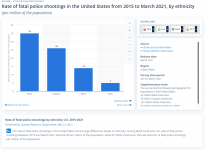
I’ve got stats too....and Im not diluting it based on 60 million"interactions". Its roughly 1000 people per year are kille dby police (justified or not) with blacks being nearly 3 times as likely ot get into deadly altercation. Id bet the families of everyone of thsoe 1000 people would want them at home ang give less than 0.00099% shits about the normal non-violent traffic stops and other interactions where violence is unlikely to occur. Its also well know that killings in custory and shootings ar enot 100% required by law ot be reproted and not all precints keep this data or reprot to the federal LEOs.

"The annual average number of justifiable homicides alone was previously estimated to be near 400.[SUP][38][/SUP] Updated estimates from the Bureau of Justice Statistics released in 2015 estimate the number to be around 930 per year, or 1,240 if assuming that non-reporting local agencies kill people at the same rate as reporting agencies.[SUP][39][/SUP]A 2019 study by Esposito, Lee, and Edwards states that police killings are a leading cause of death for men aged 25-29 at 1.8 per 100000, trailing causes such as accidental death (76.6 per 100000), suicide (26.7 per 100000), and other homicides (22.0 per 100000).[SUP][11][/SUP]

Around 2015–2016, The Guardian newspaper ran its own database, The Counted, which tracked US killings by police and other law enforcement agencies including from gunshots, tasers, car accidents and custody deaths. They counted 1,146 deaths for 2015 and 1,093 deaths for 2016. The database can be viewed by state, gender, race/ethnicity, age, classification (e.g., "gunshot"), and whether the person killed was armed.[SUP][40][/SUP]

The Washington Post has tracked shootings since 2015, reporting more than 5,000 incidents since their tracking began.[SUP][41][/SUP] The database can also classify people in various categories including race, age, weapon etc. For 2019, it reported a total of 1,004 people shot and killed by police.[SUP][3][/SUP][SUP][42][/SUP]
Racial patternsEditCivilian characteristicsEdit


According to The Guardian's database, in 2016 the rate of fatal police shootings per million was 10.13 for Native Americans, 6.6 for black people, 3.23 for Hispanics; 2.9 for white people and 1.17 for Asians.[SUP][12][/SUP] In absolute numbers, police kill more white people than any other race or ethnicity, however this must be understood in light of the fact that white people make up the largest proportion of the US population.[SUP][43][/SUP] As a percentage of the U.S. population, black Americans were 2.5 times more likely than whites to be killed by the police in 2015.[SUP][43][/SUP] A 2015 study found that unarmed blacks were 3.49 times more likely to be shot by police than were unarmed whites.[SUP][13][/SUP] Another study published in 2016 concluded that the mortality rate of legal interventions among black and Hispanic people was 2.8 and 1.7 times higher than that among white people. Another 2015 study concluded that black people were 2.8 times more likely to be killed by police than whites. They also concluded that black people were more likely to be unarmed than white people who were in turn more likely to be unarmed than Hispanic people shot by the police.[SUP][44][/SUP][SUP][45][/SUP] A 2018 study in the American Journal of Public Health found the mortality rate by police per 100,000 was 1.9 to 2.4 for black men, 0.8 to 1.2 for Hispanic men and 0.6 to 0.7 for white men.[SUP][46][/SUP] A 2020 study found "strong and statistically reliable evidence of anti-Black racial disparities in the killing of unarmed Americans by police in 2015–2016."[SUP][15][/SUP]

A 2016 study by economist Roland G. Fryer, Jr. of the National Bureau of Economic Research, updated in 2018, found that while overall "blacks are 21 percent more likely than whites to be involved in an interaction with police in which at least a weapon is drawn" and that in the raw data from New York City's Stop and Frisk program"blacks and Hispanics are more than fifty percent more likely to have an interaction with police which involves any use of force" after "[p]artitioning the data in myriad ways, we find no evidence of racial discrimination in officer-involved shootings."[SUP][4][/SUP] A 2020 study by Princeton University political scientists disputed the findings by Fryer, saying that if police had a higher threshold for stopping whites, this might mean that the whites, Hispanics and blacks in Fryer's data are not similar.[SUP][6][/SUP] Nobel-laureate James Heckman and Steven Durlauf, both University of Chicago economists, published a response to the Fryer study, writing that the paper "does not establish credible evidence on the presence or absence of discrimination against African Americans in police shootings" due to issues with selection bias.[SUP][48][/SUP] Fryer responded by saying Durlauf and Heckman erroneously claim that his sample is "based on stops". Further, he states that the "vast majority of the data...is gleaned from 911 calls for service in which a civilian requests police presence."[SUP][49][/SUP]

A 2016 study published in the journal Injury Prevention concluded that African Americans, Native Americans and Latinos were more likely to be stopped by police compared to Asians and whites, but found that there was no racial bias in the likelihood of being killed or injured after being stopped.[SUP][50][/SUP] A January 2017 report by the DOJ found that the Chicago Police Department had "unconstitutionally engaged in a pattern of excessive and deadly force" and an independent task force, created by the mayor of Chicago, stated that police "have no regard for the sanctity of life when it comes to people of color."[SUP][14][/SUP] A 2018 study found that minorities are disproportionately killed by police but that white officers are not more likely to use lethal force on blacks than minority officers.[SUP][51][/SUP] A 2019 study in The Journal of Politics found that police officers were more likely to use lethal force on blacks, but that this was "most likely driven by higher rates of police contact among African Americans rather than racial differences in the circumstances of the interaction and officer bias in the application of lethal force."[SUP][52][/SUP] A 2019 study in the journal Proceedings of the National Academy of Sciences of the United States of America (PNAS) found that blacks and American Indian/Alaska Natives are more likely to be killed by police than whites and that Latino men are more likely to be killed than white men.[SUP][11][/SUP] According to the study, "for young men of color, police use of force is among the leading causes of death."[SUP][11][/SUP]

A 2019 study in PNAS by Cesario et al. initially concluded from a dataset of fatal shootings that white officers were not more likely to shoot minority civilians than non-white officers, but it was later retracted over errors in its methodology.[SUP][53][/SUP] The study was criticized by several academics, who stated that its conclusion could not be supported by the data.[SUP][7][/SUP] It was criticized in a subsequent PNAS article, which stated that it rested on the erroneous assumption that police encounter minorities and whites at the same rate, and that if police have a higher threshold for stopping whites who engage in suspicious behavior than blacks, then the data on police shootings masks the discrimination.[SUP][54][/SUP]PNAS issued a correction to the original article and retracted it in July 2020.[SUP][55][/SUP] A 2020 study in the American Political Science Review found that there was racial bias in who was stopped by police.[SUP][6][/SUP]

An early study, published in 1977, found that a disproportionately high percentage of those killed by police were racial minorities compared to their representation in the general population. The same study, however, noted that this proportion is consistent with the number of minorities arrested for serious felonies.[SUP][57][/SUP] A 1977 analysis of reports from major metropolitan departments found officers fired more shots at white suspects than at black suspects, possibly because of "public sentiment concerning treatment of blacks." A 1978 report found that 60 percent of black people shot by the police were armed with handguns, compared to 35 percent of white people shot.[SUP][58][/SUP]

A 2014 study involving computer-based simulations of a police encounter using police officers and undergraduates found a greater likelihood to shoot black targets instead of whites for the undergraduate students but for the police, they generally found no biased pattern of shooting.[SUP][59][/SUP] Another study at Washington State University used realistic police simulators of different scenarios where a police officer might use deadly force. The study concluded that unarmed white suspects were three times more likely to be shot than unarmed black suspects. The study concluded that the results could be because officers were more concerned with using deadly force against black suspects for fear of how it would be perceived.[SUP][58][/SUP]

Although Congress instructed the Attorney General in 1994 to compile and publish annual statistics on police use of excessive force, this was never carried out, and the Federal Bureau of Investigation does not collect these data either.[SUP][16][/SUP]Consequently, no official national database exists to track such killings.[SUP][17][/SUP] This has led multiple non-governmental entities to attempt to create comprehensive databases of police shootings in the United States.[SUP][18][/SUP] The National Violent Death Reporting System is a more complete database to track police homicides than either the FBI's Supplementary Homicide Reports (SHR) or the Centers for Disease Control's National Vital Statistics System (NVSS).[SUP][19][/SUP] This is because both the SHR and NVSS under-report the number of police killings.[SUP][20][/SUP]
Government data collectionEdit"

Capture.PNG - Click image for larger version  Name:	Capture.PNG Views:	0 Size:	163.2 KB ID:	2985937
 
Last edited:

Blazers46

Adjectives: wise/brilliant/handsome.
Messages
8,107
Reaction score
5,459
I’ve got stats too....and Im not diluting it based on 60 million"interactions". Its roughly 1000 people per year are kille dby police (justified or not) with blacks being nearly 3 times as likely ot get into deadly altercation. Id bet the families of everyone of thsoe 1000 people would want them at home ang give less than 0.00099% shits about the normal non-violent traffic stops and other interactions where violence is unlikely to occur. Its also well know that killings in custory and shootings ar enot 100% required by law ot be reproted and not all precints keep this data or reprot to the federal LEOs.

"The annual average number of justifiable homicides alone was previously estimated to be near 400.[SUP][38][/SUP] Updated estimates from the Bureau of Justice Statistics released in 2015 estimate the number to be around 930 per year, or 1,240 if assuming that non-reporting local agencies kill people at the same rate as reporting agencies.[SUP][39][/SUP]A 2019 study by Esposito, Lee, and Edwards states that police killings are a leading cause of death for men aged 25-29 at 1.8 per 100000, trailing causes such as accidental death (76.6 per 100000), suicide (26.7 per 100000), and other homicides (22.0 per 100000).[SUP][11][/SUP]

Around 2015–2016, The Guardian newspaper ran its own database, The Counted, which tracked US killings by police and other law enforcement agencies including from gunshots, tasers, car accidents and custody deaths. They counted 1,146 deaths for 2015 and 1,093 deaths for 2016. The database can be viewed by state, gender, race/ethnicity, age, classification (e.g., "gunshot"), and whether the person killed was armed.[SUP][40][/SUP]

The Washington Post has tracked shootings since 2015, reporting more than 5,000 incidents since their tracking began.[SUP][41][/SUP] The database can also classify people in various categories including race, age, weapon etc. For 2019, it reported a total of 1,004 people shot and killed by police.[SUP][3][/SUP][SUP][42][/SUP]
Racial patternsEditCivilian characteristicsEdit


According to The Guardian's database, in 2016 the rate of fatal police shootings per million was 10.13 for Native Americans, 6.6 for black people, 3.23 for Hispanics; 2.9 for white people and 1.17 for Asians.[SUP][12][/SUP] In absolute numbers, police kill more white people than any other race or ethnicity, however this must be understood in light of the fact that white people make up the largest proportion of the US population.[SUP][43][/SUP] As a percentage of the U.S. population, black Americans were 2.5 times more likely than whites to be killed by the police in 2015.[SUP][43][/SUP] A 2015 study found that unarmed blacks were 3.49 times more likely to be shot by police than were unarmed whites.[SUP][13][/SUP] Another study published in 2016 concluded that the mortality rate of legal interventions among black and Hispanic people was 2.8 and 1.7 times higher than that among white people. Another 2015 study concluded that black people were 2.8 times more likely to be killed by police than whites. They also concluded that black people were more likely to be unarmed than white people who were in turn more likely to be unarmed than Hispanic people shot by the police.[SUP][44][/SUP][SUP][45][/SUP] A 2018 study in the American Journal of Public Health found the mortality rate by police per 100,000 was 1.9 to 2.4 for black men, 0.8 to 1.2 for Hispanic men and 0.6 to 0.7 for white men.[SUP][46][/SUP] A 2020 study found "strong and statistically reliable evidence of anti-Black racial disparities in the killing of unarmed Americans by police in 2015–2016."[SUP][15][/SUP]

A 2016 study by economist Roland G. Fryer, Jr. of the National Bureau of Economic Research, updated in 2018, found that while overall "blacks are 21 percent more likely than whites to be involved in an interaction with police in which at least a weapon is drawn" and that in the raw data from New York City's Stop and Frisk program"blacks and Hispanics are more than fifty percent more likely to have an interaction with police which involves any use of force" after "[p]artitioning the data in myriad ways, we find no evidence of racial discrimination in officer-involved shootings."[SUP][4][/SUP] A 2020 study by Princeton University political scientists disputed the findings by Fryer, saying that if police had a higher threshold for stopping whites, this might mean that the whites, Hispanics and blacks in Fryer's data are not similar.[SUP][6][/SUP] Nobel-laureate James Heckman and Steven Durlauf, both University of Chicago economists, published a response to the Fryer study, writing that the paper "does not establish credible evidence on the presence or absence of discrimination against African Americans in police shootings" due to issues with selection bias.[SUP][48][/SUP] Fryer responded by saying Durlauf and Heckman erroneously claim that his sample is "based on stops". Further, he states that the "vast majority of the data...is gleaned from 911 calls for service in which a civilian requests police presence."[SUP][49][/SUP]

A 2016 study published in the journal Injury Prevention concluded that African Americans, Native Americans and Latinos were more likely to be stopped by police compared to Asians and whites, but found that there was no racial bias in the likelihood of being killed or injured after being stopped.[SUP][50][/SUP] A January 2017 report by the DOJ found that the Chicago Police Department had "unconstitutionally engaged in a pattern of excessive and deadly force" and an independent task force, created by the mayor of Chicago, stated that police "have no regard for the sanctity of life when it comes to people of color."[SUP][14][/SUP] A 2018 study found that minorities are disproportionately killed by police but that white officers are not more likely to use lethal force on blacks than minority officers.[SUP][51][/SUP] A 2019 study in The Journal of Politics found that police officers were more likely to use lethal force on blacks, but that this was "most likely driven by higher rates of police contact among African Americans rather than racial differences in the circumstances of the interaction and officer bias in the application of lethal force."[SUP][52][/SUP] A 2019 study in the journal Proceedings of the National Academy of Sciences of the United States of America (PNAS) found that blacks and American Indian/Alaska Natives are more likely to be killed by police than whites and that Latino men are more likely to be killed than white men.[SUP][11][/SUP] According to the study, "for young men of color, police use of force is among the leading causes of death."[SUP][11][/SUP]

A 2019 study in PNAS by Cesario et al. initially concluded from a dataset of fatal shootings that white officers were not more likely to shoot minority civilians than non-white officers, but it was later retracted over errors in its methodology.[SUP][53][/SUP] The study was criticized by several academics, who stated that its conclusion could not be supported by the data.[SUP][7][/SUP] It was criticized in a subsequent PNAS article, which stated that it rested on the erroneous assumption that police encounter minorities and whites at the same rate, and that if police have a higher threshold for stopping whites who engage in suspicious behavior than blacks, then the data on police shootings masks the discrimination.[SUP][54][/SUP]PNAS issued a correction to the original article and retracted it in July 2020.[SUP][55][/SUP] A 2020 study in the American Political Science Review found that there was racial bias in who was stopped by police.[SUP][6][/SUP]

An early study, published in 1977, found that a disproportionately high percentage of those killed by police were racial minorities compared to their representation in the general population. The same study, however, noted that this proportion is consistent with the number of minorities arrested for serious felonies.[SUP][57][/SUP] A 1977 analysis of reports from major metropolitan departments found officers fired more shots at white suspects than at black suspects, possibly because of "public sentiment concerning treatment of blacks." A 1978 report found that 60 percent of black people shot by the police were armed with handguns, compared to 35 percent of white people shot.[SUP][58][/SUP]

A 2014 study involving computer-based simulations of a police encounter using police officers and undergraduates found a greater likelihood to shoot black targets instead of whites for the undergraduate students but for the police, they generally found no biased pattern of shooting.[SUP][59][/SUP] Another study at Washington State University used realistic police simulators of different scenarios where a police officer might use deadly force. The study concluded that unarmed white suspects were three times more likely to be shot than unarmed black suspects. The study concluded that the results could be because officers were more concerned with using deadly force against black suspects for fear of how it would be perceived.[SUP][58][/SUP]

Although Congress instructed the Attorney General in 1994 to compile and publish annual statistics on police use of excessive force, this was never carried out, and the Federal Bureau of Investigation does not collect these data either.[SUP][16][/SUP]Consequently, no official national database exists to track such killings.[SUP][17][/SUP] This has led multiple non-governmental entities to attempt to create comprehensive databases of police shootings in the United States.[SUP][18][/SUP] The National Violent Death Reporting System is a more complete database to track police homicides than either the FBI's Supplementary Homicide Reports (SHR) or the Centers for Disease Control's National Vital Statistics System (NVSS).[SUP][19][/SUP] This is because both the SHR and NVSS under-report the number of police killings.[SUP][20][/SUP]
Government data collectionEdit"


Your stats lack context... that context is crime.
 

Cackalacky2.0

Specimen
Messages
9,023
Reaction score
8,018
No but 10,085,207 arrests typically mean a crime was committed...

There are drawbacks to using arrest data as a measure of crime. Arrest statistics do not reflect the number of different people arrested each year, because an unknown number of people may be arrested more than once in a year. For some crimes, no arrests are made. For others, there may be multiple arrests. Furthermore, not everyone who is arrested has committed the crime for which he or she was arrested. Arrests also depend on a number of factors other than overall crime levels, including policies of particular police agencies, the cooperation of victims, the skill of the perpetrator, and the age, sex, race, and social class of the suspect (Cook and Laub, 1998; McCord, 1997c).

Nor should arrest statistics be confused with the number of crimes committed, because in some cases, the arrest of one person may account for a series of crimes, and in others several people may be arrested for one crime. This is particularly true for young people, who are more likely than adults to commit crimes in a group (McCord, 1990; Reiss, 1986; Reiss and Farrington, 1991; Zimring, 1981). Snyder (1998) contends that this tendency to offend in groups makes arrest statistics an inappropriate measure of the relative proportion of crime attributed to young people. Checking on Snyder's position, McCord and Conway (2000) analyzed a random sample of juvenile offenders in Philadelphia. They found that the number of crimes accounted for by juveniles would be reduced by approximately 40 percent with an adjustment for co-offending. Rather, arrest statistics measure the flow of young people into the juvenile justice system or the criminal justice system. For this reason, the number of crimes known to police is often a preferred measure of crime (Cook and Laub, 1998). The UCR provide information on all crimes known to reporting police agencies, whether or not an arrest has been made. There is no information on age of the perpetrator, however, in the data on crimes known to police; thus even if they are a more accurate crime measure, the number of crimes known to police cannot be used to analyze juvenile crime.

Arrest clearance statistics, which measure the proportion of reported crime cleared by arrest (or other exceptional means, such as death of the offender), may more accurately portray the proportion of crime committed by young people, according to Snyder (1998). But even clearance statistics may overestimate juvenile crime. For example, if young people are more easily apprehended than adults, the proportion of their crimes cleared by arrest would be higher than the proportion of all crimes for which they were responsible (Snyder, 1998). The proportion of young people arrested consistently exceeds the proportion of crimes cleared by the arrest of young people for all crimes and across time, indicating that the use of arrest statistics may make it appear that juveniles account for more crime than they actually do. Likewise, Reiss and Farrington (1991) showed that offending appears less common in the teenage years if the rate is based on the number of offenses (which takes into account co-offending) committed by juveniles rather than on the number of juvenile offenders.
 

Bishop2b5

SEC Exchange Student
Messages
8,933
Reaction score
6,160
oh so all 61 million contacts indicate crime was committed? talk about lack of context, lmao.


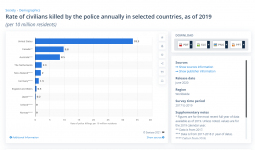
"In selected countries" is the problem with your graph. It compares the US to some of the countries with the lowest crime rates. Sadly, the crime rate in the US for things like murder, rape, and assault - violent crime (not to mention drug related and property crime) - is MUCH more similar to that of some third world countries than that of Canada, Japan, and most of Western Europe. Many of our major cities look like scenes from war torn third world countries. Crime rates there are comparable to some of the worst places in Central America or Africa.
 
Last edited:

Blazers46

Adjectives: wise/brilliant/handsome.
Messages
8,107
Reaction score
5,459

I think all of that is irrelevant. 10 million arrests are 10 million arrests. What does getting arrested multiple times have to do with anything? If a guy was arrested 3 times those events are stand alone events with different facts, crimes, location officer, ect.
 

tommyIRISH23

Well-known member
Messages
1,629
Reaction score
156
I’ve got stats too....and Im not diluting it based on 60 million"interactions". Its roughly 1000 people per year are kille dby police (justified or not) with blacks being nearly 3 times as likely ot get into deadly altercation. Id bet the families of everyone of thsoe 1000 people would want them at home ang give less than 0.00099% shits about the normal non-violent traffic stops and other interactions where violence is unlikely to occur. Its also well know that killings in custory and shootings ar enot 100% required by law ot be reproted and not all precints keep this data or reprot to the federal LEOs.

"The annual average number of justifiable homicides alone was previously estimated to be near 400.[SUP][38][/SUP] Updated estimates from the Bureau of Justice Statistics released in 2015 estimate the number to be around 930 per year, or 1,240 if assuming that non-reporting local agencies kill people at the same rate as reporting agencies.[SUP][39][/SUP]A 2019 study by Esposito, Lee, and Edwards states that police killings are a leading cause of death for men aged 25-29 at 1.8 per 100000, trailing causes such as accidental death (76.6 per 100000), suicide (26.7 per 100000), and other homicides (22.0 per 100000).[SUP][11][/SUP]

Around 2015–2016, The Guardian newspaper ran its own database, The Counted, which tracked US killings by police and other law enforcement agencies including from gunshots, tasers, car accidents and custody deaths. They counted 1,146 deaths for 2015 and 1,093 deaths for 2016. The database can be viewed by state, gender, race/ethnicity, age, classification (e.g., "gunshot"), and whether the person killed was armed.[SUP][40][/SUP]

The Washington Post has tracked shootings since 2015, reporting more than 5,000 incidents since their tracking began.[SUP][41][/SUP] The database can also classify people in various categories including race, age, weapon etc. For 2019, it reported a total of 1,004 people shot and killed by police.[SUP][3][/SUP][SUP][42][/SUP]
Racial patternsEditCivilian characteristicsEdit


According to The Guardian's database, in 2016 the rate of fatal police shootings per million was 10.13 for Native Americans, 6.6 for black people, 3.23 for Hispanics; 2.9 for white people and 1.17 for Asians.[SUP][12][/SUP] In absolute numbers, police kill more white people than any other race or ethnicity, however this must be understood in light of the fact that white people make up the largest proportion of the US population.[SUP][43][/SUP] As a percentage of the U.S. population, black Americans were 2.5 times more likely than whites to be killed by the police in 2015.[SUP][43][/SUP] A 2015 study found that unarmed blacks were 3.49 times more likely to be shot by police than were unarmed whites.[SUP][13][/SUP] Another study published in 2016 concluded that the mortality rate of legal interventions among black and Hispanic people was 2.8 and 1.7 times higher than that among white people. Another 2015 study concluded that black people were 2.8 times more likely to be killed by police than whites. They also concluded that black people were more likely to be unarmed than white people who were in turn more likely to be unarmed than Hispanic people shot by the police.[SUP][44][/SUP][SUP][45][/SUP] A 2018 study in the American Journal of Public Health found the mortality rate by police per 100,000 was 1.9 to 2.4 for black men, 0.8 to 1.2 for Hispanic men and 0.6 to 0.7 for white men.[SUP][46][/SUP] A 2020 study found "strong and statistically reliable evidence of anti-Black racial disparities in the killing of unarmed Americans by police in 2015–2016."[SUP][15][/SUP]

A 2016 study by economist Roland G. Fryer, Jr. of the National Bureau of Economic Research, updated in 2018, found that while overall "blacks are 21 percent more likely than whites to be involved in an interaction with police in which at least a weapon is drawn" and that in the raw data from New York City's Stop and Frisk program"blacks and Hispanics are more than fifty percent more likely to have an interaction with police which involves any use of force" after "[p]artitioning the data in myriad ways, we find no evidence of racial discrimination in officer-involved shootings."[SUP][4][/SUP] A 2020 study by Princeton University political scientists disputed the findings by Fryer, saying that if police had a higher threshold for stopping whites, this might mean that the whites, Hispanics and blacks in Fryer's data are not similar.[SUP][6][/SUP] Nobel-laureate James Heckman and Steven Durlauf, both University of Chicago economists, published a response to the Fryer study, writing that the paper "does not establish credible evidence on the presence or absence of discrimination against African Americans in police shootings" due to issues with selection bias.[SUP][48][/SUP] Fryer responded by saying Durlauf and Heckman erroneously claim that his sample is "based on stops". Further, he states that the "vast majority of the data...is gleaned from 911 calls for service in which a civilian requests police presence."[SUP][49][/SUP]

A 2016 study published in the journal Injury Prevention concluded that African Americans, Native Americans and Latinos were more likely to be stopped by police compared to Asians and whites, but found that there was no racial bias in the likelihood of being killed or injured after being stopped.[SUP][50][/SUP] A January 2017 report by the DOJ found that the Chicago Police Department had "unconstitutionally engaged in a pattern of excessive and deadly force" and an independent task force, created by the mayor of Chicago, stated that police "have no regard for the sanctity of life when it comes to people of color."[SUP][14][/SUP] A 2018 study found that minorities are disproportionately killed by police but that white officers are not more likely to use lethal force on blacks than minority officers.[SUP][51][/SUP] A 2019 study in The Journal of Politics found that police officers were more likely to use lethal force on blacks, but that this was "most likely driven by higher rates of police contact among African Americans rather than racial differences in the circumstances of the interaction and officer bias in the application of lethal force."[SUP][52][/SUP] A 2019 study in the journal Proceedings of the National Academy of Sciences of the United States of America (PNAS) found that blacks and American Indian/Alaska Natives are more likely to be killed by police than whites and that Latino men are more likely to be killed than white men.[SUP][11][/SUP] According to the study, "for young men of color, police use of force is among the leading causes of death."[SUP][11][/SUP]

A 2019 study in PNAS by Cesario et al. initially concluded from a dataset of fatal shootings that white officers were not more likely to shoot minority civilians than non-white officers, but it was later retracted over errors in its methodology.[SUP][53][/SUP] The study was criticized by several academics, who stated that its conclusion could not be supported by the data.[SUP][7][/SUP] It was criticized in a subsequent PNAS article, which stated that it rested on the erroneous assumption that police encounter minorities and whites at the same rate, and that if police have a higher threshold for stopping whites who engage in suspicious behavior than blacks, then the data on police shootings masks the discrimination.[SUP][54][/SUP]PNAS issued a correction to the original article and retracted it in July 2020.[SUP][55][/SUP] A 2020 study in the American Political Science Review found that there was racial bias in who was stopped by police.[SUP][6][/SUP]

An early study, published in 1977, found that a disproportionately high percentage of those killed by police were racial minorities compared to their representation in the general population. The same study, however, noted that this proportion is consistent with the number of minorities arrested for serious felonies.[SUP][57][/SUP] A 1977 analysis of reports from major metropolitan departments found officers fired more shots at white suspects than at black suspects, possibly because of "public sentiment concerning treatment of blacks." A 1978 report found that 60 percent of black people shot by the police were armed with handguns, compared to 35 percent of white people shot.[SUP][58][/SUP]

A 2014 study involving computer-based simulations of a police encounter using police officers and undergraduates found a greater likelihood to shoot black targets instead of whites for the undergraduate students but for the police, they generally found no biased pattern of shooting.[SUP][59][/SUP] Another study at Washington State University used realistic police simulators of different scenarios where a police officer might use deadly force. The study concluded that unarmed white suspects were three times more likely to be shot than unarmed black suspects. The study concluded that the results could be because officers were more concerned with using deadly force against black suspects for fear of how it would be perceived.[SUP][58][/SUP]

Although Congress instructed the Attorney General in 1994 to compile and publish annual statistics on police use of excessive force, this was never carried out, and the Federal Bureau of Investigation does not collect these data either.[SUP][16][/SUP]Consequently, no official national database exists to track such killings.[SUP][17][/SUP] This has led multiple non-governmental entities to attempt to create comprehensive databases of police shootings in the United States.[SUP][18][/SUP] The National Violent Death Reporting System is a more complete database to track police homicides than either the FBI's Supplementary Homicide Reports (SHR) or the Centers for Disease Control's National Vital Statistics System (NVSS).[SUP][19][/SUP] This is because both the SHR and NVSS under-report the number of police killings.[SUP][20][/SUP]
Government data collectionEdit"


I used most of those studies for my research thesis to get my masters. Also, according to my research, violent crime rates SIGNIFICANTLY influence police deadly force. I used the most populated cities in each state, city level violent crime rates, and used the Washington Post deadly shooting tracker (at the time there was not federal tracking of deadly force but I think that has changed). The homicides were/are counted in the UCR rates ofcourse.

Other significant variables were resource deprivation, failing school, and urban plight in general. Makes sense though right? High crime areas are generally poorly lit with abandoned homes that are infested with drugs, gangs, and all kinds of other indicators of violent crime.

Gun violence and by extension police use of deadly force is the byproduct of economic problems. And neither democrats or republicans are remotely close to having the answers.


Sent from my iPhone using Tapatalk
 

Trait Expectations

New member
Messages
887
Reaction score
455
I used most of those studies for my research thesis to get my masters. Also, according to my research, violent crime rates SIGNIFICANTLY influence police deadly force. I used the most populated cities in each state, city level violent crime rates, and used the Washington Post deadly shooting tracker (at the time there was not federal tracking of deadly force but I think that has changed). The homicides were/are counted in the UCR rates ofcourse.

Other significant variables were resource deprivation, failing school, and urban plight in general. Makes sense though right? High crime areas are generally poorly lit with abandoned homes that are infested with drugs, gangs, and all kinds of other indicators of violent crime.

Gun violence and by extension police use of deadly force is the byproduct of economic problems. And neither democrats or republicans are remotely close to having the answers.


Sent from my iPhone using Tapatalk

Fuckin A
 

Blazers46

Adjectives: wise/brilliant/handsome.
Messages
8,107
Reaction score
5,459
I used most of those studies for my research thesis to get my masters. Also, according to my research, violent crime rates SIGNIFICANTLY influence police deadly force. I used the most populated cities in each state, city level violent crime rates, and used the Washington Post deadly shooting tracker (at the time there was not federal tracking of deadly force but I think that has changed). The homicides were/are counted in the UCR rates ofcourse.

Other significant variables were resource deprivation, failing school, and urban plight in general. Makes sense though right? High crime areas are generally poorly lit with abandoned homes that are infested with drugs, gangs, and all kinds of other indicators of violent crime.

Gun violence and by extension police use of deadly force is the byproduct of economic problems. And neither democrats or republicans are remotely close to having the answers.


Sent from my iPhone using Tapatalk

Thank you. This post is great! Its safe to say this goes way beyond police reform...
 
Top