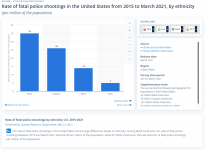
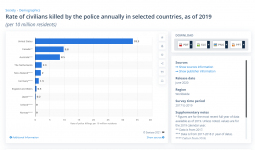
I’ve got stats too....and Im not diluting it based on 60 million"interactions". Its roughly 1000 people per year are kille dby police (justified or not) with blacks being nearly 3 times as likely ot get into deadly altercation. Id bet the families of everyone of thsoe 1000 people would want them at home ang give less than 0.00099% shits about the normal non-violent traffic stops and other interactions where violence is unlikely to occur. Its also well know that killings in custory and shootings ar enot 100% required by law ot be reproted and not all precints keep this data or reprot to the federal LEOs.
"The annual average number of
justifiable homicides alone was previously estimated to be near 400.[SUP]
[38][/SUP] Updated estimates from the
Bureau of Justice Statistics released in 2015 estimate the number to be around 930 per year, or 1,240 if assuming that non-reporting local agencies kill people at the same rate as reporting agencies.[SUP]
[39][/SUP]A 2019 study by Esposito, Lee, and Edwards states that police killings are a leading cause of death for men aged 25-29 at 1.8 per 100000, trailing causes such as accidental death (76.6 per 100000), suicide (26.7 per 100000), and other homicides (22.0 per 100000).[SUP]
[11][/SUP]
Around 2015–2016,
The Guardian newspaper ran its own database,
The Counted, which tracked US killings by police and other law enforcement agencies including from gunshots, tasers, car accidents and custody deaths. They counted 1,146 deaths for 2015 and 1,093 deaths for 2016. The database can be viewed by state, gender, race/ethnicity, age, classification (e.g., "gunshot"), and whether the person killed was armed.[SUP]
[40][/SUP]
The Washington Post has tracked shootings since 2015, reporting more than 5,000 incidents since their tracking began.[SUP]
[41][/SUP] The database can also classify people in various categories including race, age, weapon etc. For 2019, it reported a total of 1,004 people shot and killed by police.[SUP]
[3][/SUP][SUP]
[42][/SUP]
Racial patterns
EditCivilian characteristicsEdit
According to
The Guardian's database, in 2016 the rate of fatal police shootings per million was 10.13 for Native Americans, 6.6 for black people, 3.23 for Hispanics; 2.9 for white people and 1.17 for Asians.[SUP]
[12][/SUP] In absolute numbers, police kill more white people than any other race or ethnicity, however this must be understood in light of the fact that white people make up the largest proportion of the US population.[SUP]
[43][/SUP] As a percentage of the U.S. population, black Americans were 2.5 times more likely than whites to be killed by the police in 2015.[SUP]
[43][/SUP] A 2015 study found that unarmed blacks were 3.49 times more likely to be shot by police than were unarmed whites.[SUP]
[13][/SUP] Another study published in 2016 concluded that the mortality rate of legal interventions among black and Hispanic people was 2.8 and 1.7 times higher than that among white people. Another 2015 study concluded that black people were 2.8 times more likely to be killed by police than whites. They also concluded that black people were more likely to be unarmed than white people who were in turn more likely to be unarmed than Hispanic people shot by the police.[SUP]
[44][/SUP][SUP]
[45][/SUP] A 2018 study in the
American Journal of Public Health found the mortality rate by police per 100,000 was 1.9 to 2.4 for black men, 0.8 to 1.2 for Hispanic men and 0.6 to 0.7 for white men.[SUP]
[46][/SUP] A 2020 study found "strong and statistically reliable evidence of anti-Black racial disparities in the killing of unarmed Americans by police in 2015–2016."[SUP]
[15][/SUP]
A 2016 study by economist
Roland G. Fryer, Jr. of the
National Bureau of Economic Research, updated in 2018, found that while overall "blacks are 21 percent more likely than whites to be involved in an interaction with police in which at least a weapon is drawn" and that in the raw data from
New York City's Stop and Frisk program"
blacks and Hispanics are more than fifty percent more likely to have an interaction with police which involves any use of force" after "[p]artitioning the data in myriad ways, we find no evidence of racial discrimination in officer-involved shootings."[SUP]
[4][/SUP] A 2020 study by Princeton University political scientists disputed the findings by Fryer, saying that if police had a higher threshold for stopping whites, this might mean that the whites, Hispanics and blacks in Fryer's data are not similar.[SUP]
[6][/SUP] Nobel-laureate
James Heckman and
Steven Durlauf, both
University of Chicago economists, published a response to the Fryer study, writing that the paper "does not establish credible evidence on the presence or absence of discrimination against African Americans in police shootings" due to issues with
selection bias.[SUP]
[48][/SUP] Fryer responded by saying Durlauf and Heckman erroneously claim that his sample is "based on stops". Further, he states that the "vast majority of the data...is gleaned from 911 calls for service in which a civilian requests police presence."[SUP]
[49][/SUP]
A 2016 study published in the journal
Injury Prevention concluded that African Americans, Native Americans and Latinos were more likely to be stopped by police compared to Asians and whites, but found that there was no racial bias in the likelihood of being killed or injured after being stopped.[SUP]
[50][/SUP] A January 2017 report by the DOJ found that the Chicago Police Department had "unconstitutionally engaged in a pattern of excessive and deadly force" and an independent task force, created by the mayor of Chicago, stated that police "have no regard for the sanctity of life when it comes to people of color."[SUP]
[14][/SUP] A 2018 study found that minorities are disproportionately killed by police but that white officers are not more likely to use lethal force on blacks than minority officers.[SUP]
[51][/SUP] A 2019 study in
The Journal of Politics found that police officers were more likely to use lethal force on blacks, but that this was "most likely driven by higher rates of police contact among African Americans rather than racial differences in the circumstances of the interaction and officer bias in the application of lethal force."[SUP]
[52][/SUP] A 2019 study in the journal
Proceedings of the National Academy of Sciences of the United States of America (
PNAS) found that blacks and American Indian/Alaska Natives are more likely to be killed by police than whites and that Latino men are more likely to be killed than white men.[SUP]
[11][/SUP] According to the study, "for young men of color, police use of force is among the leading causes of death."[SUP]
[11][/SUP]
A 2019 study in
PNAS by Cesario
et al. initially concluded from a dataset of fatal shootings that white officers were not more likely to shoot minority civilians than non-white officers, but it was later retracted over errors in its methodology.[SUP]
[53][/SUP] The study was criticized by several academics, who stated that its conclusion could not be supported by the data.[SUP]
[7][/SUP] It was criticized in a subsequent
PNAS article, which stated that it rested on the erroneous assumption that police encounter minorities and whites at the same rate, and that if police have a higher threshold for stopping whites who engage in suspicious behavior than blacks, then the data on police shootings masks the discrimination.[SUP]
[54][/SUP]
PNAS issued a correction to the original article and retracted it in July 2020.[SUP]
[55][/SUP] A 2020 study in the
American Political Science Review found that there was racial bias in who was stopped by police.[SUP]
[6][/SUP]
An early study, published in 1977, found that a disproportionately high percentage of those killed by police were racial minorities compared to their representation in the general population. The same study, however, noted that this proportion is consistent with the number of minorities arrested for serious felonies.[SUP]
[57][/SUP] A 1977 analysis of reports from major metropolitan departments found officers fired more shots at white suspects than at black suspects, possibly because of "public sentiment concerning treatment of blacks." A 1978 report found that 60 percent of black people shot by the police were armed with handguns, compared to 35 percent of white people shot.[SUP]
[58][/SUP]
A 2014 study involving computer-based simulations of a police encounter using police officers and undergraduates found a greater likelihood to shoot black targets instead of whites for the undergraduate students but for the police, they generally found no biased pattern of shooting.[SUP]
[59][/SUP] Another study at
Washington State University used realistic police simulators of different scenarios where a police officer might use deadly force. The study concluded that unarmed white suspects were three times more likely to be shot than unarmed black suspects. The study concluded that the results could be because officers were more concerned with using deadly force against black suspects for fear of how it would be perceived.[SUP]
[58][/SUP]
Although Congress instructed the Attorney General in 1994 to compile and publish annual statistics on police use of excessive force, this was never carried out, and the
Federal Bureau of Investigation does not collect these data either.[SUP]
[16][/SUP]Consequently, no official national database exists to track such killings.[SUP]
[17][/SUP] This has led multiple non-governmental entities to attempt to create comprehensive databases of police shootings in the United States.[SUP]
[18][/SUP] The
National Violent Death Reporting System is a more complete database to track police homicides than either the FBI's Supplementary Homicide Reports (SHR) or the
Centers for Disease Control's
National Vital Statistics System (NVSS).[SUP]
[19][/SUP] This is because both the SHR and NVSS under-report the number of police killings.[SUP]
[20][/SUP]
Government data collectionEdit"