
You are using an out of date browser. It may not display this or other websites correctly.
You should upgrade or use an alternative browser.
You should upgrade or use an alternative browser.
2016 Presidential Horse Race
- Thread starter DomeX2 eNVy
- Start date

Are you sure about that? Do you remember the 2008 primary?
The Democratic party, as I have argued before, is a coalition of the fringes. Playing one off the other is pretty easy, and we see it all the time: blacks vs. Mexicans, blacks/Mexicans vs. Asians, blacks vs. gays, blacks vs. gentry white liberals, unions vs. Asians, etc.
Everyone else votes Republican.
You left non-Evangelical women off of your list of Democratic supporters. Now if everyone else votes for Republicans, what does that leave for the Republicans? Oh, that's right, Conservative white males and Evangelicals. It's no wonder the Republicans do all they can to limit voter turn-out. If Republican policies were favored by the majority of Americans, you'd see Republican legislatures expanding the vote rather than limiting it.

Veritate Duce Progredi
A man gotta have a code
- Messages
- 9,358
- Reaction score
- 5,352
It's not just Jeb it's the whole party. Clinton grew up a Republican and she and her husband governed as Republicans. Hillary is every bit the hawk the GOP makes a prerequisite for candidacy, her support for issues like gay marriage is as calculated as any Republican who flipped for political gain, her economic views are every bit as corporate as any Republican who has a shot at winning. When you look at Hillary with disgust you're just seeing a Republican without the Fox News/AM radio PR umbrella. You'd need a magnifying glass to see the difference between the Dem candidate and GOP candidate, no different than 2004.
Whoa, too much truth.
#soreal

connor_in
Oh Yeeaah!!!
- Messages
- 11,433
- Reaction score
- 1,006
You left non-Evangelical women off of your list of Democratic supporters. Now if everyone else votes for Republicans, what does that leave for the Republicans? Oh, that's right, Conservative white males and Evangelicals. It's no wonder the Republicans do all they can to limit voter turn-out. If Republican policies were favored by the majority of Americans, you'd see Republican legislatures expanding the vote rather than limiting it.
Please continue on this topic...
B
Buster Bluth
Guest
Every voting regulation passed is done by Republicans. I can't think of any voter ID crap put forth by Democrats, that topic is especially troubling when you read about places like Alabama that shut down BMVs in rural areas due to budget issues (read: make poor people travel an hour or so to renew their license to vote).Please continue on this topic...
Consider for a moment that Republicans dominate state legislatures and 35 states do not allow felons to vote. Something like 1/3 of Florida's black males will likely, without reform, never vote again.
Republicans are usually the ones who oppose greater early-voting measures, too. It's widely known that the poor use that method of voting more than the wealthy.
On a rather separate note it's a joke that Christopher Columbus gets a holiday but Election Day isn't one. Columbus Day needs to get axed.

- Messages
- 20,894
- Reaction score
- 8,126
Every voting regulation passed is done by Republicans. I can't think of any voter ID crap put forth by Democrats, that topic is especially troubling when you read about places like Alabama that shut down BMVs in rural areas due to budget issues (read: make poor people travel an hour or so to renew their license to vote).
Consider for a moment that Republicans dominate state legislatures and 35 states do not allow felons to vote. Something like 1/3 of Florida's black males will likely, without reform, never vote again.
Republicans are usually the ones who oppose greater early-voting measures, too. It's widely known that the poor use that method of voting more than the wealthy.
On a rather separate note it's a joke that Christopher Columbus gets a holiday but Election Day isn't one. Columbus Day needs to get axed.
None of that is untrue, but Democrats engage in similar practices aimed at benefiting their own constituencies.

BleedBlueGold
Well-known member
- Messages
- 6,265
- Reaction score
- 2,489
Every voting regulation passed is done by Republicans. I can't think of any voter ID crap put forth by Democrats, that topic is especially troubling when you read about places like Alabama that shut down BMVs in rural areas due to budget issues (read: make poor people travel an hour or so to renew their license to vote).
Consider for a moment that Republicans dominate state legislatures and 35 states do not allow felons to vote. Something like 1/3 of Florida's black males will likely, without reform, never vote again.
Republicans are usually the ones who oppose greater early-voting measures, too. It's widely known that the poor use that method of voting more than the wealthy.
On a rather separate note it's a joke that Christopher Columbus gets a holiday but Election Day isn't one. Columbus Day needs to get axed.
Two things that need to change. Been saying it for awhile. Incarcerated? Ok, maybe no right to vote. But on probation, out on parole, out after serving your sentence? No reason why the right to vote should be taken away (unless you're a Republican, then your reason is that those votes are probably Democrat votes). And yes, it's a sham that Election Day is not a national holiday. Stupid shit like this infuriates me, because 1) it's clearly done on purpose and 2) too many people are oblivious to these things.
NDgradstudent
Banned
- Messages
- 2,414
- Reaction score
- 165
It's not just Jeb it's the whole party. Clinton grew up a Republican and she and her husband governed as Republicans. Hillary is every bit the hawk the GOP makes a prerequisite for candidacy, her support for issues like gay marriage is as calculated as any Republican who flipped for political gain, her economic views are every bit as corporate as any Republican who has a shot at winning. When you look at Hillary with disgust you're just seeing a Republican without the Fox News/AM radio PR umbrella. You'd need a magnifying glass to see the difference between the Dem candidate and GOP candidate, no different than 2004.
Interestingly, though, the Clinton-Bush plutocracy agrees about amnesty for illegals, continued mass immigration, electing a new people, etc. Republican voters do not support these policies, and Trump and Cruz at least pretend not to, which explains why they enjoy greater support.
Every voting regulation passed is done by Republicans. I can't think of any voter ID crap put forth by Democrats, that topic is especially troubling when you read about places like Alabama that shut down BMVs in rural areas due to budget issues (read: make poor people travel an hour or so to renew their license to vote).
Consider for a moment that Republicans dominate state legislatures and 35 states do not allow felons to vote. Something like 1/3 of Florida's black males will likely, without reform, never vote again.
Republicans are usually the ones who oppose greater early-voting measures, too. It's widely known that the poor use that method of voting more than the wealthy.
The Democrats oppose reform because voter fraud helps them- it gave them a 60th Senate seat in 2009, for example. We require photo IDs to drive, and to get on a plane, and to buy booze. But not to vote.
As for effects on black turnout, in 2012 black turnout exceeded white turnout. So how big of a problem is this 'depression,' really?
Felons should not be allowed to vote. You lose your liberty when you are convicted of a crime- including the liberty to vote. Don't commit a crime and there is no problem.
BleedBlueGold
Well-known member
- Messages
- 6,265
- Reaction score
- 2,489
Interestingly, though, the Clinton-Bush plutocracy agrees about amnesty for illegals, continued mass immigration, electing a new people, etc. Republican voters do not support these policies, and Trump and Cruz at least pretend not to, which explains why they enjoy greater support.
The Democrats oppose reform because voter fraud helps them- it gave them a 60th Senate seat in 2009, for example. We require photo IDs to drive, and to get on a plane, and to buy booze. But not to vote.
As for effects on black turnout, in 2012 black turnout exceeded white turnout. So how big of a problem is this 'depression,' really?
Felons should not be allowed to vote. You lose your liberty when you are convicted of a crime- including the liberty to vote. Don't commit a crime and there is no problem.
The difference is that voting is a right while driving, flying, buying alcohol are privileges.
If someone who commits a crime, does the time, there's no reason to continue to restrict their freedoms. I agree that incarcerated citizens should temporarily lose that right until they've completed their sentencing.
connor_in
Oh Yeeaah!!!
- Messages
- 11,433
- Reaction score
- 1,006
Every voting regulation passed is done by Republicans. I can't think of any voter ID crap put forth by Democrats, that topic is especially troubling when you read about places like Alabama that shut down BMVs in rural areas due to budget issues (read: make poor people travel an hour or so to renew their license to vote).
Consider for a moment that Republicans dominate state legislatures and 35 states do not allow felons to vote. Something like 1/3 of Florida's black males will likely, without reform, never vote again.
Republicans are usually the ones who oppose greater early-voting measures, too. It's widely known that the poor use that method of voting more than the wealthy.
On a rather separate note it's a joke that Christopher Columbus gets a holiday but Election Day isn't one. Columbus Day needs to get axed.
Why do people continue to have a problem with proving your identity to vote? I get it (maybe) if it is passed just before an election when people with possibly expired credentials (or the very rare people with no credentials) may have a short amount of time to obtain credentials. However, many states have now had these rules for multiple elections and in many states just a plain ID card is free. Plus there are tons of things that require a photo ID, including people picking up their kids from LA school system during the recent cancellation. Also, Mexico requires voter ID. You don't think we should have as stringent election laws as Mexico?
Sid Miller says voters in Mexico must have a tamper-proof photo ID with hologram, thumbprint | PolitiFact Texas
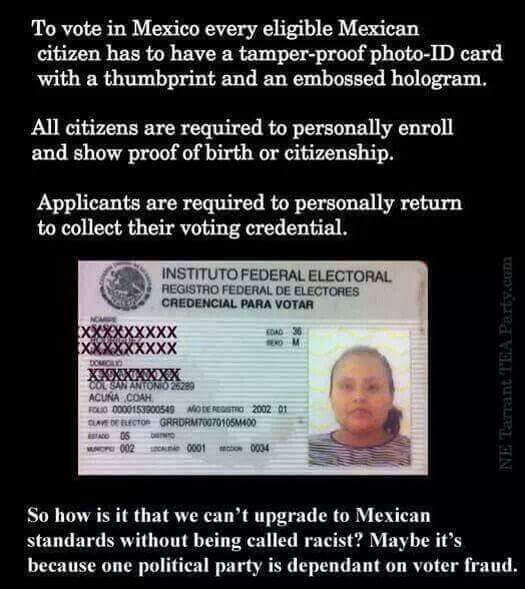
At what point for you is it OK that someone who has to prove who they are for multiple other things has to prove who they are to vote? Hey, they are telling us how quick and easy background checks are for gun owners and for refugees, maybe we should have background checks done before we vote? Or Obamacare's website is so good, maybe we need a national website that we all go to in order to vote...and those without internet access can still go down to the local polls and vote on available computers there? Or we could all call in like American Idol?
So is this guy an up and comer or does he have a huge target on his back now? I'm shocked someone from this inept Congress is actually calling out how broken Congress is and allowing the Executive branch power grab by both parties.
<iframe width="560" height="315" src="https://www.youtube.com/embed/sjgRbI7yQCI" frameborder="0" allowfullscreen></iframe>
<iframe width="560" height="315" src="https://www.youtube.com/embed/sjgRbI7yQCI" frameborder="0" allowfullscreen></iframe>

woolybug25
#1 Vineyard Vines Fan
- Messages
- 17,677
- Reaction score
- 3,018
Forgive me if this has already been presented.... ahem...
Donald Trump: Hillary Clinton 'got schlonged' in 2008 - CNNPolitics.com
"Even a race to Obama, she was gonna beat Obama. I don't know who would be worse, I don't know, how could it be worse? But she was going to beat -- she was favored to win -- and she got schlonged, she lost, I mean she lost," Trump said, using a vulgar Yiddish word for a man's penis.
Donald Trump: Hillary Clinton 'got schlonged' in 2008 - CNNPolitics.com
B
Buster Bluth
Guest
None of that is untrue, but Democrats engage in similar practices aimed at benefiting their own constituencies.
Definitely agree.
And the Democratic Party is going above and beyond anything I remember the Republicans ever doing in terms of shitting on democratic ideals with this primary season, evidence being the scheduling of these debates. It's beyond pathetic and into the realm of unforgivable.
As I assume you'd agree, power corrupts and the Democrats are ultimately no different than the Republicans. Each are willing to slant the game in not only their separate favor but even more grossly in their collective favor by working against any sort of alternative candidates.
B
Buster Bluth
Guest
Why do people continue to have a problem with proving your identity to vote?
Because voter fraud is practically nonexistent. You should be inherently suspicious of politicians working to solve problems that don't actually exist.
I get it (maybe) if it is passed just before an election when people with possibly expired credentials (or the very rare people with no credentials) may have a short amount of time to obtain credentials. However, many states have now had these rules for multiple elections and in many states just a plain ID card is free. Plus there are tons of things that require a photo ID, including people picking up their kids from LA school system during the recent cancellation.
That's super and all but at the end of the day the Republicans simply know that of the people who cannot get their ID updated, more of them are Democrats than Republicans. It's not unheard of for the poor old grandmas who don't drive any more to have an expired license and actually have it be an ordeal to get it updated.
Also, Mexico requires voter ID. You don't think we should have as stringent election laws as Mexico?
That's some weird logic to suggest to someone who thinks the voter ID regulations are slightly harmful for our democratic practices. Mexico isn't exactly a paragon of democratic ideals, so their more stringent ID laws would actually make sense...
Dank meme. Can the creator of this crap point to some evidence for a party in this country, any party, relying on voter fraud? I served on a grand jury and had the opportunity to see what happens to people who commit voter fraud, it's not fun. He was facing five years in prison when it went to trial, and only committed (allegedly..) the crime from his own stupidity within his transient lifestyle. The idea of a political party backing a voter fraud operation in this country is almost beyond my comprehension. But if they were, they sure as shit could make the fake IDs, that'd be the easy part.
At what point for you is it OK that someone who has to prove who they are for multiple other things has to prove who they are to vote?
Allow them to present an expired ID and 99% of my issues with it go away. A believable ID should pass on the judgment of the official there. The whole game it to pick off a few voters, more of them Democrat than Republican, with a regulation that doesn't effect the majority of voters at all.
B
Buster Bluth
Guest
Felons should not be allowed to vote. You lose your liberty when you are convicted of a crime- including the liberty to vote. Don't commit a crime and there is no problem.
You think it's okay that someone could get into a bar fight as a teenager and elbow a cop and the punishment should include not voting for the rest of your life?
*looks up and realizes it's ndgradstudent*

Interestingly, though, the Clinton-Bush plutocracy agrees about amnesty for illegals, continued mass immigration, electing a new people, etc. Republican voters do not support these policies, and Trump and Cruz at least pretend not to, which explains why they enjoy greater support.
The Democrats oppose reform because voter fraud helps them- it gave them a 60th Senate seat in 2009, for example. We require photo IDs to drive, and to get on a plane, and to buy booze. But not to vote.
As for effects on black turnout, in 2012 black turnout exceeded white turnout. So how big of a problem is this 'depression,' really?[/B]
Felons should not be allowed to vote. You lose your liberty when you are convicted of a crime- including the liberty to vote. Don't commit a crime and there is no problem.
1. You can also drive, get on a plane, and buy booze most every day of the year. None of those activities are limited to a single day and waiting in long lines at a single outlet.
2. Black turnout was greater for two reasons. First, a black man was running for president. Second, blacks resented the effort to restrict their right to vote and rallied to increase turnout.
3. While they are imprisoned I have no problem with limiting voting rights. Some freedoms are given up for being convicted of violating the law. However, when a man or woman has served his or her time, voting rights should be restored along with other freedoms taken from them during incarceration.
- Messages
- 20,894
- Reaction score
- 8,126
The Atlantic's David Frum just published an article titled "The Great Republican Revolt":
The angriest and most pessimistic people in America aren’t the hipster protesters who flitted in and out of Occupy Wall Street. They aren’t the hashtavists of #BlackLivesMatter. They aren’t the remnants of the American labor movement or the savvy young dreamers who confront politicians with their American accents and un-American legal status.
The angriest and most pessimistic people in America are the people we used to call Middle Americans. Middle-class and middle-aged; not rich and not poor; people who are irked when asked to press 1 for English, and who wonder how white male became an accusation rather than a description.
You can measure their pessimism in polls that ask about their expectations for their lives—and for those of their children. On both counts, whites without a college degree express the bleakest view. You can see the effects of their despair in the new statistics describing horrifying rates of suicide and substance-abuse fatality among this same group, in middle age.
White Middle Americans express heavy mistrust of every institution in American society: not only government, but corporations, unions, even the political party they typically vote for—the Republican Party of Romney, Ryan, and McConnell, which they despise as a sad crew of weaklings and sellouts. They are pissed off. And when Donald Trump came along, they were the people who told the pollsters, “That’s my guy.”
They aren’t necessarily superconservative. They often don’t think in ideological terms at all. But they do strongly feel that life in this country used to be better for people like them—and they want that older country back.
You hear from people like them in many other democratic countries too. Across Europe, populist parties are delivering a message that combines defense of the welfare state with skepticism about immigration; that denounces the corruption of parliamentary democracy and also the risks of global capitalism. Some of these parties have a leftish flavor, like Italy’s Five Star Movement. Some are rooted to the right of center, like the U.K. Independence Party. Some descend from neofascists, like France’s National Front. Others trace their DNA to Communist parties, like Slovakia’s governing Direction–Social Democracy.
These populists seek to defend what the French call “acquired rights”—health care, pensions, and other programs that benefit older people—against bankers and technocrats who endlessly demand austerity; against migrants who make new claims and challenge accustomed ways; against a globalized market that depresses wages and benefits. In the United States, they lean Republican because they fear the Democrats want to take from them and redistribute to Americans who are newer, poorer, and in their view less deserving—to “spread the wealth around,” in candidate Barack Obama’s words to “Joe the Plumber” back in 2008. Yet they have come to fear more and more strongly that their party does not have their best interests at heart.
A majority of Republicans worry that corporations and the wealthy exert too much power. Their party leaders work to ensure that these same groups can exert even more. Mainstream Republicans were quite at ease with tax increases on households earning more than $250,000 in the aftermath of the Great Recession and the subsequent stimulus. Their congressional representatives had the opposite priorities. In 2008, many Republican primary voters had agreed with former Arkansas Governor Mike Huckabee, who wanted “their next president to remind them of the guy they work with, not the guy who laid them off.” But those Republicans did not count for much once the primaries ended, and normal politics resumed between the multicultural Democrats and a plutocratic GOP.
This year, they are counting for more. Their rebellion against the power of organized money has upended American politics in ways that may reverberate for a long time. To understand what may come next, we must first review the recent past.
Not so long ago, many observers worried that Americans had lost interest in politics. In his famous book Bowling Alone, published in 2000, the social scientist Robert Putnam bemoaned the collapse in American political participation during the second half of the 20th century. Putnam suggested that this trend would continue as the World War II generation gave way to disengaged Gen Xers.
But even as Putnam’s book went into paperback, that notion was falling behind the times. In the 1996 presidential election, voter turnout had tumbled to the lowest level since the 1920s, less than 52 percent. Turnout rose slightly in November 2000. Then, suddenly: overdrive. In the presidential elections of 2004 and 2008, voter turnout spiked to levels not seen since before the voting age was lowered to 18, and in 2012 it dipped only a little. Voters were excited by a hailstorm of divisive events: the dot-com bust, the Bush-versus-Gore recount, the 9/11 terrorist attacks, the Iraq War, the financial crisis, the bailouts and stimulus, and the Affordable Care Act.
Putnam was right that Americans were turning away from traditional sources of information. But that was because they were turning to new ones: first cable news channels and partisan political documentaries; then blogs and news aggregators like the Drudge Report and The Huffington Post; after that, and most decisively, social media.
Politics was becoming more central to Americans’ identities in the 21st century than it ever was in the 20th. Would you be upset if your child married a supporter of a different party from your own? In 1960, only 5 percent of Americans said yes. In 2010, a third of Democrats and half of Republicans did. Political identity has become so central because it has come to overlap with so many other aspects of identity: race, religion, lifestyle. In 1960, I wouldn’t have learned much about your politics if you told me that you hunted. Today, that hobby strongly suggests Republican loyalty. Unmarried? In 1960, that indicated little. Today, it predicts that you’re a Democrat, especially if you’re also a woman.
Meanwhile, the dividing line that used to be the most crucial of them all—class—has increasingly become a division within the parties, not between them. Since 1984, nearly every Democratic presidential-primary race has ended as a contest between a “wine track” candidate who appealed to professionals (Gary Hart, Michael Dukakis, Paul Tsongas, Bill Bradley, and Barack Obama) and a “beer track” candidate who mobilized the remains of the old industrial working class (Walter Mondale, Dick Gephardt, Bill Clinton, Al Gore, and Hillary Clinton). The Republicans have their equivalent in the battles between “Wall Street” and “Main Street” candidates. Until this decade, however, both parties—and especially the historically more cohesive Republicans—managed to keep sufficient class peace to preserve party unity.
Not anymore, at least not for the Republicans.
The Great Recession ended in the summer of 2009. Since then, the U.S. economy has been growing, but most incomes have not grown comparably. In 2014, real median household income remained almost $4,000 below the pre-recession level, and well below the level in 1999. The country has recovered from the worst economic disaster since the Great Depression. Most of its people have not. Many Republicans haven’t shared in the recovery and continued upward flight of their more affluent fellow partisans.
It was these pessimistic Republicans who powered the Tea Party movement of 2009 and 2010. They were not, as a rule, libertarians looking for an ultraminimal government. The closest study we have of the beliefs of Tea Party supporters, led by Theda Skocpol, a Harvard political scientist, found that “Tea Partiers judge entitlement programs not in terms of abstract free-market orthodoxy, but according to the perceived deservingness of recipients. The distinction between ‘workers’ and ‘people who don’t work’ is fundamental to Tea Party ideology.”
It’s uncertain whether any Tea Partier ever really carried a placard that read keep your government hands off my medicare. But if so, that person wasn’t spouting gibberish. The Obama administration had laid hands on Medicare. It hoped to squeeze $500 billion out of the program from 2010 to 2020 to finance health insurance for the uninsured. You didn’t have to look up the figures to have a sense that many of the uninsured were noncitizens (20 percent), or that even more were foreign-born (27 percent). In the Tea Party’s angry town-hall meetings, this issue resonated perhaps more loudly than any other—the ultimate example of redistribution from a deserving “us” to an undeserving “them.”
Yet even as the Republican Main Street protested Obamacare, it rejected the hardening ideological orthodoxy of Republican donors and elected officials. A substantial minority of Republicans—almost 30 percent—said they would welcome “heavy” taxes on the wealthy, according to Gallup. Within the party that made Paul Ryan’s entitlement-slashing budget plan a centerpiece of policy, only 21 percent favored cuts in Medicare and only 17 percent wanted to see spending on Social Security reduced, according to Pew. Less than a third of ordinary Republicans supported a pathway to citizenship for illegal immigrants (again according to Pew); a majority, by contrast, favored stepped-up deportation.
As a class, big Republican donors could not see any of this, or would not. So neither did the politicians who depend upon them. Against all evidence, both groups interpreted the Tea Party as a mass movement in favor of the agenda of the Wall Street Journal editorial page. One of the more dangerous pleasures of great wealth is that you never have to hear anyone tell you that you are completely wrong.
It was mitt romney who got the first post–Tea Party presidential nomination, and he ran on a platform of Conservatism Classic: tax cuts, budget cuts, deregulation, free trade—all lightly seasoned with some concessions to the base regarding stricter immigration enforcement. The rank and file did not like it. But they could not stop it. The base kept elevating “not Romneys” into first place, and each rapidly failed or fizzled; Romney, supported by a cumulative total of $139 million in primary funds by March 2012, trundled on.
Romney ultimately lost the presidential election, of course, to the surprise and dismay of a party elite confident of victory until the very end. One might have expected this shock to force a rethink. The Republicans had now lost four out of the past six presidential elections. Another election had been won only in the Electoral College, despite the loss of the popular vote. Even their best showing, 50.7 percent of the vote in 2004, represented the closest escape of any incumbent president who won reelection since the first recorded popular vote.
And yet, within hours of Romney’s defeat, Republican donors, talkers, and officials converged on the maximally self-exculpating explanation. The problem had not been the plan to phase out Medicare for people younger than 55. Or the lack of ideas about how to raise wages. Or the commitment to ending health-insurance coverage for millions of working-age Americans. Or the anthems to wealth creation and entrepreneurship in a country increasingly skeptical of both. No, the problem was the one element of Romney’s message they had never liked anyway: immigration enforcement.
Owners of capital assets, employers of low-skill laborers, and highly compensated professionals tend to benefit economically from the arrival of immigrants. They are better positioned to enjoy the attractive cultural and social results of migration (more-interesting food!) and to protect themselves against the burdensome impacts (surges in non-English-proficient pupils in public schools). A pro-immigration policy shift was one more assertion of class interest in a party program already brimful of them.
Nobody expressed the party elites’ consensus view more assuredly than Charles Krauthammer. “Ignore the trimmers,” he wrote in his first postelection column. “There’s no need for radical change. The other party thinks it owns the demographic future—counter that in one stroke by fixing the Latino problem. Do not, however, abandon the party’s philosophical anchor … No reinvention when none is needed.”
“We’ve gotta get rid of the immigration issue altogether,” Sean Hannity told his radio audience the day after the election. “It’s simple for me to fix it. I think you control the border first, you create a pathway for those people that are here, you don’t say, ‘You gotta go home.’ And that is a position that I’ve evolved on.”
A co-owner of Fox News—Krauthammer and Hannity’s TV network—agreed: “Must have sweeping, generous immigration reform,” tweeted Rupert Murdoch on November 7, 2012. “It would be inhumane to send those people back, to send 12 million people out of this country,” the casino mogul and Republican donor Sheldon Adelson told The Wall Street Journal in December of that year. “We’ve got to find a way, find a route, for those people to get legal citizenship.” The Republican National Committee made it all official in a March 2013 postelection report signed by party eminences. The report generally avoided policy recommendations, with a notable exception: “We must embrace and champion comprehensive immigration reform.” To advance the cause, Paul Singer, one of the most open-pocketed GOP donors, made a six-figure contribution to the National Immigration Forum that spring.
If all of this sounds like a prescription for a Jeb Bush candidacy for president … well, perhaps that was not an entirely unintended consequence.
Almost as soon as the new Congress convened in 2013, Senate Republicans worked to strike a deal over immigration issues. A bipartisan “Gang of Eight,” including Florida’s ambitious young Marco Rubio, agreed on a plan that would create a path to citizenship for millions of illegal immigrants and substantially increase legal-immigration limits for both high- and low-skilled workers. Otherwise, the party yielded on nothing and doubled down on everything. No U-turns. No compromises.
The new strategy soon proved a total and utter failure. George W. Bush’s tax cuts for high earners expired in 2013, and Republicans could not renew them. The drive to cut the deficit ended in budget sequestration, whose harshest effect fell on the military. The Gang of Eight deal never came to a vote in the House. All the while, Republicans’ approval ratings slipped and slid. Instead of holding on to their base and adding Hispanics, Republicans alienated their base in return for no gains at all. By mid-2015, a majority of self-identified Republicans disapproved of their party’s congressional leadership—an intensity of disapproval never seen by the Republican majority of the 1990s nor by Democrats during their time in the majority after the 2006 midterm elections.
In fact, disapproval had flared into an outright revolt of the Republican base in the summer of 2014. House Majority Leader Eric Cantor, the No. 2 man in the Republican caucus, had emerged as a leader of the new line on immigration. Up for reelection in Virginia’s Seventh District, Cantor was challenged that year by a conservative Christian professor of economics, Dave Brat. During Obama’s first term, Tea Party insurgents had toppled incumbents and defeated party favorites in primaries from Delaware to Nevada. Those challenges had ended badly in the general election, for the most part: Tea Party Republicans lost at least five Senate seats that might plausibly have been won. Party leaders believed the lesson had been learned and expected their voters to be more tractable in future elections.
Cantor’s loss to Brat jolted House leaders. Immigration reform slipped off their agenda. Marco Rubio repudiated his own deal. But Republican elites outside Congress did not get the message. They rationalized Cantor’s defeat as a freak event, the sad consequence of a nationally minded politician’s neglect of his district. They continued to fill the coffers of Jeb Bush and, to a lesser extent, Rubio and Scott Walker, all reliable purveyors of Conservatism Classic. Last February, three of the party’s most important moneymen—the fast-food executive Andrew Puzder, the health-care investor Mike Fernandez, and the national finance chair of Mitt Romney’s 2012 campaign, Spencer Zwick—publicly urged the GOP to push ahead toward more-open immigration. “America should be a destination for hardworking immigrants from all over the world,” said Puzder, an advocate of importing more low-skilled laborers to meet the needs of his high-turnover industry. Zwick said that any presidential candidate who wanted to be taken seriously had better “be in a similar place” to Jeb Bush on the immigration issue.
Maybe it was not a good idea for Jeb Bush’s allies to describe his fund-raising strategy as “shock and awe.” Perhaps the Iraq War reference stirred painful memories, even among Republicans. Still, Bush’s fund-raising genuinely inspired awe. In his financial disclosure for the second quarter of 2015, Bush reported raising $11.4 million for his formal campaign and another $103 million for his super PAC. These funds were provided by a relatively small number of very wealthy people. Of Bush’s presidential-campaign dollars, only 3 percent arrived in amounts of $200 or less. Almost 82 percent arrived in the maximum increment of $2,700. Nearly 80 percent of Bush’s super-PAC take arrived in increments of $25,000 or more; about a quarter of the haul was made up of donations of $1 million or more.
Yet seldom in the history of fund-raising has so much bought so little, so fleetingly. Between December 2014 and September 2015, Jeb Bush plunged from first place in the Republican field to fifth. Between late September and mid-October, he purchased 60 percent of all political spots aired in New Hampshire. That ad barrage pushed his poll numbers in the state from about 9 percent to about 8 percent.
As the governor of Florida, Bush had cut taxes and balanced budgets. He’d challenged unions and championed charter schools. At the same time, Bush passionately supported immigration liberalization. The central event in his life history was his reinvention as an honorary Latino American when he married a Mexican woman, Columba Garnica de Gallo. He spoke Spanish at home. He converted to Catholicism. He sought his fortune with a Cuban American business partner. In his most quotable phrase, he described illegal immigration as an “act of love.”
Bush’s update of Conservatism Classic had made him a hit with the party’s big donors. He had won accolades from Karl Rove (“the deepest thinker on our side”) and Arthur Brooks, the president of the American Enterprise Institute (“a top-drawer intellect”). Yet within five weeks of his formal declaration of candidacy on June 15, Bush’s campaign had been brutally rejected by the GOP rank and file.
From Jupiter Island, Florida, to Greenwich, Connecticut; from Dallas’s Highland Park to Sea Island, Georgia; from Fifth Avenue in Manhattan to California’s Newport Beach, the baffled question resounded: What went wrong?
Big-dollar Republican favorites have run into trouble before, of course. Rudy Giuliani imploded in 2007–08; Mitt Romney’s 2012 nomination was knocked off course as Republicans worked their way through a series of alternative front-runners: Rick Perry, Herman Cain, Newt Gingrich, and finally Rick Santorum. But Giuliani lost ground to two rivals equally acceptable to the donor elite, or nearly so: Mitt Romney and John McCain. In 2011–12, the longest any of the “not Romneys” remained in first place was six weeks. In both cycles, resistance to the party favorite was concentrated among social and religious conservatives.
The mutiny of the 2016 election cycle has been different. By the fall of 2015, a majority of Republicans favored candidates who had never been elected to anything: Donald Trump, Ben Carson, and Carly Fiorina. Fiorina’s campaign was perhaps not so unusual. A former CEO, she appealed to the same business-minded Republicans who might have voted for Romney in 2012. Carson appealed to the same religious conservatives that candidates like Mike Huckabee and Santorum had appealed to in prior presidential cycles. What was new and astonishing was the Trump boom. He jettisoned party orthodoxy on issues ranging from entitlement spending to foreign policy. He scoffed at trade agreements. He said rude things about Sheldon Adelson and the Koch brothers. He reviled the campaign contributions of big donors—himself included!—as open and blatant favor-buying. Trump’s surge was a decisive repudiation by millions of Republican voters of the collective wisdom of their party elite.
When Trump first erupted into the Republican race in June, he did so with a message of grim pessimism. “We got $18 trillion in debt. We got nothing but problems … We’re dying. We’re dying. We need money … We have losers. We have people that don’t have it. We have people that are morally corrupt. We have people that are selling this country down the drain … The American dream is dead.”
That message did not resonate with those who’d ridden the S&P 500 from less than 900 in 2009 to more than 2,000 in 2015. But it found an audience all the same. Half of Trump’s supporters within the GOP had stopped their education at or before high-school graduation, according to the polling firm YouGov. Only 19 percent had a college or postcollege degree. Thirty-eight percent earned less than $50,000. Only 11 percent earned more than $100,000.
Trump Republicans were not ideologically militant. Just 13 percent said they were very conservative; 19 percent described themselves as moderate. Nor were they highly religious by Republican standards.
What set them apart from other Republicans was their economic insecurity and the intensity of their economic nationalism. Sixty-three percent of Trump supporters wished to end birthright citizenship for the children of illegal immigrants born on U.S. soil—a dozen points higher than the norm for all Republicans. More than other Republicans, Trump supporters distrusted Barack Obama as alien and dangerous: Only 21 percent acknowledged that the president was born in the United States, according to an August survey by the Democratic-oriented polling firm PPP. Sixty-six percent believed the president was a Muslim.
Trump promised to protect these voters’ pensions from their own party’s austerity. “We’ve got Social Security that’s going to be destroyed if somebody like me doesn’t bring money into the country. All these other people want to cut the hell out of it. I’m not going to cut it at all; I’m going to bring money in, and we’re going to save it.”
He promised to protect their children from being drawn into another war in the Middle East, this time in Syria. “If we’re going to have World War III,” he told The Washington Post in October, “it’s not going to be over Syria.” As for the politicians threatening to shoot down the Russian jets flying missions in Syria, “I won’t even call them hawks. I call them the fools.”
He promised a campaign independent of the influences of money that had swayed so many Republican races of the past. “I will tell you that our system is broken. I gave to many people. Before this, before two months ago, I was a businessman. I give to everybody. When they call, I give. And you know what? When I need something from them, two years later, three years later, I call them. They are there for me. And that’s a broken system.”
He promised above all to protect their wages from being undercut by Republican immigration policy.
It cannot last, can it? “The casino does not always win,” Stuart Stevens, Mitt Romney’s lead strategist during the 2012 campaign, quipped to me in September. “But that’s the way to bet.” The casino won in 2012, and will very likely win again in 2016.
And yet already, Trump has destroyed one elite-favored presidential candidacy, Scott Walker’s, and crippled two others, Jeb Bush’s and Chris Christie’s. He has thrown into disarray the party’s post-2012 comeback strategy, and pulled into the center of national discussion issues and constituencies long relegated to the margins.
Something has changed in American politics since the Great Recession. The old slogans ring hollow. The insurgent candidates are less absurd, the orthodox candidates more vulnerable. The GOP donor elite planned a dynastic restoration in 2016. Instead, it triggered an internal class war.
The contest for the presidency turns on external events as much as—or more than—internal party politics. George W. Bush’s team believed that the last-minute revelation of a 1976 drunk-driving arrest cost him the popular vote in the 2000 election. Jimmy Carter blamed his 1980 defeat on the debacle of the attempted rescue of American hostages in Iran. So anything can happen. But that does not mean anything will happen. Barring shocks, presidential elections turn on the fundamentals of economics, demography, and ideology.
The puzzle for the monied leaders of the Republican Party is: What now? And what next after that? None of the options facing the GOP elite is entirely congenial. But there appear to be four paths the elite could follow, for this campaign season and beyond. They lead the party in very different directions.
Option 1: Double Down
The premise of the past few thousand words is that the Republican donor elite failed to impose its preferred candidate on an unwilling base in 2015 for big and important reasons. But maybe that premise is wrong. Maybe Jeb Bush has just been a bad candidate with a radioactive last name. Maybe the same message and platform would have worked fine if espoused by a fresher and livelier candidate. Such is the theory of Marco Rubio’s campaign. Or—even if the donor message and platform have troubles—maybe $100 million in negative ads can scorch any potential alternative, enabling the donor-backed candidate to win by default.
And if not Rubio, maybe the core donor message could still work if joined to a true outsider candidacy: Ben Carson’s, for example. Carson is often regarded as a protest candidate, but as The Weekly Standard’s Fred Barnes enthused back in January 2015: “One thing not in doubt is Carson’s conservatism. He’s the real deal, an economic, social, and foreign policy conservative.” Carson may say wacky things, but he does not say heterodox things.
Yet even if the Republican donor elite can keep control of the party while doubling down, it’s doubtful that the tactic can ultimately win presidential elections. The “change nothing but immigration” advice was a self-flattering fantasy from the start. Immigration is not the main reason Republican presidential candidates lose so badly among Latino and Asian American voters, and never was: Latino voters are more likely to list education and health care as issues that are extremely important to them. A majority of Asian Americans are non-Christian and susceptible to exclusion by sectarian religious themes.
So …
Option 2: Tactical Concession
Perhaps some concession to the disgruntled base is needed. That’s the theory of the Cruz campaign and—after a course correction—also of the Christie campaign. Instead of 2013’s “Conservatism Classic Plus Immigration Liberalization,” Cruz and Christie are urging “Conservatism Classic Plus Immigration Enforcement.” True, Cruz’s carefully selected words on immigration leave open the possibility of guest-worker programs or other pro-employer reforms after a burst of border enforcement. But Cruz and Christie have seen the reaction to Donald Trump’s message, and appear to appreciate the need to at least seem to do something to redress the grievances of the Republican base.
Much of the donor elite could likely be convinced that while Jeb Bush’s idea of immigration reform would be good to have, it isn’t a must-have. Just as the party elite reached a pact on abortion with social conservatives in the 1980s, it could concede the immigration issue to its Main Street base in the 2010s.
Yet a narrow focus on immigration populism alone seems insufficient to raise Republican hopes. Trump shrewdly joins his immigration populism to trade populism. On the Democratic side, Bernie Sanders’s opposition to open borders is logically connected to his hopes for a Democratic Socialist future: His admired Denmark upholds high labor standards along with some of the world’s toughest immigration rules. Severed from a larger agenda, however—as Mitt Romney tried to sever the issue in 2012—immigration populism looks at best like pandering, and at worst like identity politics for white voters. In a society that is and always has been multiethnic and polyglot, any national party must compete more broadly than that.
Which brings us to …
Option 3: True Reform
Admittedly, this may be the most uncongenial thought of them all, but party elites could try to open more ideological space for the economic interests of the middle class. Make peace with universal health-insurance coverage: Mend Obamacare rather than end it. Cut taxes less at the top, and use the money to deliver more benefits to working families in the middle. Devise immigration policy to support wages, not undercut them. Worry more about regulations that artificially transfer wealth upward, and less about regulations that constrain financial speculation. Take seriously issues such as the length of commutes, nursing-home costs, and the anticompetitive practices that inflate college tuition. Remember that Republican voters care more about aligning government with their values of work and family than they care about cutting the size of government as an end in itself. Recognize that the gimmick of mobilizing the base with culture-war outrages stopped working at least a decade ago.
Such a party would cut health-care costs by squeezing providers, not young beneficiaries. It would boost productivity by investing in hard infrastructure—bridges, airports, water-treatment plants. It would restore Dwight Eisenhower to the Republican pantheon alongside Ronald Reagan and emphasize the center in center-right.
To imagine the change is to see how convulsive it would be—and how unlikely. True, center-right conservative parties backed by broad multiethnic coalitions of the middle class have gained and exercised power in other English-speaking countries, even as Republicans lost the presidency in 2008 and 2012. But the most-influential voices in American conservatism reject the experience of their foreign counterparts as weak, unprincipled, and unnecessary. In parliamentary democracy, winning or losing is starkly binary: A party either is in power or is the opposition. In the American system, that binary is much blurrier. Republicans can, of course, exert some control over government as long as they hold any one of the House, Senate, or presidency.
Which brings us finally to …
Option 4: Change the Rules of the Game
“The filibuster used to be bad. Now it’s good.” So Fred Thompson, the late actor and former Republican senator, jokingly told an audience on a National Review cruise shortly after Barack Obama won the presidency for the first time. How partisans feel about process issues is notoriously related to what process would benefit them at any given moment. Liberals loved the interventionist Supreme Court in the 1960s and ’70s, hated it in the 1990s and 2000s—and may rotate their opinion again if a President Hillary Clinton can tilt a majority of the Supreme Court their way. It’s an old story that may find a new twist if and when Republicans acknowledge that the presidency may be attainable only after they make policy changes that are unacceptable to the party elite.
There are metrics, after all, by which the post-2009 GOP appears to be a supremely successful political party. Recently, Rory Cooper, of the communications firm Purple Strategies, tallied a net gain to the Republicans of 69 seats in the House of Representatives, 13 seats in the Senate, 900-plus seats in state legislatures, and 12 governorships since Obama took office. With that kind of grip on state government, in particular, Republicans are well positioned to write election and voting rules that sustain their hold on the national legislature. The president may be able to grant formerly illegal immigrants the right to work, but he cannot grant them the right to vote. In this light, instead of revising Republican policies to stop future Barack Obamas and Hillary Clintons, maybe it’s necessary to revise only the party rules to stop future Donald Trumps from confronting party elites with their own unpopularity.
The inaugural issue of The Weekly Standard, the conservative magazine launched in 1995, depicted then–Speaker of the House Newt Gingrich swinging into action, a submachine gun blazing in his left hand, under the headline “Permanent Offense.” But that was then. Maybe the more natural condition of conservative parties is permanent defense—and where better to wage a long, grinding defensive campaign than in Congress and the statehouses? Maybe the presidency itself should be regarded as one of those things that is good to have but not a must-have, especially if obtaining it requires uncomfortable change.
What happens to an elite whose followers withdraw their assent? Does it self-examine? Or does it take refuge in denial? Does it change? Or does it try to prevent change? Does it challenge itself to build a new political majority? Or does it seize the opportunities the American political system offers to compact and purposeful minorities? When its old answers fail, will it think anew? Or will it simply repeat louder the dogmas that enthralled supporters in the past? Americans love the crush of competition, the hard-fought struggle, the long-slogging race. But much more than the pundit’s “Who will win?,” it is these deeper questions from the election of 2016 that will shape the future of American politics.


GoIrish41
Paterfamilius
- Messages
- 9,929
- Reaction score
- 2,119
Are you sure about that? Do you remember the 2008 primary?
The Democratic party, as I have argued before, is a coalition of the fringes. Playing one off the other is pretty easy, and we see it all the time: blacks vs. Mexicans, blacks/Mexicans vs. Asians, blacks vs. gays, blacks vs. gentry white liberals, unions vs. Asians, etc.
Everyone else votes Republican.
Lol at "the fringes" comment. Don't look now, but this is what America looks like in 2015. It's like you time traveled to this year from the 1950s. The myopic view of much of the GOP is the reason the party is so out of alignment with voters in national elections. Blacks. Asians, Mexicans. Gays, gentry white liberals, union workers? These are not fringe groups. They are America. Add women, young people, Muslims (thanks Mr. Trump), educators, the educated, etc., etc.

Polish Leppy 22
Well-known member
- Messages
- 6,594
- Reaction score
- 2,009
It's not just Jeb it's the whole party. Clinton grew up a Republican and she and her husband governed as Republicans. Hillary is every bit the hawk the GOP makes a prerequisite for candidacy, her support for issues like gay marriage is as calculated as any Republican who flipped for political gain, her economic views are every bit as corporate as any Republican who has a shot at winning. When you look at Hillary with disgust you're just seeing a Republican without the Fox News/AM radio PR umbrella. You'd need a magnifying glass to see the difference between the Dem candidate and GOP candidate, no different than 2004.
Yeah if you remove issues like healthcare, education, social security, medicare, and medicaid she might as well have an R behind her name.
BleedBlueGold
Well-known member
- Messages
- 6,265
- Reaction score
- 2,489
Trump's tax plan: Trump Tax Plan Would Cut Federal Revenue 22%
I personally like the quote about hedge fund managers. "They're getting away with murder," in regards to them paying carried interest tax instead of income tax. Yet under Trump's plan, he's actually giving those people a tax cut. Haha.
I personally like the quote about hedge fund managers. "They're getting away with murder," in regards to them paying carried interest tax instead of income tax. Yet under Trump's plan, he's actually giving those people a tax cut. Haha.

ShawneeIrish
Well-known member
- Messages
- 1,325
- Reaction score
- 137
Is NDgradstudent really IrishPat?
C
Cackalacky
Guest
Just so everyone is clear, when NDgradstudent mentions "Coalition of the Fringes" it is a term used only by Steve Sailor, one of the most right-wing disgusting human beings i have had the displeasure of reading. He is matched and out done only by Coulter, Limbaugh and Boortz, with Ted Cruz pulling in close.
Edited my post out of respect for Whiskey and a rash and thoughtless post.
Apologies.
Edited my post out of respect for Whiskey and a rash and thoughtless post.
Apologies.
Last edited:
- Messages
- 20,894
- Reaction score
- 8,126
Just so everyone is clear, when NDgradstudent mentions "Coalition of the Fringes" it is a term used only by Steve Sailor, one of the most right-wing disgusting human beings i have had the displeasure of reading. He is matched and out done only by Coulter, Limbaugh and Boortz, with Ted Cruz pulling in close
Sailer may very well be as extreme as you describe, but there are reasons to doubt the objectivity of your cited source. First, National Review isn't "far right-wing", but pretty mainstream conservative. Second, The American Conservative definitely isn't "far right-wing". As you're likely aware, it's my favorite magazine, and I share AmCon articles here frequently. It's support for New Urbanism, communitarian values, and military restraint often garners criticism from the right for being insufficiently conservative.
And lastly, I'm a bit bothered by the breathless condemnation of those who criticize our existing immigration policy (if you can even call it a "policy") as obviously racist xenophobes who should be immediately disregarded as beyond the pale. This touches on some of my recent posts about Trump as well. It's true that anti-immigrant sentiment is often associated with white nationalism, but we should be careful not to conflate those two ideas. There are huge numbers of Americans who strongly believe that our elites have sold our middle class down the river through a de facto open border and policies that promote the out-sourcing of American jobs. Many of them are now supporting Trump. If we attempt to summarily dismiss them as bigoted rubes and refuse to address their legitimate complaints, we'll be opening the door to all sorts of demagoguery in the near future.
NDgradstudent
Banned
- Messages
- 2,414
- Reaction score
- 165
You left non-Evangelical women off of your list of Democratic supporters. Now if everyone else votes for Republicans, what does that leave for the Republicans? Oh, that's right, Conservative white males and Evangelicals. It's no wonder the Republicans do all they can to limit voter turn-out. If Republican policies were favored by the majority of Americans, you'd see Republican legislatures expanding the vote rather than limiting it.
Single women.
You think it's okay that someone could get into a bar fight as a teenager and elbow a cop and the punishment should include not voting for the rest of your life?
The restriction on voting is part of the punishment, and it should last as long as the punishment. I don’t think ‘elbowing’ a cop should involve a lifetime punishment.
Lol at "the fringes" comment. Don't look now, but this is what America looks like in 2015. It's like you time traveled to this year from the 1950s. The myopic view of much of the GOP is the reason the party is so out of alignment with voters in national elections. Blacks. Asians, Mexicans. Gays, gentry white liberals, union workers? These are not fringe groups. They are America. Add women, young people, Muslims (thanks Mr. Trump), educators, the educated, etc., etc.
It’s not what America looks like on the Upper West Side of Manhattan, for example, where gentry liberals go to extraordinary lengths to keep blacks from their children’s schools. The fringes often fight with each other, and so they need a common enemy to unite them.
Just so everyone is clear, when NDgradstudent mentions "Coalition of the Fringes" it is a term used only by Steve Sailor, one of the most right-wing disgusting human beings i have had the displeasure of reading. He is matched and out done only by Coulter, Limbaugh and Boortz, with Ted Cruz pulling in close.
Logic does not always pervade discussion here at IE.
Sailer describes his personal ideology as "Citizenism", which he explains as:
I believe Americans should be biased in favor of the welfare of our current fellow citizens over that of the six billion foreigners... [since] Americans grasp that we are lucky to be American citizens and they want to pass on their good fortune to their posterity undiluted.[44]
American government should prioritize the interests of the people who fund it? The horror!
Last edited:

pumpdog20
Well-known member
- Messages
- 4,742
- Reaction score
- 3,153
The difference is that voting is a right while driving, flying, buying alcohol are privileges.
If someone who commits a crime, does the time, there's no reason to continue to restrict their freedoms. I agree that incarcerated citizens should temporarily lose that right until they've completed their sentencing.
Owning a firearm is a right, you need an ID for that. I'm going to guess that the number of people who wouldn't be able to afford/get some type of voter identification would be about as immaterial as actual voter fraud.

phgreek
New member
- Messages
- 6,956
- Reaction score
- 433
<iframe width="560" height="315" src="https://www.youtube.com/embed/bRmTtOVqNeU" frameborder="0" allowfullscreen></iframe>
Did not see this posted. Also, just heard about the hub bub that fell out after this due to the WaPo
I laughed...Guy has a sense of humor

Hammer Of The Gods
Well-known member
- Messages
- 1,355
- Reaction score
- 189
Just so everyone is clear, when NDgradstudent mentions "Coalition of the Fringes" it is a term used only by Steve Sailor, one of the most right-wing disgusting human beings i have had the displeasure of reading. He is matched and out done only by Coulter, Limbaugh and Boortz, with Ted Cruz pulling in close.
Edited my post out of respect for Whiskey and a rash and thoughtless post.
Apologies.
Michael savage makes these guys look like Barney the purple dinosaur. He fly's off the handle. I am very conservative but he even makes me cringe from time to time.
- Messages
- 20,894
- Reaction score
- 8,126
Michael savage makes these guys look like Barney the purple dinosaur. He fly's off the handle. I am very conservative but he even makes me cringe from time to time.
You mean Mike Weiner?