Oregon Community college shooting

BGIF

Varsity Club
Messages
43,946
Reaction score
2,922
My assumption is that we were discussing armed security guards. Is that not the case?

I wasn't. I was taking about common people.

My brother-in-law, an internist, and my wife both have carry permits and have been through training at their own cost. My brother-in-law recently gave up his permit due to a double vision problem although state law did not require him to. He did due to a safety concern.

I've been a gun owner since I was 5. It was locked up back then with my father's. I was taught gun safety, was only allowed to handle the gun or shoot with supervision. As I got older I shot at an indoor range in an elementary school in my home town 15 minutes out of NYC. I don't have a carry permit by my choice. I don't carry.
 

BGIF

Varsity Club
Messages
43,946
Reaction score
2,922
How many members are in the Oathkeepers?


They claim 30,000.

Since you seem to be familiar with the Oathkeepers, how many people have their members shot or killed in the 6 years of their existence? I didn't find any.
 

GoIrish41

Paterfamilius
Messages
9,929
Reaction score
2,119
They claim 30,000.

Since you seem to be familiar with the Oathkeepers, how many people have their members shot or killed in the 6 years of their existence? I didn't find any.

I don't think the question was how many they've shot. I think it was how many people are there "itiching" to kill someone. Judging from them patroling to "keep the order" in Ferguson and other locations with AR15s, I'd say that it will only be a matter of time before the distinction between the two questions is blurred.
 

dshans

They call me The Dribbler
Messages
9,624
Reaction score
1,181
If any of the victims or witnesses were armed, the death count would have been much lower. More guns in the hands of the "good guys" would prevent these rampage shootings.

... and if the gunman hadn't had access to the arms he carried and discharged so cavalierly and savagely, the death count would have been zero.
 

wizards8507

Well-known member
Messages
20,660
Reaction score
2,661
... and if the gunman hadn't had access to the arms he carried and discharged so cavalierly and savagely, the death count would have been zero.
Show me a law that would make that possible, even in theory.
 

notredomer23

Staph Member
Messages
17,635
Reaction score
17,557
... and if the gunman hadn't had access to the arms he carried and discharged so cavalierly and savagely, the death count would have been zero.

Yup. Because banning guns stops evil, lawbreaking people from obtaining them.
 

Corry

Active member
Messages
769
Reaction score
98
Show me a law that would make that possible, even in theory.

Through interviews, investigators said they discovered that Mercer struggled with his mental health since he was a teenager and that his condition undermined his ability to succeed in life, a law enforcement source said.

One of the setbacks occurred in 2008, when he was discharged from the Army after only one month for failing to meet the minimum administrative standards to serve, according to records. He had been stationed at Ft. Jackson, S.C, from Nov. 5 to Dec. 11 of that year.

Oregon gunman left hate-filled note and long struggled with mental issues, sources say - LA Times

People with mental health issues should have no access to guns. I have no idea how it would work. It may dissuade people from getting the treatment they need, for fear of being put "on the list" but something needs to happen.


I'm in favor of adopting Australian type laws.

Firearms in Australia are grouped into categories set out in the National Firearm Agreement, with different levels of control. The categories are:

Category A: Rimfire rifles (not semi-automatic), shotguns (not pump-action or semi-automatic), air rifles including semi automatic, and paintball gun. A "Genuine Reason" must be provided for a Category A firearm.

Category B: Centrefire rifles (not semi-automatic), muzzleloading firearms made after 1 January 1901. Apart from a "Genuine Reason", a "Genuine Need" must be demonstrated, including why a Category A firearm would not be suitable. A category B license also covers category A but not vice versa

Category C: Self-loading rimfire rifles holding 10 or fewer rounds and pump-action or self-loading shotguns holding 5 or fewer rounds. primary producers, occupational shooters, firearm dealers, firearm safety officers, collectors and some clay target shooters can own functional Category C firearms.

Category D: Self-loading centrefire rifles, pump-action or self-loading shotguns holding more than 5 rounds. Functional Category D firearms are restricted to government agencies and occupational shooters. Collectors may own deactivated Category D firearms.

Category H: Handguns including air pistols and deactivated handguns. Neither South Australia nor Western Australia require deactivated handguns to be regarded as handguns after deactivation. This situation[when?] prompted the deactivation and diversion of thousands of handguns to the black market in Queensland[vague] – the loophole[which?] shut since 2001) This class is available to target shooters and certain security guards whose job requires possession of a firearm. To be eligible for a Category H firearm, a target shooter must serve a probationary period of 6 months using club handguns, after which they may apply for a permit. A minimum number of matches yearly to retain each category of handgun and be a paid-up member of an approved pistol club.[3]

These categories – A,B,C,D and H were those determined by the NFA. The others listed here are determined by the states that have implement them at their own discretion.

https://en.wikipedia.org/wiki/Gun_laws_in_Australia
 

Whiskeyjack

Mittens Margaritas Ante Porcos
Staff member
Messages
20,894
Reaction score
8,126
... and if the gunman hadn't had access to the arms he carried and discharged so cavalierly and savagely, the death count would have been zero.

My understanding is that the weapons were legally acquired by his mother in a state that touts relatively strict gun laws. There are more firearms in this country than people, and there's no politically feasible solution for significantly decreasing their number.

Last year, The Week's Pascal Emmanuel Gobry published an article titled "Both sides are wrong on the gun debate. Here's Why":

In the wake of several fatal shootings that have once again unnerved Americans, partisans on both sides are trotting out the same tired narratives. Liberals declare that if only we regulated and banned guns like Europe does, there wouldn't be any more gun violence. Conservatives insist that the solution to gun violence is more guns, and just more guns.

Both of these narratives fail to take into account inconvenient facts, and in the end, both sides are wrong. Here are five critical facts that greatly inconvenience the simple narratives they are peddling.

1. The Second Amendment doesn't say what you think it does

The Second Amendment of the U.S. Constitution reads, "A well regulated militia, being necessary to the security of a free State, the right of the People to keep and bear arms shall not be infringed." To liberals, this means that the right to keep and bear arms is only connected to service in a militia, and is not a universal individual right. To conservatives, the Militia Clause is essentially decoration (a "prefatory clause," in the words of Justice Antonin Scalia's majority opinion in the landmark case DC v. Heller) and doesn't affect the heart of the matter: everyone under the U.S. Constitution has an individual right to bear arms. The conservatives have more of a case, because the Second Amendment was directly influenced by a similar provision in the English Bill of Rights, which protected an individual right to bear arms.

Still, they're both wrong in important ways. To liberals, the Militia Clause doesn't refer to a militia, but the Militia (singular). But in the early United States, the Militia did not refer to any specific organization; instead, it referred to the whole of able-bodied men. The Constitution does not refer to a standing Army, but rather to Congress' power to raise an Army — where from? From the Militia, i.e. all able-bodied men who, being already armed, were ready and willing to fight to defend the United States.

In other words, the situation envisioned by the Second Amendment is, contra the liberals, one where most everyone owns guns. But, contra the conservatives, the founders envisioned a society where gun ownership is connected to certain service obligations. Imagine a situation more like Switzerland — the other rich country with widespread private gun ownership but where, because everyone is required to undergo regular training and secure their weapons and so on, gun violence is very low.

Suffice it to say, an agreement along those lines — with an individual right to bear arms, but stringent training and safety requirements — is not on the cards politically in the U.S., and has something to drive each side insane. Yet that's what the Second Amendment envisions.

2. There are hundreds of millions of guns in America

(Alex Wong/Getty Images)
Most promoters of stringent gun regulations want to bring the U.S. more in line with most of Europe and Japan, where guns are severely restricted, most people don't have guns, and everything is fine. Liberals constantly point to the fact that levels of gun violence are much, much lower practically everywhere outside of America's borders.

Here's the biggest problem with that: There already are hundreds of millions of guns in the U.S. If you could wave a magic wand and get rid of all privately owned guns, and set up a European-style system, putting aside moral questions related to the desirability of a right to bear arms, would there be a lot less gun violence? Probably, yes. But in the real world, there are no magic wands. Short of establishing a totalitarian police state (insert your own joke here, libertarians), there is no feasible way to make America a non-gun-saturated country. Whether or not it is theoretically desirable that there not be hundreds of millions of guns circulating in America, it is simply not the world we live in. Any credible gun-related policy needs to take into account this inconvenient, stubborn fact.

3. We don't have a cure for mental illness

In a country where we can't magically wave a wand and make hundreds of millions of guns vanish overnight, a big reason for the depressingly common occurrence of mass shootings is mental illness. The simple fact of the matter is that we — collectively as a society — know very little about mental illness. We know very little about what causes it, how to detect it, how to prevent it, how to cure it, and so on. Closing the so-called "gun show loophole," which lets people buy guns without background checks, sounds like a good idea. But in America, a determined crazy person will find a way to get their hands on guns.

There are many small-bore initiatives that could to be tried; if anything, we should experiment as much as we can with various local initiatives all over the country, and especially try them out as randomized experiments. But we should also keep our expectations rational and realistic. Mental illness will always be with us, this side of the ObamaCare soma mandate, at least.

4. People have a right to self-defense

When conservatives respond to a mass shooting by claiming that if only someone there had a gun the shooting wouldn't have happened, liberals either scoff or become apoplectic.

Of course, conservatives wildly overstate their case: no, K-12 teachers should not be packing heat. Still, law-abiding citizens use guns to save lives. As Jeffrey Goldberg noted in 2007, at least one law-abiding gun-carrying citizen stopped a massacre, and concealed-carry permit holders commit crimes at a lower rate than the general population and perhaps even at a lower rate than the police. The vast, vast majority of law-abiding gun owners pose no danger to anyone.

Every human being has a natural, personal right to self-defense. I don't know of any moral system that doesn't hold this to be true. In non-gun-saturated countries, the government can restrict legal gun ownership to a great extent without unduly restricting the natural right to self defense, because it is vanishingly unlikely that someone will have to defend themselves against a gun-wielding attacker.

The United States, however, is a gun-saturated country. However much we may wish that it were not the case, guns circulate widely in the United States. There are millions of illegal guns in circulation, and this will remain so for the foreseeable future. Crime happens. And people have a natural right to self-defense. Given all those facts, it is hard to see how it is possible to severely restrict the rights of law-abiding citizens to own guns without also unacceptably restricting human rights as they are understood in the Enlightenment tradition in general, and in the Anglo-American Constitutional tradition in particular.

5. There is one good way to get rid of guns, and liberals hate it

You'll have noted that many of the grim evaluations I've laid out are based on one premise: that the United States is, and for any foreseeable future will remain, a gun-saturated country. But there is one jurisdiction that has led a largely successful campaign to become what liberals want — a largely gun-free polity — but it has done so through means that liberals loudly revile. I am talking, of course, of New York City under Mayor Bloomberg and of the practice known as stop-and-frisk.

Any policy dedicated to getting rid of illegal guns will end up with police targeting areas where crime is more common. And the sad truth in America is that such areas are largely poor and populated by minorities. If you want to get rid of illegal guns in a neighborhood, given that a gun is a very small and easy-to-conceal item, there are no two ways to go about it effectively: you have to search very large amounts of people, in a systematic, sustained way. As John Podhoretz has argued, it is the very comprehensiveness of stop-and-frisk that makes it effective: it's once you know that your likelihood of being searched is very high that you don't dare venture out with an illegal gun. And given the social reality of the United States, most of the people targeted will be young minorities. That this is deplorable doesn't make it any less real.

This state of affairs may point to some hypocrisy on the part of some conservatives, some of whom might perhaps like stop-and-frisk and a gun in every middle-class home. But it also leaves liberals in a moral bind. For liberals, stop-and-frisk clearly isn't about empirical costs and benefits; the liberal discourse on stop-and-frisk is that it is comprehensively wrong because it fails to protect a civil right that they particularly care about, rightly, namely the Fourth Amendment, and the fact that stop-and-frisk disproportionately targets minorities is the terrible icing on the awful cake. This is an honorable position. It is also a position that, given the reality of American society, precludes any serious effort at "solving the gun problem." Again: I am not saying that this is something I am happy about. But facts really are stubborn.

What, then, can we do about guns? Well, the first step is to have humility. Humility to recognize the facts as they actually exist, and humility to recognize that there is no magic wand that will stop every bullet. Second, there are, indeed, practical steps to take, such as closing the biggest loopholes in gun laws, and embarking on a significant, but realistic, endeavor to experiment locally and incrementally with initiatives to combat mental illness. But embarking on these practical steps entails having the humility to recognize that the utopian (or, perhaps, dystopian, in the light of stop-and-frisk) vision of a gun-free America just isn't going to happen. And third, most importantly and most difficultly, Americans should evolve their culture toward a greater recognition, as the original vision of the Second Amendment and the example of Switzerland point us to, that gun ownership is a right, yes, but also a responsibility. But this humble recognition is hampered by the fact-free, boasting utopianism of both sides screeching through this so-called debate.

The last time civil liberty and public security clashed in a prominent way (post-9/11), our domestic surveillance programs f*ck-tupled in size, resulting in a seemingly permanent degradation of critical American freedoms. Since there's no easy solution to this rising trend of mass shootings, I fear our elected officials will "fix" this problem in a similar manner.
 
Last edited:

wizards8507

Well-known member
Messages
20,660
Reaction score
2,661
Oregon gunman left hate-filled note and long struggled with mental issues, sources say - LA Times

People with mental health issues should have no access to guns. I have no idea how it would work. It may dissuade people from getting the treatment they need, for fear of being put "on the list" but something needs to happen.


I'm in favor of adopting Australian type laws.


https://en.wikipedia.org/wiki/Gun_laws_in_Australia
Oregon HAS laws that prohibit the mentally ill from buying firearms. Obviously didn't work.
 

NDRock

Well-known member
Messages
7,489
Reaction score
5,448
One thing these shooting seem to do is to reinforce whatever your view on guns is. No matter how you feel it is sad our society is trending this way. Sad. Prayers to the victims.
 

Circa

Conspire to keep It real
Messages
8,000
Reaction score
818
I do. But then I also believe driver training should be mandatory, and licensed driver's should be re-certified due to vision deficiencies, mental capacity diminishment, physical impairment, loss of eye/hand coordination, loss of flexibility (head swivel to look around), and lack of knowledge of changing driving laws from 60 years ago.

We slaughter tens of thousands of people a year in cars with people who shouldn't be behind the wheel but we don't do a thing about it. It's accepted collateral damage.

The right to bear arms is a constitutional right, driving isn't. All the deficiencies I mentioned above are cause for pilots of even single seater aircraft to lose their ticket to pilot a plane. And they have to go through annual physicals. Commercial pilots have physicals twice a year.

The right to travel is also in that thingy... Forget the driver's license (non-commercial) and go with the intangibles of driving.
"The right of the citizen to travel upon the public highways and to transport his property thereon, either by carriage or by automobile, is not a mere privilege which a city may prohibit or permit at will, but a common law right which he has under the right to life, liberty, and the pursuit of happiness." Thompson v. Smith, 154 SE 579.
 
Last edited:

Redbar

Well-known member
Messages
3,531
Reaction score
806
This is the crux of the issue. The bad guys already have guns. I've yet to see a single proposed gun law that would prevent just one criminal from obtaining a gun.

But all of these mass shootings are not perpetrated by lifelong criminals or boisterous fringe outlaws, or "bangers in Chicago"; "bad guys" per se. They are done by individuals who purchased their weapons legally and probably would not have a clue where they could go to purchase a firearm illegally. Sad to say, that if guns weren't so readily available this is exactly the type of crime that could be most prevented. These are the innocent victims that you could most impact by sensible gun positions.

You said, "I couldn't care less if the bangers in Chicago are shooting each other." Well, if you do care about this type of violence, explain to me how having stricter requirements on the purchase of firearms would make this situation worse? You are probably right in saying that no gun law will stop the violence we see in poverty ravaged urban centers just like stricter gun requirements will not stop individuals like you and me from going through the proper channels to acquire our guns legally. The criminal element is not going away, neither is the avid gun enthusiast/2nd amendment NRA type/ or the person who believes in using a gun to secure the safety of their home and those in it. By and large stricter restrictions on obtaining a gun will not effect those two groups. Many of these mass killings are not being perpetrated by those groups though.
 

Andy in Sactown

Can't wait 'til gameday.
Messages
2,689
Reaction score
327
Really hard for me to participate in this conversation. I own multiple firearms, some on the side of recreation, some on the side of collecting and lastly some that double as defensive possibilities.

I'm also a "fiscally responsible" democrat (quotes were a preemptive reply to my Republican friends) that is a card carrying member of the NRA AND thinks we should have more progressive gun control laws. I can see how that could be viewed as mutually exclusive, but I'd rather err on the side of funding the gun lobby for the entire spectrum of gun issues, but would like to see well crafted controls improve our current system.

Terrible tragedy; the issue of mental health and how we keep legally acquired firearms out of the hands of unstable relatives or acquaintances is more present in my mind than more sweeping measures.
 

MNIrishman

Well-known member
Messages
2,532
Reaction score
481
No. But they cited data. I thought that contributed to the conversation.

It's data from an anti-gun advocacy group. It's like me linking an article written by Matt Drudge and citing statistics from the Koch Brothers on climate change and expecting it to convince anybody. You can do better.
 

drayer54

Well-known member
Messages
8,380
Reaction score
5,807
Oregon gunman left hate-filled note and long struggled with mental issues, sources say - LA Times

People with mental health issues should have no access to guns. I have no idea how it would work. It may dissuade people from getting the treatment they need, for fear of being put "on the list" but something needs to happen.
This is no different from any of the other wack jobs. They see other wack jobs become famous and glorified on the media and then they want to join them. This guy was a real pos, just like the others. But sacrificing the freedom of millions because of a few bad apples is absolutely nuts.
 

IrishJayhawk

Rock Chalk
Messages
7,181
Reaction score
464
It's data from an anti-gun advocacy group. It's like me linking an article written by Matt Drudge and citing statistics from the Koch Brothers on climate change and expecting it to convince anybody. You can do better.

Okay. Here are several peer reviewed sources. They aren't about gun laws, which is certainly a different conversation. And, frankly, I'm going to bed for the night. But the "good guy with a gun" argument doesn't hold water.

BU Researcher Finds Correlation Between Gun Ownership and Firearm Homicide | Public Relations

Regression analysis was used to examine the relationship between state levels of gun ownership and firearm homicide rates, while controlling for a range of potential state-level confounding variables, including: age, gender, race/ethnicity, urbanization, poverty, unemployment, income, education, divorce rate, alcohol use, violent crime rate, nonviolent crime rate, number of hunting licenses, age-adjusted non-firearm homicide rate, incarceration rate, and suicide rate.

The regression model predicted that each 1 percentage point increase in gun ownership increases a state’s firearm homicide rate by 0.9 percent, translating into a 12.9 percent increase in the gun homicide rate for each one standard deviation increase in gun ownership. All other factors being equal, for example, the model predicts that if the gun ownership estimate for Mississippi were 58 percent (the average for all states), instead of 77 percent (the highest of all states), its firearm homicide rate would be 17 percent lower.

The results of the research are consistent with previous studies that have demonstrated a correlation between higher levels of gun ownership and higher levels of firearm homicide.

Siegel noted that the study did not determine causation, allowing that it is theoretically possible that people are more likely to purchase guns if they live in states with higher levels of firearm homicide. But he said the issue warrants further study.

Homicide | Harvard Injury Control Research Center | Harvard T.H. Chan School of Public Health

Review of literature on gun ownership rates.

Study Links Higher Gun Ownership to Higher Violent Crime

Americans believe that having a gun in the house makes their home safer. It’s a perception in keeping with a constant refrain from the National Rifle Association and other gun-rights proponents, who have steadfastly pushed the idea that a society with more guns leads to less crime, and that “the only way to stop a bad guy with a gun is a good guy with a gun.”

But those arguments, however persuasive on the surface, do not withstand empirical scrutiny. Instead, the most reliable academic analysis consistently shows that gun ownership is more often a catalyst than a deterrent to crime.

Last week, amid heightened scrutiny of gun violence in the wake of the Charleston church shootings, a group of researchers released the latest study on the correlation between firearm prevalence and crime rates. Their findings only add to the growing evidence against the “More Guns, Less Crime” hypothesis.
 

pkt77242

IPA Man
Messages
10,805
Reaction score
719
Okay. Here are several peer reviewed sources. They aren't about gun laws, which is certainly a different conversation. And, frankly, I'm going to bed for the night. But the "good guy with a gun" argument doesn't hold water.

BU Researcher Finds Correlation Between Gun Ownership and Firearm Homicide | Public Relations


Homicide | Harvard Injury Control Research Center | Harvard T.H. Chan School of Public Health

Review of literature on gun ownership rates.

Study Links Higher Gun Ownership to Higher Violent Crime

Here is another one.

Texas A&M research refutes gun-control advocates who argue policies are deterring numerous crimes | WyomingNews.com

A new academic study refutes claims that concealed-carry gun laws in Wyoming and other states are preventing crimes.

Researchers from Texas A&M University recently published a paper in the Journal of Criminology that finds there is no connection between crime rates and the number of concealed-carry permits issued on the county level.

The research looked at crime and concealed-carry licensing data from four states - Texas, Michigan, Florida and Pennsylvania - over the past decade.

It found there was no correlation between lower crime rates and changes in gun laws in those four states.

The study goes on to conclude that state laws that loosen concealed-carry restrictions will generally "not have an effect on crime rates."

Charles Phillips, the lead author of the study and a professor at Texas A&M's Health Science Center, said the study was done because the science behind arguments that concealed handguns lead to less crime has been "murky."

"People often think they acquire concealed-carry licenses because of their likelihood of becoming a crime victim," he said. "We measured the rate of victimization at the county level, and we found no relationship between the actual crime rate and an increase in concealed-carry permits."

Wyoming is one of 46 states that allows individuals to carry concealed handguns. And the Cowboy State is one of a handful of states that also allow eligible residents to carry a handgun without a permit.

Wyoming put in place the so-called constitutional carry law in 2011. But the state still sees around 250 to 350 new or renewal concealed-carry applications per month, according to the state's Division of Criminal Investigation.

Some lawmakers also have been pushing to remove some restrictions on where concealed-carry permit holders can have the firearms.

The Legislature considered a bill earlier this year that would allow the permit holders to carry guns in public schools, on college campuses and at government meetings.

Rep. Allen Jaggi, R-Lyman, the lead sponsor of that proposal, said allowing these areas to remain as gun-free zones is a public safety risk.

"This gives the bad guys, who don't care what the laws are, something to think about as they go in," he said during floor debate on the bill, which passed the House but failed in the Senate.

But the Texas A&M study adds to the often-contentious debate on whether concealed-carry laws actually make the public safer.

The Crime Prevention Research Center, a group that often argues for expanding access to guns, released its own study earlier this year that disagrees with the Texas A&M report.

It argued that its review of data across the nation found that the "states that had the biggest increases in permits had the biggest percentage drop in murder rates."

John Lott, an economist and gun-rights advocate, is the founder and president of the center.

He said the reason these laws lower crime rates is simple: potential criminals are less likely to commit a crime if they don't know if the other person is armed.

"You can deter criminals with higher arrest rates or giving the right for a would-be victim to be able to defend themselves," he said.

Lott also questioned why the Texas A&M study only picked four states for research. This was a concern echoed by Anthony Bouchard, executive director of Wyoming Gun Owners, a statewide group that bills itself as a "no compromise" advocacy organization.

Bouchard argued the study "cherry picked" data without looking at states with stricter gun-control polices.

The Texas A&M researchers, however, note in their paper the four states they selected were the only states that publicly released data on concealed handgun licenses and crime over a long period of time.

Other academic studies also have disagreed with claims that concealed-carry laws have lowered crime rates.

Stanford University researchers published a study last year that argued against the so-called "more guns, less crime" theory.

It found that right-to-carry laws actually led to higher rates of aggravated assaults and some other crimes after the less-restrictive gun laws were put in place.

Both the Stanford and Texas A&M studies note that further research is needed on this subject, however.
 

IrishinSyria

In truth lies victory
Messages
6,042
Reaction score
1,920
Like Chicago right? DC? Baltimore?

I would argue that theory has been tested and I won't frequent any of those cities (minus the good parts of DC)

Seriously? I've lived in all three (live in the south side of Chicago right now) and I've never once felt unusually unsafe. Like yeah, the gang bangers go after each other, and occasionally they mug someone, but unless you try to fight back or something they almost never shoot someone whose not involved. Innocent bystanders are a different story, but that's usually kids.

You're missing out on three great cities if you're too scared to go into those three.
 

drayer54

Well-known member
Messages
8,380
Reaction score
5,807
Seriously? I've lived in all three (live in the south side of Chicago right now) and I've never once felt unusually unsafe. Like yeah, the gang bangers go after each other, and occasionally they mug someone, but unless you try to fight back or something they almost never shoot someone whose not involved. Innocent bystanders are a different story, but that's usually kids.

You're missing out on three great cities if you're too scared to go into those three.

My point is that the crime rate versus the gun laws doesn't support Obama's claim that gun laws prevent crime.
 

drayer54

Well-known member
Messages
8,380
Reaction score
5,807
According to DOJ’s Bureau of Justice Statistics, U.S. gun-related homicides dropped 39 percent over the course of 18 years, from 18,253 during 1993, to 11,101 in 2011. During the same period, non-fatal firearm crimes decreased even more, a whopping 69 percent. The majority of those declines in both categories occurred during the first 10 years of that time frame. Firearm homicides declined from 1993 to 1999, rose through 2006, and then declined again through 2011. Non-fatal firearm violence declined from 1993 through 2004, then fluctuated in the mid-to-late 2000s.

And where did the bad people who did the shooting get most of their guns? Were those gun show “loopholes” responsible? Nope. According to surveys DOJ conducted of state prison inmates during 2004 (the most recent year of data available), only two percent who owned a gun at the time of their offense bought it at either a gun show or flea market. About 10 percent said they purchased their gun from a retail shop or pawnshop, 37 percent obtained it from family or friends, and another 40 percent obtained it from an illegal source.

Forbes Welcome

The guns didn't make us more likely to commit crimes...

Is it so hard to believe we have a people problem? The guys doing this shit are always lunatics. People who we should have seen it coming from. The key is to find a mental health restriction that doesn't impede on normal peoples freedom.


NRA Supports John Cornyn's New Mental Health Bill - Cortney O'Brien
 

IrishinSyria

In truth lies victory
Messages
6,042
Reaction score
1,920
My point is that the crime rate versus the gun laws doesn't support Obama's claim that gun laws prevent crime.

It does if you look at it state by state.

10 States With the Most Gun Violence - 24/7 Wall St.

While federal gun laws are uniform across the country, state regulations vary, offering more lax or more strict approaches to firearm use. Seven of the 10 states with the most firearm deaths in 2013 have enacted stand your ground laws. In keeping with a state’s culture, Roman explained, many states with these laws likely also have laws that make it easier to possess firearms and buy ammunition.

In fact, none of the states with the most gun violence require permits to purchase rifles, shotguns, or handguns. Gun owners are also not required to register their weapons in any of these states. Meanwhile, many of the states with the least gun violence require a permit or other form of identification to buy a gun.

Gun-related homicides were also relatively frequent in the states with the most gun violence. Nationally, there were 3.61 homicides per 100,000 people. Seven of the the 10 states with the most gun violence reported homicide rates higher than the national rate. Louisiana is one of only four states in the country where homicides accounted for a larger share of firearm deaths than suicides. In 2013, Louisiana reported nearly 10 homicides per 100,000 residents, the highest rate in the country.

The Geography of Gun Deaths - The Atlantic

FirearmDEDIT-thumb-600x463-40176.jpg


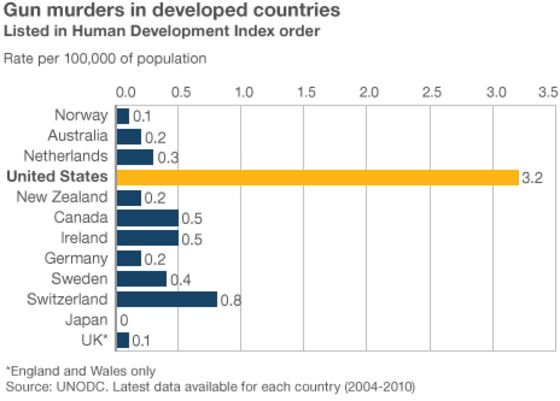
And it most certainly does if you look at it country by country.

_64891158_gun_deaths_dev_countries_464.gif
 

BGIF

Varsity Club
Messages
43,946
Reaction score
2,922
Oregon gunman enrolled at college he attacked in deadly rampage | Reuters

BY ERIC M. JOHNSON AND COURTNEY SHERWOOD
Sat Oct 3, 2015 12:45am EDT

A heavily armed gunman who shot to death an English professor and eight others in an Oregon community college classroom was identified on Friday as a student in the class who previously had been turned away from a private firearms training academy.

...

Harper-Mercer's preoccupation with firearms dated back at least to 2012 or 2013, when he sought to register for training at Seven 4 Para, a private self-defense and law enforcement academy in Torrance, California, where he lived at the time, said Eloy Way, president and head instructor for the center.

"We wanted him to take a beginner safety course, and he was trying to tell me that he already had experience with firearms, and I didn't get a good feeling about him, so I turned him down," Way told Reuters.

"He was just kind of a weird guy and seemed kind of spoiled, immature," Way recalled. "He was a little bit too anxious to get high-level training, and there was no reason for it."

Way's concerns that Harper-Mercer might misuse the training he would receive at the academy proved prescient.

...

Harper-Mercer was born in the United Kingdom and arrived in the United States as a boy, his stepsister Carmen Nesnick told CBS Los Angeles.

His parents, Ian Mercer and Laurel Harper, divorced in Los Angeles in 2006 when he was a teenager, public records show, and he continued to live with his mother.

Harper-Mercer, who identified himself as "mixed race" on a social networking site, enlisted in the U.S. Army and served for about a month in 2008 before being discharged for failing to meet administrative standards, military records showed.

He graduated from the Switzer Learning Center in Torrance, in 2009, a graduation listing in the Daily Breeze newspaper showed. Switzer is a private, nonprofit school geared for special education students with learning disabilities, health problems and autism or Asperger Syndrome, the school says on its website.

At some point, Harper-Mercer appears to have been sympathetic to the Irish Republican Army, a militant group that waged a violent campaign to drive the British from Northern Ireland. On an undated Myspace page, he posted photos of masked IRA gunmen carrying assault rifles.

...
 

Blazers46

Adjectives: wise/brilliant/handsome.
Messages
8,106
Reaction score
5,458
In places like Chicago, DC, and Baltimore, guns are like a burner phone. After they use the gun any trace of that gun is long gone. They either dispose of it or sell it off as fast as they can. I cannot think of one reason why a gang banger would want to buy a gun the legal way. Its cheaper, quicker, and more private the illegal way. Stricter gun laws would only hurt the people trying to buy guns the legal way.

Sure there are the legal gun owners that go crazy or the legal gun owners crazy son, friend, or family member that has access to the legal guns but I cannot think of any way remedy crazy people having access to guns.

I carry a gun pretty much everywhere that will allow me to carry. People are crazy. I also try to avoid rush hour traffic for the same reason, people are crazy.
 
Top