Cosmos

notredomer23

Staph Member
Messages
17,635
Reaction score
17,557
As a Catholic, I find the criticisms of this show very unfounded. I thought it was very good and will continue to watch. It's presented in an extremely simple way for everyone to understand. You usually don't get that with topics such as these, IMO
 

Sherm Sticky

The Prophet
Messages
19,321
Reaction score
1,638
Now that all of that is out the way I really like what they did with the cosmic calendar. I think it will be a part of the other episodes (at least I hope so).

Bingo. They made it really easy to understand just how young our planet, life on our planet and our species really are compared to the grand scope of the universe.
 

IrishInFl

Back in Florida
Messages
5,288
Reaction score
424
This is the only tv show that I watch on a regular basis. Otherwise I only watch shows on the internet.
 

Quinntastic

IE's Microbiologist
Messages
1,036
Reaction score
111
One of my favorite quotes by Neil deGrasse Tyson to date,

"The wonderful thing about evolution is that it's true whether you believe in it or not"

I love this re-vamp of COSMOS. I think the graphics are stunning and the information is engrossing. The cosmic calendar was explained so well.

Also, the whole evolution topic in week 2's episode was done really well. I'm excited to see the rest of the series!
 

magogian

New member
Messages
1,467
Reaction score
155
One of my favorite quotes by Neil deGrasse Tyson to date,

"The wonderful thing about evolution is that it's true whether you believe in it or not"

I love this re-vamp of COSMOS. I think the graphics are stunning and the information is engrossing. The cosmic calendar was explained so well.

Also, the whole evolution topic in week 2's episode was done really well. I'm excited to see the rest of the series!

And God is true whether you believe in Him or not.

Either statement may be true but proves nothing to those who don't believe.
 
C

Cackalacky

Guest
And God is true whether you believe in Him or not.

Either statement may be true but proves nothing to those who don't believe.
Not really so. There is much physical evidential support for evolution and is as much a fact as gravity. There is no need to "believe" in evolution. It simply is. The trick is whether a person can assimilate that into their world view.

Regarding the new episode, I am glad they talked so much about Halley and Newton and much of an a-hole Hooke was. Hopefully they will touch on how much of an a-hole Newton was while in charge of the Royal Society.

One point that keeps popping up in each episode is to "think for yourself." Not surprised coming from Seth or NdGT.
 

IrishInFl

Back in Florida
Messages
5,288
Reaction score
424
I loved yesterday's episode. The feuds between scientists back then fascinates me.
 
C

Cackalacky

Guest
Missed yesterday's episode. What was the topic?

General topic was on Comets, Jan Ort, Edmund Halley, and Newton and his cantankerous relationship with Hooke. Overall it was a good discussion on how the unknown is viewed to persons with no knowledge and how it shaped their history. Then once they discovered what it was and how it behaved, they could remove the superstition from it.
 

IrishInFl

Back in Florida
Messages
5,288
Reaction score
424
I know. Me too. I would love to be able to watch these guys go at it in society meetings. If I could back in time to see anything this is one of the things I would go see:

1860 Oxford evolution debate - Wikipedia, the free encyclopedia.

This one too now that I think of it:
Solvay Conference - Wikipedia, the free encyclopedia

There was a modern day version of this was the conference where it was determined that Pluto was no longer classified as a planet. I recommended everyone to watch The Pluto Files, which is hosted by Neil DeGrasse Tyson.
 
C

Cackalacky

Guest
There was a modern day version of this was the conference where it was determined that Pluto was no longer classified as a planet. I recommended everyone to watch The Pluto Files, which is hosted by Neil DeGrasse Tyson.

I have seen that. It was very interesting and I am fine with the demotion. That is how classifications work.

Sob story here. I read a story to my son when he was younger and it was about a father and son trying to outdo how much they loved each other. It was a simple story but the dad basically "won" by saying he loved the son "all the way to the moon and back."

I was working late last week and my son left me a note on my pillow since he would already be in bed before I got home.

It said: "Good night Dad. I love you all the way to Haumea and back."
 

no.1IrishFan

Well-known member
Messages
6,279
Reaction score
421
Tonight I'm attending a very intimate(30 people) screening of the new film "Unbelievers" by theoretical physicist and cosmologist Lawrence Krauss.
For those that aren't familiar, and if the title of the film didn't give it away, he's a firm believer that there is no room in science for theism.
There will be a Q and A session with him afterwards that I'll be voice recording.
I thought some minds brighter than mine, in regards to physics, might have some intelligent questions that I could ask and post responses to later tonight.
 
C

Cackalacky

Guest
Tonight I'm attending a very intimate(30 people) screening of the new film "Unbelievers" by theoretical physicist and cosmologist Lawrence Krauss.
For those that aren't familiar, and if the title of the film didn't give it away, he's a firm believer that there is no room in science for theism.
There will be a Q and A session with him afterwards that I'll be voice recording.
I thought some minds brighter than mine, in regards to physics, might have some intelligent questions that I could ask and post responses to later tonight.

This is an incredible opportunity. Enjoy! I don't know where you fall in this whole debate but both Dawkins and Krause are antitheists. They will not be kind to religion.

If I was in front of Krauss I would like to ask him what his vision of a world without the social controls of religion might look like and how it might function.
 

no.1IrishFan

Well-known member
Messages
6,279
Reaction score
421
This is an incredible opportunity. Enjoy! I don't know where you fall in this whole debate but both Dawkins and Krause are antitheists. They will not be kind to religion.

If I was in front of Krauss I would like to ask him what his vision of a world without the social controls of religion might look like and how it might function.

On a personal level, I believe in God.

From a strictly scientific point of view, I'm not sure if anything has ever had me so fickle.
The biology courses I took to get my RN degree really sparked an interest in science that I never knew was there. Now I can't get enough lol.

Good question!
 
C

Cackalacky

Guest
On biology, the Talk Origins website is an amazing source for information. Richard Dawkins website likewise has tons of information. Biology is not quite at the mathematical law level yet like physics and chemistry and it may never be, because biology is the accumulation of large scale physics and chemistry but I am always amazed at what physical manifestations they bring forth.
 
B

Buster Bluth

Guest
If I was in front of Krauss I would like to ask him what his vision of a world without the social controls of religion might look like and how it might function.

The world would be a much better place.
 
C

Cackalacky

Guest
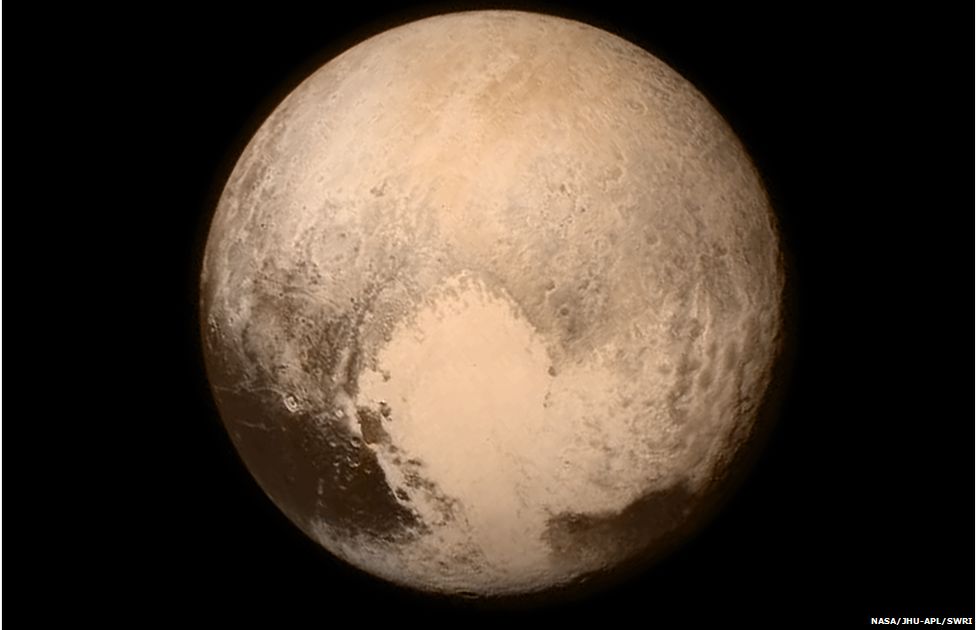
_84270464_p_lorri_fullframe_color.png


New Horizons reached Pluto. Amazing picture. I am very excited to see other photos.
 

zelezo vlk

Well-known member
Messages
18,009
Reaction score
5,048
Not a planet. Not interested.

Sent from my SAMSUNG-SM-G900A using Tapatalk
 

connor_in

Oh Yeeaah!!!
Messages
11,433
Reaction score
1,006
1


<blockquote class="twitter-tweet" lang="en"><p lang="en" dir="ltr">Mind = Blown <a href="http://t.co/jYs2S6S7Az">pic.twitter.com/jYs2S6S7Az</a></p>— Darth Vader (@DepressedDarth) <a href="https://twitter.com/DepressedDarth/status/620994014137974785">July 14, 2015</a></blockquote> <script async src="//platform.twitter.com/widgets.js" charset="utf-8"></script>
 

Whiskeyjack

Mittens Margaritas Ante Porcos
Staff member
Messages
20,894
Reaction score
8,126
<iframe width="560" height="315" src="https://www.youtube.com/embed/6jXazEYi3P8" frameborder="0" allowfullscreen></iframe>

Well worth a watch. Loved the segment where Colbert informs Tyson that Hell is indeed cold.
 

zelezo vlk

Well-known member
Messages
18,009
Reaction score
5,048
<iframe width="560" height="315" src="https://www.youtube.com/embed/6jXazEYi3P8" frameborder="0" allowfullscreen></iframe>

Well worth a watch. Loved the segment where Colbert informs Tyson that Hell is indeed cold.

Points docked for not having read the Inferno.
 
C

Cackalacky

Guest
Its interesting to me how words and meanings evolve over the centuries. The Philistine are widely considerd the Bible's bad guys IIRC and as they hailed from Palestine it carries a much more significant historical and contextual meaning today.
ARCHEOLOGISTS NOW SAY PHILISTINES WEREN'T SO BAD AFTER ALL - NYTimes.com
WASHINGTON— ''Philistine'' has long been a byword for a person lacking cultural values, spiritual enlightenment and intellectual interests. Nineteenth-century essayists ridiculed the English middle class as vulgar Philistines. Matthew Arnold, the poet and critic, suggested that those who invented the nickname meant ''a strong, dogged, unenlightened opponent of the chosen people, of the children of light.'' Arnold in turn considered Philistine ''people who believe most that our greatness and welfare are proved by our being very rich, and who most give their lives and thoughts to becoming rich.''

Twentieth-century archeology has now come to the rescue of this beleaguered people, refurbishing their reputation and showing that the Philistines were, materially and culturally, an advanced society.

A leading authority on the Philistines, Trude Dothan of Hebrew University in Jerusalem, writes that their ''material culture, particularly the pottery and cult vessels, does not accord with the negative meaning of the term 'Philistine' as it is used today.'' The pottery, she says, ''demonstrates high artistic and esthetic abilities.''

Robert R. Stieglitz, chairman of the Department of Hebraic Studies at Rutgers University in Newark, has called the Philistines ''a great ancient civilization.'' Though scholars have not identified the language they spoke or found indisputable specimens of writing, Professor Stieglitz says he is sure the Philistines did write. Their culture, he said, was advanced and there is overwhelming evidence that writing was well known in the Aegean world from which the Philistines came.

It was biblical commentators who gave the Philistines a bad reputation; nothing else was known about the Philistines until 19th century scholars deciphered Egyptian references to them. Goliath, the giant slain by David, was a Philistine. Delilah, who coaxed Samson into revealing the secret of his strength, may have been one.

The Philistines occupied the southern coast of Palestine, the area between Gaza and what is now Tel Aviv, in about 1200 B.C. The name Palestine comes from a Greek translation of the Hebrew word for Philistines - p'lishtim. Palestine is thus literally the land of the Philistines. The precise origins of the Philistines, however, are unknown, though there are many tantalizing clues. The motifs on their pottery, their religion, the design of their ships and their military tactics all show affinities with those of ancient people who lived in the Aegean. The Philistines seem to have inherited much from the cultures of Greece and its islands, especially Crete, where the Minoans erected palaces starting around 2000 B.C.

Historic Truths Embedded in Myth

Professor Dothan's effort to identify the origin and homeland of the Philistines shows the types of evidence scholars today use to reconstruct events of more than 30 centuries ago. She has considered the accounts given in the Bible and in Greek myths, and has tried to trace the sources of words and place names. Professor Dothan has also had access to artifacts found in recent excavations -pottery, coffins, daggers and clay tablets found at 41 sites. By correlating the successive layers of history unearthed at the major sites, Professor Dothan has constructed a chronology of the Philistines from 1250 B.C. to 950 B.C.

Soon after they appeared in the eastern Mediterranean, the Philistines seem to have begun attacking Syria, Palestine and Egypt. They were repulsed from Egypt after fierce land and sea battles, depicted in stone carvings on the walls of an Egyptian temple at Thebes. The Philistines are shown wearing curious feathered headdresses, chest-protecting armor and short kilts with wide hems and tassels. The Egyptian Pharaoh Ramses III allowed the Philistines to settle on the southern coast of Palestine, then called Canaan. They became the archenemy of the Israelites, who, archeologists say, had entered Canaan from the east several generations earlier.

The Philistines were confined to southwestern Palestine until the second half of the 11th century B.C., when they expanded their influence east toward the Jordan River and north toward the Sea of Galilee. Philistine soldiers came into conflict with the Israelites, who were in the process of settling the land. After being defeated by King David early in the 10th century B.C., the Philistines steadily declined in importance. Their pottery, like the rest of their culture, seemed to lose its distinctive Aegean character as the Philistines were assimilated into the surrounding population.

According to biblical tradition, the Philistines came from the Isle of Caphtor, which many scholars identify as Crete. Yet, there is no archeological proof that the Philistines ever occupied the island. There is a traditional belief that Crete was the Philistine homeland. A mysterious clay disk was found at one of the Minoan palaces on Crete, Phaestos. The disk shows men in feathered headdresses much like the Philistines' headgear, but no one knows how it found its way to Phaestos. Mr.Stieglitz has also noted that in the second century A.D., Gaza, a Philistine city in Palestine, was sometimes called ''Minoa,'' after King Minos of Crete, and its coins bore the inscription ''Meino,'' referring to Minos.

How to interpret such bits of evidence is a puzzle. But unlike some of their predecessors, archeologists today pay close attention to mythical traditions. Said Mr. Stieglitz: ''Archeology tends to confirm that there is a historical kernel in myths. The more archeology we do, the more we find that myth is based on some historical event.''
The Problem of Induction (Stanford Encyclopedia of Philosophy)
The problem of Induction is a significant and valid criticism to philosophy and one that wreaks havoc when trying to philosophize real word scientific data. There are others of course but I find it very unproductive to watch philosophers quibble over meanings of words and run in circles until the argument reaches an impasse over each philosophers ability to drag his nsrrative to the next yard marker. I like it to the final score of a 0-0 football game from the 1910s. A prime example is the "necessary being" argument. I posted a video in the Theology thread. Bertrand Russell was arguing over the meaning of a being being necessary and the FATHER was arguing that a being must be necessary. IMO Russell had the better argument but its awful to sit and listen to. I came away with little more than I went in with except gaining a few more logical reasons to have at my disposal when someone discusses metaphysics.

Its entirely possible NdGT is fully dismissive of the practice of philosophy as he said. My opinion is more in line with Russells:
Philosophy, like all other studies, aims primarily at knowledge. The knowledge it aims at is the kind of knowledge which gives unity and system to the body of the sciences, and the kind which results from a critical examination of the grounds of our convictions, prejudices, and beliefs.

But it cannot be maintained that philosophy has had any very great measure of success in its attempts to provide definite answers to its questions. If you ask a mathematician, a mineralogist, a historian, or any other man of learning, what definite body of truths has been ascertained by his science, his answer will last as long as you are willing to listen.
But if you put the same question to a philosopher, he will, if he is candid, have to confess that his study has not achieved positive results such as have been achieved by other sciences. It is true that this is partly accounted for by the fact that, as soon as definite knowledge concerning any subject becomes possible, this subject ceases to be called philosophy, and becomes a separate science.

The whole study of the heavens, which now belongs to astronomy, was once included in philosophy; Newton's great work was called 'the mathematical principles of natural philosophy'. Similarly, the study of the human mind, which was a part of philosophy, has now been separated from philosophy and has become the science of psychology.

Thus, to a great extent, the uncertainty of philosophy is more apparent than real: those questions which are already capable of definite answers are placed in the sciences, while those only to which, at present, no definite answer can be given, remain to form the residue which is called philosophy.

The value of philosophy is, in fact, to be sought largely in its very uncertainty.
Philosophy, though unable to tell us with certainty what is the true answer to the doubts which it raises, is able to suggest many possibilities which enlarge our thoughts and free them from the tyranny of custom. Thus, while diminishing our feeling of certainty as to what things are, it greatly increases our knowledge as to what they may be; it removes the somewhat arrogant dogmatism of those who have never travelled into the region of liberating doubt, and it keeps alive our sense of wonder by showing familiar things in an unfamiliar aspect.

Thus, to sum up our discussion of the value of philosophy; Philosophy is to be studied, not for the sake of any definite answers to its questions since no definite answers can, as a rule, be known to be true, but rather for the sake of the questions themselves; because these questions enlarge our conception of what is possible, enrich our intellectual imagination and diminish the dogmatic assurance which closes the mind against speculation; but above all because, through the greatness of the universe which philosophy contemplates, the mind also is rendered great, and becomes capable of that union with the universe which constitutes its highest good.
 
Top