This Week in Science

connor_in

Oh Yeeaah!!!
Messages
11,433
Reaction score
1,006
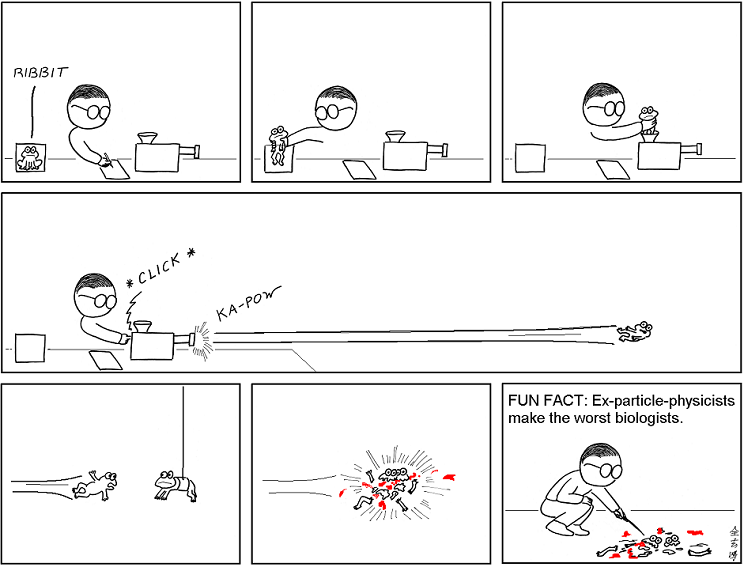
high_energy_biology.png
 

GATTACA!

It's about to get gross
Messages
15,120
Reaction score
12,954
Awesome discovery! Stories like these always make me wish we would have finished our LHC
 

Corry

Active member
Messages
769
Reaction score
98
<iframe width="635" height="352" src="https://www.youtube.com/embed/2OSrvzNW9FE" frameborder="0" allowfullscreen></iframe>
 
C

Cackalacky

Guest
<iframe width="635" height="352" src="https://www.youtube.com/embed/2OSrvzNW9FE" frameborder="0" allowfullscreen></iframe>

Very cool. I wonder if there are any wind energy applications with this? The current bladed turbines are a bit bulky and visually unappealing but the ones on the boat could be applied to building structures as columns maybe.
 

BGIF

Varsity Club
Messages
43,946
Reaction score
2,922
Very cool. I wonder if there are any wind energy applications with this? The current bladed turbines are a bit bulky and visually unappealing but the ones on the boat could be applied to building structures as columns maybe.

I recall reading about the Flettner Rotor in the 60's in Popular Science. The U.S. Army designed a Flettner Rotor Bomblet for biological weapons deployment in the 60's which was very effective but they dropped it as biological weapons lost favor.

Currently there is a Flettner Ventilator on the market. It,s for home/commercial installation. It does not have a tall stack but rather a lower profile then many roof turbines.

There's a detailed description of Flettner Wind Generator applications and principles here,

https://www.cdlive.lr.org/informati...15 Flettner Rotor Guidance Notes COMPLETE.pdf

Starts at page 26. It has been adapted to wind turbines but I did not see an application as part of a building structure.

To use it with building columns you have to leave the building sides open on that floor. Obviously it would not be a work space. You'd need a lot of paperweights, safety netting etc. I imagine wind drag on the floor and ceiling (underside of floor above) and sidewalks (even if a parking floor) would create much higher drag than a ship application with only the deck to consider. Galloping Gertie harmonics would be a consideration a consideration. For you non Civil Engineers and physics majors google Tacoma Narrows bridge, a spectacular failure.

I don't see why they couldn't be roof mounted on tall buildings but again drag considerations and turbulence with AC units and such on the roof would have to be evaluated. Once again the canyons of Manhatten and Chicago don't lend themselves to the ship alone at sea model. You may end up with an unforeseen problem like I.M.Pei encountered with the "Plywood Palace" Bostonians nickname for the Prudential (or Hankcock) building where wind pressure in the canyons sucked the windows out of the building. Sheets of plywood were bolted in place while Pei and associates went back to the drawing board.
 
C

Cackalacky

Guest
I recall reading about the Flettner Rotor in the 60's in Popular Science. The U.S. Army designed a Flettner Rotor Bomblet for biological weapons deployment in the 60's which was very effective but they dropped it as biological weapons lost favor.

Currently there is a Flettner Ventilator on the market. It,s for home/commercial installation. It does not have a tall stack but rather a lower profile then many roof turbines.

There's a detailed description of Flettner Wind Generator applications and principles here,

https://www.cdlive.lr.org/informati...15 Flettner Rotor Guidance Notes COMPLETE.pdf

Starts at page 26. It has been adapted to wind turbines but I did not see an application as part of a building structure.

To use it with building columns you have to leave the building sides open on that floor. Obviously it would not be a work space. You'd need a lot of paperweights, safety netting etc. I imagine wind drag on the floor and ceiling (underside of floor above) and sidewalks (even if a parking floor) would create much higher drag than a ship application with only the deck to consider. Galloping Gertie harmonics would be a consideration a consideration. For you non Civil Engineers and physics majors google Tacoma Narrows bridge, a spectacular failure.

I don't see why they couldn't be roof mounted on tall buildings but again drag considerations and turbulence with AC units and such on the roof would have to be evaluated. Once again the canyons of Manhatten and Chicago don't lend themselves to the ship alone at sea model. You may end up with an unforeseen problem like I.M.Pei encountered with the "Plywood Palace" Bostonians nickname for the Prudential (or Hankcock) building where wind pressure in the canyons sucked the windows out of the building. Sheets of plywood were bolted in place while Pei and associates went back to the drawing board.

Yeah there will definitely be structural engineering design considerations :) Having lots of them would induce a bunch of additional torsion in structures as well which is not great. I was initially thinking that having column shaped versions of these would be much more visually appealing than other current designs.
 

Huntr

24 Karat Shamrock
Messages
7,509
Reaction score
10,437
I had never looked too deeply at the Pluto is not a planet debate, but I read a bit this week about it.

It's diameter is less than the straight-line distance from Boston to Dallas. More than 50% of its volume is ice. Even w/o the definition of a planet...yeah, no.
 
Last edited:

Huntr

24 Karat Shamrock
Messages
7,509
Reaction score
10,437
Cue the gif of that dude throwing his bow at it.
 
C

Cackalacky

Guest
They discovered dragons, fellas...

150717012051-zhenyuanlong-illustration-exlarge-169.jpg


China discovers winged, feathered 'dragon' - CNN.com

There has been no comment from Daenerys Targaryen.

From a mythological perspective I could totally see how some ancient cultures could have found a dinosaur head/ body parts etc fossilized and came up with the idea of a dragon. Since dinosaur fossils are fairly common across the planet it makes sense that many cultures would have some version of them in their mythology independently of other cultures.
 
C

Cackalacky

Guest
nh-charon-inset.jpg

Pluto's moon Charon.

pluto-observations-through-the-years.gif

Pluto through the years

nh-pluto_charon_150709.png

Pluto and Charon
 

woolybug25

#1 Vineyard Vines Fan
Messages
17,677
Reaction score
3,018
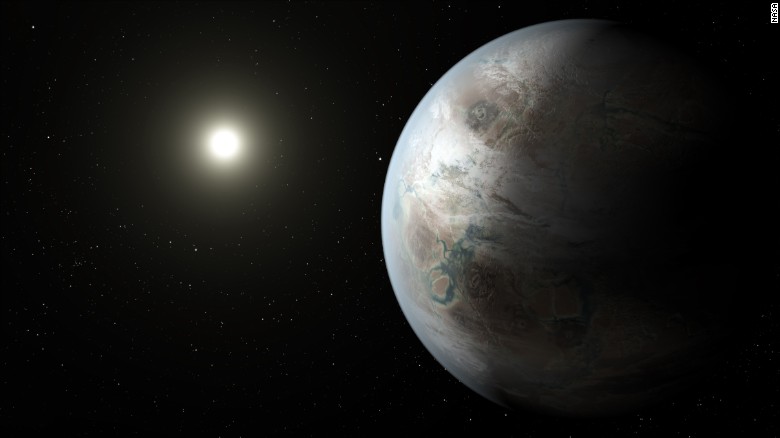
NASA finds 'Earth's bigger, older cousin

150723124341-02-earths-bigger-older-cousin-exlarge-169.jpg


The planet, Kepler-452b, is about 1,400 light years from Earth in the constellation Cygnus. It's about 60% bigger than Earth, NASA says, and is located in its star's habitable zone -- the region where life-sustaining liquid water is possible on the surface of a planet.

A visitor there would experience gravity about twice that of Earth's, and planetary scientists say the odds of it having a rocky surface are "better than even."

While it's a bit farther from its star than Earth is from the sun, its star is brighter, so the planet gets about the same amount of energy from its star as Earth does from the sun. And that sunlight would be very similar to Earth's, Jenkins said.

If the assumptions of planetary geologists are correct, he said, Kepler-452b could have a thicker atmosphere than Earth's, as well as active volcanoes.

It takes 385 days for the planet to orbit its star, very similar to Earth's 365-day year, NASA said. And because it's spent so long orbiting in this zone -- 6 billion years -- it's had plenty of time to brew life, Jenkins said.

NASA finds 'Earth's bigger, older cousin' - CNN.com
 

IrishLion

I am Beyonce, always.
Staff member
Messages
19,128
Reaction score
11,077
Shout outs to our alien brethren on Earth2.

Can we come hang when our planet kicks the bucket?
 

IrishLion

I am Beyonce, always.
Staff member
Messages
19,128
Reaction score
11,077
On a serious note, how debilitating would it feel to be on a surface that has twice the gravity of earth?

Would it be completely debilitating, or just extremely uncomfortable?
 

woolybug25

#1 Vineyard Vines Fan
Messages
17,677
Reaction score
3,018
On a serious note, how debilitating would it feel to be on a surface that has twice the gravity of earth?

Would it be completely debilitating, or just extremely uncomfortable?

HOW MUCH GRAVITY CAN HUMANS HANDLE?

Humans are a very adaptable species. We do have our limits though. According to NASA’s Ames Research Center’s expert on humans in space, a person has survived 2x Earth’s gravity for 24 straight hours without ill effects. They go on to claim that it is theoretically possible for a human to adapt to a gravity environment that is between 2x and 3x that of the Earth. However, they say that at 4 times Earth’s gravity (4G) or above, human physiology cannot maintain sufficient blood-flow to the brain.

In the future, it may be possible to break the 4G limit with enhancements in genetic manipulation and extremely strong mechanical replacement organs to keep our body’s systems running, but that technology is a long way off.
Could Humans Colonize A Planet With Stronger Gravity?

This planet has a 60% increase in gravity. So while I do think it would be quite noticeable, it wouldn't be debilitating. You would still be able to jump, walk and move around. Just not as well.

I think (i'm just spitballin' here) that it would be a planet better suited for smaller people though. Simply because of the gravity issue. A 150 pound man would feel like he is 240 pounds. That seems uncomfortable, but manageable. But a 250 pound man would feel like he's 400 pounds. That's no bueno.
 

IrishLion

I am Beyonce, always.
Staff member
Messages
19,128
Reaction score
11,077
Could Humans Colonize A Planet With Stronger Gravity?

This planet has a 60% increase in gravity. So while I do think it would be quite noticeable, it wouldn't be debilitating. You would still be able to jump, walk and move around. Just not as well.

I think (i'm just spitballin' here) that it would be a planet better suited for smaller people though. Simply because of the gravity issue. A 150 pound man would feel like he is 240 pounds. That seems uncomfortable, but manageable. But a 250 pound man would feel like he's 400 pounds. That's no bueno.

Would a person's body adapt to that new feeling of weight through an increase in muscle mass and whatnot to get back to a sort of "baseline" of operation? Or would we just be stuck as creatures that would be a bit more sluggish than we would be on earth?

And then, what about a human that came from this environment and visited Earth? Would they be Superman lol?
 

woolybug25

#1 Vineyard Vines Fan
Messages
17,677
Reaction score
3,018
Would a person's body adapt to that new feeling of weight through an increase in muscle mass and whatnot to get back to a sort of "baseline" of operation? Or would we just be stuck as creatures that would be a bit more sluggish than we would be on earth?

And then, what about a human that came from this environment and visited Earth? Would they be Superman lol?

On your first point, everything I have been told is that your body adapts. Just like your body eventually adapts to zero gravity.

On your second point... the answer is YES.
 

Old Man Mike

Fast as Lightning!
Messages
8,984
Reaction score
6,482
.... debilitating for you; normal for them. Structures would have evolved to make life not only possible but thrive-able.


When Frank Drake of the giant radiotelescope observatory at Arecibo wanted to structure the theory as to whether ET-intelligence was likely, he created what others called The Drake Equation. It has several factors meant to sharpen discussion on key points.

There was once a little debate on how many stars were suitable for life on planets. Those numbers have risen over time to staggering amounts, as even some scenarios with multiple star systems and dwarf stars seem now possible.

Then there was almost violent rejection that there would be many planetary systems and nothing like Earth. Every year those objectors look dumb and dumber. As we get cleverer and cleverer, the Earth-like planets grow. I believe that Kepler has about 12 now, all in Cygnus where it is pointed.

Next the objectors will be forced to claim that life will not arise. They'll be horribly wrong too. We'll get the deepspace spectroscopy to spot free oxygen in the atmospheres, and that goofy idea will also hit the trash bin.

Finally the objectors will entrench their defenses on the idea that: OK! Life exists all over the place, BUT it is all single-cell simples --- NO ADVANCED LIFE!!! That position will be defensible only until the deepspace spectroscopy picks up signature nuclear fission fragments out there. Amoebas don't do that.

Then the only question left: will they get here, or we there? Or have they already? THERE's where the real fear lies that drives this behavior. All anthropologists know that inferior cultures are swallowed into technologically superior ones, and their individuality stops. Ernst Mayr of Harvard HATED this idea. Astronomer Rees from the UK said: if the ET phone rings, HANG UP!! The Brookings Institute study said: direct interaction is full of much greater risks than rewards. Such concerns almost canceled the SETI program, and made the study of UFO reports nearly impossible.

At the stage of finding new Earth-like planets, almost all of us really love this. As "it" gets closer and closer, we as a species begin to change our minds.
 
Top