
You are using an out of date browser. It may not display this or other websites correctly.
You should upgrade or use an alternative browser.
You should upgrade or use an alternative browser.
Politics
- Thread starter BobD
- Start date


- Messages
- 20,894
- Reaction score
- 8,126
The Week's Matthew Walther just published an article titled "The ashes of the pro-life movement":
Two years ago I asserted in this space that the pro-life movement was dead. I say "asserted" rather than "argued" because the thing seemed plain. By "dead" I did not intend to offer a value judgment (though implicitly one may have been intended); all I meant was that, like an old appliance that can no longer be serviced by the manufacturer, for which parts are difficult if not impossible to find (but not as difficult as securing a technician who understands how the machine is supposed to operate), it had reached the end of its useful life.
The movement had a precise goal and a universally agreed-upon means of pursuing it. Pro-lifers were supposed to vote for Republican candidates, especially in presidential elections, on the assumption that if they were elected, we would have justices on the Supreme Court committed to what is called "originalism," a bizarre legal theory that pretends the phrase "to keep and bear Arms" in 2020 means exactly what it did in 1789 and things like that. It was not a pro-life theory, but at some point it was decided that originalism was at the very least not incompatible with opposition to abortion and certainly better than what was on offer elsewhere.
We all know what was supposed to happen. Republican president gets in the White House, nominates good justices; eventually we arrive at a majority of five or more such carefully chosen Ivy League lawyers and, in keeping with the supposed tenets of originalism, they strike down Roe v. Wade and Planned Parenthood v. Casey. That was, roughly speaking, what it meant to be "pro-life." The aim was clear, the methods chosen.
On Monday we learned that this strategy was a failure. We can say so for the very simple reason that it failed. The conservative majority was there on the Supreme Court, but it did not produce the long hoped-for result. Instead, Chief Justice John Roberts voted with the four liberals to strike down a statute in Louisiana that dared to require abortion providers to obtain the same hospital admitting privileges as the rest of their supposed colleagues in the profession. He did so despite having sided with three of his fellow justices in favor of upholding a similar statute in 2016. His reasoning? That a book on the Intercollegiate Studies Institute reading list told him he had no choice. If the chief justice of the United States believes that "precedent" enjoins him to reject any challenges to a case narrowly decided four years ago, there can be no doubt how he would rule if asked to revisit one dating back three or more decades.
Robert's decision, and the absurd response of the vice president, who appears to have less contact with reality than even his boss, is already giving rise to questions. Is it time to abandon originalism in favor of a new theory of constitutional law, one that does not leave social conservatives fighting with one hand behind their backs? The court's liberal justices have a substantive understanding of the common good that does not depend upon procedural arguments, or, at times, upon anything but prose poetry. Should there be a successor to the Federalist Society, a network of law professors and institutions that will raise up the next generation of young conservative lawyers? One can be inclined to answer yes to all of these questions while also believing that such an answer entails — a long slow process of rebuilding America's legal establishment from the ground up — something impractical. Have America's unborn got that much time? Did they ever?
Here are other questions that all opponents of abortion should be asking themselves. Why is the pro-life movement a quasi-official adjunct of Conservatism Inc.? Why do people like Abby Johnson, the former Planned Parenthood employee who recently said that it would be "smart" for the police to "be more careful around my brown son than my white son," think they are speaking on behalf of the movement, and why is it that journalists are always allowed to come away with this impression? How have we allowed the horrifying reality that more black babies are aborted than born alive in New York to go unobserved during a national conversation about race, especially given the residual social conservatism of so many African-American voters?
Why are the Supreme Court and a nearly half-century-old ruling that you consider illegitimate the be-all end-all anyway? You know already that at the state level there are decent men and women far more committed to the cause than the national Republican Party. Why not borrow a lesson from sanctuary cities or, if you support it, as one suspects an increasing number of you do, the legalization of marijuana in various states? The Nine say that abortion is legal; let them enforce it, or rather, let the president who claims to be on your side do so, and make his real feelings known one way or the other. Urge your governors and state senators and representatives to ban abortion tomorrow. Empower state police to close down facilities. Will Trump really send in the National Guard? Will the next Democratic president do so, in 2021 or 2025 or whenever the White House again comes under the control of the party whose resolve on cultural questions has not been tested thanks to the high court's willingness to implement its agenda by fiat?
Speaking of the National Guard: What exactly is the point of the March for Life, a glorified field trip that receives no publicity year in and year out regardless of how large the crowds are (the only exception being when cable news networks wish to engage in character assassinations of teenagers). Why not shut down a highway or two instead? Make things inconvenient. Tear down a statue of Margaret Sanger, the eugenicist founder of Planned Parenthood. Scribble "Black Lives Matter" and "NO KKK" on her bust in the National Portrait Gallery.
Finally, what are the arguments in favor of voting for Republican candidates, especially on presidential ballots? The vast majority of the American people hold views that could be best described as conservative on social questions and moderate to progressive when it comes to economic matters. Given how little effect the election of two Republican presidents in as many decades — and the nomination of four justices to the Supreme Court — seems to have had on the former, it seems to me almost impossible to understand why the GOP is more entitled to the support of such voters than the Democrats are. Voting Republican may be force of habit. It may be, pragmatically speaking, the lesser of two evils. But surely any argument that suggests supporting the GOP is a strict matter of conscience must be abandoned.
These are only a few of the questions that all of us who believe that children — all children — are made lovingly in God's image should consider as we look with hope rather than despair upon the ashes of the pro-life movement as it has existed for decades.

zelezo vlk
Well-known member
- Messages
- 18,013
- Reaction score
- 5,055
Great article
- Messages
- 20,894
- Reaction score
- 8,126
Michael Lind just published an article titled "The Double Horseshoe Theory of Class Politics":
According to elite neoliberalism, the U.S. and Western Europe today are imperfect meritocracies divided chiefly by race and gender, and not by class. Anyone whose career does not depend on affirming this narrative can see through it. It is obvious that class conflicts have set the North Atlantic world ablaze. But what are the classes?
In The New Class War: Saving Democracy from the Managerial Elite (2020), building on my argument in The Next American Nation (1995), I offered an answer. I proposed that, while the proletariat is still the proletariat, James Burnham, Bruno Rizzi, John Kenneth Galbraith and other thinkers were correct that by the mid-twentieth century power had passed from individual bourgeois business owners to a new ruling class of technocrats or bureaucrats, whose income, wealth, and status is linked to their positions in large, hierarchical organizations, (i.e. nonprofits, government agencies, industrial and financial firms, and so on).
I use the term “overclass” to describe this group. A similar though not identical concept is what is known, after Barbara Ehrenreich, as the “professional-managerial class” (PMC). Whatever terminology you prefer to use, generalizations about all Western elites need to be accompanied by more granular analysis at the level of each country. Referring only to the U.S., I think it is helpful to go beyond the basic distinction between the overclass and the working class and identify distinct groups within each.
The managerial elite proper consists of the functionaries of corporations, large investment banks, law firms, government agencies, both civilian and military, nonprofits, and universities. They may have professional degrees, but they are essentially organization men and organization women in centralized, hierarchical, bureaucratic entities. They are the chief beneficiaries of the neoliberal system set up in the last half century to replace the New Deal order.
But the American elite includes three other groups, in addition to these bureaucratic managers. One consists of hereditary rentiers—heirs and heiresses, born into rich families. Old money types should be distinguished from tycoons like Bill Gates or Jeff Bezos, who tend to be products of upper-middle-class or modestly rich families who happened to become incredibly rich. Only the most primitive Marxists believe that a tiny group of individual capitalists—to the manor born or self-made—controls modern societies from behind the scenes. I will not pay further attention to old money in this essay.
In German a distinction has long been made between the Besitzbürgertum (propertied bourgeoisie) and the Bildungsbürgertum (educated bourgeoisie). The equivalents of these two groups exist in the U.S. today. They are distinct from the big-organization managers and important in American politics out of all proportion to their numbers. Lumping them together as “PMC” confuses matters. Let us call them the professional bourgeoisie and the small business bourgeoisie.
The professional bourgeoisie—made up of lawyers, doctors, professors, K-12 teachers, journalists, nonprofit workers, and many of the clergy—is concentrated in the teaching, helping, and research sectors. Their jobs often pay modestly but provide both status and a degree of personal autonomy that the frequently better-paid managerial functionaries in more hierarchical occupations do not possess.
The small business bourgeoisie consists of the owner-operators of small businesses and franchises, along with genuine contractors (as opposed to proletarian “gig workers”), both those who are self-employed and those who employ others.
In the United States (if not necessarily other Western countries), the overclass broadly defined, then, can be viewed as a compound of the classic managerial elite plus these two bourgeois classes. A four-year college diploma is a prerequisite for entry into all of these elite groups except for the small business bourgeoisie, which includes a few individuals who become prosperous without attending a university.
The working class in the U.S. is divided as well. First, there is the heartland working class—those who work in the industries located in the low-density exurban heartland. These industries include manufacturing, agriculture, energy, retail distribution and warehousing.
And then there is the hub-city working class. This class of workers can be found in metropolises like New York, San Francisco, Atlanta, and Houston. Many of these members work directly for the urban overclass as maids, nannies and other domestic staff, or otherwise indirectly in luxury services that cater to the affluent elite.
(A note: by the “heartland working class” I do not mean the stereotypical “white working class.” Most African-Americans and Hispanics are high-school-educated workers who live and work in suburbs and exurbs. Those areas also contain many foreign-born workers, though first-generation immigrants make up a greater share of the populations of hub cities.)
To the distinct hub and heartland working classes can be added a third non-elite group, often described as the lumpenproletariat—or, perhaps more clearly, the “underclass.” (In the 1990s the speech police of the politically-correct left banned the use of “underclass” from academic and journalistic usage in the U.S., but the term is neither racist nor an insult.) This refers to members of often-broken families caught in multigenerational poverty, particularly those trapped in the grim carceral subculture of public housing, food stamps, petty crime, and the prison-industrial complex. Like the hub and heartland working classes, the multigenerational underclass is racially and ethnically diverse, and found in both urban and rural parts of the U.S.
The reader who has followed me to this point will be relieved to learn that my taxonomy includes only these six categories: three within the broadly defined overclass (the managerial elite, the professional bourgeoisie and the small business bourgeoisie) and three within the broadly defined working class (the hub city working class, the heartland working class, and the underclass).
Since this is all very abstract, an image might help. Visualize two horseshoes—a lower horseshoe whose two prongs point up, and an upper horseshoe whose two prongs point down. The lower horseshoe has the underclass at the bottom/midpoint and the hub city working class and the heartland working class as the points of its two opposing prongs. The upper horseshoe has the managerial elite proper as its midpoint/apex and the professional bourgeoisie and the small business bourgeoisie as the points of its two opposing prongs. Arranged in this way, the two horseshoes form a rough outline of a circle, with the managerial elite at the very top, the underclass at the very bottom, and the two working classes and the two bourgeoisies distributed in between.
The individual makeup of the two horseshoes are not equal in number. By the broadest definition of membership in the overclass—possession of a four-year college degree, plus a few affluent high-school-educated contractors or business owners—the upper horseshoe includes no more than a third of the U.S. population.

American politics is little more than the internal politics of the overclass, now that the working class majority has lost the grassroots, mass-membership institutions that once gave it collective bargaining power—private sector trade unions, influential religious organizations, and local political parties. Members of the working-class majority play no role except as occasional voters. They tend to be ignored, except during election seasons, when they are targeted by manipulative appeals based on race and gender in the case of the Democrats and religion and patriotism in the case of the Republicans.
Let us focus, then, on the three overclass factions of the upper horseshoe. The present system serves the credentialed elite in the large private, public, and nonprofit bureaucracies of the managerial elite quite well. In contrast, the members of the professional bourgeoisie and the small business bourgeoisie live in terror of proletarianization. Many professionals fear they will not be able to secure high-status jobs with their educational credentials, and the small proprietors fear they will lose their businesses and be compelled to work for others.
At the risk of being overly schematic I would suggest that the “center,” “left” and “right” of America’s top-thirty-percent politics can be mapped imperfectly onto the managerial elite, the professional bourgeoisie and the small business bourgeoisie. In particular, both DSA progressivism and Tea Party conservatism can be understood as different strategies for enlisting the power of government to stave off the proletarianization of the constituents of the two bourgeoisies.
The goal of so-called progressivism in 2020s America is to expand employment opportunities for college-educated, center-left professionals, while adding new wings to the welfare state that are tailored to their personal needs. The slogan “Defund the police” is interpreted by the bourgeois professional left to mean transferring tax revenues from police officers, who are mostly unionized but not college-educated, to social service and nonprofit professionals, who are mostly college-educated but not unionized. The enactment of proposals for free college education and college debt forgiveness would disproportionately benefit the professional bourgeoisie, not the working class majority whose education ends with high school. Likewise, public funding for universal day-care allows both parties in a two-earner professional couple to maximize their individual incomes and individual career achievements by outsourcing the care of their children to a mostly-female, less well-paid workforce at taxpayer expense.
It is no coincidence that many professionals in the sectors most dependent on their funding on donations from the capricious rich, like philanthropy, colleges and universities, and the media, hate billionaires with the passionate resentment that is reserved for benefactors. In their view, in a just society, the arts program or the NGO would be permanently funded by tax revenues, instead of annual fund-raising appeals to this or that plutocrat’s personal fortune or foundation.
Gore Vidal was known to say that America has socialism for the rich and free enterprise for the poor. Contemporary American progressivism can be succinctly described as social democracy for the professional class.
While the professional bourgeoisie, based in the public sector, universities and nonprofits, is the social base of progressivism, the social base of conservatism is the small business bourgeoisie, particularly those in this group who are native, white and suburban or exurban, as opposed to immigrants who run small businesses. Like the professional bourgeoisie, the proprietarian bourgeoisie wants to enlist the power of the state to protect its members from proletarianization.
To avoid being squeezed out of existence between big business and organized labor, the small business bourgeoisie has fought for generations on two fronts, demanding subsidies and exemptions from government regulations, while insisting on anti-union and anti-labor legislation and a reliable supply of cheap labor (preferably guest workers or illegal immigrants who cannot vote). The lobbies for the small business sector naturally oppose any “decommodifying” social insurance reforms. Examples are longer periods for unemployment insurance or universal health care, each of which can increase the bargaining power even of non-unionized workers by allowing them to hold out longer until employers are forced to make better offers.
The upper horseshoe schema explains American political factions in terms of different combinations of its elements. When the professional bourgeoisie allies itself with the Managerial Elite, you get Clinton-Obama-Biden left-neoliberalism. When the small business bourgeoisie allies itself with the Managerial Elite, you get George W. Bush-Paul Ryan-Nikki Haley right-neoliberalism.
When the professional bourgeoisie and the small business bourgeoisie unite with each other against the oligopolies and monopolies that dominate modern industry and finance and the managers who run them, you get the neo-Brandeisian, small-is-beautiful antitrust school. Their anachronistic small-producerist ideal, in which everything big has been broken up by government antitrust litigation, is an economy of small shops, artisanal craft breweries and independent doctors and lawyers.
In addition to clarifying the constituencies and goals of contemporary American political factions, the double horseshoe theory helps explains what might be called “the two reopenings” during the COVID-19 pandemic, between March 2020 and July 2020.
The protests associated with the first reopening were led during the early stages of the lockdown by conservative members of the small business bourgeoisie. Many of their undercapitalized storefront businesses, like hair salons, and restaurants, and car repair shops, were threatened or wiped out by city and state shut-down orders. The protests were dominated by petty-bourgeois business owners, and not their low-paid employees—some of whom might have been endangered by a premature return to their workplaces during the pandemic.
The initial response of the progressive professional bourgeoisie was to ridicule and denounce the right-wingers for endangering their own lives and those of others by ignoring the advice of credentialed public health experts.
Then, during the protests that followed the murder of George Floyd by Minneapolis police officers, the same progressive professional bourgeoisie concluded that systemic racism was a greater threat to public health than COVID-19, which—mirabile dictu!—cannot be spread at left-wing demonstrations.
I am not the first to observe that what were initially legitimate protests against the use of excess force and racism by particular police departments have turned into a campaign for greater funding for social-services jobs and diversity officer jobs for members of the professional bourgeoisie in their twenties and thirties.
What does all of this mean for the neglected working class majority on the sidelines of American politics? A century ago, trade unionists like Samuel Gompers and socialists like Eugene Debs criticized antitrust and praised large industrial combinations, on the sensible grounds that large, modern corporations are easier to unionize and/or socialize than lots of small businesses.
A case can be made that both the professional bourgeoisie and the small business bourgeoisie are relics of an earlier techno-economic paradigm. Each is a leftover pocket of technological backwardness and labor exploitation in an advanced industrial economy.
In American higher education, a dwindling minority of tenured academics, using pedagogical methods unchanged from the agrarian era, lords it over a mass of impoverished guild apprentices, the poorly-paid, insecure, non-unionized adjuncts who now teach most university students nationwide. At the same time, the business models of many small, owner-operated firms in the U.S. are made possible by poor-country levels of worker rights and social insurance—and much of the workforce consists of recent, desperate immigrants from actual poor countries. Because the backward professional and small business sectors have much lower productivity than the rationalized, capital-intensive parts of the economy like manufacturing and energy, they pay low wages to much of their workforces while charging high prices to consumers.
Needless to say, any new cross-class settlement would have to follow the recreation of powerful mass-membership working class organizations in current and newly-rationalized, sectors, which would permit the transformation of the majority of Americans in the bottom horseshoe into subjects, not mere objects, of American politics. But that is a story for another day.

Circa
Conspire to keep It real
- Messages
- 8,000
- Reaction score
- 818
I'm sorry. Why do we all think that Biden would be ok?
Biden Is a comedian. "I like my legs rubbed by kids"... WTF?
<iframe width="560" height="315" src="https://www.youtube.com/embed/dtspv72ApM0" frameborder="0" allow="accelerometer; autoplay; encrypted-media; gyroscope; picture-in-picture" allowfullscreen></iframe>
Please tell me the left has another candidate... I just want a good old fella. No weirdos.
Biden Is a comedian. "I like my legs rubbed by kids"... WTF?
<iframe width="560" height="315" src="https://www.youtube.com/embed/dtspv72ApM0" frameborder="0" allow="accelerometer; autoplay; encrypted-media; gyroscope; picture-in-picture" allowfullscreen></iframe>
Please tell me the left has another candidate... I just want a good old fella. No weirdos.
Michael Lind just published an article titled "The Double Horseshoe Theory of Class Politics":
Good article. Thanks for posting.

ACamp1900
Counting my ‘bet against ND’ winnings
- Messages
- 48,951
- Reaction score
- 11,235
Lol, every once in a while you just have to sit back and smile:
https://www.google.com/amp/s/www.cb...past/501-9fe67711-47e1-4ade-ada3-286fa20b443f
https://www.google.com/amp/s/www.cb...past/501-9fe67711-47e1-4ade-ada3-286fa20b443f

- Messages
- 44,608
- Reaction score
- 20,091
Lol, every once in a while you just have to sit back and smile:
https://www.google.com/amp/s/www.cb...past/501-9fe67711-47e1-4ade-ada3-286fa20b443f
Will be curious if there will be some type of a response and if there is, the spin that will be used.
- Messages
- 20,894
- Reaction score
- 8,126

For reference, the oldest millennials are about to turn 40.
Lol, every once in a while you just have to sit back and smile:
https://www.google.com/amp/s/www.cb...past/501-9fe67711-47e1-4ade-ada3-286fa20b443f
That’s hilarious.

RDU Irish
Catholics vs. Cousins
- Messages
- 8,627
- Reaction score
- 2,732
I think John Roberts just handed the election to Trump. Ruling that churches in Nevada cannot operate at 50% capacity while casinos and strip clubs can is asinine. Clinger vote is locked in now and won't sit this one out for sure.

Irishize
Well-known member
- Messages
- 4,531
- Reaction score
- 461
I think John Roberts just handed the election to Trump. Ruling that churches in Nevada cannot operate at 50% capacity while casinos and strip clubs can is asinine. Clinger vote is locked in now and won't sit this one out for sure.
As bad as that ruling is, I think it’s too late for Trump. He’s too far behind and Biden is one dead horse that Trump cannot beat.
ACamp1900
Counting my ‘bet against ND’ winnings
- Messages
- 48,951
- Reaction score
- 11,235
I think John Roberts just handed the election to Trump. Ruling that churches in Nevada cannot operate at 50% capacity while casinos and strip clubs can is asinine. Clinger vote is locked in now and won't sit this one out for sure.
California is trying to ban in home bible studies,.........
- Messages
- 20,894
- Reaction score
- 8,126
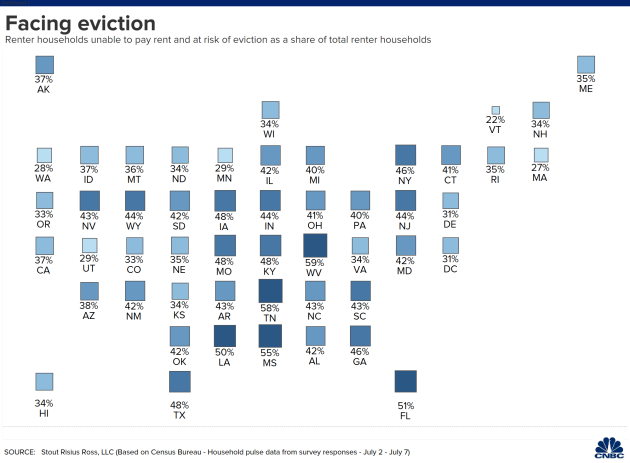
Here's how the eviction crisis is shaping up to impact each individual state:
<blockquote class="twitter-tweet"><p lang="en" dir="ltr">you best start believing in late republic collapses; you're in one <a href="https://t.co/SKsGh2SOIW">https://t.co/SKsGh2SOIW</a></p>— Micah Meadowcroft (@Micaheadowcroft) <a href="https://twitter.com/Micaheadowcroft/status/1287875950349135873?ref_src=twsrc%5Etfw">July 27, 2020</a></blockquote> <script async src="https://platform.twitter.com/widgets.js" charset="utf-8"></script>
<blockquote class="twitter-tweet"><p lang="en" dir="ltr">you best start believing in late republic collapses; you're in one <a href="https://t.co/SKsGh2SOIW">https://t.co/SKsGh2SOIW</a></p>— Micah Meadowcroft (@Micaheadowcroft) <a href="https://twitter.com/Micaheadowcroft/status/1287875950349135873?ref_src=twsrc%5Etfw">July 27, 2020</a></blockquote> <script async src="https://platform.twitter.com/widgets.js" charset="utf-8"></script>

NorthDakota
Grandson of Loomis
- Messages
- 15,705
- Reaction score
- 6,010
Here's how the eviction crisis is shaping up to impact each individual state:
<blockquote class="twitter-tweet"><p lang="en" dir="ltr">you best start believing in late republic collapses; you're in one <a href="https://t.co/SKsGh2SOIW">https://t.co/SKsGh2SOIW</a></p>— Micah Meadowcroft (@Micaheadowcroft) <a href="https://twitter.com/Micaheadowcroft/status/1287875950349135873?ref_src=twsrc%5Etfw">July 27, 2020</a></blockquote> <script async src="https://platform.twitter.com/widgets.js" charset="utf-8"></script>
I'm ready. Lets f'ing go lmao

TorontoGold
Mr. Dumb Moron
- Messages
- 7,372
- Reaction score
- 5,716
I'm ready. Lets f'ing go lmao
Your Manhattan lease up? ND looks like it's doing well based on that chart.
NorthDakota
Grandson of Loomis
- Messages
- 15,705
- Reaction score
- 6,010
Your Manhattan lease up? ND looks like it's doing well based on that chart.
My lease was up the day I left. The building I lived in was school-owned and they gave me a pro-rated refund since we pay for a semester at a time up front. They just looked at the last time our ID cards were used and checked if our place was clean lol. That was a really nice thing for them to do. I don't know if every school did that.
ND is always doing well
 We still got a bunch of oil money sitting around. I wouldn't be shocked if they tapped into that to help folks out if necessary but since our state is pretty well open I don't think it'll come to that.\
My #LFG comment was more referring to the fall of the republic. The Plains People are ready.
Last edited:
TorontoGold
Mr. Dumb Moron
- Messages
- 7,372
- Reaction score
- 5,716
My lease was up the day I left. The building I lived in was school-owned and they gave me a pro-rated refund since we pay for a semester at a time up front. They just looked at the last time our ID cards were used and checked if our place was clean lol. That was a really nice thing for them to do. I don't know if every school did that.
ND is always doing well
Wow, that's incredible they did that for you. But, guessing the tuition you guys pay it's a drop in the bucket for them. Don't think any school up here did anything similar to that.
Lol, make sure you get all pipelines built by Enbridge/TransCanada so that your boy can make a nice profit off them.

- Messages
- 37,545
- Reaction score
- 28,995
Here's how the eviction crisis is shaping up to impact each individual state:
<blockquote class="twitter-tweet"><p lang="en" dir="ltr">you best start believing in late republic collapses; you're in one <a href="https://t.co/SKsGh2SOIW">https://t.co/SKsGh2SOIW</a></p>— Micah Meadowcroft (@Micaheadowcroft) <a href="https://twitter.com/Micaheadowcroft/status/1287875950349135873?ref_src=twsrc%5Etfw">July 27, 2020</a></blockquote> <script async src="https://platform.twitter.com/widgets.js" charset="utf-8"></script>
Funny this is brought up here, I was just discussing this like 5 minutes ago on Discord with some people.
Some context:
1. Generally speaking, about 20% of people don't pay their rent on a monthly basis. So keep that in mind for context.
2. This graphic is mostly bullshit because they polled a bunch of people and basically asked them "are you scared?" That's not real data.
3. The percentage of people who stopped paying rent basically spiked to 30% after the pandemic hit and they passed laws saying you couldn't evict people. It has stabilized there and not moved much over the past 3 months. No one I do work for is seeing a 50% delinquency rate, as suggested by the image, or if they are they're lying to me.
4. I had multiple large projects that were paused/canceled come back to life last week. Why? In short, real estate companies got scared when the pandemic hit because they had no clue what was going to happen and decided to hold their capital tight. Now that they've got a good idea what's going on, they're not nearly as bearish as some media types predicting a worse-than-2008 crisis. In fact, they're the opposite and forecasting good things starting Q1 next year.
All of these numbers are stuff I've heard from real estate people, don't know if it's publicly supported anywhere with real data but might be worth googling. My numbers could be way off, or skewed by a small sample. But while there are a lot of people behind on payments and it's significantly more than normal... it's not a doomsday situation. Rather, if congress extends benefits and protections through the fall you're like to see a one time surge of evictions and then a rapid return to "normal" market behavior.
NorthDakota
Grandson of Loomis
- Messages
- 15,705
- Reaction score
- 6,010
Funny this is brought up here, I was just discussing this like 5 minutes ago on Discord with some people.
Some context:
1. Generally speaking, about 20% of people don't pay their rent on a monthly basis. So keep that in mind for context.
2. This graphic is mostly bullshit because they polled a bunch of people and basically asked them "are you scared?" That's not real data.
3. The percentage of people who stopped paying rent basically spiked to 30% after the pandemic hit and they passed laws saying you couldn't evict people. It has stabilized there and not moved much over the past 3 months. No one I do work for is seeing a 50% delinquency rate, as suggested by the image, or if they are they're lying to me.
4. I had multiple large projects that were paused/canceled come back to life last week. Why? In short, real estate companies got scared when the pandemic hit because they had no clue what was going to happen and decided to hold their capital tight. Now that they've got a good idea what's going on, they're not nearly as bearish as some media types predicting a worse-than-2008 crisis. In fact, they're the opposite and forecasting good things starting Q1 next year.
All of these numbers are stuff I've heard from real estate people, don't know if it's publicly supported anywhere with real data but might be worth googling. My numbers could be way off, or skewed by a small sample. But while there are a lot of people behind on payments and it's significantly more than normal... it's not a doomsday situation. Rather, if congress extends benefits and protections through the fall you're like to see a one time surge of evictions and then a rapid return to "normal" market behavior.
I would think businesses who work in a particular industry generally have a good feel for what's going on. Unlike government, they have skin in the game.
This post was reassuring. Thanks bud!
Funny this is brought up here, I was just discussing this like 5 minutes ago on Discord with some people.
Some context:
1. Generally speaking, about 20% of people don't pay their rent on a monthly basis. So keep that in mind for context.
2. This graphic is mostly bullshit because they polled a bunch of people and basically asked them "are you scared?" That's not real data.
3. The percentage of people who stopped paying rent basically spiked to 30% after the pandemic hit and they passed laws saying you couldn't evict people. It has stabilized there and not moved much over the past 3 months. No one I do work for is seeing a 50% delinquency rate, as suggested by the image, or if they are they're lying to me.
4. I had multiple large projects that were paused/canceled come back to life last week. Why? In short, real estate companies got scared when the pandemic hit because they had no clue what was going to happen and decided to hold their capital tight. Now that they've got a good idea what's going on, they're not nearly as bearish as some media types predicting a worse-than-2008 crisis. In fact, they're the opposite and forecasting good things starting Q1 next year.
All of these numbers are stuff I've heard from real estate people, don't know if it's publicly supported anywhere with real data but might be worth googling. My numbers could be way off, or skewed by a small sample. But while there are a lot of people behind on payments and it's significantly more than normal... it's not a doomsday situation. Rather, if congress extends benefits and protections through the fall you're like to see a one time surge of evictions and then a rapid return to "normal" market behavior.
Commercial real estate seems like it’s headed for a major shakeup here in the Bay Area. Between retail and restaurants there are a lot of business throwing in the towel in San Francisco. You can buy a liquor license in SF for about 100k now. They were about four times that pre Covid.
- Messages
- 37,545
- Reaction score
- 28,995
Commercial real estate seems like it’s headed for a major shakeup here in the Bay Area. Between retail and restaurants there are a lot of business throwing in the towel in San Francisco. You can buy a liquor license in SF for about 100k now. They were about four times that pre Covid.
Commercial real estate (especially retail) is quite fucked right now. There are a lot of competing strategies out there on how to deal with it and what the market will look like post-COVID. I had one client tell me that it's basically "sharks" and "shark food." A lot of people bought commercial properties counting on a certain amount of cash flow from long term tenants or with plans to refinance the building... and now they're stuck selling buildings for pennies on the dollar. And the "sharks" who have the capital are more than happy to buy them up and wait out COVID. What I hear from most is that for retail they expect a gradual bounce back starting Q1, and then for office space they have no clue because many more companies are now built for "remote" work and they don't know if there will be a downsizing trend. But in general, there have been far less non-retail businesses breaking lease.
I think that situation stands in stark contrast to the landlord-and-tenant situation where what I'm hearing is that while their revenue stream has taken a hit it's been nowhere close to catastrophic unless you were already losing money // breaking even on your properties. My clients cover everything from high end apartments to rent controlled properties, so I feel like I'm getting an honest picture even if it's just for the DC area.
RDU Irish
Catholics vs. Cousins
- Messages
- 8,627
- Reaction score
- 2,732
Great points Lax. My first thought seeing Whiskey's chart was "what is the baseline here" - no context on what normal looks like. Your 20% sounds very plausible if not low when you look at average Americans not having access to $500 in an emergency. Renters tend to be lower income and I don't think there is any dispute that there is a huge divergence between Haves and Have Nots in this pandemic - $600/week of extra unemployment has been a boost but fact is still unemployed versus higher skill taking paycuts that will bounce back or busier than ever in many cases.
Commercial real estate will be interesting - I can see more flex arrangements to deal with "sick" leave reality that you can't have fevers in the office. That would be weeks of leave whereas you can be plugged in at home and zoom from anywhere with internet to stay engaged, productive if/when you or your kid are sick (or school closed) or you need to isolate b/c you have grandma living with you. Functional but not exactly great way to climb the corporate ladder which is why I don't see the trend overtaking society and re-writing history. Out of sight out of mind - managers are only human.
Commercial real estate will be interesting - I can see more flex arrangements to deal with "sick" leave reality that you can't have fevers in the office. That would be weeks of leave whereas you can be plugged in at home and zoom from anywhere with internet to stay engaged, productive if/when you or your kid are sick (or school closed) or you need to isolate b/c you have grandma living with you. Functional but not exactly great way to climb the corporate ladder which is why I don't see the trend overtaking society and re-writing history. Out of sight out of mind - managers are only human.
Last edited:

Wild Bill
Well-known member
- Messages
- 5,519
- Reaction score
- 3,266
I have ten tenants and one isn't paying right now, and he wasn't paying pre-covid.
Maybe I'm just lucky but those numbers seem off.
I agree with Bluto/Lax, commercial property seems like it's going to take a big hit.
Ehh, don't be so sure. I have no idea what's going to happen in my industry over the next six months to a year. I can think of several different scenarios playing out but it's impossible to predict at the moment.
Maybe I'm just lucky but those numbers seem off.
I agree with Bluto/Lax, commercial property seems like it's going to take a big hit.
I would think businesses who work in a particular industry generally have a good feel for what's going on. Unlike government, they have skin in the game.
This post was reassuring. Thanks bud!
Ehh, don't be so sure. I have no idea what's going to happen in my industry over the next six months to a year. I can think of several different scenarios playing out but it's impossible to predict at the moment.
- Messages
- 20,894
- Reaction score
- 8,126
Commercial real estate (especially retail) is quite fucked right now. There are a lot of competing strategies out there on how to deal with it and what the market will look like post-COVID. I had one client tell me that it's basically "sharks" and "shark food." A lot of people bought commercial properties counting on a certain amount of cash flow from long term tenants or with plans to refinance the building... and now they're stuck selling buildings for pennies on the dollar. And the "sharks" who have the capital are more than happy to buy them up and wait out COVID. What I hear from most is that for retail they expect a gradual bounce back starting Q1, and then for office space they have no clue because many more companies are now built for "remote" work and they don't know if there will be a downsizing trend. But in general, there have been far less non-retail businesses breaking lease.
I think that situation stands in stark contrast to the landlord-and-tenant situation where what I'm hearing is that while their revenue stream has taken a hit it's been nowhere close to catastrophic unless you were already losing money // breaking even on your properties. My clients cover everything from high end apartments to rent controlled properties, so I feel like I'm getting an honest picture even if it's just for the DC area.
I wouldn't at all be surprised if a CNBC infographic ended up being misleading. But I shared it because it lines up with some of the things I'm seeing here in Arizona, and I doubt that LAX's experience is standard for the rest of the country:
- D.C., as the imperial capital, is basically recession proof. One would expect its markets, including real estate, to bounce back soonest and strongest. Most of the provinces won't be so lucky.
- America's lower classes are mostly renters. They make up the bulk of the workforce in the retail and hospitality industries. Huge numbers of this cohort lost their jobs to COVID (which is why so many can't pay their rent right now), and a lot of those jobs simply won't be coming back. How are we going to house and employ these people going forward?
- Even if those numbers are inflated, it doesn't take a big upswing in unemployment and homelessness to dramatically destabilize American society.
RDU Irish
Catholics vs. Cousins
- Messages
- 8,627
- Reaction score
- 2,732
Good points on DC area - gubmint is recession proof. Also unemployment booster payments have people able to pay now - what happens when that goes back to normal? What about renewals? Most are 12 month leases - might go move to someone's couch for a while and not renew. What about schools being closed and not able to work and need to live on lower unemployment? Just scratching the surface on destabilization of our society.
Also - Trump thread broken for anyone else? I'm not seeing anything past one of Circa's recent posts. Tried quoting another to comment and can't see my post.
Big Brother has infiltrated IE?!
Also - Trump thread broken for anyone else? I'm not seeing anything past one of Circa's recent posts. Tried quoting another to comment and can't see my post.
Big Brother has infiltrated IE?!
Irishize
Well-known member
- Messages
- 4,531
- Reaction score
- 461
Good points on DC area - gubmint is recession proof. Also unemployment booster payments have people able to pay now - what happens when that goes back to normal? What about renewals? Most are 12 month leases - might go move to someone's couch for a while and not renew. What about schools being closed and not able to work and need to live on lower unemployment? Just scratching the surface on destabilization of our society.
Also - Trump thread broken for anyone else? I'm not seeing anything past one of Circa's recent posts. Tried quoting another to comment and can't see my post.
Big Brother has infiltrated IE?!
Me, too. I started noticing yesterday. Circa had the last visible post w/ the Hilary/Donald debate clip. If you hit REPLY however; you can see that others have since posted. We just can’t see them on the thread.
- Messages
- 20,894
- Reaction score
- 8,126
Also - Trump thread broken for anyone else? I'm not seeing anything past one of Circa's recent posts. Tried quoting another to comment and can't see my post.
Big Brother has infiltrated IE?!
Circa had embedded some cancerous garbage from the bowels of the interwebs that broke the thread. I deleted a few of his posts with videos, and now it's working again.
Wild Bill
Well-known member
- Messages
- 5,519
- Reaction score
- 3,266
I wouldn't at all be surprised if a CNBC infographic ended up being misleading. But I shared it because it lines up with some of the things I'm seeing here in Arizona, and I doubt that LAX's experience is standard for the rest of the country:
- D.C., as the imperial capital, is basically recession proof. One would expect its markets, including real estate, to bounce back soonest and strongest. Most of the provinces won't be so lucky.
- America's lower classes are mostly renters. They make up the bulk of the workforce in the retail and hospitality industries. Huge numbers of this cohort lost their jobs to COVID (which is why so many can't pay their rent right now), and a lot of those jobs simply won't be coming back. How are we going to house and employ these people going forward?
- Even if those numbers are inflated, it doesn't take a big upswing in unemployment and homelessness to dramatically destabilize American society.
They're going to live in pods and eat bugs. Women will get by with onlyfans accounts and men can either leech off of them or live in the streets of southern california.
- Messages
- 20,894
- Reaction score
- 8,126
They're going to live in pods and eat bugs. Women will get by with onlyfans accounts and men can either leech off of them or live in the streets of southern california.
Lamest dystopia ever. Cyberpunk is dark, but at least it has a good aesthetic.