
- Messages
- 38,129
- Reaction score
- 30,928


The Democrats' Coalition of the Fringes is fraying...

What is this Coalition of the Fringe?
What the CNN article fails to note is that in addition to writing columns and movie reviews for The American Conservative, Sailer is the founder of the Human Biodiversity Institute, a neo-eugenics online discussion forum where right-wing journalists and race scientists have promoted selective breeding of the human species. He also writes frequently for the anti-immigrant hate site Vdare.com, named for the first white child born in America, and runs a website, isteve.com.
Sailer's website is rife with primitive stereotypes. On it, Sailer mocks professional golfer Annika Sorenstam for having well-developed muscles and claims that Asian men have a hard time finding dates because they look “less masculine” than other men.
Last January, on the hate site vdare.com, Sailer labeled Obama a “wigger.”
“He's a remarkably exotic variety of the faux African-American, but a wigger nonetheless,” Sailer wrote. “Even genetically, Obama, whose East African descent is apparent in his unusual features, has only a distant relationship to the West Africans who are the ancestors of almost all African-Americans.” To illustrate his point, Sailer used photos of Obama side-by-side with Jesse Jackson and the rapper Ludacris, “both of whom have conventional West African features.”
Assessing the tragic aftermath of Hurricane Katrina in September 2005, Sailer wrote, “The plain fact is that they [black Americans] tend to possess poorer native judgment than members of better-educated groups. Thus they need stricter moral guidance from society.”
This isn’t the only time in recent history that CNN has turned to an unabashed bigot for commentary on controversial issues in America while cloaking the source’s full identity.
In October 2006, CNN medical correspondent Dr. Sanjay Gupta reported on a study by J. Phillpe Rushton that purported to show that men, on average, are more intelligent than women. Gupta identified Rushton only as a professor of psychology at the University of Western Ontario. Since 2002, Rushton has been the head of the Pioneer Fund, a pro-eugenics foundation that funds the research of academic racists like Jared Taylor and Rushton, who himself has received over $1 million in Pioneer grants. Among Rushton’s findings are that on average blacks have larger genitals, breasts and buttocks, characteristics that, according to Rushton’s "research," have an inverse relationship to brain size and, thus, intelligence.
Then last April, CNN host Paula Zahn invited white supremacist James Edwards to participate in a live on-air panel discussion of “self-segregation” in America. Edwards, a self-proclaimed crusader for the white race, is the co-founder of the Political Cesspool, a Memphis, Tenn.-based AM radio show whose guest lineup is a rogue’s gallery of prominent figures on the radical right, including former Klan leader David Duke, anti-Semitic attorney Edgar Steele and the neo-Nazi teen singing duo Prussian Blue.
.
Steve Sailer
Steve Sailer is a hardcore racist, misogynist, white supremacist, anti-Semite, Islamophobe, homophobe, classist, ableist, transphobe, transmisogynist, xenophobe, pseudo-scientist and all-round champion asshole and bigot who can arguably be credited (if such a resumé can be to someone's credit) as the godfather of pseudo-scientific on-line hate. If it's foul, fetid and attempts to give itself a biological and/or intellectual veneer, then Sailer will have had a hand in it somewhere, trust us. For example, Sailer crafted, christened and cruise-controlled the "Human Bio-Diversity"/HBD meme in an attempt to leverage the inadequacies and insecurities of white nerds/geeks for the racist/white-supremacist cause. His obsessive/obscene offspring therefore include the likes of geek-girl HBD-Chick and dweeb-duo Gregory Cochran and Henry Harpending at West Hunter, all three of whom parlay their ignorance, stupidity and non-existent grasp of elementary logic to promote a hi-hate, lo-intellect pseudo-scientific agenda of which even creationists would be ashamed to admit ownership.
Rational wiki apparently missed the 'no labels' movement.....
Rationalwiki has a glowing assessment of Steve Sailer:
Lmao. My god what is like living in your world?

Is anyone really surprised?

How do Republicans win over Hispanics? Basically stop being such complete assholes. Lol.

Is anyone really surprised?
Lmao. My god what is like living in your world?
The Southern Poverty Law Center doesn't have much love for him either.
Not I. The guy's posts are digusting and I am shocked he has not been banned yet. I know of multiple posters who were given time off for far less than his typical post.
I assess claims by their truth or falsity, not by who makes them. To do otherwise is to engage in an ad hominem argument. I was answering your question about the "Coalition of the Fringes," which accurately describes the Democratic coalition.
I don't care what RationalWiki says about Steve Sailer any more than I care what it says about Pope Benedict.
Nor do I care what the wealthiest poverty organization in the world thinks about anything.
How dare somebody disagree with me? Ban him!
How dare somebody disagree with me? Ban him!
Ok, your white nationalist associations have been clearly established.
The SPLC's wealth has nothing to do with the voracity and facts with which they maintain and track extreme racially based hate crimes. It could be that you don't care what they say because they are the antithesis of your white nationalist dogma? If you are such a crusader for the truth then you should not dismiss them in the least.
You aren't fooling anyone. Your arguments are paper thin and your veneer of pseudo-intellectualism is fading.


No I am not Joe Friday although that would be awesome. Your plethora of posts before today are a trail of shining beacons decrying the blight of other races upon the mighty nobility of English white males. I can pull a few if you so choose.My "connections have been clearly established"? Who are you, Joe Friday?
I googled “Coalition of the Fringes” because I have never hear that term before and only came up with limited citations from Sailer’s associated web sites. Websites that are apparently notoriously xenophobic, racist, right wing, and typically cited by other white nationalists and frowned upon by most of the remainder of the internet. I find it hard to believe that you just happen to know about this obscure reference without spending much time on Sailer’s websites…..as even the vaunted google machine could find no other references to “Coalition of the Fringes” elsewhere.I cited a blogger when explaining the meaning of "Coalition of the Fringes."
Correct, but most rational people do not quote white nationalist pseudoscience bloggers who claim that race is an indicator of intelligence and that “What you won’t hear, except from me, is that "Let the good times roll" is an especially risky message for African-Americans. The plain fact is that they tend to possess poorer native judgment than members of better-educated groups. Thus they need stricter moral guidance from society”. If you find truth in statements like this and want to be associated with him, by all means, but you will be hard pressed to find any rational person who will support it on this board.This is ordinary practice when referencing ideas that are not your own. Evidently, you lost interest in discussing "Coalition of the Fringes" when I cited who came up with the concept.
Not on that singular statement no… you entire posting history is a testament to your quite clear white nationalism. Remember when you said this gem:I can be credited with saying I do not think that a person's opinion A is damned because he holds some other opinion B. If I cited Peter Singer in defense of animal rights, for example, would my "infanticide connections be clearly established"?
Your loathing of the SPLC has been stated in more than one instance as well. We get it. You called them abhorrent and reject their existence. Fine. Other rational people see that their purpose is facilitate, track, and maintain public records of hate crimes and have succeeded in disenfranchising well established hate groups here in the south as well as dismantling the really stubborn portions of Jim Crow laws. It also has legitimate legal standing in this country whether you feel the need to like it or not, but as a white nationalist I can understand why a group like this with any power at all could be threatening. So when they are actively aware of several websites know to promote hate, which happen to be populated with material from Sailer, the guy YOU cited…it has relevance whether you like it or not and can be used against whatever point you are trying to make.Liberals often cite the SPLC as if it is some impartial, disinterested group. It is not: as I mentioned, it is a racket, as even some liberals such as Alexander Cockburn have recognized. I am not so credulous as to accept any group's self-designation as the country's "watchdog" over "hate" groups. Obviously, this would give that group a great deal of power- and everybody wants power. What is mystifying is why everyone else wants to give them power.
Its good that you are not trying because its been a failure so far and you would be a sad excuse for troll if you were trying. We will chalk it up to incompetence at this point.I'm not trying to "fool" anyone. What is worrying is that an awful lot of liberals on here seem very comfortable proposing to ban anybody that they disagree with. I am unaware of conservatives on here demanding that anybody be banned.

No I am not Joe Friday although that would be awesome. Your plethora of posts before today are a trail of shining beacons decrying the blight of other races upon the mighty nobility of English white males. I can pull a few if you so choose.
I googled “Coalition of the Fringes” because I have never hear that term before and only came up with limited citations from Sailer’s associated web sites. Websites that are apparently notoriously xenophobic, racist, right wing, and typically cited by other white nationalists and frowned upon by most of the remainder of the internet. I find it hard to believe that you just happen to know about this obscure reference without spending much time on Sailer’s websites…..as even the vaunted google machine could find no other references to “Coalition of the Fringes” elsewhere.
Correct, but most rational people do not quote white nationalist pseudoscience bloggers who claim that race is an indicator of intelligence and that “What you won’t hear, except from me, is that "Let the good times roll" is an especially risky message for African-Americans. The plain fact is that they tend to possess poorer native judgment than members of better-educated groups. Thus they need stricter moral guidance from society”. If you find truth in statements like this and want to be associated with him, by all means, but you will be hard pressed to find any rational person who will support it on this board.
Not on that singular statement no… you entire posting history is a testament to your quite clear white nationalism. Remember when you said this gem:
“People say immigration 'made the country great,' but I don't really understand how that is so. In my view, what has made this country great is that it was founded by Englishmen.”
Your loathing of the SPLC has been stated in more than one instance as well. We get it. You called them abhorrent and reject their existence. Fine. Other rational people see that their purpose is facilitate, track, and maintain public records of hate crimes and have succeeded in disenfranchising well established hate groups here in the south as well as dismantling the really stubborn portions of Jim Crow laws. It also has legitimate legal standing in this country whether you feel the need to like it or not, but as a white nationalist I can understand why a group like this with any power at all could be threatening. So when they are actively aware of several websites know to promote hate, which happen to be populated with material from Sailer, the guy YOU cited…it has relevance whether you like it or not and can be used against whatever point you are trying to make.
Its good that you are not trying because its been a failure so far and you would be a sad excuse for troll if you were trying. We will chalk it up to incompetence at this point.
As to you last claim of maltreatment….you know exactly why the few posters that are doing so are requesting you be banned. I have already said as much to you in our previous discussions in private and on line as to what you can expect form other posters. You should not be shocked by this when you spout your white nationalist rhetoric that there is blowback. Defend your paper thin vagaries instead of ignoring peoples responses to you.


How do we decide what is right and wrong? Psychologist Jonathan Haidt's theory is that humans have a small number of fundamental, intuitive "moral foundations," such as sanctity, loyalty, authority, fairness, and an axis he calls care/harm. A corollary to this theory is that liberals tend to reason overwhelmingly on the fairness and care/harm factors, denigrating or ignoring other foundations that most other people consider as vital as the Big Two. In a talk for Edge, he once likened this to a restaurant that only serves sugar, or salt:
t's a metaphor for how I feel when I read moral philosophy and some moral psychology. Morality is so rich and complex. It's so multifaceted and contradictory. But many authors reduce it to a single principle, which is usually some variant of welfare maximization. So that would be the sugar. Or sometimes, it's justice and related notions of fairness and rights. And that would be the chemist down the street. So basically, there's two restaurants to choose from. There's the utilitarian grille, and there's the deontological diner. That's pretty much it.
For reasons that may be obvious, Haidt has become caught up in the culture war between conservatives and liberals, because his work reframes the abundance of social psychology papers that have been produced purporting to show that conservatives are horrible people, frightened, authoritarian, and all-around downright awful. Haidt's work suggests instead that conservatives are people who rely on a broader array of moral foundations than do liberals.
I'm an enormous fan of Jonathan Haidt's work. Nonetheless, I've always had two outstanding questions about it (and would note that these are not exactly questions of which Professor Haidt is unaware). The first is simply whether his surveys capture the actual moral reasoning that people do, or represent people pretending to do the sort of moral reasoning they think they ought to do. Take two of the questions he asks about purity. One involves brother-sister incest in which every precaution is taken to prevent pregnancy, and leaves both parties feeling pretty good about the experience with no long-term side effects on the family. The other involves a man having carnal knowledge of his poultry before he cooks it and eats it for dinner.
When asked if these two things are morally wrong, American liberals and libertarians would tend to answer no. (Or try to get around the hypothetical by positing undetected harm from the incest, or the potential dangers of salmonella and/or freezer burn from the chicken.) And yet, I submit that if those people found out that a stranger exhibited such behavior, most would probably be less interested in becoming friends with that stranger. That's a moral judgement, but cultural norms among the secular educated elite don't give people any vocabulary to express it, and so they say that it's not wrong in the first place -- even though in the actual situation, they would probably still make a moralizing judgement about it. As I wrote last year, "It is clearly true that liberals profess a moral code that excludes concerns about loyalty, honor, purity and obedience -- but over the millennia, man has professed many ideals that are mostly honored in the breach."
The second issue is a simply a perennial problem for surveys that look at political and moral reason: What questions did you ask? If you give people a quiz on global warming, conservatives may look more ignorant and ideologically motivated than liberals. On the other hand, if you ask that same group how many prisoners are in jail for non-violent drug offenses, you may "prove" that liberals ignorantly and/or willfully underestimate the number. Another way of saying that is that liberals may indeed resort to reasoning from sanctity, group loyalty, and authority -- but the questions Haidt has asked simply may not capture that tendency.
This problem occurred to Jeremy Frimer, who did a paper on how conservative and liberal attitudes towards authority shift when you shift who the authority is. "Together with my collaborators Dr. Danielle Gaucher and Nicola Schaefer, we asked both red and blue Americans to share their views about obeying liberal authorities (e.g., "obey an environmentalist"). In an article that we recently published in Personality and Social Psychology Bulletin, we found that liberals were now the ones calling for obedience. And when the authorities were viewed as ideologically neutral (e.g., office manager), liberals and conservatives agreed. Only when people perceived the authority to be conservative (e.g., religious authority) did conservatives show a positive bias."
Now Frimer has a new paper, co-authored with Haidt, on sanctity. And again they find liberals arguing from a broader range of moral foundations than Haidt's work initially suggested. When it comes to desecrating the purity of a mountain, instead of, say, the American flag, it turns out that liberal mountain climbers care a lot, even though no sentient being is harmed by the action.
Of course, this is a limited paper: It's a case study of mountain climbers, who, as anyone who has hung out with them can readily attest, are a wee bit different from normal folks. It certainly resonates with my personal experience of the environmental movement, and I suspect that there are other areas where we'd see sanctity take precedence over other moral concerns. But I don't want to lean too hard on a single study, however well it matches my intuitions.
But if this result holds up, it brings us back to the first point I raised: It may not be so much that liberals don't care about sanctity, authority, and so forth, as that they are culturally encouraged not to admit that they do. That may seem like a distinction without a difference, of course, but I don't think that it is, because our stubborn moral intuitions about what is right and wrong are much more powerful than our logic when we make decisions. (Just try to get the average person to sit down and coolly reason through the discovery that their spouse enjoys the occasional fling at a conference with people they never see again.) Coming at someone with utilitarian math when the problem is actually that you've desecrated their sacred space is a recipe for bitter and unresolvable conflict -- and perhaps, for a culture war that no one is going to win.
Ross Douthat, the resident social conservative of the New York Times opinion page, doesn't usually get angry. But in a blog post Wednesday, he unloaded on liberal columnists who suggest that defunding Planned Parenthood is going to cause more abortions by depriving women of access to birth control. Such columns, he argues, rest on the assumption, stated or not, that America's abortion rate is driven by a lack of that access -- and that if only we made birth control more widely and cheaply available, we could resolve America's rancorous abortion dispute by rendering the issue moot.
I ended up in a long Facebook discussion with one of the columnists he attacked by name, Damon Linker. Before I go further, I should say that both Ross and Damon are former colleagues, and I think they're both brilliant columnists. But on this issue -- not whether abortion should be legal, but whether the main thing standing between America and fewer abortions is better government birth-control policy -- I think Douthat has the better argument.
Damon, and many others who participated in that Facebook thread, voiced the belief that America has far more abortions than it otherwise would because conservatives are not doing enough to give women better access to contraception. This belief seems intuitive -- after all, birth control keeps you from getting pregnant, and it's hard to get an abortion if you're not pregnant. But when I look at the data, I am reminded of Ambrose Bierce's definition of prejudice: a vagrant opinion without visible means of support.
Consider abortion rates in various developed nations:
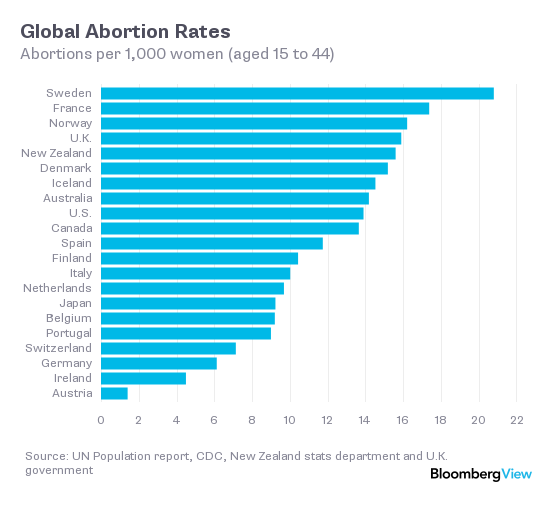
The U.S. rate is certainly high compared with, say Germany or the Netherlands. On the other hand, it's lower than Sweden, and right around that of New Zealand and the UK -- countries with comprehensive national health-care services that provide birth control. And who had one of the lowest abortion rates? Ireland, where it was illegal. (Irish women travel abroad to get abortions, but the rate still seems to be quite low by international standards.)
Now, obviously, we could theoretically do something to reduce our abortion rates to more German levels without going so far as to ban it. But this data doesn't really suggest that "something" is necessarily "provide more affordable reproductive health care services to women," or indeed, anything else that lends itself to government intervention, such as "better sex ed." Extremely high abortion rates can coexist with extremely comprehensive health-care systems and liberal social norms.
You see a similar pattern in the U.S. when you look at the variation in abortion rates between states: Liberal blue states with liberal abortion laws and liberal attitudes about birth control seem to have the highest, not the lowest, rates of abortion. What drives this? I can come up with a number of plausible theories, but I couldn't tell you which one is right. On the other hand, I think we can reject the hypothesis that liberal attitudes toward sex and birth control are a surefire way to get the abortion rate down.
In fact, the evidence for this thesis was never very good. Even William Saletan, who used to be a leading advocate of the squishy pro-choicer thesis that abortion is terrible so we need to give people lots of free birth control, ended up abandoning this thesis when he concluded that there's just not good data showing that the high price of birth control, or the inability to get your hands on the stuff, is the major reason people end up having abortions.
But wait, I hear you cry! What about Colorado?
Ah, yes, Colorado. A little while back, some Colorado researchers published a study on the Colorado Family Planning Initiative (CFPI), a program to provide long-acting reversible contraceptives (LARCs) to low-income women, called . Here are the results: "In CFPI counties, the proportion of births that were high-risk declined by 24% between 2009 and 2011; abortion rates fell 34% and 18%, respectively, among women aged 15–19 and 20–24. Statewide, infant enrollment in WIC declined 23% between 2010 and 2013. CONCLUSIONS: Programs that increase LARC use among young, low-income women may contribute to declines in fertility rates, abortion rates and births among high-risk women." This made columnists very excited. A 30 percent decline in the teen birthrate, and a huge decline in the teen abortion rate (with a smaller decline in abortions for women aged 20 to 24), for such a cheap program? Yes, please.
Here's the problem: That study is not very good. This is the part where I spend a lot of time wading through the numbers. If that sort of thing bores you, just accept arguendo that the numbers don't add up very well, and skip to the concluding paragraphs.
Basically, what you would want to do with a study like this is randomize it: Divide women into two populations, give half of them increased LARC access, and track what happened. Failing that, you'd at least want to track what actually happened to the women who got LARCs. The study does neither of these things; instead, after the program had been operating for a while, it took a look at county-level data, either for the whole population of the county, or the population of low-income women in the counties where LARCs became more widely available. Then it shows you that various things, such as teen births and abortion rates decreased. There's not really much evidence of a causal link, but there are so many pretty charts and tables that you don't really notice its absence until you start to work through the underlying numbers.
By 2011, 8,435 women aged 15 to 24 had been given LARCs, out of a total population of about 420,000 women who fell into that age range for at least some of the study period. (At any given time, in Colorado, there are about 320,000 women aged 15 to 24.) Between 2008 and 2011, the study reports that the abortion rate in CFPI counties had fallen from 10.9 to 7.2 per 1,000 women aged 15 to 19, and from 22 to 18 per 1,000 for women aged 20 to 24. Doing some quick math, that gives me about 1,200 fewer abortions in a single year. To believe that the CFPI was responsible for all or most of the change, we have to believe that around 15 percent of the women who got LARCs would have gotten pregnant and had abortions in a single year -- and that's before we even try to account for the fact that some substantial number of women who got those 8,400 LARCs would have aged out of the range by 2011, and therefore would presumably not have been counted in the abortion data, so that the remaining women who were would need to have had even higher rates of pregnancy and abortion. Just for reference, the pregnancy rate in the U.S. for teen women aged 15 to 24 was about 6.5 percent, and about 15 percent for women aged 20 to 24. Obviously, not all of those women have abortions.
Now, pregnancy rates for low-income women are much higher than normal, and the unintended pregnancy rate is well north of 10 percent. That is still not high enough to account for those numbers unless you literally assume that the women who got LARCs would otherwise have had extremely high rates of unintended pregnancy, and that all of the ones who got pregnant would have had abortions.
It's not safe to assume that, however, because the study also contains a substantial section on birth rates during that time period. They fell substantially, and the LARC "game change" is also, by implication, credited with this decline. Now, abortions and births are pretty much mutually exclusive, so you have to add the two numbers together to get the implied number of pregnancies the researchers believe have been prevented in the target population. The paper says that "Between 2009 and 2011, the fertility rate for all Colorado women aged 15–19 declined 26%, from 37 to 28 births per 1,000. In the same period, the fertility rate among all women aged 20–24 declined 12%, from 89 to 78 births per 1,000. An estimated 77% and 74% of the decline among these age groups, respectively, can be attributed to the decline in births among low-income women in the CFPI counties." But if we do the math on those numbers, with the known number of Colorado women in those age groups, I get somewhere in the neighborhood of 2,200 fewer births among low income women in the CFPI counties. If we attribute that decline to the LARCs, we get an incredible 3,400 prevented pregnancies in 2011, or around 40 percent of the women who received them. That seems way too high. Of course, the LARCs might have contributed something to the decline -- in fact, I'd assume they did. But how much? The paper can't tell us.
Did Colorado's birthrate fall significantly faster than the nation's? Yes. So did Florida's, Georgia's, Arizona's, Maryland's, Delaware's, Mississippi's, and Massachusetts', to name just some of the biggest outliers. Probably all of these states had some program that you could suggest helped lower the birthrate. Probably many of the states that didn't see declines also had such programs, only since their birthrate didn't decline spectacularly, no one wrote that paper. This is the sort of thing that makes John Ioannidis suspect that most published research results are false.
The researchers attempt to control for this problem by looking at counties where the CFPI didn't operate, and comparing their abortion rates with the ones where it did. Problem: "Beginning in 2009, funding was provided to 28 Title X– funded agencies in 37 of Colorado’s 64 counties, which contained 95% of the state’s total population, including 95% of the low-income population (defined as individuals with incomes at or below 150% of the federal poverty level)." The remaining counties, a footnote tells us, were rural places with a lot of land mass and very few people. This is not a good control group for the counties with all the people in them. For one thing, if we assume that the age ranges are roughly similar, we are talking about only 16,000 women out of roughly 320,000. More importantly, rural people tend to differ from urban and suburban people in their experience of poverty, cultural and political values, and other ways.
Perhaps most importantly, the teen abortion rate also declined precipitously in the non-CFPI counties -- by 29 percent, compared with 34 percent in the CFPI counties. The idea of a big difference in the abortion rate ends up resting entirely on a difference between the abortion rate among women aged 20 to 24 in non-CFPI counties, which ticked up slightly, and those in CFPI counties, where it fell by 18 percent. Given how few people lived in the non-CFPI counties, the fact that they already had substantially higher abortion rates, and the fact that this effect only seems to operate on older women even though the clients of the clinics are roughly split between the two age groups, this starts looking more like Texas Sharpshooter Fallacy than a robust result.
That's the whole study. They tell you that Colorado gave out LARCs; they tell you that birthrates and abortions fell. They don't dwell on the simultaneous fall in these areas at the national level, which is somewhat mysterious but may be fallout from the financial crisis. They have no way to establish causality except for an inadequate control group that doesn't even show a substantial difference in teen abortion rates, a fact that they appear to have forgotten in other sections of the paper. (They also mention that the overall decline in Colorado's birthrates was concentrated among low-income women in the studied counties, but that's not actually very interesting, because early motherhood and unintended pregnancy are also concentrated among low-income women.)
The authors basically concede that they cannot come close to establishing causality, because the summary conclusion is a weasel: LARCs may contribute to a decline in fertility and abortion among high-risk women. How much? We don't know, but look at the pretty graphs! Needless to say, most of the people who have hyped the study missed the weasel words and treated the results as if the study had shown a direct causal link, when in fact it does no such thing.
The universe contains many more correlations than causes. Is this correlation plausible? Sure. But that doesn't mean it's there. And this paper simply doesn't show that it is.
Yet even if this paper actually did make a reasonable stab at establishing causality, and we accept that Colorado produced some sort of miracle, it seems worth pointing out that for all this, their abortion rate is still not zero. It's almost 2 percent of women aged 20 to 24, and almost 1 percent of women aged 15 to 19. Overall, women in this age range had something north of 4,000 abortions in Colorado in 2011. If you think that abortion is murder, it's obviously good news that this was 1,200 fewer than they would have had in 2008. But the 4,000 murders are probably still going to bother you quite a lot. And this is the result of giving away free or low-cost birth control that is basically impossible to screw up to a target population of the poorest women in the state.
Every time I've written about this issue before, I've ended up concluding the same thing: the primary barrier to people using birth control is simply not the price, or the distribution. There are a host of reasons that people don't use birth control, from concern about side effects, to cultural values, to simply not anticipating their need for it. And that matters for policy, because the government is relatively good at providing free stuff, and relatively bad at getting people to change their most intimate behaviors. I'd certainly guess that offering women cheap LARCs instead of other birth control methods does something to prevent abortions and unwanted births. But I certainly wouldn't assert that it was large based on this research.
That's not to say that the government shouldn't help low-income women get access to birth control. It's just to say that there's not a lot of great evidence that doing so will knock our abortion rate down to German or Austrian levels. When I pointed this out yesterday, someone I was arguing with said that even if this study was weak, he believed that well-crafted policy could make a big difference. And that may well be so. But unless you can actually articulate that policy, and provide some evidence that it works the way you believe, you're in a weak position to criticize pro-lifers for not embracing it.
For squishy pro-choicers -- a category I have spent many years in myself -- believing that free birth control can reduce abortion to negligible levels is very convenient. It is the "torture doesn't work" of the feminist movement. Instead of forcing a hard moral choice between the autonomy of the woman and the value of the potential life that is terminated, belief in the birth control fairy lets us off the hook. It would certainly be lovely if programs such as the Colorado Family Planning Initiative could make abortion so rare that it no longer required us to make those moral and political choices. But hoping for something to be right doesn't make it so -- and neither does bad data.
How do we decide what is right and wrong? Psychologist Jonathan Haidt's theory is that humans have a small number of fundamental, intuitive "moral foundations," such as sanctity, loyalty, authority, fairness, and an axis he calls care/harm. A corollary to this theory is that liberals tend to reason overwhelmingly on the fairness and care/harm factors, denigrating or ignoring other foundations that most other people consider as vital as the Big Two. In a talk for Edge, he once likened this to a restaurant that only serves sugar, or salt:
t's a metaphor for how I feel when I read moral philosophy and some moral psychology. Morality is so rich and complex. It's so multifaceted and contradictory. But many authors reduce it to a single principle, which is usually some variant of welfare maximization. So that would be the sugar. Or sometimes, it's justice and related notions of fairness and rights. And that would be the chemist down the street. So basically, there's two restaurants to choose from. There's the utilitarian grille, and there's the deontological diner. That's pretty much it.
For reasons that may be obvious, Haidt has become caught up in the culture war between conservatives and liberals, because his work reframes the abundance of social psychology papers that have been produced purporting to show that conservatives are horrible people, frightened, authoritarian, and all-around downright awful. Haidt's work suggests instead that conservatives are people who rely on a broader array of moral foundations than do liberals.
I'm an enormous fan of Jonathan Haidt's work. Nonetheless, I've always had two outstanding questions about it (and would note that these are not exactly questions of which Professor Haidt is unaware). The first is simply whether his surveys capture the actual moral reasoning that people do, or represent people pretending to do the sort of moral reasoning they think they ought to do. Take two of the questions he asks about purity. One involves brother-sister incest in which every precaution is taken to prevent pregnancy, and leaves both parties feeling pretty good about the experience with no long-term side effects on the family. The other involves a man having carnal knowledge of his poultry before he cooks it and eats it for dinner.
When asked if these two things are morally wrong, American liberals and libertarians would tend to answer no. (Or try to get around the hypothetical by positing undetected harm from the incest, or the potential dangers of salmonella and/or freezer burn from the chicken.) And yet, I submit that if those people found out that a stranger exhibited such behavior, most would probably be less interested in becoming friends with that stranger. That's a moral judgement, but cultural norms among the secular educated elite don't give people any vocabulary to express it, and so they say that it's not wrong in the first place -- even though in the actual situation, they would probably still make a moralizing judgement about it. As I wrote last year, "It is clearly true that liberals profess a moral code that excludes concerns about loyalty, honor, purity and obedience -- but over the millennia, man has professed many ideals that are mostly honored in the breach."
The second issue is a simply a perennial problem for surveys that look at political and moral reason: What questions did you ask? If you give people a quiz on global warming, conservatives may look more ignorant and ideologically motivated than liberals. On the other hand, if you ask that same group how many prisoners are in jail for non-violent drug offenses, you may "prove" that liberals ignorantly and/or willfully underestimate the number. Another way of saying that is that liberals may indeed resort to reasoning from sanctity, group loyalty, and authority -- but the questions Haidt has asked simply may not capture that tendency.
This problem occurred to Jeremy Frimer, who did a paper on how conservative and liberal attitudes towards authority shift when you shift who the authority is. "Together with my collaborators Dr. Danielle Gaucher and Nicola Schaefer, we asked both red and blue Americans to share their views about obeying liberal authorities (e.g., "obey an environmentalist"). In an article that we recently published in Personality and Social Psychology Bulletin, we found that liberals were now the ones calling for obedience. And when the authorities were viewed as ideologically neutral (e.g., office manager), liberals and conservatives agreed. Only when people perceived the authority to be conservative (e.g., religious authority) did conservatives show a positive bias."
Now Frimer has a new paper, co-authored with Haidt, on sanctity. And again they find liberals arguing from a broader range of moral foundations than Haidt's work initially suggested. When it comes to desecrating the purity of a mountain, instead of, say, the American flag, it turns out that liberal mountain climbers care a lot, even though no sentient being is harmed by the action.
Of course, this is a limited paper: It's a case study of mountain climbers, who, as anyone who has hung out with them can readily attest, are a wee bit different from normal folks. It certainly resonates with my personal experience of the environmental movement, and I suspect that there are other areas where we'd see sanctity take precedence over other moral concerns. But I don't want to lean too hard on a single study, however well it matches my intuitions.
But if this result holds up, it brings us back to the first point I raised: It may not be so much that liberals don't care about sanctity, authority, and so forth, as that they are culturally encouraged not to admit that they do. That may seem like a distinction without a difference, of course, but I don't think that it is, because our stubborn moral intuitions about what is right and wrong are much more powerful than our logic when we make decisions. (Just try to get the average person to sit down and coolly reason through the discovery that their spouse enjoys the occasional fling at a conference with people they never see again.) Coming at someone with utilitarian math when the problem is actually that you've desecrated their sacred space is a recipe for bitter and unresolvable conflict -- and perhaps, for a culture war that no one is going to win.
Ross Douthat, the resident social conservative of the New York Times opinion page, doesn't usually get angry. But in a blog post Wednesday, he unloaded on liberal columnists who suggest that defunding Planned Parenthood is going to cause more abortions by depriving women of access to birth control. Such columns, he argues, rest on the assumption, stated or not, that America's abortion rate is driven by a lack of that access -- and that if only we made birth control more widely and cheaply available, we could resolve America's rancorous abortion dispute by rendering the issue moot.
I ended up in a long Facebook discussion with one of the columnists he attacked by name, Damon Linker. Before I go further, I should say that both Ross and Damon are former colleagues, and I think they're both brilliant columnists. But on this issue -- not whether abortion should be legal, but whether the main thing standing between America and fewer abortions is better government birth-control policy -- I think Douthat has the better argument.
Damon, and many others who participated in that Facebook thread, voiced the belief that America has far more abortions than it otherwise would because conservatives are not doing enough to give women better access to contraception. This belief seems intuitive -- after all, birth control keeps you from getting pregnant, and it's hard to get an abortion if you're not pregnant. But when I look at the data, I am reminded of Ambrose Bierce's definition of prejudice: a vagrant opinion without visible means of support.
Consider abortion rates in various developed nations:
The U.S. rate is certainly high compared with, say Germany or the Netherlands. On the other hand, it's lower than Sweden, and right around that of New Zealand and the UK -- countries with comprehensive national health-care services that provide birth control. And who had one of the lowest abortion rates? Ireland, where it was illegal. (Irish women travel abroad to get abortions, but the rate still seems to be quite low by international standards.)
Now, obviously, we could theoretically do something to reduce our abortion rates to more German levels without going so far as to ban it. But this data doesn't really suggest that "something" is necessarily "provide more affordable reproductive health care services to women," or indeed, anything else that lends itself to government intervention, such as "better sex ed." Extremely high abortion rates can coexist with extremely comprehensive health-care systems and liberal social norms.
You see a similar pattern in the U.S. when you look at the variation in abortion rates between states: Liberal blue states with liberal abortion laws and liberal attitudes about birth control seem to have the highest, not the lowest, rates of abortion. What drives this? I can come up with a number of plausible theories, but I couldn't tell you which one is right. On the other hand, I think we can reject the hypothesis that liberal attitudes toward sex and birth control are a surefire way to get the abortion rate down.
In fact, the evidence for this thesis was never very good. Even William Saletan, who used to be a leading advocate of the squishy pro-choicer thesis that abortion is terrible so we need to give people lots of free birth control, ended up abandoning this thesis when he concluded that there's just not good data showing that the high price of birth control, or the inability to get your hands on the stuff, is the major reason people end up having abortions.
But wait, I hear you cry! What about Colorado?
Ah, yes, Colorado. A little while back, some Colorado researchers published a study on the Colorado Family Planning Initiative (CFPI), a program to provide long-acting reversible contraceptives (LARCs) to low-income women, called . Here are the results: "In CFPI counties, the proportion of births that were high-risk declined by 24% between 2009 and 2011; abortion rates fell 34% and 18%, respectively, among women aged 15–19 and 20–24. Statewide, infant enrollment in WIC declined 23% between 2010 and 2013. CONCLUSIONS: Programs that increase LARC use among young, low-income women may contribute to declines in fertility rates, abortion rates and births among high-risk women." This made columnists very excited. A 30 percent decline in the teen birthrate, and a huge decline in the teen abortion rate (with a smaller decline in abortions for women aged 20 to 24), for such a cheap program? Yes, please.
Here's the problem: That study is not very good. This is the part where I spend a lot of time wading through the numbers. If that sort of thing bores you, just accept arguendo that the numbers don't add up very well, and skip to the concluding paragraphs.
Basically, what you would want to do with a study like this is randomize it: Divide women into two populations, give half of them increased LARC access, and track what happened. Failing that, you'd at least want to track what actually happened to the women who got LARCs. The study does neither of these things; instead, after the program had been operating for a while, it took a look at county-level data, either for the whole population of the county, or the population of low-income women in the counties where LARCs became more widely available. Then it shows you that various things, such as teen births and abortion rates decreased. There's not really much evidence of a causal link, but there are so many pretty charts and tables that you don't really notice its absence until you start to work through the underlying numbers.
By 2011, 8,435 women aged 15 to 24 had been given LARCs, out of a total population of about 420,000 women who fell into that age range for at least some of the study period. (At any given time, in Colorado, there are about 320,000 women aged 15 to 24.) Between 2008 and 2011, the study reports that the abortion rate in CFPI counties had fallen from 10.9 to 7.2 per 1,000 women aged 15 to 19, and from 22 to 18 per 1,000 for women aged 20 to 24. Doing some quick math, that gives me about 1,200 fewer abortions in a single year. To believe that the CFPI was responsible for all or most of the change, we have to believe that around 15 percent of the women who got LARCs would have gotten pregnant and had abortions in a single year -- and that's before we even try to account for the fact that some substantial number of women who got those 8,400 LARCs would have aged out of the range by 2011, and therefore would presumably not have been counted in the abortion data, so that the remaining women who were would need to have had even higher rates of pregnancy and abortion. Just for reference, the pregnancy rate in the U.S. for teen women aged 15 to 24 was about 6.5 percent, and about 15 percent for women aged 20 to 24. Obviously, not all of those women have abortions.
Now, pregnancy rates for low-income women are much higher than normal, and the unintended pregnancy rate is well north of 10 percent. That is still not high enough to account for those numbers unless you literally assume that the women who got LARCs would otherwise have had extremely high rates of unintended pregnancy, and that all of the ones who got pregnant would have had abortions.
It's not safe to assume that, however, because the study also contains a substantial section on birth rates during that time period. They fell substantially, and the LARC "game change" is also, by implication, credited with this decline. Now, abortions and births are pretty much mutually exclusive, so you have to add the two numbers together to get the implied number of pregnancies the researchers believe have been prevented in the target population. The paper says that "Between 2009 and 2011, the fertility rate for all Colorado women aged 15–19 declined 26%, from 37 to 28 births per 1,000. In the same period, the fertility rate among all women aged 20–24 declined 12%, from 89 to 78 births per 1,000. An estimated 77% and 74% of the decline among these age groups, respectively, can be attributed to the decline in births among low-income women in the CFPI counties." But if we do the math on those numbers, with the known number of Colorado women in those age groups, I get somewhere in the neighborhood of 2,200 fewer births among low income women in the CFPI counties. If we attribute that decline to the LARCs, we get an incredible 3,400 prevented pregnancies in 2011, or around 40 percent of the women who received them. That seems way too high. Of course, the LARCs might have contributed something to the decline -- in fact, I'd assume they did. But how much? The paper can't tell us.
Did Colorado's birthrate fall significantly faster than the nation's? Yes. So did Florida's, Georgia's, Arizona's, Maryland's, Delaware's, Mississippi's, and Massachusetts', to name just some of the biggest outliers. Probably all of these states had some program that you could suggest helped lower the birthrate. Probably many of the states that didn't see declines also had such programs, only since their birthrate didn't decline spectacularly, no one wrote that paper. This is the sort of thing that makes John Ioannidis suspect that most published research results are false.
The researchers attempt to control for this problem by looking at counties where the CFPI didn't operate, and comparing their abortion rates with the ones where it did. Problem: "Beginning in 2009, funding was provided to 28 Title X– funded agencies in 37 of Colorado’s 64 counties, which contained 95% of the state’s total population, including 95% of the low-income population (defined as individuals with incomes at or below 150% of the federal poverty level)." The remaining counties, a footnote tells us, were rural places with a lot of land mass and very few people. This is not a good control group for the counties with all the people in them. For one thing, if we assume that the age ranges are roughly similar, we are talking about only 16,000 women out of roughly 320,000. More importantly, rural people tend to differ from urban and suburban people in their experience of poverty, cultural and political values, and other ways.
Perhaps most importantly, the teen abortion rate also declined precipitously in the non-CFPI counties -- by 29 percent, compared with 34 percent in the CFPI counties. The idea of a big difference in the abortion rate ends up resting entirely on a difference between the abortion rate among women aged 20 to 24 in non-CFPI counties, which ticked up slightly, and those in CFPI counties, where it fell by 18 percent. Given how few people lived in the non-CFPI counties, the fact that they already had substantially higher abortion rates, and the fact that this effect only seems to operate on older women even though the clients of the clinics are roughly split between the two age groups, this starts looking more like Texas Sharpshooter Fallacy than a robust result.
That's the whole study. They tell you that Colorado gave out LARCs; they tell you that birthrates and abortions fell. They don't dwell on the simultaneous fall in these areas at the national level, which is somewhat mysterious but may be fallout from the financial crisis. They have no way to establish causality except for an inadequate control group that doesn't even show a substantial difference in teen abortion rates, a fact that they appear to have forgotten in other sections of the paper. (They also mention that the overall decline in Colorado's birthrates was concentrated among low-income women in the studied counties, but that's not actually very interesting, because early motherhood and unintended pregnancy are also concentrated among low-income women.)
The authors basically concede that they cannot come close to establishing causality, because the summary conclusion is a weasel: LARCs may contribute to a decline in fertility and abortion among high-risk women. How much? We don't know, but look at the pretty graphs! Needless to say, most of the people who have hyped the study missed the weasel words and treated the results as if the study had shown a direct causal link, when in fact it does no such thing.
The universe contains many more correlations than causes. Is this correlation plausible? Sure. But that doesn't mean it's there. And this paper simply doesn't show that it is.
Yet even if this paper actually did make a reasonable stab at establishing causality, and we accept that Colorado produced some sort of miracle, it seems worth pointing out that for all this, their abortion rate is still not zero. It's almost 2 percent of women aged 20 to 24, and almost 1 percent of women aged 15 to 19. Overall, women in this age range had something north of 4,000 abortions in Colorado in 2011. If you think that abortion is murder, it's obviously good news that this was 1,200 fewer than they would have had in 2008. But the 4,000 murders are probably still going to bother you quite a lot. And this is the result of giving away free or low-cost birth control that is basically impossible to screw up to a target population of the poorest women in the state.
Every time I've written about this issue before, I've ended up concluding the same thing: the primary barrier to people using birth control is simply not the price, or the distribution. There are a host of reasons that people don't use birth control, from concern about side effects, to cultural values, to simply not anticipating their need for it. And that matters for policy, because the government is relatively good at providing free stuff, and relatively bad at getting people to change their most intimate behaviors. I'd certainly guess that offering women cheap LARCs instead of other birth control methods does something to prevent abortions and unwanted births. But I certainly wouldn't assert that it was large based on this research.
That's not to say that the government shouldn't help low-income women get access to birth control. It's just to say that there's not a lot of great evidence that doing so will knock our abortion rate down to German or Austrian levels. When I pointed this out yesterday, someone I was arguing with said that even if this study was weak, he believed that well-crafted policy could make a big difference. And that may well be so. But unless you can actually articulate that policy, and provide some evidence that it works the way you believe, you're in a weak position to criticize pro-lifers for not embracing it.
For squishy pro-choicers -- a category I have spent many years in myself -- believing that free birth control can reduce abortion to negligible levels is very convenient. It is the "torture doesn't work" of the feminist movement. Instead of forcing a hard moral choice between the autonomy of the woman and the value of the potential life that is terminated, belief in the birth control fairy lets us off the hook. It would certainly be lovely if programs such as the Colorado Family Planning Initiative could make abortion so rare that it no longer required us to make those moral and political choices. But hoping for something to be right doesn't make it so -- and neither does bad data.

It isn't about disagreeing ... it is about offending. There are people of color on this board, and you routinely say things that are overtly offensive about them and everyone who looks like them. It is about ignorance and the degree to which posters on this board want to be associated with a person who demonstrates disregard for the dignity of other human beings, let alone the the promotion of white supremacy in the 21st Century. Simply saying I disagree with you is not nearly sufficient to explain why I feel so strongly that you should be banned. I disagree with a lot of posters, but don't think they should be banned. I simply find you and your rhetoric objectionable in every way, and not something that I want to be exposed to on a daily basis. And, I'm certain that I am not alone in this.

Take two of the questions he asks about purity. One involves brother-sister incest in which every precaution is taken to prevent pregnancy, and leaves both parties feeling pretty good about the experience with no long-term side effects on the family. The other involves a man having carnal knowledge of his poultry before he cooks it and eats it for dinner.
When asked if these two things are morally wrong, American liberals and libertarians would tend to answer no. (Or try to get around the hypothetical by positing undetected harm from the incest, or the potential dangers of salmonella and/or freezer burn from the chicken.) And yet, I submit that if those people found out that a stranger exhibited such behavior, most would probably be less interested in becoming friends with that stranger. That's a moral judgement, but cultural norms among the secular educated elite don't give people any vocabulary to express it, and so they say that it's not wrong in the first place -- even though in the actual situation, they would probably still make a moralizing judgement about it. As I wrote last year, "It is clearly true that liberals profess a moral code that excludes concerns about loyalty, honor, purity and obedience -- but over the millennia, man has professed many ideals that are mostly honored in the breach."
a: there's no way that's true.
b: I suspect most liberals would find that physically abusing the chicken like that was per se wrong, I call bullshit on anyone trying to argue that "freezer burn" is the only reason not to do that.
c: Of course people are fighting the incest hypo. Long term damage to the family relationship is exactly why we have a prohibition on incest (that and the messed up gene pool thing). Positing that you could simply engage in incest without running a high risk of running into those harms is absurd. For the record, if you could do so, I wouldn't see the problem. But I don't believe that you can, hence the taboo.
I disagree; liberals who understand the first principles of their own worldview are required to answer as such. Absent an appeal to "sanctity", how can the taboos against incest and beastiality be sustained? Fairness and harm/care don't rule it out of bounds.
Whiskeyjack said:Please. The taboo exists because of Judeo-Christian sexual ethics; not due to some sort of utilitarian calculus. "Long term damage to the family relationship" is sufficient to stop siblings from shacking up, but no-fault divorce is A-OK? Quick inexpensive genetic testing can determine whether the offspring of any specific pair of siblings is more likely than average to suffer from hereditary diseases. It would be completely inconsistent to uphold Judeo-Christian ethics here when we've jettisoned them virtually everywhere else.
