Economics

Ndaccountant

Old Hoss
Messages
8,370
Reaction score
5,771
A couple of things.
1. Compensation/benefits only declining by 1% doesn't mean much because that is just a number without any detail to it. What if pay has been stagnant for 95% (and dropping in the case of benefits) of the company but the other 5% are getting massive increases? I guess I have a different view as I have multiple friends who work for JPMorganChase in multiple different states and in multiple functional areas and the picture they paint is that for the average worker compensation is not going up much and the benefits are getting worse every year.

2. If revenue is declining why is the CEO getting raises every year?

3. At some point profit chasing is out of control, 24 Billion a year while cutting staffing to increase profits, seems to be a little ridiculous. It basically turns into a big circle jerk where the CEO cuts expenses (instead actually growing the business) to earn more profits, the shareholders are happy with the increased profits and thus give the CEO a nice large raise, and on and on it goes. Sadly the person that gets left out is the average employee.

4. Profits are good, and are a sign of a healthy company, and companies should be profitable but there comes a point when there is excess profit taking. I believe that we have reached that some companies.

I can't speak for Chase, but simply looking at their results (and being a client and shareholder for years), you can see some big trends. First, prior to the financial crisis and their mergers with Bear Sterns and Wash Mu, they were operating at a ~23% profit margin. It wasn't until 2015 that they finally got back to their previous demonstrated profit levels. That 23% isn't even the best for Major US Banks. For example, Wells Fargo has been at 25% for the last 3 years.

During this time period, Jamie Dimon's salary has moved quite a bit. Based on regulatory filings, his pay has ranged for current day's levels all the way down to $1M in 2009. In those filings you can see what the performance metrics were and that 93% of his pay is at risk.

I think there are a few things that stick out here.
1) the raw $ amount is so big. No doubt there. But the % margin isn't out of whack when compared to the industry.

2) Dimon getting compensated for performance. I think the headcount issue is real, but I also think, based on pure top line metrics, their headcount was bloated to begin with. I agree it looks bad that Dimon gets additional compensation while total employment drops. But what incentive would management have to get the organization healthy compared to peers? Sure, you could always fire him. But like football coaches, a change for the sake of change doesn't always work.
 

Whiskeyjack

Mittens Margaritas Ante Porcos
Staff member
Messages
20,894
Reaction score
8,126
cc: Buster Bluth

cc: Buster Bluth

CityCommentary's Joe Cortright just published an article titled "Muddling income inequality and economic segregation":

The big divides between rich and poor in the US are drawing increased attention, which is a good thing. Income inequality has been steadily growing in the US, and it’s a big problem.

As we’ve pointed out, this problem has an important spatial dimension as well. The concentration of poverty, in particular, amplifies all of the negative effects of poverty—and unfortunately, over the past four decades, the number of high poverty neighborhoods has been increasing. Poor people are now considerably more likely to live in neighborhoods where a large fraction of their neighbors are also poor.

But some of what’s being written about inequality at the city level is misleading, meaningless, or simply wrong.

There’s a kind of conundrum that confronts us when we talk about income inequality. Judged at a national level, a wide diversity of income levels is a bad thing. But in any particular neighborhood, having a diversity of incomes is pretty much the opposite: an indicator of economic integration. Conversely, lower levels of variation in income at the national level could be taken as a sign of a more equal society. But if there are very low levels of variation in income in a particular neighborhood, that’s pretty much a sure sign of strong economic segregation (whether that’s a neighborhood composed largely of the well-to-do or of the poor). The key point is this: while greater equality is generally a good thing at a national level, it can be a bad thing at a highly local level.

The reason of course is that at the neighborhood level, the distribution of income is shaped not by the overall distribution of income in the economy, but by the price of housing and the desirability of neighborhoods.

The confusion generated by this conundrum is very much in evidence in an article that appeared in Next City last week. Entitled “Five Charts that Detail Wealth and Inequality in U.S. Cities,” the article summarizes a new report by the Washington, DC-based Economic Innovation Group using a range of zip code level Census data to assess levels of economic distress among and within metropolitan areas.

Screen-Shot-2016-03-06-at-9.49.58-PM.png


The featured table in this report lists the “ten most prosperous cities.”

This is less a list of “most prosperous cities” than it is a list of “most exclusive suburbs.” In each case, these are suburban cities on the periphery of one of the nation’s larger and more successful metropolitan areas. The reason they score so low on the distress indicator is not because they’ve created lots of jobs, but because their land use planning systems and high priced housing effectively exclude poorer residents from locating there.

For example, consider Flower Mound, Texas. According to the Census Bureau’s “On the Map” data service, of the 32,152 workers who lived in the city in 2013, 28,482 (88 percent) worked outside the city limits. Flower Mound’s story is not about its localized economic success, but rather about being a bedroom community for relatively high income people who work somewhere else—and not being a place that many low income people can afford.

Screen-Shot-2016-03-06-at-9.48.23-PM.png


Describing such places as “the country’s most prosperous cities” isn’t so much wrong as it is incomplete and misleading.

And it diverts our attention from the fact that the creation of such exclusive enclaves is one of the factors that is amplifying the spatial economic segregation of metropolitan areas. Within a single metropolitan area—Phoenix—some suburban cities are classified as being prosperous and equal (Gilbert and Scottsdale) while another suburb a few miles away (Glendale) is among the most distressed.

This is clear when you look at the data in the EIG report: the two cities with the highest levels of “equality” are Cleveland and Detroit—essentially because poverty is so severe and widespread.

Just because we can compile data on income levels and economic inequality at the city level doesn’t mean that these are the useful units to use to assess or diagnose these problems.

In an important sense, municipalities are simply the wrong units for measuring economic performance—they don’t correspond to entire functioning economies, and they vary so widely in how their defined from region to region that comparisons simply aren’t meaningful.
 

Whiskeyjack

Mittens Margaritas Ante Porcos
Staff member
Messages
20,894
Reaction score
8,126
Here's an article from the Distributist Review titled "G.K. Chesterton's Distributism":

I remember a certain kind of television commercial that I vaguely saw about a million times when I was growing up. It was for some breakfast cereal. It would always end with a quick parting shot of the bowl of cereal surrounded by a lot of other food with the announcer’s voiceover urgently telling us, “Part of this complete breakfast!” The unconscious message was that the cereal alone was the complete breakfast. The “part of” was the part we missed. In order to achieve that elusive standard of completeness, we really had to have all that other stuff too. I can’t remember what it all was. It went by too fast. I know there was a glass of orange juice. There might have been a side of baked beans for all I know. And maybe some liver steaks. It is quite possible, in fact, that the breakfast shown would have been just as complete without the cereal. At any rate, the cereal alone was not enough, even though most people bought it thinking it was.

Most of our modern ideas suffer from being no more than breakfast cereal. Most of the energy and attraction in them is in the packaging. Inside there is very little substance. A lot of it is fried air with sugar-coating. There may be a few grains of truth, but not enough, not the whole truth. Yet the world feeds on these light and snappy ideas and on nothing else. The rest of the complete breakfast is completely missing. Even those ideas which are profound and practical for our world still suffer from incompleteness. We can have the right ideas about politics and economics, but life is more than politics and economics. The affliction of specialization is myopia. As specialists we are under the delusion that our small area of expertise informs us about everything else. We know more and more about less and less. Truth has been carefully compartmentalized. Colleges and universities have been carefully departmentalized. We are all specialists, and none of us are generalists, and there is no glue to hold all our fragmented truths together. There is thinking, but no thought, as in a complete understanding that is comprehensive and coherent.

G.K. Chesterton had a word for all the specialists of the modern world. It is a surprising word. A jarring word. The word is “heretics.” The problem is not that the specialist—or heretic—is wrong, but rather narrow and incomplete. The heretic is someone who has broken himself off from a wider view of the world. The heretic, says Chesterton, has locked himself in “the clean, well-lit prison of one idea. Another way Chesterton puts it is that the heretic has one idea and has let it go to his head. It is a case where myopia leads to madness.

Chesterton was one of the last of the great generalists. He wrote about everything. Everything: history, current events, art, literature, politics, economics, social theory, science, philosophy, and religion. But his dozens and dozens of books and his thousands of essays were not simply random observations and disconnected thinking. His writing was all part of one very consistent and coherent and complete system of thought. We could argue that Chesterton really wrote only one book, but it was in many chapters, many volumes. In one of those essays, he says, “There is only one subject.” Elsewhere, he writes,

MEN HAVE ALWAYS ONE OF TWO THINGS: EITHER A COMPLETE AND CONSCIOUS PHILOSOPHY OR THE UNCONSCIOUS ACCEPTANCE OF THE BROKEN BITS OF SOME INCOMPLETE AND SHATTERED AND OFTEN DISCREDITED PHILOSOPHY.4

To try to sum up Chesterton’s “complete and conscious philosophy” is a good exercise. Like any good exercise, however, it is not easy. Chesterton saw the world as a wonder, a miracle that does not explain itself. He saw life as a gift, the best kind of gift—a surprise, and something undeserved. Thus, gratitude and joy informed his perspective of everything. He believed in the dignity and liberty of the human person, made in God’s image, but sullied by sin. He believed that we generally want happiness but often pursue pleasure in the mistaken sense that it is the same thing as happiness. He saw morality and civil order as safeguards against sin and utter selfishness. He saw the home and the family as the centerpiece of society because they are the centerpiece of living. Home and family are the normal things. Trade and politics are necessary but minor things that have been emphasized out of all proportion. He saw that proper proportion was the key to art as well as the key to justice. And sanity.

As a young man, Chesterton flirted with socialism, but he soon realized that it was mostly a reactionary idea. The rise of socialism and its attendant evils was a reaction against industrial capitalism and its attendant evils. The danger of fighting injustice is that if the battle is misguided, even a victory is a defeat. Good motives can have bad results. This is the point Chesterton makes when he talks about how the “virtues wander wildly” when they are isolated from each other and wandering alone. In a broken society where we have this seemingly endless battle between the left and right, the virtues on either side are doing war with each other: truth that is pitiless and pity that is untruthful.

The conservatives and the liberals have successfully reduced meaningful debate to name-calling. We use catchwords as a substitute for thinking. We know things only by their labels, and we have “not only no comprehension but no curiosity touching their substance or what they are made of.”

It is interesting, it is fitting, that the philosophy which Chesterton embraced as the only real alternative to socialism and capitalism (as well as to liberalism and conservatism) goes by a name that is utterly awkward and misunderstood. As a label it is so useless it cannot even be used as a form of abuse. Its uselessness as a label demands that it be discussed. To say the name immediately requires explanation, and the explanation immediately provokes debate. The troublesome title is “Distributism.” It has to do with property. It has to do with justice. And it has to do with everything else.

The word “property” has to do with what is proper. It also has to do with what is proportional. Balance has to do with harmony. Harmony has to do with beauty. The modern world is out of balance. And it is ugly. We have only glimpses of beauty, glimpses of things as they should be. These glimpses are our inspiration.

The word “economy” and the word “economics” are based on the Greek word for house, which is oikos. The word “economy” as we know it, however, has drifted completely away from that meaning. Instead of house, it has come to mean everything outside of the house. The home is the place where the important things happen. The economy is the place where the most unimportant things happen. The backwardness of the situation is something constantly pointed out by Chesterton: “There is nothing queerer today than the importance of unimportant things. Except, of course, the unimportance of important things.”

There is another rather neglected meaning to the word “economy”: the idea of thriftiness.

The best and last word of mysticism is an almost agonising sense of the preciousness of everything, the preciousness of the whole universe, which is like an exquisite and fragile vase, and among other things the preciousness of other people’s tea-cups. The last and best word of mysticism is not lavishness, but rather a sublime and sacred economy.8

Chesterton points out that inside the word thrift is the word thrive. We can only thrive within our means, just as we can only be free within the rules. The modern understanding of the word economy is, once again, just the opposite. It is about accumulation instead of thrift. Even worse, it is about mere exchange. It is about trade, and not even about the things that are traded. It is about figures in a ledger. It is about noughts. It is about the accumulation of zeros. It is more about nothing than it is about something.

Our separation of economy from the home is part of a long fragmentation process. Each of the modern ideas that might have once been part of this complete breakfast have come to claim that they are complete all by themselves. We have separated everything from everything else. We have accomplished this by separating everything from the home. Feminism has separated women from the home. Capitalism has separated men from the home. Socialism has separated education from the home. Manufacturing has separated craftsmanship from the home. The news and entertainment industry has separated originality and creativity from the home, rendering us into passive and malleable consumers rather than active citizens.

There is more to Distributism than economics. That is because there is more to economics than economics. Distributism is not just an economic idea. It is an integral part of a complete way of thinking. But in a fragmented world we not only resist a complete way of thinking, we do not even recognize it. It is too big to be seen. In the age of specialization we tend to grasp only small and narrow ideas. We don’t even want to discuss a true Theory of Everything, unless it is invented by a specialist and addresses only that specialist’s “everything.” In reality, everything is too complicated a category because it contains, well, everything. But the glory of a great philosophy or a great religion is not that it is simple but that it is complicated. It should be complicated because the world is complicated. Its problems are complicated.

The solution to those problems must also be complicated. It takes a complicated key to fit a complicated lock. But we want simple solutions. We don’t want to work hard. We don’t want to think hard. We want other people to do both our work and our thinking for us. We call in the specialists. And we call this state of utter dependency “freedom.” We think we are free simply because we seem free to move about.
Chesterton’s opening line in his book about his visit to America was this: “I have never managed to lose my conviction that travel narrows the mind.” As with all his paradoxes he points to a truth that is the opposite of what we expect. The man in his field, the man in his garden, thinks about everything. The man who is traveling thinks about only a few things. He is distracted not just with details but with destinations. He thinks the thing he has come to see is the only important thing and this makes him narrow. The real purpose of traveling is to return. The true destination of every journey is home. That is the main idea behind Distributism.

The distributist ideal is that the home is the most important place in the world. Every man should have his own piece of property, a place to build his own home, to raise his family, to do all the important things from birth to death: eating, singing, celebrating, reading, writing, arguing, story-telling, laughing, crying, praying. The home is above all a sanctuary of creativity. Creativity is our most Godlike quality. We not only make things, we make things in our own image. The family is one of those things. But so is the picture on the wall and the rug on the floor. The home is the place of complete freedom, where we may have a picnic on the roof and even drink directly from the milk carton.

We will stop here a moment and address the feminists who recoil in horror as they read this use of the male pronoun and the warlike word, “man.” Chesterton’s view of women is not that they are chattel but that they are queens of their own realm. Women were not kept at home in order to keep them narrow; on the contrary, they were kept at home in order to keep them broad. The world outside the home was one mass of narrowness, a maze of cramped paths, a madhouse of monomaniacs.

IT IS NOT DIFFICULT TO SEE WHY … THE FEMALE BECAME THE EMBLEM OF THE UNIVERSAL … NATURE … SURROUNDED HER WITH VERY YOUNG CHILDREN, WHO REQUIRE TO BE TAUGHT NOT SO MUCH ANYTHING AS EVERYTHING. BABIES NEED NOT TO BE TAUGHT A TRADE, BUT TO BE INTRODUCED TO A WORLD. TO PUT THE MATTER SHORTLY, WOMAN IS GENERALLY SHUT UP IN A HOUSE WITH A HUMAN BEING AT THE TIME WHEN HE ASKS ALL THE QUESTIONS THAT THERE ARE, AND SOME THAT THERE AREN’T. IT WOULD BE ODD IF SHE RETAINED ANY OF THE NARROWNESS OF A SPECIALIST.

NOW IF ANYONE SAYS THAT THIS DUTY OF GENERAL ENLIGHTENMENT … IS IN ITSELF TOO EXACTING AND OPPRESSIVE, I CAN UNDERSTAND THE VIEW. I CAN ONLY ANSWER THAT OUR RACE HAS THOUGHT IT WORTHWHILE TO CAST THIS BURDEN ON WOMEN IN ORDER TO KEEP COMMONSENSE IN THE WORLD. BUT WHEN PEOPLE BEGIN TO TALK ABOUT THIS DOMESTIC DUTY AS NOT MERELY DIFFICULT BUT TRIVIAL AND DREARY, I SIMPLY GIVE UP THE QUESTION. FOR I CANNOT WITH THE UTMOST ENERGY OF IMAGINATION CONCEIVE WHAT THEY MEAN. WHEN DOMESTICITY, FOR INSTANCE, IS CALLED DRUDGERY, ALL THE DIFFICULTY ARISES FROM A DOUBLE MEANING IN THE WORD. IF DRUDGERY ONLY MEANS DREADFULLY HARD WORK, I ADMIT THE WOMAN DRUDGES IN THE HOME, AS A MAN MIGHT DRUDGE AT THE CATHEDRAL OF AMIENS OR DRUDGE BEHIND A GUN AT TRAFALGAR. BUT IF IT MEANS THAT THE HARD WORK IS MORE HEAVY BECAUSE IT IS TRIFLING, COLORLESS, AND OF SMALL IMPORT TO THE SOUL, THEN AS I SAY, I GIVE IT UP; I DO NOT KNOW WHAT THE WORDS MEAN. HOW CAN IT BE A LARGE CAREER TO TELL OTHER PEOPLE’S CHILDREN ABOUT THE RULE OF THREE, AND A SMALL CAREER TO TELL ONE’S OWN CHILDREN ABOUT THE UNIVERSE? HOW CAN IT BE BROAD TO BE THE SAME THING TO EVERYONE, AND NARROW TO BE EVERYTHING TO SOMEONE? NO; A WOMAN’S FUNCTION IS LABORIOUS, BUT BECAUSE IT IS GIGANTIC, NOT BECAUSE IT IS MINUTE. I WILL PITY MRS. JONES FOR THE HUGENESS OF HER TASK; I WILL NEVER PITY HER FOR ITS SMALLNESS.WHAT’S WRONG WITH THE WORLD.'>11

Chesterton could be very specific at times, but in general, he was a generalist. His critics always rush in with objections to his generalizations forgetting that they are generalizations, and generalizations by their nature allow for exceptions. The problem in the modern world is that the exceptions get all the attention. The generalizations get none. The exceptions have become the rule. It is now an exception for a woman to raise her own children. But Chesterton’s distributist ideal not only called for mothers to stay at home, it called for fathers to stay at home as well. The home-based business, the idea of self-sufficiency would not only make for stronger, healthier families, but a stronger, healthier society. If everything in a society is based on nurturing and strengthening and protecting the family, that society will survive centuries of storms. A home-based society is naturally and necessarily a local and de-centralized society. If the government is local, if the economy is local, then the culture is also local. What we call culture right now is neither local nor is it culture. It is an amorphous society based on the freeway off-ramp and tall glowing signs that all say the same thing. Convenience is our culture. We all convene at the convenience store, where we get our gas and our munchies and our magazine and we are careful not to look anyone in the eye, not even the Pakistani clerk who waves our credit card across the laser beam. This is a revealing snapshot of our fragmented society: passive, restless, shutter-eyed, lonely, not at home.

It would take “a clear and conscious philosophy” to build a distributist society, not a philosophy of broken and leftover ideas. The first clear and conscious idea would be to recognize that money is not the most important thing. It is the means and not the end. The end is a quiet, happy home. It is many small places with many local heroes.
So. How does this all happen? That is the grand question when it comes to Distributism. Chesterton argues that the main thing about Distributism is that it is voluntary. If we are not creatures of free will, if everything is predetermined by God or by Fate or by Biology or by Birth Order or by the Big Bang, well, then I suppose it is not worth wasting energy talking about how we can bring about a distributist society. Let’s just kick back and pop open a beer.

Though Chesterton would argue that a distributist society would be most fully realized if it were based on a Catholic worldview, he would not insist upon that basis as essential for achieving such a society. In fact, he would argue that such a society is more congenial to the different religions than any other societal plan. Freedom of religion, as it now supposedly exists under a huge centralized government, actually needs to be “enforced” by that government. The result, as we have seen, is that religion has actually been stifled where the government watchdog is there to “guarantee” the freedom. But local-based governments (supported by local-based economies) are more conducive to religious freedom because people of the same religion would naturally gravitate together. The main reason that people of the same religion tend to scatter in our society and that people of different religions tend to mix uncomfortably is that our society is not based on the home. It is based on the opportunities outside the home. The better jobs are always elsewhere. It is not their religion that makes people chose a place to live; it is their job. It is convenience. It is not philosophy.

The dilemma of Distributism is the dilemma of freedom itself. Distributism cannot be done to people, but only by people. It is not a system that can be imposed from above; it can only spring up from below. It can only come from what Chesterton calls “the non-mechanical part of man, the sacred quality in creation and choice.” If it happens, it seems most likely that it would be ushered in by a popular revolution. In any case, it must be popular. It would at some point require those with massive and inordinate wealth to give it up. In most popular revolutions, this has been achieved by means that are not always soft and cushy. In order to avoid a lot of blood and broken glass, religion can provide a very practical solution. It usually does. The Christian argument, if taken seriously, should be more terrifying to a rich man than a mob with axes and torches. The Christian argument has to do with eternity and not just immediate creature comforts. The central figure of the Christian religion said quite unambiguously that it is easier for a camel to go through an eye of a needle than for a rich man to enter heaven. No matter how the rich man may try to breed smaller camels and manufacture larger needles, no matter how hard he snorts and stomps, he cannot get around the reality that to cling to his riches is to put his soul in peril. Although there are commentators who rush to soften the interpretation of this passage, the message is unfortunately backed up by the rest of the New Testament, most notably in Matt. 29:16–22, where a very good man is told to sell all he has and give to the poor, and in James 5:1–6, where the description of the eternal scenario for the rich is not very soft at all. The implication is clear. As Chesterton says, “The obligation of wealth is to chuck it.”

But the rich are a small part of the problem–only because there are so few of them. The larger part of the problem is the mentality that drives so many people to chase after money. Again, religion provides a practical solution. There is a commandment that states, “Thou shall not covet.” This little known commandment would have to be rediscovered and re-emphasized in order to build a distributist society.

Most people have never heard of Distributism. They know only about socialism and capitalism and favor one or the other while they suffer under a combination of both. Our schools have ill-served us, for the idea has never been taught. If more people were exposed to the idea they would realize that it makes sense. They would at least realize that there is an alternative to the two ideas that they claim polarize them but which in fact unite them in despair. The big schools right now tend to teach the smallest ideas. But Distributism is, like any secret, something that cannot be kept secret forever, in spite of institutionalized censorship. It will be taken seriously in spite of those who sneer at it. It will be stumbled on by those who try to avoid it. To quote Chesterton in reference to something else, Distributism “has not been tried and found wanting; it has been found difficult and left untried.

It is quite possible to defend Distributism as the best system with which to build a fair society and a solid economy. We can have the discussion, if we must, by confining ourselves to the subjects of law and labor practice and ownership policy and taxation and the rest of the textbook and newspaper stuff. We can provide answers for all the arguments and objections that come from either the socialists and the capitalists. It would be a fertile and provocative discussion to be sure. But it would always be incomplete. Distributism is only part of this complete breakfast. There is more to it than commercial breakfast cereal to be sure. There is more to it than state-issued gruel. We can make the argument that it is daily bread. But it needs the other staples of human life to supplement it. It needs the milk of morality, the meat of meaning, the juice of joy. We must have a code to guide us, a purpose to push us, a philosophy to fill us. Man cannot live by bread alone.
 

Legacy

New member
Messages
7,871
Reaction score
321
AN ANALYSIS OF DONALD TRUMP’S TAX PLAN

His proposal would cut taxes at all income levels, although the largest benefits, in dollar and percentage terms, would go to the highest-income households. The plan would reduce federal revenues by $9.5 trillion over its first decade before accounting for added interest costs or considering macroeconomic feedback effects. The plan would improve incentives to work, save, and invest. However, unless it is accompanied by very large spending cuts, it could increase the national debt by nearly 80 percent of gross domestic product by 2036, offsetting some or all of the incentive effects of the
tax cuts.

AN ANALYSIS OF TED CRUZ’S TAX PLAN

Presidential candidate Ted Cruz’s tax proposal would (1) repeal the corporate income tax, payroll taxes for
Social Security and Medicare, and estate and gift taxes; (2) collapse the seven individual income tax rates to
a single 10 percent rate, increase the standard deduction, and eliminate most other deductions and credits;
and (3) introduce a new 16 percent broad-based consumption tax. The plan would cut taxes at most income
levels, although the highest-income households would benefit the most and the poor the least. Federal tax
revenues would decline by $8.6 trillion (3.6 percent of gross domestic product) over a decade.
 
Last edited:

Legacy

New member
Messages
7,871
Reaction score
321
Bush Tax Cuts

Bush Tax Cuts

With regards to the Federal Debt, which has been rising and currently over $18 billion, the monetary impact of the Bush Era Tax Cuts and their extensions will cost $4.4 trillion dollars through 2018. (The extension made permanent 82% of the Bush Tax Cuts.)
---The amount they have cost so far is estimated at $1.8 trillion. Through 2021, the Bush Tax Cuts are estimated to cost $6.6 trillion.

Each year the tax cuts contribute 12.3% to the deficit. That $1.8 trillion so far would pay for health insurance for the 46 million Americans without health insurance prior to Obamacare, for instance.
--- Percentage-wise, the poorest benefit the most from those tax cuts, but the richest Americans benefit the most dollar-wise.

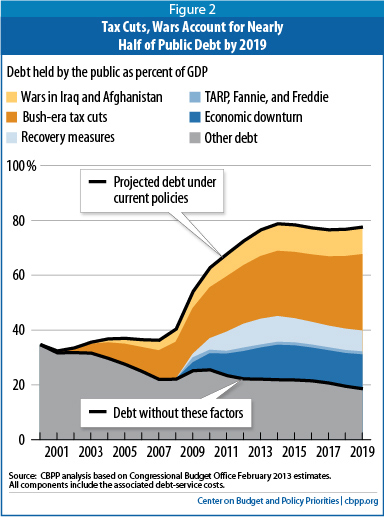
The Congressional Budget Office detailed how the Bush Tax Cuts and other tax cuts have impacted the Federal Debt (link)

Other factors have contributed to the Federal Debt including the Middle East wars and tax breaks and interest on the debt.
10-10-12bud_rev2-28-13-f2.jpg

As the title of the graph says, "Tax Cuts, Wars Account for Nearly Half of Public Debt by 2019"

Tax breaks this year will cost $1.18 trillion, as much as the entire discretionary spending and larger than the Federal Deficit, estimated at $702 billion this coming year.

One of the largest corporate tax break is for allowing multinational corporations to defer paying taxes on offshore profits, which will cost $65 billion a year.

The special low rate on capital gain and dividends is a lower rate than taxpayers pay on regular wages. That tax break will cost the federal government $83 billion this year, and a "staggering 68 percent of that total will go to the top 1 percent".
Big Tax Breaks Equal Big Cash for the Top 1%

The Republican Party platform in 2012 says taxes "reduce an citizen's freedom", feel taxation should only be for services specifically authorized by the Constitution, would have a simple tax like a flat tax, "oppose(s) retroactive taxation" and says any restructuring of federal taxes must include a repeal of the Sixteenth Amendment to the Constitution. The Party would reduce spending to lower the Federal deficit and debt. They isolate Medicare as a "largest driver of future debt".

Trump's and Cruz's Tax Plans linked above, with analysis of how they would increase the Federal Debt as well as impact the GDP. Both would further lower taxes for the top 10% to historic lows. Trump would lower the top tax bracket from 39% to 25%. Trump's Tax Plan cuts would cost between $10-12 trillion over a decade. It would increase public debt to 125% of the size of the economy by 2025 - up from 74% today.

So, combine the expected increase of the Federal Debt by 2019 (graph) and the amount further tax cuts would add to that debt, estimate how much more continued wars in the Middle East will cost, plus the interest on the debt and consider the pressure that the increasing debt will have on domestic and entitlement programs - or just read the Republican Party Platform for 2012 for their solutions.
 
Last edited:

wizards8507

Well-known member
Messages
20,660
Reaction score
2,661
I posted this in the Election thread but I think it's natural home is here.

How the Democrats Created a "Liberalism of the Rich"

When you press Democrats on their uninspiring deeds — their lousy free trade deals, for example, or their flaccid response to Wall Street misbehavior — when you press them on any of these things, they automatically reply that this is the best anyone could have done. After all, they had to deal with those awful Republicans, and those awful Republicans wouldn’t let the really good stuff get through. They filibustered in the Senate. They gerrymandered the congressional districts. And besides, change takes a long time. Surely you don’t think the tepid-to-lukewarm things Bill Clinton and Barack Obama have done in Washington really represent the fiery Democratic soul.

So let’s go to a place that does. Let’s choose a locale where Democratic rule is virtually unopposed, a place where Republican obstruction and sabotage can’t taint the experiment.

Let’s go to Boston, Massachusetts, the spiritual homeland of the professional class and a place where the ideology of modern liberalism has been permitted to grow and flourish without challenge or restraint. As the seat of American higher learning, it seems unsurprising that Boston should anchor one of the most Democratic of states, a place where elected Republicans (like the new governor) are highly unusual. This is the city that virtually invented the blue-state economic model, in which prosperity arises from higher education and the knowledge-based industries that surround it.

The coming of post-industrial society has treated this most ancient of American cities extremely well. Massachusetts routinely occupies the number one spot on the State New Economy Index, a measure of how “knowledge-based, globalized, entrepreneurial, IT-driven, and innovation-based” a place happens to be. Boston ranks high on many of Richard Florida’s statistical indices of approbation — in 2003, it was number one on the “creative class index,” number three in innovation and in high tech — and his many books marvel at the city’s concentration of venture capital, its allure to young people, or the time it enticed some firm away from some unenlightened locale in the hinterlands.

Boston’s knowledge economy is the best, and it is the oldest. Boston’s metro area encompasses some 85 private colleges and universities, the greatest concentration of higher-ed institutions in the country — probably in the world. The region has all the ancillary advantages to show for this: a highly educated population, an unusually large number of patents, and more Nobel laureates than any other city in the country.

The city’s Route 128 corridor was the original model for a suburban tech district, lined ever since it was built with defense contractors and computer manufacturers. The suburbs situated along this golden thoroughfare are among the wealthiest municipalities in the nation, populated by engineers, lawyers, and aerospace workers. Their public schools are excellent, their downtowns are cute, and back in the seventies their socially enlightened residents were the prototype for the figure of the “suburban liberal.”

Another prototype: the Massachusetts Institute of Technology, situated in Cambridge, is where our modern conception of the university as an incubator for business enterprises began. According to a report on MIT’s achievements in this category, the school’s alumni have started nearly 26,000 companies over the years, including Intel, Hewlett Packard, and Qualcomm. If you were to take those 26,000 companies as a separate nation, the report tells us, its economy would be one of the most productive in the world.

Then there are Boston’s many biotech and pharmaceutical concerns, grouped together in what is known as the “life sciences super cluster,” which, properly understood, is part of an “ecosystem” in which PhDs can “partner” with venture capitalists and in which big pharmaceutical firms can acquire small ones. While other industries shrivel, the Boston super cluster grows, with the life-sciences professionals of the world lighting out for the Athens of America and the massive new “innovation centers” shoehorning themselves one after the other into the crowded academic suburb of Cambridge.

To think about it slightly more critically, Boston is the headquarters for two industries that are steadily bankrupting middle America: big learning and big medicine, both of them imposing costs that everyone else is basically required to pay and which increase at a far more rapid pace than wages or inflation. A thousand dollars a pill, 30 grand a semester: the debts that are gradually choking the life out of people where you live are what has made this city so very rich.

Perhaps it makes sense, then, that another category in which Massachusetts ranks highly is inequality. Once the visitor leaves the brainy bustle of Boston, he discovers that this state is filled with wreckage — with former manufacturing towns in which workers watch their way of life draining away, and with cities that are little more than warehouses for people on Medicare. According to one survey, Massachusetts has the eighth-worst rate of income inequality among the states; by another metric it ranks fourth. However you choose to measure the diverging fortunes of the country’s top 10% and the rest, Massachusetts always seems to finish among the nation’s most unequal places.

Seething City on a Cliff

You can see what I mean when you visit Fall River, an old mill town 50 miles south of Boston. Median household income in that city is $33,000, among the lowest in the state; unemployment is among the highest, 15% in March 2014, nearly five years after the recession ended. Twenty-three percent of Fall River’s inhabitants live in poverty. The city lost its many fabric-making concerns decades ago and with them it lost its reason for being. People have been deserting the place for decades.

Many of the empty factories in which their ancestors worked are still standing, however. Solid nineteenth-century structures of granite or brick, these huge boxes dominate the city visually — there always seems to be one or two of them in the vista, contrasting painfully with whatever colorful plastic fast-food joint has been slapped up next door.

Most of the old factories are boarded up, unmistakable emblems of hopelessness right up to the roof. But the ones that have been successfully repurposed are in some ways even worse, filled as they often are with enterprises offering cheap suits or help with drug addiction. A clinic in the hulk of one abandoned mill has a sign on the window reading simply “Cancer & Blood.”

The effect of all this is to remind you with every prospect that this is a place and a way of life from which the politicians have withdrawn their blessing. Like so many other American scenes, this one is the product of decades of deindustrialization, engineered by Republicans and rationalized by Democrats. This is a place where affluence never returns — not because affluence for Fall River is impossible or unimaginable, but because our country’s leaders have blandly accepted a social order that constantly bids down the wages of people like these while bidding up the rewards for innovators, creatives, and professionals.

Even the city’s one real hope for new employment opportunities —- an Amazon warehouse that is now in the planning stages — will serve to lock in this relationship. If all goes according to plan, and if Amazon sticks to the practices it has pioneered elsewhere, people from Fall River will one day get to do exhausting work with few benefits while being electronically monitored for efficiency, in order to save the affluent customers of nearby Boston a few pennies when they buy books or electronics.

But that is all in the future. These days, the local newspaper publishes an endless stream of stories about drug arrests, shootings, drunk-driving crashes, the stupidity of local politicians, and the lamentable surplus of “affordable housing.” The town is up to its eyeballs in wrathful bitterness against public workers. As in: Why do they deserve a decent life when the rest of us have no chance at all? It’s every man for himself here in a “competition for crumbs,” as a Fall River friend puts it.

The Great Entrepreneurial Awakening

If Fall River is pocked with empty mills, the streets of Boston are dotted with facilities intended to make innovation and entrepreneurship easy and convenient. I was surprised to discover, during the time I spent exploring the city’s political landscape, that Boston boasts a full-blown Innovation District, a disused industrial neighborhood that has actually been zoned creative — a projection of the post-industrial blue-state ideal onto the urban grid itself. The heart of the neighborhood is a building called “District Hall” — “Boston’s New Home for Innovation” — which appeared to me to be a glorified multipurpose room, enclosed in a sharply angular façade, and sharing a roof with a restaurant that offers “inventive cuisine for innovative people.” The Wi-Fi was free, the screens on the walls displayed famous quotations about creativity, and the walls themselves were covered with a high-gloss finish meant to be written on with dry-erase markers; but otherwise it was not much different from an ordinary public library. Aside from not having anything to read, that is.

This was my introduction to the innovation infrastructure of the city, much of it built up by entrepreneurs shrewdly angling to grab a piece of the entrepreneur craze. There are “co-working” spaces, shared offices for startups that can’t afford the real thing. There are startup “incubators” and startup “accelerators,” which aim to ease the innovator’s eternal struggle with an uncaring public: the Startup Institute, for example, and the famous MassChallenge, the “World’s Largest Startup Accelerator,” which runs an annual competition for new companies and hands out prizes at the end.

And then there are the innovation Democrats, led by former Governor Deval Patrick, who presided over the Massachusetts government from 2007 to 2015. He is typical of liberal-class leaders; you might even say he is their most successful exemplar. Everyone seems to like him, even his opponents. He is a witty and affable public speaker as well as a man of competence, a highly educated technocrat who is comfortable in corporate surroundings. Thanks to his upbringing in a Chicago housing project, he also understands the plight of the poor, and (perhaps best of all) he is an honest politician in a state accustomed to wide-open corruption. Patrick was also the first black governor of Massachusetts and, in some ways, an ideal Democrat for the era of Barack Obama — who, as it happens, is one of his closest political allies.

As governor, Patrick became a kind of missionary for the innovation cult. “The Massachusetts economy is an innovation economy,” he liked to declare, and he made similar comments countless times, slightly varying the order of the optimistic keywords: “Innovation is a centerpiece of the Massachusetts economy,” et cetera. The governor opened “innovation schools,” a species of ramped-up charter school. He signed the “Social Innovation Compact,” which had something to do with meeting “the private sector’s need for skilled entry-level professional talent.” In a 2009 speech called “The Innovation Economy,” Patrick elaborated the political theory of innovation in greater detail, telling an audience of corporate types in Silicon Valley about Massachusetts’s “high concentration of brainpower” and “world-class” universities, and how “we in government are actively partnering with the private sector and the universities, to strengthen our innovation industries.”

What did all of this inno-talk mean? Much of the time, it was pure applesauce — standard-issue platitudes to be rolled out every time some pharmaceutical company opened an office building somewhere in the state.

On some occasions, Patrick’s favorite buzzword came with a gigantic price tag, like the billion dollars in subsidies and tax breaks that the governor authorized in 2008 to encourage pharmaceutical and biotech companies to do business in Massachusetts. On still other occasions, favoring inno has meant bulldozing the people in its path — for instance, the taxi drivers whose livelihoods are being usurped by ridesharing apps like Uber. When these workers staged a variety of protests in the Boston area, Patrick intervened decisively on the side of the distant software company. Apparently convenience for the people who ride in taxis was more important than good pay for people who drive those taxis. It probably didn’t hurt that Uber had hired a former Patrick aide as a lobbyist, but the real point was, of course, innovation: Uber was the future, the taxi drivers were the past, and the path for Massachusetts was obvious.

A short while later, Patrick became something of an innovator himself. After his time as governor came to an end last year, he won a job as a managing director of Bain Capital, the private equity firm that was founded by his predecessor Mitt Romney — and that had been so powerfully denounced by Democrats during the 2012 election. Patrick spoke about the job like it was just another startup: “It was a happy and timely coincidence I was interested in building a business that Bain was also interested in building,” he told the Wall Street Journal. Romney reportedly phoned him with congratulations.

Entrepreneurs First

At a 2014 celebration of Governor Patrick’s innovation leadership, Google’s Eric Schmidt announced that “if you want to solve the economic problems of the U.S., create more entrepreneurs.” That sort of sums up the ideology in this corporate commonwealth: Entrepreneurs first. But how has such a doctrine become holy writ in a party dedicated to the welfare of the common man? And how has all this come to pass in the liberal state of Massachusetts?

The answer is that I’ve got the wrong liberalism. The kind of liberalism that has dominated Massachusetts for the last few decades isn’t the stuff of Franklin Roosevelt or the United Auto Workers; it’s the Route 128/suburban-professionals variety. (Senator Elizabeth Warren is the great exception to this rule.) Professional-class liberals aren’t really alarmed by oversized rewards for society’s winners. On the contrary, this seems natural to them — because they are society’s winners. The liberalism of professionals just does not extend to matters of inequality; this is the area where soft hearts abruptly turn hard.

Innovation liberalism is “a liberalism of the rich,” to use the straightforward phrase of local labor leader Harris Gruman. This doctrine has no patience with the idea that everyone should share in society’s wealth. What Massachusetts liberals pine for, by and large, is a more perfect meritocracy — a system where the essential thing is to ensure that the truly talented get into the right schools and then get to rise through the ranks of society. Unfortunately, however, as the blue-state model makes painfully clear, there is no solidarity in a meritocracy. The ideology of educational achievement conveniently negates any esteem we might feel for the poorly graduated.

This is a curious phenomenon, is it not? A blue state where the Democrats maintain transparent connections to high finance and big pharma; where they have deliberately chosen distant software barons over working-class members of their own society; and where their chief economic proposals have to do with promoting “innovation,” a grand and promising idea that remains suspiciously vague. Nor can these innovation Democrats claim that their hands were forced by Republicans. They came up with this program all on their own.
 

RDU Irish

Catholics vs. Cousins
Messages
8,622
Reaction score
2,722
The Office of Redundancy Office called and said linking an article AND posting the whole damn thing is particularly effective when the article is a mile long. If it is so inspiring why not summarize what is linked and/or paste a handful of most impactful parts.
 

wizards8507

Well-known member
Messages
20,660
Reaction score
2,661
The Office of Redundancy Office called and said linking an article AND posting the whole damn thing is particularly effective when the article is a mile long. If it is so inspiring why not summarize what is linked and/or paste a handful of most impactful parts.
Really? Whiskeyjack does it ten times a day but when I do it I get called out? His signature post goes something like this:

TAC's so-and-so just posted an interesting article titled 'The End of the American Dream.' Link. Wall of text.
 

Whiskeyjack

Mittens Margaritas Ante Porcos
Staff member
Messages
20,894
Reaction score
8,126
The Spectator's Fraser Nelson just published an article titled "The return of eugenics":

The only way of cutting off the constant stream of idiots and imbeciles and feeble-minded persons who help to fill our prisons and workhouses, reformatories, and asylums is to prevent those who are known to be mentally defective from producing offspring. Undoubtedly the best way of doing this is to place these defectives under control. Even if this were a hardship to the individual it would be necessary for the sake of protecting the race.
— The Spectator, 25 May 1912

It’s comforting now to think of eugenics as an evil that sprang from the blackness of Nazi hearts. We’re familiar with the argument: some men are born great, some as weaklings, and both pass the traits on to their children. So to improve society, the logic goes, we must encourage the best to breed and do what we can to stop the stupid, sick and malign from passing on their defective genes. This was taken to a genocidal extreme by Hitler, but the intellectual foundations were laid in England. And the idea is now making a startling comeback.

A hundred years ago the eugenic mission involved a handful of crude tools: bribing the ‘right’ people to have larger families, sterilising the weakest. Now stunning advances in science are creating options early eugenicists could only dream about. Today’s IVF technology already allows us to screen embryos for inherited diseases such as cystic fibrosis. But soon parents will be able to check for all manner of traits, from hair colour to character, and choose their ‘perfect’ child.

The era of designer babies, long portrayed by dystopian novelists and screenwriters, is fast arriving. According to Hank Greely, a Stanford professor in law and biosciences, the next couple of generations may be the last to accept pot luck with procreation. Doing so, he adds, may soon be seen as downright irresponsible. In his forthcoming book The End of Sex, he explains a brave new world in which mothers will be given a menu with various biological options. But even he shies away from the word that sums all this up. For Professor Greely, and almost all of those in the new bioscience, eugenics is never mentioned, as if to avoid admitting that history has swung full circle.

The word ‘eugenics’ was coined in 1883 by Francis Galton, a polymath who invented fingerprinting and many of the techniques of modern statistical research. He started with a hunch: that so many great men come from the same families because genius is hereditary. Fascinated by the evolutionary arguments of his cousin Charles Darwin, he wondered whether advances in health care and welfare had sullied the national gene pool because they allowed more of the sick and disabled not just to survive but to lead normal family lives. He went off to collect data, and came back with his theory of eugenics.

This was hailed not as a theory but as a discovery — a new science of human life, with laws as immutable as Newton’s. A race of gifted men could be created, he said, ‘as surely as we can propagate idiots by mating cretins’

Some of the most revered names in British history lapped this up. As Home Secretary, Churchill wrote to the Prime Minister urging him to do more to stop the “multiplication of the unfit”. Darwin himself would come to fear that “if the prudent avoid marriage whilst the reckless marry, inferior members tend to supplant the better members of society”.

By 1908, a Royal Commission conveyed the grave news that there were 150,000 ‘feeble-minded’ people in Britain. So what was to be done with them? As one reformer put it: “They must be acknowledged dependents of the State…but with complete and permanent loss of all civil rights – including not only the franchise but civil freedom and fatherhood”. This was William Beveridge, founder of the welfare state.

A report in The Times conveyed, matter-of-factly, the substance of a lecture given to the Eugenics Society following survey of the people of Devon by a Dr Grunby.

As to imbeciles, he said there was only one thing to do with them: exterminate them as they arose. He put forward the suggestion on purely humanitarian grounds.

Eugenics came to stand for modernity: to believe in it was to declare one’s belief in science and rationalism, to be liberated from religious qualms. Some of the most revered names in English history lapped all of this up. The Bishop of Birmingham called for sterilisation. Bertrand Russell looked forward to a eugenic era driven by science, not religion. ‘We may perhaps assume that, if people grow less superstitious, government will acquire the right to sterilise those who are not considered desirable as parents,’ he argued in 1924.

When a Sterilisation Bill was brought before Parliament in 1931 it had the backing of social workers, dozens of local authorities and the medical and scientific establishment. It was defeated, but the agenda continued. The Nuremberg Trials established that the Nazis (latecomers to all this) carried out some 400,000 compulsory sterilisations — a figure so horrific it has eclipsed the 60,000 in Sweden and a similar number in the United States. The idea of a biological divide between the fit and the unfit was no Nazi invention. It was the conventional wisdom of the developed world.

And this is the problem. Because we forget how badly Britain fell for eugenics, we fail to recognise the basic arguments of eugenics when they reappear — which they are now doing with remarkable regularity.

Consider Adam Perkins, a lecturer at King’s College London, who has published a study echoing the Royal Commission’s attempt to quantify the feeble-minded. The group he aims to study are the ‘employment-resistant’: those disposed to a life on welfare as a result of genetic predispositions and having grown up in workless homes. With Galtonesque precision, he estimates some 98,040 ‘extra’ people were ‘created by the welfare state’ over 15 years due to a rise in welfare spending. They represent an ‘ever-greater burden on the more functional citizens’.

In 1938, Germans were shown a poster of a cripple and invited to be angry about the costs of caring for him (60,000 Reichmarks). Dr Perkins tries a softer version of this general idea, calculating the £12,000-a-head annual cost of the new British untermensch — not just in welfare, but the crimes they will probably commit. His remedy? That Cameron’s government restricts welfare, so that claimants have fewer children. A perfect eugenic solution.

There is nothing monstrous about Dr Perkins, himself a former welfare claimant, nor anything very original about his book. He simply joins the dots of recent academic research and spells out what others won’t. His footnotes show the growing academic pedigree of the new eugenics: work has been done to identify genes relating to alcoholism, criminality, sporting success, even premature ejaculation. Extrapolations are now made about how far the quality of human stock worldwide has been eroded by health care and welfare.

In academia, the word ‘eugenics’ may be controversial but the idea is not. To Professor Julian Savulescu, editor-in-chief of the Journal of Medical Ethics, the ability to apply ‘rational design’ to humanity, through gene editing, offers a chance to improve the human stock — one baby at a time. ‘When it comes to screening out personality flaws such as potential alcoholism, psychopathy and disposition to violence,’ he said a while ago, ‘you could argue that people have a moral obligation to select ethically better children’.

Meanwhile, the scientific pursuit of ‘ethically better children’ is advancing rapidly. Since Louise Brown was conceived in a laboratory 38 years ago — the world’s first IVF baby — the treatment has become mainstream, sought by 100 women a day in Britain. Developments in IVF mean that, today, several embryos can be fertilised and screened for diseases, with the winner implanted in the uterus. The next step was taken last year, when Chinese scientists succeeded in modifying the genes of a fertilised embryo. It was rather messy: they attempted to treat 86 non-viable embryos, and failed in most cases. So they abandoned the experiment, saying a 100 per cent success rate is needed when dealing in human life.

This — the genetic modification of human embryos — is what causes the concern. But here, and at each point in the new eugenics, you can argue: where is the moral problem? There are no deaths, no sterilisations, no abortions: just a scientifically guided conception. The potential avoidance of disease, to the betterment of humanity. So who could complain?

One answer came four months ago, when 150 scientists and academics called for a complete shutdown of human gene editing. In a letter released before a summit in Washington DC, they argued that the technology would ‘open the door to an era of high-tech consumer eugenics’, with affluent parents choosing the best qualities and creating a new form of genetically modified human. To these scientists, the complex issue boils down to a simple point: ‘We must not engineer the genes we pass on to our descendants.’

Such concerns cannot be heard from the British government, which recently helped to build the Francis Crick Institute, a new nerve centre for biomedical research. A few weeks ago, the institute was given authorisation to begin a new, controversial gene-editing technique known as CRISPR-Cas9. To supporters, this is proof of Britain’s position at the cutting edge of research. To critics, it is proof that Britain (one of the few countries that does not ban the use of fertilised human embryos in experiments) is again rushing headlong into eugenic science with minimal debate.

On the rare occasions the matter is raised in Parliament, ministers say that they do not support eugenics. But, as Chris Patten has pointed out in the Lords, that is a meaningless statement if there is no attempt to define the term. To David Galton, who has written more about the subject than any British academic, the definition is simple. If you use science to make the best of genes handed down to the next generation, that’s eugenics: ‘Sweeping the word under the carpet or sanitising it with another name merely conceals the appalling abuses that have occurred in the past and may lull people into a false sense of security.’

The idea of consumer eugenics is no futurist fantasy. Already, sperm banks boast about screening for everything from autism to red hair. £12,000 buys you the chance to choose which embryo to implant. And £400 buys sperm-sorting, the better to conceive a boy (or a girl). And even in the slums of India, women desperate for a boy will pay for ante-natal screening to identify — and abort — girls. It doesn’t take government to pursue eugenics: parents will do it themselves.

The Francis Crick Institute says its gene-editing research has nothing to do with eugenics; even British law prohibits pregnancies from gene-edited embryos, and its researchers plan to destroy them after seven days. Instead, it aims to learn about the role of genes in miscarriage. But if its research improves gene-editing technology, less scrupulous scientists can make use of that. This is why scholars like Robert Pollack, a professor at Columbia University, want a moratorium on the whole process of modifying human genes. ‘Imagine that, many years hence, there are two sorts of people: those who carry the messy inheritance of their ancestors, and those whose ancestors had the resources to clean up their germ cells before IVF.’ So you end up with two types of humans: the genetically tidy rich and everyone else.

The experiments being carried out in London are worrying, he says, precisely because the British have such a good success rate. ‘It is not failure, but success, that concerns me,’ says Professor Pollack. ‘And for that concern, there are few venues more troubling than the Crick Institute — it is as likely as any place in the world to do this without making any distracting, avoidable mistakes.’

So some 130 years after Britain gave the world the idea of perfecting humanity, we are once again at the cutting edge of this troubled science. For good or ill, eugenics is back.

Welcome to the post-Christian West. It looks a lot more like Brave New World than Star Trek.
 

wizards8507

Well-known member
Messages
20,660
Reaction score
2,661
Whiskey, if you ever have a chance to see Damon Owens from the Theology of the Body Institute speak on human sexuality, he's absolutely brilliant.

Sent from my Galaxy Note4 using Tapatalk.
 

Legacy

New member
Messages
7,871
Reaction score
321
Corporate Inversions

Corporate Inversions

After a divided Congress did not act (once again) on nearly unanimous agreement that U.S. Corporate Tax Inversions needed to be resolved, the Treasury has put out its new rules to impede these deals which are made to protect overseas profits from U.S. taxes. Obama had called on Congress to act to prevent this. (Wall Street Journal)

Tax Inversion Explained

Here's a good explanation of how corporations like Google, Apple, Facebook and more than fifty others have stashed away trillions of dollars and paid minimal taxes.
Tax avoidance: The Irish inversion
Nine of the top ten global pharmaceutical companies have operations in Ireland.

Bloomberg won the Pulitzer Prize in Explanatory Reporting for their writing on Tax Inversions. (Tax Inversion: How U.S. Companies Buy Tax Breaks) Here's Bloomberg's table of corporate inversion corporations..

The announcement of the new regulations on inversions by the Treasury stopped Pfizer from buying the Irish pharmaceutical company, Allergen, which is half as big, yesterday and changing their country of origin.

Yesterday's Bloomberg piece on how the Treasury regulations have affected some companies and their stock prices -- The Taxman Gets Tough on Inversions.

The Google Example
Google has avoided U.S. taxes on $2 billion which shifting its profits from Ireland to the Netherlands and then to Bermuda in 2014 and has again recently stashed more billions in Bermuda. That's what's called the Double Irish with a Dutch Sandwich. (An illustration and explanation.)

Google has paid 0.024% in taxes on $11.7 billion in overseas profit.[/URL] The European Union has calculated that they lose $1.3 trillion per year. Ireland has acted to curb this, but corporations already there, like Google, have until 2020 to conform to their new rules.

Inversion Myths
Here's Fortune's 3 Myths About Inversions and U.S. Corporate Taxes including

Myth 1: Corporate America is not competitive, and our tax code is to blame.
Myth 2: Inversions are being driven by the corporate response to America’s uncompetitive tax system.
Myth 3: A territorial system that exempted foreign income would solve the inversion problem.

Presidential Candidates' Proposals
Here's how the Presidential candidates stand on 2016 Presidential Tax reform, specifically Corporate Income Tax Rate and Corporate Income Tax: International Income


As long as the revenue is stored overseas, it is not subject to U.S. tax. Some Presidential candidates propose a repatriation of foreign income at a 10% tax rate and shifting to a territorial tax system. Trump would additionally preserve the foreign tax credit.

With trillions not subject to U.S. taxes and billions in federal revenue lost each year and with a National Debt of $19 trillion with proposals by candidates to further cut tax revenue, Congress will have to find funding to compensate, increase the Debt or shift the tax burden to those who cannot take advantage of these tax breaks.
 
Last edited:

RDU Irish

Catholics vs. Cousins
Messages
8,622
Reaction score
2,722
Allergan the "small" company has a 90 billion market cap versus 200 billion for Pfizer. Half as big might be a more suitable description but small is ridiculous.
 

Legacy

New member
Messages
7,871
Reaction score
321
Allergan the "small" company has a 90 billion market cap versus 200 billion for Pfizer. Half as big might be a more suitable description but small is ridiculous.

Corrected. Any other thoughts or comments?
 

Whiskeyjack

Mittens Margaritas Ante Porcos
Staff member
Messages
20,894
Reaction score
8,126
Paging wizards...

Paging wizards...

The Week's Pascal-Emmanuel Gobry just published an article titled "A capitalist critique of consumerism":

It's become a cliché to note that we in the modern world have gorged on an unprecedented abundance of stuff. Still, Frank Trentmann's new book on consumerism, The Empire of Things, begins with an eye-opening fact: "A typical German owns 10,000 objects." Let that sink in. Ten thousand!

The second and third sentences are hardly less forgiving. "In Los Angeles, a middle-class garage no longer houses a car but several hundred boxes of stuff. The United Kingdom in 2013 was home to six billion items of clothing, roughly 100 per adult; a quarter of these never leave the wardrobe." Though consumerism is often seen as a liberal bogeyman, even supporters of free enterprise — of whom I am one — need to admit we have a problem.

Let's start, however, by noting that consumerism's defenders have more than half a point.

That's because the alternative to "consumerism" is, literally, the Soviet Union. Back in the USSR, you had one brand of car, and it was certainly no-frills. So were clothes, housing, books, entertainment, and everything else. Anyone who cares about human flourishing should remember the well-attested-to scenes of East Germans coming to West Germany after the Berlin Wall fell and literally falling down crying the first time they walked into a supermarket. What looks like shallow consumerism to us is also the only alternative to deep, grinding misery.

Another important point is that one person's consumerism is another person's welfare-enhancing piece of humanity. When Facebook games like FarmVille (remember that?) were all the rage, our great and good mercilessly mocked anyone who would invest so much time and energy into virtual farms, and decried the companies that made those games as nothing but giant wastes of energy and capital. But I guarantee you there's more than one frazzled housewife or single mom in Ohio with three kids for whom that virtual farm is the only oasis of peace and tranquility in her life. And who am I to say that her hobby is "consumerism" and my hobby is a welfare-enhancing hobby?

Or, to take another example, it's an understatement to say that the world of fashion is stunningly superficial. But fashion is also a way to express oneself and to construct a social identity, which is a worthy part of life. And remember: The alternative is Mao collars for everyone. And who will sit on the omniscient and benevolent committee that decides what counts as shallow consumerism?

Another place where the consumerists have a point is the upside of ads. Yes, ads bludgeon every sphere of our existence, but as Amar Bhidé, one of the greatest and most underrated business scholars out there, argues in his book The Venturesome Economy, what we think of the "shallow" side of the consumer economy is actually key to innovation.

We think of inventions as coming fully-formed from the head of geniuses — Thomas Edison with the light bulb, Steve Jobs with the iPhone — but the reality is much more complex. The first version of an innovation is rarely any good, but it blossoms into a game-changer because "venturesome consumers" are willing to take a chance on something wonky, which encourages innovators to build second, third, and fourth versions. Perhaps as much as its accumulation of capital or its regulatory environment, America's infamous and much-decried consumerism is a key element of its vaunted innovation engine.

But here is where I part ways with the consumerists and explain why I think you should only give two cheers to consumerism.

We're sometimes told that consumerism is what creates jobs and livelihoods. If we didn't buy meaningless trinkets, what would all the people who have jobs building and selling them do? This sort of reasoning exposes the fundamental clash in worldviews at the heart of most visions of economic life. I call them the "productivist view" and the "creative view."

What is an economy for?

The productivist view says that an economy is for producing stuff. Its endless cycle of buying and selling provides both jobs and the stuff we need. In this view, it doesn't matter if we buy iPhones or punch-button dumbphones — the former might be better, but so long as there are enough factories and offices humming to give everyone a job and the means to buy the necessities of life, it means the economy is going well.

The creative view says that an economy is what happens when people cooperate to solve problems. The cycle of buying and selling just happens to be the most productive process to enable that cooperation.

In this scheme, almost all progressives are productivists. But a lot of people who identify with the right, or who support capitalism, are also productivists.

The liberal economist John Maynard Keynes was a productivist. His most famous idea — which says recessions can be overcome by pumping more money into the economy to kick-start the buying-selling cycle — is classic productivism. But the right-wing alternative — the idea that cutting taxes also promotes more buying and selling — is also productivist.

My belief is that the productivists are right in the short term, because some form of stimulus really is a good idea during a recession. But in the long run, the productivists are wrong and the creativists are right. The reason why billions of people no longer even have a concept of the hardscrabble, food-insecure life their forebears led is not because people started buying and selling more, but because people invented technologies — engineering technologies, like the steam engine, and social technologies, like modern finance and the limited liability corporation — that enabled people to cooperate more to solve more problems.

And here's where the anti-consumerists have a point: If we all suddenly and collectively decided to stop buying pointless junk, the economy wouldn't grind to a halt forever. People would just start working on more interesting, more valuable things.

I can refrain from judging the Ohio mom who loves FarmVille, and the engineers and designers who make the game she loves. But I can also think that the world would be a better place if she took up woodworking instead and those engineers and designers made educational games.

So, what should we do? What regulation should be put in place? None. At the end of the day, the only "remedy" for "consumerism" is the self-knowledge to realize what truly contributes to our own flourishing and the virtue to carry it out. The alternative to consumerism isn't political. It is cultural and even — dare I say it — metaphysical.

But I do want my fellow capitalists to realize that if they take a shot at consumerism once in a while, they're not taking a shot at their own side. To the contrary, they're reminding us of the first principle of free enterprise — that what a flourishing economy needs is not piles of junk, but creativity.

And here's an article from the Acton Institute's Paul Heyne titled "Limitations of the Economic Way of Thinking":

The noted ecological writer Bill McKibben began a recent article for Audubon magazine with the following suggestion for a thought experiment:

Let’s assume, for the duration of this article, that to you trees are vertical stalks of fiber, that a forest carries no more spiritual or aesthetic value than a parking lot, that woodland creatures are uninteresting sacks of calories, and that the smell of sunbaked pine needles on a breezy June afternoon merely matches the scent that comes from those conifer-shaped air fresheners that dangle from your rearview mirror.

Let’s assume, in other words, that you’ve done something rotten and God has turned you into an economist.

McKibben does not really believe that the economist’s way of thinking is as crude as this implies, but his remarks draw a smile because economists have, in fact, acquired a reputation for knowing “the price of everything and the value of nothing”–Oscar Wilde’s definition of a cynic.

As a long-time teacher of economics and even the author of a textbook titled The Economic Way of Thinking, I am not about to repudiate the perspective that economists employ in explaining the world they study. It is a powerful perspective and a highly useful one. Discussion of social issues would be vastly improved and public policy would be much sounder if more people understood the economic way of thinking and put it to work.

What exactly is the economic way of thinking? It is a perspective on human decisions and social transactions. I like to summarize it as the view that emerges from the presupposition that all social phenomena result from interactions among the choices that individuals make after calculating the expected benefits and costs to themselves. This perspective is very useful when employed to explain the working of the largely impersonal network of transactions that we call the market system or simply the economy.

Problems of Price and Value

Markets work best when exchange transactions can be arranged and carried through at low cost. Transaction costs decline rapidly when money prices are attached to all the alternatives under consideration, because these prices provide all parties with a common denominator for comparing values. Grocers can decide much more easily what to stock, for example, and customers can decide what to buy, by comparing price tags, which enables them to cooperate very effectively. When prices are not attached to alternatives, cooperation becomes more difficult. How can we compare the value of the better housing people will enjoy as a result of lower timber prices with the value of the amenities preserved when a forest is left standing, without placing some kind of dollar value on the latter as well as the former? Economists have acquired their reputation for knowing the price of everything and the value of nothing, in large part, by trying to explain a system in which relative prices are used as reflections of relative values and by trying to infer relative prices when markets do not provide any.

As long as economists use prices merely as the best available measure of values for selected purposes, the reputation is undeserved and unfair, but some people–not just professional economists–do conflate price and value. Doing that amounts to a failure to recognize a major limitation of the economic way of thinking. The Gross Domestic Product as measured by government statisticians is not identical to the Gross National Welfare. Some of what contributes to the former makes no contribution to total welfare or even makes it less. If the crime rate increases and homeowners buy security systems, the price of the security systems gets added to the Gross Domestic Product. If air pollution requires houses to be painted more often, the prices of the additional paint and painters’ services are counted in the gdp. If a man divorces his wife and subsequently hires a housekeeper, the wages of the housekeeper will contribute to the gdp, although the unpriced work of the wife did not.

Moreover, the fact that one person was willing to pay a higher price for a good than another does not prove that the first valued the good more highly. The first may simply have valued money less than the other at the margin, which means, given the relative amounts of money and other goods that each commanded when making decisions.

Most economists are so afraid of contaminating their analysis with value judgements that they will freely admit, even insist, that economic theory cannot decide whether one set of arrangements is better or more in the public interest than another. Many of these same economists fail to see, however, that the economic way of thinking also cannot determine whether one set of arrangements is more efficient than another. Claims that rent controls or protective tariffs promote inefficiency, if they mean anything definite at all, mean that rent controls and protective tariffs reduce the size of the potential Gross Domestic Product. That may be an interesting and important claim, but it is not as significant as the claim that they are inefficient. And the latter claim has no foundation in economic theory.

Efficiency refers ultimately to valuations. (The term technical efficiency is a meaningless combination of words.) Because prices and values are not the same, the economic way of thinking cannot pronounce on the relative efficiency of alternative arrangements. It is often said that rush-hour urban traffic is inefficient because it is made up predominantly of single passenger vehicles. That is an insupportable claim. Those who drive alone rather than forming a car pool or taking the bus are implicitly showing that they place a higher value on the benefits relative to the costs of driving alone than of any available alternative. For people with the appropriate values, the most efficient way to commute to work could be in solemn procession, carrying candles and chanting psalms.

Effective Coordination with Millions of Others

The economic way of thinking has at least one other major limitation, a limitation that is also closely related to the connection between economic theory and market systems. The problem begins with the fact that economic theory is a defense of market systems. While many, perhaps most, economists would vigorously dispute that last sentence, they are being disingenuous. Economic theory shows how millions of people, pursuing the infinitely varied projects that interest them, coordinate their activities effectively with millions of other people, although they know next to nothing about the projects that interest those other people. The economic way of thinking shows how social processes that look like recipes for chaos (and that have often been so described) produce actual cooperation and advance the purposes of those who participate in these processes. Adam Smith invoked a semi-theological metaphor to characterize this process: the invisible hand. Because economic theory explains the working of the invisible hand, it is in a very basic sense a defense of market systems. It does not defend every aspect of such systems, but it certainly tends strongly to demonstrate to anyone willing to pay attention that markets work a lot better than most people suppose and that proposed substitutes for market systems, such as socialism, are the true recipes for chaos.

However, the economic way of thinking exaggerates the achievements of markets by overlooking their subversive effect on other forms of human relationship. Adam Smith noted that in a society characterized by extensive specialization, people stand “at all times in need of the cooperation and assistance of great multitudes.” That certainly describes us. We depend upon multitudes of other people, most of whom we do not know and never think about, to provide the food, clothing, shelter, medical care, and other goods that enable us to live in comfort and health.

This dependence on others has one feature that deserves more attention than it usually receives: The dependence is characterized by extraordinary freedom because we rarely have to depend on specific others. If we do not like the product or the terms on which it is offered, we can take our business to someone else. We have lots of choices, and choice means freedom for each of us: genuine independence despite our dependence on “the cooperation and assistance of great multitudes.”

Communities of Exceptional Thinness

That is not an unmixed good. It produces a society in which people barely know, if they even know at all, most of the people with whom they interact. The market functions very well even when the transactions that make it up are between people with no personal knowledge of one another. In fact, this is a major source of the market’s effectiveness as a system for increasing the cooperative production of wealth. Specialization is the prime source of wealth; the degree of specialization is limited by the number of people with whom we can exchange at low cost; and we could not exchange with very many people if exchange always required personal knowledge of those with whom we are trading. It is not that market transactions are inherently impersonal but that markets have so extended the range of our transactions that we necessarily do most of our exchanging with people whom we cannot possibly know personally.

Reflect for a moment on the role of money in this scheme. Most of us feel vaguely uneasy selling to friends or buying from friends for money; it seems somehow cold and impersonal. At Christmastime we give our friends gifts that we have taken the trouble to choose, and which they must then sometimes take the trouble to exchange for something that better suits their situation. We do not just give them money and let them choose for themselves. Why? Because money is impersonal. And that is its great virtue. The evolution of money has facilitated impersonal transactions and thus has vastly expanded our ability to exchange at low cost with people all over the globe.

The corollary is that money creates communities in which very little is actually shared and that these communities, through their effectiveness in enabling us to further the projects in which we are interested, become the principal communities in which we participate. Monetary exchange so dominates our social transactions that we have come to reside primarily in communities of exceptional thinness. We cannot love our neighbors because we do not even know their names, which we have never had occasion to learn because we are in no way dependent on them, and we are not dependent on them because it is so much easier to consult the Yellow Pages when we find ourselves in need of assistance.

Even that is not all bad. How many of us want to live in a village where people all know one another? We have become strongly attached to the privacy that the market system makes possible. But we do incur costs for this: crime, isolation, loneliness, anomie, a sense of impotence in the face of social problems, festering inequities that both market and government are too impersonal to overcome. While some of us are in a position to belittle these costs, they are serious burdens for others.

The costs are unanticipated side effects of markets, part of the price we pay for the enormous wealth and personal liberty that markets create. They are not effects of the economist’s way of thinking, but the economic way of thinking has proved itself surprisingly blind to these costs, which is why I have emphasized them in discussing limitations of the economic way of thinking.

A Free, Prosperous, and Just Society

As already stated, I am a devoted practitioner of the economic way of thinking. I am also, as anyone can readily infer from this essay, a staunch defender of markets. Nothing in this essay should be interpreted as a call to replace either one. I would prefer that we learn to celebrate their strengths. I ask only that we do so with a clear consciousness of their limitations. Market systems and the economic way of thinking are necessary but not sufficient conditions for the nurture of a free, prosperous, and just society.

We must also learn to nurture social institutions about which economics can say relatively little that is interesting or important, face-to-face institutions as distinct from the largely impersonal institutions that respond to monetary signals. These are often the very same institutions that the market system tends over time to displace: the family, the church, and the neighborhood.

The operative word is displace, not replace. The market cannot be a complete substitute for the family, but it can and does provide family members with attractive opportunities that make participation in family activities less important. Time spent eating dinner together becomes too costly to prolong when the television set is calling.

Consider how the automobile, a favorite gift of the market system, has altered the role of churches in the lives of many who think of themselves as faithful “churchgoing people.” The mobility created by the automobile enables people to worship more easily at a church that suits them, which often means a church that imposes on them no uncomfortable demands and where they need not stay long enough to develop any serious responsibilities.

And who really needs the neighborhood? Why concern oneself with the neighborhood school when an efficient real-estate market makes it so easy to transfer residence to where the neighborhood school is more satisfactory?

The market is a faithful servant in America today, providing more and more of the good things that we want. That is no reason to cripple it. It is reason, however, to think more carefully about what we want.

I don't agree with PEG that Soviet-style socialism is the only alternative to capitalism, and I would have liked to read these authors' thoughts on the possibility that the "economic way of thinking" inherent in capitalism actively undermines the virtue it depends on to be successful. But I'm heartened to see classical liberals acknowledging the social costs inherent in their preferred economic system.
 

Whiskeyjack

Mittens Margaritas Ante Porcos
Staff member
Messages
20,894
Reaction score
8,126
TAC's Gene Callahan just published an article titled "Distribution is the Future":

Distributism is the rather awkward name given to a program of political economy formulated chiefly by G.K. Chesterton and Hilaire Belloc, two of the most prominent English writers of the early 20th century. Both Catholics, they sought to turn the social teaching of Popes Leo XIII and Pius XI into a concrete program of action. They rejected socialism, believing that private property was an essential component of human flourishing, but they also rejected the existing capitalist system as concentrating private property in far too few hands.

Distributism has garnered increased interest of late, due among other things to the social commentary of Pope Francis. Notwithstanding its Catholic origins, many non-Catholics have also embraced distributism over the years. Dorothy L. Sayers, E.F. Schumacher, and Christopher Lasch were influenced by its ideas, as has been the Spanish worker cooperative Mondragón.

Chesterton and Belloc shared a diagnosis for what they saw as the ills of the England of their day: the problem was not private property, as Marxists argued, but the fact that private property owners were scarce. As Chesterton put it in The Outline of Sanity: “The truth is that what we call Capitalism ought to be called Proletarianism. The point of it is not that some people have capital, but that most people only have wages because they do not have capital.”

When “Chesterbelloc”—as G.B. Shaw named the pair—talked about property, their focus was on capital goods, not consumption goods. They would not be impressed by arguments showing that, while American workers may be totally dispossessed of the means of production, at least they have 40-inch LCD televisions and smart phones.

Belloc understood what had occurred over the last several centuries of Western political development as a regression to conditions resembling those of the late Roman Empire, in which a few men owned great landed estates while the masses owned little or nothing in the way of productive property. In The Servile State, he wrote:

The two marks, then, defining the Capitalist State are: (1) That the citizens thereof are politically free: i.e. can use or withhold at will their possessions or their labour, but are also (2) divided into capitalist and proletarian in such proportions that the State as a whole is not characterised by the institution of ownership among free citizens, but by the restriction of ownership to a section markedly less than the whole, or even to a small minority.

Chesterton and Belloc were not the only ones thinking along these lines in the early decades of the 20th century. Karl Polanyi was a Hungarian economic historian and political philosopher who sought to highlight how an economy is always embedded in a larger social system. His 1944 book, The Great Transformation, detailed many of the ways in which the transition from the medieval economy to the capitalism of today occurred. While not every jot and tittle of Polanyi’s case has survived subsequent historical research, his basic thesis remains unscathed: capitalists often deliberately created a proletariat by legislative action.

A recent paper by David Meredith and Deborah Oxley in The Cambridge Economic History of Modern Britain, for example, provides evidence that “one-tenth of the English population in 1800 was slowly starving to death.” The authors describe how for the poor:

A few eggs, a cow for milk, a potato ground, all mattered. But over the eighteenth and nineteenth centuries self-provisioning came under serious attack. A padlock was placed on nature’s larder. First … traditional wage supplements such as gleaning and sweeping, and the collection of firewood from the forests, became criminal offenses; items of a ‘base nature’—rabbits, hares, fish—were redefined as private property, and their capture became a felony … Second, enclosure contributed to a class of ‘landless labourers’ without farming strips for growing household provisions, and they likewise suffered from a contraction of common lands upon which a cow might be kept or firewood harvested.

Their research into the relative heights of various occupants of the British Isles shows that in Scotland and Ireland, where the move towards modern capitalism lagged, people were taller—and thus, they conclude, better nourished—than in England, especially compared to English urban centers, where the creation of a proletariat had gone the furthest. London had the least healthy population of all.

Considering these facts, we might suspect that English capitalists, in need of cheap labor, passed laws to starve the English peasantry off of their land and force them into factories as the peasants’ only means of survival. If the proletariat was deliberately created by legislation and is not a spontaneous phenomenon, as many defenders of the status quo contend, that creation might also be undone by legislative action.

But if that is so, what direction should we head? The one recommended by the distributists sought to combine the best elements of various other visions of political economy.

Distributism shares with Marxism the goal of the workers owning the means of production and of eliminating the alienation of the worker from his product. (Of course, distributists meant that the workers should really own the means of production—not, as communists usually did, that the workers should “own” them through the intermediary of the state.) And distributist class analysis resembles Marxist class analysis in obvious ways.

Along with free-market economists, however, distributists recognize the importance of private property. Further, modern distributists recognize the crucial role of something that early advocates such as Chesterton and Belloc did not have the theoretical resources to articulate: namely, the vital role of true market prices in achieving economic efficiency. As Friedrich Hayek put it, market prices are able to incorporate knowledge of the “particular circumstances of time and place” into a worldwide economic system.

Distributism also contains aspects of communitarianism: with capital owned on a local level, owners are more likely to engage with the social and civic life of their community. Chesterton liked to refer to distributism as “real democracy.”

And finally—something that Belloc stressed—distributism has a conservative aspect: it posits as a laudable end not some utopian experiment in untested social arrangements but a socio-economic system that we already know is workable, from both historical and contemporary evidence. Furthermore, because workers themselves are the owners of capital goods, they are less likely to be forced to abandon their communities and extended families in order to keep a good job. There of course may be efficiency trade-offs in choosing to stay put rather than moving to some distant but more profitable location to find some work. But under distributism, workers would evaluate these trade-offs for themselves, rather than having some global corporate entity send them, willy-nilly, thousands of miles from their family and community—or finding themselves suddenly unemployed, as the modern corporation is loath to give its workers even a moment’s notice before they are escorted out of their workplace and onto the street by corporate security.

Our current system of global capitalism has its strong points. Capital can be moved around the globe swiftly in response to changing circumstances, something that would likely be much more difficult under distributism. And global capital has strong incentives to innovate, given that capital in one place is in competition for profits with all other capital around the world. Would a locally based manufacturer, favored by other local businesses, be as likely to embrace some risky new technology? Perhaps not.

When the workers of a given company are also its owners, evidence shows that they have a harder time adjusting their workforce to changing economic conditions. In fact, workers are liable to overpay for capital goods in order to preserve their jobs.

So what if we actually implemented distributist reforms and we found that large corporations continued to dominate our economic landscape for reasons like those above? If that happened, our situation would not have changed much from the status quo, but at least on the margin we would have a few more local businesses and family-owned farms.

♦♦♦

Let us examine some existing instances of economic activities that are more or less distributist in character.

Mondragón is the world’s largest worker cooperative, with 74,000 employees, and the tenth largest company in Spain. Founded in 1956, its nearly six decades of continuous operation are strong evidence that distributist ideas are not utopian. Centered in the Basque region of Spain, the creative impetus behind the organization came from Father José María Arizmendiarrieta, who was inspired by Catholic social teaching.

Various cautions have been put forward about employing Mondragón as a paradigm that others might emulate. One is the unique, apparently quite charismatic personality of Father Arizmendiarrieta: not every potential worker-owned cooperative will have a similar figure to lead it in its early days. A second consideration is the special character of the Basque region, whose residents seem to have felt a greater sense of solidarity than is typical in a similarly sized locale due to their history as a linguistic and ethnic minority in a Spanish kingdom. Lastly, Mondragón grew and flourished in an era when the Spanish economy was highly protectionist. Could it have prospered in a Spain more open to world markets?

Mondragón’s history has not been untroubled. Despite worker ownership, the corporation experienced serious labor unrest in the 1970s. In 2013 one of its major subsidiaries, Fagor, declared bankruptcy and was sold by its parent. Other problems emerge upon exploring the company’s history in greater detail. In fact, they are the very ones that would be predicted to hamper distributist enterprises: a difficulty in radically changing course when necessary, an inability to adjust the workforce to properly reflect market conditions, and the tendency to invest capital to save jobs, rather than directing it to its most efficient use.

(The above material on Mondragón is largely drawn from William Foote Whyte and Kathleen King Whyte’s Making Mondragón: The Growth and Dynamics of the Worker Cooperative Complex.)

We next come to a very odd type of worker-owned enterprise—one that is not actually owned in the traditional sense at all, and in which the workers, at least directly, earn nothing in terms of cash compensation: open-source software projects.

These anomalous enterprises constitute a valuable part of our economic landscape. For instance, Linux, built and maintained by volunteers and freely available to all, is the world’s most used operating system, as the basis for the mobile-device platform Android, as well as for many embedded systems such as cable set-top boxes, networking components, robotics-control systems, and medical systems.

Python, also maintained by a volunteer workforce, has become an extremely important programming language and is becoming a mainstay in scientific computing. Git and GitHub, also open-source projects, are now the most popular way to maintain public software repositories. And there are numerous other examples of this phenomenon.

Rather than earning money for their products, the volunteers who develop open-source software work for reputation. Lists of who has contributed the most to various open-source endeavors are publicly available and readily translate into job offers from more traditional enterprises.

This situation does not fit comfortably into mainstream economic analysis, but to be fair it is certainly not the kind of business model that the founders of distributism envisioned either. Nevertheless, it more closely resembles a distributist model than a traditionally capitalist one, as the means of production are the programmers’ own computers.

The communications revolution has made distributism more feasible in other ways as well. What is called the “sharing economy” has been a hot subject in the news, and in city councils, as companies like Airbnb and Uber have cut into the business of traditional hotels and taxi services, respectively. Both companies can be characterized, to some extent, as distributist enterprises.

Airbnb, by allowing homeowners to treat their property as small hotels, turns ordinary homes into capital goods, something of which Chesterton and Belloc would have approved. Uber does the same with people’s automobiles.

I have personal experience as an Airbnb host, having rented out my cabin in the Poconos for a few months through the service. I essentially worked as a hotel maid for that time, but I am sure my experience was very different than that of an employee of a hotel chain: I was working at my own pace, under my own direction. Making beds or mopping floors is much less onerous when you are doing it for your own business.

Many critics of the sharing economy complain that companies like Airbnb and Uber should count the people providing rooms and rides as employees rather than independent contractors. These companies, critics contend, are exploiting their workers by not providing minimum-wage guarantees, overtime, healthcare benefits, unemployment insurance, and so on.

I have two responses. First of all, I can state for a fact that “working for” Airbnb was nothing like being an employee at a traditional company: I never met a single person from Airbnb and only once corresponded with someone from the company, to resolve a payment issue. Airbnb did not set my hours, prevent me from subcontracting, or tell me anything about how to do my job, other than demanding that I fulfill the promises I made on their website about rates and accommodations. And more importantly, things like minimum wages and employer-provided benefits are the very sort of provisions that for Belloc marked the return of servile conditions, in which the proletariat would lack all independence but would be “well cared for” by its corporate masters. (The fact that the proletariat is now considered unable even to secure its own contraceptives without a company providing them is a sign of how far down this road we have traveled.)

More traditionally structured worker-owned businesses have also succeeded in the United States. The state of Vermont actively encourages worker-owned cooperatives, and the most prominent one, Cabot, is probably familiar to many buyers of cheese and other dairy products. And PBS Newshour recently detailed how New Belgium Brewing in Colorado became employee-owned and is achieving high levels of job satisfaction as a result, with workers “pouring their hearts” into the business on account of their stake in it.

Finally, I will mention another worker-owned enterprise with which I was involved: OTA Limited Partnership, a stocks and options trading company where I worked for several years around the turn of the century. I began as a consultant but was soon asked to join the company as a regular employee, which also meant becoming a part owner since the employees owned the company. I accepted, and not long after starting full time I went to a colleague’s office and asked him what the company vacation policy was. He looked at me oddly. “There is no vacation policy: you’re one of the owners. You take vacation when you feel you can afford to.”

I left his office with the odd feeling of being treated as an adult at work.

♦♦♦

For anyone attracted to the distributist model as one that respects the dignity and freedom of the individual, the obvious question is how to proceed in achieving it. This is one arena in which Chesterton, in particular, came up short. Understandably adverse to simple confiscation of property from existing owners—for how, exactly, could the confiscators decide exactly which holdings were amassed through “crony capitalism” and which through honest innovation and work?—he recommended that the state compensate large landowners for their land and distribute it to small ones. The problem with this idea is that the funds to pay the compensation have to be taxed away from somebody: if from the large landowners, then they are just having their property confiscated by a different route. But if the people to receive the land are taxed to pay for the public-domain seizures, then it would have been more sensible just to let them buy the land themselves.

I recommend that the way forward here is to recognize that markets always exist within some institutional framework. (This is a fact that Belloc recognized in his recommendations for advancing the distributist vision.) For the last couple of centuries, that framework has favored large concentrations of capital. If we change the tilt of the playing field to favor small proprietors, family farms, and worker-owned cooperatives, then first of all we are undoing a past injustice, and, secondly, we are not forbidding larger enterprises—which will still flourish when they truly have a significant edge in an industry over smaller ones.

I suggest the issue comes down to one of vision: do we see the common person as essentially a passive being, happiest giving up control of his or her own life to corporate and government experts, who will care for us with benefit packages and guaranteed levels of consumption goods? Or is the ideal for each person to exercise judgment over his or her life’s course to the maximum extent possible, accepting the risks that go along with independence? If the latter, then shifting our legal framework to enable more people to live independent lives is a risk worth taking.
 

Legacy

New member
Messages
7,871
Reaction score
321
The Campaign of Magical Thinking

In 1980, the third-party Presidential candidate John Anderson succinctly summed up Ronald Reagan’s promise to simultaneously cut taxes, increase defense spending, keep government services intact, and balance the budget: “Reagan’s budget is constructed with mirrors.” Sure enough, Reagan presided over eight years of deficits that tripled the national debt. Yet the Republican faith that you can tax-cut your way to deficit reduction has never dimmed. This year’s Republican race is dominated by candidates whose budgetary plans make Reagan’s look downright reasonable.

Kansas’ Pass-through Carve-out: A National Perspective

It’s important to note here that while decreasing taxes is generally associated with greater economic growth, the pass-through carve out is primarily incentivizing tax avoidance, not job creation.

If they passed a provision like this in Washington, D.C., where I live and work, I would go to my employer the next day and ask them to start paying me as an independent contractor. I would still be doing the same job and contributing the same value to the economy, I just wouldn’t be paying any income taxes.

Tax reform is about broadening tax bases and lowering tax rates. This state has lowered tax rates, but the pass-through exemption significantly narrows tax bases, and the wheels are coming off because of it.
 
Last edited:

wizards8507

Well-known member
Messages
20,660
Reaction score
2,661
Distributism Is the Future (That Few People Want) | Acton PowerBlog

Paging Whiskeyjack.

Distributism Is the Future (That Few People Want)
Thursday, April 21, 2016
By Joe Carter

Over the years, many of us here at Acton have been engaged in long-running (and mostly congenial) feud with distributists.

Family squabbles can often be the most heated, and that is true of this rivalry between the Christian champions of distributism and the Christian champions of free markets here at the Acton Institute. We fight among ourselves because we have an awful lot in common.

For example, we share the a focus on encouraging subsidiarity, self-sufficiency, and entrepreneurship. We also share a respect for rule of law, private property, and the essential nature of the family. The key difference — at least as viewed from this side of the feud — can be summed up in one word: distributism is mostly unrealistic.

That’s a long-standing critique, but it’s also one that may be changing. Not that distributists are necessarily becoming more realistic (I don’t know that they are) but merely that some of the most forward-thinking of the neo-distributists (the neo-neo-distributists?) are adopting a more realistic form of unrealistic aspirations.

To see what I mean, consider the old school neo-distributist model for how the system could work in the real world: the Mondragon Corporation. The only example these type of neo-distributists ever give — and good grief, they refer to it ad nauseam – is the Mondragon Corporation, a Spanish worker cooperative federation. The problem with using the Mondragon Corporation as a model of distributism is that it does not fit the basic definition of a distributist firm.

For starters, it’s hard to see how such as globalist company fits the ideal of “localism.” Mondragon has over 70,000 employees in 257 companies and annual revenues of more than 13 billion. The idea that individual workers are “owners” is a myth that even their employees don’t consider real. A third of the company’s employees are not even members of the collective. And surveys have shown that relatively few workers in Mondragon firms consider themselves to be “owners” of the company. Most seem to agree with one worker who said, “I am the owner of my job. The only property I have is my job.” If the only “property” you own is your job, then you do not own property. You don’t even own your job as much as your job owns you.

Multi-billion dollar globalist collectives owned by two-thirds of the employees is not a practical model for changing America’s economic system. What is needed is more small-scale practical changes — and any of the more realistic of the neo-distributists have begun to recognize this reality. In a recent debate sponsored by Acton, distributist Joseph Pearce said,

In practical terms, every policy or every practice that leads to a reuniting of man with the land and capital on which he depends for his sustenance is a step in the right direction. Every policy or practice that puts him more at the mercy of those who control the land and the capital on which he depends, and therefore who controls his labor also, is a step in the wrong direction. Practical politics is about moving in the right direction, however slowly.

Over the past few years there has been two economic shifts toward practices that reunite “man with the land and capital on which he depends for his sustenance.” They are the “gig economy” and the “sharing economy.”


Gene Callahan recognizes this shift in a smart essay in The American Conservative titled “Distributism is the Future.” After explaining the basic theory and history of distributism, Callahan says, “Let us examine some existing instances of economic activities that are more or less distributist in character.”

His first example (of course) is Mondragon (it might now be a requirement for distributist to mention that company in every essay), though Callahan points out some of the many reasons it might not be the best model. His second example — open-source software projects — is interesting, but as he admits, suffers from the fact that most of the “workers” don’t actually make any money.

His third example is the most intriguing of all:

The communications revolution has made distributism more feasible in other ways as well. What is called the “sharing economy” has been a hot subject in the news, and in city councils, as companies like Airbnb and Uber have cut into the business of traditional hotels and taxi services, respectively. Both companies can be characterized, to some extent, as distributist enterprises.

Airbnb, by allowing homeowners to treat their property as small hotels, turns ordinary homes into capital goods, something of which Chesterton and Belloc would have approved. Uber does the same with people’s automobiles.


I can picture the Wendell Berry-type distributists spewing their locally-grown coffee all over their computer screens after reading Uber and Airbnb are models of distributism. But I think Callahan is mostly correct. The sharing economy is likely to be the most realistic form of distributism we will see in our lifetimes.

And that’s bad news for distributism.

G.K. Chesterton, one of the founding fathers of distributism, quipped that, “The problem with capitalism is not too many capitalists, but not enough capitalists.” If that is a problem for capitalism, it is the fatal blow to distributism. The single biggest reason why distributism has not yet, nor ever will, become a mainstream “third way” is because relatively few people want to rely on their own private property to provide their income. Few people have the capacity, much less the willingness, to be self-sufficient capitalists in the mode that true distributism requires.

Yesterday, the Boston Globe Magazine ran an article with a headline that summarizes the problem: “The gig economy is coming. You probably won’t like it.”

According to a 2014 study commissioned by the Freelancers Union, 53 million Americans are independent workers, about 34 percent of the total workforce. A study from Intuit predicts that by 2020, 40 percent of US workers will fall into this category.

While there is considerable disagreement over this projection, what is clear is that “more and more jobs are being moved to independent contractor status,” says Jeffrey Pfeffer, a professor of organizational behavior at Stanford University. Pfeffer cites a recent paper that found that “the percentage of workers engaged in alternative work arrangements rose from 10.1 percent in February 2005 to 15.8 percent in late 2015.” This rise accounts for over 9 million people — more than all of the net employment growth in the US economy over that decade.


I’m one of those 9 million. For the past five years, I’ve been an independent laborer who works from home. All of the products and services I provide (blog posts, editing, etc.) are produced with material goods that I own (a laptop, etc.). I’ve been living the distributist dream. I can also attest that this distributist ideal is is hard. Very, very hard.

I don’t have employee benefits (I pay for health insurance out of my own pocket) or take vacations (my last vacation was in 2008) and I have to pay all of my own payroll taxes (if you work for someone else take what your payroll taxes and double them — that’s what I pay). I also work many more hours than would a person who has a nine-to-five corporate job.

And yet . . . I wouldn’t change a thing. For me, this type of situation is the best option available. But it’s not for everyone. Indeed, it’s not for most people.

Most workers want security. They want limited responsibility. They want to sell their labor on the open market and collect a paycheck. They don’t want the extra layer of having to combine their labor with some tangible “capital goods” in order to make a living. They want to work for someone else, have someone else give them pay and benefits, and leave the worries to someone else.

Like the distributists, I wish the world were full of entrepreneurs who were more willing and able to make a living solely through their own capital and labor. Unfortunately, we don’t live in such a world. And if this is the vision distributist’s vision for the future, it’s a vision of a future that most people don’t want.
 

Whiskeyjack

Mittens Margaritas Ante Porcos
Staff member
Messages
20,894
Reaction score
8,126

I don't disagree with anything he wrote; you may recall that I've explicitly argued that because of its emphasis on the local, sustainable and communitarian, Distributism could never be a plausible replacement for totalizing, global ideologies like capitalism or socialism. I still think it's a far superior way to live, though.

My beef with some Acton writers is that their defense of capitalism seems to blind them to its flaws. Paraphrasing Churchill, I can get on board with a defense of capitalism that admits, "It's the worst form of economic system, except for all those other forms that have been tried from time to time..."

Did you see the Acton article I shared above by Paul Heyne? Thought that was excellent.
 

wizards8507

Well-known member
Messages
20,660
Reaction score
2,661
Did you see the Acton article I shared above by Paul Heyne? Thought that was excellent.
I disagree with the thought experiment at the beginning under which the rest of the article operates. If public property were privatized, price and value would be much more closely aligned. There's economic value to biodiversity, for example. But when federal governments control national parks, there's nobody capturing that value in the form of transactions.

Privatization eliminates the tragedy of the commons by eliminating the commons.
 

Whiskeyjack

Mittens Margaritas Ante Porcos
Staff member
Messages
20,894
Reaction score
8,126
I disagree with the thought experiment at the beginning under which the rest of the article operates. If public property were privatized, price and value would be much more closely aligned. There's economic value to biodiversity, for example. But when federal governments control national parks, there's nobody capturing that value in the form of transactions.

Privatization eliminates the tragedy of the commons by eliminating the commons.

Huh? The article was about the limitations inherent to economic analysis; it had nothing to do with the Tragedy of the Commons.
 

wizards8507

Well-known member
Messages
20,660
Reaction score
2,661
Huh? The article was about the limitations inherent to economic analysis; it had nothing to do with the Tragedy of the Commons.
It's the same thing. The limitations inherent to economic analysis are because there are things with real value that are perceived as "free" and therefore not measured in economic analysis. When everything is owned by somebody, nothing is free and therefore all exchange of value also comes with an exchange of money and gets measured.
 

Legacy

New member
Messages
7,871
Reaction score
321
Bogtrotter07 OP#1: So the basic ethical, moral, and scientific question is : "Is putting more earned wealth into the hands of more people the solution to the economic problems faced by America today?" If not, what is?

Taxes on the rich may change a lot in 2017 (Brookings Institute)

If we focus on the top 0.1 percent of the spectrum – a group with an average income that exceeds $10 million – the average annual difference in taxes under the different plans runs in the millions of dollars....If Hillary Clinton’s proposal were enacted, they’d pay $500,000 more. By contrast, the Republican plans would give the rich big tax cuts. Ted Cruz would cut taxes by $2 million for those in the top 0.1 percent. Donald Trump would cut taxes for this group by $1.3 million. (John Kasich has not offered a tax plan.) In all cases, the tax changes come about through a combination of modifications to the rate structure as well as changes to existing deductions and credits.

These are tectonic shifts in tax policy. The eye-popping dollar figures don’t occur just because the top 0.1 percent has a lot of income. The proposed tax changes represent big percentage changes in after-tax income.

In contrast, the Republican proposals would bestow much larger proportionate benefits to the rich compared to the middle class. Under the Cruz proposal, the top 0.1 percent would see an increase in after-tax income of 29 percent compared to 3 percent for the middle quintile. Under the Trump plan, the after-tax income of the very rich would increase by roughly 19 percent compared to about 5 percent for the middle quintile.

Of course, there’s another side to the ledger. The Democrats’ tax increases would pay for new federal spending. The Republican plans would greatly increase the deficit – even if one uses dynamic scoring – and so would require spending cuts or future tax increases.

(My bolded)
 
Last edited:
Top