Economics

C

Cackalacky

Guest
AmCon's Scott Galupo just posted an article which touches on the American habit of sanctifying the "Market":

You might shoot me for saying this Whiskeyjack but I agree that the market/economy/ idealized version of of Capitalism is amoral at its very nature but where would the morals for a moral economy originate? Objective or subjective morals?


1091.gif


my-reaction-when-I-get-into-an-argument-with-women-homer-simpson-hide-in-bush-disappears.gif
 
Last edited:

Whiskeyjack

Mittens Margaritas Ante Porcos
Staff member
Messages
20,894
Reaction score
8,126
You might shoot me for saying this Whiskeyjack but I agree that the market/economy/ idealized version of of Capitalism is amoral at its very nature but where would the morals for a moral economy originate? Objective or subjective morals?

705391.png

"Now listen here, you little shit. You can take this moral relativism and shove it right up your..."

Believe it or not, I'm not in favor of imposing Christian morality on others through legislation (primacy of free will and all that). But I do think it's important that people realize how the "Market", detached from social and religious contexts, has become the enemy of community and social cohesion. It's useful, and concerns about efficiency certainly have their place, but to subjugate all aspects of our lives to a blind, amoral force of nature is incredibly harmful to human society.

I'd like to see a wider appreciation of this phenomenon, and policies designed to reverse the trend. Markets should serve communities; not visa versa. Such policies could appeal to a broad range of political and religious groups.
 

Whiskeyjack

Mittens Margaritas Ante Porcos
Staff member
Messages
20,894
Reaction score
8,126
Found a couple good articles on Distributism today. The first is titled "Pope Francis Needs Distributism":

Francis, after all, is only one of several modern Popes to have criticized capitalism. At the apex of the Industrial Revolution Pope Leo XIII addressed the disparity between the rich and the poor in his 1891 encyclical Rerum Novarum, setting forth the proper duties between worker and employer. Workers were to faithfully perform their duties and refrain from acts of violence and destruction of property. Employers were to pay a living wage, provide time off for religious days and holidays, and respect workers according to ability, age, and gender. In addition to promoting the dignity of the worker, the encyclical asserted that owning property was a basic human right according to natural law. The employer has a right to property, but the laborer should be able to advance so that he too could own property.

To mark the 40-year anniversary of Rerum Novarum, Pope Pius XI reasserted the foundational necessity of private property ownership for a free society. Quadragesimo Anno (1931) re-emphasized the importance of fair wages and ethical relations between worker and employer. Pius XI placed special emphasis on the functionality of small- and medium-sized enterprises to maintain a balance in the social order against the threat of monopolizing powers. Both Pope Pius XII and John Paul II spoke expressively of solidarity, the idea that we need associations to survive and thrive economically.

These Popes are only the beginning of thoughtful Catholic critiques of capitalism’s ill effects. British writer and historian Hilaire Belloc said that if pure capitalism reigned there would be constant unemployment, starvation in the streets, and perpetual turmoil. Belloc believed modern capitalism was an unstable force and in conflict with the moral theories of liberty. Belloc’s contemporary, G.K. Chesterton, couldn’t have agreed more, and they both directed much of their energies into disparaging what they deemed to be the “Servile State,” an economic system whereby an unfree majority of nonowners work for the pleasure of a free minority of owners.

Belloc and Chesterton were supporters of distributism. Distributism is not a form of socialism or communism. Rather, it envisions an economy with the widest use of private productive property. Distributism is best viewed as a humane microcapitalism. While the American version of it is found in Jefferson’s agrarian society, the Russian version of it is found in Alexander Solzhenitsyn’s “democracy of small places.” Belloc and Chesterton were not opposed to capitalism per se, but they saw unrestrained capitalism to tend toward state-sustained monopolies. When Chesterton quipped, “Too much capitalism does not mean too many capitalists, but too few capitalists,” he had in mind a robust economy of small businesses and family farms.

The second is titled "The Conservative Case Against Capitalism":

Democracy alone was totally inadequate to ensure freedom and dignity. Belloc maintained that crony capitalism was the inevitable result once the wealthy classes had reduced all others to dependency and their full weight of influence corrupted the legislature. A society with well-distributed property would provide a check against the rich and the state both. "The family must have not only power to complain against arbitrary control external to it, but power to make its complaint effective," he wrote.

Even today, millions of Americans intuitively agree with Belloc's definition of freedom as including some form of economic independence. But for most Americans it is an aspiration, something for the lucky or the extraordinarily productive, or both. When listeners tune in to financial guru Dave Ramsey looking for "financial peace," he urges them to thrift and a tenacious desire for increased income, so that one day they can turn that income into productive property; their own business, their own trade, or even enough mutual funds that they never be at the mercy of a boss again. People really do fantasize about how they would quit their jobs, which serves to dramatize their dissatisfaction and makes plain to their bosses the indignities they suffer as wage-slaves.

But the critique of the distributists goes further. Extraordinary personal virtue may effectively free a few families, but is not enough to create a society characterized by freedom — not when capitalists have rigged the game as thoroughly as they have. The redistribution of property would necessarily require state intervention, because the concentration of property would be protected by the rules of that game. Belloc's distributist order was one where society remained powerful, families mostly free, and the state mostly contained. He theorized that taxes would go up in capitalism's Servile State, to subsidize the wage-earners and dependents, but would be constrained in his ideal...

But the distributists still have something to offer contemporary conservatives, namely the ideas that economic freedom is measured by the way families flourish; that economic freedom means more than just an income with a boss or a government agency at the end of it; that real freedom is the ability to say no to tyrants in both the public and private spheres. They could profit much from Belloc's insights into how the plutocracy corrupts both representative government and the market. And they could also benefit from grounding their politics, as the early distributists did, not just in theories of liberty or trust in the invisible hand of the market, but in the supreme dignity of man.

Chesterton, always the better stylist than Belloc, could work himself into righteous fury in defense of the distributist ideal over the capitalist one. He gave that ideal a peroration in the book What's Wrong with the World that suffices as a conclusion for this article, because it has all the revolutionary romance and inevitability of Marx, but more moral force and beauty:

With the red hair of one she-urchin in the gutter I will set fire to all modern civilization. Because a girl should have long hair, she should have clean hair; because she should have clean hair, she should not have an unclean home: because she should not have an unclean home, she should have a free and leisured mother; because she should have a free mother, she should not have an usurious landlord; because there should not be an usurious landlord, there should be a redistribution of property, because there should be a redistribution of property, there shall be a revolution. That little urchin with the gold-red hair, whom I have just watched toddling past my house, she shall not be lopped and lamed and altered; her hair shall not be cut short like a convict's; no, all the kingdoms of the earth shall be hacked about and multilated to suit her. She is the human and sacred image; all around her the social fabric shall sway and slip and fall; the pillars of society shall be shaken, and the roofs of ages come rushing down; and not one hair of her head shall be harmed.

And for Buster, A Ranking of the Most Sprawling US Metro Areas, and Why You Should Care:

Why is it better to find your city at the top of the rankings, rather than at the bottom – where Atlanta, Baton Rouge, Louisiana, and Hickory, North Carolina, rank as most sprawling among their respective cohorts? The researchers found that sprawl correlated with higher rates of obesity, traffic fatalities, ozone pollution, lack of social capital, vehicle miles traveled, physical activity, and residential energy use.

The researchers also found that residents of more compact metros had greater upward economic mobility: “for every 10 percent increase in an index score, there is a 4.1 percent increase in the probability that a child born to a family in the bottom quintile of the national income distribution reaches the top quintile of the national income distribution by age 30.”

Residents of more sprawling regions were stuck with fewer transportation options and higher combined costs of housing and transportation, despite higher housing costs in more compact cities. An average household in the San Francisco metro area (a national leader in terms of density, with a score of 194.1) spends 46.7 percent of its budget on combined housing and transportation. In Tampa, Florida, which scores a dismal 98.5, that proportion is 56 percent.

Residents of compact metro areas also have longer, healthier lives, with lower BMIs, lower blood pressure, lower rates of diabetes, and fewer car crash fatalities. An average American in a more compact county has a life expectancy three years longer than one in a less compact county.

All these are observations of correlation, not causation. But they tell a remarkably consistent story. Not only can cities limit sprawl through the use of specific policy tools, but the benefits for their citizens of doing so are real and life-changing.
 

chicago51

Well-known member
Messages
3,658
Reaction score
387
It just occurred to me sprawl is partically responsible for gerrymandering of congressional districts as well. Sprawl at the very least made it easier to do.
 
B

Buster Bluth

Guest
It just occurred to me sprawl is partically responsible for gerrymandering of congressional districts as well. Sprawl at the very least made it easier to do.

Yep. That's why I sometimes add "politically" to the "economically, socially, and environmentally unsustainable" bit.
 

Whiskeyjack

Mittens Margaritas Ante Porcos
Staff member
Messages
20,894
Reaction score
8,126
I enjoyed this read the best of the three.

That was my favorite as well.

Though I wonder if the writer would be feel the same about capitalism with strict anti trust laws.

From a Distributist perspective, stricter enforcement of our anti-trust laws would definitely be a good thing. But that wouldn't really solve the problem, since the plutocracy will inevitably capture any government or market agency that stands in its way.

To be honest, I'm not sure how we can distribute the means of production widely enough to avoid these issues. It probably starts with devolving power away from Washington and back to the States, though.
 
Last edited:

Rack Em

Community Bod
Messages
7,089
Reaction score
2,727
That was my favorite as well.


From a Distributist perspective, stricter enforcement of our anti-trust laws would definitely be a good thing. But that wouldn't really solve the problem, since the plutocracy will inevitably capture any government or market agency that stands in its way.

To be honest, I'm not sure how we can distribute the means of production widely enough to avoid these issues. It probably starts with devolving power away from Washington and back to the States, though.

That plus reversing years and year and years of destructive Commerce Clause jurisprudence. Clarence Thomas is the only Justice to actually understand what it means in the Constitution.

EDIT: Commerce Clause jurisprudence may not change a lot immediately, but it would be a way of devolving power away from Washington IMO. As it stands, it gives Congress a myriad of "hooks" into regulating other things under the guise of commerce. So Congress would have to be more straightforward with their legislation and it would give them less power (in a good way).
 
Last edited:

Whiskeyjack

Mittens Margaritas Ante Porcos
Staff member
Messages
20,894
Reaction score
8,126
That plus reversing years and year and years of destructive Commerce Clause jurisprudence. Clarence Thomas is the only Justice to actually understand what it means in the Constitution.

EDIT: Commerce Clause jurisprudence may not change a lot immediately, but it would be a way of devolving power away from Washington IMO. As it stands, it gives Congress a myriad of "hooks" into regulating other things under the guise of commerce. So Congress would have to be more straightforward with their legislation and it would give them less power (in a good way).

I wish the Rehnquist Court had gone further in limiting the Commerce Clause. It's going to take a concerted effort to reverse 60+ years of absurdly broad interpretation.
 

Rack Em

Community Bod
Messages
7,089
Reaction score
2,727
I wish the Rehnquist Court had gone further in limiting the Commerce Clause. It's going to take a concerted effort to reverse 60+ years of absurdly broad interpretation.

Agreed. I'm curious for your opinion though, do you think that reigning in the Commerce Clause will help devolve power like you're talking about?
 

chicago51

Well-known member
Messages
3,658
Reaction score
387
So any ideas of what should be federal and what should be state?

I'll make my list:

Defense - federal

Whiskey's of basic income plan thus eliminating all other welfare) - federal with states being able to offer additional income based on local condition.

Catastrophic health care - federal and states can chose to offer additional coverage or leave it to private insurance

Education - states, states, states! States have become to dependent on grant money from the Department of Education states may have to raise taxes but it is time states go back to soley funding their own public education.

Road and transportation funding - ideally states but with the creation of the US and Intersate highways and states seemingly dependent of federal higway funds I'm not sure how to roll this back effectively.

Environmental - it would make sense that whatever environmental standards we deem reasonable in the balance of economy, planent sustainability, etc should probably be federal because things like lakes and rivers are shared between states.

Misc Issues marriage, abortion, gun control laws - states
 

chicago51

Well-known member
Messages
3,658
Reaction score
387
I tend to think federalism has gone too far but if I my play devils advocate and voice a different concern that someone may want to stab at.

So say we did roll back a lot of commerce power to the states wouldn't that mean that whichever states kissed the most corporate rear ends by taxing the oligarchs the least and paid workers the least end up with all the jobs?

Isn't Rick Perry kind of proving this (albeit alot his job creation is low wage)? Wouldn't giving more power to the states put this on steroids?

I may be misguided here and if someone can alleviate my concerns I'd actually appreciate it, as I mentioned I do think federalism is out of hand.
 
Last edited:

Rack Em

Community Bod
Messages
7,089
Reaction score
2,727
I tend to think federalism has gone too far but if I my play devils advocate and voice a different concern that someone may want to stab at.

So say we did roll back a lot of commerce power to the states wouldn't that mean that whichever states kissed the most corporate rear ends by taxing the oligarchs the least and paid workers the least end up with all the jobs?

Isn't Rick Perry kind of proving this? Wouldn't giving more power to the states put this on steroids?

I may be misguided here and if someone can alleviate my concerns I'd actually appreciate it, as I mentioned I do think federalism is out of hand.

Yes and no. But it allows states to decide what works for them - instead of Congress or the President deciding.

This is a microcosmic example, but there is a current "border war" going on between Kansas City, KS and Kansas City, MO. Each state legislature is passing tax breaks for corporations and throwing money at them to stay on "their" side of KC. It's gotten to the point that both sides have essentially enacted a truce because they realize how destructive these policies will be. If states don't realize their limits, then they will get to the point that Illinois is in right now: Chicago is economically ruining the entire state. High wage earners are leaving the state because taxes will eventually be astronomic to pay for Chicago's gross incompetence.

Ideally, it would incite healthy competition among states. They could figure out what works for them instead of one-size-fits-all-then-let's-enact-piecemeal-legislation-to-cover-our-original-fuck-up-legislation-then-let's-add-some-porkbarrel-bullshit-too from Congress.

If they want to lower corporate tax rates to attract business, fantastic. If they want to be tree-hugging hippies, go for it. If they want to common core education, radical. If they want unions galore, be my guest. If they want to make Rick Astley's birthday a state holiday, rock on.
 

chicago51

Well-known member
Messages
3,658
Reaction score
387
If states don't realize their limits, then they will get to the point that Illinois is in right now: Chicago is economically ruining the entire state. High wage earners are leaving the state because taxes will eventually be astronomic to pay for Chicago's gross incompetence.

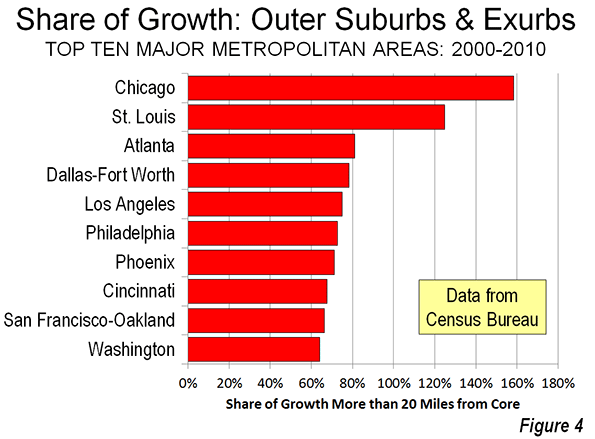
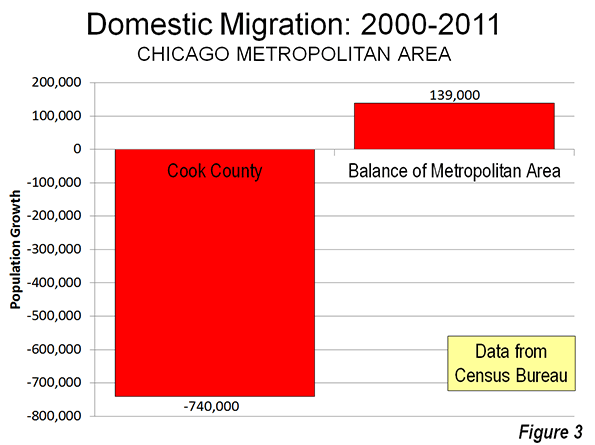
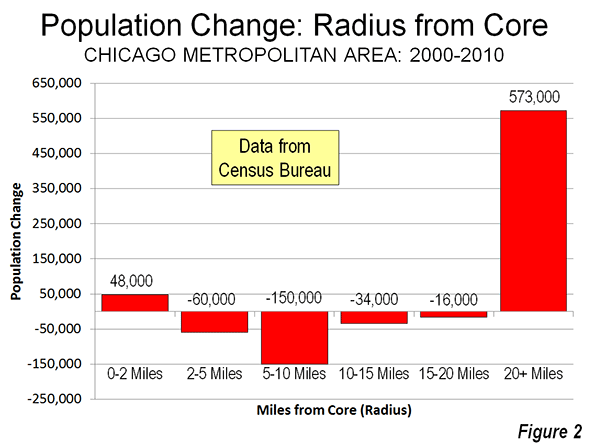
Chicago is not ruining the state. At least not our government policies (not that they are perfect). Sprawl is ruining the state.

I assume you are referring to the property tax increase coming down the pipe. Chicago is raising property taxes to avoid falling into a Detroit like debt. I agree it will hurt the city but they don't have many options.

I'm gonna do my best to channel my inner Buster here.

Chicago's problems like Detroit is due to sprawl. Chicago has been hit to a lesser extent because it is still a great white collar business city as opposed to Detroit based soley on manufacturing.

chicago-and-detroit-populations.png


cox-chicago-crains-4.png


cox-chicago-crains-3.png


cox-chicago-crains-2.png


You can see Chicago's population had been shrinking although the overall level the Chicago metropolitan area has continued to grow.

Chicago's size is the same but its population is less thus it has less population revenue to cover the services needed to run the city. Not saying there isn't some bureaucratic problems with our city and state government but the real issue is sprawl.

Chicago city population in terms of very recently is growing again but it is growing slowly and I think we've done a good job with some of the more recent city development projects but this problem isn't going to get fixed overnight.

I'm not sure how we can roll back the issues of sprawl especially in the short term. I remember a post Buster way back in the political thread about regional governments. I think the best temporary solution is for Cook, Lake, Dupage, Will, and Kane to have some sort of regional government and share our resources to serve the population area as a whole.
 
Last edited:

Ndaccountant

Old Hoss
Messages
8,370
Reaction score
5,771
Chicago is not ruining the state. At least not our government policies (not that they are perfect). Sprawl is ruining the state.

I assume you are referring to the property tax increase coming down the pipe. Chicago is raising property taxes to avoid falling into a Detroit like debt. I agree it will hurt the city but they don't have many options.

I'm gonna do my best to channel my inner Buster here.

Chicago's problems like Detroit is due to sprawl. Chicago has been hit to a lesser extent because it is still a great white collar business city as opposed to Detroit based soley on manufacturing.

chicago-and-detroit-populations.png


cox-chicago-crains-4.png


cox-chicago-crains-3.png


cox-chicago-crains-2.png


You can see Chicago's population had been shrinking although the overall level the Chicago metropolitan area has continued to grow.

Chicago's size is the same but its population is less thus it has less population revenue to cover the services needed to run the city. Not saying there isn't some bureaucratic problems with our city and state government but the real issue is sprawl.

Chicago city population in terms of very recently is growing again but it is growing slowly and I think we've done a good job with some of the more recent city development projects but this problem isn't going to get fixed overnight.

I'm not sure how we can roll back the issues of sprawl especially in the short term. I remember a post Buster way back in the political thread about regional governments. I think the best temporary solution is for Cook, Lake, Dupage, Will, and Kane to have some sort of regional government and share our resources to serve the population area as a whole.

Fat chance at that. You think the people in Kane and Will counties will ever vote to pool resources so that Cook county and the city have more revenues? They love their schools too much.
 

Wild Bill

Well-known member
Messages
5,518
Reaction score
3,261
Chicago is not ruining the state. At least not our government policies (not that they are perfect). Sprawl is ruining the state.

I assume you are referring to the property tax increase coming down the pipe. Chicago is raising property taxes to avoid falling into a Detroit like debt. I agree it will hurt the city but they don't have many options.

I'm gonna do my best to channel my inner Buster here.

Chicago's problems like Detroit is due to sprawl. Chicago has been hit to a lesser extent because it is still a great white collar business city as opposed to Detroit based soley on manufacturing.

chicago-and-detroit-populations.png


cox-chicago-crains-4.png


cox-chicago-crains-3.png


cox-chicago-crains-2.png


You can see Chicago's population had been shrinking although the overall level the Chicago metropolitan area has continued to grow.

Chicago's size is the same but its population is less thus it has less population revenue to cover the services needed to run the city. Not saying there isn't some bureaucratic problems with our city and state government but the real issue is sprawl.

Chicago city population in terms of very recently is growing again but it is growing slowly and I think we've done a good job with some of the more recent city development projects but this problem isn't going to get fixed overnight.

I'm not sure how we can roll back the issues of sprawl especially in the short term. I remember a post Buster way back in the political thread about regional governments. I think the best temporary solution is for Cook, Lake, Dupage, Will, and Kane to have some sort of regional government and share our resources to serve the population area as a whole.

Chicago's problems have nothing to do with "sprawl". Frankly, this city would be screwed if not for the highway system and suburbs. The city has limited space and eliminating "sprawl" would increase demand, which would cause an increase in already high real estate prices. If you're buying in Lincoln Park you're looking at prices north of $500 per square foot. Expensive, right? Ok, let's buy in an "up and coming" neighborhood, the south loop for example. You'll get a "bargain" for $300 per square foot. I don't know too many families of four than can afford a $600k mortgage. People aren't moving to the burbs b/c they can, they're moving b/c it's more affordable.

For the sake of argument, assume I can afford the purchase price. Well, now we have to talk about property taxes - roughly $1000 per month. This is where it becomes laughable. Roughly 80% of my money is used to fund the public school system. That's right, the same public school system that can't teach kids how to read. I don't have kids right now so it's not an issue. However, once I have kids, you think I'm going to pay my mortgage, taxes and an additional $20k per year for each child to attend private school? The whole thing is a big fucking joke. I explain this shit to my immigrant father and he looks at me like I have a dick on my head. Hell, any reasonable person would. And this my friend, taxation without representation, is the reason Chicago is turning into a dump. It has nothing to do with sprawl. This may come as a big shock, but I'm not looking forward to leaving my city life for a long commute and lawn mowing in the suburbs. Unfortunately, it'll be a necessary evil if I decide to have a family.
 
Last edited:

chicago51

Well-known member
Messages
3,658
Reaction score
387
Chicago's problems have nothing to do with "sprawl". Frankly, this city would be screwed if not for the highway system and suburbs. The city has limited space and eliminating "sprawl" would increase demand, which would cause an increase in already high real estate prices. If you're buying in Lincoln Park you're looking at prices north of $500 per square foot. Expensive, right? Ok, let's buy in an "up and coming" neighborhood, the south loop for example. You'll get a "bargain" for $300 per square foot. I don't know too many families of four than can afford a $600k mortgage. People aren't moving to the burbs b/c they can, they're moving b/c it's more affordable.

density_city.PNG


Notice the density of NY and LA vs other world cities
large-population.jpg


Unlike a lot of the world the US does not have a city overcrowding issue in Chicago or another other major city. We got a lot of room to grow.

Take a drive to Laramie and Jackson. Yes Lincoln Park, Wrigley Ville, the Lakefront areas, and some other communities are very expensive on the other hand the South Austin neighborhood is full of emptied boarded up houses. South Austin is not the only neighborhood like that. No, the way things are right now I wouldn't expect anyone to live in those areas if they could help it but if we had put the same amount of resources into developing our cities and our neighborhood communities in cities, as we did to build suburbia we wouldn't have areas that bad.

Yes I'm not saying expansion out beyond the city limits or expansion of the city limits wouldn't have been necessary but what we have done in America is insanity, and the Chicago area has been sprawl on steroids.

For the sake of argument, assume I can afford the purchase price. Well, now we have to talk about property taxes - roughly $1000 per month. This is where it becomes laughable. Roughly 80% of my money is used to fund the public school system. That's right, the same public school system that can't teach kids how to read. I don't have kids right now so it's not an issue. However, once I have kids, you think I'm going to pay my mortgage, taxes and an additional $20k per year for each child to attend private school? The whole thing is a big fucking joke. I explain this shit to my immigrant father and he looks at me like I have a dick on my head. Hell, any reasonable person would. And this my friend, taxation without representation, is the reason Chicago is turning into a dump. It has nothing to do with sprawl. This may come as a big shock, but I'm not looking forward to leaving my city life for a long commute and lawn mowing in the suburbs. Unfortunately, it'll be a necessary evil if I decide to have a family.

Rahm Emanuel just closed over 50 schools, a decision that I was against it but have sinced flip flopped on it as I honestly see why it was necessary. We probably need to close a few more schools because schools in some areas aren't close to being full because people have largely abandoned those neighborhoods.

That isn't going to solve all the cities revenue problems. We still have the same amount roads that need to be re-paved, pipes and sewers that need to be maintained/replaced yet we have a smaller population to draw revenue from than we did previously.

Sprawl is absolutely a problem for Chicago and Illinois, in fact maybe the biggest problem. Just think of the huge expansion of roads alone that need to be maintained because of sprawl and suburban expansion. Low population density suburban expansion has been huge misallocation of resources, not to mention the horrible suburban grids that basically make driving to even the grocery store, or the local school mandatory.

Ironic for conservative poster like you to be supporting sprawl model as it has required the need of increased government spending in order to maintain our society.
 
Last edited:

Wild Bill

Well-known member
Messages
5,518
Reaction score
3,261
density_city.PNG


Notice the density of NY and LA vs other world cities
large-population.jpg


Unlike a lot of the world the US does not have a city overcrowding issue in Chicago or another other major city. We got a lot of room to grow.

Take a drive to Laramie and Jackson. Yes Lincoln Park, Wrigley Ville, the Lakefront areas, and some other communities are very expensive on the other hand the South Austin neighborhood is full of emptied boarded up houses. South Austin is not the only neighborhood like that. No, the way things are right now I wouldn't expect anyone to live in those areas if they could help it but if we had put the same amount of resources into developing our cities and our neighborhood communities in cities, as we did to build suburbia we wouldn't have areas that bad.

Yes I'm not saying expansion out beyond the city limits or expansion of the city limits wouldn't have been necessary but what we have done in America is insanity, and the Chicago area has been sprawl on steroids.


Rahm Emanuel just closed over 50 schools, a decision that I was against it but have sinced flip flopped on it as I honestly see why it was necessary. We probably need to close a few more schools because schools in some areas aren't close to being full because people have largely abandoned those neighborhoods.

That isn't going to solve all the cities revenue problems. We still have the same amount roads that need to be re-paved, pipes and sewers that need to be maintained/replaced yet we have a smaller population to draw revenue from than we did previously.

Sprawl is absolutely a problem for Chicago and Illinois, in fact maybe the biggest problem. Just think of the huge expansion of roads alone that need to be maintained because of sprawl and suburban expansion. Low population density suburban expansion has been huge misallocation of resources, not to mention the horrible suburban grids that basically make driving to even the grocery store, or the local school mandatory.

Ironic for conservative poster like you to be supporting sprawl model as it has required the need of increased government spending in order to maintain our society.

Sure, let's blame sprawl. It has nothing to do with paying for schools that can't teach children, paying for police that can't protect citizens and government corruption. People are moving to Plainfield in droves b/c they really love vinyl siding, sitting in traffic and eating at chain restaurants. To hell with these beautiful brick homes, great restaurants, city architecture, and the magnificent lake shore! Let's sprawl, baby!
 

Rack Em

Community Bod
Messages
7,089
Reaction score
2,727
density_city.PNG


Notice the density of NY and LA vs other world cities
large-population.jpg


Unlike a lot of the world the US does not have a city overcrowding issue in Chicago or another other major city. We got a lot of room to grow.

Take a drive to Laramie and Jackson. Yes Lincoln Park, Wrigley Ville, the Lakefront areas, and some other communities are very expensive on the other hand the South Austin neighborhood is full of emptied boarded up houses. South Austin is not the only neighborhood like that. No, the way things are right now I wouldn't expect anyone to live in those areas if they could help it but if we had put the same amount of resources into developing our cities and our neighborhood communities in cities, as we did to build suburbia we wouldn't have areas that bad.

Yes I'm not saying expansion out beyond the city limits or expansion of the city limits wouldn't have been necessary but what we have done in America is insanity, and the Chicago area has been sprawl on steroids.


Rahm Emanuel just closed over 50 schools, a decision that I was against it but have sinced flip flopped on it as I honestly see why it was necessary. We probably need to close a few more schools because schools in some areas aren't close to being full because people have largely abandoned those neighborhoods.

That isn't going to solve all the cities revenue problems. We still have the same amount roads that need to be re-paved, pipes and sewers that need to be maintained/replaced yet we have a smaller population to draw revenue from than we did previously.

Sprawl is absolutely a problem for Chicago and Illinois, in fact maybe the biggest problem. Just think of the huge expansion of roads alone that need to be maintained because of sprawl and suburban expansion. Low population density suburban expansion has been huge misallocation of resources, not to mention the horrible suburban grids that basically make driving to even the grocery store, or the local school mandatory.

Ironic for conservative poster like you to be supporting sprawl model as it has required the need of increased government spending in order to maintain our society.

Is sprawl the cause or effect of Chicago being less and less desirable? Chicago51, you're treating it as the cause. Irish19 and I are looking at it as the effect of corrupt government, high taxes, congestion, high cost-of-living, crime, etc.
 

chicago51

Well-known member
Messages
3,658
Reaction score
387
Is sprawl the cause or effect of Chicago being less and less desirable? Chicago51, you're treating it as the cause. Irish19 and I are looking at it as the effect of corrupt government, high taxes, congestion, high cost-of-living, crime, etc.

Sorry to turn this into a Chicago politics debate.

The chicken and the egg thing.

Growing pains of city development and poor local policies may have contributed to sprawl. Sprawl though made things worse for both the city and the state.

Truthfully I'm not sure how Chicago goes forward. We probably need to close another 25 schools. Emanuel also took on the teachers union much to dismay of some liberals to get a better bargain for the city. Public worker greed may be an issue but it alone isn't breaking the city I don't believe.

Major cities require a minimum standard of maitenance and city services. Rahm has already cut a lot of spending and actual pissed a lot of liberals off. I'm not sure Chicago has the population thanks to the abandonment of certain neighborhoods to maintain the minimal level of service a major city requires without raising taxes to insanity levels. My problem with the property tax increase is it doesn't always necessarily reflect an individuals ability to pay the way an income tax does.

Bottom line we are in a tough spot. I also maintain we (Chicago and IL) would have been better off if we had used our resources to improve the city's issues rather than sprawl out as far as we have.
 
Last edited:
B

Buster Bluth

Guest
Is sprawl the cause or effect of Chicago being less and less desirable? Chicago51, you're treating it as the cause.

It's both.

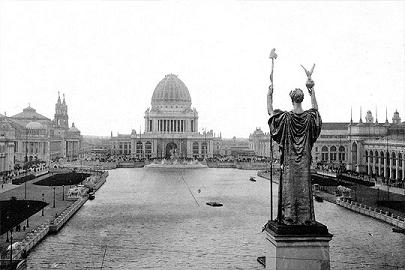
As stated earlier, urban life in America during the industrial revolution was pretty traumatic. Chicago did lead the way in trying to change that (eg World's Fair in 1892 showcasing the White City):
Court_of_Honor_and_Grand_Basin.jpg


People largely left to seek a cleaner, 100% crime-free environment, whiter, quieter environment. That said, of your complaints:

high taxes

Due to? Corruption/mismanagement, for sure. But I could certainly argue that the wealth moved outside of the city limits and the city still had to maintain all of its roads, bridges, schools and the employees it took to maintain the same square footage. Taxes went up incrementally, which only encouraged an incrementally higher number of people to leave. Repeat for thirty years. It is a cause and then again an effect. See how it's both?


Fewer affluent/middle-class families in the area concentrates the poverty. Concentrated poverty has been shown, study after study, to make the poverty worse and more systematic/inescapable. In Chicago specifically the freeways were designed to wall off (or rather, a moat of cars) the ghettos from surrounding neighborhoods. Heartless Buster says that did save areas from ghetto-creep; honest Buster admits it was (and is) running (..driving) away from the problem.

congestion

I would think that traffic gridlock is worse for my well-being than being around other people on transit and the sidewalk. It certainly takes some balls at first I guess.

high cost-of-living

Two points here. 1) The federal government built the freeways, the suburbs didn't. The suburbs had an artificially low cost of living. I say had because you can do studies and add up the higher rent vs. the cost of car, gas, car insurance, lawn mower, lawn mower's gas, reroofing the house, etc etc etc and it's really not quite as bad now. The suburbs are a great way to get your paycheck nickle and dimed away from you. 2) As we've walled off whole sections of the city and let them fall into disrepair, we've taken those places out of the marketplace. Fewer available nice neighborhoods = higher rents. It's both the cause and effect.

corrupt government

How is that supposed to change if the voters who are fed up become non-voters? Like the rest of these things, it's running (again, driving) away from the problem. Ronald Reagan called it "voting with your feet," not untrue, but part of it is being a pussy too. We'll pat ourselves on the back as a brave country because we knew a kid in high school who went to Iraq, but here at home we piss down our leg when there is a break-in a few blocks over or if we have to use the red line.

Sprawl doesn't cause these problems per se, it is just the reason they are exponentially worsened.
 
Last edited:
B

Buster Bluth

Guest
You guys mentioned Detroit, so I'm bringing this up. The difference between Chicago and Detroit is that Detroit did not at all diversify its economy.

Automobiles are a tricky thing. One of you econ nutz have to help me out, because there is a term for this type of good and I've forgotten it. It's the type of good that is prone to very high highs and very low lows, in the sense that if there is a recession NO ONE is buying a car, and if it's a bullish market EVERYONE is buying a car. Growing up in Toledo, every couple of months it's "Chrysler is hiring 1,200 people! Sign up Tuesday!" in the good times and "Jeeps lays off 983!" every so often in the bad times. That sends of wave through all of the suppliers, etc. It is absolutely catastrophic when white flight happens and your middle class is alone in the city and now unemployed for stretches longer than other cities. When left 100% untreated, you end up as Detroit. That's the lesson of sprawl.
 

Whiskeyjack

Mittens Margaritas Ante Porcos
Staff member
Messages
20,894
Reaction score
8,126
Posting this here because: (1) it's one of my all-time favorite IE threads; and (2) it contains most of Buster's posts re good urban planning.

TAC's Rod Dreher just published an article titled "New Urbanism of the Soul":

We bought a house this past summer—a red-brick, cookie-cutter, ticky-tacky exurban Louisiana house of the sort that would make the combustible urbanist James Howard Kunstler’s hair catch on fire, if he still had hair.

It has been a good move. The neighbors are wonderful, the house is comfortable, and kids, they are everywhere. A Spielbergian Valhalla this is, and I’m glad we came. But as satisfying as our subdivision is, I can’t help thinking of how far my wife and I have come from the best neighborhood we ever lived in: Cobble Hill, Brooklyn, a 19th-century brownstone townhouse quarter, where we rented an apartment in the late 1990s.

Almost everything we wanted was a 10-minute walk from our front door. There was the greengrocer, the baker, the meat market, coffee shops, mom-and-pop restaurants, newsstands, churches, wine shops, movie theaters, bookstores, pocket parks, and playgrounds. Going out to do errands was an opportunity to see our neighbors and find out what was going on in the community, which at every level was built to human scale. And nobody needed a car.

Back then, in thinking about why Cobble Hill worked so well as a built environment, I realized how intrinsically conservative neighborhoods like it are. Though my wife and I might well have been the only Republicans in the entire 22-block neighborhood, the underlying structure of Cobble Hill, both physical and social, is profoundly traditionalist—and not because it is old.

Traditional conservatives, as distinct from our more libertarian brethren, believe that there is a sacred order to which individuals and communities must conform to flourish, and we have an obligation to protect, nurture, and develop that order as it comes to us through tradition. Many believe this refers only to morality, but others have a more holistic view: for them, the built environment must also in some sense embody that transcendent order and make it accessible.

When I first discovered the New Urbanism design movement as a resident of my old urbanist Brooklyn village, it made intuitive sense to me as a traditional conservative. At the time, I followed closely the often vicious intra-Catholic arguments over the liturgy and church architecture centered on whether the sacred order was properly expressed in post-conciliar practice. If the symbolic grammar of architecture mattered so much in church, might it also matter a great deal in the public square?

Reading the New Urbanists, the philosophical connection between traditionalism in politics and culture on the one hand and traditionalism in the built environment on the other came into sharp focus. The New Urbanist whose work perhaps makes the picture clearest is Philip Bess, author of Till We Have Built Jerusalem: Architecture, Urbanism, and the Sacred.

You can’t be a conservative or a Christian interested in architecture for long without running into Bess, the prominent Notre Dame architecture professor who advocates New Urbanism from within the Catholic intellectual tradition. Bess, 62, earned a master’s degree in theology from the Harvard Divinity School in 1976 before continuing on to get his master’s in architecture at the University of Virginia in 1981. Along the way, he converted to Catholicism.

“I had an intuition,” he says, “that I couldn’t articulate clearly—perhaps still can’t—about the spiritual significance of both persons and material things. I began to find a language for those intuitions in Catholic Christianity, and a discipline for pursuing them in architecture.” When New Urbanism emerged in the early 1990s, it made perfect sense to a Catholic humanist like Bess, a Thomist who believes that the purpose of the city is to provide an environment in which people can live virtuously—that is, achieve excellence in their vocations—in community. New Urbanism is not expressly theological; indeed, Bess concedes that most New Urbanists are secular progressives. But they are “implicitly Aristotelian,” he contends, because they affirm that there are certain design forms consonant with human nature.

“There’s a reciprocity between the individual and the culture,” he tells me. “The built environment can help sustain and nurture communities, but at the same time it’s the product of communities.” Whatever path New Urbanists follow in coming to that conclusion, the destination itself is what matters most. “In the absence of a conviction that the built environment matters, if there’s no common commitment to the place that we share, that we need places for ritual activity, whether it’s at the intimate scale of the family or more public rituals, then we are going to have a very hard time getting good urbanism off the ground.”

Bess has long served as an unlikely apostle to New Urbanists and conservatives alike, neither of whom seem to get the other. He tells New Urbanists that building good neighborhoods is a necessary condition for building good communities, but not a sufficient one: they must integrate their architectural vision with a broader vision of the good life. To put it in an Augustinian way, you can’t build a city fit for man without a vision of the city of God.

“Urbanism is about human flourishing, and human flourishing requires virtues, which are character dispositions that lead toward certain goods. People aren’t passive receivers of urbanism,” he says. “New Urbanists do a lot of things right, but good urbanism is more than bioswales”—environmentally friendly alternatives to storm sewers—“bike lanes, good coffee, and olive oil.”

Yet the bigger challenge, from Bess’s point of view, is to convince conservatives that New Urbanism is something they should embrace. In a 2005 address presenting New Urbanism to the right, Bess made the familiar Aristotelian claim that “the best life for human beings is the life of moral and intellectual excellence lived in community with others.” The built environment is an indispensible foundation for that.

The history of human settlement, he argues, shows that an ordered and just urban environment, the kind that resonates the best with human nature, is one in which the needs of daily life—commercial, recreational, religious, and so forth—are within easy walking distance. Postwar suburban sprawl, by contrast, separates communities by race and income and dissolves the idea of community as a coherent, organic entity. When the automobile freed modern people from geographical limits, it not only bound those without cars to their homes but also caused a moral dimension of social life that had been with us since time immemorial to fade from view.

Moreover, when we ceased to design and construct buildings in a pattern-language tradition based on human nature, we created places that were harder to love. James Howard Kunstler calls this “the geography of nowhere.” New Urbanism aims to recover the lost art of urban design as a way to reverse these conditions. What traditionalist conservatives are trying to do in politics, New Urbanists—even those who consider themselves progressives—are attempting in urban design.

But not everyone on the right sees it that way. Libertarians tend to view New Urbanism as a form of social engineering that stifles individual liberty. Even some socially conservative thinkers, who know why natural law matters to social constructs like marriage, puzzle over its connection to social constructs like neighborhoods. “I just spent a sabbatical year at Princeton as a Madison Fellow,” says Bess, referring to the program organized by law professor Robert P. George, “hanging out with brilliant and generous people, a lot of them natural-law political theorists. I think even contemporary natural-law folks, when confronted by a natural-law argument for urbanism, are less likely to find it convincing if they live in suburbia.”

But that doesn’t discourage Bess from continuing to teach and preach the New Urbanist gospel in the context of Catholic higher education. Renewing America architecturally and culturally will be the work of many generations.

“I’ve been pushing on my students the idea that after they get their professional credentials in order, and maybe before, instead of going to Manhattan or D.C. or San Francisco to participate in some kind of global architectural practice—and if their circumstances and temperament allow—they should go back home to pursue their professional lives,” says Bess. “Or, at least, that they should go somewhere, stay put, and make their life in that place, and resolve to make it beautiful.” For the past three years, Bess has been focusing his graduate urban-design studio around a project called After Burnham: The Notre Dame Plan of Chicago 2109—in part an homage to Daniel Burnham, a 19th-century urban planner and member of the parks-oriented City Beautiful movement. thisarticleappears

Burnham’s 1909 Plan of Chicago is a landmark document, the last great plan to bring principles of classical humanist architecture and urbanism to bear upon a modern metropolitan region. After Burnham imagines what Chicago—given its current architectural, social, and environmental order—might look like 100 years hence if the next century is informed by classical humanist urbanism and Catholic social teaching.

Bess says that After Burnham, which has not yet been completed and released, will address a range of issues—water, transportation, land use, agriculture, industry—across the entire Chicago-area landscape. In its architectural forms it will acknowledge sacred order in a modern and religiously pluralistic metropolis, under a legal regime of religious non-establishment. Bess believes the future of New Urbanism depends in part on the New Testament—if only traditional Christians will begin to learn from New Urbanism, and to think more deeply about urbanism as soulcraft.

“Religion, especially biblical religion and worshipping communities, will be part of any successful rebuilding,” he says. “I’m sure many people’s reaction to that will be, ‘Aren’t you following the news? Christianity and classic architecture and urbanism aren’t the wave of the future.’ I think that’s a very short-term view.”

Having settled comfortably in my suburban present, I hope for the sake of my children and grandchildren that Bess and his disciples find success connecting the architectural past to the architectural future. Amid the chaotic geography of nowhere, they are building bridges to somewhere.

Bess is a boss. Curious to hear Buster's thoughts on this.
 

Emcee77

latress on the men-jay
Messages
7,295
Reaction score
555
Love this. So true, and the benefits of living in a walkable environment are so often overlooked. I would never have believed what a difference it makes.
 

wizards8507

Well-known member
Messages
20,660
Reaction score
2,661
My brain is breaking trying to reconcile that article into anything that can be described as "conservatism." I'm trying really hard because I respect Whiskey and his opinions, but this reeks of flat-out communism to me. When we talk about "central plans" and "master design," we need to remember that those things require an agent to do the planning and designing. By default and as a function of scale, those roles are filled by the State.
 
Top