COVID-19

yankeehater

Well-known member
Messages
2,199
Reaction score
774

The two interesting things to me from this article are the mention of the spike protein contained in the vaccines and inflammation in the spinal cord and brain. One, why anyone would continue to inject spike protein willingly into their body when it has shown in several studies to do severe damage regardless of whether they contain virus I still cannot understand. Secondly, if there is brain inflammation caused by the vaccine would this not indicate they penetrate the blood brain barrier.
 

PerthDomer

Well-known member
Messages
1,326
Reaction score
483
Would you like to address Moderna's study in the previous post?

I didn't claim that the increase was vax related. I simply posted the data. Who is to say that the increase isn't COVID related? I agree - not enough information there. But it's a warning signal with a temporal correlation to vax uptake (which was not observed with pre-vax COVID).

Secondly, you are posting a study funded by the same Canadian government that implemented vax passports? lol ok.
What if a Canadian government funded study discovered that vaccinated pregnancy outcomes were worse? What do you think might happen since that same government implemented vax passports and widely promoted vax uptake? Think before you answer.

The study you posted doesn't include pre-pregnancy vax, it doesn't include miscarriage endpoints, and it doesn't provide neonatal death info - which would be nearly mutually exclusive to the data I posted. Did you read the explanation and the referenced studies about why they didn't include miscarriages? Doubt it. And does that bother you? Doubt it - you have already made your mind up. Also, would you like to provide a better explanation behind the reasoning behind excluding births < 500g?

A thing people don't appreciate is that a lot of pregnancies end in miscarriage. Large registries of vaccinated patients actually find lower rates of miscarriage than the unvaccinated (likely due to the more educated/more likely to be in touch with the medical system nature of vaccine recipients. It looks like they're probably similar, but catching covid definitely increases miscarriage/preterm labor risk.)

The reason you run these large population based studies is that a lot of vaccinated people will have medical problems because there are a lot of vaccinated people. You need to know how rare said events are at baseline and how many vaccinated people see getting them. 1% vs 0% in a study in the hundreds or low thousands isn't enough.
 

sixstar

Well-known member
Messages
1,144
Reaction score
2,064
Large registries of vaccinated patients actually find lower rates of miscarriage than the unvaccinated (likely due to the more educated/more likely to be in touch with the medical system nature of vaccine recipients. It looks like they're probably similar, but catching covid definitely increases miscarriage/preterm labor risk.)
Can you link me to the registries please?

1% vs 0% in a study in the hundreds or low thousands isn't enough.
Agree, but ironically, a few hundred/thousand participants were good enough to get the paxlovid and molnupiravir approved for EUA and widespread usage. The bivalent booster was tested in what, 8 mice, before approval?

to be clear: i do not believe that data for 4,000 per year in an isolated region of Scotland is evidence of anything. It is a potential safety signal. Like I said, I would love to see similar data from other countries - and yes, stratified by age and vax status - over multiple years to see if there is consistency.
 

PerthDomer

Well-known member
Messages
1,326
Reaction score
483
Can you link me to the registries please?


Agree, but ironically, a few hundred/thousand participants were good enough to get the paxlovid and molnupiravir approved for EUA and widespread usage. The bivalent booster was tested in what, 8 mice, before approval?

to be clear: i do not believe that data for 4,000 per year in an isolated region of Scotland is evidence of anything. It is a potential safety signal. Like I said, I would love to see similar data from other countries - and yes, stratified by age and vax status - over multiple years to see if there is consistency.

I'll link some of the miscarriage stuff later. Paxlovid/molnupiravir could be approved due to larger effect sizes. Molnupiravir specifically was only recommended for high risk due to its mutagenic effect. It's straight up contraindicated in pregnancy.

We generally tolerate more side effects in drugs since we're treating something. It's also more common to see problems later on (especially for drugs requiring chronic use).
 

sixstar

Well-known member
Messages
1,144
Reaction score
2,064
Here's a report on the largest meta analysis of pregnancy. 9% miscarriage rTe for both groups, 150k patients.


Thanks, Perth.

The study from the article (link: risk of miscarriage following COVID-19 vaccination: a systematic review and meta-analysis) is transparent. I appreciate that.

I liked that the researchers created a bias risk matrix, though I disagree that the Pfizer and Moderna studies were low risk of bias. For obvious reasons.

A few nuggets:
Of the 21 studies in the meta-analysis, only 5 were RCTs. 4 of those 5 were conducted by Jansen, Moderna, and Pfizer. The other RCT received funding from the Bill and Melinda Gates foundation and only looked at Astra Zeneca.

All included studies were assessed as having missing information on adherence to the vaccine administration schedule, not allowing accurate assessment of the risk of bias for deviations from the intended intervention. Six of the included studies had an overall low risk of bias (6/21, 29%), half showed a moderate risk (11/21, 52%), and 4 showed a high risk of bias (4/21, 19%) mainly due to participant selection and measurement and outcomes reporting. Outcome reporting was poor overall with only two studies offering a clear outcome definitions for miscarriage and ongoing pregnancy (Aharon et al., 2021; Hillson et al., 2021).
If you add the 4 pharma-executed RCTs from Low to Moderate risk, then only 2/21 (9.5%) of the studies included would have low bias risk. 91% would have at least moderate bias risk. If you all want to throw stones at c19early for including non-RCTs, you also must be willing to throw stones at RCTs with funding bias, or meta-analyses that lack quality RCTs.

Separately, notice that only two studies offered a clear outcome definition, which is odd since miscarriages were primary endpoints.

Our funnel plot suggested no major variation across included studies with a non-significant Egger’s test at P = 0.81
No outliers - that's good. Consistent results help (but do not resolve) offset concerns of inconsistent administration, endpoints, and bias.

Overall, the certainty in the pooled evidence was low (Fig. 4) due to serious concerns about the consistency, precision and directness of our synthesized effect estimate. Given the high heterogeneity across included studies, our results should be interpreted with caution pending larger well-powered controlled studies.
yes, I agree.

Only about half of the included studies had appropriately matched controls which limited our ability to generate a RR with accurate confidence intervals.
They should've been excluded if they didn't appropriately match controls.

Still, we reported narratively on all included studies and generated a weighted average to estimate the overall proportion of miscarriage and ongoing pregnancy or live birth among vaccinated pregnant women.
that reads similarly to c19early. same exact approach.

However, as pregnant women were excluded from these trials at the time of randomization, the evidence included in this review is mainly observational with high level of heterogeneity ... This limits the generalizability of our meta-analysis and highlights the need for better quality primary studies involving pregnant women.
yes - agree again.

The majority of the included studies practiced suboptimal and varied outcome reporting which limited our ability to synthesize high-quality evidence, as reflected in our GRADE assessment (Fig. 4). This reduced the certainty of our pooled estimates, especially since other important pregnancy outcomes, e.g. stillbirth and ectopic pregnancy, were not reported.
If we are going to criticize c19early for supposed low-quality studies, the same rigor should be applied here. agree?

While we reported a relatively low miscarriage rate (9%) across a large cohort (n = 123 184), our pooled rate offers a limited snapshot assessment over a short period of time and therefore should be interpreted with caution.
yes - that's a very low miscarriage rate based on what I've seen. Which is why Lanarkshire's 51% miscarriage rate is so extraordinary.

As most of these studies focused on short snapshot assessment of COVID-19 vaccine safety, the majority reported on the combined outcome of ongoing pregnancy or live birth. Clearly, this outcome does not offer an accurate assessment of long-term reproductive outcomes as not all ongoing pregnancies captured will yield a live birth.
correct, so now we use data to determine long-term reproductive outcomes.

Still, we chose to report on this outcome to provide an accurate summary of the current available literature, assess the knowledge gap, and make recommendations to improve the quality of future research.
Great statement.

We planned to perform meta-regression and subgroup analysis to evaluate and adjust for important confounders such as patient characteristics, vaccine types (e.g. mRNA versus vector), and the number of vaccine boosters. However, we were unable to produce these additional analyses due to poor reporting across included studies (Table I).
I don't understand how researchers can submit studies - and get those studies approved - with poor reporting. That would never fly in the world of tech research.

In addition to its high virality, rapid mutations, and lack of curative treatments, a key challenge in controlling the COVID-19 virus was the role of mass media misinformation that often undermined efforts to promote key prevention strategies like mask-wearing, social distancing, and vaccination
This aged extremely poorly now that the "anti-mask misinformation" proved correct and that public health regulators have admitted that social distancing was best guess.

Generally, concerns about the safety of vaccines in pregnancy could be attributed to the generic immunological and inflammatory response that could impact foetal implantation and embryogenesis (Arora and Lakshmi, 2021; Moodley et al., 2021).
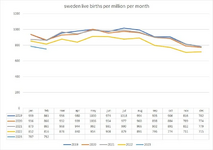
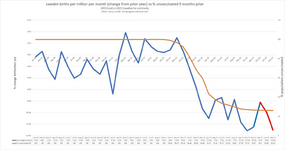
This is true - so we should closely watch birth rates across different countries then.

Sweden, for example, looks horrendous.
1682346438213.png
1682346464702.png
The R2 here is a staggering .83, which is incredibly high for a series this multifactorial and implies that this one variable account for over 80% of cause. That is not a level of association one would be wise to dismiss blithely.

However, in the case of COVID-19 mRNA vaccines, there were concerns disseminated on social media platforms claiming higher risk of miscarriage due to the formation of antibodies that could cross the placenta and bind to the spike protein called syncytin-1, a critical protein in the formation of the syncytiotrophoblast layer of the human placenta and embryogenesis (Blake Evans et al., 2021). Several studies have came out since to disprove these claims with no evidence from immunological studies to support such interaction (Moodley et al., 2021).
This aged poorly as well. Multiple studies have since confirmed that mRNA is crossing into the placenta and ovaries. I haven't yet searched to see if anyone has confirmed/denied binding to syncytin-1.

Ideally, the risks of vaccination should be evaluated considering the patient’s current medical health, risk profile for COVID-19 morbidity, and past adverse reactions or febrile illnesses to previous vaccinations.
Absolutely agree. I wish public health took this approach.

We were unable to explore the optimal timing to provide COVID-19 vaccines in pregnancy and whether such side effects could have a differential impact on first versus second-trimester pregnancies.
Yeah, this is an interesting question. Not sure we've answered that yet.

There is a critical need to evaluate the short and long-term safety and effectiveness outcomes of the different COVID-19 vaccines on pregnant women and their offspring. As the use of different COVID-19 vaccines grows (mRNA versus vector vaccines), large prospective cohorts with appropriately matched controls are needed to evaluate the effectiveness and safety of the different COVID-19 vaccination programmes in reducing the reported risks of adverse maternal and neonatal outcomes (Wei et al., 2021).
Agree

Several studies have identified binding and neutralizing antibody titres for COVID-19 in infant cord blood and the breast milk of lactating vaccinated women. This could suggest long-lasting protective immunity that might help to reduce the risk of re-infection or severe disease among this vulnerable cohort (Fell et al., 2022; Goldshtein et al., 2022; Magnus et al., 2022).
Interesting assertion after the authors just claimed that there's been no evidence that the formation of antibodies crossing the placenta. Cognitive dissonance.

We encountered a high degree of varied outcome reporting which significantly hindered effective evidence synthesis.
yes, that's fair.

The current evidence remains limited and larger population studies are needed to evaluate the effectiveness and safety of COVID-19 vaccines in pregnancy.
Agree, which is why vax mandates and passports were indefensible.
 

PerthDomer

Well-known member
Messages
1,326
Reaction score
483
Thanks, Perth.

The study from the article (link: risk of miscarriage following COVID-19 vaccination: a systematic review and meta-analysis) is transparent. I appreciate that.

I liked that the researchers created a bias risk matrix, though I disagree that the Pfizer and Moderna studies were low risk of bias. For obvious reasons.

A few nuggets:
Of the 21 studies in the meta-analysis, only 5 were RCTs. 4 of those 5 were conducted by Jansen, Moderna, and Pfizer. The other RCT received funding from the Bill and Melinda Gates foundation and only looked at Astra Zeneca.


If you add the 4 pharma-executed RCTs from Low to Moderate risk, then only 2/21 (9.5%) of the studies included would have low bias risk. 91% would have at least moderate bias risk. If you all want to throw stones at c19early for including non-RCTs, you also must be willing to throw stones at RCTs with funding bias, or meta-analyses that lack quality RCTs.

Separately, notice that only two studies offered a clear outcome definition, which is odd since miscarriages were primary endpoints.


No outliers - that's good. Consistent results help (but do not resolve) offset concerns of inconsistent administration, endpoints, and bias.


yes, I agree.


They should've been excluded if they didn't appropriately match controls.


that reads similarly to c19early. same exact approach.


yes - agree again.


If we are going to criticize c19early for supposed low-quality studies, the same rigor should be applied here. agree?


yes - that's a very low miscarriage rate based on what I've seen. Which is why Lanarkshire's 51% miscarriage rate is so extraordinary.


correct, so now we use data to determine long-term reproductive outcomes.


Great statement.


I don't understand how researchers can submit studies - and get those studies approved - with poor reporting. That would never fly in the world of tech research.


This aged extremely poorly now that the "anti-mask misinformation" proved correct and that public health regulators have admitted that social distancing was best guess.


This is true - so we should closely watch birth rates across different countries then.

Sweden, for example, looks horrendous.
View attachment 3053400
View attachment 3053401
The R2 here is a staggering .83, which is incredibly high for a series this multifactorial and implies that this one variable account for over 80% of cause. That is not a level of association one would be wise to dismiss blithely.


This aged poorly as well. Multiple studies have since confirmed that mRNA is crossing into the placenta and ovaries. I haven't yet searched to see if anyone has confirmed/denied binding to syncytin-1.


Absolutely agree. I wish public health took this approach.


Yeah, this is an interesting question. Not sure we've answered that yet.


Agree


Interesting assertion after the authors just claimed that there's been no evidence that the formation of antibodies crossing the placenta. Cognitive dissonance.


yes, that's fair.


Agree, which is why vax mandates and passports were indefensible.


I hadn't looked to see if it's in the meta analysis, but here's the Israeli data.


No difference in preterm birth, birth weight, mortality. Looking at 1st trimester women vaccinated, they look similar to the other groups.

Every vaccine mandate I saw had pregnancy as an exception (both military and hospital)
 

Cackalacky2.0

Specimen
Messages
9,023
Reaction score
8,018

The surgeon general, a well-known Covid-19 vaccine skeptic, faced a backlash from the medical community after he made the assertions, which go against guidance from the Centers for Disease Control and American Academy of Pediatrics. But Ladapo’s statements aligned well with Gov. Ron DeSantis’ stance against mandatory Covid-19 vaccination.
Researchers with the Johns Hopkins Bloomberg School of Public Health and University of Florida, who viewed Ladapo’s edits on the study and have followed the issue closely, criticized the surgeon general for making the changes. One said it appears Ladapo altered the study out of political — not scientific — concerns.
“I think it’s a lie,” Matt Hitchings, an assistant professor of biostatistics at the University of Florida, said of Ladapo’s assertion that the Covid-19 vaccine causes cardiac death in young men. “To say this — based on what we’ve seen, and how this analysis was made — it’s a lie.”
 

Cackalacky2.0

Specimen
Messages
9,023
Reaction score
8,018

PerthDomer

Well-known member
Messages
1,326
Reaction score
483


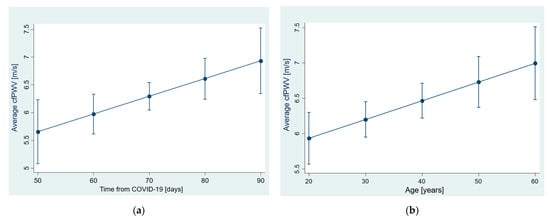
We've known COVID is a vasculopathy. It's why you see increased incidence of erectile dysfunction, stroke, and heart attack in people diagnosed with COVID in all age groups.

It's unclear if that just shows up in the acute period post infection, or if it also matters 10 years from now. It's also unclear whether infections after you have a mature immune response (vaxxed or infected 3 plus times) have a significant vascular impact.

I can assure you the adult cardiologists are still seeing the same age cohort as before. This looks like an increase in baseline risk, so absolute increase in heart attacks is going up more among the usual suspects. You're just also seeing a noticeable uptick in young people (or at least were prior to 2022)

A cool flu fact is we've shown getting your flu shot reduces your risk of getting a heart attack for 6 months after getting vaccinated, implying some portion of heart attacks are set off by viral infection. COVID just does this way more effectively.
 

sixstar

Well-known member
Messages
1,144
Reaction score
2,064
Unfortunately, the study did not disclose the vaccination status of any of the 32 participants. Seems like an important omission. I emailed the POC to ask if she can provide that.
 

PerthDomer

Well-known member
Messages
1,326
Reaction score
483
Unfortunately, the study did not disclose the vaccination status of any of the 32 participants. Seems like an important omission. I emailed the POC to ask if she can provide that.

It's a good bet most are unvaccinated. The study enrolled young people in Croatia between 2019 and 2022. They probably didn't even have vaccine access until summer/fall 2021 and eastern Europe had less vaccine uptake than western Europe.

Prior COVID serology would also be interesting to have as well as timing in general. You'd expect to see less impact with each subsequent infection (or post vaccine). To me the paper adds to the likelihood COVID impacts the vasculature even in mild infection. It doesn't tell me what that means 5 years down the line, after second/3rd infection, with omicron, etc.
 

sixstar

Well-known member
Messages
1,144
Reaction score
2,064
I heard back from the POC:
Only 4 out of 32 participants (12.5%) had been vaccinated. These 4 participants received their second vaccine dose between 5 and 11 months after the first measurement was taken. The low prevalence of vaccinated participants is due to two reasons. Firstly, a portion of the study was conducted before the vaccine was made available to the general population in April 2021. Secondly, there was a very low vaccination rate in the Split-Dalmatia County.

Perth, you were right on track.
 

irishff1014

Well-known member
Messages
26,511
Reaction score
9,285
I can't remember if i put this here on not but the word on the street is that Covid in Maryland will be a thing of the past in about a week and a half.
 

ulukinatme

Carr for QB 2025!
Messages
31,516
Reaction score
17,382
I've got a confession...the poster that used to be ulukinatme passed away 2 years ago. I've just been covering for him.

Fv8O6ZQWAAsm30g
 

ulukinatme

Carr for QB 2025!
Messages
31,516
Reaction score
17,382

Blazers46

Adjectives: wise/brilliant/handsome.
Messages
8,106
Reaction score
5,458

irishff1014

Well-known member
Messages
26,511
Reaction score
9,285
Surprise, surprise, the kids weren't at risk after all.


Not only should she be fired but I hope the state and her personally get sued til the point she has nothing.

Another worthless piece of trash the government will do nothing about.
 

notredomer23

Staph Member
Messages
17,635
Reaction score
17,557
You don't? What benefit did it give you, risks aside?

Fair question. Completely anecdotally, I'd guess Moderna (which I got) is a superior vax to Pfizer. Nobody in my family that got Moderna ever got COVID. Everyone that got Pfizer did. Again, totally anecdotal, but I am grateful for that as there were certainly some family members that would not have faired well. And while coincidental, around the time of me getting the vaccine, it really helped me mentally kick my health into gear. In my mind it signified COVID was over for me and I went back to normal (right or wrong, doesn't really matter anymore). So I don't regret it at all, but as more and more comes out it just becomes tough to ignore.
 

Lberry

Banned
Messages
2,285
Reaction score
1,875
Fair question. Completely anecdotally, I'd guess Moderna (which I got) is a superior vax to Pfizer. Nobody in my family that got Moderna ever got COVID. Everyone that got Pfizer did. Again, totally anecdotal, but I am grateful for that as there were certainly some family members that would not have faired well. And while coincidental, around the time of me getting the vaccine, it really helped me mentally kick my health into gear. In my mind it signified COVID was over for me and I went back to normal (right or wrong, doesn't really matter anymore). So I don't regret it at all, but as more and more comes out it just becomes tough to ignore.
Appreciate the thorough response. Glad you all have been Ok.

I knew two people personally, one 33, other 37, who fell dead in their homes shortly after you know what. No questions asked and deaths attributed to nothing other than surprise. I wonder how many of these cases there are, my social network isn't abnormally big.
 

AKRowdy

Well-known member
Messages
772
Reaction score
798


I don't regret getting the vaccine but at some point these things keep happening at a rate we never saw pre-COVID

Doubt this has anything to do with the vaccine, but rather an undiagnosed heart condition.

Think events like these have unfortunately always been there but in the new age of social media and post COVID, it gets reported nationally more often.

Also, in the US it is not recommend to do cardiac screening for athletes, which is different from Europe. With a lot of these athlete cardiac arrests, the cause is an undiagnosed genetic heart structural problem or conduction issue.
 

ulukinatme

Carr for QB 2025!
Messages
31,516
Reaction score
17,382
Doubt this has anything to do with the vaccine, but rather an undiagnosed heart condition.

Think events like these have unfortunately always been there but in the new age of social media and post COVID, it gets reported nationally more often.

Also, in the US it is not recommend to do cardiac screening for athletes, which is different from Europe. With a lot of these athlete cardiac arrests, the cause is an undiagnosed genetic heart structural problem or conduction issue.

I'm not buying this. Media keeps pushing like it's a normal thing and it was always happening, but not this often and this many young healthy people. I'd find it hard to believe that LeBron James would have a kid that has an undiagnosed heart issue that was missed prior to now. He's one of the richest athletes in the world with every advantage available to him. Social media isn't a new concept, I feel like we would have been hearing more about famous young athletes dropping from cardiac arrest in the past if this was a normal thing.
 

GATTACA!

It's about to get gross
Messages
15,104
Reaction score
12,943
I'm not buying this. Media keeps pushing like it's a normal thing and it was always happening, but not this often and this many young healthy people. I'd find it hard to believe that LeBron James would have a kid that has an undiagnosed heart issue that was missed prior to now. He's one of the richest athletes in the world with every advantage available to him. Social media isn't a new concept, I feel like we would have been hearing more about famous young athletes dropping from cardiac arrest in the past if this was a normal thing.
He would have had his heart tested just because he's LeBron's kid?
 
Top