All Things SkunkBear

Wolverine1997

Banned
Messages
606
Reaction score
87
That's beside the point. Schools with integrity don't stoop to what some schools in the SEC do!

No they just win national championships....

Some schools? You mean 13/14? Have you seen what Mississippi and Kentucky are doing in recruiting? Uh....I think something is going on there.

You guys saw what real football looks like. So did Michigan. Twice.

You have to get down in the dirt to be successful nowadays. Michigan isn't ever gonna do it and I don't expect them to. (awaiting smartass comment about Fab Five)

National titles aren't the goal here. Never have been. You see it with the numbers. For all the parading some fans do saying "ELEVEN NATIONAL CHAMPIONSHIPS!!!1!", 10 of them were before 1950. And back then there really wasn't a national championship like there is today. It looks nice to parade around. But when you dig deeper.....merr...

Goal here is to win the B1G and go to the Rose Bowl. And if you are fortunate enough to win all of your games, you can shoot for the next one (1997).
 

IrishLax

Something Witty
Staff member
Messages
37,544
Reaction score
28,990
No they just win national championships....

Some schools? You mean 13/14? Have you seen what Mississippi and Kentucky are doing in recruiting? Uh....I think something is going on there.

You guys saw what real football looks like. So did Michigan. Twice.

You have to get down in the dirt to be successful nowadays. Michigan isn't ever gonna do it and I don't expect them to. (awaiting smartass comment about Fab Five)

National titles aren't the goal here. Never have been. You see it with the numbers. For all the parading some fans do saying "ELEVEN NATIONAL CHAMPIONSHIPS!!!1!", 10 of them were before 1950. And back then there really wasn't a national championship like there is today. It looks nice to parade around. But when you dig deeper.....merr...

Goal here is to win the B1G and go to the Rose Bowl. And if you are fortunate enough to win all of your games, you can shoot for the next one (1997).

What's so sad is that it's your goal to win the worst major conference in America (RIP Big East)... which is an incredibly low goal... and yet, you haven't won an outright Big Ten title in 15 years. That is just so incredibly sad and pathetic.
 
B

Bogtrotter07

Guest
And what does that make you? A kind man?

I'm Catholic and I'm pretty much used to the fact that nearly everyone in A2 doesn't like Catholics. Doesn't stop me from living here and loving it and not giving a damn what others think about me or my religion. I look at is us against the world.

And you mention Michigan holding Bo up on a pedestal. He is getting an 8ft statue at the Schembechler Hall. First person in the history of Ann Arbor to have a statue.

I don't know where you get he was anti-Catholic from though. I've never heard of anything like that.

And haha you used the term Student-Athlete. Because it IS all about the student athlete. (I'm sure maybe one other person on this board may know what show I am referencing)

Your mind is a great example of cerebral flatulence, when held too long causes an intellectual fog, a confusion.

1) Rack 'Em is a really good man. And from the evidence of both of your posts, you really should be about the last one to criticize him. I can offer you one piece of million dollar advice. Don't go toe to toe with Rack, here.

2) The way things are set, if you don't see all these kids as student athletes, you are part of the problem. The whole greasy, smarmy cheating mess. And from an ND prespective there is little difference between your moral airs and what the Buckeyes do. It is all slime.

3) Only in Ann Arbor, would the first person who they put up a statue to be a football coach who went like, 1 - 20 in bowl games, and never won a national championship! And anyone who lived worked and breathed Michigan football in the early days was. Some were more recently to. I am Irish, so I don't see letting someone who tried to fukk your people off the hook so easy.
 
B

Bogtrotter07

Guest
The Dark Days of the Black Legion

By Richard Bak


White supremacists of the 1930s maintained there was one sure way to identify a fellow member of the “master race” — blushing. It was thought that only a true pureblood Aryan could display a noticeable change of color in their skin upon an episode of shyness, shame, or modesty. That Charley Poole was a non-Aryan was not the real issue with the Black Legion, which saw to it that his cheeks were eternally blanched for a different, more powerful reason: the sanctity of Protestant womanhood. On the night of May 12, 1936, the young unemployed autoworker was taken into the countryside west of Detroit and shot five times at point-blank range, an honor killing that was the latest in a long string of atrocities committed by the black-robed vigilantes.

“Nobody could hate Charley,” cried Becky Poole, after being told by detectives that her husband’s body had been found near Gulley Road in what is now Dearborn Heights. “He never hurt anyone in his whole life.”

That wasn’t what the local chapter of the Legion — which included Becky’s brother-in-law, Lowell Rushing — believed. Rushing had gotten wind of Charley’s occasional arguments with Becky and reported back to his friends at the Wolverine Republican Club, one of various fronts the Legion used to mask its activities. He exaggerated the Pooles’ discord, which typically centered on Charley’s inability to find a steady job. At a secret meeting inside a rented hall, “Colonel” Harvey Davis helped stir Legionnaires into a frenzy by describing Charley as an abusive husband who had beaten his pregnant wife so badly she had miscarried. “What shall we do about such a man?” he asked. “Whip him!” members yelled. “Kill him!”

The following evening, as Becky lay in her bed at Detroit’s Herman Kiefer Hospital, Rushing lured Charley into a car filled with Legion members. Charley, a talented sandlot ball player, thought he had been invited to the organizational meeting of a factory baseball team, which would have assured him a job at the sponsoring plant. But, in the hard-boiled vernacular of the day, this was a one-way ride. “You’ve beaten your wife for the last time,” he was told before being shot and dumped into a ditch.

As unremarkable as Poole’s life had been up to that point, in death he wound up extracting an extraordinary price from his killers. His murder caused the previously unknown Black Legion to explode into the headlines, resulting in most of its leaders being sent to prison and exposing the clandestine brotherhood of bullies to ridicule. “Hooey may look like romance and adventure in the moonlight,” The Detroit News editorialized toward the end of the Legion’s brief but spectacular appearance on the public stage, “but it always looks like hooey when you bring it out in the daylight.”

Despite its similarities with the Ku Klux Klan (KKK), the Black Legion wasn’t a direct descendant of that right-wing organization, but more like a sinister stepbrother. Many Legionnaires were former or concurrent members of the Klan, originally a vigilante group active in the former Confederacy for several years following the Civil War. In 1915, the Klan was jolted out of its decades-long dormancy by D. W. Griffith’s controversial film, The Birth of a Nation. Hollywood’s first blockbuster sentimentalized the KKK and provided a new generation of extremists with a template for ritualistic terrorism, right down to the cross-burnings and standardized white costumes — dramatic devices Griffith had invented for the movie. The flood of immigrants and Southern blacks to America’s big cities brought made-to-order targets, allowing the resurgent Klan to expand from its rural Southern roots and become a truly national political movement, agitating for such reforms as immigration control. The “Invisible Empire” soon controlled state governments in Indiana, Colorado, and Oregon.

During the 1920s, the KKK’s heyday, Michigan reportedly had more Klansmen than any state in the country — as many as 800,000, according to some estimates, though historians today believe a figure in the range of 80,000 to 120,000 is more plausible. Roughly half lived in metro Detroit. Prospective mem-bers — many of whom were white factory workers originally from the South — had to swear to be a “native born, true, and loyal citizen … a white male Gentile person … a believer in the tenets of the Christian religion, the maintenance of White Supremacy, and principles of pure Americanism.”

In 1925, the Klan movement was stopped dead in its tracks by a sensational sex scandal involving its most prominent leader. David Curtis Stephenson, the Grand Wizard of Indiana and 22 other states, including Michigan, was convicted of rape and murder in the case of a woman whose body bore so many bite marks she was described by a witness as looking as if she had been “chewed by a cannibal.” Upset over not receiving clemency or a commutation of his life sentence from the Klan-backed governor of Indiana, the vengeful Stephenson took several public officials down with him. The series of exposés caused a meltdown in membership, from an estimated peak of 6 million in the mid-1920s to about 30,000 a few years later.

During this period, a small-town physician in Bellaire, Ohio, named William Shepard — a former Grand Cyclops in the Klan — fiddled with the Klan’s formula and came up with his own version of hooded Americanism. He called the secret fraternity the Black Legion. (An alternative account says the Legion was originally formed as the Black Guards in about 1925 to provide security for officers of the Ohio KKK.) Shepard’s followers wore black-silk robes sporting a skull-and-crossbones insignia; a black hood topped by a high-horned headpiece also bearing the “Jolly Roger” completed the ensemble.

As Protestant nativists who were convinced that “their” country was slowly being taken over by “aliens,” the Legion’s professed enemies were the same as the Klan’s: Catholics, Jews, immigrants, blacks, Communists, and labor activists. Unlike the Klan, however, the Legion eschewed publicity. They operated in deep secrecy, with any member foolish enough to mention the Legion’s existence to an outsider subject to a bullwhipping. During the day “Dr. Billy” made house calls with a .45-caliber pistol packed inside his satchel; at night, he presided over elaborate initiation ceremonies and the occasional tar-and-feathering of a local deemed to be “un-American.”

The Black Legion expanded and grew lethal after another ex-Klansman, Virgil Effinger, an electrician from Lima, Ohio, assumed leadership in the early 1930s. Effinger, described as a “dour, humorless fanatic,” helped recruit large numbers of members in Michigan. He was capably assisted by an ex-Detroit cop named Isaac “Peg Leg” White. Ultimately, there were tens of thousands of members in the state. While many regarded the Legion as a secret lodge and an outlet for mild adventure, a fanatical few used it as an excuse for night riding that often was more personal than ideological in nature. Their victims may have included the father of a future famous black-nationalist leader.

One evening in 1931, Earl Little was run over by a streetcar in Lansing. Local authorities considered the preacher’s death either an accident or, improbably, a suicide. However, Little’s young son, Malcolm, grew up believing that it had been an execution — a chilling message delivered by the Black Legion to intimidate “uppity” blacks. Malcolm Little, who later would change his name to Malcolm X as he rose to prominence with the Nation of Islam, doubted that his father could “bash himself in the head, then get down across the streetcar tracks to be run over.”
Other beatings, bombings, and murders involving left-wing political and labor organizations occurred over the years. Authorities never seemed able to solve them. Then came the killing of Charley Poole.
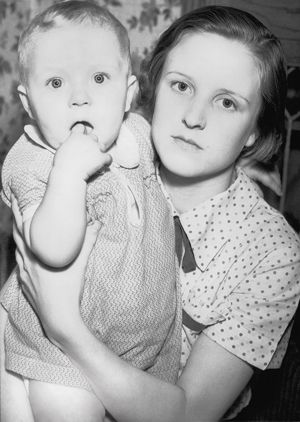


Widowed by vigilantes Becky Poole holds one of her daughters. Poole’s Catholic husband, Charley, was killed by the Black Legion in 1936 in what is now Dearborn Heights for supposedly beating his Protestant wife.

Photograph Courtesy of Richard Bak


Poole, 22, was a slightly built, pleasant-looking man of French heritage, with slicked-back hair and a pencil mustache. A Catholic who had been chased out of Kentucky by the local Klan, he had been married for three years to Becky, an attractive, blond-haired Baptist. In the spring of 1936, she was pregnant with their second child. Charley had been approached about joining the Legion but said no. His mildly disparaging comments about the group annoyed Lowell Rushing, a young Legionnaire whose brother was married to Becky’s sister. Rushing fabricated a story about Charley beating Becky, knowing full well the Legion’s likely response. Some people later suggested Rushing was infatuated with Becky and wanted to remove Charley from the scene. Whatever his motive, the result was the same.

Detroiters were shocked at newspaper stories describing Poole’s murder, with page-one photos of the murdered man’s young family producing a blend of outrage and sympathy. Within days, several of the victim’s friends stepped forward and described three men as having visited Poole’s house on the day of the killing. Harvey Davis, a 38-year-old employee of Detroit’s public-lighting department, was the first to be taken in for questioning.

Davis had a commanding presence: tall with graying close-cropped hair, bushy eyebrows, and a perpetually sullen look. Speaking with a Southern accent, he talked in a roundabout way about “something sinister and gigantic, a threat to the peace of the nation itself.” Fascinated detectives were hearing of the Black Legion for the first time. Every person of interest Davis named was quickly tracked down and brought in. Search warrants were executed, and soon an arsenal of pistols, rifles, ammunition, knives, blackjacks, whips, and leather-bladed bludgeons was stockpiled on desktops for the cameras. Some detectives donned robes for the photographers. On May 22, nine days after Poole’s body was found, Detroit’s three dailies screamed with front-page news about “a fantastic tale of terrorism … straight from the heart of the Deep South of Carpetbag days.”

Among the earliest of those arrested and charged in the Poole case was the chief triggerman. Dayton Dean worked with Davis in the public-lighting department and was a “major” in the Legion. A short, thickset Navy veteran with oddly spaced eyes, the 36-year-old grade-school dropout admitted he had fired the first shots — but only because he had feared being plugged by Davis if he hadn’t obeyed his command. Dean had once been tied to a tree and flogged by his fellow Legionnaires for some transgression, and that memory was still fresh.

Dean was shocked to learn from detectives that Becky Poole had actually given birth to the baby she had supposedly miscarried (a girl she named Nancy) and that she claimed to have never been mistreated by her husband. “A horrible mistake,” Dean said. “But I was just following the orders of my superiors.” To the delight of his interrogators, the shaken suspect abandoned the blood oath he had made to keep the inner workings of the Legion a secret unto death. He started talking — and kept talking for days. In the view of Charles T. Haun, who covered the case for the Detroit Free Press, “somewhere in that peculiar mind there was a sense of fair play, a willingness to be a good boy after having been such a very bad one. It made police a little afraid of what he had to tell, but most of his stories turned out to be true ones.”

The second murder Dean detailed, after Poole’s, was the racially motivated “thrill killing” of Silas Coleman. One May evening in 1935, the 42-year-old Army veteran was taken out into the marshes near Pinckney and forced to run for his life before finally being gunned down. The ringleader was Davis, who had simply wanted to “see how it felt to shoot a Negro,” Dean said. On another occasion, a carload of Legionnaires, frustrated over not finding their targeted prey, randomly shot and wounded a black man walking down an Ecorse street.

More revelations poured forth — of murders and attempted murders, of fire-bombings and floggings, of spooky rituals and ominous-sounding oaths. Dean told of failed Legion plots to kill the publisher of a Highland Park newspaper, who was running for office against a Legion candidate, and the mayor of Ecorse, who had hired too many Negroes for the Legion’s taste. He described the initiation ceremony, where new members knelt with a loaded pistol aimed at the back of their head and swore: “In the name of God and the devil, one to reward and the other to punish, and by the powers of light and darkness, goodness and evil, here under the black arch of heaven’s avenging symbol, I pledge and consecrate my heart, my brain, my body, and limbs; and swear by all the powers of heaven and hell, to devote my life to the obedience of my superiors that I will exert every possible means in my power for the extermination of the antichrist, Communist, the Roman hierarchy, and their abettors.”

Caught up in the excitement of this newfound threat, the press published unsubstantiated claims of the Legion’s size and its body count of victims. The Legion was said to be responsible for as many as 50 deaths, many of them staged suicides, stated the Free Press, while The Detroit News reported 10,000 Legionnaires in Wayne County alone. The Associated Press wrote of “vague stories of a plot to establish a Fascist dictatorship with 6 million armed men taking part in a coup … .” This involved issuing the Legion’s ultimate password, “Lixto,” which, when sounded at a prearranged time, would call members to take over government buildings, arsenals, and power plants.

Just how insidious was the Black Legion? In Oakland County, Circuit Judge George Hartrick conducted a one-man grand-jury investigation. He estimated the Legion had between 2,200 and 4,500 members countywide. In addition to scores of policemen in Pontiac and Royal Oak, their ranks included 86 public officials, among them the county prosecutor, a state legislator, and the police chief of Royal Oak. In Wayne County, the city halls of Ecorse and Highland Park were found to be riddled with “black knights” in positions of power, while Detroit’s police chief was widely suspected of being a Legionnaire. These kinds of ties helped explain why certain crimes committed by the Legion before Poole’s murder were unenthusiastically investigated.

Among the most shocking developments — though it didn’t come to light until after the trials of Poole’s killers were completed — was Wayne County prosecutor Duncan McCrea admitting to having “accidentally” signed a membership card. Legion defendants testified McCrea had actually gone through the initiation ceremony and attended secret meetings. McCrea’s past affiliation with the Legion didn’t prevent him from vigorously prosecuting the Poole case.

Each new revelation ramped up the hysteria. At the time, the public was absorbing newspaper reports and newsreel images of fascism on the march throughout Europe. Could a homegrown movement topple the U.S. government? The ongoing depression of the 1930s provided the perfect ingredients for revolution: fear, desperation, confusion, and hate. Two national symbols of intolerance were right in Detroit’s own backyard, as automaker Henry Ford and “radio priest” Father Charles Coughlin shook their fists at Jewish bankers and Bolshevik union organizers. In such an environment, it was easy to over-reckon the power and reach of this strange new group.

However, the deeper investigators dug, the more apparent it became that the Legion was not a tightly controlled national paramilitary organization of ideologically driven acolytes prepared to move in lockstep at a moment’s notice. They found an uncoordinated collection of cells of poorly educated blue-collar workers, centered principally in Michigan and Ohio, with a scattering of members in Indiana and Illinois. According to historians who have studied the Legion, its membership rolls numbered between 60,000 and 100,000 overall.

As exemplars of the model Christian behavior they demanded of others, local Legion leaders fell far short. Davis was revealed to have been a petty criminal in Kentucky before moving to Detroit, serving time for grand larceny and impersonation. Dean hardly qualified as anyone’s choice to defend the flower of Protestant womanhood. After his first wife divorced him for cruelty, his common-law wife — with whom he’d had two children — left him after he was found taking “indecent liberties” with the woman’s 14-year-old daughter. The woman said she dropped sexual-assault charges against Dean after his Legion friends threatened to “dump me in a ditch.”
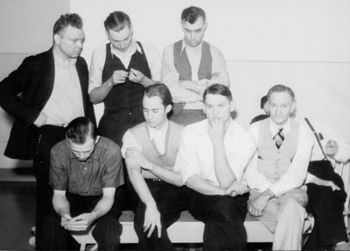


Black Legion defendants, pictured May 26, 1936. From left, back row: Dayton Dean, Urban Lipps, Harvey Davis. Sitting, from left: Ervin Lee, Lowell Rushing, Herschell Gill, John Vincent.

Photograph Courtesy of Richard Bak


Jack Carlisle, a crime reporter of The Detroit News, visited the Legion’s founder, Dr. Shepard, in Ohio. “To the substantial and solid citizens of Bellaire, like his cronies in the luncheon club, Shepard is a ‘harmless old coot’ who was always joining something and talking a lot of sentimental twaddle about the old South and white supremacy,” Carlisle wrote. “They heard he was a Klansman, and then they learned he wore a black robe with a skull and crossbones, and sat on the hillsides near town at midnight. But the solid folks just thought that was ‘Dr. Billy’s way.’

“To others, like the mill workers and the steel men, Dr. Shepard was a messiah, who stood for mystery and adventure, who sent out the ‘Lixto Call’ for the hillside meetings and gave the secret password from the old South. They called him chief, and they said they were ready to die for him, but Dr. Billy confided ‘they only got drunk instead.’ ” Shepard was no Hitler or Mussolini. He told Carlisle he had never been to Michigan, did not know or approve of any of the Legion’s crimes committed there, and said that any member found guilty of murder should be executed.

By mid-June, the Free Press was criticizing the wave of over-reaction to which it had contributed, saying that the “exposure of the Black Legion’s activities in Detroit has been used by certain newspapers to whip up a wave of hysteria out of all proportion to that dark organization’s power or importance.” The paper dismissed estimates of the Legion’s strength as 5 million members nationally, including 100,000 in Michigan, as “just so much poppycock.” The FBI, whose agents had been following Legion activities for a year, found no evidence of a federal crime and thus declined to get involved. In a memo to FBI Director J. Edgar Hoover, one special agent described the Legion as “a bunch of low-type hillbillies who have come out of the mountains of Kentucky and Tennessee … it is easy to see how they would kill with impunity just on the violation of a woman.”

Nonetheless, individuals targeted by the Legion, notably civil-rights attorney Maurice Sugar, were convinced it was an immense threat. Sugar and Homer Martin, president of the fledgling United Automobile Workers, believed the Legion’s reach extended into the factories of local automakers like Hudson and Packard, where members were given jobs and special privileges in exchange for sabotaging the efforts of union organizers. They insisted Legion members had infiltrated union ranks as management spies, while others worked for the Dawn Patrol Detective Agency, a private security force that guarded factories. Eventually, three unsolved murders of labor activists, one of whom was hanged, turned out to be Legion handiwork. There almost assuredly were more, but Dean could attest only to those crimes he had firsthand knowledge of. Other implicated Legionnaires kept their mouths zipped.

Sugar had a deeply personal interest in bringing down the Legion: They had marked him for assassination. Dean confirmed a couple of botched attempts to kill Sugar the previous year when the liberal lawyer was running for city council and Recorder’s Court judge. Sugar spent months investigating the Legion for a book he never wrote. One of the most chilling plots he uncovered was the plan to release cyanide gas in local synagogues during Hanukkah. Another unrealized scheme involved “Major General” Arthur Lupp of Highland Park, an investigator for the Detroit Board of Health and the Legion’s buffoonish state commander. Lupp, who was not charged in the Poole murder, allegedly experimented with methods of injecting typhoid germs into dairy products sold in Jewish neighborhoods.

Psychologists studied Legion members in custody. Most were Southern transplants with few industrial skills, nagged by a feeling of alienation in an urban environment that seemed to increasingly favor foreigners, minorities, and Catholics at the expense of the old-stock Protestants that had settled the nation. Detroit, one of the largest ethnic and racial melting pots in the country, was particularly threatening. The Legion offered members fraternity in a city of strangers and provided simple solutions in a complex, uncertain world.

On June 29, 1936, Dean pleaded guilty to his role in the Poole and Coleman slayings. He was sentenced to life in prison with no parole. In September, he testified in the trials of a dozen fellow Legionnaires. All but one of the defendants were convicted of first-degree or second-degree murder. During a break in the proceedings, Becky Poole approached the prosecution’s star witness, cradling an infant in her arms. “This is Mary Lou, my oldest girl,” she said. “I have another baby at home, too.” Dean stared at her and said nothing. After the verdicts were read, she strode up to Lowell Rushing. “I hope you never come out alive,” she told her brother-in-law. She got her wish. Rushing was handed a life sentence.

The most notorious fascist group of 1930s America vanished as suddenly as it had appeared. The New York Times, for example, which published 84 stories about the Legion in 1936, wrote only 10 the following year. Although much of the Legion’s suspected criminal activity proved to be impossible to prosecute because of a lack of witnesses and informants, within three years of Poole’s killing, nearly 50 members were in prison for murder and other crimes. Thirteen of them were serving life terms. Many others, their identities exposed in various grand-jury investigations and newspaper reports, managed to keep their freedom, but lost their public-service jobs. The Black Legion was permanently broken, its bizarre story briefly living on in pop culture. By 1940, it had inspired at least one novel, two films (one starring Humphrey Bogart), and an episode of the radio crime drama The Shadow (featuring the voice of Orson Welles).

Charley Poole’s clandestine killers went to their graves not knowing Becky Poole’s own little secret. The fair-skinned blonde’s ancestors included an African-American great-grandmother — a revelation that would have flushed the cheeks of her wayward Aryan defenders.

Bak is a Dearborn-based freelancer. E-mail: editorial@hourdetroit.com.
 

Wolverine1997

Banned
Messages
606
Reaction score
87
What's so sad is that it's your goal to win the worst major conference in America (RIP Big East)... which is an incredibly low goal... and yet, you haven't won an outright Big Ten title in 15 years. That is just so incredibly sad and pathetic.

10 years. But nice try.

Not that that is any better. 2004 was the last one. Don't have to worry about outright anymore with the CCG.
 

Wolverine1997

Banned
Messages
606
Reaction score
87
The Dark Days of the Black Legion

By Richard Bak


White supremacists of the 1930s maintained there was one sure way to identify a fellow member of the “master race” — blushing. It was thought that only a true pureblood Aryan could display a noticeable change of color in their skin upon an episode of shyness, shame, or modesty. That Charley Poole was a non-Aryan was not the real issue with the Black Legion, which saw to it that his cheeks were eternally blanched for a different, more powerful reason: the sanctity of Protestant womanhood. On the night of May 12, 1936, the young unemployed autoworker was taken into the countryside west of Detroit and shot five times at point-blank range, an honor killing that was the latest in a long string of atrocities committed by the black-robed vigilantes.

“Nobody could hate Charley,” cried Becky Poole, after being told by detectives that her husband’s body had been found near Gulley Road in what is now Dearborn Heights. “He never hurt anyone in his whole life.”

That wasn’t what the local chapter of the Legion — which included Becky’s brother-in-law, Lowell Rushing — believed. Rushing had gotten wind of Charley’s occasional arguments with Becky and reported back to his friends at the Wolverine Republican Club, one of various fronts the Legion used to mask its activities. He exaggerated the Pooles’ discord, which typically centered on Charley’s inability to find a steady job. At a secret meeting inside a rented hall, “Colonel” Harvey Davis helped stir Legionnaires into a frenzy by describing Charley as an abusive husband who had beaten his pregnant wife so badly she had miscarried. “What shall we do about such a man?” he asked. “Whip him!” members yelled. “Kill him!”

The following evening, as Becky lay in her bed at Detroit’s Herman Kiefer Hospital, Rushing lured Charley into a car filled with Legion members. Charley, a talented sandlot ball player, thought he had been invited to the organizational meeting of a factory baseball team, which would have assured him a job at the sponsoring plant. But, in the hard-boiled vernacular of the day, this was a one-way ride. “You’ve beaten your wife for the last time,” he was told before being shot and dumped into a ditch.

As unremarkable as Poole’s life had been up to that point, in death he wound up extracting an extraordinary price from his killers. His murder caused the previously unknown Black Legion to explode into the headlines, resulting in most of its leaders being sent to prison and exposing the clandestine brotherhood of bullies to ridicule. “Hooey may look like romance and adventure in the moonlight,” The Detroit News editorialized toward the end of the Legion’s brief but spectacular appearance on the public stage, “but it always looks like hooey when you bring it out in the daylight.”

Despite its similarities with the Ku Klux Klan (KKK), the Black Legion wasn’t a direct descendant of that right-wing organization, but more like a sinister stepbrother. Many Legionnaires were former or concurrent members of the Klan, originally a vigilante group active in the former Confederacy for several years following the Civil War. In 1915, the Klan was jolted out of its decades-long dormancy by D. W. Griffith’s controversial film, The Birth of a Nation. Hollywood’s first blockbuster sentimentalized the KKK and provided a new generation of extremists with a template for ritualistic terrorism, right down to the cross-burnings and standardized white costumes — dramatic devices Griffith had invented for the movie. The flood of immigrants and Southern blacks to America’s big cities brought made-to-order targets, allowing the resurgent Klan to expand from its rural Southern roots and become a truly national political movement, agitating for such reforms as immigration control. The “Invisible Empire” soon controlled state governments in Indiana, Colorado, and Oregon.

During the 1920s, the KKK’s heyday, Michigan reportedly had more Klansmen than any state in the country — as many as 800,000, according to some estimates, though historians today believe a figure in the range of 80,000 to 120,000 is more plausible. Roughly half lived in metro Detroit. Prospective mem-bers — many of whom were white factory workers originally from the South — had to swear to be a “native born, true, and loyal citizen … a white male Gentile person … a believer in the tenets of the Christian religion, the maintenance of White Supremacy, and principles of pure Americanism.”

In 1925, the Klan movement was stopped dead in its tracks by a sensational sex scandal involving its most prominent leader. David Curtis Stephenson, the Grand Wizard of Indiana and 22 other states, including Michigan, was convicted of rape and murder in the case of a woman whose body bore so many bite marks she was described by a witness as looking as if she had been “chewed by a cannibal.” Upset over not receiving clemency or a commutation of his life sentence from the Klan-backed governor of Indiana, the vengeful Stephenson took several public officials down with him. The series of exposés caused a meltdown in membership, from an estimated peak of 6 million in the mid-1920s to about 30,000 a few years later.

During this period, a small-town physician in Bellaire, Ohio, named William Shepard — a former Grand Cyclops in the Klan — fiddled with the Klan’s formula and came up with his own version of hooded Americanism. He called the secret fraternity the Black Legion. (An alternative account says the Legion was originally formed as the Black Guards in about 1925 to provide security for officers of the Ohio KKK.) Shepard’s followers wore black-silk robes sporting a skull-and-crossbones insignia; a black hood topped by a high-horned headpiece also bearing the “Jolly Roger” completed the ensemble.

As Protestant nativists who were convinced that “their” country was slowly being taken over by “aliens,” the Legion’s professed enemies were the same as the Klan’s: Catholics, Jews, immigrants, blacks, Communists, and labor activists. Unlike the Klan, however, the Legion eschewed publicity. They operated in deep secrecy, with any member foolish enough to mention the Legion’s existence to an outsider subject to a bullwhipping. During the day “Dr. Billy” made house calls with a .45-caliber pistol packed inside his satchel; at night, he presided over elaborate initiation ceremonies and the occasional tar-and-feathering of a local deemed to be “un-American.”

The Black Legion expanded and grew lethal after another ex-Klansman, Virgil Effinger, an electrician from Lima, Ohio, assumed leadership in the early 1930s. Effinger, described as a “dour, humorless fanatic,” helped recruit large numbers of members in Michigan. He was capably assisted by an ex-Detroit cop named Isaac “Peg Leg” White. Ultimately, there were tens of thousands of members in the state. While many regarded the Legion as a secret lodge and an outlet for mild adventure, a fanatical few used it as an excuse for night riding that often was more personal than ideological in nature. Their victims may have included the father of a future famous black-nationalist leader.

One evening in 1931, Earl Little was run over by a streetcar in Lansing. Local authorities considered the preacher’s death either an accident or, improbably, a suicide. However, Little’s young son, Malcolm, grew up believing that it had been an execution — a chilling message delivered by the Black Legion to intimidate “uppity” blacks. Malcolm Little, who later would change his name to Malcolm X as he rose to prominence with the Nation of Islam, doubted that his father could “bash himself in the head, then get down across the streetcar tracks to be run over.”
Other beatings, bombings, and murders involving left-wing political and labor organizations occurred over the years. Authorities never seemed able to solve them. Then came the killing of Charley Poole.


Widowed by vigilantes Becky Poole holds one of her daughters. Poole’s Catholic husband, Charley, was killed by the Black Legion in 1936 in what is now Dearborn Heights for supposedly beating his Protestant wife.

Photograph Courtesy of Richard Bak


Poole, 22, was a slightly built, pleasant-looking man of French heritage, with slicked-back hair and a pencil mustache. A Catholic who had been chased out of Kentucky by the local Klan, he had been married for three years to Becky, an attractive, blond-haired Baptist. In the spring of 1936, she was pregnant with their second child. Charley had been approached about joining the Legion but said no. His mildly disparaging comments about the group annoyed Lowell Rushing, a young Legionnaire whose brother was married to Becky’s sister. Rushing fabricated a story about Charley beating Becky, knowing full well the Legion’s likely response. Some people later suggested Rushing was infatuated with Becky and wanted to remove Charley from the scene. Whatever his motive, the result was the same.

Detroiters were shocked at newspaper stories describing Poole’s murder, with page-one photos of the murdered man’s young family producing a blend of outrage and sympathy. Within days, several of the victim’s friends stepped forward and described three men as having visited Poole’s house on the day of the killing. Harvey Davis, a 38-year-old employee of Detroit’s public-lighting department, was the first to be taken in for questioning.

Davis had a commanding presence: tall with graying close-cropped hair, bushy eyebrows, and a perpetually sullen look. Speaking with a Southern accent, he talked in a roundabout way about “something sinister and gigantic, a threat to the peace of the nation itself.” Fascinated detectives were hearing of the Black Legion for the first time. Every person of interest Davis named was quickly tracked down and brought in. Search warrants were executed, and soon an arsenal of pistols, rifles, ammunition, knives, blackjacks, whips, and leather-bladed bludgeons was stockpiled on desktops for the cameras. Some detectives donned robes for the photographers. On May 22, nine days after Poole’s body was found, Detroit’s three dailies screamed with front-page news about “a fantastic tale of terrorism … straight from the heart of the Deep South of Carpetbag days.”

Among the earliest of those arrested and charged in the Poole case was the chief triggerman. Dayton Dean worked with Davis in the public-lighting department and was a “major” in the Legion. A short, thickset Navy veteran with oddly spaced eyes, the 36-year-old grade-school dropout admitted he had fired the first shots — but only because he had feared being plugged by Davis if he hadn’t obeyed his command. Dean had once been tied to a tree and flogged by his fellow Legionnaires for some transgression, and that memory was still fresh.

Dean was shocked to learn from detectives that Becky Poole had actually given birth to the baby she had supposedly miscarried (a girl she named Nancy) and that she claimed to have never been mistreated by her husband. “A horrible mistake,” Dean said. “But I was just following the orders of my superiors.” To the delight of his interrogators, the shaken suspect abandoned the blood oath he had made to keep the inner workings of the Legion a secret unto death. He started talking — and kept talking for days. In the view of Charles T. Haun, who covered the case for the Detroit Free Press, “somewhere in that peculiar mind there was a sense of fair play, a willingness to be a good boy after having been such a very bad one. It made police a little afraid of what he had to tell, but most of his stories turned out to be true ones.”

The second murder Dean detailed, after Poole’s, was the racially motivated “thrill killing” of Silas Coleman. One May evening in 1935, the 42-year-old Army veteran was taken out into the marshes near Pinckney and forced to run for his life before finally being gunned down. The ringleader was Davis, who had simply wanted to “see how it felt to shoot a Negro,” Dean said. On another occasion, a carload of Legionnaires, frustrated over not finding their targeted prey, randomly shot and wounded a black man walking down an Ecorse street.

More revelations poured forth — of murders and attempted murders, of fire-bombings and floggings, of spooky rituals and ominous-sounding oaths. Dean told of failed Legion plots to kill the publisher of a Highland Park newspaper, who was running for office against a Legion candidate, and the mayor of Ecorse, who had hired too many Negroes for the Legion’s taste. He described the initiation ceremony, where new members knelt with a loaded pistol aimed at the back of their head and swore: “In the name of God and the devil, one to reward and the other to punish, and by the powers of light and darkness, goodness and evil, here under the black arch of heaven’s avenging symbol, I pledge and consecrate my heart, my brain, my body, and limbs; and swear by all the powers of heaven and hell, to devote my life to the obedience of my superiors that I will exert every possible means in my power for the extermination of the antichrist, Communist, the Roman hierarchy, and their abettors.”

Caught up in the excitement of this newfound threat, the press published unsubstantiated claims of the Legion’s size and its body count of victims. The Legion was said to be responsible for as many as 50 deaths, many of them staged suicides, stated the Free Press, while The Detroit News reported 10,000 Legionnaires in Wayne County alone. The Associated Press wrote of “vague stories of a plot to establish a Fascist dictatorship with 6 million armed men taking part in a coup … .” This involved issuing the Legion’s ultimate password, “Lixto,” which, when sounded at a prearranged time, would call members to take over government buildings, arsenals, and power plants.

Just how insidious was the Black Legion? In Oakland County, Circuit Judge George Hartrick conducted a one-man grand-jury investigation. He estimated the Legion had between 2,200 and 4,500 members countywide. In addition to scores of policemen in Pontiac and Royal Oak, their ranks included 86 public officials, among them the county prosecutor, a state legislator, and the police chief of Royal Oak. In Wayne County, the city halls of Ecorse and Highland Park were found to be riddled with “black knights” in positions of power, while Detroit’s police chief was widely suspected of being a Legionnaire. These kinds of ties helped explain why certain crimes committed by the Legion before Poole’s murder were unenthusiastically investigated.

Among the most shocking developments — though it didn’t come to light until after the trials of Poole’s killers were completed — was Wayne County prosecutor Duncan McCrea admitting to having “accidentally” signed a membership card. Legion defendants testified McCrea had actually gone through the initiation ceremony and attended secret meetings. McCrea’s past affiliation with the Legion didn’t prevent him from vigorously prosecuting the Poole case.

Each new revelation ramped up the hysteria. At the time, the public was absorbing newspaper reports and newsreel images of fascism on the march throughout Europe. Could a homegrown movement topple the U.S. government? The ongoing depression of the 1930s provided the perfect ingredients for revolution: fear, desperation, confusion, and hate. Two national symbols of intolerance were right in Detroit’s own backyard, as automaker Henry Ford and “radio priest” Father Charles Coughlin shook their fists at Jewish bankers and Bolshevik union organizers. In such an environment, it was easy to over-reckon the power and reach of this strange new group.

However, the deeper investigators dug, the more apparent it became that the Legion was not a tightly controlled national paramilitary organization of ideologically driven acolytes prepared to move in lockstep at a moment’s notice. They found an uncoordinated collection of cells of poorly educated blue-collar workers, centered principally in Michigan and Ohio, with a scattering of members in Indiana and Illinois. According to historians who have studied the Legion, its membership rolls numbered between 60,000 and 100,000 overall.

As exemplars of the model Christian behavior they demanded of others, local Legion leaders fell far short. Davis was revealed to have been a petty criminal in Kentucky before moving to Detroit, serving time for grand larceny and impersonation. Dean hardly qualified as anyone’s choice to defend the flower of Protestant womanhood. After his first wife divorced him for cruelty, his common-law wife — with whom he’d had two children — left him after he was found taking “indecent liberties” with the woman’s 14-year-old daughter. The woman said she dropped sexual-assault charges against Dean after his Legion friends threatened to “dump me in a ditch.”


Black Legion defendants, pictured May 26, 1936. From left, back row: Dayton Dean, Urban Lipps, Harvey Davis. Sitting, from left: Ervin Lee, Lowell Rushing, Herschell Gill, John Vincent.

Photograph Courtesy of Richard Bak


Jack Carlisle, a crime reporter of The Detroit News, visited the Legion’s founder, Dr. Shepard, in Ohio. “To the substantial and solid citizens of Bellaire, like his cronies in the luncheon club, Shepard is a ‘harmless old coot’ who was always joining something and talking a lot of sentimental twaddle about the old South and white supremacy,” Carlisle wrote. “They heard he was a Klansman, and then they learned he wore a black robe with a skull and crossbones, and sat on the hillsides near town at midnight. But the solid folks just thought that was ‘Dr. Billy’s way.’

“To others, like the mill workers and the steel men, Dr. Shepard was a messiah, who stood for mystery and adventure, who sent out the ‘Lixto Call’ for the hillside meetings and gave the secret password from the old South. They called him chief, and they said they were ready to die for him, but Dr. Billy confided ‘they only got drunk instead.’ ” Shepard was no Hitler or Mussolini. He told Carlisle he had never been to Michigan, did not know or approve of any of the Legion’s crimes committed there, and said that any member found guilty of murder should be executed.

By mid-June, the Free Press was criticizing the wave of over-reaction to which it had contributed, saying that the “exposure of the Black Legion’s activities in Detroit has been used by certain newspapers to whip up a wave of hysteria out of all proportion to that dark organization’s power or importance.” The paper dismissed estimates of the Legion’s strength as 5 million members nationally, including 100,000 in Michigan, as “just so much poppycock.” The FBI, whose agents had been following Legion activities for a year, found no evidence of a federal crime and thus declined to get involved. In a memo to FBI Director J. Edgar Hoover, one special agent described the Legion as “a bunch of low-type hillbillies who have come out of the mountains of Kentucky and Tennessee … it is easy to see how they would kill with impunity just on the violation of a woman.”

Nonetheless, individuals targeted by the Legion, notably civil-rights attorney Maurice Sugar, were convinced it was an immense threat. Sugar and Homer Martin, president of the fledgling United Automobile Workers, believed the Legion’s reach extended into the factories of local automakers like Hudson and Packard, where members were given jobs and special privileges in exchange for sabotaging the efforts of union organizers. They insisted Legion members had infiltrated union ranks as management spies, while others worked for the Dawn Patrol Detective Agency, a private security force that guarded factories. Eventually, three unsolved murders of labor activists, one of whom was hanged, turned out to be Legion handiwork. There almost assuredly were more, but Dean could attest only to those crimes he had firsthand knowledge of. Other implicated Legionnaires kept their mouths zipped.

Sugar had a deeply personal interest in bringing down the Legion: They had marked him for assassination. Dean confirmed a couple of botched attempts to kill Sugar the previous year when the liberal lawyer was running for city council and Recorder’s Court judge. Sugar spent months investigating the Legion for a book he never wrote. One of the most chilling plots he uncovered was the plan to release cyanide gas in local synagogues during Hanukkah. Another unrealized scheme involved “Major General” Arthur Lupp of Highland Park, an investigator for the Detroit Board of Health and the Legion’s buffoonish state commander. Lupp, who was not charged in the Poole murder, allegedly experimented with methods of injecting typhoid germs into dairy products sold in Jewish neighborhoods.

Psychologists studied Legion members in custody. Most were Southern transplants with few industrial skills, nagged by a feeling of alienation in an urban environment that seemed to increasingly favor foreigners, minorities, and Catholics at the expense of the old-stock Protestants that had settled the nation. Detroit, one of the largest ethnic and racial melting pots in the country, was particularly threatening. The Legion offered members fraternity in a city of strangers and provided simple solutions in a complex, uncertain world.

On June 29, 1936, Dean pleaded guilty to his role in the Poole and Coleman slayings. He was sentenced to life in prison with no parole. In September, he testified in the trials of a dozen fellow Legionnaires. All but one of the defendants were convicted of first-degree or second-degree murder. During a break in the proceedings, Becky Poole approached the prosecution’s star witness, cradling an infant in her arms. “This is Mary Lou, my oldest girl,” she said. “I have another baby at home, too.” Dean stared at her and said nothing. After the verdicts were read, she strode up to Lowell Rushing. “I hope you never come out alive,” she told her brother-in-law. She got her wish. Rushing was handed a life sentence.

The most notorious fascist group of 1930s America vanished as suddenly as it had appeared. The New York Times, for example, which published 84 stories about the Legion in 1936, wrote only 10 the following year. Although much of the Legion’s suspected criminal activity proved to be impossible to prosecute because of a lack of witnesses and informants, within three years of Poole’s killing, nearly 50 members were in prison for murder and other crimes. Thirteen of them were serving life terms. Many others, their identities exposed in various grand-jury investigations and newspaper reports, managed to keep their freedom, but lost their public-service jobs. The Black Legion was permanently broken, its bizarre story briefly living on in pop culture. By 1940, it had inspired at least one novel, two films (one starring Humphrey Bogart), and an episode of the radio crime drama The Shadow (featuring the voice of Orson Welles).

Charley Poole’s clandestine killers went to their graves not knowing Becky Poole’s own little secret. The fair-skinned blonde’s ancestors included an African-American great-grandmother — a revelation that would have flushed the cheeks of her wayward Aryan defenders.

Bak is a Dearborn-based freelancer. E-mail: editorial@hourdetroit.com.

index.php
 

IrishLax

Something Witty
Staff member
Messages
37,544
Reaction score
28,990
10 years. But nice try.

Not that that is any better. 2004 was the last one. Don't have to worry about outright anymore with the CCG.

Uhhhhhh 2004 was split with Iowa. But... you know... nice try. Iowa also finished with a better record and ranked higher.

How is it that I know this and you don't?
 

Wolverine1997

Banned
Messages
606
Reaction score
87
Uhhhhhh 2004 was split with Iowa. But... you know... nice try. Iowa also finished with a better record and ranked higher.

How is it that I know this and you don't?

Uhhhh, 10 years ago was 2003 big boy. Outright, 7-1 conference record.

I meant 2004 was the last TITLE, co or outright.

And with 2004, that's funny you bring iowa up being ranked higher. Michigan beat them down in A2 that year, thus winning the tiebreaker and going to the Rose Bowl.

Try again.

Your mind is a great example of cerebral flatulence, when held too long causes an intellectual fog, a confusion.

1) Rack 'Em is a really good man. And from the evidence of both of your posts, you really should be about the last one to criticize him. I can offer you one piece of million dollar advice. Don't go toe to toe with Rack, here.

2) The way things are set, if you don't see all these kids as student athletes, you are part of the problem. The whole greasy, smarmy cheating mess. And from an ND prespective there is little difference between your moral airs and what the Buckeyes do. It is all slime.

3) Only in Ann Arbor, would the first person who they put up a statue to be a football coach who went like, 1 - 20 in bowl games, and never won a national championship! And anyone who lived worked and breathed Michigan football in the early days was. Some were more recently to. I am Irish, so I don't see letting someone who tried to fukk your people off the hook so easy.

1) Ask me if I give a ****.

2) Want some cheese with that whine?

3) 4-12 in Bowls, 1973 and 1985 national championships were awarded but not claimed by the university. Oops.

And with Michigan blocking ND from the B1G, get over it. That was a long time ago. I thought you valued your independence? Or is that just another thing you say to heighten your bravado?


I don't know about you guys but I am having fun. This is a blast.
 
Last edited:

Rack Em

Community Bod
Messages
7,089
Reaction score
2,727
I don't know about you guys but I am having fun. This is a blast.

No, we're having a great time watching you admit to mediocrity while still dodging the mickey mouse majors michigan's student-athletes enroll in.
 

IrishLax

Something Witty
Staff member
Messages
37,544
Reaction score
28,990
Uhhhh, 10 years ago was 2003 big boy. Outright, 7-1 conference record.

I meant 2004 was the last TITLE, co or outright.

And with 2004, that's funny your bring iowa up being ranked higher. Michigan beat them down in A2 that year, thus winning the tiebreaker and going to the Rose Bowl.

Try again.

Well I said outright... so that's what we were talking about... and then you said 2004..... soooooooo..... yeah, I'm not going to be a mind reader of when you change train of thought to something that wasn't being discussed. So I looked up 2004. You're right that 2003... 10 years ago... was outright. But that's not what you said. You said 2004. Because you're an idiot or can't type or I don't know what excuse.

So if I amend my statement to say you haven't won an outright title in a decade (versus 15 years) of the worst major conference in country... you still suck.

And awesome about beating Iowa at home. They still finished with a better record. And ranked higher. So yeah... cool story bro.
 

Wolverine1997

Banned
Messages
606
Reaction score
87
No, we're having a great time watching you admit to mediocrity while still dodging the mickey mouse majors michigan's student-athletes enroll in.

You mention mediocrity when your team hasn't won dick since 1988. In that time Michigan has won-

ZERO outright National Championships
1 outright championship of an irrelevant and bad conference... and you don't play in a conference so this is stupid to bring up
2 BCS games
Lost to an FCS team AT HOME

What have you guys done? Actually make a BCS championship game? Not luck into an easy matchup against a bad Virginia Tech team in your BCS bowl games?

But at least you are graduating students at a much better rate with meaningful degrees whereas we still suck despite tons of joke majors?
 
Last edited by a moderator:
B

Bogtrotter07

Guest

That's okay. You are the idiot that brought up how you didn't care how people treated others of your faith. Hope for your sake things don't change, because you have demonstrated just about enough IQ to walk right into it!
 

Wolverine1997

Banned
Messages
606
Reaction score
87
That's okay. You are the idiot that brought up how you didn't care how people treated others of your faith. Hope for your sake things don't change, because you have demonstrated just about enough IQ to walk right into it!

I said I never heard of Bo being anti-Catholic.
 
B

Bogtrotter07

Guest
Derpy Derp Derp

Michigan has not won 1 national championship since 1988; they have won 1/2.

There has been a standard for deciding National Champions since 1936 when the AP and the UPI took over for the MacArthur Bowl Committee. The lone exception to that was when the Wolverines cheated to take the 1948 crown from undefeated Notre Dame who was awarded the NC after the season, as was custom. This of course was the Wolverines other NC. Wow! So, then the great tradition of the Wolverines was built in beating up on smaller schools that didn't stand a chance like Appalachian State and the University of Toledo. Oppps!
 

Wolverine1997

Banned
Messages
606
Reaction score
87
Michigan has not won 1 national championship since 1988; they have won 1/2.

There has been a standard for deciding National Champions since 1936 when the AP and the UPI took over for the MacArthur Bowl Committee. The lone exception to that was when the Wolverines cheated to take the 1948 crown from undefeated Notre Dame who was awarded the NC after the season, as was custom. This of course was the Wolverines other NC. Wow! So, then the great tradition of the Wolverines was built in beating up on smaller schools that didn't stand a chance like Appalachian State and the University of Toledo. Oppps!


They went 12-0, won all their games. That was the Coaches poll who gave Tom Osborn a going away present. But fine, it is still 1/2 more of a national title than you have since 1988.

Oh, now it's time to hop into the time machine and go back to yesteryear because you can't come up with any better. The facts I listed above don't lie. Why do you think everyone laughs at you guys? You think you are this powerhouse but haven't done squat in a long time in terms of winning things.

You mention app state and toledo, and I mention Tulsa.
 
B

Bogtrotter07

Guest
They went 12-0, won all their games. That was the Coaches poll who gave Tom Osborn a going away present. But fine, it is still 1/2 more of a national title than you have since 1988.

Oh, now it's time to hop into the time machine and go back to yesteryear because you can't come up with any better. The facts I listed above don't lie. Why do you think everyone laughs at you guys? You think you are this powerhouse but haven't done squat in a long time in terms of winning things.

You mention app state and toledo, and I mention Tulsa.

Why do you post here?


Good-by!
 

Rack Em

Community Bod
Messages
7,089
Reaction score
2,727
You mention mediocrity when your team hasn't won dick since 1988. In that time Michigan has won-

ZERO outright National Championships
1 outright championship of an irrelevant and bad conference... and you don't play in a conference so this is stupid to bring up
2 BCS games
Lost to an FCS team AT HOME

What have you guys done? Actually make a BCS championship game? Not luck into an easy matchup against a bad Virginia Tech team in your BCS bowl games?

But at least you are graduating students at a much better rate with meaningful degrees whereas we still suck despite tons of joke majors?

Wow, this is the first thing you said that I have agreed with! Maybe you're not such a trolling douche after all!
 

IrishLax

Something Witty
Staff member
Messages
37,544
Reaction score
28,990
They went 12-0, won all their games. That was the Coaches poll who gave Tom Osborn a going away present. But fine, it is still 1/2 more of a national title than you have since 1988.

Oh, now it's time to hop into the time machine and go back to yesteryear because you can't come up with any better. The facts I listed above don't lie. Why do you think everyone laughs at you guys? You think you are this powerhouse but haven't done squat in a long time in terms of winning things.

You mention app state and toledo, and I mention Tulsa.

Tulsa finished the year in the top 25. Soooooo... might as well rip on us for all top 25 teams we've lost to. I'll get you started:

"LOL you guys lost to USC!"

And in terms of "winning things" the only measuring stick is national championships. Notre Dame doesn't play for consolation prizes in the form of partial championships of irrelevant conferences devoid of talent. In the BCS era (conveniently after Michigan's last half of a "championship" in 1997) there have been 15 teams that have made an appearance and 11 champions. Michigan is not one of them. At least Notre Dame has been to the rodeo.
 
Last edited:

Who'saWildManNow

Bald Prick
Messages
3,863
Reaction score
485
They went 12-0, won all their games. That was the Coaches poll who gave Tom Osborn a going away present. But fine, it is still 1/2 more of a national title than you have since 1988.

Oh, now it's time to hop into the time machine and go back to yesteryear because you can't come up with any better. The facts I listed above don't lie. Why do you think everyone laughs at you guys? You think you are this powerhouse but haven't done squat in a long time in terms of winning things.

You mention app state and toledo, and I mention Tulsa.

Every fan-base is laughed at. Including your own Wal-Mart Wolverines. You have as many high horsed, delusional fans as we do so stop kidding yourself.. as if you're the one lonely, honest, introspective and logical group of fans..

**** the history. As of today, even with Tommy behind center we are more talented on both sides of the ball than UM. Will that win us the game? I don't know.
 
B

Bogtrotter07

Guest
Tulsa finished the year in the top 25. Soooooo... might as well rip on us for all top 25 teams we've lost to. I'll get you started:

"LOL you guys lost to USC!"

Toledo won two other games that year; and they won in the BIG HOUSE! I remember it like yesterday. As pleased as I was to see the shock, anguish, and dismay on the Wolverine fans faces, I was pissed, because that win guaranteed Tom Amstutz another year!

And where is that Tulsa coach at now?
 

bibigon

Banned
Messages
46
Reaction score
4
So uh, how about that Michigan recruiting... Looks like they're going to put together an okay class.
 

NDWorld247

New member
Messages
2,474
Reaction score
302
Not specifically related to recruiting, but how the f*** did Michigan get themselves in this predicament? For all of you moaning and groaning about ND's lack of QB depth heading into the 2013 season, things could be A LOT worse.

Adding another QB off the table for Michigan | CollegeFootballTalk

“I think we’re pretty set with what we have,” head coach Brady Hoke said at a camp Friday. “I believe in the guys we have in the program.”

The Wolverines are set at starter with Devin Gardner, and will be fine as long as the redshirt junior stays healthy. After Gardner, though, it’s nothing but inexperienced question marks as far as the eye can see.

The only other scholarship quarterback on the roster at the moment is Shane Morris, who as a true freshman has yet to take his first snap at the collegiate level. A pair of walk-ons appeared in UM’s spring game two months ago.
 

IrishSteelhead

All Flair, No Substance
Messages
11,114
Reaction score
4,686
Bo was a great coach:

0 titles
5-12 in bowl games
2-8 in Rose Bowls
4-5 vs a program "everyone laughs at"

*go take a nap wolverine, and come back when 50 cents equals a dollar if you wanna argue further.....
 

bibigon

Banned
Messages
46
Reaction score
4
Not specifically related to recruiting, but how the f*** did Michigan get themselves in this predicament? For all of you moaning and groaning about ND's lack of QB depth heading into the 2013 season, things could be A LOT worse.
They lost their backup Bellomy to a torn ACL in the Spring, but he looked like absolute garbage anyway, and they skipped taking a QB the previous class because of all the depth issues on the offensive/defensive lines caused by RichRod.

A reminder of the importance of taking a QB every class. A lot of coaches have that rule, but then occasionally skip it to make room elsewhere. This is the price you pay for not sticking to that rule.

As a bonus issue, Morris is a lefty, so if Gardner goes down, there's going to be an adjustment period all around for the running backs and the offensive line.
 

Andy in Sactown

Can't wait 'til gameday.
Messages
2,689
Reaction score
327
Remember the conversation recently where we discussed the most pleasant, respectful and informative posters from other fan bases (Oklahoma, Alabama, etc.)?

Yeah.....

At least the Miami fans stfu.
 

IrishSteelhead

All Flair, No Substance
Messages
11,114
Reaction score
4,686
Usually fans of programs with pride, (not a "legendary" coach who was beyond worthless outside of the Big Ten) show some class.
 

NDinFL

New member
Messages
2,946
Reaction score
278
If only wooly were here...

He called this troll out a long time ago, and it couldn't be more obvious now.
 

phork

Raining On Your Parade
Messages
9,863
Reaction score
1,019
Only a Michigan man will coach Michigan, says the OhioSt assistant and Miami if Ohio coach. Whos last school currently has a coach from, *gasp* Ohio.

The goal to win the Big10 and play in the Rose Bowl is an outdated fantasy, the world has moved on sadly you and your fan base has not.
And frankly I get a kick out your friends at MGoBlog. Harping about ND chickening out of the series, which were big words from a man who doesn't even wear a headset during games. Michigan would know, they cancelled the series twice already. We chickened out all right. Chickened out of you and into a series with Texas.

Also blasting ND about maintaining independence and not getting in line and joining the suckers at the BIG trough. We get $25Million a year from the BIGNET, yah thats for all sports. ND gets $15 million for just football. ND now plays in more markets than I would guess any other team. But yah, we'll join the BIG and become a regional team like you.

42 BIG titles. 26 Shared. Nice.

I am just waiting for OSU to drop the series with you as well. Seeing as how you have been their bitch for the better part of decade. I think its also hilarious that the "streaks" were broken. Those of the MSU and OSU streaks. While you might get by MSU I am quite sure your friends from down south are going to have your number for the forseeable future.
 
Top