
bigedefense
New member
- Messages
- 734
- Reaction score
- 109
Can Buddha play NT for us?
What about JoeBoo? I think he could fit somewhere on defense. He has that wild side!

Can Buddha play NT for us?


Growing up in a small town that was majority Baptist & Methodist, this was the nice thing about being Catholic.
Catholicism required you come to church. It didn't require you take church to 2nd period Algebra or organize a Bible study before school to show your friends how "christian" you were.
What about JoeBoo? I think he could fit somewhere on defense. He has that wild side!

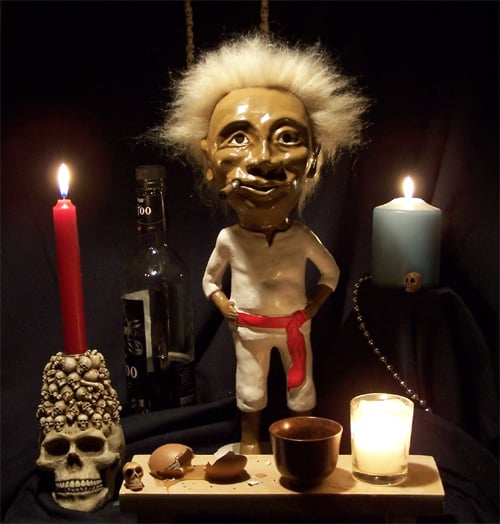

Wow, they thought they could get this monument put up at the capital?
They're crazier than I thought.
The whole point is the stupid law they wrote allows any religious statue to be displayed as long as it is fund 100% by private entities. Well, they opened up a constitutional can of worms because anyone can put up anything as long as it has a religious nature. There are plans for a Hindu statue and the Pastafarian Flying Spagehtti Monster as well. The people who crafted the law just to show the Ten Commandments now have to go through the legal battle of what can and can't be displayed. It will be determined to be unconstitutional to deny Hindus or any other religion the ability to display what they want at the location approved by Oklahoma. So Oklahoma will have to go back to the draft board and try some other underhanded way to display the 10 Commandments on public property and violate the Constitution or take everything down all together.Wow, they thought they could get this monument put up at the capital?
They're crazier than I thought.

See, this is the problem. You constitutional scholars tend to grossly exaggerate what's actually IN the Constitution.Hahaha. Translation: We don't give a flip about the constitution.
Wow. There you go. Catholicism is about going to Church for one hour a week and then forgetting everything you heard for the other 167. Living the Faith has nothing to do with it.Growing up in a small town that was majority Baptist & Methodist, this was the nice thing about being Catholic.
Catholicism required you come to church. It didn't require you take church to 2nd period Algebra or organize a Bible study before school to show your friends how "christian" you were.
There are plans for... the Pastafarian Flying Spagehtti Monster as well.
I could support a Flying Spaghetti monster statue next to the Ten Commandments, but not Satan.
Why? Its a religion as well.


The players' first amendment rights aren't being violated. Freedom of religion is not the same as freedom FROM religion. As long as an individual isn't harassing you, he or she is free to share his or her beliefs just like you're free to ignore them. You can say "Christian things" to a non-Christian and nobody's rights are being violated. The First Amendment is designed to protect what you can say, not restrict what you feel like hearing. The rights belong to the speaker, not to the listener. Nobody has a right to "not be offended by shit."
Ehhhhhh. Maybe it is. I don't pretend to be familiar with the Satanic Church of Omaha, but a lot of these "statue of the devil" people in the past have been fake-Satanists just to stick it in the eye of Christians (like the spaghetti monster people).
See, this is the problem. You constitutional scholars tend to grossly exaggerate what's actually IN the Constitution.
Congress shall make no law respecting an establishment of religion, or prohibiting the free exercise thereof.
That's it. Literally. The end. A statue of the Ten Commandments isn't "establishing a religion." Declining to put up a devil statue is not "prohibiting the free exercise thereof." The only violation of the Constitution here would be if the legislature in Oklahoma passed a law that said "everyone must be Christian" (...establishment of religion...) or if they shut down all the Satanic churches (...prohibiting the free exercise thereof...). A statue or whatever else in a public space is neither "establishment of religion" nor "prohibiting free exercise" so communities can decide whatever the rip they feel like deciding.
The First Amendment has two provisions concerning religion: the Establishment Clause and the Free Exercise Clause. The Establishment clause prohibits the government from "establishing" a religion. The precise definition of "establishment" is unclear. Historically, it meant prohibiting state-sponsored churches, such as the Church of England.
Today, what constitutes an "establishment of religion" is often governed under the three-part test set forth by the U.S. Supreme Court in Lemon v. Kurtzman, 403 U.S. 602 (1971). Under the "Lemon" test, government can assist religion only if (1) the primary purpose of the assistance is secular, (2) the assistance must neither promote nor inhibit religion, and (3) there is no excessive entanglement between church and state.
The Free Exercise Clause protects citizens' right to practice their religion as they please, so long as the practice does not run afoul of a "public morals" or a "compelling" governmental interest. For instance, in Prince v. Massachusetts, 321 U.S. 158 (1944), the Supreme Court held that a state could force the inoculation of children whose parents would not allow such action for religious reasons. The Court held that the state had an overriding interest in protecting public health and safety.
Sometimes the Establishment Clause and the Free Exercise Clause come into conflict. The federal courts help to resolve such conflicts, with the Supreme Court being the ultimate arbiter.
Check out similar cases related to Engel v. Vitale that deal with religion in schools and the Establishment Clause of the First Amendment.
First Amendment and Religion
There is a recognized Jedi religion. As greyhammer said, do we want someone deciding what a religion is?Ehhhhhh. Maybe it is. I don't pretend to be familiar with the Satanic Church of Omaha, but a lot of these "statue of the devil" people in the past have been fake-Satanists just to stick it in the eye of Christians (like the spaghetti monster people).
Theres a problem though...theres no smoking and no alcohol permitted in Notre Dame stadium.

There is a recognized Jedi religion. As greyhammer said, do we want someone deciding what a religion is?

Sure it is. What the Oklahoma representative said is a complete distinction to what you are saying. He basically said that Oklahoma is a Christian state. The establishment clause prohibits this. According to the Constitution Christianity can't be given special privileges over other religions. If they deny the satanic statue then they are effectively promoting one religion over another. That is unconstitutional.
School sponsorship of a religious message is impermissible because it sends the ancillary message to members of the audience who are nonadherants "that they are outsiders, not full members of the political community, and an accompanying message to adherants that they are insiders, favored members of the political community." Lynch v. Donnelly, 465 U. S., at 688 (1984) (O'Connor, J., concurring).
This is a tricky area of the law. Over the last 30 years the Supreme Court has sometimes ignored the Lemon test and simply asked whether a reasonable person would understand the state or state institution involved to be endorsing religion. For instance, a Texas school district's practice of allowing an elected "student chaplain" to lead the spectators in a prayer over the P.A. system before football games was held to violate the Establishment Clause. As the Court explained in that case:
FindLaw | Cases and Codes
It's hard for me to imagine how Jones could put into practice his philosophy of keeping Jesus Christ in the huddle without violating the Establishment clause. I can't say for sure without knowing exactly what he means by "keeping Jesus Christ in the huddle," but it definitely sets off my lawyer alarm.


Of course, for sure there is interpretation. In van Orden vs. Perry, Texas was allowed to display the Ten Comandments. Justice Breyer provided these as part of his opinion:This is a tricky area of the law. Over the last 30 years the Supreme Court has sometimes ignored the Lemon test and simply asked whether a reasonable person would understand the state or state institution involved to be endorsing religion. For instance, a Texas school district's practice of allowing an elected "student chaplain" to lead the spectators in a prayer over the P.A. system before football games was held to violate the Establishment Clause. As the Court explained in that case:
FindLaw | Cases and Codes
It's hard for me to imagine how Jones could put into practice his philosophy of keeping Jesus Christ in the huddle without violating the Establishment clause. I can't say for sure without knowing exactly what he means by "keeping Jesus Christ in the huddle," but it definitely sets off my lawyer alarm.
I disagree with some of them but its his opinion so that's what matters. Generally if it is secular in nature there is no problem. when one religion gets special privileges, then it definitely is an alarm to me.In opening his discussion of reasoning Breyer states:
The case before us is a borderline case. It concerns a large granite monument bearing the text of the Ten Commandments located on the grounds of the Texas State Capitol. On the one hand, the Commandments' text undeniably has a religious message, invoking, indeed emphasizing, the Deity. On the other hand, focusing on the text of the Commandments alone cannot conclusively resolve this case. Rather, to determine the message that the text here conveys, we must examine how the text is used. And that inquiry requires us to consider the context of the display.
He then goes on to list points which are stated to be insufficient individually, but together seem to provide a reasonable basis for "secular purpose":
The monument's 40-year history on the Texas state grounds indicates that nonreligious aspects of the tablets' message predominate.
The group that donated the monument, the Fraternal Order of Eagles, is a private civic (and primarily secular) organization. Who, while interested in the religious aspect of the Ten Commandments, sought to highlight the Commandments' role in shaping civic morality as part of that organization's efforts to combat juvenile delinquency.
The Eagles' consulted with a committee composed of members of several faiths in order to find a nonsectarian text — an act which underscores the group's ethics-based motives.
The tablets, as displayed on the monument, prominently acknowledge that the Eagles donated the display.
The physical setting of the monument suggests little or nothing of the sacred.
The monument sits in a large park containing 17 monuments and 21 historical markers, all designed to illustrate the "ideals" of those who settled in Texas and of those who have lived there since that time.
The setting does not readily lend itself to meditation or any other religious activity.
The setting does provide a context of history and moral ideals.
The larger display (together with the display's inscription about its origin) communicates to visitors that the State sought to reflect moral principles, illustrating a relation between ethics and law that the State's citizens, historically speaking, have endorsed. That is to say, the context suggests that the State intended the display's moral message — an illustrative message reflecting the historical "ideals" of Texans — to predominate.
I think the difference there is that the Texas school district itself endorsed the prayer. This comment didn't come from the University of Connecticut itself, but from an individual.
Sent from my Samsung Galaxy S III using Tapatalk 4
I think the difference there is that the Texas school district itself endorsed the prayer. This comment didn't come from the University of Connecticut itself, but from an individual.
Sent from my Samsung Galaxy S III using Tapatalk 4
UConn President Susan Herbst, in a letter that appears in Wednesday's Courant, responded.
"At public universities we value everyone in our community, and treat each person with the same degree of respect, regardless of who they are, what their background is, or what their beliefs may be," Herbst wrote. "Every student, including student-athletes, must know they are accepted and welcomed at UConn. Always. Our staff should educate and guide students, to ensure they are well-prepared for life at UConn and beyond. But it should go without saying that our employees cannot appear to endorse or advocate for a particular religion or spiritual philosophy as part of their work at the university, or in their interactions with our students. This applies to work-related activity anywhere on or off campus, including on the football field. Our athletic director and Coach Diaco agree wholeheartedly with me, and have made this clear to their staff."
Of course, for sure there is interpretation. In van Orden vs. Perry, Texas was allowed to display the Ten Comandments. Justice Breyer provided these as part of his opinion:
I disagree with some of them but its his opinion so that's what matters. Generally if it is secular in nature there is no problem. when one religion gets special privileges, then it definitely is an alarm to me.
Could you imagine if he won it? He would probably be on the fast track to not being homeless. Got to admire ingenuity and the fortitude to try it.Interesting fact about this case: the dude who brought it to the Supreme Court was HOMELESS at the time. He was a former lawyer who had fallen into alcoholism, and every day he would wake up and go to the public law library in the Texas Supreme Court building to kill time. He thought that the statue of the Ten Commandments outside the Texas Supreme Court violated the Establishment clause, and he decided to test it in court.
I don't have a point. I just always thought that was interesting. I mean, when I read these cases, I always wonder who is the person who is actually so offended by the Ten Commandments that he wants to bring a lawsuit, you know? I grew up in Catholic schools so I wouldn't even notice a statute of the Ten Commandments. It's a total commonplace for me. Sometimes, no doubt, it's that the people bringing the lawsuit truly feel excluded from the political community by the religious expression, I guess. But sometimes, as in Van Orden, it's just that the people bringing the lawsuit don't have enough to do. Lol.

UConn President Susan Herbst, in a letter that appears in Wednesday's Courant, responded.
"At public universities we value everyone in our community, and treat each person with the same degree of respect, regardless of who they are, what their background is, or what their beliefs may be," Herbst wrote. "Every student, including student-athletes, must know they are accepted and welcomed at UConn. Always. Our staff should educate and guide students, to ensure they are well-prepared for life at UConn and beyond. But it should go without saying that our employees cannot appear to endorse or advocate for a particular religion or spiritual philosophy as part of their work at the university, or in their interactions with our students. This applies to work-related activity anywhere on or off campus, including on the football field. Our athletic director and Coach Diaco agree wholeheartedly with me, and have made this clear to their staff."

Could you imagine if he won it? He would probably be on the fast track to not being homeless. Got to admire ingenuity and the fortitude to try it.
I don't know ho much of it is feeling excluded,or preventing others from feeling excluded, or how much it is at least an attempt to uphold the first amendment out of principle.
It is really clear the fathers did not want a state sanctioned religion. These people like the ones in Oklahoma are defacto ignoring it.

Sure, I did too, for years. But the argument could be made easily against it like Emcee pointed out above.I'm curious whether or not UCONN drops to a knee right before they leave the locker room on gameday to say a quick prayer.
I went to a public high school and we did this before every game. I'm fairly certain this is common around the country, both at high schools and colleges.


