Theology

Old Man Mike

Fast as Lightning!
Messages
8,965
Reaction score
6,453
Francis, unlike some "leaders" today, is constantly trying to be a unifier. Blessings to that good man.
 

zelezo vlk

Well-known member
Messages
18,009
Reaction score
5,047
I was just chatting with a friend about a month ago that we're long overdue for an encyclical.
 

Whiskeyjack

Mittens Margaritas Ante Porcos
Staff member
Messages
20,894
Reaction score
8,126
Carlo Acutis was a Roman teenager who died of leukemia in 2006 at the age of 15. He had a special devotion to the Blessed Sacrament, creating a website which carefully catalogued all known Eucharistic miracles. He is due to be canonized in a couple weeks by Pope Francis.

His tomb in Assisi was recently opened for veneration, and he seems to be incorrupt:
<blockquote class="twitter-tweet"><p lang="en" dir="ltr">The tomb of Carlo Acutis in Assisi has been opened for veneration <a href="https://t.co/cATbmGe0LV">pic.twitter.com/cATbmGe0LV</a></p>— Sachin Jose (@Sachinettiyil) <a href="https://twitter.com/Sachinettiyil/status/1311620849804300289?ref_src=twsrc%5Etfw">October 1, 2020</a></blockquote> <script async src="https://platform.twitter.com/widgets.js" charset="utf-8"></script>

I have to admit I never expected to see a saint buried in a track suit and Nikes. It's convicting to see someone so modern raised to the altars.
 

zelezo vlk

Well-known member
Messages
18,009
Reaction score
5,047
Carlo Acutis was a Roman teenager who died of leukemia in 2006 at the age of 15. He had a special devotion to the Blessed Sacrament, creating a website which carefully catalogued all known Eucharistic miracles. He is due to be canonized in a couple weeks by Pope Francis.

His tomb in Assisi was recently opened for veneration, and he seems to be incorrupt:
<blockquote class="twitter-tweet"><p lang="en" dir="ltr">The tomb of Carlo Acutis in Assisi has been opened for veneration <a href="https://t.co/cATbmGe0LV">pic.twitter.com/cATbmGe0LV</a></p>— Sachin Jose (@Sachinettiyil) <a href="https://twitter.com/Sachinettiyil/status/1311620849804300289?ref_src=twsrc%5Etfw">October 1, 2020</a></blockquote> <script async src="https://platform.twitter.com/widgets.js" charset="utf-8"></script>

I have to admit I never expected to see a saint buried in a track suit and Nikes. It's convicting to see someone so modern raised to the altars.

Yeah, what the heck are we even doing with our lives?

Blessed Carlo pray for us!
 

NorthDakota

Grandson of Loomis
Messages
15,693
Reaction score
5,993
Carlo Acutis was a Roman teenager who died of leukemia in 2006 at the age of 15. He had a special devotion to the Blessed Sacrament, creating a website which carefully catalogued all known Eucharistic miracles. He is due to be canonized in a couple weeks by Pope Francis.

His tomb in Assisi was recently opened for veneration, and he seems to be incorrupt:
<blockquote class="twitter-tweet"><p lang="en" dir="ltr">The tomb of Carlo Acutis in Assisi has been opened for veneration <a href="https://t.co/cATbmGe0LV">pic.twitter.com/cATbmGe0LV</a></p>— Sachin Jose (@Sachinettiyil) <a href="https://twitter.com/Sachinettiyil/status/1311620849804300289?ref_src=twsrc%5Etfw">October 1, 2020</a></blockquote> <script async src="https://platform.twitter.com/widgets.js" charset="utf-8"></script>

I have to admit I never expected to see a saint buried in a track suit and Nikes. It's convicting to see someone so modern raised to the altars.

thats amazing. How very Italian to bury him in such a manner.
 

Whiskeyjack

Mittens Margaritas Ante Porcos
Staff member
Messages
20,894
Reaction score
8,126
Esquire just published an interview with Dr. Richard Gallagher, a psychiatrist who specializes in demonic possession:

Decades ago, Dr. Richard Gallagher, an academic psychiatrist, awoke in the night to the sound of his two otherwise-docile cats screeching and clawing at one another. Gallagher was forced to separate the berserk cats into two rooms, then went back to bed, mystified by their strange behavior. The next morning, a priest with whom Gallagher was acquainted knocked at the door, accompanied by a woman with jet black hair whose eyeliner stretched to her hairline. “How’d you like those cats last night?” she quipped.

This was Julia, who claimed to be a high priestess of Satanism possessed by demonic forces. Her remarkable case was among the first of many that Gallagher would encounter in a long career spent distinguishing psychosis from alleged possession. Julia exhibited a series of behaviors that, as Gallagher sees it, constituted a “once-in-a-century” possession, from speaking in languages she claimed not to know to allegedly levitating for over half an hour during an exorcism.

“I know I’m possessed,” Julia later told Gallagher during a consultation. “I space out and then don’t recall what happens. They tell me a voice comes out of me. I don’t know. I don’t remember anything. It’s a demon, I’m sure.”

So began Gallagher’s long immersion into the world of supposed demonic possession. In the decades since encountering Julia, Gallagher has consulted with faith leaders from numerous religions on hundreds of cases, assisting them in the process of distinguishing “troubles of the mind” from what he believes are “troubles of the spirit.” As a result, Gallagher has been present at scores of exorcisms, leading him to become a sought-after resource on demonic possession. Since the early 1990s, Gallagher has been an active member of the International Association of Exorcists, serving for a time as a scientific advisor on its governing board. Gallagher recounts his experiences in Demonic Foes: My Twenty-Five Years as a Psychiatrist Investigating Possessions, Diabolic Attacks, and the Paranormal, a new book spanning the depth and breadth of his unusual medical career. Gallagher spoke with Esquire about his own faith, the rigorous process of gathering evidence, and the complicated interplay of science and spirituality.

Esquire: You mention in the preface that you were hesitant to write this book. What compelled you to write it?

Richard Gallagher: It involves a controversial subject and I'm an academic psychiatrist, so I wasn't sure that it was a great idea, professionally speaking, to publicize a belief that is unacceptable to a lot of people in my field. However, that wasn't the major consideration. I had another consideration about revealing people’s stories. These individuals were never patients of mine, but people about whom I consulted with clergy. I was hesitant about confidentiality. I eventually decided that I could disguise the characters well enough; I also had the permission of these individuals to write about them.

I think there are a certain people, both psychiatric patients and the rare cases of people who suffer, who should understand this. There are people with mental problems who think they're possessed and the reverse. I did think it could enlighten a certain population. I also thought it would be of public interest. Obviously it's a topic that people tend to be interested in, but often there are a lot of misconceptions and confusion. I thought I was in a unique position, both with my extensive experience in this field and having it studied scientifically, as an academic professor of psychiatry. I thought that my vantage point would allow me to write a book that would be enlightening to a lot of people.

ESQ: You write early in the book that some of your physician colleagues would agree with your findings, but would be reluctant to reveal their agreement openly. Why is that?

RG: In America, there are a lot of Christian psychiatrists. All over the world, there are plenty of spiritually-oriented psychiatrists, who truly accept the possibility of possession by spirits, sometimes with different ideological frameworks. A lot of them are reluctant to speak out. They may think, "This is a little out of the mainstream for the mental health field, so maybe I ought to keep this to myself." Also, many of them lack the extensive experience I have. It's not like they have a database or much familiarity with the literature on this subject, as I've developed over the years.

ESQ: What role does your own faith system play in your involvement with possessions?

RG: I'd be naive not to assume that my Catholic upbringing piqued my interest in the subject. I’m the type of person who has always questioned my faith, so it's not as if I accepted it without inquiry. I really tried to study it dispassionately as a phenomenon. It hasn’t come to be a central part of my thinking about religion, but it was certainly a set of phenomena that intrigued me, both as a doctor and as a thinking human being. I allowed myself to get involved with a few priests who asked me for my opinion; then I got involved with the International Association of Exorcists, who have taken a somewhat scholarly approach to this whole thing. I became versed enough in the subject matter that I then became considered an expert to consult.

ESQ: What are the typical conditions that lead to demonic interference in a person's life? Who is particularly vulnerable to these attacks?

RG: Possession is not something that's going to happen willy-nilly to anybody. People don't have to go to bed at night worried that they're going to wake up possessed in the morning. There’s a spectrum of attacks, but the people who become possessed are almost invariably—and I'm choosing my words carefully here, because there are a few exceptional cases—people who have turned in a serious way to something evil. That could mean serious dabbling or immersion in dark, occult areas of behavior, like Satanism. That said, you can't go around saying that Satan is everywhere. More people become involved in the serious pursuit of what they regard as magic or witchcraft.

The second category of people vulnerable to possessions, which often overlaps with the first, is people who have seriously turned to evil in their lives. Surprisingly, some people who have turned to evil in a serious way will turn to beliefs that we would regard as occult or dark, like cults. They get involved in that, then they expect favors in return, and after awhile, they find that it was a fool’s bargain. They’re in over their heads, and the occult forces they've committed to have spun out of control, effectively possessing them.

ESQ: Doesn’t it seem like a self-fulfilling prophecy that most victims of demonic possession are involved in a spiritual practice? What about people who are agnostics or atheists? Are they vulnerable to possessions?

RG: People will often say, "How come it's only these Christians, especially Christian fundamentalists, who get possessed?" It’s true that certain fundamentalist religious people are going to misinterpret psychiatric problems or other medical problems as possession. They may be the most exhibitionist about it, but possession can happen to anybody—and it has, throughout history. Possession has attacked any and all cultures. Pretty much all religions and all cultures have seen cases of possession; it doesn't in any way depend on the particular religious tradition, nor does it even depend on a person’s belief or disbelief in God. It's not going to happen to your average atheist of good will, but if somebody has no religious belief and they’ve turned to evil, in some ways, they're in a worse condition, because they don't know how to get help. I've met people with completely agnostic or atheistic beliefs who somehow dabbled in the occult, then found themselves way in over their heads. They didn't know who to turn to, so sometimes they were more willing to speak to a psychiatrist than to a clergy member. Although, an awful lot of the cases referred to me do come my way through clergy.

ESQ: You write that, in order to recover from demonic possession, a person has to work at it and want it. What does that work look like?

RG: Considering that these possessions usually happen to people who have turned to evil or the occult, you have to renounce that. You have to say, "I'm not going to do that again." Or, "I'm not going to get involved in Satanism. I'm not going to get involved in witchcraft." Some people are very reluctant to do that. Julia was one of them. I had the strong impression that she liked her activity in the cult, although she was also frightened by it and afraid to leave. She was afraid she would be harmed if she left the cult.

Julia was an extreme case, because she credibly convinced me that she was what she said she was, which was a high priestess in a Satanic cult. To be liberated, she would have had to renounce the cult and renounce a sinful life, because these cults are not innocent. They do some nefarious things. She also would have had to build herself up spiritually. She would have had to turn to God. She would have had to develop some kind of religious practices. That's how people get better, often in conjunction with prayers and exorcisms, in extreme cases. Many exorcists have said to me that it's 90% the patient's own efforts and 10% the exorcisms. I'm certainly not saying that exorcisms are inefficacious, but they're only part of the process of liberation. They're not magic.

ESQ: What’s a typical exorcism like, and how do you know when a series of exorcisms has been effective?

RG: In one sense, there’s no such thing as a typical exorcism, because they're all different. Different spiritual traditions have different ceremonies and rituals. The Catholic exorcism is perhaps the most ritualized. Orthodox Christians also have a fairly set ritual prayer that they say. A typical session may go on for 45 minutes. The prayers are said. Sometimes the demon surfaces; sometimes it doesn't. I’ve seen a person delivered in one exorcism, but I've seen other exorcisms that go on for months or years. Sometimes the person is never delivered.

ESQ: What’s the variance you see in these demons? What’s the range of personalities you've observed?

RG: They don't reveal their personalities very much. What they do reveal is invariably nasty, prideful, and arrogant. Some of them seem sillier than others. Some of them appear super silly while others are quite malevolent. Clearly you're dealing with different levels of personality, but we're seeing the side of them that is particularly bitter. They don't want to leave, so invariably they lie. They are constantly trying to confuse people, so they may say they're a dead soul. In ancient times, Jewish and Christian writers felt that demons pretended to be gods possessing people. This was a common belief in the Greek world.

In modern times, especially in the developed world, many people think the possessed are just mentally ill. There's a real difference. As I often say to people, mentally ill people can't all of the sudden speak foreign languages. They don't exhibit levitation. They don't have superhuman strength, and as Julia exhibited on many occasions, they don't have psychic abilities enabling them to reveal information called hidden knowledge. All of these symptoms are a good indication that there's a separate creature involved. I leave the official diagnosis process to the clergy, but I'm well aware that, to constitute a possession, you have to rule out psychiatric and medical illnesses, some of which have superficial similarities, but are really quite different. You must have clear and rigorous evidence. In the Catholic church, the diagnostic process is rigorous, intended to result in a moral certainty. You're not supposed to assume that this happens without a lot of very hard evidence.

ESQ: You write in the book that demand for exorcisms is rising. Why is that?

RG: There are two theories about that. I think they both have some merit. One is that there's more preoccupation with this stuff, so people think they need an exorcism when they don't. Young people nowadays are brought up on movies, TV shows, and paranormal beliefs. That's different from when I was a kid, when this stuff was dismissed and frowned upon. Part of it may be that there are more people who think they're possessed. They may even have prayer said over them when in fact they're mentally ill.

The second factor that most experienced exorcists believe, likely with credibility, is the decline of traditional religions. It's quite clear that mainstream religions, not just Christianity, have had a decline in recent decades. When people give up a mainstream or more orthodox type of religion, they generally develop some kind of substitute belief system. That often involves ideas about energy forces, occult themes, and visitation by spirits. A lot of exorcists feel that, through alternate spiritualities, these people have opened themselves up to evil forces and evil spirits, in ways that more mainstream religious people are protected from.

ESQ: For somebody seeking the services of an exorcist, how can they tell a true professional from a huckster?

RG: There are many hucksters. People find these topics outlandish, but there are plenty of shamans in New York City and California. There are the people who call themselves psychic healers. There was a craze in France a couple of years ago where a lot of people were styling themselves as alternative healers and exorcists. I’m sure some of them are well-meaning, but they often charge a lot of money. One criteria is to find someone who does this as a spiritual ministry, or someone from a more mainstream religious tradition rather than someone who sets themselves up as a self-styled expert in exorcisms. I've almost never seen anyone who goes to someone who charges money get successfully delivered.

ESQ: You mention late in the book that your colleague Father Jacques felt endangered by cult members, and that those cult members wanted to suppress his testimony to the media. Can you tell me more about that tension between cult members and clergy?

RG: I'm a psychiatrist, and in at least part of my professional life, I was exposed to a lot of people who were hysterical about cults and Satanism. The famous Christian writers said, "Demons are happy that we don't believe in them, and they're also happy that we become over-preoccupied with them." There were subcultures in America where people were seeing Satanists and cultists everywhere. I don't think organized Satanic cults are very common. However, there are certain people who turn to a type of true Satanism or diabolism. Those people hate all authentically spiritual people, but they especially hate clergy of the different key faiths, because they see them as the enemy, teaching people to lead righteous lives and to combat evil forces.

ESQ: Plenty of people will view your findings and your experiences with skepticism. They might say it's unscientific or superstitious. What do you say to skeptics?

RG: I wouldn't say that I proselytize in any way. I'm not overly ambitious about convincing people. The victims of these possessions are suffering in the extreme. I'm a physician, so I try to help suffering people. One can say, “I don't believe in that stuff." Okay, so what are these people supposed to do? Just assume that this is all nonsense when they know that it’s a real condition they're suffering from? In the last few hundred years in the western world, this has been a very controversial subject. I think people have misconceptions, which I try to address in the book, about what science can verify and what it can't verify.

You can't do experiments in this area. I went to medical school and I went to a mainstream residency at Yale. I was taught science and the scientific method. The scientific method of the modern age is built on what we call methodological naturalism. In other words, we don't assume that spiritual forces are operating, because you can't study them in the same way. You can't study them empirically. You can't do experiments on them.

You're also dealing with creatures who know you're studying them, observing them, or trying to tape them. A lot of people think they're going to capture evidence on a camera and prove the existence of demons to the world, but these creatures know when they're being filmed. They're not about to cooperate when a large part of their efforts has been to hide themselves. They're not about to make their existence obvious to people.

What people don't understand is that you can use a broader definition of science, which was the classical view of science in the western world, where science was knowledge. Then you have to decide: “Is there enough knowledge based on historical evidence?” You can't really prove how many people crossed the Delaware with George Washington; you have to accept it on the basis of sound testimony. It's the same with exorcisms. You have to look at the testimony. Does it seem to be reasonable? Is it consistent with other teachings? For instance, teachings of the major faiths, all of which believe in evil spirits. It's a historical subject.

I never suggest to people, “I want you to believe me.” My job is not to convert anyone. My job is to present the evidence for the reasons that I want to help people and enlighten those who are open to the evidence. I belong to an organization called the International Association of Exorcists, comprised of about 400 exorcists. They all have stories like those I tell in the book. I get calls from all over the country and all over the world. I tell people, "Look, I don't care if you believe me. If you're interested in the subject, talk to these exorcists." They're usually perfectly willing to talk to somebody.

ESQ: Is there any verification process to what you do? When family members of the possessed come to you describing strange behavior, how do you verify their accounts?

RG: I try to verify things as much as I can. Some of it is based on personal observation. With Julia, as I described in the book, she would tell me things about people that I could verify. She told me about my mother, who died of ovarian cancer. I don't know what her motive was to tell me that, but that's exactly what happened. She once told me what a priest was wearing even though they were hundreds of miles apart. I've gotten verification through my personal observations, but I often speak to family members and to priests, as well as to people who conduct the exorcisms, to find out what happened in the exorcism.

Some of the most dramatic manifestations go on during the exorcisms. I've never seen a levitation, but I've had about thirty people tell me that they've witnessed a levitation. Julia had a levitation, and there were eight or nine people at that exorcism. I've been to many exorcisms in my life, though I didn't go to that one. These are salt of the earth, honest people who are just trying to help by doing all this pro bono. They swore to me that she levitated for half an hour. Many priests have told me that. A renowned professor in Europe and his assistants told me they performed an exorcism, and the person levitated.

It becomes a question of when to start believing people. 400 of these exorcists at the International Association have similar stories. I'm sure there are many Protestant ministers in America who have seen some very weird phenomena, both during exorcisms and outside of exorcisms. You listen to them and you decide, like anything else. But it's a historical question; it's not going to be decided by lab tests or X-rays. Do you believe the testimony? Does this make sense to you, and do you think the testimony is sound enough? Otherwise, why would you believe it? I wouldn't have believed it until I had a lot of experience with it.
 

Old Man Mike

Fast as Lightning!
Messages
8,965
Reaction score
6,453
EXORCISM and POSSESSION. I debated myself as whether to write about this, but what the heck, maybe somebody's interested. (Bona Fides: I have a friend who is a Catholic priest and a "registered" exorcist for the Faith. I also got to talk with another priest, once only, who had attended an exorcism as the exorcist's prayer support aid --- i.e. constant prayer during the entire procedure and in the room. More marginally, I had a student who had made some bad "ritual" decisions and had to have her apartment exorcised; and more marginally still, I had to read up on all this stuff to direct the research of two different students in my Science and Parascience class at WMU. They had picked this topic as their challenge to determine whether there was anything real about it.)

I might break my remarks up into more than one post.

First: The article/interview above is unusually sane for something related to this subject. I expected a bunch of shallow "oh so very modern" crap from a typical academic, but that didn't happen at all. This guy seems to have done honest work, deeply enough, and without the childish fear-driven materialist biases of today's academics. So good on him. Almost anytime that you read a modern academic of today on any subject bordering on the spiritual, you are reading reductionist crap, wasting your time, and subtracting from the knowledge you once had. Academic writing is quite good usually on truly material-based subjects, but anything spiritual becomes nonsense.

Well, the study of "possession" is not nonsense and apparently our writer not only found that out but was brave enough to say it out loud.

I'll give you my second hand knowledge now and maybe write a little more in a later post.

THE EXORCIST THAT I KNOW. I had a great friend, a retired Catholic priest, who passed away almost exactly a year ago. He had a great friend who was with him in his graduating class from seminary, and they stayed close. Through my buddy, Fr. Mike Howell, I met this fellow several times, liked him immediately, and found that he was an approved exorcist, then living in Northern Michigan. Well, I was patient to begin with but couldn't restrain myself from asking him about it ultimately.

He surprised me --- greatly --- by saying that yes, he had done exorcisms OVER A HUNDRED TIMES!!! Thoroughly boggled, I asked how could this be? He said that this is a lot more common than you will ever hear about because it is so private and neither the families nor the priests talk about it. Reflecting a moment that made sense. It's about the LAST thing any family would want to make public.

I eased into the discussion further wondering about the caricature nastiness associated with these things. He said that yes, these incidents do have a nasty aspect about them but that he never has any real trouble. Boggled again, I asked how? He thinks that most people that the public hears about just take the wrong approach. He believes that these "struggling" exorcists take the possessing agents too seriously.

What could he possibly mean by that? He said that sure, this possession state IS serious and must be handled with care, but the exorcists shouldn't feel that they are dealing with some powerful foe. In fact, it was his opinion, and his experience, that the possessing agents were spiritual lightweights. He experienced them as stupid, silly, poorly motivated, almost incompetent childish morons with little "skill" at casting darkness in any organized way. To defeat them, his technique was to engage them for a bit, and then turn their image into ones of silliness and mockery until they couldn't stand to be around the possessed person and this mocking priest any longer. If there were darker more malign foes, he hadn't been engaged with them yet. If there were cleverer ones --- well, he didn't think so in any of these cases anyway.

... well, this is already long. Maybe I'll write more another day ... particularly if anyone thinks it's worth doing. The bottom line here is that possession by whatever those possessing agents are is very real.
 

Old Man Mike

Fast as Lightning!
Messages
8,965
Reaction score
6,453
EXORCISM and POSSESSION, part two. I'll try to squeeze in the rest of what I think i know. (then quit.)

A couple of second-hand "personal" experiences.
1. I had the lucky opportunity to sit down with a Catholic priest --- not an exorcist --- who was willing to tell me about his experience. He was in a seminary at the time and was called in by the head of the organization. He was told that there was going to be an exorcism performed and that trouble was expected to the point that the exorcist needed a support priest to engage in constant prayer inside the room, praying that the exorcist priest could sustain against the spiritual attack that was expected. Since he, the priest talking to me, was the only one available, he was getting the job.

It was the sort of order that one simply said yes to, so he went. The exorcist explained that while the attempted "healing" went on, the priest's job was to constantly pray (I don't believe that there was a specific prayer ritual for him) for strength from The Holy Spirit to fortify the will of the exorcist. It was important, he was told, NOT to interrupt these prayers NO MATTER WHAT SEEMED TO BE HAPPENING. Properly scared to death, the priest took up his station at a prayer kneeler off to the side and began to pray.

Things DID happen during the ritual which went on for (I think that my memory's OK on this point) over an hour. The priest felt not only attempts to distract him from the task but palpable evil radiating towards him and around the room. Most spectacularly, objects in the room would rush at him as if being thrown. He would involuntarily duck away, but keep his prayer activity intact. Finally the action subsided with everyone drenched in sweat. And this is the most notable thing that he remembers: All of the moving objects in the room were exactly as they had always been. It was as if the appearance of things being thrown at him was a psychic illusion placed in his mind alongside the other psychic attacks.

This may be important. When one believes that astounding physical things are taking place, they may not be, but rather exist as psychic illusions placed in the mind (even in multiple persons attending.) This is worth at least taking note of when considering things like whether a levitation physically took place.

2. I had a student who became comfortable with talking to her prof (me) and one day admitted that she and three friends had decided for the fun of it to play with the OUIJA board. It started out like all such tomfoolery does --- giggling and accusing one another of moving the planchet --- but as often happens, became much darker over several sessions. The famous sociology researcher and fiction writer, Fr. Andrew Greeley, described this in his SF novel God Game thusly:

"Ever play with a Ouija board? It's fun at first, a harmless game. Jokes, suggestive remarks, little digs at one another. Then something or someone else seems to take control of the game, something powerful and angry and frightening. If you're smart, you stop. Maybe it's something deep down inside yourself or one of the other players, but it's still terrifying and who needs it? Especially since there is a hint that if you keep fooling around with the thing, it might just take over your life." {{As an aside, this might put IE on the same footing.}}

Well, such happened and the nastiness came through with avengeance. Three of the girls began to be thoroughly scared and stated that they were no longer going to "play." Then "poltergeist" activity began to break out in the apartment. The roommate of the Ouija board owner insisted that she throw the board in the trash. Poltergeist activity got worse, culminating in an apartment fire. This was the point at which the student asked me for advice. ... like I'd know ... I of course pleaded ignorance, but asked if she or her roommate had a priest or minister to whom they could go. That happened and the priest performed some ceremony involving holy water spraying and breaking and burning up the board. I wish I'd have known when they were doing this, but missed my chance to attend. ... anyway, as far as they were concerned it worked.

The Church views things like this precisely like dabbling with ritual magic (actually "magic" is the wrong word, and this, since it aims at intelligent agents outside oneself should be labeled "witchcraft" --- "magic" is an entirely different thing which difference the peasant folk knew well, and has been smeared together with Witchcraft by the churches.) Ouija, just as with ritual witchcraft, aims at contacting entities beyond oneself and once you open that door might just take over enough to require exorcism. The Church says "TRUE" but Don't Be Stupid!

The Church in the 20th century had an expert student of "possession" in the Jesuit (I think; it's not important) PhD Jean Lhermitte. He published a very good analysis of what was known titled TRUE or FALSE POSSESSION in 1956. It was way ahead of the curve in distinguishing the various things diagnosed rightly or wrongly as "possession." I take some pride, again, that The Church is so advanced in its learning and statements separating properly scientific and spiritual matters. By the way, the biggest difficulty in separating a true spiritual possession from a physical syndrome is the case of Multiple Personality Disorder (a possible PTSD resultant, especially from early sexual abuse.) The disorders featuring the typical three way split with a core, a child, and a dramatically aggressive personality are the key troublesome cases, especially when that third personality easily/commonly manifests. As to the doctor in the previous article's claim that no one is suddenly going to begin speaking a different language --- well, not true. There are cases in the MPD literature doing exactly that and occasionally found out as to how it could happen. (Hint: it's related to the sorts of "impossible" genius areas manifested by autistics.)

Well, I'm done. It's a big field. If anyone's actually interested I'd suggest reading Lhermitte and TK Oersterreich' very ponderous tome : POSSESSION, DEMONIACAL and OTHER. 1921. The 1966 reprinting influenced Blatty in his fictionalizations.
 

Whiskeyjack

Mittens Margaritas Ante Porcos
Staff member
Messages
20,894
Reaction score
8,126
<blockquote class="twitter-tweet"><p lang="en" dir="ltr">probably the most overlooked thing in all of occult writing is that elphias levy, one of the most famous occultists ever (and of the 19th century), hes the guy who drew that famous baphomet image, said in one of his last books that magic was over now that christianity beat it out <a href="https://t.co/npPF54NRDU">pic.twitter.com/npPF54NRDU</a></p>— owen cyclops &#55358;&#56800; (@owenbroadcast) <a href="https://twitter.com/owenbroadcast/status/1167788240860004352?ref_src=twsrc%5Etfw">August 31, 2019</a></blockquote> <script async src="https://platform.twitter.com/widgets.js" charset="utf-8"></script>
 

Whiskeyjack

Mittens Margaritas Ante Porcos
Staff member
Messages
20,894
Reaction score
8,126
Ben Sixsmith just published an article in The Spectator titled "The sad irony of celebrity pastors":

When I was a young attendee of a Charismatic Christian church, people were very keen to make themselves look ‘cool’. There was Christian rock. There was Christian rap. There was something called The Street Bible, which reframed Biblical stories through a modern lens.

I don’t want to be too mean about this stuff. Some of the Christian rock was pretty good. The Street Bible had a sense of humor about itself. Even the rap wasn’t that bad. (I say that because I know what you are imagining. ‘My name is Ben and I’m here to say/Worship God and don’t be gay.’)

Hillsong, at the time, was a very cool church. They had enormous services, and hit songs, and pastors who looked as if they had walked out of daytime television. Founded in Australia in the 1980s, Hillsong branched out across the globe, from the US, to Russia, to Israel, on the back of glossy marketing and guitar-driven worship songs. In the 2000s, Hillsong achieved more recognition through its close relationship with mainstream celebrities. Justin Bieber, Chris Pratt and Kevin Durant are all members.

Bieber was an especially notable catch. The young singer was drifting towards a life of dissolution when he made a sudden recommitment to his faith under the guidance of Carl Lentz, lead pastor of Hillsong Church NYC. Lentz, who resembles an aging boy band member clinging on to a solo career, was seen with Bieber all over the place.

It would be spiteful to suggest that Lentz and Bieber were not true friends — but also silly to suppose that the lead pastor would have made as much time for someone without Bieber’s cultural cachet. Well, a church has to make itself known. But at what cost? Hillsong NYC put celebrities front and center, which, as one churchgoer told the New York Times, ‘doesn’t feel like something Jesus would do.’

Lentz turned himself into a brand. His Instagram is full of photos of his sharp suits, hipster glasses, rippling biceps and mid-life crisis jackets. Even when he addresses social causes, he is self-involved, in the classic manner of the modern ‘influencer’. One post halves the faces of the late Ahmaud Arbery and Lentz’s bespectacled young son in an attempt to make a point about ‘white privilege’ that ends up reeking of narcissism and exploitation.

One problem with turning yourself into a celebrity is that your failings become scandals. Lentz was fired from Hillsong in November for cheating on his wife. His mistress, seeing the chance to get her 15 minutes, sold her story to the press. Other women have come forward with claims about sexual relations with Lentz, and Hillsong have announced that they have decided to appoint a third-party legal team to ‘conduct an in-depth review and investigation into all concerns and any wider cultural issues’.

Lentz’s actions are a matter for his family and his faith. There is an irony, though, in how whenever Christians seem to attach themselves to mainstream culture, with all its vices, in the hope of drawing people towards God, they seem to get drawn towards vice. Jerry Falwell Jr was a similarly public, if ideologically different, evangelical who acquired fabulous wealth and fame before being swept off by an avalanche of accusations of sexual impropriety.

Making yourself a very public representative of God, rather than a humble messenger, is a dangerous business when you are — like all of us — a very flawed human being. When you add in all the sweet temptations of wealth and fame, that becomes especially true. If you put yourself up on a pedestal you have further to fall, and when you are a religious authority, unlike an artist, or an athlete, or even a politician, your rectitude is your only excuse for being there.

This case also asks questions about the church itself. I have no doubt that Hillsong NYC, under Lentz’s leadership, enriched thousands of lives. Even young Mr Bieber has avoided legal controversies and settled down with his wife since joining Hillsong. Good luck to him! Still, it seems to represent what I call the ‘…with a twist of Christianity’ trend. There is mainstream culture, celebrities, fashion, music, modish political activism and a message of self-love, but with a twist of Christianity. Most people stick with mainstream culture because they can have all those things and pre-marital sex.

We can see the ‘…with a twist of Christianity’ trend elsewhere. Falwell was representative of the right-wing, business-oriented evangelicals who offer capitalist self-enrichment and hubristic jingoism…with a twist of Christianity. Then there are progressive Christians of whom Nadia Bolz-Weber is an extreme example, who promote the usual left-wing causes…with a twist of Christianity. While different in beliefs, such people share patterns of thought: the former believe secular individualists mysteriously share God’s wishes for what should be done with money while the latter think that secular progressives mysteriously share God’s wishes for what should be done with bodies. So, if Christianity is such an inessential add-on, why become a Christian?

I am not religious, so it is not my place to dictate to Christians what they should and should not believe. Still, if someone has a faith worth following, I feel that their beliefs should make me feel uncomfortable for not doing so. If they share 90 percent of my lifestyle and values, then there is nothing especially inspiring about them. Instead of making me want to become more like them, it looks very much as if they want to become more like me. That, sadly, appears to have been true of Lentz and his celebrity acquaintances.
 

Old Man Mike

Fast as Lightning!
Messages
8,965
Reaction score
6,453
... as soon as you see someone putting oneself "out there" in any form of self-orientation, you know that following that person is the wrong path.
 

Brother_M

New member
Messages
1
Reaction score
1
"And Jesus said to him, Why call you me good? none is good, save one, that is, God." There is none essentially, entirely, absolutely good but one, that is, God. Therefore seek after him, love him, imitate him. He alone can satisfy your longing desires, as in this life with his grace, so in the life to come with his glory.
 

dad4aa

Well-known member
Messages
3,754
Reaction score
741
Looking at James 1:2-3, which reads, “Consider it pure joy, my brothers and sisters, whenever you face trials of many kinds because you know that the testing of your faith produces perseverance,” we are given one reason why God allows bad things to happen.

As trials come (as they do for us all), they test the strength of our faith. This process can be likened to a silversmith who refines silver. As the heat intensifies, dross rises to the surface and is removed to make the silver pure. So it is with our faith, that in every trial, we are tested, refined, and made stronger than before.
 

Whiskeyjack

Mittens Margaritas Ante Porcos
Staff member
Messages
20,894
Reaction score
8,126
Whiskeyjack (and others): To someone who has experienced real trauma and loss and is questioning their faith, how would you best answer this question:

Why do bad things happen to good people?

Christians have always struggled with theodicy. A few points to keep in mind:
  • Our lives here on our earth last but the blink of an eye compared to eternity. St. Paul likens it to race we must run to obtain a great prize. As time-bound corporeal creatures, our ability to grok heaven and eternity is very poor, so it's easy to focus on present suffering and forget/ discount the value of what awaits us. Faith is the only way to counter that tendency.
  • God permits evil because he's capable of drawing an even greater good out of it than if it had not happened at all. Again, it can be hard (if not impossible) to see that the in midst of a trial. But it happens all the time.
  • As dad4aa alludes to above, trials are intended to make you stronger. But you have to trust in Providence, which isn't possible without grace. Faith (along with Hope and Love) is one of the theological virtues, so it is only obtained as a gift from God. It's not like the cardinal virtues that can be obtained and strengthened simply through your own will and personal effort. So if you're struggling with Faith, the first thing to do is pray for help with that specifically. Mark 9:23 is a good place to start: "I do believe, Lord. Help my unbelief."
Please feel free to DM me if you'd like to discuss any of this more privately.
 

TNUtoNotreDame

Voted must gracious poster for seven years running
Messages
3,127
Reaction score
2,963
"And Jesus said to him, Why call you me good? none is good, save one, that is, God." There is none essentially, entirely, absolutely good but one, that is, God. Therefore seek after him, love him, imitate him. He alone can satisfy your longing desires, as in this life with his grace, so in the life to come with his glory.

True, no one who lives is truly good. I hate evil and wish to be rid of it and wonder why it exist. But then when I look at my own heart and actions I am fallen. I want someone else's wrongs to cease but never call God to smite my own sin. Free will enters the world and sin and brokenness arise everywhere. We're not robots. Suffering sucks and watching people die is horrible (been there several times). But that does not disprove God.
There can be no objective evil if there is no objective good.

On my phone so I hope this makes some sense.
 

tussin

Well-known member
Messages
4,153
Reaction score
1,982
Great stuff fellas -- appreciate the posts. Threads like this are what make this football forum special.

Maybe I'll post on 247 and compare responses.
 

BrownerandFry

Banned
Messages
1,141
Reaction score
198
In this world you shall have tribulation but be of good cheer for I have overcome the world. Those who want evil to suddenly go away have not accepted Christ the Way the Truth The Life. They are infatuated with a faux Christ a weak non Christian amalgam of Santa the Tooth Fairy and the Make a Wish Foundation. Wanna follow Christ? Then take up thy Cross.......
 

BrownerandFry

Banned
Messages
1,141
Reaction score
198
The point about the Catholic Church being obsessed with sex was interesting. I don't know the facts behind his accusation about contraception/Africa, but if true, that's pretty bad.

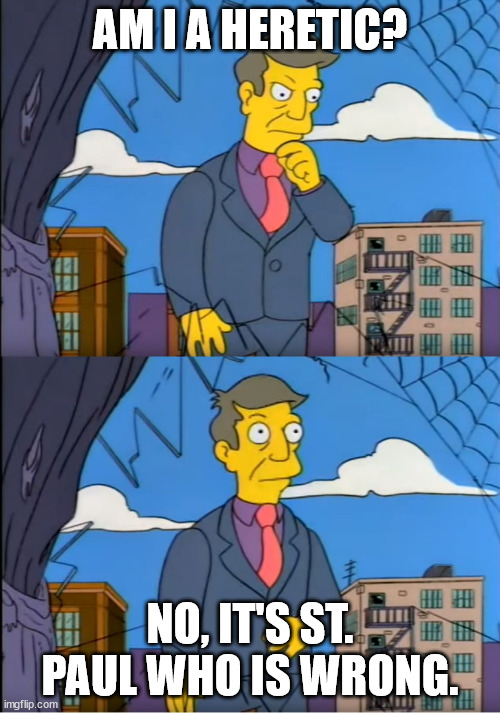
The source of the problem is Paul.

Riddle me this: How many times did Christ mention circumcision?
How many times did Paul?

Paul, simply, was concerned with his peepee.

and Oh, Yeah,
I am working on a book that should be ready in the Second Half of '22

"the Excommunication of St. Paul"

It blends the Catholic system of Excommunication with the errors of Paul.

There are two paths:
Follow Christ OR
Follow OT, Paul and Revelations

I have a simple litmus test to identify charlatans and grifters, and sadly, the errant, the misguided.

If 80% of their references are to
Paul/OT/Revelations

then they are not JESUSCHRISTIANS

when you get that, the fog lifts.

Christ
89 Chapters
Easy to read
 

Whiskeyjack

Mittens Margaritas Ante Porcos
Staff member
Messages
20,894
Reaction score
8,126
5gq1dt.jpg
 

BrownerandFry

Banned
Messages
1,141
Reaction score
198
068-Heretical-Garbage-Stamp-4.jpg


Heresy aside, I don't care for the song's melody.

Unpopular opinion: don't care for Silent Night either.

Hans Kung and I disagree on the Immaculate Conception, and I am merely the fly on the elephant's back here, with the late great Kung the elephant.
Sometihing about the immaculate Concenption didn't ring true when I was at a weekday Mass and some priest (overweight, alcoholic-ruddy face) went into a black rage about the immaculate conception, equating faith not with Christ as Way Truth and Life, but with drinking the Immaculate Conception koolaid.

I walked out mid homily.

About five years later, I found Hans Kung's stuff about the Immaculate conception./

I felt better, less isolated.
 

BrownerandFry

Banned
Messages
1,141
Reaction score
198
Is it accurate to declare that
Every Orthodox Jew, by definition, is a Messiah Denier, specifically that Jesus, later the Christ was neither the Messiah nor the Way, the Truth, the LIFE?
 

Valpodoc85

Well-known member
Messages
1,719
Reaction score
466
Question for the theology minds: what is the current thought in the religious community regarding the Parasite Stress theory of values as articulated by Randy Thornhill? Particularly with regard to religiosity and infectious disease?
 

BrownerandFry

Banned
Messages
1,141
Reaction score
198
Question for the theology minds: what is the current thought in the religious community regarding the Parasite Stress theory of values as articulated by Randy Thornhill? Particularly with regard to religiosity and infectious disease?

I will defer to others on your specific question.

But I believe Christ would expand it to all stress, beyond bodily ones.

"Take up thy cross..." seems an invitation to embrace adversity

for Christ it was Pass Through, not Pass over

"In this world you WILL HAVE TRIBULATION, but be of good cheer, for I have overcome"

But my constant concern is that faith and walk and belief are FREOCIUSLY individual
Group don't matter
cohort doesn't work

And if merely OBSERVE how christ worked, he focused on one individual at a time.

But thanks for your post and I hope you draw some informed commnentary, or, minimallyh, heartfelt passionate commentary.
 

du Lac

CEO of IE
Messages
1,643
Reaction score
1,064
sorry, don’t mean to bring up the elephant in the room on the above conversation about Dabo being Christian, but ND is the most well known Christian school in the world. Lol.
 
Top