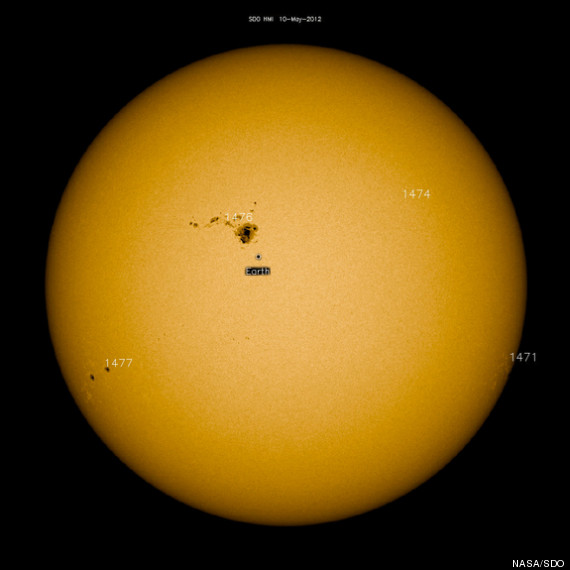
I suppose that people are aware that
1). the E-flux of the recent solar storm passed us by last week [civilization did not end]; and,
2). we had a larger flare last August [civilization did not end].
Most of the main electronic land-based systems of the planet are significantly "hardened" against solar fluxes [a procedure which started in the military way back circa Korean War time, using data from dedicated facilities like the High Altitude Observatory in Boulder to predict timing and strength of the "incoming".]
What is vulnerable are not land-based systems, but anything which depends upon satellite communications. The power-grid business is, in my opinion, just a red herring. The famous Quebec-to-East Coast black-out was not caused by Solar Activity, but bad designs and Human errors.[ as usual]. But, things like GPS, TV, phones, air-coordination, etc --- yes, those could be in theory more vulnerable to a really big one.
On re-reading this, I realize that I've written a little too simplistically. Obviously, since the solar storm DID begin a sequence of events which caused the 1989 Quebec failure, I should admit that. But what followed the geomagnetic storm was largely our own short-sightedness. The Quebec system rests literally upon igneous rock [various quartz-containers etc] and is the worst bedrock upon which to sit a power station, because a geomagnetic storm's electrically-induced land currents will not readily be dissipated by such stone. Therefore the earth-currents "hang around" and do more damage.
The damage is due to them setting up inside the power grid equipment what are called "harmonic currents" [temporary electrical fluxes which can have wave-additive "peaks" which can overload certain capacitors or transformers causing shut-downs or burn-outs.] There are ways to avoid this phenomenon, and the first flux through the Quebec system WAS avoided by adjustments by on-duty personnel. The second was not [it happened several hours later]. Whether that was human-error simply, I do not know. Either way, the design is/was flawed. The monitoring/control/ current deflection protection measures were set too low and this seems to be fixed.
Big electrical systems have a lot at stake in not letting such things go on. The "hardening" talked about involves the current-shunting measures, the type of sensors and responders, and the "toughness" of things like the transformers, as well of things that I am not aware of, doubtlessly.
This problem diminishes rapidly as you get away from high latitudes where the solar E-fluxes are far stronger. It is nearly inconceivable that a southern power grid would ever get enough EM-pulse earth-current-generation to cause system shutdowns.