Foreign Policy

Andy in Sactown

Can't wait 'til gameday.
Messages
2,689
Reaction score
327
The last time we erred on the side of non-aggression in regard to small boat threats, the USS Cole happened.

Now, I'm not saying we should unload on these Iranian small boats, but I'm all for deploying SEAL units to task forces transiting the Hormuz Canal and putting a .50 cal round through their outboard engines when they pull these simulated attack runs in clear violation of international maritime law.

Let them float around awhile and contemplate their actions.
 
Last edited:

phgreek

New member
Messages
6,956
Reaction score
433
I think auditing the defense budget would be a start.

It is indeed...but you may not like the conclusion. From my perspective, Sequestration has taken the fat out, and significant muscle as well. We all know if money inside government was self-leveling, and flowed to need, we wouldn't be here. Politics / special interest destroys the ability of even the most well-meaning, and responsible people from doing the right things.

I am ok running DoD as a pre-determined % allowance based on the prior year's national economic performance...so long as every other agency does the same. I'm reasonably tired of hearing sniveling about the % spent on defense vs whatever. Lets duke it out and set the budget priorities for 20 years as fixed % based upon of prior year economic performance, not last year +3%.

If government has indeed become too large and complex to do budgets every year from 0, then the only responsible way to cut the bullshit is to end spending growth by definition. Tie budgets to national economic performance...for ALL agencies. If economic growth of 3% is a thing of the past...why the fuck would we grow the spend side blindly by 3%??? thats just stupid. It is equally as stupid to select a government function and whack its budget 20% per year...because politics doesn't work anymore.

I'm also ok with forcing a minimum budget surplus every year. I think having cash on hand is just as important to the health of a nation as anything. Allows the government to strategically invest in (read destroy) selected industries which allows us to squeeze the fuck out of our enemies. You need cash to fight economic warfare...although we act like we do have it anyway...SMH.

We are at war 24/7, and given the rise of Russia, China, and the enemies in the Middle East, thats not changing in our lifetimes. If you have a moral issue with bombs, I'm ok with cyber and economic warfare...but throttling DoD is not saving money...nor ushering peace...it is acknowledging that we are moving warfare to another plane....just that simple.
 

IrishinSyria

In truth lies victory
Messages
6,042
Reaction score
1,920
Why does the government need cash on hand when it can borrow almost infinite amounts at damn close to 0% interest?

Other than that, I agree that sequestration is dumb, agree that the politics of procurement makes it impossible to efficiently manage the defense budget, but I do think that there are probably still savings to be found given things as they are. Probably nowhere near as much as people think though.
 

phgreek

New member
Messages
6,956
Reaction score
433
Why does the government need cash on hand when it can borrow almost infinite amounts at damn close to 0% interest?

Other than that, I agree that sequestration is dumb, agree that the politics of procurement makes it impossible to efficiently manage the defense budget, but I do think that there are probably still savings to be found given things as they are. Probably nowhere near as much as people think though.

cash on hand = leverage. IMHO, If I owe no one, then I have no trepidation to act aggressively in my best interest. If I owe, I have the issue of the underwriter of my cheap money, and their entanglements to consider.

There are savings to be found, but the ones people could get to, that aren't politically sheltered are dwindling from what I see. The area you start to see acquisition working is in sustainment commodities and some common stock listed sustainment parts ...the working groups and efficiency gets better every year

...Bombs and bullets seem a little politically charged...and of course major weapon systems anything is a freak show of congressional meddling and inefficiency. I knew we were screwed the day they made the Acquisition University courses acknowledge that it is common practice for acquisition professionals to be directed to use a source per a senator or representative...SMDH.
 

IrishinSyria

In truth lies victory
Messages
6,042
Reaction score
1,920
cash on hand = leverage. IMHO, If I owe no one, then I have no trepidation to act aggressively in my best interest. If I owe, I have the issue of the underwriter of my cheap money, and their entanglements to consider.

There are savings to be found, but the ones people could get to, that aren't politically sheltered are dwindling from what I see. The area you start to see acquisition working is in sustainment commodities and some common stock listed sustainment parts ...the working groups and efficiency gets better every year

...Bombs and bullets seem a little politically charged...and of course major weapon systems anything is a freak show of congressional meddling and inefficiency. I knew we were screwed the day they made the Acquisition University courses acknowledge that it is common practice for acquisition professionals to be directed to use a source per a senator or representative...SMDH.


Personally, I think the entanglements work both ways and have been hugely beneficial to world peace. Sure Russia or Iran or China might nibble around the edges, but they're all far more reliant on the economic system we've created than we are on them. We might lose our ability to discipline them a little bit, but I think ultimately the incentives the way they are now actually work in our favor. We traded in mutual nuclear destruction for mutual fiscal destruction.
 

phgreek

New member
Messages
6,956
Reaction score
433
Personally, I think the entanglements work both ways and have been hugely beneficial to world peace. Sure Russia or Iran or China might nibble around the edges, but they're all far more reliant on the economic system we've created than we are on them. We might lose our ability to discipline them a little bit, but I think ultimately the incentives the way they are now actually work in our favor. We traded in mutual nuclear destruction for mutual fiscal destruction.

Well...Kinda...we still have our MAD era weapons...some of them anyway :) Couldn't we participate in that system w/o being beholden to anyone?
 

Legacy

New member
Messages
7,871
Reaction score
321
It is indeed...but you may not like the conclusion. From my perspective, Sequestration has taken the fat out, and significant muscle as well. We all know if money inside government was self-leveling, and flowed to need, we wouldn't be here. Politics / special interest destroys the ability of even the most well-meaning, and responsible people from doing the right things.

I am ok running DoD as a pre-determined % allowance based on the prior year's national economic performance...so long as every other agency does the same. I'm reasonably tired of hearing sniveling about the % spent on defense vs whatever. Lets duke it out and set the budget priorities for 20 years as fixed % based upon of prior year economic performance, not last year +3%.

If government has indeed become too large and complex to do budgets every year from 0, then the only responsible way to cut the bullshit is to end spending growth by definition. Tie budgets to national economic performance...for ALL agencies. If economic growth of 3% is a thing of the past...why the fuck would we grow the spend side blindly by 3%??? thats just stupid. It is equally as stupid to select a government function and whack its budget 20% per year...because politics doesn't work anymore.

I'm also ok with forcing a minimum budget surplus every year. I think having cash on hand is just as important to the health of a nation as anything. Allows the government to strategically invest in (read destroy) selected industries which allows us to squeeze the fuck out of our enemies. You need cash to fight economic warfare...although we act like we do have it anyway...SMH.

We are at war 24/7, and given the rise of Russia, China, and the enemies in the Middle East, thats not changing in our lifetimes. If you have a moral issue with bombs, I'm ok with cyber and economic warfare...but throttling DoD is not saving money...nor ushering peace...it is acknowledging that we are moving warfare to another plane....just that simple.

Some questions and points:

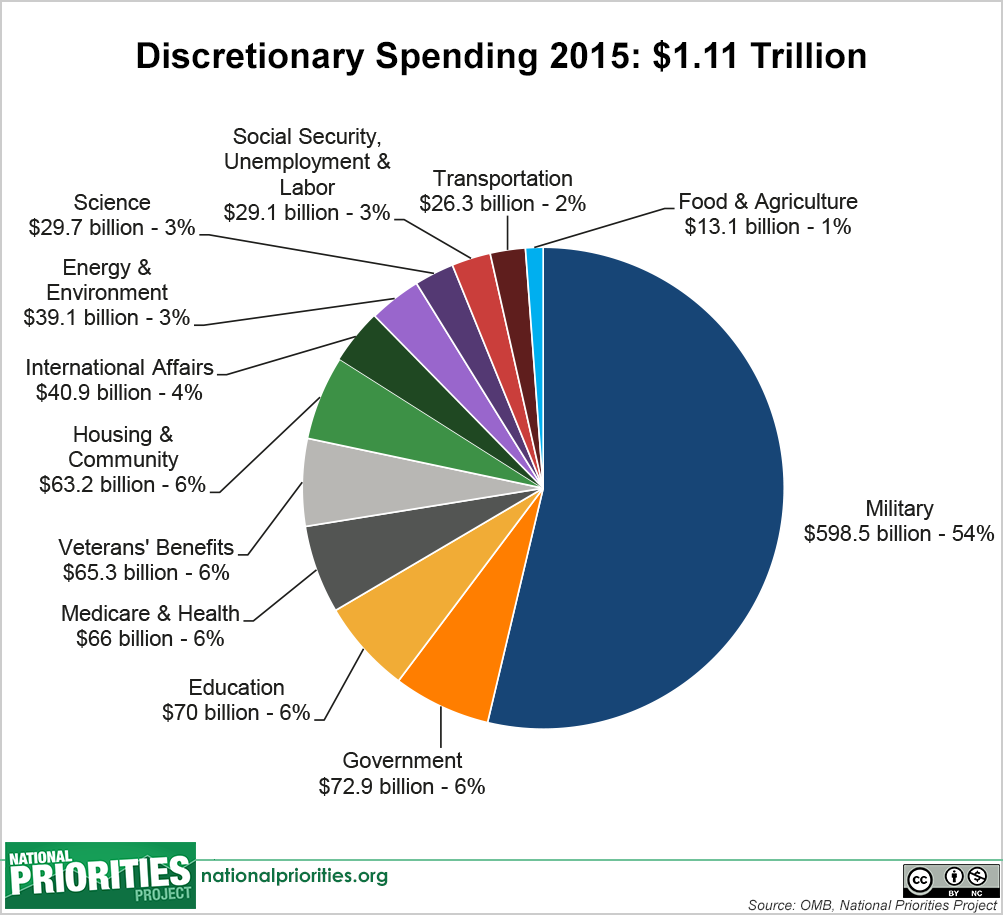
Your predetermined % is referring to Discretionary Spending, right?

discretionary_spending_pie,_2015_enacted.png


DoD spending seems to never goes down and, by far, is the largest cost in Discretionary spending - more than 50% of it. How about a baseline for spending tied to spending prior to initiating the Middle Eastern wars?

With a sequestration-type cut of 10% to all agencies, military spending cuts would be 5.4% of total discretionary spending in the first year or about $60 billion per year with decreases annually from there.

Tie tax cuts to this type of the results of this economic performance barometer? No tax cuts until we see the positive results of this performance. Only half of us pay individual taxes now, right?

Monetary supply policy is tied to GDP now. Are we in for more low interest rates and more borrowed money in the foreseeable future?

How do you propose covering future spending increases in Mandatory Spending?

How do you stem the tied of MNCs moving overseas? More regulations on inversions?

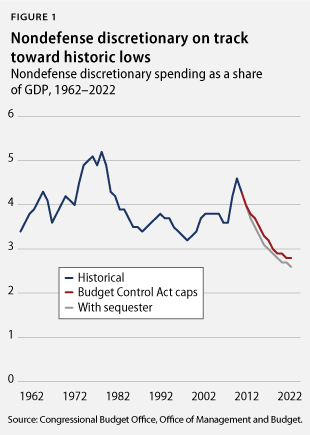
Non-defense discretionary spending is at historic lows.
LindenNonDefense_fig1.png
 
Last edited:

IrishinSyria

In truth lies victory
Messages
6,042
Reaction score
1,920
Pentagon Tells Congress to Stop Buying Equipment it Doesn't Need | Military.com

We could probably find cost savings if we stop making the Army buy tanks it doesn't want.

TBF though, that's no as crazy as it sounds. Even if we don't need the tanks today (and we definitely don't) we may one day need a factory to be able to pump out world class tanks in bulk. And it's tough to make that happen if we lose the expertise. So in a grand-strategy type way, it does (maybe) make sense from a national security standpoint to keep building cutting edge stuff even if it seems pointless.

But there's also the issue of congressmen keeping their districts happy. And it's tough to know for sure how much that (arguably illegitimate) justification is what drives the process and how much the above (arguably legitimate) explanation does.
 

phgreek

New member
Messages
6,956
Reaction score
433
Pentagon Tells Congress to Stop Buying Equipment it Doesn't Need | Military.com

We could probably find cost savings if we stop making the Army buy tanks it doesn't want.

TBF though, that's no as crazy as it sounds. Even if we don't need the tanks today (and we definitely don't) we may one day need a factory to be able to pump out world class tanks in bulk. And it's tough to make that happen if we lose the expertise. So in a grand-strategy type way, it does (maybe) make sense from a national security standpoint to keep building cutting edge stuff even if it seems pointless.

But there's also the issue of congressmen keeping their districts happy. And it's tough to know for sure how much that (arguably illegitimate) justification is what drives the process and how much the above (arguably legitimate) explanation does.

I have been advocating for coupling the need to keep production capability with the need to make systems engineers live in the real world. IE as we develop advanced weapons systems capability, take it through LRIP, and do extensive field testing, then shelve. Stop building last years shit, that you know will be outdated by the time we need it. Make agile Systems Engineers and keep production capabilities...keep technology curve in our favor.
 

phgreek

New member
Messages
6,956
Reaction score
433
Some questions and points:

Your predetermined % is referring to Discretionary Spending, right?

Great question. No discretionary spending w/o a super majority approval from both houses, and each discretionary item must be adjudicated BY ITSELF. Discretionary spending itself MUST have a future projected budget, and must not steal from more than two years future discretionary spending, and may only use a percentage of those (25%).


DoD spending seems to never goes down and, by far, is the largest cost in Discretionary spending - more than 50% of it. How about a baseline for spending tied to spending prior to initiating the Middle Eastern wars?

Except that Clinton baseline was not effective. It is somewhere more than Clinton and less than Bush. Closer to Clinton. If there is a pathway where our weapons match our fighting strategies, and innovation needs, and acquisition efficiency can be realized, I'm sure there is fat. By that I mean let the generals figure out their needs, and let the military pick their contractors to execute, and get congress the hell out acquisitions...there are billions upon billions in losses due to pet programs and stupid special interest deals. The Military is prime ground for ridiculousness because they can hide stuff in "black" programs + people don't understand the technical...its not the "military" as much as it is the abuse of the acquisition process by congress.

With a sequestration-type cut of 10% to all agencies, military spending cuts would be 5.4% of total discretionary spending in the first year or about $60 billion per year with decreases annually from there.

No...sequestration means "too stupid and unengaged" to make organizational changes that meet cost constraints w/o long term service level impacts...need to stop appointing morons and people unfamiliar with an organization to lead it. Then we need to pay them on service level and cost cutting effectiveness...you have to be dedicated to competence above the political.

Tie tax cuts to this type of the results of this economic performance barometer? No tax cuts until we see the positive results of this performance. Only half of us pay individual taxes now, right?

No...since part of a strategy to generate revenue, and improve performance, thereby increasing budgets would be to strategically cut taxes. Folks can complain, but there are instances where tax cuts have increased revenue...it is a viable and reasonable response. The issue is how and where.

Monetary supply policy is tied to GDP now. Are we in for more low interest rates and more borrowed money in the foreseeable future?

How do you propose covering future spending increases in Mandatory Spending?

How do you stem the tied of MNCs moving overseas? More regulations on inversions?

IMHO, Monetary supply policy is tied to manipulating perceptions of the electorate. Its not real, and hasn't been for a long time. I think the idea is to focus on something "tangible".

MNCs by definition are multinational...there is a reason they direct profit elsewhere. I've heard many ideas...some give away too much, some too draconian. Something on the order of one time hit seems all the rage...meh. More to do here than repatriating $$$.

As for all spending...

For ease of discussion, I'll use numbers that match...the idea is...I'm talking about a government wide re-baseline which is in force for 20 years. If the inflation you report to the American people is 1%, thats all the federal budget can increase, provided the GDP grew at least 1% (this could be less...again simplified for discussion). Government baseline spending may only grow by inflation provided the GDP also grew. Further, if growth exceeds 1%, some part of that money could be used for one time increase to discretionary spending. If we experience GDP retraction, everything goes back to the baseline + inflationary increases already booked and a government wide budget drill to recoup the loss in revenue (for instance delay new weapon system purchases or captial purchases or civil engineering projects),...no inflationary increases to discretionary spending ever.

Non-defense discretionary spending is at historic lows.
LindenNonDefense_fig1.png
 

Legacy

New member
Messages
7,871
Reaction score
321
Thanks for the detailed answers, phgreek.

With projected rises in spending in interest on the national debt and in health care costs in an aging population as well as projected total military budget increases, within the context of a national debt of $18 trillion+, wouldn't a deeper cut in military/defense spending improve national economic performance?

Projected Health Care Cost Increases (roughly 3% a year in the next decade)

National Health Expenditure Projections 2015-2025

Interest on National Debt
The Legacy of Debt: Interest Costs Poised to Surpass Defense and Nondefense Discretionary Spending

Currently, the government’s interest costs are around $200 billion a year, a sum that’s low due to the era of low interest rates. Forecasters at the White House and Congressional Budget Office believe interest rates will gradually rise, and when that happens, the interest costs of the U.S. government are set to soar, from just over $200 billion to nearly $800 billion a year by decade’s end
.
By 2021, the government will be spending more on interest than on all national defense. according to White House forecasts. And one year later, interest costs will exceed nondefense discretionary spending–essentially every other domestic and international government program funded annually through congressional appropriations. (The largest part of the budget is, and will remain, the mandatory spending programs of Social Security, Medicare and Medicaid. Mandatory spending is over $2 trillion and is set to double to $4 trillion by 2025.)

By 2025, the White House projects interest costs will be 2.8% of GDP. The CBO is somewhat less optimistic and expects it will be 3%. Most economists and budget experts would agree that interest payments at 3% of GDP are manageable for an economy. The true cost may be the squeeze to other places the government could be spending a decade from now.

Mandatory spending increases, too:
Mandatory spending will rise from 12.4% of GDP to about 14.5% of GDP over this period.
Also, mandatory spending will increase: (another 3% annually by 2025)

51580-home-figure1-b.png


from Congressional Budget Office, The 2016 Long-Term Budget Outlook
 
Last edited:

IrishinSyria

In truth lies victory
Messages
6,042
Reaction score
1,920
I have been advocating for coupling the need to keep production capability with the need to make systems engineers live in the real world. IE as we develop advanced weapons systems capability, take it through LRIP, and do extensive field testing, then shelve. Stop building last years shit, that you know will be outdated by the time we need it. Make agile Systems Engineers and keep production capabilities...keep technology curve in our favor.

This makes a lot of sense to me and I hope you get traction. Any senators you need people to write to?
 

IrishinSyria

In truth lies victory
Messages
6,042
Reaction score
1,920
I will say this: defense acquisitions/logistics is still capable of making miracles happen when needed. I deployed to Afghanistan with a Stryker brigade in 2012. All of our Strykers had the v-hull design that had been rushed into production just a year or so earlier. I've got a couple friends who came home with minor concussions instead of permanent injuries because of it.
 

phgreek

New member
Messages
6,956
Reaction score
433
This makes a lot of sense to me and I hope you get traction. Any senators you need people to write to?

I'll let you know...right now I have General Officers working it over...If they think it makes sense and get push back from DC...then yea.
 
B

Buster Bluth

Guest
They have taken some prisoner and they have practiced attack runs against our ships. So yes they have put our men and women in danger

So, no fired weapons on the part of Iranians? No killed Americans?

This is meant for domestic consumption. Sorta like how in the 1990s, during the containment of Iraq and our daily no-fly zone enforcement, not a single American jet was shot down over that decade. Saddam could have pushed more than he did, but instead he strategically pushed safe envelopes with his saber rattling to build a facade of toughness within the country. It went the same for his WMDs, he didn't have any but didn't reveal that fact so he could intimidate his neighbors and people.

Iran isn't looking to attack an American ship, or kill an American sailor. They want the toughness headline and a bonus boost in oil prices.

I think we learned in 2003 what damage fools can do by escalating situations that should otherwise be forgotten.
 

phgreek

New member
Messages
6,956
Reaction score
433
So, no fired weapons on the part of Iranians? No killed Americans?

This is meant for domestic consumption. Sorta like how in the 1990s, during the containment of Iraq and our daily no-fly zone enforcement, not a single American jet was shot down over that decade. Saddam could have pushed more than he did, but instead he strategically pushed safe envelopes with his saber rattling to build a facade of toughness within the country. It went the same for his WMDs, he didn't have any but didn't reveal that fact so he could intimidate his neighbors and people.

Iran isn't looking to attack an American ship, or kill an American sailor. They want the toughness headline and a bonus boost in oil prices.

I think we learned in 2003 what damage fools can do by escalating situations that should otherwise be forgotten.

So is Iraq merely prevented from firing upon our ships by international maritime law...or is harassment, threatening, boarding our ships ok so long as they don't shoot?
 

Legacy

New member
Messages
7,871
Reaction score
321
Munitions Manufacturing Factories

Munitions Manufacturing Factories

From the article in my post above, I was interested in why ammunition factories received $24 billion of the $40 billion Congress appropriated last year. That's about 7% of total discretionary expenditures on the military last year. Specifically, Lake City Army Ammunitions Plant (LCAAP) in Missouri received one third ($8 billion) of that $24 billion. That's a huge chunk of money. The results may be illuminating.

LCAAP has existed since Harry Truman's presidency and manufactures four types of ammunition are manufactured on a 4,000 acre site – 5.56mm, 7.62mm, .50 BMG and 20mm. The site is owned by the Army and operated by Alliance Technology (ATK) until recently. LCAAP recently received a $52 million upgrade their facilities. In total, upgrades to "ATK and the Army amount to $400 million to increase the plant’s efficiency in producing ammunition of various calibers."

Some current production facts:
- 6.5 million rounds of .50 BMG ammunition produced per month.
- 3.5 million rounds of 5.56mm ammunition produced per day.
- Each 5.56mm machine loading can produce 1200 rounds of 5.56 per minute
- 1.6 billion rounds of ammunition are manufactured on site per year.
- 8 million rounds are test fired as part of quality control, research, and development per year.

In 2013, Alliance announced they were laying off 2,600 workers due to “recent drawdowns in military actions.” A vast majority of their local workers are hired on a temporary basis by Alliance with few government workers.

After the $400 million on upgrades, the layoffs of 2,600 workers, and the recent $8 billion from Congress, Alliance (ATK) merged with Orbital Sciences, which is primarily an aerospace industry company. ATK had received a $2.3 billion 10-year contract to manufacture small-caliber ammunition for the U.S. Army. (part of the $8 billion?) Orbital Science is part of the privatization of space contracts, providing rockets to resupply the Space Station. (One - an Antares - blew up soon after takeoff years ago.) Orbital's stock had been skyrocketing, until their accountants determined the $2.3 billion contract Alliance had would end up losing money. Orbital announced a restatement of projected earnings, lost hundreds of millions due stock price decreases. The combined company is called Orbital ATK, undoubtedly has Congressional ties, a large lobbying segment, and now encompasses small arms manufacturing and space rocket industries. Link for Orbital ATK's systems/divisions.

So, Congress makes huge financial investments of tax dollars in these military industries even when wars are being drawn down. Liabilities rest with the government as owners of ammunition sites, in this case, the Army. Employees benefit for periods of time and then are layed off.
-- Are we gearing up for continuing wars?
-- Are tax dollars being used wisely?
-- Do these munitions expenditures make sense in overall military spending?
-- In the overall economic picture?
-- Like other industries, military/defense companies are consolidating with benefit of more leverage with decreased competition. How do we reduce our national debt with these type of expenditures?
-- How much of this commitment to these industries determine future foreign policy?
-- Where is the fat we can reduce?

I have only looked at Lake City Army Ammunitions Plant. The Army and our government also has liabilities which cost the taxpayers hundreds of millions of dollars with LCAAP, but I'll touch on those with another post.
 
Last edited:

phgreek

New member
Messages
6,956
Reaction score
433
From the article in my post above, I was interested in why ammunition factories received $24 billion of the $40 billion Congress appropriated last year. That's about 7% of total discretionary expenditures on the military last year. Specifically, Lake City Army Ammunitions Plant (LCAAP) in Missouri received one third ($8 billion) of that $24 billion. That's a huge chunk of money. The results may be illuminating.

LCAAP has existed since Harry Truman's presidency and manufactures four types of ammunition are manufactured on a 4,000 acre site – 5.56mm, 7.62mm, .50 BMG and 20mm. The site is owned by the Army and operated by Alliance Technology (ATK) until recently. LCAAP recently received a $52 million upgrade their facilities. In total, upgrades to "ATK and the Army amount to $400 million to increase the plant’s efficiency in producing ammunition of various calibers."

Some current production facts:
- 6.5 million rounds of .50 BMG ammunition produced per month.
- 3.5 million rounds of 5.56mm ammunition produced per day.
- Each 5.56mm machine loading can produce 1200 rounds of 5.56 per minute
- 1.6 billion rounds of ammunition are manufactured on site per year.
- 8 million rounds are test fired as part of quality control, research, and development per year.

In 2013, Alliance announced they were laying off 2,600 workers due to “recent drawdowns in military actions.” A vast majority of their local workers are hired on a temporary basis by Alliance with few government workers.

After the $400 million on upgrades, the layoffs of 2,600 workers, and the recent $8 billion from Congress, Alliance (ATK) merged with Orbital Sciences, which is primarily an aerospace industry company. ATK had received a $2.3 billion 10-year contract to manufacture small-caliber ammunition for the U.S. Army. (part of the $8 billion?) Orbital Science is part of the privatization of space contracts, providing rockets to resupply the Space Station. (One - an Antares - blew up soon after takeoff years ago.) Orbital's stock had been skyrocketing, until their accountants determined the $2.3 billion contract Alliance had would end up losing money. Orbital announced a restatement of projected earnings, lost hundreds of millions due stock price decreases. The combined company is called Orbital ATK, undoubtedly has Congressional ties, a large lobbying segment, and now encompasses small arms manufacturing and space rocket industries. Link for Orbital ATK's systems/divisions.

So, Congress makes huge financial investments of tax dollars in these military industries even when wars are being drawn down. Liabilities rest with the government as owners of ammunition sites, in this case, the Army. Employees benefit for periods of time and then are layed off.
-- Are we gearing up for continuing wars?
-- Are tax dollars being used wisely?
-- Do these munitions expenditures make sense in overall military spending?
-- In the overall economic picture?
-- Like other industries, military/defense companies are consolidating with benefit of more leverage with decreased competition. How do we reduce our national debt with these type of expenditures?
-- How much of this commitment to these industries determine future foreign policy?
-- Where is the fat we can reduce?

I have only looked at Lake City Army Ammunitions Plant. The Army and our government also has liabilities which cost the taxpayers hundreds of millions of dollars with LCAAP, but I'll touch on those with another post.


Keep digging...the more you read, the more you'll find the "defense" spending isn't necessarily a "defense" problem. Just wait til you dig into Weapon system acquisitions, and the Billions and billions squandered by congress...thats not even considering their influence peddling which results in the wrong contractors being awarded contracts...Congress is the enemy of a functional defense department.
 

Legacy

New member
Messages
7,871
Reaction score
321
Keep digging...the more you read, the more you'll find the "defense" spending isn't necessarily a "defense" problem. Just wait til you dig into Weapon system acquisitions, and the Billions and billions squandered by congress...thats not even considering their influence peddling which results in the wrong contractors being awarded contracts...Congress is the enemy of a functional defense department.

We rarely hear about this:

Read the Pentagon’s $59 Billion ‘Black Budget’
The U.S. military has billions of dollars’ worth of secret projects it doesn’t want you to know about. Too bad—here they are.


There are, of course, some complications with looking at these numbers. First, while some line items are conveniently labeled “classified”, others are called by cloak-and-dagger names like the Army’s “Tractor Hip,”—cut in half this year to $16.4 million —and the Navy’s “Chalk Eagle”—a $543 million program that has seen continued growth over the last three years. Because of the nature of these weird titles, we might (and probably are) missing some other covert programs. And experts don’t put it past the DoD to label more secret operations under innocuous titles or hide them in other budget categories like personnel.
One more nerdy note: We’re just looking at the so-called “base budget” of the Pentagon here; it doesn’t include the money for the war on terror, known in mil-speak as the Overseas Contingency Operations (OCO) account. The Defense Department has set aside $79 billion for OCO for the next fiscal year, the same placeholder amount as this one. But it’s unclear as of now, how much of the money that creatively overcomes budget restraints will go to black budget programs.
With those caveats in mind, here are the line items from the Department of Defense’s black budget for 2015. Play with the numbers yourself here and tell us what we’ve missed.

That $59 billion in itself is almost as much as the "Medicare & Health" part of the Discretionary Spending budget (see graph above).
 
Last edited:

phgreek

New member
Messages
6,956
Reaction score
433
We rarely hear about this:

Read the Pentagon’s $59 Billion ‘Black Budget’
The U.S. military has billions of dollars’ worth of secret projects it doesn’t want you to know about. Too bad—here they are.


That $59 billion in itself is almost as much as the "Medicare & Health" part of the Discretionary Spending budget (see graph above).

This is the main tool for shenanigans...

So as I mentioned a ways back, you get some political issues in the realm of Bombs and bullets...more in weapon systems acquisitions, and even more in black programs. Get congress out of DoDs everyday spending decisions and things suddenly look better. It isn't cheap to fight wars, but we spent far more and got less than we should /could have...and do so daily.
 

Legacy

New member
Messages
7,871
Reaction score
321
This is the main tool for shenanigans...

So as I mentioned a ways back, you get some political issues in the realm of Bombs and bullets...more in weapon systems acquisitions, and even more in black programs. Get congress out of DoDs everyday spending decisions and things suddenly look better. It isn't cheap to fight wars, but we spent far more and got less than we should /could have...and do so daily.

I understand. Give us an (some) example(s) of weapon systems acquisitions waste.

Also, policy decisions such as Reagan's Star Wars or calls for a full-scale return to a Mideastern war across more countries also seem to be examples of political disregard of strategic intervention and waste.
 
Last edited:

Rizzophil

Well-known member
Messages
2,431
Reaction score
579
Globalization is a bad bad idea.

When is the idea of a one world order ever a good idea? Everyone with common sense knows that countries are sovereign and can work ghost her, but diversity among countries is a great thing
 

Legacy

New member
Messages
7,871
Reaction score
321
This is the main tool for shenanigans...

So as I mentioned a ways back, you get some political issues in the realm of Bombs and bullets...more in weapon systems acquisitions, and even more in black programs. Get congress out of DoDs everyday spending decisions and things suddenly look better. It isn't cheap to fight wars, but we spent far more and got less than we should /could have...and do so daily.

It's hard to detail all the waste in weapon systems acquisition. But here are a few articles from a few of those who have:

Wasteful Defense Spending Is a Clear and Present Danger
We could afford a stronger military if we implemented some contracting reforms.
(Wall Street Journal, 2009) Examples from the article:
- F18 price should be about $18 million each. We are paying about $90 million.
- F22 price should be about $60 million each. We are paying $350 million.
- The Government Accountability Office recently reported that the cost overruns for the top 75% procurement programs were over $295 billion.
(Examples of cost overruns only, not including weapons systems that were canceled.)

Waste Land (New Republic, 2010)
This year, the United States will spend at least $700 billion on defense and security. Adjusting for inflation, that’s more than America has spent on defense in any year since World War II—more than during the Korean war, the Vietnam war, or the Reagan military buildup. Much of that enormous sum results from spending increases under presidents George W. Bush and Barack Obama. Since 2001, military and security expenditures have soared by 119 percent.

Congress Pushes for Weapons Pentagon Didn't Want (Military.com, 2012)

"If members try to restore their favorite programs without regard to an overall strategy, the cuts will have to come from areas that could impact overall readiness," Defense Secretary Leon Panetta said in a May news briefing.
"Every dollar that is added will have to be offset by cuts in national security," Panetta added. "And if for some reason they do not want to comply with the Budget Control Act, then they would certainly be adding to the deficit, which only puts our national security further at risk."

The Pentagon Is Practically Begging Congress To Stop Funding Wasteful Weapons Programs (Business Insider, 2014)
"Our efforts to reshape and reform the military continue to be rejected," Army General Martin Dempsey, the chairman of the Joint Chiefs of Staff, told the Senate hearing.
"We have infrastructure that we don't need and with your support, we ought to be able to divest. We have legacy weapon systems that we can't afford to sustain and with your support, we ought to be able to retire," Dempsey said.
"Failing to act on these issues ... will force us into an unbalanced level of cuts to our readiness and modernization."

Waste, Greed, and Fraud: The Business that Makes the World’s Greatest Army (Harvard Politics, 2016) - Good article
In the years following the 9/11 attacks, the United States and its allies have fought a continuous war on terror. The taxpayer tab for the war totals about $5 trillion, or $16,000 per person, according to Brown University’s Watson Institute for International Studies. This was, according to Hartung, the “biggest Pentagon spending buildup in history since World War II.”
Reports from the Inspector Generals’ offices of Iraq and Afghanistan estimate that the U.S. military has lost $60 billion to waste and fraud in Iraq, $100 billion to Afghan reconstruction efforts, and billions more in wasted equipment either burned or left behind after the withdrawal of forces. Part of the problem may be that the Pentagon has 1.7 million contracts open, which makes oversight difficult, if not impossible. “In Iraq and Afghanistan there was huge waste fraud and abuse on the part of companies like Halliburton and others that [these companies] were able to get away with in the fog of war because there wasn’t enough scrutiny into what they were doing,” said Hartung. “In some cases billions of dollars went missing; [contractors] were overcharging for everything from simple tasks like doing the laundry for the troops and [providing] meals to building shoddy facilities for schools and things for water and electricity.”
Corporations can then influence their member of government to fight against sequester cuts to defense spending, push for their contracts, and more. Such spending has swelled the military industry to become the eighth-largest lobbying sector in the nation, spending well over $100 million annually on lobbying the government. Boeing, Lockheed Martin, Honeywell International, and Northrop Grumman are among the top spenders.
Why Wasteful Military Spending Never Stops (The American Conservative, 2016) - Good Article
This year, for instance, the Navy is spending a billion and a half dollars in research and development funds on its new missile submarine, known only as the SSBN(X)....Assiduously tabulating these projections, experts at the Monterey Center for Nonproliferation Studies peg the price of the total program at a trillion dollars. In reality, though, the true bill that will come due over the next few decades will almost certainly be multiples of that.
 
Last edited:

Legacy

New member
Messages
7,871
Reaction score
321
Overseas Contingency Operations: The Pentagon Slush Fund (National Priorities Project)

What are Overseas Contingency Operations?
The Overseas Contingency Operations (OCO) fund - sometimes referred to as war funds - is a separate pot of funding operated by the Department of Defense and the State Department, in addition to their "base" budgets (i.e., their regular peacetime budgets). Originally used to finance the Iraq and Afghanistan wars, the OCO continues to be a source of funding for the Pentagon, with a fraction of the funds going to the State Department.

Since the OCO fund has very little oversight and is not subject to the sequestration cuts that slashed every other part of the budget in 2013, many experts consider it a “slush fund” for the Pentagon. For example, Todd Harrison, senior fellow for defense studies at the Center for Strategic and Budgetary Assessments, found that the Pentagon was stashing an estimated extra $20 billion worth of non-war funding in the “operation and maintenance” accounts of its proposed 2014 war budget. Even Secretary of Defense Ash Carter has recently called the OCO "a road to nowhere."

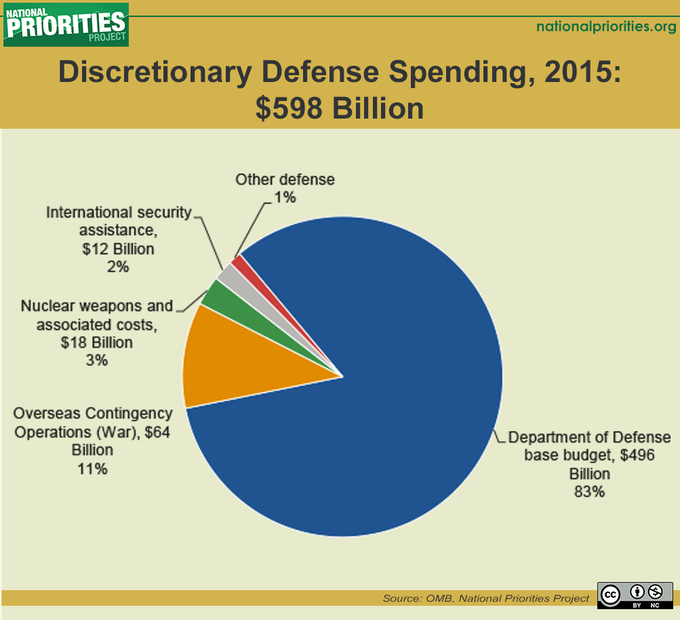
military_pie%2C_gold_background_large.png


In FY2015, the U.S. will spend $64 billion through the OCO, in addition to its $496 billion Department of Defense base budget.

Cost of National Security (National Priorities)
 
Last edited:
B

Buster Bluth

Guest
Globalization is a bad bad idea.

When is the idea of a one world order ever a good idea? Everyone with common sense knows that countries are sovereign and can work ghost her, but diversity among countries is a great thing

The problem with the word globalization is it can mean anything to anyone.

Economically, globalization has brought about the most peaceful period in human history. The Post-World War II world dominated by the United States hasn't been perfect but it has been objectively better for the majority of those living under it. Better than any period in human history.

The rise in living standards in the developing world--and developed world too--is a tangible miracle that trumps any farcical religious miracle anyone could dream up. Bringing medical technology to every corner of the globe has done more for humanity than any endeavor in human history.

The interconnection of communication has spread liberal values of equality, specifically the equality of women, secularism, and economic freedom faster than anything in human history.

There are all sorts of growing pains. When a place liberalizes too fast, extremists combat it. When a Westerner's economic value is less than a foreign sweat shop worker, the Westerner is unemployed. When the hoax of various religions is threatened by science, extremists combat it again. Additionally, soulless corporations are freer to roam than ever before, with a trail of misery often in their paths.

But it's better than it has ever been, outside of a few warzones caught in the no man's land between the West and those still who oppose it (see: Russia, Iran).
 

BobbyMac

Staff & Stuff
Staff member
Messages
33,950
Reaction score
9,294
The problem with the word globalization is it can mean anything to anyone.

Economically, globalization has brought about the most peaceful period in human history. The Post-World War II world dominated by the United States hasn't been perfect but it has been objectively better for the majority of those living under it. Better than any period in human history.

The rise in living standards in the developing world--and developed world too--is a tangible miracle that trumps any farcical religious miracle anyone could dream up. Bringing medical technology to every corner of the globe has done more for humanity than any endeavor in human history.

The interconnection of communication has spread liberal values of equality, specifically the equality of women, secularism, and economic freedom faster than anything in human history.

There are all sorts of growing pains. When a place liberalizes too fast, extremists combat it. When a Westerner's economic value is less than a foreign sweat shop worker, the Westerner is unemployed. When the hoax of various religions is threatened by science, extremists combat it again. Additionally, soulless corporations are freer to roam than ever before, with a trail of misery often in their paths.

But it's better than it has ever been, outside of a few warzones caught in the no man's land between the West and those still who oppose it (see: Russia, Iran).

So humans don't have souls because religion is a farcical hoax but corporations could have a soul if they operated in what, a more thoughtful dare I say... Christian way?

The post WWII world has been led by the US. Besides the Christian Religion, The US (despite its shortcomings) has been the single greatest source of good the world has ever known. Its founding, existence and sovereignty is owed to the confluence of Christianity and Classical Liberal founders. As a real Liberal, not an atheist Progressive who high-jacked a word, I've always found it funny when Progressives bath in the glory of Liberalism and America then do everything they can to enlarge government, taking those liberties away from the individual and ignoring Christianity's inseparable providence in America's genesis.
 
B

Buster Bluth

Guest
So humans don't have souls because religion is a farcical hoax but corporations could have a soul if they operated in what, a more thoughtful dare I say... Christian way?

Christian as in telling serfs that god had bound them to the land of their lords and that they should just tolerate their suffering on Earth for a made up reward in an afterlife? Christian as in allying a religion to tyrant Kings/Queens whose legitimacy stemmed from some made up will of god?

Or do you mean the modern Christian sense in preaching to susceptible Africans that condoms are worse for your soul than contracting HIV? Or standing in the way of fighting poverty by fighting a woman's control over her reproductive abilities (perhaps the easiest way to fight the cycle of poverty)?

The rise in the standards of living correlates to secularism and scientific literacy, not the foundation of any religion. The biggest reason those two aspects of spread across the world is a United States-led world order. Fitting, because the United States is the first and greatest secular nation.

The post WWII world has been led by the US. Besides the Christian Religion, The US (despite its shortcomings) has been the single greatest source of good the world has ever known. Its founding, existence and sovereignty is owed to the confluence of Christianity and Classical Liberal founders.

This is a tremendous bit considering the religious influence on the founding of the United States is purely Protestant. It's a moot point, considering that in our founding they outlined the world's first secular nation. I mean they went out of their way to separate church and state in part because key men didn't care for organized religion and felt clergymen and religions as whole corrupted societies (eg Jefferson, Madison, Washington, etc)

As a real Liberal, not an atheist Progressive who high-jacked a word, I've always found it funny when Progressives bath in the glory of Liberalism and America then do everything they can to enlarge government, taking those liberties away from the individual and ignoring Christianity's inseparable providence in America's genesis.

You can put me on record saying the United States and capitalism have done more good for humanity than anything any religion could dream of. But I was specifically talking about Islam in the latter part of my post when referring to conflict between liberalism and various religions.

I didn't mean to pick a fight on religion in my initial post. But here we are. :/
 
Last edited:
Top