
dublinirish
Everestt Gholstonson
- Messages
- 27,934
- Reaction score
- 13,951
caricature has always been a part of UK politics going back to Spitting Images that ran in the 80's. Believe me cartoon balloons are very tame in comparison 


caricature has always been a part of UK politics going back to Spitting Images that ran in the 80's. Believe me cartoon balloons are very tame in comparison


Kerry needs to STFU and go back to swiftboating, joking about presidents getting killed, and insulting Iraq war veterans. He's always been a flip flopper.
A life long catcher.
A new trade deal between the EU and Japan (The Economist)Japan and the European Union have signed a massive trade deal that creates an open-trade zone for more than 600 million people. The EU and Japan account for about one-third of GDP worldwide.
The deal has been in the works for years, but the parties reached an agreement in principle a year ago, several months after President Trump pulled the United States out of the Trans-Pacific Partnership, a major trade deal with Japan and 10 other nations.
At a EU-Japan summit on Tuesday in Tokyo, the envoys were clear that the agreement was intended to send a message about the value of trade and cooperation.
"The document we signed today is much more than a trade agreement," said European Commission President Jean-Claude Juncker. "What we're saying is that we believe in open, fair and rules-based trade. What we are saying is that a trade agreement is not a zero-sum game, but a win-win for the involved parties."
FREE-TRADE agreements have seemed out of fashion as President Donald Trump has set about scotching some of America’s. But on July 5th Cecilia Malmström, the EU trade commissioner, and Fumio Kishida, the Japanese foreign minister, announced they had achieved consensus on a Japan-EU Economic Partnership Agreement (JEEPA). In front of the cameras, they swapped Japanese Daruma dolls, talismans of perseverance and good luck, and, they hope, of a win-win agreement.
The timing of JEEPA was just as carefully co-ordinated. When negotiations started in 2013, it was neither side’s main priority. But now both want to show that they can fill the vacuum left by America’s withdrawal under Mr Trump from its role as the world’s trade leader. To highlight its political importance, they note that this is the first trade agreement to mention the Paris climate accord, another deal Mr Trump has spurned. Haste is handy: the EU wanted success before Brexit negotiations and national elections swamp its agenda.
The deal is about more than political symbolism, however. Average tariffs between the two sides are already low, but prizes are still there to be grasped. Exporters from the EU pay €1bn ($1.1bn) in export duties to Japan each year, and on agricultural products face average tariffs of 21%. JEEPA will slash Japanese tariffs on beef, pork and wine, eliminating 85% of the tariffs on agricultural food products going into Japan. European producers of Roquefort cheese or prosecco can cheer: their products become two of 205 protected “geographical indications”. Similarly, only feta from Greece will be sold under that name.
FREE-TRADE agreements have seemed out of fashion as President Donald Trump has set about scotching some of America’s. But on July 5th Cecilia Malmström, the EU trade commissioner, and Fumio Kishida, the Japanese foreign minister, announced they had achieved consensus on a Japan-EU Economic Partnership Agreement (JEEPA). In front of the cameras, they swapped Japanese Daruma dolls, talismans of perseverance and good luck, and, they hope, of a win-win agreement.
The timing of JEEPA was just as carefully co-ordinated. When negotiations started in 2013, it was neither side’s main priority. But now both want to show that they can fill the vacuum left by America’s withdrawal under Mr Trump from its role as the world’s trade leader. To highlight its political importance, they note that this is the first trade agreement to mention the Paris climate accord, another deal Mr Trump has spurned. Haste is handy: the EU wanted success before Brexit negotiations and national elections swamp its agenda.
The deal is about more than political symbolism, however. Average tariffs between the two sides are already low, but prizes are still there to be grasped. Exporters from the EU pay €1bn ($1.1bn) in export duties to Japan each year, and on agricultural products face average tariffs of 21%. JEEPA will slash Japanese tariffs on beef, pork and wine, eliminating 85% of the tariffs on agricultural food products going into Japan. European producers of Roquefort cheese or prosecco can cheer: their products become two of 205 protected “geographical indications”. Similarly, only feta from Greece will be sold under that name.

Interesting that they claim that this is a "Free Trade" deal when it includes tariffs.
Its American debt holdings have plunged far more than any other nation’s.
The Biggest Owner Is You!
Intragovernmental Holdings. This is the portion of the federal debt owed to 230 other federal agencies. Intragovernmental holdings total $5.6 trillion, almost 30 percent of the debt. Why would the government owe money to itself? Some agencies, like the Social Security Trust Fund, take in more revenue from taxes than they need. Rather than stick this cash under a giant mattress, these agencies buy U.S. Treasurys with it.
By owning Treasurys, they transfer their excess cash to the general fund, where it is spent. Of course, one day they will redeem their Treasury notes for cash. The federal government will either need to raise taxes or issue more debt to give the agencies the money they will need.
Which agencies own the most Treasurys? Social Security, by a long shot. The U.S. Treasury published a report as of December 31, 2017. The data is in the Monthly Treasury Statement, Table 6. Schedule D-Investments of Federal Government Accounts in Federal Securities. It's updated quarterly.
As of that date, the total debt was $20.5 trillion and intragovernmental debt was $5.67 trillion.
Current Foreign Ownership of U.S. Debt
In April 2018, China owned $1.18 trillion of U.S. debt. It's the largest foreign holder of U.S. Treasury securities. The second largest holder is Japan at $1.03 trillion. Both Japan and China want to keep the value of the dollar higher than the value of their currencies. That helps keep their exports affordable for the United States, which helps their economies grow. Despite China's occasional threats to sell its holdings, both countries are happy to be America's biggest foreign bankers. China replaced the United Kingdom as the second largest foreign holder on May 31, 2007.
The funds will come through direct assistance, a food purchase and distribution program, and a trade promotion program.
It will rely in part on a Depression-era program called the Commodity Credit Corporation, a division of the Agriculture Department created in 1933 to offer a financial backstop for farmers.
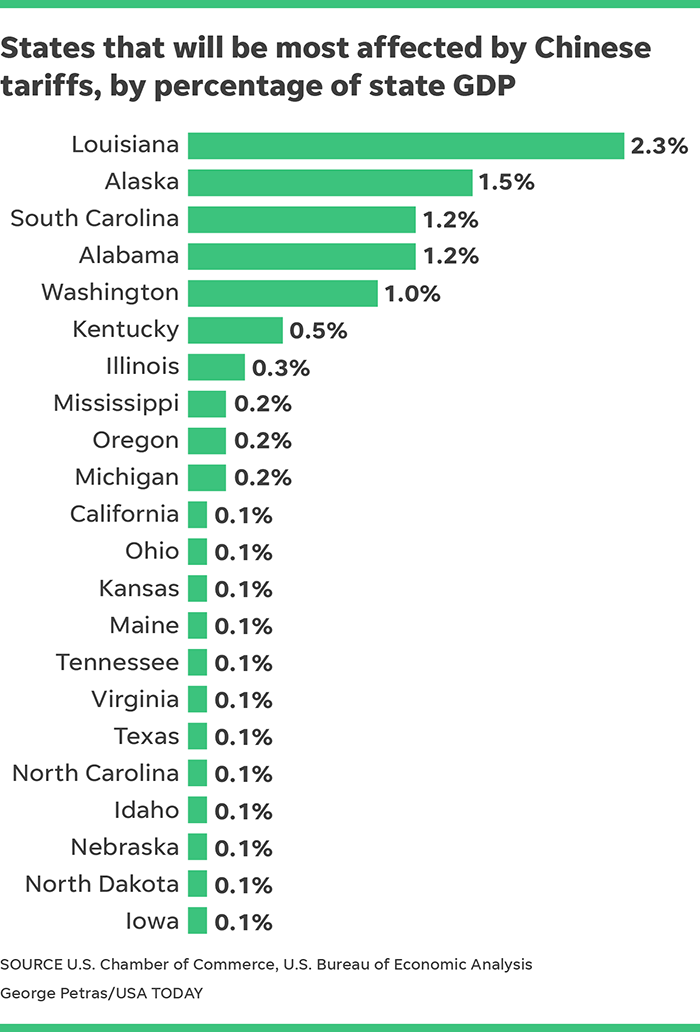
Soybean prices have fallen particularly hard in the past few months, though Trump has tried to deflect blame and promised to somehow take care of these farmers, many of whom are from politically crucial states like Iowa and Wisconsin.
The new plan at the Agriculture Department would advance emergency funds for these farmers but likely not provide a long-term solution if the trade disputes with China and other countries persist.
Because the program was created during the Depression, it does not rely on new congressional approval. It allows the CCC to borrow up to $30 billion from the Treasury Department to “stabilize, support, and protect farm income and prices.”
Still, some Republicans several months ago had warned against using the CCC as part of a trade-war related bailout, saying it could distort market forces and pay farmers for products they don’t produce. And there was biparitsan criticism from Republicans and Democrats on Tuesday to what the White House was trying to do. At least two Republicans said the plan equated to a type of welfare program for farmers.
"Our farmers have been in nonstop, saying they want trade, not aid, and now they’re being put on welfare,” said Sen. Bob Corker (R-Tenn.). “So the tariff policies that have been put in place by the administration are now causing them to invoke a welfare policy for our farmers which I’m sure is not what they wish. So pressure is continuing to build. We’re getting more and more complaints I know the administration is also and hopefully soon this ill-thought out policy will end.”
Sens. Rand Paul (R-Ky.) and Ben Sasse (R-Neb.), meanwhile, had equally harsh criticism about the Trump administration’s new plan.
“If tariffs punish farmers, the answer is not welfare for farmers — the answer is remove the tariffs,” Paul wrote on Twitter.
This trade war is cutting the legs out from under farmers and White House’s ‘plan’ is to spend $12 billion on gold crutches. This administration’s tariffs and bailouts aren’t going to make America great again, they’re just going to make it 1929 again.
The best relief for the president’s trade war would be ending the trade war. This proposed action would only be a short-term attempt at masking the long-term damage caused by tariffs.
Since 2002, Congress has added in multiple means-testing for federal farm subsidies to prevent them from going to the hands of wealthy farm-owners. But tucked away in Sec. 1603 of new bill, is an exemption for "pass-through" businesses from the means testing requirements.
In practice, this would mean that with a simple accounting trick, billionaire farm owners would once again be eligible for lucrative farm subsidies.
"It'a basically cronyism," said Daren Bakst, a Senior Research Fellow in agriculture policy at the conservative Heritage Foundation.
"Someone in Beverly Hills might be getting a check because somehow they're 'farming' in Iowa," Bakst added. "There are too many people who think they can get away with providing billions of dollars to a small section of the agriculture industry, and they think they can do it because they think people aren't paying attention."
A study by the EWG showed that prior to the 2008 rule change, 50 members of the Forbes 400 list received subsidies, including Richard DeVos, the billionaire father of Education Secretary Betsy DeVos (net worth: $5.6 billion), Microsoft co-founder Paul Allen (net worth: $17.8 billion), and Charles Schwab (Net worth: $6.4 billion).

Hate to see Haley go.
Nikki Haley is going to be a tough act to follow....
Condeleeza Rice would be an absolute homerun-shot if she were to be appointed. A very-smart, independent, experienced, supremely qualified person who happens to be black and female - the left would flip the F out.
Nikki Haley is going to be a tough act to follow....
Condeleeza Rice would be an absolute homerun-shot if she were to be appointed. A very-smart, independent, experienced, supremely qualified person who happens to be black and female - the left would flip the F out.
If SNAP work requirements are jettisoned, the farm bill is “primarily a status quo bill, I guess would be the best summary,” said Ferd Hoefner of the National Sustainable Agriculture Coalition. There would be no major changes to farm subsidies, public nutrition programs, or crop insurance. For conservation programs, money would shift somewhat from working lands stewardship to easement programs that retire fragile land from production or prevent development.
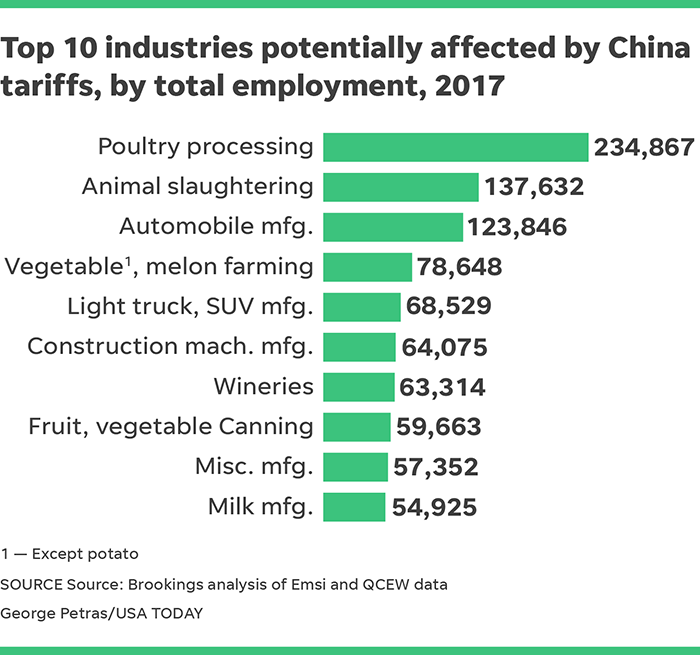
China, formerly the No. 1 customer for U.S. ag exports, will buy a comparatively paltry $9 billion worth of those exports this fiscal year, a startling 45% cutback due to the trade war, said the USDA on Thursday. Soybeans, in particular, are paying the price, with markedly smaller sales worldwide at the same time a record crop will swell the U.S. stockpile to an unprecedented size.