Economics

Ndaccountant

Old Hoss
Messages
8,370
Reaction score
5,771
https://www.bloomberg.com/news/articles/2019-05-09/aoc-bernie-sanders-credit-card-interest

So, follow the chain reaction. Cap interest rates, which invariably means less people will have credit. But wait, the postal office could offer low interest loans to those turned away. Except, interest rates and credit worthiness would be disconnected. Excellent idea for an organization that is already dying. What could go wrong? Except, for that whole issue of people trying to do this in housing lending 15-20 years ago, which obviously ended swimmingly.
 

NDBoiler

The Rep Machine
Messages
4,455
Reaction score
1,826
https://www.bloomberg.com/news/articles/2019-05-09/aoc-bernie-sanders-credit-card-interest

So, follow the chain reaction. Cap interest rates, which invariably means less people will have credit. But wait, the postal office could offer low interest loans to those turned away. Except, interest rates and credit worthiness would be disconnected. Excellent idea for an organization that is already dying. What could go wrong? Except, for that whole issue of people trying to do this in housing lending 15-20 years ago, which obviously ended swimmingly.

Agreed, the whole idea of turning the post office into a bank is a real head scratcher.

It seems to be a recurring theme that some in Congress just don’t understand what personal responsibility is. It’s the “loan sharks” or “big corporations”. Never mind the fact that they aren’t holding a gun to someone’s head when THEY SIGN UPFOR a 17% interest rate credit card. They seem to just be a helpless “victim” of “corporate greed”, as it is apparently too much to ask for a person to act like a responsible adult and live within their financial means. It’s always someone else’s fault.
 

Irish#1

Livin' Your Dream!
Staff member
Messages
44,581
Reaction score
20,031
https://www.bloomberg.com/news/articles/2019-05-09/aoc-bernie-sanders-credit-card-interest

So, follow the chain reaction. Cap interest rates, which invariably means less people will have credit. But wait, the postal office could offer low interest loans to those turned away. Except, interest rates and credit worthiness would be disconnected. Excellent idea for an organization that is already dying. What could go wrong? Except, for that whole issue of people trying to do this in housing lending 15-20 years ago, which obviously ended swimmingly.

Stick to your core competency and deliver the mail.
 

Meatloaf

Well-known member
Messages
2,058
Reaction score
951
Agreed, the whole idea of turning the post office into a bank is a real head scratcher.

It seems to be a recurring theme that some in Congress just don’t understand what personal responsibility is. It’s the “loan sharks” or “big corporations”. Never mind the fact that they aren’t holding a gun to someone’s head when THEY SIGN UPFOR a 17% interest rate credit card. They seem to just be a helpless “victim” of “corporate greed”, as it is apparently too much to ask for a person to act like a responsible adult and live within their financial means. It’s always someone else’s fault.

The only real way to deal with this, IMO, is education. Personal finance needs to be taught in high school; you can't keep writing laws to save ignorant people from themselves.
 

Irish#1

Livin' Your Dream!
Staff member
Messages
44,581
Reaction score
20,031
The only real way to deal with this, IMO, is education. Personal finance needs to be taught in high school; you can't keep writing laws to save ignorant people from themselves.

Waaaay back in my days we were taught personal finance. It was a full semester class, but was taught as part of a class. We were taught about expenses, budgets, planning for unforeseen expenses, etc.
 

Legacy

New member
Messages
7,871
Reaction score
321
The Dollar Is Still King. How (in the World) Did That Happen?

The supremacy of the dollar has also intensified pressure on Russia. Amid the possible motives for Russian interference in the American election of 2016 was President Vladimir Putin’s eagerness to gain relief from United States sanctions — especially for his cronies. Years of sanctions have restricted their movement of money in the global banking system. The dominance of the dollar has made such limits easier to enforce.

In a speech last week, Benoît Cœuré, a member of the governing board of the European Central Bank, accused the United States of wielding the dollar to force its policies on others.

“Being the issuer of a global reserve currency confers international monetary power, in particular the capacity to ‘weaponize’ access to the financial and payments systems,” he said. In face of such “hard power,” Europe had an imperative to raise the “global standing” of the euro, using the currency as “a tool to project global influence.”

Over 2017 & 2018, Russia bought up 16 million troy ounces of gold and there is evidence their buying is continuing including buying $840 million of gold bars from Venezuela. Hugo Chavez repatriated gold to the country. Madura is selling the gold off with other buyers including Turkey and U.A.E. despite Trump's sanctions on Venezuela.

Russia Is Dumping U.S. Dollars to Hoard Gold

Vladimir Putin’s quest to break Russia’s reliance on the U.S. dollar has set off a literal gold rush.

Within the span of a decade, the country quadrupled its bullion reserves, and 2018 marked the most ambitious year yet. And the pace is keeping up so far this year. Data from the central bank show that holdings rose by 1 million ounces in February, the most since November.

The data shows that Russia is making rapid progress in its effort to diversify away from American assets. Analysts, who have coined the term de-dollarization, speculate about the global economic impacts if more countries adopt a similar philosophy and what it could mean for the dollar’s desirability compared with other assets, such as gold or the Chinese yuan.
Trump favors returning to the gold standard. His picks for the Fed - Herman Cain and Stephen Moore - favored returning to the gold standard. Another one being vetted, Judy Shelton, would return to the gold standard. Many countries including Germany and France are repatriating their gold stored in places like the NY Fed Reserve. Many of those were impacted by Trump declaring sanctions on Iran and had to abandon projects. China is the biggest buyer of Iranian oil and India relies on it. Each reduces their purchases but still buy Iran oil financed through their own currency.

Are these countries just hedging their investments? Are Europeans preparing for returning to national currencies should the European Union dissolve? Are all of these countries setting up a financial system independent of the dollar? Do they want to do trade with countries sanctioned by Trump?

How the U.S. Has Weaponized the Dollar; The currency’s “exorbitant privilege” gives the nation extraordinary leverage.

Convinced of an existential threat from competitors, America is weaponizing the dollar to preserve its global economic and geopolitical position.

While the U.S. accounts for about 20 percent of the world’s economic output, more than half of all global currency reserves and trade is in dollars. This is the result of the 1944 Bretton Woods agreement, the effect of which was enhanced when the link between the dollar and gold ended in the 1971 Nixon shock, allowing America to control the supply of the currency.

The dollar’s pivotal role — an “exorbitant privilege,” in the term coined by then French Finance Minister Valéry Giscard d'Estaing in 1965 — allows the U.S. easily to finance its trade and budget deficits. The nation is protected against balance-of-payments crises, because it imports and services borrowing in its own currency. American monetary policies, such as quantitative easing, can influence the value of the dollar to gain a competitive advantage.

But the real power of the dollar is its relationship with sanctions programs. Legislation such as the International Emergency Economic Powers Act, the Trading With the Enemy Act and the Patriot Act allow Washington to weaponize payment flows. The proposed Defending Elections From Threats by Establishing Redlines Act and the Defending American Security From Kremlin Aggression Act would extend that armory.
 
Last edited:

Whiskeyjack

Mittens Margaritas Ante Porcos
Staff member
Messages
20,894
Reaction score
8,126
American Affair's Julius Krein just published an article titled "Share Buybacks and the Contradictions of 'Shareholder Capitalism'":

In the jargon of finance, America is suffering from a capital allocation problem. The country seems incapable of making the necessary investments to fuel future productivity and growth, or to ensure widespread prosperity. At the government level, public spending on basic research and development as well as infrastructure investment has declined significantly over the past several decades. This trend, of course, should not be surprising, as reducing government spending has been a conscious policy objective for many years, especially (though not exclusively) for conservatives.

Over the same period, however, business investment has also declined. As a percentage of GDP, corporate investment has been in a long-term downward trend since 1980. And this trend is much more pronounced when viewed as a percentage of corporate profits or market capitalization.

This latter fact is particularly problematic for advocates of “free market” policies: if “getting government out of the way” does not lead to more entrepreneurial investment in the private sector, then what’s the point? Indeed, the entire neoliberal/libertarian economic policy toolkit has essentially been discredited by its failure to generate increased business investment in recent decades.

To take the most recent examples, the 2017 corporate tax cut was sold in large part with claims that it would increase private-sector investment, thus driving growth. Yet although there was some uptick in investment in early 2018, capital spending has stalled out in recent months, and growth estimates have been revised downward. In fact, in the second and third quarters of this year, S&P 500 companies spent more money buying back their own shares than on capital investment. For the foreseeable future, the prospects for any major boom in investment—certainly one matching the magnitude of the tax cut—are dim. Apparently the Trump administration’s vaunted deregulatory agenda has not worked either.

Looking back further, the Fed’s uniquely accommodative monetary policy in the aftermath of the financial crisis did lead to extraordinary asset-price inflation, but it did not produce anything approaching extraordinary investment growth. Meanwhile, the much-lauded “gains from trade”—really increases in corporate profits from tax and labor arbitrage—were never reinvested in the domestic economy. Nor were increased monopoly rents resulting from relaxed anti-trust, nor the labor cost savings resulting from de-unionization.

In short, neoliberal policies—from tax cuts, to deregulation, to trade liberalization, and so on—have produced massive increases in corporate profits, but these profits have not been reinvested in productive, entrepreneurial activity as promised (nor, of course, have they gone to labor). Instead, they have simply flowed into financial markets and remained there. But without sufficient investment into productivity-enhancing technologies, facilities, equipment, and the like, productivity has inevitably stagnated, and the economic prospects for future generations have deteriorated. In addition, given the highly unequal distribution of stock ownership (50 percent of Americans own no stocks; the top 10 percent own over 80 percent of equities, and the top 1 percent owns almost 40 percent), more capital flowing into financial markets has led to and will only continue to exacerbate gaping inequality, apparently with no compensating benefit that was supposed to come from increased investment.

The net result, as William Lazonick has argued, has been the construction of a “value extraction” economy rather than a system that rewards “value creation.” In other words, the financial markets are rewarding corporate behavior that extracts value from capital assets in order to convert it into liquid financial assets, rather than incentivizing the investment of financial assets into the real economy.

New Attempts at Reform

Many serious voices on the left have been calling attention to these problems for some time, unfortunately to little apparent effect even within the Democratic Party. But the situation has gotten so bad that critiques of the current system and new policy proposals to address its problems are starting to come from some unexpected quarters. Larry Fink, the CEO of BlackRock, recently called on companies to focus more on long-term capital investment rather than the short-term boosts of financial engineering (though there is no indication that BlackRock has used its considerable power as a massive institutional investor to force changes in corporate behavior). Moreover, today, Senator Marco Rubio proposed amending the tax code such that corporate share buybacks would be deemed dividends and taxed accordingly. This would remove the tax advantage/deferral that buybacks currently enjoy versus other forms of capital return, and aims to reduce the warped incentives that reward financial engineering at the expense of productive investment as well as labor compensation.

Needless to say, this tax change, even if implemented, would not itself solve all the problems related to counterproductive corporate behavior and financialized “shareholder capitalism.” Yet it is certainly the first serious attempt to address these issues—and one that goes beyond the conventional policy toolkit—to emerge from a Republican.

If discouraging financial engineering is now a bipartisan cause, it seems likely that a new and perhaps more concrete public debate around these issues will have to occur. And while the basic positions on these matters are fairly well defined, many delusions persist, so it is worth investigating in particular the issues around share buybacks.

Shortsighted Defenses of Shortsighted Behavior

At this point, the only remaining intellectual defenders of share buybacks or financial engineering more broadly fall into two groups. First, there are the salaried salesmen of “free market” think tanks, who typically have no practical knowledge of financial markets or the business world (indeed it is shocking—though probably not accidental—how few libertarian think tank commentators have any real-world business or Wall Street experience). On the other hand, the second group is mostly comprised of a few mediocre stock-pickers with academic pretensions like Cliff Asness who are basically talking their own book. Their main argument is that returning capital to shareholders does not reduce investment but simply allows for the reallocation of cash from one company to another which could deploy that cash more efficiently.

As an aside, some still argue that buybacks serve a bona fide business purpose, like “restructuring,” but anyone with any experience in institutional investing recognizes these arguments as utterly frivolous. In almost all cases, companies do buybacks in order to return capital to shareholders and boost their stock price by reducing the number of shares outstanding and thus improving earnings-per-share (EPS) metrics. Buybacks have also come to be preferred over dividends because they enjoy a tax advantage: shareholders who do not sell immediately receive a tax deferral on the price appreciation resulting from the stock’s increased EPS, whereas dividends are subject to tax immediately upon payment.

Returning to the main question, however, defenders of buybacks argue that returning capital to shareholders does not come at the expense of productive investment but rather represents the best use of capital available and allows shareholders to allocate capital to other companies more in need of it. Like most neoliberal economic arguments, this claim benefits from a certain logical simplicity, but it totally breaks down when applied to the real world.

First, the statistics simply do not support this argument. According to data from the Peterson Institute for International Economics and Bloomberg, in 1980 total capital return (buybacks plus dividends) represented about 2 percent of U.S. GDP, while investment was close to 15 percent of GDP. In 2016, investment represented around 12 percent of GDP while capital return was about 6 percent of GDP. To be sure, there is some variation in these numbers year over year, but the long-term trends are obvious.

Share-Buybacks-768x451.jpg


And remember: because government investment has been in decline over the same period, private-sector investment would have to grow significantly, and to levels well above its previous highs, for the country as a whole to maintain the same level of overall investment.

Some try to obfuscate these general trends by isolating year-over-year changes in investment and buybacks and highlighting that in many years both capital return and capital expenditure increased versus the previous period. The problem with focusing solely on year-over-year changes, however, is that it ignores the accumulated effects of the change in corporate behavior over time. It also undermines the second part of the argument—that buybacks lead to the more efficient allocation of capital. If companies are simply returning more capital whenever they have more cash—and buying back stock even at unusually high valuations—then there is no reason to believe that increasing share buybacks has anything to do with changes in a given company’s investment opportunity set.

Thus there is likewise no reason to believe the argument that higher levels of capital return have led to the more productive deployment of capital. If that were the case, one would expect to see significant increases in productivity, but that has not materialized, and, if anything, the opposite has occurred.

Others argue that the phenomenon of corporations returning more and more capital simply reflects changes in the broader economy—the decline of capital-intensive industries and the rise of intellectual-property-oriented businesses and service industries. But this argument does not answer the fundamental questions around investment; it simply restates them. Why are capital intensive businesses no longer attractive investments in the United States? And if asset-light businesses are so profitable, why are they not attracting and deploying much more capital to invest in further expansion—which might even spread the presumed benefits of the “digital revolution” more broadly throughout the country?

These questions become much easier to answer by simply looking at the concrete motivations of financial markets participants and corporate executives. The actual behavior of today’s corporations and institutional investors makes the problems of the shareholder-driven economy even more evident than abstract theoretical or data analysis.

The idea, for example, that capital returned to shareholders is going to market participants that are unconstrained, rational, and sufficiently well-informed and incentivized to better deploy that capital and invest it more productively is just laughable. When an activist investor profits by pressuring a company to return more capital (or a non-activist stock-picker correctly chooses one), it is highly unlikely that this investor will subsequently redeploy those profits to a growth investment. On the contrary, the investor will use the now larger pool of capital—probably augmented by new capital raised from limited partners on the basis of a successful track record—to pursue the same strategy on different targets, simply pressuring other companies to increase capital returns to shareholders. Most fund managers are highly constrained in what strategies they can pursue, and they cannot simply flip from shareholder activism one day to funding risky technology investments the next, much less seed fledgling startups. Even funds that can pursue multiple strategies rarely have the expertise or interest to fund entrepreneurial investment. Their analysts are trained to view equity ownership as nothing more than “an option on future cash flow streams.” Most of the time, they have at best a cursory, secondhand grasp of business and industry dynamics, much less any entrepreneurial desire to fundamentally remake an industry or product. If all that matters are annual performance numbers, why pursue a complicated, unpredictable, and risky entrepreneurial investment if it’s possible to engage in easily quantifiable financial engineering and profit in the short term?

In addition, these firms get their capital from limited partners (LPs) such as university endowments, pensions, and funds of funds. The employees of these types of firms are typically more rules-constrained, less well-paid, and therefore less ambitious than, say, the hedge fund manager they allocate capital to. These LP managers also rarely benefit much from outperformance, but can often lose their jobs after even a short period of underperformance. Hence an extreme amount of group-think and risk aversion prevails among these sources of capital. Along with family offices representing ultra-high-net-worth individuals, they also tend to prioritize “capital preservation,” reducing risk and volatility, rather than aiming for transformational investments. For all these reasons and more, the major pools of investor capital are inherently predisposed to prefer the near-term safety of financial engineering over risky, long-term investment. The net result of these dynamics is that the “gains” from corporate capital returns are rarely reinvested in capital-starved growth companies. Instead, more and more capital is simply deployed to pressure more and more companies to engage in more and more financial engineering.

And even when companies do not face external pressure from Wall Street, executives know what sort of behavior gets rewarded by markets—share buybacks. Combine this with a situation in which executives are principally motivated by stock-based compensation, and the incentives to manipulate stock prices through financial engineering rather than undertake long-term productive investment become even more problematic. Thus whatever principal-agent problems might have afflicted midcentury corporate executives, giving more and more power to “shareholders” and financial markets today is the opposite of entrepreneurial.

Meanwhile, during the last several years, passive index funds have come to be major shareholders of most publicly traded companies. A passive index fund, of course, is going to do very little in terms of capital reallocation in response to buybacks. Theoretically, the ultimate beneficial owners might. But, then again, the people putting their money in passive index funds are probably not highly responsive to any single company’s decisions, nor are many of them likely to be interested in evaluating the business models, capital needs, and investment opportunities of individual firms.

Furthermore, at this point, it is impossible to ignore the fact that actual corporate behavior frequently and egregiously contradicts the theoretical justifications of buybacks and financial engineering. To take some recent, high-profile examples: General Electric’s (GE) stock price has fallen from around $32 in 2016 to around $7 today as multiple business lines have experienced distress. Yet GE spent a total of $24 billion buying back its own shares in 2016 and 2017. How could anyone plausibly argue that this represented the most efficient use of capital for the company? And even if one wanted to make the preposterous case that this spending did not somehow “come at the expense” of the investment desperately needed to shore up GE’s operating businesses, then surely returning capital through dividends would have been much better for long-term shareholders. Removing the current disparity in the tax treatment of buybacks is the least that could be done.

Before GE, there was IBM. IBM spent around $105 billion on buybacks from 2005 to the early 2010s, artificially inflating its EPS even while its revenues were declining and its technology was obsolescing. The company still trades far below its 2012 levels. There is perhaps no better example of value extraction and self-inflicted value destruction (by legal means) in modern corporate history.

The fate of these two former national corporate champions is, sadly, probably a harbinger of what is to come for the U.S. economy as a whole if recent trends continue. One could list many more examples totally disproving the notion that buybacks are an efficient use of capital, or that companies prefer to buy back shares when valuations are unusually low, and so on. On the contrary, until the bonanza of recent years, spending on buybacks reached its highest levels just before the financial crisis.

In fact, among America’s largest companies, the amount spent on share buybacks and dividends has exceeded free cash flow since 2014. This means that corporations are not simply distributing excess cash; they are actually borrowing money in order to fund capital returns to shareholders. Much of the re-levering of U.S. corporate balance sheets since the end of the financial crisis, in fact, has occurred because companies are distributing so much cash to shareholders. Even if one wants to make the frankly fantastical assumption that this has not occurred at the expense of investment in the present, it certainly constrains corporations’ ability to invest in the future. Money spent on buybacks, after all, does not create any asset for the company; it does not create any future revenue stream. Yet the interest and principal on that debt will have to be repaid by the company. In other words, the core activity of the U.S. corporate sector today is actively cannibalizing future growth in order to inflate the prices of financial assets that are already trading at historically high valuations. Barely a decade after the financial crisis, we are again witnessing one of the greatest systemic misallocations of capital in American history.

A Time for Choosing

Even the most successful companies are not immune from these pressures. Following the passage of the 2017 tax cut, Apple announced a $100 billion buyback program for 2018. Yet how is turning this cash over to the financial markets supposed to benefit the economy? Not only is Apple at the forefront of a high-technology sector, but its management has a relatively good track record of developing innovative products in recent years. It is one of the few companies with the scale needed to invest in size in fundamental, capital-intensive innovations. These resources could have been used to build manufacturing capacity in the United States or to pursue advances in new technologies like quantum computing or AI. Even if the cash remained on Apple’s balance sheet—though that’s hardly an ideal scenario—it would still be more likely to be deployed productively in the future than it is now—sitting on the balance sheet of a passive investment vehicle, or in the hands of some overrated equities trader.

At bottom, the only justification for returning capital to shareholders is that there is no better investment option available to the company. And while it is true that any given business may from time find itself in such a situation, when this is said to be the case year after year at a massive scale, it raises profound questions.

Goldman Sachs estimates that $1 trillion will be spent on buybacks in 2018—that is $1 trillion that the corporate sector is saying it cannot invest profitably. Now, either the corporate sector is wrong: maybe there are more investments to be made, and capital is simply being misallocated due to horrendously misaligned incentives. Or there are in fact no better investments to be made, and the corporate sector simply has no use for this vast sum of capital. If the latter is true, however, it calls into question the viability of the free market capitalist system itself. After all, the entire social justification of free enterprise is that the private sector is the most capable of finding productive investments and deploying capital effectively. But when the corporate sector itself admits that it has no use for vast and ever-increasing amounts of capital, then someone else must find a use for it. More precisely, the state should use it to fund public investment, which in many areas is sorely needed. In this sense, taxing capital returns to shareholders is one of the most efficient taxes conceivable, since the entity being taxed has already admitted that it has no use for the cash. On the other hand, some like Matt Bruenig go even further, arguing for full nationalization of ownership. And if in fact the financial system continues to incentivize more and more value extraction and less and less value creation, then it will become difficult to refute these arguments on any economic grounds.

As Ronald Reagan might say, America’s largest shareholders and corporate managerial classes have reached a time for choosing. Either they will begin investing in the future of this country again, or they will continue to surrender their most important role in a capitalist economy, until the system collapses on itself.

The main opponents of any government effort to encourage the better allocation of capital and promote domestic investment invariably style themselves as defenders of markets and entrepreneurs. But by parroting the notion that the corporate sector generates massive amounts of excess capital for which there is no productive use, these brain-dead ideologues and apparatchiks are actually undermining the basic justification for free enterprise itself. Perhaps it should not surprise anyone that the advocates of share buybacks often fail to appreciate the long-term implications of their position. But the question raised by the intensifying debates over value extraction versus value creation is no less than the question of whether it is possible—through better policy choices that correct skewed incentives—to save capitalism from itself.
 

Ndaccountant

Old Hoss
Messages
8,370
Reaction score
5,771
American Affair's Julius Krein just published an article titled ":

What used to be developed organically is now largely purchased/inorganic. It's much more efficient use of capital and you can place your bets more strategically. On top of that, advancements are coming from 0's and 1's and not iron/material. Once is much more expensive to develop than the other.
 

Whiskeyjack

Mittens Margaritas Ante Porcos
Staff member
Messages
20,894
Reaction score
8,126
What used to be developed organically is now largely purchased/inorganic. It's much more efficient use of capital and you can place your bets more strategically. On top of that, advancements are coming from 0's and 1's and not iron/material. Once is much more expensive to develop than the other.

Then how to explain Apple's $100b buyback in 2018?
 

Ndaccountant

Old Hoss
Messages
8,370
Reaction score
5,771
Then how to explain Apple's $100b buyback in 2018?

Apple has over $130B in cash on hand and is generating over $70B in FCF annually. So the $100B is simply a result of their strategy to systematically draw down their cash reserves as they have stated for the past few years.

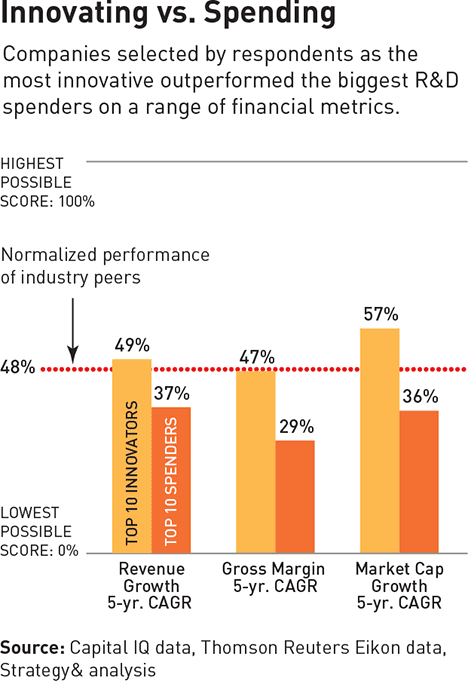
Of note, Apple does typically spend 4-5% of sales each year in R&D. That isn't some abnormally low amount, especially when you look at it from a $ perspective. There does come a point where spending more just isn't practical nor prudent. Even so, Apple has routinely been hailed as the most innovative company and innovation isn't perfectly correlated to spending:

41165807b_exh.gif
 

Ndaccountant

Old Hoss
Messages
8,370
Reaction score
5,771
For the record, I am not necessarily pro buy-backs. I would rather have equal tax treatment for both dividends and buy-backs. I just don't think buy-backs and investment are mutually exclusive.
 

Legacy

New member
Messages
7,871
Reaction score
321
Then how to explain Apple's $100b buyback in 2018?

Repatriation is a factor. With the Tax Cuts and Jobs Act (TCJA) must now pay tax on about $2.6 trillion of pre-TCJA offshore profits regardless of whether those profits are returned to the United States. The one-time repatriation tax on foreign earnings held in cash and cash equivalents is taxed at 15.5 percent instead of the 35% due with a credit for foreign taxes paid or the 21% corporate tax in the TCJA.

Overall, the rate of repatriation by MNCs quarterly is also slowing and the amount that has been repatriated ($465 B) is not nearly been the windfall that proponents predicted ($4 Trill). Some feel the total cash parked overseas is closer to $2.6 trillion. That's a lot of cash that's being brought back and a major source for multi-national company buybacks, which as pointed out is tax deductible. When companies got a repatriation tax holiday in 2004, they also did not spend it on raising wages or increasing capital expenditures but used it for stock buybacks, too.

Tax consequences. Companies have up to eight years to pay the taxes. In Apple's case, that's $38 Billion on $275 B in cash and equivalents overseas. Apple plans to pay 8% per year of that for five years, then the remaining 60% over the last three years. Their capital expenditures in 2018 went up ($16.7 B) over '17 ($15 B), but guidance is that those expenditures in 2019 ($14 B) will be lower than in 2017, implying the cash is less for capital expenditures and more for buybacks and raise dividends.

The other plum for the multinationals is that unlike the previous tax code now foreign profits are not taxed.

Call it a massive redistibution of wealth with government at the service of MNCs and rewarding corporate behavior for tax schemes and which add little value to the real economy.
 
Last edited:

Whiskeyjack

Mittens Margaritas Ante Porcos
Staff member
Messages
20,894
Reaction score
8,126
<blockquote class="twitter-tweet" data-lang="en"><p lang="en" dir="ltr">Angela Nagle offers a spot-on critique of woke capitalism on a recent episode of <a href="https://twitter.com/RedScarePod?ref_src=twsrc%5Etfw">@RedScarePod</a> <a href="https://t.co/nU0Ab7GONv">pic.twitter.com/nU0Ab7GONv</a></p>— Ramona Tausz (@rvtausz) <a href="https://twitter.com/rvtausz/status/1141052137910276096?ref_src=twsrc%5Etfw">June 18, 2019</a></blockquote>
<script async src="https://platform.twitter.com/widgets.js" charset="utf-8"></script>
 

Legacy

New member
Messages
7,871
Reaction score
321
New development related to a prior post on Trump's fed picks favoring a return to the gold standard and gold purchases by other countries. Trump is nominating a third candidate, Judy Shelton, for a seat on the Fed Reserve who favors returning to the gold standard. His prior two picks to the Fed who also favored returning to the gold standard withdrew due to comments about women and about questionable behavior occasioning Mitch McConnell to advise
“There are two things the administration ought to consider before nominating someone: first a background check and second, likelihood of confirmation. And generally better to check that up in advance before you send that nomination up. There are a number of members ... who had some reservations about some of the names that have been mentioned.”

Shelton, after arguing for years against the Fed's recession-era rate cuts, has since fallen in line with Trump's call for cheaper money amid the threat of an economic slowdown.

Gold has jumped on the news, though it had jumped over 4% prior to the announcement. For the countries that have bought large amounts of gold in the past year like Russia and Saudi Arabia, the potential profits could be immense. Trump had previously criticized China for currency manipulation to lower the prices on their exported goods. Trump favors the Fed lowering interest rates to 0 for the same reason.

Two seats are open on the Fed. His other nominee, Christopher Waller, has worked at the Federal Reserve Bank of St. Louis since 2009, and previously was an acting chair of economics at the University of Notre Dame from 2006-07 and a chair in macroeconomics and monetary theory at the University of Kentucky.

Transparency is not a hallmark of this White House, especially with regard to Trump's financial holdings, as well as his discussions with foreign leaders. Two days ago a judge allowed Democrats to proceed with collecting financial documents on Trump's holdings and investments in their emoluments lawsuit against Trump.
 

Irishize

Well-known member
Messages
4,531
Reaction score
461
Linked article from WaPo about the roaring economy only being felt by 60% of the US while 40% still struggle to recover from the 2008 financial crisis.

https://apple.news/AUyqzfKGPS6ipKmI_DxF-og

I feel for a lot of these folks but it’s a good reminder to our youth that their choices will have consequences. Read the families detailed in the article. Granted, we have to read between the lines and it’s risky to assume but there seemed to be a similar trend:

The heads of the families were the women that were interviewed, not the men. Nothing wrong with that but it goes back to choices. Reading a bit more on the two families highlighted, we find that both women had kids at a young age and their boyfriends didn’t stick around which left them w/ a family to raise & support as a single parent. They finally found the right partner in life, but that person has their baggage to bring to the mix. They’re on the right track & trying to do it the right way. I commend them. But the solution is more than blaming the 60% who have purchased a home or own stocks.

You fix that one crisis in America & I truly believe a lot of our societal problems & inequities disappear. The problem is the gov’t (esp the Left) don’t want to address that b/c it’s the source of their power. They need to keep those folks as single parents dependent on the gov’t for everything so they can ensure reelection in exchange for the handouts.

I truly believe these folks in the article are trying to break out of the cycle by finally getting married & getting higher education. That’s admirable. But, they still have to deal with the circumstances that their earlier choices led them to. If they’re “victims” it’s of the government’s doing as the cycle of single mother households has continued to rise.

This problem will not be fixed by a higher minimum wage, free healthcare or free college for all. If anything, that would just push more of the middle class down to the 40% that are highlighted in the linked article.

Personal responsibility is a lost virtue these days.
 
K

koonja

Guest
Our current mortgage through Wells Fargo is a 30 year fixed @4.5%.

They sent us something in the mail that caught our eye, so we decided to submit an app with them to refinance. They're offering us 3.99% at 20 year's fixed rate ($4,000 closing costs, rolled into loan). They had other offers at 15/30 years, but we'd like to do 20 years.

I submitted two other apps to get competitive rates. The best one is through "New American Financial", which has 4.5 reviews and an "A+" with the BBB.

Their offer is 3.875% for 20 years, fixed. $5,000 closing costs (rolled into loan).

I've never gone through this before - is there any reason not to jump on the New American offer for 3.875% for 20 years?
 

RDU Irish

Catholics vs. Cousins
Messages
8,622
Reaction score
2,722
Our current mortgage through Wells Fargo is a 30 year fixed @4.5%.

They sent us something in the mail that caught our eye, so we decided to submit an app with them to refinance. They're offering us 3.99% at 20 year's fixed rate ($4,000 closing costs, rolled into loan). They had other offers at 15/30 years, but we'd like to do 20 years.

I submitted two other apps to get competitive rates. The best one is through "New American Financial", which has 4.5 reviews and an "A+" with the BBB.

Their offer is 3.875% for 20 years, fixed. $5,000 closing costs (rolled into loan).

I've never gone through this before - is there any reason not to jump on the New American offer for 3.875% for 20 years?

www.bankrate.com - I would go for a $0 or low closing cost option with a decent chance rates go lower from here.
 

BobbyMac

Staff & Stuff
Staff member
Messages
33,950
Reaction score
9,294
20-Year vs 30-Year Fixed Rate Mortgage:

..................................... 20-year mortgage ......... 30-year mortgage

Mortgage value ................. $200,000 ....................... $200,000
Interest rate ...........................4.0% ............................ 4.5%
Monthly payment ................. $1,211 .......................... $1,013
Interest paid first 5 years ..... $35,426 ......................... $43,118
Total interest paid ................ $90,992 ........................ $164,813

Your 20 year IF it was $200k loan:

Mort value = $205k
Int % = 3.85
Mo $ = $1226
Total % = $89,268

At $200k-ish, you'd be better off taking the $200 additional a month the new loan would cost and investing it in a Index fund.
 
K

koonja

Guest
20-Year vs 30-Year Fixed Rate Mortgage:

..................................... 20-year mortgage ......... 30-year mortgage

Mortgage value ................. $200,000 ....................... $200,000
Interest rate ...........................4.0% ............................ 4.5%
Monthly payment ................. $1,211 .......................... $1,013
Interest paid first 5 years ..... $35,426 ......................... $43,118
Total interest paid ................ $90,992 ........................ $164,813

Your 20 year IF it was $200k loan:

Mort value = $205k
Int % = 3.85
Mo $ = $1226
Total % = $89,268

At $200k-ish, you'd be better off taking the $200 additional a month the new loan would cost and investing it in a Index fund.

If we didn't do the 20 year, that ~$200/month savings isn't getting invested. I get this is how the lender gets their money one way or another, but in reality we just wont increase our investments.

So seems like the best course of action is to lock into the 20 year at this rate.
 

RDU Irish

Catholics vs. Cousins
Messages
8,622
Reaction score
2,722
That Wells Fargo rate sucks - they are making a mint off of you. Should be able to get under 4% especially with that high of closing costs. 3 7/8% is out there with reasonable closing costs. Hard pressed to save even a .25% on a 20 year compared to that. Easy enough to pay extra automatically on the 30 to turn it in to a 20 year loan - always amazed at the people obsessed with the loan term and equally unaware of the ability to pre-pay without penalty.
 

Irish#1

Livin' Your Dream!
Staff member
Messages
44,581
Reaction score
20,031
That Wells Fargo rate sucks - they are making a mint off of you. Should be able to get under 4% especially with that high of closing costs. 3 7/8% is out there with reasonable closing costs. Hard pressed to save even a .25% on a 20 year compared to that. Easy enough to pay extra automatically on the 30 to turn it in to a 20 year loan - always amazed at the people obsessed with the loan term and equally unaware of the ability to pre-pay without penalty.

I have no idea what the percentage is, but I would imagine most who have mortgages know they can pay extra, but never do because they don't have the discipline to maintain that or there is always something popping up (washer/dryer, home repair, car repair, etc.) to eat the extra. If Koon goes with the 20, he has no choice but to pay it, so he's essentially paying the extra in the form of a little higher payment. I do agree the closing cost is high.
 
K

koonja

Guest
That Wells Fargo rate sucks - they are making a mint off of you. Should be able to get under 4% especially with that high of closing costs. 3 7/8% is out there with reasonable closing costs. Hard pressed to save even a .25% on a 20 year compared to that. Easy enough to pay extra automatically on the 30 to turn it in to a 20 year loan - always amazed at the people obsessed with the loan term and equally unaware of the ability to pre-pay without penalty.

I have no idea what the percentage is, but I would imagine most who have mortgages know they can pay extra, but never do because they don't have the discipline to maintain that or there is always something popping up (washer/dryer, home repair, car repair, etc.) to eat the extra. If Koon goes with the 20, he has no choice but to pay it, so he's essentially paying the extra in the form of a little higher payment. I do agree the closing cost is high.

We make an extra one-time payment at the end of each year for $2,000.

So that helps and I'm aware we can do that (or just pay more monthly).

But overpaying or not, I'm still paying into a 4.5% rate when I could drop it to 3.875%.

I'd bet it makes more sense to lock into a lower rate that forces me to pay more for the next ~20 years, than unofficially paying more at some ad hoc frequency against a 4.5% rate. If my 30 Year was at 3.9% and I could just pay over that, I would.

But Obviously I'm not a banker or I wouldn't have asked the question.
 

Wild Bill

Well-known member
Messages
5,518
Reaction score
3,263
We make an extra one-time payment at the end of each year for $2,000.

So that helps and I'm aware we can do that (or just pay more monthly).

But overpaying or not, I'm still paying into a 4.5% rate when I could drop it to 3.875%.

I'd bet it makes more sense to lock into a lower rate that forces me to pay more for the next ~20 years, than unofficially paying more at some ad hoc frequency against a 4.5% rate. If my 30 Year was at 3.9% and I could just pay over that, I would.

But Obviously I'm not a banker or I wouldn't have asked the question.

How long do you plan on living there?
 

MNIrishman

Well-known member
Messages
2,532
Reaction score
481
We make an extra one-time payment at the end of each year for $2,000.

So that helps and I'm aware we can do that (or just pay more monthly).

But overpaying or not, I'm still paying into a 4.5% rate when I could drop it to 3.875%.

I'd bet it makes more sense to lock into a lower rate that forces me to pay more for the next ~20 years, than unofficially paying more at some ad hoc frequency against a 4.5% rate. If my 30 Year was at 3.9% and I could just pay over that, I would.

But Obviously I'm not a banker or I wouldn't have asked the question.

There's a reason 90% of mortgages are 30 year, even though you get better rates for 20 and 15 year. The rate doesn't tell the whole story. If you can pay the 20 year monthly rate against the 4.5/30 mortgage, you'll be in much better shape. It's like part of your mortgage is at 4.5% and part is 0%.
 

Whiskeyjack

Mittens Margaritas Ante Porcos
Staff member
Messages
20,894
Reaction score
8,126
Here's a good Twitter thread by Deneen on an extended Edmund Burke quote (circa 1790) about the financialization of the economy:

<blockquote class="twitter-tweet"><p lang="en" dir="ltr">Read Burke on the effect of financialization of the economy, and be amazed: “He knows little indeed onf the influence of money on mankind who does not see the force of management of a monied concern...”</p>— Patrick Deneen (@PatrickDeneen) <a href="https://twitter.com/PatrickDeneen/status/1192012796495577088?ref_src=twsrc%5Etfw">November 6, 2019</a></blockquote> <script async src="https://platform.twitter.com/widgets.js" charset="utf-8"></script>

And here's an essay by Marco Rubio titled Common Good Capitalism and the Dignity of Work in Public Discourse:

A few weeks ago, the Attorney General gave a speech about religious liberty at Notre Dame. The reaction was a cautionary tale about how, if a Catholic public official speaks to a Catholic audience on the connection between our faith and public policy, he or she will be accused of supporting a “religious theocracy” right out of The Handmaid’s Tale.

So, in order to avoid getting “cancelled” by an online mob, I decided to base my remarks on a secular source of wisdom acceptable to the “blue check brigade.” My first choice was Kanye West, . . . but then he came out with an album called Jesus Is King. So it was back to the drawing board.

I settled on focusing on the writings of a nineteenth-century Italian named Vincenzo Pecci. Because who could possibly be triggered by a nineteenth-century Italian?

Almost 130 years ago, Pecci wrote the following:

The labor of the working class—the exercise of their skill, and the employment of their strength in the workshops of trade is indispensable. . . . Justice demands that the interests of the working classes be carefully watched over by the administration, so that they who contribute so largely to the community may themselves share in the benefits which they create.

He went on to write that the ultimate goal for any society should be to “make men better,” by providing regular people the opportunity to attain the dignity that comes from hard work, ownership, and raising a family.

According to Pecci, what makes this kind of society possible is the rights of both workers and business, but also their obligations to each other. Businesses have a right to make a profit. And workers have a right to share in the benefits of the profits their work helped create. But businesses also have an obligation to reinvest those profits productively for the benefit of the workers and the society that made it possible. And workers have an obligation to work.

Now time for something we Catholics are familiar with . . . a confession. Mr. Pecci wasn’t some secular economist. His views were deeply rooted in his Christian faith. Because Mr. Pecci is better known as Pope Leo XIII.

Forgive me, “outrage police,” for I have sinned. I have once again mixed politics with religion!

In 1891, in the midst of an Industrial Revolution that was transformative and disruptive, and the rise of socialism, Pope Leo wrote an encyclical titled Rerum Novarum. I wanted to revisit what he wrote, because we are once again in the midst of transformative and disruptive economic change. And we once again face rising calls for socialism.

The economy he described as the right response was one in which workers and businesses are not competitors for their share of limited resources, but instead partners in an effort that benefits both and strengthens the entire nation. This describes not just the kind of economy most of us want here in America: it describes our economy during our nation’s most prosperous and secure moments.

Yet, for some reason, we have drifted far from this kind of society. We are quite familiar and enthusiastic about our rights, but not nearly as familiar or excited about our obligations.

On the political right, we have become defenders of the right of businesses to make a profit, the right of shareholders to receive a return on their investment, and the obligation people have to work. But we have neglected the rights of workers to share in the benefits they create for their employer—and the obligation of businesses to act in the best interest of the workers and the country that have made their success possible.

The political left has been an enthusiastic champion of everyone’s right to various benefits, and of businesses’ obligation to share their success with their workers and the government. But they rarely focus on either our obligation to work or businesses’ right to make a profit.

This is the false choice our politics has offered us for almost three decades. And facing an economy whose architecture has been rapidly and dramatically transformed, we have been left with an economy and a society no one is happy with.

Even after three years of robust economic growth, we still have millions of people unable to find dignified work and feeling forgotten, ignored, and left behind. And the result of decades of this negligence isn’t just economic. It has weakened families and eroded communities. It has fueled the rise of grievances in which over 70 percent of Americans believe their fellow countrymen on the opposing side of politics aren’t just wrong, they are a threat to the country. This, not social media or any politician, is why we have become incapable of identifying a common good and pursuing it.

Economic Ideal vs. Reality

Free enterprise made America the most prosperous nation in human history. But that prosperity wasn’t just about businesses making a profit, it was also about the creation and availability of dignified work. And our strength came not just from the size of our economy, but also from how its success served the broader national interest.

For example, we could never have defeated Nazi Germany or Imperial Japan without both an advanced and profitable industrial base, and the willingness of those businesses to participate in the war effort. And after the war, returning veterans would never have been able to find a job, buy a home, and start a baby boom if we didn’t have strong businesses to hire them.

That was the America my parents came to in 1956—the place in which it was possible for poorly educated immigrants like them to find dignified work, purchase a house, raise a family, and leave all four of their children better off than themselves. This is why I have always told their story. Not because of what it says about me, but because of what it says about our country.

This is why, since the day I entered public service, I have been an unabashed believer in American exceptionalism and promoter of the American Dream. But when I ran for president, I learned the hard way that many Americans did not share my optimism. They were anxious—even angry at those they blamed for ignoring them, disrespecting them, and leaving them behind.

From cabinet-makers in Georgia to power tool factory workers in Pennsylvania, they are the people whose lives were turned upside down when companies exercised their right to make a profit by offshoring their jobs, with little regard for their corresponding duty to invest in their own workers—the people who were told to go back to school, learn to code, and leave their extended family and community behind and get a job in the “new economy.” These millions of Americans are the victims of an economic reordering that Pope Benedict described in Caritas in Veritate as the dominance of “largely speculative” financial flows detached from real production.

When we started only focusing on the right of businesses to make a profit, and stopped recognizing the obligation of businesses to reinvest in America, large corporations became nothing more than financial vehicles for shareholders, managers, and banks to assert their claims over. The right to return money to shareholders became a right above all others. And the obligation to invest for the benefit of our workers and our country became an afterthought.

The economic numbers tell the tale. Over the last forty years, the financial sector’s share of corporate profits increased from about 10 to nearly 30 percent. The share of those profits sent to shareholders increased by 300 percent, while investment of those profits back into the companies’ workers and future dropped 20 percent. Last year, corporations on the S&P 500 spent over a trillion dollars buying back their own shares. To take them at their word, these are the largest corporations in the world collectively saying, “We don’t have anything to invest in.” This is what it looks like when, as Pope Francis warned, “finance overwhelms the real economy.”

The Dignity of Work and Social Decay

Because economics and culture are strongly intertwined, the effect of all this has extended far beyond the economy.

Family is the most basic and most important of all of our institutions. It is the first school any of our children will attend, the place where we learn how to become responsible, productive adults.

And community isn’t just the city or neighborhood you live in. The church where members come together to deliver meals on Thanksgiving is a community. The youth sports team where the parents serve as coaches and equipment managers for their children is a community. The PTA that organizes the school supply giveaway for needy children and the end-of-year appreciation gifts for teachers is a community.

But when an economy stops providing dignified work for millions of people, families and communities begin to erode. Families splinter and children fall into poverty. More families need Thanksgiving meals delivered, but fewer families have the money or time to provide them. Parents can’t coach teams, and PTAs struggle to form in the first place.

And men are hit especially hard. Because without dignified work, the core to being a man—providing for your family—is taken away.

The numbers bear witness to the devastation that follows: a decline in marriage, childbirth, and life expectancy; an increase in drug dependency, suicides, and other deaths of despair.

National Dissension

The shockwaves of this economic implosion extend further into the society at large, driving bitter cultural, political, and generational grievances.

On the one hand, this disordered economy has created pockets of urban and/or coastal prosperity—in New York, the home of our finance and media elites; and in Los Angeles, home of our entertainment elites; and here in Washington, D.C., home to our political elites.

Millions of people benefit from the new economy. But they are isolated from and oblivious to the struggles of the millions of the angry Americans sandwiched in between these pockets of prosperity. Making matters even worse is that the prevalent social and cultural views in these elite pockets are very different from those of many of the Americans who feel forgotten and left behind. The results are media, an entertainment industry, and politics that incessantly mock the traditional values of middle America as backward and even racist.

In addition to the geographic and cultural divide, we face an increasingly bitter generational one. My four children are part of the most educated and ethnically diverse generation in history. But it is also becoming the first generation that will enter adulthood worse off than their parents did. They have to borrow money to pay for overpriced college degrees that often do not lead to a good career. Homeownership is nowhere in sight, and rents eat up half their income. They will buy homes, get married, and start families far later than any generation before them.

And they are angry—angry at a system that has been rigged against them by the very people who created these problems: the people who enjoyed cheaper college themselves, but then turned around and raised tuition; the people who brazenly adopted the motto “greed is good” in the 1980s but then caused a catastrophic financial crisis and left them with this disordered economy.

This cultural, geographic, and generational divide forces us to confront an ancient and enduring truth. No nation can be strong if the whole nation does not benefit from its strength. Pericles said that “when a man is doing well for himself but his country is falling to pieces, he goes to pieces along with it.” The Roman emperor Marcus Aurelius observed, “that which is not good for the beehive cannot be good for the bees.” And in 1968 Senator Robert F. Kennedy observed that that “if . . . we, as Americans, are bound together by a common concern for each other, then an urgent national priority is upon us.” Because, he said, “even if we act to erase material poverty, there is another greater task; it is to confront the poverty of satisfaction—purpose and dignity—that afflicts us all.”

The American Way Forward

So what will we do to reclaim the kind of country we want America to be?

It begins with forming a national consensus that our challenge is not simply one of cyclical downturns or the wrong party being in charge. Our challenge is an economic order that is bad for America: bad economically because it is leaving too many people behind; and bad because it is inflicting tremendous damage on our families, our communities, and our society.

Agreeing on the problem is something we should be able to achieve across the political spectrum. Deciding what government should do about it must be the core question of our national politics.

The old ways simply will not do. The notion that, left unguided, the market will solve our problems, will not restore a balance between the obligations and rights of the private sector and working Americans. It may lead to GDP growth and record profits, but economic growth and record profits will not, on their own, lead to the creation of dignified work. And it fails to recognize what St. John Paul II did, that “the obligation to earn one’s bread by the sweat of one’s brow also presumes the right to do so. A society in which this right is systematically denied, in which economic policies do not allow workers to reach satisfactory levels of employment, cannot be justified.”

Socialism would be even worse. The idea that government can impose a balance between the obligations and rights of the private sector and working Americans has never worked. We have millions of refugees who came here fleeing socialism who can testify to that. A government that guarantees you a basic income is also one that controls where you work and how much you make. A government that promises you free health care is also one that controls who your doctor is and what care you’ll receive. A government that promises free college is also one that controls what school you must go to and what you are taught. And a government that seeks to control all our societal needs is one that tells churches what they can preach and tells community members how we can interact.

What we need to do is restore “common-good capitalism.” A system of free enterprise in which workers fulfill their obligation to work and enjoy the benefits of their work; and where businesses enjoy their right to make a profit and reinvest enough of those profits to create dignified work for Americans.

Our current government policies gets this wrong. We reward and incentivize certain business practices that promote economic growth—but it’s growth that often solely benefits shareholders at the expense of new jobs and better pay.

For example, our tax code is biased in favor of stock buybacks. Buybacks shouldn’t be illegal; and buybacks shouldn’t be used to force companies to adopt left-wing policies. But buybacks do not boost job creation or worker pay. So why should they have a tax preference? Instead, the tax preference should be for the use of corporate profits that furthers the common good by creating new jobs or higher wages. That is why we should make immediate expensing a permanent feature of our tax code, giving a tax preference to businesses when they reinvest their profits in a way that creates new jobs and higher paychecks.

Common-good capitalism also means recognizing that the market may determine that outsourcing industries like manufacturing is the most efficient use of capital. But our national interest and the common good are threatened by the loss of these industries and capacities.

For two decades, we have allowed competitors like China to use subsidies and protectionism to build up their capabilities in various key industries while destroying ours. For example, rare-earth minerals are vital to our national security because they are a critical component of specialized computer and weapons systems. And mining them is also a source of stable and dignified work. But we have allowed America to become almost completely dependent on China for rare-earth minerals, and done nothing to further our ability to provide them for ourselves. That’s why I have filed legislation to create a national cooperative that guarantees investment in this sector.

There are many other emerging industries that we should take a similar approach to. Promoting the common good will require public policies that drive investments in key industries, because pure market principles and our national interest are not aligned. Aerospace, telecommunications, autonomous vehicles, energy, transportation, and housing are just a few of the industries where America must always retain not just domestic capacity, but global leadership.

The goal isn’t to recreate the economy of 1969. The goal is to retrofit past engines of productivity for the economy of our new century. This is why I’m trying to reform the Small Business Administration, so that it channels finance into small business manufacturers instead of lifeless corporate conglomerates. A revamped SBA will drive the success of innovative, high-growth small businesses in advanced manufacturing. It will spur innovation in the physical economy and ramp up federal funding for R&D. We will reinvigorate the legacy of business innovation that delivered Americans to the moon fifty years ago.

Common-good capitalism also means recognizing fundamental shifts in our culture and how they affect Americans. For example, today many parents are struggling with the growing costs of raising children, and few can afford taking unpaid leave when a child is born. The market may not account for the benefits to our country of parental engagement, but common-good capitalism does. That is why I’ve worked to expand the federal per-child tax credit; and this is why I have proposed creating an option for paid parental leave that doesn’t raise taxes, grow the debt, or place any new mandates on business.

Common-good capitalism is about a vibrant and growing free market. But it is also about harnessing and channeling that growth to the benefit of our country, our people, and our society. Because after all, our nation does not exist to serve the interests of the market. The market exists to serve our nation and our people.

And the most impactful benefit the market can provide our people, our society, and the nation at large is the creation and availability of dignified work. Dignified work gives people the chance to give their time, talent, and treasure to our churches, our charities, and community groups. Dignified work also makes it easier to form and raise strong families in stable communities. And dignified work helps reinvigorate the institutions that bind us together as a people.

Because when you live with, worship with, serve with, or share a community with someone, you know them as a whole person. You may not agree with their politics, but you have other commonalities that bind you together. But when your neighbors are all strangers, and all you know about your fellow countrymen is who they voted for, it is much easier to hate them, to see them as the other.

In that 1968 speech, Robert Kennedy decried the deep cultural sickness of his era that was “discouraging initiative, paralyzing will and action, and dividing Americans from one another, by their age, their views and by the color of their skin.” As Kennedy did in 1968, we must accept the indivisible tie between culture and economics, so that once again we can reclaim the motto on our nation’s seal: E pluribus unum—out of many, one.

Conclusion

In the lead-up to this address, some have asked me what was my goal for it. Was it to create a “third way” forward between the two prevalent schools of thought in our politics? Was it to define a post-Trump conservatism for the Republican Party? It is neither.

My goal, for this address, but also in what I have tried to do in the Senate, is above all else about doing whatever it takes to keep our country from coming apart. Whatever it takes so that this exceptional nation continues and endures instead of ending with us. Politics today is about victory over the other side. But what is the point of total victory over your political rivals if afterwards there is no country left to govern?

If and how we resolve this will not just define twenty-first-century America: it will define the century itself.

For the first time in almost three decades, we are confronted with a near-peer competitor on the global stage: a China undertaking a patient effort to reorient the global order to reflect their values and their interests at the expense of ours: a global order in which the key industries and good jobs are based in and controlled by them; in which the principles of freedom of religion and speech are replaced by what they call “societal harmony”; and in which the right to elect your own leaders and voice dissent is replaced by a totalitarian system that criminalizes protest and imprisons minorities.

Therefore, an America in which no one is held back by their gender, the color of their skin, or their ethnic origin is no longer just morally right: it’s a national imperative. Because in this competition with a near-peer adversary, with three times our population, we need all hands on deck and can’t afford to leave anyone behind. This is a difficult challenge we face. But being America has always been difficult. For, in the words of the late sociologist Robert Bellah, the American tradition—the “transcendent goal” of our politics—renders sacred our “obligation to carry out God’s will on Earth.”

That is the difficult goal accepted by each generation before us. And we are the beneficiaries of their sacrifices and achievements. Now we must decide whether to accept the challenge of our time. Now we must author the next chapter in the story of the nation that changed the world. We have the opportunity to create an America greater than it has ever been: to give our children and grandchildren the chance to be the freest and most prosperous people who have ever walked the Earth. If we succeed, America will once again transform the world. And the twenty-first century will be known as The New American Century.
 

Bluto

Well-known member
Messages
8,146
Reaction score
3,979
Here's a good Twitter thread by Deneen on a Edmund Burke (circa 1790) about the financialization of the economy:

<blockquote class="twitter-tweet"><p lang="en" dir="ltr">Read Burke on the effect of financialization of the economy, and be amazed: “He knows little indeed onf the influence of money on mankind who does not see the force of management of a monied concern...”</p>— Patrick Deneen (@PatrickDeneen) <a href="https://twitter.com/PatrickDeneen/status/1192012796495577088?ref_src=twsrc%5Etfw">November 6, 2019</a></blockquote> <script async src="https://platform.twitter.com/widgets.js" charset="utf-8"></script>

And here's an essay by Marco Rubio titled Common Good Capitalism and the Dignity of Work in Public Discourse:

Uhhh...is Rubio feeling the Bern? Lol.
 
Top