Economics

cody1smith

Active member
Messages
679
Reaction score
61
I think it is time to reduce the work week from the current 40 hour week.

If a 35, 32, or a 30 hour work week gets the nation to full employment why not do it. There was a time when going the 40 hour work week seemed insane but it ended up being a great thing. I think with the advances in productivity the 40 hour work week has run its course.

Maybe the basic income that has been discussed can be phased in. Maybe if we go to a 32 hour work week it gets us close to full employment so the basic income can start as a rebate on given a sliding scale based on income that would account for the loss work hours.

As the automation revolution cuts more and more job hours we just cut the work week and increase the basic income. After productivity is creating more and more wealth we as a society should be able to afford it.
Wow. 40 hours a week is already a very short work week. I would be all for raising it to 50
 

cody1smith

Active member
Messages
679
Reaction score
61
Are you paying them 100 times more? Are they 100 times as productive as the others? Do they really make 100 times as many widgits for every 1 made by your average worker? Do their sales generate 100 times the income for your company? I would guess you probably aren't paying them 100 times what the others are being paid, and that's my point. It isn't just about time on the job. That is just one factor to consider. I assume you are paying them a fair salary for the work they do, but you aren't paying them 100 times or 500 times what your average worker makes. If they are more productive, they deserve to be paid more, but I seriously doubt they are 100 times or 500 times or 5000 times as productive as the average Joe that works for you.

Yes, there are all kinds of workers, including college-educated, hard-working people that work minimum wage jobs and live below the poverty level. People that work for corporations that make billions. They are not lazy. They are not lacking in ambition. They are lacking opportunities.

There are also people making hundreds of millions of dollars while doing very little and people who work very hard for their huge salaries.

I understand more than you care to admit. I understand that the suffering of the poor and the greed of many (but by no means all) of the wealthy co-exist to the detriment of our society.
Still missing the point
 

cody1smith

Active member
Messages
679
Reaction score
61
Wow. 40 hours a week is already a very short work week. I would be all for raising it to 50
I kind of retract this statement. It should vary based on job. A guy sacking groceries could work longer days than a guy finishing concrete.
 

ACamp1900

Counting my ‘bet against ND’ winnings
Messages
48,944
Reaction score
11,225
I kind of retract this statement. It should vary based on job. A guy sacking groceries could work longer days than a guy finishing concrete.

I just saw your quote, thought about neg repping... On second thought ill just track your ip and find you.... Lol
 

cody1smith

Active member
Messages
679
Reaction score
61
I just saw your quote, thought about neg repping... On second thought ill just track your ip and find you.... Lol
Ha... im pretty easy to find. Real name and home town posted. Live in a town of 600. And you would be hard pressed to find someone in the town that did not know me.
 

Veritate Duce Progredi

A man gotta have a code
Messages
9,358
Reaction score
5,352
A better understanding of how we got here might be helpful in this discussion. The Protestant Deformation by James Kurth (himself a Presbyterian elder) describes how our national ideology is a debased and secularized version of Protestantism. Here's an excerpt on the bit about how it affected our economic system specifically:


(I'd encourage you to read the whole thing. It primarily focuses on foreign policy, but I've found it very useful in understanding American culture.)

Thus, having swept aside most of the institutions-- tradition, custom, guilds, etc.-- that had historically mediated between individuals and the "Economy", many Protestants came to believe that work is an end instead of a means, and that success was evidence of God's favor. All of this was wide-spread at America's founding, and is baked into our national DNA. It's no surprise that we've ended up with social Darwinism and capitalism "red in tooth and claw".

It's tempting to argue that if the Anti-Trust Division just started doing its job, and if our entitlement programs were a bit more generous and efficient, etc., that we'd be just fine. But that doesn't sound like a recipe for human flourishing to me. Even in the early 1800s, de Tocqueville predicted how the radical individualism of the Protestants would eventually destroy all the intermediate institutions described above, leading (ironically) to a certain kind of collectivism-- everyone isolated from his fellow man, and utterly dependent on the State.

The Catholic answer has long been Distributism, which works wonderfully on small scales, but, to the best of my knowledge, has never been tried on a national level. I'm currently exploring ways to make this work in my community, but I don't have much hope for the national economy.


Capital-ism, after all, favors those with capital. No amount of tinkering with the status quo is going to produce social justice. We need an entirely new system.

Whiskey, your posts triggered a discussion with a good friend. I'm posting the conclusion I'm temporarily in agreement with, and that he apparently believed for some time.

There is no perfect system. Clearly democracy fails. Democracy is a pacified mob. We should have no faith in democracy because it assumes every man thinks equally well and that clearly is NOT the case in our collective experience. It also assumes tabula rasa, which again, just doesn't fit with the reality of experience....we aren't born equal and we aren't reared equally and we don't have equal opportunities, so some of us do better and others do more poorly. So ultimately, Democracy is a mob voting to panderers to give them what they want. That will always and ultimately end in self annihilation as the do-nots and takers eventually reach a critical mass and all "progress" is halted in the government giving you everything you need to do nothing, from the work of the few raised to work hard

These aren't original thoughts but I thought this phrasing was poignant.
 

MJ12666

New member
Messages
794
Reaction score
60
I think it is time to reduce the work week from the current 40 hour week.

If a 35, 32, or a 30 hour work week gets the nation to full employment why not do it. There was a time when going the 40 hour work week seemed insane but it ended up being a great thing. I think with the advances in productivity the 40 hour work week has run its course.

Maybe the basic income that has been discussed can be phased in. Maybe if we go to a 32 hour work week it gets us close to full employment so the basic income can start as a rebate on given a sliding scale based on income that would account for the loss work hours.

As the automation revolution cuts more and more job hours we just cut the work week and increase the basic income. After productivity is creating more and more wealth we as a society should be able to afford it.

Since your plan will be paying "basic income" from taxes collected from productive members of the private sector who don't agree with this method of wealth transfer, you should consider what Thomas Jefferson said on this subject.

"To compel a man to furnish funds for the propagation of ideas he disbelieves and abhors is sinful and tyrannical."
 

MJ12666

New member
Messages
794
Reaction score
60
What are you talking about? Those who build / create new American wealth are almost ALWAYS universally more rewarded than the average CEO. Rather than speaking in broad generalizations, please provide examples that prove what you say is the norm and not the extreme minority.

Generally speaking, markets are pretty efficient long-term at rewarding innovative companies and penalizing those that you describe as "collecting" wealth.

While you and I share pretty much the same economic philosophy, CEO pay has really gotten out of hand in many instances (particularly considering the loss of stockholder value during their tenure). Some examples include the compensation packages of Jeff Immelt (GE), Hank McKinnell (Pfizer), Stan O'Neal (Merrill Lynch) and Franklin Raines (Fannie Mae). I can probably name more but these are the first that come to mind of overpaid CEO's based on their performance.

The problem with executive compensation is that the board members voting on executive compensation consist of other executives, and just like unions, they can point to other executive pay packages as an example of what their package should look like. It is therefore in their personal interest to provide the highest pay package they can justify so they can get theirs when their time comes.. Unfortunately there does not seems to be any way to rectify this situation.
 

chicago51

Well-known member
Messages
3,658
Reaction score
387
Since your plan will be paying "basic income" from taxes collected from productive members of the private sector who don't agree with this method of wealth transfer, you should consider what Thomas Jefferson said on this subject.

"To compel a man to furnish funds for the propagation of ideas he disbelieves and abhors is sinful and tyrannical."

Yea and what do you do when 30 percent of the country is unemployed because machines will eliminate unskilled as well as skilled jobs?

I can show a lot of Jefferson's writing to suggest he would favor wealth resdistributition.
 

MJ12666

New member
Messages
794
Reaction score
60
Yea and what do you do when 30 percent of the country is unemployed because machines will eliminate unskilled as well as skilled jobs?

I can show a lot of Jefferson's writing to suggest he would favor wealth resdistributition.

I cannot believe that I just finished writing a summarized economic plan only to discover that I was not properly logged in and therefore my post was erased. I refuse to do it again so I am only going to give your the highlights that I believe if implemented will ultimate stimulate the economy and generate private sector job growth.

1. Cut (not reduce growth) every category in the budget (including military spending) with the intent of eliminating ALL social/welfare spending withing 10 years tops (one exception - see point 5 below).
2. Eliminate the federal corporate income tax (but include a provision for a penalty for excess cash and short-term investments maintained by corporations so that either corporations pay out excess cash as dividends or used for expansion purposes).
3. Simplify the federal personal income tax by making it a flat tax and eliminating ALL deductions and credits with the exception of charitable contributions.
4. Eliminate ALL other federal taxes and assessments. The only source of federal revenue will be from the income tax so citizens know exactly what they are paying.
5. As an exception to point number 1 I would actually increase infrastructure spending but with tight controls on bidding and audits.

There is more but they mainly concern healthcare and higher education but it is getting late and I have to go to work tomorrow and have a few things I would like to do before calling it a night.

However, one question for you, can you please provide me with one quote from Thomas Jefferson where he states that he believes in confiscating the wealth from one individual and giving it to another. Also please provide a source as I have noticed in the past that your sources of information are let's say suspect. Thanks.
 

cody1smith

Active member
Messages
679
Reaction score
61
I cannot believe that I just finished writing a summarized economic plan only to discover that I was not properly logged in and therefore my post was erased. I refuse to do it again so I am only going to give your the highlights that I believe if implemented will ultimate stimulate the economy and generate private sector job growth.

1. Cut (not reduce growth) every category in the budget (including military spending) with the intent of eliminating ALL social/welfare spending withing 10 years tops (one exception - see point 5 below).
2. Eliminate the federal corporate income tax (but include a provision for a penalty for excess cash and short-term investments maintained by corporations so that either corporations pay out excess cash as dividends or used for expansion purposes).
3. Simplify the federal personal income tax by making it a flat tax and eliminating ALL deductions and credits with the exception of charitable contributions.
4. Eliminate ALL other federal taxes and assessments. The only source of federal revenue will be from the income tax so citizens know exactly what they are paying.
5. As an exception to point number 1 I would actually increase infrastructure spending but with tight controls on bidding and audits.

There is more but they mainly concern healthcare and higher education but it is getting late and I have to go to work tomorrow and have a few things I would like to do before calling it a night.

However, one question for you, can you please provide me with one quote from Thomas Jefferson where he states that he believes in confiscating the wealth from one individual and giving it to another. Also please provide a source as I have noticed in the past that your sources of information are let's say suspect. Thanks.
Yeah I would be interested to see something from Jefferson that made him seem to favor wealth distribution.

On a positive note. I have personally been to five countries and with out a doubt this one is the best. Beyond measure. And part of the reason it is awesome is because of the way our system is set up. Wealthy people built this country and will continue to build it unless we start taking money from them to give it to people that are not capable of building things with or without money.

Lets face it the majority of this country and im talking 98 percent would still die broke if they were put in any set of shoes.

Not every case but most cases those with huge paying jobs or the multi millionaires with tons of companies earned it. They worked hard, fought, studied ect to get it. They deserve it. Nothing makes me happier than to see someone kick ass.

This country was not built on the backs of the middle class. It drives me crazy when I even hear that. (I do realize that without a strong middle class there is nothing) wealthy upper class people created the middle class so they could profit from there slightly higher paying jobs. It was a brilliant idea and it is still working today.

It takes all classes to make this work. It sucks but there has to be poor people barley getting bye and there has to be rich ass holes smoking 1000 dollar cigars.
 

RDU Irish

Catholics vs. Cousins
Messages
8,622
Reaction score
2,722
While I agree with your general point that just cutting the CEO's pay isn't going to give any type of "real" raise to the employees. Having said that large companies aren't just paying the CEO large amounts of money. Lets look at JPMorgan Chase's top 5

James S. Dimon/Chairman of the Board and Chief Executive Officer 18,717,013
Daniel Pinto/Co-Chief Executive Officer, Corporate & Investment Bank - - - - 17,009,797
Mary Callahan Erdoes/Chief Executive Officer, Asset Management - 14,745,836
Douglas Braunstein/Vice Chairman and Former Chief Financial Officer - 10,537,984
Matthew E. Zames/Co-Chief Operating Officer - - - - 16,604,301

Info from JPM JPMorgan Chase & Co Executive Compensation

OK, that adds up to $310 per year for each of the 250,000 employees of JPM. About 16 cents per hour worked across the organization.
 

RDU Irish

Catholics vs. Cousins
Messages
8,622
Reaction score
2,722
From the post immediately preceding the one quoted above, and some of your posts in the past, I know you appreciate how urban sprawl and poor urban planning have negatively affected communities all over the countries. Similarly, chicago (who favors some very Progressive policies) laments the fact that Americans feel little to no sense of obligation to their communities.

That's all part and parcel of capitalism (which is itself a natural extension of the Protestant worldview our country was founded on). So one can't really praise capitalism for its efficiency while also complaining about the breakdown of civil society (not implying that you've done this). Now, one can analyze the costs and benefits of capitalism and assert that it was probably worth it, but that's very difficult for us, as modern Americans, to do-- the costs are not easily quantified, and the benefits are frequently exaggerated (see: most of the global poverty reduction occurring in China). It's particularly difficult for the young; you and I were born into a society that was already fairly atomized, and have known nothing else.


I'm definitely a Chestertonian, and my worldview is admittedly very Catholic. Your understanding of Distributism sounds very Protestant (which is ultimately why the guild system was disbanded, and why Distributism has found little purchase in the Western world). Chesterton wrote a couple books explicitly defending it, though I haven't had an opportunity to read either of them yet; so my knowledge is no better than yours here regarding the Medieval guild system.


Your arguments against a Basic Income seem to be premised on the idea that cash transfers to the poor are, at best, economically neutral simply because inflation will wipe out any increase in purchasing power. But that would require a perfect correlation between money supply and purchasing power, which is clearly not the case.

For example: the poorest ~10% of Americans have no (or negative) net wealth. If we transferred $100 to each them (at a cost of $3.14b), can you honestly say that they're no better off? They had virtually no purchasing power before the transfer, and now they can at least buy something. The counter-balancing effect of inflation would likely become more apparent as the the amount increases, but I don't see any reason to believe that the poor would somehow be worse off if they were guaranteed a subsistence-level transfer every month. Adjust it for regional differences in cost of living, make it means-tested and index it to inflation-- welfare reform solved.

And the benefits should be obvious. This would replace the entirety of the current welfare state--a patchwork of complex, redundant and often wasteful programs-- with a simple, efficient and minimally paternalistic transfer program. It would also unburden businesses to the extent current social welfare regulations (minimum wage, etc.) affect them.

I think this is the best we can realistically hope for, but that's based on my assumption that the welfare state cannot be unwound. Not sure how you could argue otherwise based on the consistent voting and polling records since the welfare state was created.

Well said Whiskey, particularly the bolded.
 
Last edited by a moderator:
B

Bogtrotter07

Guest
Paul Ryan’s Irish Amnesia


MARCH 15, 2014
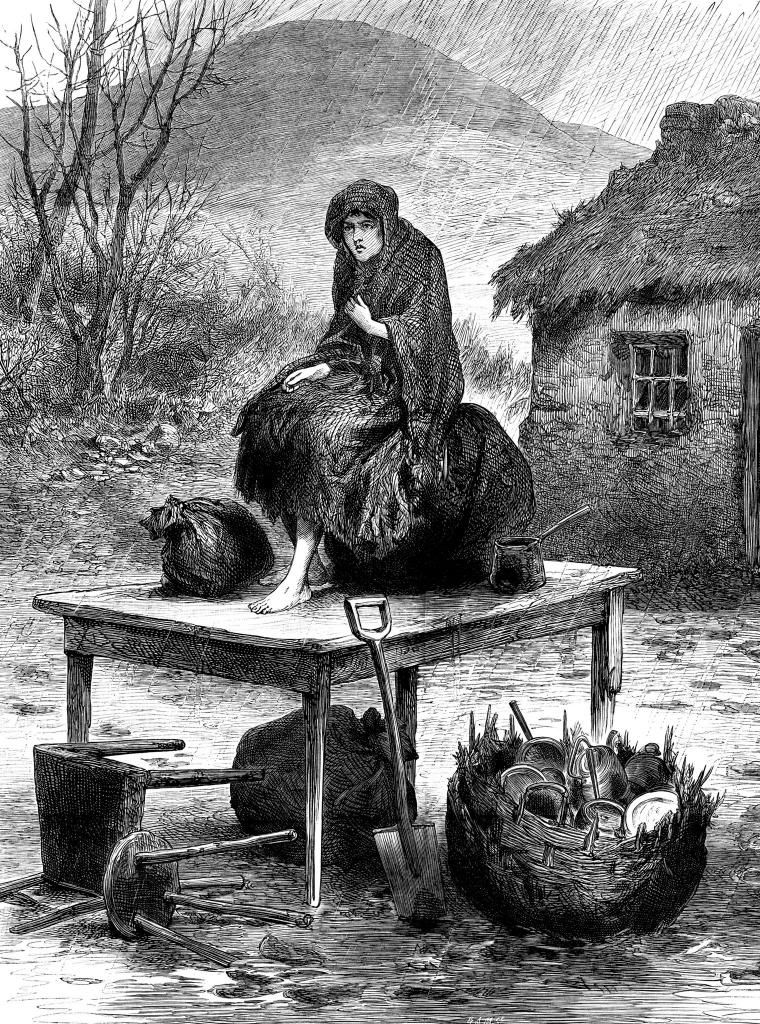


An Irish girl guarding her family’s last few possessions after eviction for nonpayment of rent, during the potato famine. A wood engraving from The Illustrated London News, April 1886. Credit Print Collector/Getty Images


IN advance of St. Patrick’s Day, I went time traveling, back to the 1840s and Ireland’s great famine. On one side of the Irish Sea was Victorian England, flush with the pomp and prosperity of the world’s mightiest empire. On the other side were skeletal people, dying en masse, the hollow-bellied children scrounging for nettles and blackberries.

A great debate raged in London: Would it be wrong to feed the starving Irish with free food, thereby setting up a “culture of dependency”? Certainly England’s man in charge of easing the famine, Sir Charles Trevelyan, thought so. “Dependence on charity,” he declared, “is not to be made an agreeable mode of life.”

And there I ran into Paul Ryan. His great-great-grandfather had fled to America. But the Republican congressman was very much in evidence, wagging his finger at the famished. His oft-stated “culture of dependency” is a safety net that becomes a lazy-day hammock. But it was also England’s excuse for lethal negligence.

There is no comparison, of course, between the de facto genocide that resulted from British policy, and conservative criticism of modern American poverty programs.

But you can’t help noticing the deep historic irony that finds a Tea Party favorite and descendant of famine Irish using the same language that English Tories used to justify indifference to an epic tragedy.

The Irish historian John Kelly, who wrote a book on the great famine, was the first to pick up on these echoes of the past during the 2012 presidential campaign. “Ryan’s high-profile economic philosophy,” he wrote then, “is the very same one that hurt, not helped, his forebears during the famine — and hurt them badly.”

What was a tired and untrue trope back then is a tired and untrue trope now. What was a distortion of human nature back then is a distortion now. And what was a misread of history then is a misread now.

Ryan boasts of the Gaelic half of his ancestry, on his father’s side. “I come from Irish peasants who came over during the potato famine,” he said last year during a forum on immigration.

BUT with a head still stuffed with college-boy mush from Ayn Rand, he apparently never did any reading about the times that prompted his ancestors to sail away from the suffering sod. Centuries of British rule that attempted to strip the Irish of their language, their religion and their land had produced a wretched peasant class, subsisting on potatoes. When blight wiped out the potatoes, at least a million Irish died — one in eight people.

“The Almighty, indeed, sent the potato blight, but the English created the famine,” wrote the fiery essayist John Mitchel, whose words bought him a ticket to the penal colony of Tasmania.

What infuriated Mitchel was that the Irish were starving to death at the very time that rich stores of grain and fat livestock owned by absentee landlords were being shipped out of the country. The food was produced by Irish hands on Irish lands but would not go into Irish mouths, for fear that such “charity” would upset the free market, and make people lazy.

Ryan’s running mate in 2012, Mitt Romney, made the Tory case with his infamous remark that 47 percent of Americans are moochers, “dependent upon government.” Part of that dependence, he said, extended to people “who believe that they are entitled to health care, to food, to housing, to you name it.” Food — the gall!

You can’t make these kinds of heartless remarks unless you think the poor deserve their fate — that they have a character flaw, born of public assistance. And there hovers another awful haunt of Irish history. In 2012, Ryan said that the network of programs for the American poor made people not want to work.

On Wednesday, he went further, using the language of racial coding. This, after he told a story of a boy who didn’t want his free school lunch because it left him with “a full stomach and an empty soul.” The story was garbage — almost completely untrue.

“We have this tailspin of culture, in our inner cities in particular, of men not working and just generations of men not even thinking about working or learning the value and the culture of work.” In other words, these people are bred poor and lazy.

Where have I heard that before? Ah, yes — 19th-century England. The Irish national character, Trevelyan confided to a fellow aristocrat, was “defective.” The hungry millions were “a selfish, perverse, and turbulent” people, said the man in charge of relieving their plight.

You never hear Ryan make character judgments about generations of wealthy who live off their inheritance, or farmers who get paid not to grow anything. Nor, for that matter, does he target plutocrats like Romney who might be lulled into not taking risks because they pay an absurdly low tax rate simply by moving money around. Dependency is all one-way.

“The whole British argument in the famine was that the poor are poor because of a character defect,” said Christine Kinealy, a professor of Irish studies and director of Ireland’s Great Hunger Institute at Quinnipiac University. “It’s a dangerous, meanspirited and tired argument.”

And it wasn’t true. The typical desperation scene of the famine was the furthest thing from a day in the hammock. Here’s what one Quaker relief agent, William Bennett, found in a visit to County Mayo in 1847:

“We entered a cabin. Stretched in one dark corner, scarcely visible from the smoke and rags that covered them, were three children huddled together, lying there because they were too weak to rise, pale and ghastly ... perfectly emaciated, eyes sunk, voice gone, and evidently in the last stage of actual starvation.”

For his role in the famine, Trevelyan was knighted. The Irish remember him differently. At Quinnipiac’s Great Hunger Museum hangs a picture of this English gentleman with a dedication: “For crimes against humanity, never brought to justice.”

Irish Alzheimer’s, goes the joke, is to forget everything but the grudges — in the case of the great famine, for good reason. What Alexis de Tocqueville called “the terrifying exactitude of memory” is burned into Ireland’s soil. But more than forgetting, Paul Ryan never learned.

A version of this op-ed appears in print on March 16, 2014, on page SR3 of the New York edition with the headline: Paul Ryan’s Irish Amnesia. Order Reprints|Today's Paper|Subscribe

So I guess it comes down to some basics about what you believe, even from your own family's history.

Shona, Lá Fhéile Pádraig!
 
Last edited:

wizards8507

Well-known member
Messages
20,660
Reaction score
2,661
Come on Bogs. Even the author of that article realizes he's spewing bullshit.

There is no comparison, of course, between the de facto genocide that resulted from British policy, and conservative criticism of modern American poverty programs... but I'm going to spend the rest of this article doing just that.
 
B

Bogtrotter07

Guest
Come on Bogs. Even the author of that article realizes he's spewing bullshit.

Where do you come up with such patronizing lines of text?

"I fear the famine in Ireland would not kill more than a million people, and that would scarcely be enough to do any good."

Nassau William Senior Advisor to the Chancellor of the Exchequer
Professor of Political Economy, Oxford University​

“We have this tailspin of culture, in our inner cities in particular, of men not working and just generations of men not even thinking about working or learning the value and the culture of work.” [/B]
Congressman Paul Ryan


"Almost everyone I’ve talked to says, ‘we're going to move to Houston.’"

Then she added, "What I’m hearing which is sort of scary is they all want to stay in Texas. Everyone is so overwhelmed by the hospitality.

"And so many of the people in the arena here, you know, were underprivileged anyway, so this--this (slight chuckle) is working very well for them."


Barbara Bush

Just as a primer for you. The above three statements, are very similar, even though the century, and the focus has changed, and even though they were spoken by different people, the sentiment is the same, and they are all true and correctly attributed statements. And they are all classist (and racist) beyond anything approaching the civilization we claim. Yes they are bull shit, and anyone who decries one who would call them out is full of bull shit, or worse.
 

RDU Irish

Catholics vs. Cousins
Messages
8,622
Reaction score
2,722
The person who introduced the term "conflation" to our community is conflating on a whole new level today.

Great Famine (Ireland) - Wikipedia, the free encyclopedia

While I wouldn't want well established historical facts to get in the way of your narrative:

"Although the potato crop failed, the country was still producing and exporting more than enough grain crops to feed the population. Records show during the period Ireland was exporting approximately thirty to fifty shiploads per day of food produce. "

"but neither body asked for charity, according to Mitchel. "They demanded that, if Ireland was indeed an Integral part of the realm, the common exchequer of both islands should be used—not to give alms, but to provide employment on public works of general utility."

Laws that restricted the rights of Irish Catholics (i.e. 80% of the Irish population)

In the 17th and 18th centuries, Irish Catholics had been prohibited by the penal laws from owning land, from leasing land; from voting, from holding political office; from living in a corporate town or within 5 mi (8.0 km) of a corporate town, from obtaining education, from entering a profession, and from doing many other things necessary for a person to succeed and prosper in Irish society at the time. The laws had largely been reformed by 1793, and in 1829, Irish Catholics could again sit in parliament following the Act of Emancipation.


Then the landlord/middleman/tenant structure was destined for abuse, which the Protestants were frankly OK with abusing since they were obviously morally superior to the dirty Catholics. See the Irish were second class citizens in their own country, it wasn't new for them when they moved to the US en masse.
 

RDU Irish

Catholics vs. Cousins
Messages
8,622
Reaction score
2,722
I think Haiti is a better illustration of the trouble of creating a dependency culture than 1840s Ireland.
 

RDU Irish

Catholics vs. Cousins
Messages
8,622
Reaction score
2,722
The Irish did not seek charity, they sought to keep more of the fruits of their labor and be enabled to provide for themselves.

If only this was more prevalent in our society today:

William Smith O'Brien, speaking on the subject of charity in a speech to the Repeal Association, February 1845, applauded the fact that the universal sentiment on the subject of charity was that they would accept no English charity. He expressed the view that the resources of this country were still abundantly adequate to maintain the population and that until those resources had been utterly exhausted, he hoped that there was no one in "Ireland who will so degrade himself as to ask the aid of a subscription from England".


So maybe you are slighting your ancestors by insisting we give more free stuff to non-working, able bodied individuals who are not only NOT starving but tend to be obese.
 

chicago51

Well-known member
Messages
3,658
Reaction score
387
However, one question for you, can you please provide me with one quote from Thomas Jefferson where he states that he believes in confiscating the wealth from one individual and giving it to another. Also please provide a source as I have noticed in the past that your sources of information are let's say suspect. Thanks.

Equality: Thomas Jefferson to James Madison

Jefferson writing to James Madison. We are currently operating under the Articles of Confederation Jefferson is an ambassador to France, where he is writing to Maddison from.

Basically is saying we should progressively tax property and also give any uncultivated lands to the unemployed.

28 Oct. 1785Papers 8:681--82
Seven o'clock, and retired to my fireside, I have determined to enter into conversation with you; this [Fontainebleau] is a village of about 5,000 inhabitants when the court is not here and 20,000 when they are, occupying a valley thro' which runs a brook, and on each side of it a ridge of small mountains most of which are naked rock. The king comes here in the fall always, to hunt. His court attend him, as do also the foreign diplomatic corps. But as this is not indispensably required, and my finances do not admit the expence of a continued residence here, I propose to come occasionally to attend the king's levees, returning again to Paris, distant 40 miles. This being the first trip, I set out yesterday morning to take a view of the place. For this purpose I shaped my course towards the highest of the mountains in sight, to the top of which was about a league. As soon as I had got clear of the town I fell in with a poor woman walking at the same rate with myself and going the same course. Wishing to know the condition of the labouring poor I entered into conversation with her, which I began by enquiries for the path which would lead me into the mountain: and thence proceeded to enquiries into her vocation, condition and circumstance. She told me she was a day labourer, at 8. sous or 4 d. sterling the day; that she had two children to maintain, and to pay a rent of 30 livres for her house (which would consume the hire of 75 days), that often she could get no emploiment, and of course was without bread. As we had walked together near a mile and she had so far served me as a guide, I gave her, on parting 24 sous. She burst into tears of a gratitude which I could perceive was unfeigned, because she was unable to utter a word. She had probably never before received so great an aid. This little attendrissement, with the solitude of my walk led me into a train of reflections on that unequal division of property which occasions the numberless instances of wretchedness which I had observed in this country and is to be observed all over Europe. The property of this country is absolutely concentered in a very few hands, having revenues of from half a million of guineas a year downwards. These employ the flower of the country as servants, some of them having as many as 200 domestics, not labouring. They employ also a great number of manufacturers, and tradesmen, and lastly the class of labouring husbandmen. But after all these comes the most numerous of all the classes, that is, the poor who cannot find work. I asked myself what could be the reason that so many should be permitted to beg who are willing to work, in a country where there is a very considerable proportion of uncultivated lands? These lands are kept idle mostly for the aske of game. It should seem then that it must be because of the enormous wealth of the proprietors which places them above attention to the increase of their revenues by permitting these lands to be laboured. I am conscious that an equal division of property is impracticable. But the consequences of this enormous inequality producing so much misery to the bulk of mankind, legislators cannot invent too many devices for subdividing property, only taking care to let their subdivisions go hand in hand with the natural affections of the human mind. The descent of property of every kind therefore to all the children, or to all the brothers and sisters, or other relations in equal degree is a politic measure, and a practicable one. Another means of silently lessening the inequality of property is to exempt all from taxation below a certain point, and to tax the higher portions of property in geometrical progression as they rise.[B] Whenever there is in any country, uncultivated lands and unemployed poor, it is clear that the laws of property have been so far extended as to violate natural right. The earth is given as a common stock for man to labour and live on. If, for the encouragement of industry we allow it to be appropriated, we must take care that other employment be furnished to those excluded from the appropriation. If we do not the fundamental right to labour the earth returns to the unemployed. It is too soon yet in our country to say that every man who cannot find employment but who can find uncultivated land, shall be at liberty to cultivate it, paying a moderate rent.[/B] But it is not too soon to provide by every possible means that as few as possible shall be without a little portion of land. The small landholders are the most precious part of a state.

Jefferson lived in an agriculture economy but based on what his writings you make the case he'd be in favor of strong antitrust laws protecting us from monopoly and oligopoly economies.

Jefferson saw a nation of independent farmers. If he had been around for the industrial revolution he probably would have envisioned a nation of small locally owned business and stores as his utopia.
 
Last edited:

Whiskeyjack

Mittens Margaritas Ante Porcos
Staff member
Messages
20,894
Reaction score
8,126
There is no perfect system. Clearly democracy fails. Democracy is a pacified mob.

I wonder if your friend is familiar with the Scottish lawyer and historian Alexander Tytler.

We should have no faith in democracy because it assumes every man thinks equally well and that clearly is NOT the case in our collective experience.

I attended a lecture by (ND prof) Pat Deneen on this very subject last week. The ancient Greek concept of education, later organized by Catholic universities into the "liberal arts", focused on teaching young elites about virtue, so that they would eventually wield their votes responsibly as trustees of their city-states. It was, in short, about teaching kids how to think, so they could eventually become effective leaders.

America has chosen instead to follow John Dewey's miserably utilitarian model, which is why we now have the STEM-focused Common Core standards, a slavish attachment to standardized testing, etc. We no longer care about producing virtuous citizens; only useful cogs in the machinery of global capitalism.

It also assumes tabula rasa, which again, just doesn't fit with the reality of experience....we aren't born equal and we aren't reared equally and we don't have equal opportunities, so some of us do better and others do more poorly.

Tocqueville discussed this at length-- that when put to the test, Americans will always choose Equality over Liberty, because inequality is deeply offensive to a (small "d") democratic people.

So ultimately, Democracy is a mob voting to panderers to give them what they want. That will always and ultimately end in self annihilation as the do-nots and takers eventually reach a critical mass and all "progress" is halted in the government giving you everything you need to do nothing, from the work of the few raised to work hard.

I'm skeptical of this last bit because it smacks of the "Takers v. Makers" narrative that Romney tried to sell during his presidential bid. There's a vast expanse of workers-- teachers, tradesmen, janitors, etc.-- that don't really fit into that dichotomy; they're not "building" something in the same sense as a small business owner, but they're also not welfare queens. They're just working hard and trying to make ends meet. The GOP's failure to speak to such people and their needs has been a major reason for its lack of recent national appeal.

And speaking of that vast expanse of workers, they are the ones most at risk in the upcoming Automation Revolution-- Bill Gates: Yes, robots really are about to take your jobs.
 

MJ12666

New member
Messages
794
Reaction score
60


Equality: Thomas Jefferson to James Madison

Jefferson writing to James Madison. We are currently operating under the Articles of Confederation Jefferson is an ambassador to France, where he is writing to Maddison from.

Basically is saying we should progressively tax property and also give any uncultivated lands to the unemployed.


Jefferson lived in an agriculture economy but based on what his writings you make the case he'd be in favor of strong antitrust laws protecting us from monopoly and oligopoly economies.

Jefferson saw a nation of independent farmers. If he had been around for the industrial revolution he probably would have envisioned a nation of small locally owned business and stores as his utopia.


Thomas Jefferson also said the following:

"A wise and frugal Government, which shall restrain men from injuring one another, which shall leave them otherwise free to regulate their own pursuits of industry and improvement, and shall not take from the mouth of labor the bread it has earned. This is the sum of good government, and this is necessary to close the circlue of our felicities."

and

“To compel a man to furnish funds for the propagation of ideas he disbelieves and abhors is sinful and tyrannical.”

and

The democracy will cease to exist when you take away from those who are willing to work and give to those who would not.

He also detested the thought of the government going into debt and interfering with private industry.
 
B

Bogtrotter07

Guest
The person who introduced the term "conflation" to our community is conflating on a whole new level today.

Great Famine (Ireland) - Wikipedia, the free encyclopedia

While I wouldn't want well established historical facts to get in the way of your narrative:

"Although the potato crop failed, the country was still producing and exporting more than enough grain crops to feed the population. Records show during the period Ireland was exporting approximately thirty to fifty shiploads per day of food produce. "

"but neither body asked for charity, according to Mitchel. "They demanded that, if Ireland was indeed an Integral part of the realm, the common exchequer of both islands should be used—not to give alms, but to provide employment on public works of general utility."

Laws that restricted the rights of Irish Catholics (i.e. 80% of the Irish population)

In the 17th and 18th centuries, Irish Catholics had been prohibited by the penal laws from owning land, from leasing land; from voting, from holding political office; from living in a corporate town or within 5 mi (8.0 km) of a corporate town, from obtaining education, from entering a profession, and from doing many other things necessary for a person to succeed and prosper in Irish society at the time. The laws had largely been reformed by 1793, and in 1829, Irish Catholics could again sit in parliament following the Act of Emancipation.


Then the landlord/middleman/tenant structure was destined for abuse, which the Protestants were frankly OK with abusing since they were obviously morally superior to the dirty Catholics. See the Irish were second class citizens in their own country, it wasn't new for them when they moved to the US en masse.

We could do this :

There is no conflation in what I say.

Many books including Paddy's Lament, and other documents show that grains and cattle to feed over 12,000,000 a year were being shipped out of Ireland at the time of the famine, under armed guard. (80 British Regiments - regulars)

The foodstuffs were produced by the absentee Irish landlords who were mostly English or Scottish. They were then shipped out under armed guard so the starving underclasses didn't intercept them.

These were used to feed other British colonies and outposts like Gibraltar, that couldn't produce food for themselves.

The real reason none of this food was used to save the Irish underclass farmers is because the English didn't want to "disrupt" the free market balance of trade that was working well for the English merchants.

The reason given by the English was because they didn't want to "build a charity dependent class." And false rumors that the Irish didn't want charity were circulated. These were lies perpetrated by those engineering the genocide. (It was opportunistic genocide.) Any one that believed or still believes these lies is stupid, ignorant, or sociopathic.

The reason that so many Irish died is because the actual Irish who remained true to their customs and traditions, were pushed down to the role of a sharecropper. Farms were divided into 20 acre plots, a farmer was given one acre to provide for his family for the year, and the other 19 were the landlord's harvest. Potatoes were one of the few crops that had the nutrient value to sustain a family, and their pig, or two, for the year. It could be stored through the winter with relatively little spoilage.

When the crop failed no one did anything to help these people. When the farmers could no longer work the fields the landlords sent well nourished men around with sledges to knock the farmers houses down regardless of whether someone was living inside or not.

The starvation, An Gota Mor began exclusively with the underclass. And it hit hard. These people were the backbone of the Irish Labor force, and desperately wanted to continue working. However, due to hunger, actual acute starvation, they could not work. The British argued against providing them any but minimal help. A thousand things could have been done to save the population, but none were.

Of roughly 8 million, over 2 died and another 2.5 left their home on unsafe or unsanitary boats. Of that 2.5 over 25 percent, or 625 thousand died en route. For its time it was as immoral as the holocaust, and just as lethal. There is no doubt that the British used this natural phenomena to starve population and depopulate the island.

The idea that one should withhold charity because of a moral imperative to allow a person to do for themselves, (or die trying), is false logic of a seriously monstrous being that is of itself entirely immoral. Every time. When someone is dying of starvation, you feed them; when someone is dying of thirst, you give them drink; when someone has little or no opportunity, you raise them up.

Now I know that some of you are of limited enough capacity that you think we are still in a place and time that one person has to compete against another, for a better job, or food. That is no longer true with technology. So perpetrating that old Calvinistic (bull shit) dogma about the sanctity of work, and that those that work hard enough to succeed will have plenty, and the rest will get their just deserts, is no longer just stupid. It is today, in and of itself immoral. Sorry, no conflation, just facts.
 
B

Bogtrotter07

Guest
The Irish did not seek charity, they sought to keep more of the fruits of their labor and be enabled to provide for themselves.

If only this was more prevalent in our society today:

William Smith O'Brien, speaking on the subject of charity in a speech to the Repeal Association, February 1845, applauded the fact that the universal sentiment on the subject of charity was that they would accept no English charity. He expressed the view that the resources of this country were still abundantly adequate to maintain the population and that until those resources had been utterly exhausted, he hoped that there was no one in "Ireland who will so degrade himself as to ask the aid of a subscription from England".


So maybe you are slighting your ancestors by insisting we give more free stuff to non-working, able bodied individuals who are not only NOT starving but tend to be obese.

During the 18th century, a new system for managing the landlord's property was introduced in the form of the "middleman system". Rent collection was left in the hands of the landlords' agents, or middlemen. This assured the (usually Protestant) landlord of a regular income, and relieved them of any responsibility; the tenants however were then subject to exploitation through these middlemen.

Catholics made up 80% of the population, the bulk of whom lived in conditions of poverty and insecurity despite Catholic emancipation in 1829. At the top of the "social pyramid" was the "ascendancy class", the English and Anglo-Irish families who owned most of the land, and who had more or less limitless power over their tenants. Some of their estates were vast: the Earl of Lucan owned over 60,000 acres (240 km2). Many of these landlords lived in England and were called "absentee landlords". The rent revenue was sent to England,[15] collected from "impoverished tenants" paid minimal wages to raise crops and livestock for export.[16]

In 1843, the British Government considered that the land question in Ireland was the root cause of disaffection in the country. They set up a Royal Commission, chaired by the Earl of Devon, to enquire into the laws with regard to the occupation of land in Ireland. Daniel O'Connell described this commission as perfectly one-sided, being made up of landlords and no tenants.[17] Devon in February 1845 reported that "It would be impossible adequately to describe the privations which they [Irish labourer and his family] habitually and silently endure . . . in many districts their only food is the potato, their only beverage water . . . their cabins are seldom a protection against the weather... a bed or a blanket is a rare luxury . . . and nearly in all their pig and a manure heap constitute their only property." The Commissioners concluded that they could not "forbear expressing our strong sense of the patient endurance which the labouring classes have exhibited under sufferings greater, we believe, than the people of any other country in Europe have to sustain."


Here is a concise depiction of the social strata that the British achieved in Ireland prior to the Great Starvation. These are the people you are speaking of, (the lower class, Catholics) that paid, and of course all the quotes you muster, those that preferred no charity were part of the top 20 percent.

Ironically, these quotes were true until disease became so prevalent until the upper classes begged Britain for immediate relief. The dirt and disease from corpses lying unburied, as well as a sick population, spread the death beyond the class boundaries!
 
Last edited:
B

Bogtrotter07

Guest
Thomas Jefferson also said the following:

"A wise and frugal Government, which shall restrain men from injuring one another, which shall leave them otherwise free to regulate their own pursuits of industry and improvement, and shall not take from the mouth of labor the bread it has earned. This is the sum of good government, and this is necessary to close the circlue of our felicities."

and

“To compel a man to furnish funds for the propagation of ideas he disbelieves and abhors is sinful and tyrannical.”

and

The democracy will cease to exist when you take away from those who are willing to work and give to those who would not.

He also detested the thought of the government going into debt and interfering with private industry.

I always want to ask someone who pulls any of the founding fathers quotes out of context to make their own points, (usually tea party or libertarian) what the founding fathers would have said about people who worked hard and were not given any chance to succeed or get ahead like the Irish.

Oh, snap! They decided that for all of their trouble they wouldn't get to vote and some would be counted as three-fifths a person! (Just a point on the context of the founding fathers, and a problem with those that cannot think for themselves.)
 
B

Bogtrotter07

Guest
I wonder if your friend is familiar with the Scottish lawyer and historian Alexander Tytler.


I attended a lecture by (ND prof) Pat Deneen on this very subject last week. The ancient Greek concept of education, later organized by Catholic universities into the "liberal arts", focused on teaching young elites about virtue, so that they would eventually wield their votes responsibly as trustees of their city-states. It was, in short, about teaching kids how to think, so they could eventually become effective leaders.

America has chosen instead to follow John Dewey's miserably utilitarian model, which is why we now have the STEM-focused Common Core standards, a slavish attachment to standardized testing, etc. We no longer care about producing virtuous citizens; only useful cogs in the machinery of global capitalism.


Tocqueville discussed this at length-- that when put to the test, Americans will always choose Equality over Liberty, because inequality is deeply offensive to a (small "d") democratic people.


I'm skeptical of this last bit because it smacks of the "Takers v. Makers" narrative that Romney tried to sell during his presidential bid. There's a vast expanse of workers-- teachers, tradesmen, janitors, etc.-- that don't really fit into that dichotomy; they're not "building" something in the same sense as a small business owner, but they're also not welfare queens. They're just working hard and trying to make ends meet. The GOP's failure to speak to such people and their needs has been a major reason for its lack of recent national appeal.

And speaking of that vast expanse of workers, they are the ones most at risk in the upcoming Automation Revolution-- Bill Gates: Yes, robots really are about to take your jobs.

Which is the crowning point.

Man is not here to work. Slavery accomplishes that.

Man is here to bring society to a new level of being. This includes producing, therefor production, but it also includes individual utilization, and other aspects important to society.

There is a consciousness to social systems. I have seen it several times in my life. Civil rights, women's rights, and now with gay rights. Every time society has become more productive, and more inclusive. We have invented machines that can do most of our work, (or the work that was deemed productive 75 or 50 years ago. So then our purpose lies beyond.
 

Veritate Duce Progredi

A man gotta have a code
Messages
9,358
Reaction score
5,352
I wonder if your friend is familiar with the Scottish lawyer and historian Alexander Tytler.


I attended a lecture by (ND prof) Pat Deneen on this very subject last week. The ancient Greek concept of education, later organized by Catholic universities into the "liberal arts", focused on teaching young elites about virtue, so that they would eventually wield their votes responsibly as trustees of their city-states. It was, in short, about teaching kids how to think, so they could eventually become effective leaders.

America has chosen instead to follow John Dewey's miserably utilitarian model, which is why we now have the STEM-focused Common Core standards, a slavish attachment to standardized testing, etc. We no longer care about producing virtuous citizens; only useful cogs in the machinery of global capitalism.


Tocqueville discussed this at length-- that when put to the test, Americans will always choose Equality over Liberty, because inequality is deeply offensive to a (small "d") democratic people.


I'm skeptical of this last bit because it smacks of the "Takers v. Makers" narrative that Romney tried to sell during his presidential bid. There's a vast expanse of workers-- teachers, tradesmen, janitors, etc.-- that don't really fit into that dichotomy; they're not "building" something in the same sense as a small business owner, but they're also not welfare queens. They're just working hard and trying to make ends meet. The GOP's failure to speak to such people and their needs has been a major reason for its lack of recent national appeal.

And speaking of that vast expanse of workers, they are the ones most at risk in the upcoming Automation Revolution-- Bill Gates: Yes, robots really are about to take your jobs.

This statement was made only in reference to those who have no motivation to work. I understand it's a blanket statement but time will tell if it's prescient.

The rest of your post was informative, I'll be reading your links tonight.
 

Veritate Duce Progredi

A man gotta have a code
Messages
9,358
Reaction score
5,352
Which is the crowning point.

Man is not here to work. Slavery accomplishes that.

Man is here to bring society to a new level of being. This includes producing, therefor production, but it also includes individual utilization, and other aspects important to society.

There is a consciousness to social systems. I have seen it several times in my life. Civil rights, women's rights, and now with gay rights. Every time society has become more productive, and more inclusive. We have invented machines that can do most of our work, (or the work that was deemed productive 75 or 50 years ago. So then our purpose lies beyond.

I don't necessarily disagree with this but I'm interested in hearing this continued. What is the purpose of man? How is it being redefined with greater automation in society?
 

chicago51

Well-known member
Messages
3,658
Reaction score
387
Thomas Jefferson also said the following:

"A wise and frugal Government, which shall restrain men from injuring one another, which shall leave them otherwise free to regulate their own pursuits of industry and improvement, and shall not take from the mouth of labor the bread it has earned. This is the sum of good government, and this is necessary to close the circlue of our felicities."

and

He also detested the thought of the government going into debt and interfering with private industry.

What does government helping the poor have to with massive deficits? We had low deficits in the 90s, 70s, 60s, and 50s with programs for the poor.

The democracy will cease to exist when you take away from those who are willing to work and give to those who would not.

How many of the unemployed do you really think don't want to work?

What about all the poor that do work?

The working poor out numbers the unemployed.

Majority of food stamp recipients are children? What work would you have the children do?

SNAP cost a $50k worker about $77.00 a year, long term unemployment $23. There are mayny larger more wasteful programs in the federal budget than programs for the poor.
 
Last edited:

chicago51

Well-known member
Messages
3,658
Reaction score
387
Which is the crowning point.

Man is not here to work. Slavery accomplishes that.

Man is here to bring society to a new level of being. This includes producing, therefor production, but it also includes individual utilization, and other aspects important to society.

There is a consciousness to social systems. I have seen it several times in my life. Civil rights, women's rights, and now with gay rights. Every time society has become more productive, and more inclusive. We have invented machines that can do most of our work, (or the work that was deemed productive 75 or 50 years ago. So then our purpose lies beyond.

I don't see anything wrong with being a post work society.

When machines start taking all jobs there is nothing wrong with being a leisure society.
 
Top