
IrishJayhawk
Rock Chalk
- Messages
- 7,181
- Reaction score
- 464
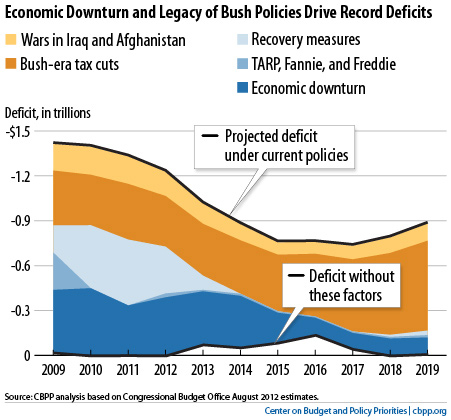
If the bottom graph is the preferred,,, GWB's doesn't look all that bad...
The massive spike at the end is during his tenure.

If the bottom graph is the preferred,,, GWB's doesn't look all that bad...

GDP is calculated as C + I + G + (Ex - Im); where C = consumer spending, I = business investment, G = government spending, and the last part is the imbalance of exported good value - imported good. I tend to agree with Buster about the ratio of debt to GDP is way more important than the debt amount; but what is more important (from what I learned from my ND MBA as a source) is the deficit to GDP ratio makes a bigger difference when it comes to money supply decisions and more importantly credit ratings.
The interesting contrast in that chart when you look at GWB vs Obama's terms is interesting from what you observe in the graph to what really was/is happening. For good or for bad, "G" in the equation is very important and generally the biggest driver. Bush's ratio look better because we had high government spending with lower taxes - a good formula for GDP. This was largely driven by war expenses - and early in his term the low taxes gave consumers more discretionary income to spend. However, the deficit soared, greed expanded with businesses causing speculation bubbles, and this model wasn't sustainable ==> huge recession.
In comes Obama during this big recession and spent a ton of government money in sub-optimal ways to stimulate the economy. And by sub-optimal, to save business and banks, those dollars spent had a low 're-cycle' rate. The Fed tightened the money supply to control inflation and hopefully lend more - but that didn't happen. The banks took the cheap money but didn't pass it along to businesses and consumers ==> lower C and I ==> bad for GDP. Then the Republican congress came in and fought over spending on principle which led to the still existing sequester ==> lower G. So for a lot of Obama's term we had a drop in G, C, and I which is probably why you see the steep slope on that chart the past few years.
Despite this the deficit is shrinking as the economy rebound and is a main reason things feel more stable.
Another very interesting point I learned in school is about the recycling of $. Very wealthy people (net worth over $10M) only spend $0.17 of every $1 they earn. This is because they usually earn way more than it costs to live (food, housing, discretionary, etc.) and they save, passively invest, or hid the rest of it. This isn't good for the economy because of I and C are driven by re-investment into good and services. Conversely, lower income people (earning <$60K per year) spend over $0.90 on every $1 earned. So to help grow the economy (GDP), it makes more sense to me that G gives more to lower income people than high wealth individuals. Granted it isn't that simple when you look at specific instances, but as a general theory this is where I land and why I don't think "trickle down economics" make much sense.
Again, this is over-simplified, but I hope it helps someone understand why economics and economic theories are difficult; and snapshots and graphs only show results, but explain little. Like how I think Bush's better looking graph actually is a driver for Obama's poor looking section.


Krugman is a fool Paul Krugman Crosses the Line | naked capitalism

Krugman is a fool Paul Krugman Crosses the Line | naked capitalism

More like Bernie has absolutely no substance to any of his bullsh*t and gets by on good-sounding nothingness that makes literally no sense once you break it down.
#FeelTheBern
(CNN)Bernie Sanders won the Wyoming Democratic caucuses Saturday, providing his campaign with one more jolt of momentum before the race against Hillary Clinton heads east.
The Vermont senator was favored going into the caucuses. Wyoming is similar to other places he's won with big margins: rural, Western and overwhelmingly white. The victory is Sanders' eighth win out of the last nine contests -- including a contest that counted the votes of Democrats living abroad -- and a big morale booster heading into the crucial New York primary on April 19.
Sanders, speaking at a rally in Queens, New York, when the state's results were projected, announced the victory to his supporters after his wife, Jane, joined him on stage to say they had won.
"News bulletin: We just won Wyoming," Sanders said as the room exploded into cheers.
Sanders won 55.7% of the vote to Clinton's 44.3%, giving each candidate seven delegates. That helps Clinton maintain her pledged delegate lead over Sanders, 1,304 to 1,075.
Lansing, Michigan (CNN)Ted Cruz suffered a rare convention loss Saturday after delegates backing John Kasich and Donald Trump boxed him out of key positions in the Michigan delegation.
The Texas senator's campaign ran eight delegates for eight committee spots and lost every one, alleging it was "double-crossed" by Kasich supporters.
The Michigan delegation picked one Trump supporter, Matt Hall, and one Kasich supporter, Judi Schwalbach, for the two seats on the powerful rules committee. The Cruz campaign lost votes for both seats.
The rules committee seats have become highly coveted prizes for their role in shaping a contested convention in Cleveland. After the delegates are selected in each state, they meet as a group and pick the members of four convention committees, the most important of which is the rules committee, which will ultimately decide who can be nominated president.
Michigan Cruz leader Saul Anuzis said they were "double-crossed" by Kasich's campaign. The Kasich delegates were supposed to vote with Cruz delegates, he said, but switched sides and voted with Trump behind closed doors Saturday afternoon.
7 things you need to know about a contested convention
Kasich's delegate director in Michigan, Jeff Timmer, said the Cruz campaign broke their end of the deal when they tried to win all eight delegation seats.
He said they finished their slate of Trump and Kasich candidates about 10 minutes before walking into the delegation meeting.
"The Cruz campaign tried a takeover and they failed miserably," Timmer said. "It backfired and they ended up with nothing. There's been all these reports about how they're out-organizing everybody. Not here."
Trump's national delegate director, Brian Jack, called it a "big win" for Trump.
"The most important votes occurred this afternoon -- we went 5-0. Five delegates for Mr. Trump ran for committee assignments; all five were elected," Jack said.
He added, "This was a big win for Team Trump. We won 25 delegates from Michigan last month, and now, at least 25 supporters of Mr. Trump will be delegates to the Republican National Convention."
Much of the focus in the delegate battle has been on the sheer numbers of delegates themselves, with Cruz outgunning Trump in states like Louisiana and Colorado. But the delegations themselves -- usually an afterthought -- have become battlegrounds on the path to an expected convention fight in Cleveland.
What happened the last time Republicans faced a contested convention
Trump and Cruz had formed an alliance behind the scenes to deny Kasich the seats needed to get himself even nominated in Cleveland, but the skirmish in Michigan marked an apparent shift in alliances.
...
Colorado Springs, Colorado (CNN)Ted Cruz on Saturday clinched the support of every pledged delegate in Colorado, capturing all of the final 13 delegates who will go to the national convention in July and demonstrating his organizational strength in the all-important delegate race.
Even though voters didn't head to the polls Saturday, Cruz's strength here could help deny Donald Trump the 1,237 delegates that he needs to clinch the nomination.
Cruz's victory Saturday, combined with delegates he had already earned, hands him 30 of the 37 delegates across the state who are legally bound to support him on the first ballot at the convention, along with four other delegates who gave him verbal commitments of support.
...
The Revolt of the Activists: The McGovern-Fraser Reforms
The 1968 Democratic convention was among the most contentious party meetings in history, and dissatisfaction with its results provided motivation for the reforms that changed the nomination system and led to the rise of the current primary-dominated system. In 1968, as was customary, most Democratic convention delegates were selected in caucuses of party functionaries. Such caucuses were generally not well publicized, and were sometimes held more than a year before the convention.
In 1968, the majority of delegates selected in Democratic caucuses supported Vice President Humphrey who, by virtue of his position within the Johnson Administration, was perceived as a candidate who would continue American involvement in the Vietnam War. Meanwhile, two anti-war candidates, Senators Eugene McCarthy and Robert F. Kennedy, together won over two-thirds of the votes cast in Democratic primaries. Humphrey, who contested no primaries, nevertheless won the nomination. The system had produced a candidate who did not reflect the views of activists, particularly on the issue of the Vietnam War, and the convention was acrimonious.
Pressure from party activists at the convention resulted in the creation of the McGovern-Fraser Commission, which proceeded to rewrite the party's roles between 1969 and 1970. The Commission mandated that all national convention delegates had to be chosen in forums that were open to all party members and conducted within the calendar year of the election. States holding primaries had to place the names of qualified candidates on the ballot, and the distribution of convention delegates would be proportional, in order to reflect the results of such primaries. Prior to the reforms, many states held delegate primaries in which the names of delegates, but not of candidates, appeared on the ballot. In many other states, primaries were advisory only-so-called "beauty contests" that had no bearing on the distribution of convention delegates. In addition, the Commission gave the party the means to enforce the new roles by centralizing control over the certification of delegates within the national party organization.(6)
The most obvious consequence of the McGovern-Fraser Commission has been an increase in the number of states holding primaries. The number of states with Democratic primaries grew from 17 in 1968, to 23 in 1972, to 40 in the year 2000. The number of states holding Republican primaries increased from 16 in 1968, to 22 in 1972, to 43 in 2000. Not surprisingly, reforms have led to increased popular participation in the nominating process. In 1968, only 13 million Americans participated in the nominating process, while in 2000, over 30 million Americans voted in primaries or took part in caucuses.(7)
The deficit is a tricky thing to discuss because its very dependent on a number of issues. However, almost everyone used to agree that the budget should be balanced. This was last achieved when the Republicans took over the House at the end of the Clinton administration.
At some point, possibly during the Gulf War, the Republicans simply stopped trying to balance the budget. I think they wanted to fund the war without raising taxes.
However, to pretend that the Democrats are any different is pretty naive. The budgets they have been proposing lately are not even close to balanced, and the programs they favor are unfundable. Everything is justified by shriking the military, but even if that would work, they aren't waiting until it happens to spend.
So, IMO, you are just picking a team and sticking with their story if you think either side id fiscally responsible. The only question is, do you want the military or social programs to bankrupt us?


Everyone in here is yapping about the con artist, lyin' Ted, Hillary the criminal, and the socialist and I'm over here looking at the only hope left....
The Secret Movement to Draft General James Mattis for President - The Daily Beast
An anonymous group of conservative billionaires is ready to place their bets on a man dubbed “Mad Dog,” hoping to draft him into the presidential race to confront Donald Trump.
How Gen. James Mattis could become the unlikeliest U.S. president in history
“Mattis is almost so good that this election might not deserve him.”


Unless of course such a farce led to wide ranging reforms in which case it would be well worth one disastorous election to reform a broken system.

Everyone in here is yapping about the con artist, lyin' Ted, Hillary the criminal, and the socialist and I'm over here looking at the only hope left....
The Secret Movement to Draft General James Mattis for President - The Daily Beast
An anonymous group of conservative billionaires is ready to place their bets on a man dubbed “Mad Dog,” hoping to draft him into the presidential race to confront Donald Trump.
How Gen. James Mattis could become the unlikeliest U.S. president in history
“Mattis is almost so good that this election might not deserve him.”
Hmm. A retired general named "Mad Dog" with back room secret support from a group of desperate billionaire republicans. I don't know anything about this guy, but the circumstances alone are enough to give a guy pause. Pass!
Hmm. A retired general named "Mad Dog" with back room secret support from a group of desperate billionaire republicans. I don't know anything about this guy, but the circumstances alone are enough to give a guy pause. Pass!

http://www.nytimes.com/2016/04/08/o...lick&contentCollection=Opinion&pgtype=article
A blistering article from avowed leftist and economics Nobel laureate Paul Krugman. Krugman has been rather critical of the issues with Sanders' economic policy during this election cycle, but he really takes it a step further this time talking about how his campaign as a whole is really going off the rails.
Draw your own conclusions, but Bernie's economic illiteracy is a complete disqualifier for me, and moreover he seems to be inching closer and closer to being the yin to Trump's yang. He's hard to even take seriously right now.
How dare you suggest this is fueled by Trump. He's just telling it like it is.
Yes. Donald Trump is obviously responsible for teen kids saying cruel things to other teens. This NEVER happened before Trump came along....


