Politics

Politics

  • Obama

    Votes: 4 1.1%
  • Romney

    Votes: 172 48.9%
  • Other

    Votes: 46 13.1%
  • a:3:{i:1637;a:5:{s:12:"polloptionid";i:1637;s:6:"nodeid";s:7:"2882145";s:5:"title";s:5:"Obama";s:5:"

    Votes: 130 36.9%

  • Total voters
    352

Legacy

New member
Messages
7,871
Reaction score
321
So you are saying in Wichita a single person can live comfortably on minimum wage without even working 60 hours per week on two jobs? Sounds to me like we should lower it, not raise it. Why bother with college if you can make $15/hour with no skills? Sure would be nice for the couch jockeys to have more X box time if they could work 20 hours instead of 40 to pay their rent and electric.

Well established that most Americans do not STAY in poverty, most work their way out on their own. I also doubt those "stuck" there today would work their way out at $15/hour. More likely they work less by choice as their highest personal utility is realized eating Cheetos on the couch.

How did you come to that conclusion? Real wage growth for the lowest as well as the middle class percentiles over the last twenty to forty years has decreased. I also pointed out that costs of living exceed wages even in Wichita which represents one of the best places for that. I also compared the cost of living indices for a KC suburb,Overland Park (119) to Wichita (86), which a state or independent commission would need to take into consideration. If one wants people to get off state and federal programs, contribute to the tax base and escape poverty, you would be a proponent of raising the minimum wage.
 

Irish YJ

Southsida
Messages
25,888
Reaction score
1,444
https://www.foxnews.com/media/aoc-decolonization-puerto-rico
AOC supports the 'decolonization process' of Puerto Rico following governor's resignation

For once I agree with AOC. It's time to leave PR and let them be independent. They don't pay federal income taxes anyway, so let them be free to fend for themselves. Corruption is rampant, and finance mismanagement has been completely off the hook crazy for a long time.
 

NorthDakota

Grandson of Loomis
Messages
15,706
Reaction score
6,013
Delaney...Hickenlooper...and LMAO...Bullock are the stars of the debate.

Bernie got rekt by Delaney very badly and repeatedly.

I wouldn't vote for those three guys..but they all seem like good guys.
 

NorthDakota

Grandson of Loomis
Messages
15,706
Reaction score
6,013
https://www.foxnews.com/media/aoc-decolonization-puerto-rico
AOC supports the 'decolonization process' of Puerto Rico following governor's resignation

For once I agree with AOC. It's time to leave PR and let them be independent. They don't pay federal income taxes anyway, so let them be free to fend for themselves. Corruption is rampant, and finance mismanagement has been completely off the hook crazy for a long time.

Yes. Cut Puerto Rico loose. They are capable of managing themselves.
 

RDU Irish

Catholics vs. Cousins
Messages
8,627
Reaction score
2,732
How did you come to that conclusion? Real wage growth for the lowest as well as the middle class percentiles over the last twenty to forty years has decreased. I also pointed out that costs of living exceed wages even in Wichita which represents one of the best places for that. I also compared the cost of living indices for a KC suburb,Overland Park (119) to Wichita (86), which a state or independent commission would need to take into consideration. If one wants people to get off state and federal programs, contribute to the tax base and escape poverty, you would be a proponent of raising the minimum wage.

"Growth decreased" so you saying it still grew.

And it is so well established that it is not even worth linking that Americans are upwardly mobile - those in the bottom fifth do not stay in the bottom fifth. Those that do are by far the exception, not the rule.

Show up on time and sober and you will not make minimum wage for long. I prefer the most marginal in the work force to get a chance to prove they can do just this rather than being priced out of bagging groceries or mopping a floor.
 

Legacy

New member
Messages
7,871
Reaction score
321
Two-thirds of Americans favor raising federal minimum wage to $15 an hour
(Pew, July 30, 2019)

By a wide margin, Americans say they favor raising the federal minimum wage to $15 an hour. But there is a deep partisan divide in views of this proposed policy – a version of which recently passed the Democratic-controlled House of Representatives, though it is unlikely to be taken up by the GOP-controlled Senate.

Two-thirds of Americans (67%) support raising the minimum wage to $15 an hour, including 41% who say they strongly favor such an increase, according to a Pew Research Center survey conducted this spring.

Large majority of Democrats favor increasing the federal minimum wageDemocrats and Democratic-leaning independents are largely united in backing a $15 an hour federal minimum wage: 86% favor this, including nearly six-in-ten (59%) who say they strongly support it.

Republican opinion on this issue is more divided, but a majority of Republicans and Republican leaners – 57% – oppose raising the minimum wage to $15 an hour, including nearly three-in-ten (29%) who say they are strongly against it.

The current federal minimum wage is $7.25 an hour, though many states have higher minimum wages.

Large majorities of women, blacks and Hispanics favor raising the minimum wageMajorities of women and men, whites, blacks and Hispanics favor increasing the federal minimum wage to $15 an hour, though there are demographic differences in how widespread support for this policy is.

Women are more likely than men to support raising the federal minimum wage to $15 an hour (72% vs. 61%, respectively). About nine-in-ten black Americans (93%) support this increase – including 80% who express strong support – compared with about three-quarters of Hispanics (73%) and six-in-ten whites.

There is a stark ideological gap in support for a $15 federal minimum wage among Republicans. Conservative Republicans oppose an increase by more than two-to-one (69% vs. 30%), but a majority of moderate and liberal Republicans (59%) favor such an increase.

In contrast, there are more modest ideological differences on this issue among Democrats. Overwhelming majorities of both liberal Democrats (91%) and conservative and moderate Democrats (82%) favor raising the minimum wage to $15 an hour, but liberal Democrats are substantially more likely to say they strongly favor this policy (68% vs. 51%).

Majorities across all income levels favor a $15 federal minimum wage. Nearly three-quarters (74%) of those with annual family incomes of less than $40,000 favor this increase, as does a narrower majority of those with family incomes of $75,000 or more (61%).

At least eight-in-ten Democrats across all income levels back this increase. In contrast, lower-income Republicans are more likely than those with higher incomes to support this proposal: 56% of Republicans with annual incomes of less than $40,000 say they favor raising the federal minimum wage to $15 an hour, compared with 34% of Republicans with incomes of $75,000 or more.
 
Last edited:

Legacy

New member
Messages
7,871
Reaction score
321
They'll favor the pay raise until they realize they dont have a job anymore.

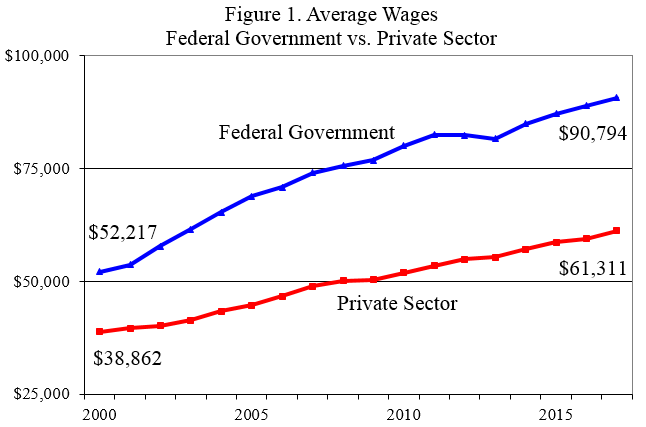
Federal employees have it much, much better. They get paid more and have better benefits. Pensions are eating up a larger share of federal costs while total federal employment has remained the same since February 1968 (2.8 million). So, if minimum wage people at $7.25/hr could just navigate the hiring process and become federal workers....

All Employees: Government: Federal (St. Louis Fed) - An interactive chart of historical totals for fed gov employee totals.

Pension costs over time.
usgs_chart2p71.png


Average wage - Federal v private sector workers
downsizing-govt-fed-worker-pay-figure-1.png


But switching to federal jobs is not realistic for most and is borderline poverty level so they don't pay taxes and qualify for a lot of government programs. Raise the minimum wage gradually to keep above costs of living. Should Trump have gotten behind a gradual, phasing-in of an increase in the minimum wage, he would have eliminated a Dem talking point. But he may have been thinking about how much more he would have to pay his hotel workers - and what he may have to pay his legal employees for overtime work now.
 
Last edited:

NorthDakota

Grandson of Loomis
Messages
15,706
Reaction score
6,013
Federal employees have it much, much better. They get paid more and have better benefits. Pensions are eating up a larger share of federal costs while total federal employment has remained the same since February 1968 (2.8 million). So, if minimum wage people at $7.25/hr could just navigate the hiring process and become federal workers....

All Employees: Government: Federal (St. Louis Fed) - An interactive chart of historical totals for fed gov employee totals.

Pension costs over time.
usgs_chart2p71.png


Average wage - Federal v private sector workers
downsizing-govt-fed-worker-pay-figure-1.png


But switching to federal jobs is not realistic for most and is borderline poverty level so they don't pay taxes and qualify for a lot of government programs. Raise the minimum wage gradually to keep above costs of living. Should Trump have gotten behind a gradual, phasing-in of an increase in the minimum wage, he would have eliminated a Dem talking point. But he may have been thinking about how much more he would have to pay his hotel workers - and what he may have to pay his legal employees for overtime work now.

A.) What does a Federal job have to do with minimum wage?

B.) You should know better, minimum wage will continue to get complained about regardless of how high or low it is.
 

Legacy

New member
Messages
7,871
Reaction score
321
A.) What does a Federal job have to do with minimum wage?

B.) You should know better, minimum wage will continue to get complained about regardless of how high or low it is.

A. For comparison purposes only, though legislators are quite aware of the differences. A GS-1 with no high school diploma FTE earns $8.64/hr. A GS-3 with a high school diploma earns $10.60/hr. Under the current plan for raising the minimum wage, it works out to $1.04 per hour per year, which in three years catches up to current GS-3 salary. Then there are cost of living adjustments for fed workers. Twenty-nine states have higher minimum wages than the federal standard with twenty of those higher than $9/hr.

B. A higher minimum wage would move more people to complain about taxes.

Using 2018 inflation-adjusted dollars, the federal minimum wage peaked at $11.79 per hour in 1968.[7][8][9] If the minimum wage in 1968 had kept up with labor's productivity growth, it would have reached $19.33 in 2017
(Source)

If the US minimum wage had kept up with the economy, many low-wage earners could earn double what they're making now (Business Insider)

In 2017, 80.4 million workers age 16 and older in the United States were paid at hourly rates, representing 58.3 percent of all wage and salary workers. Among those paid by the hour, 542,000 workers earned exactly the prevailing federal minimum wage of $7.25 per hour. About 1.3 million had wages below the federal minimum. Together, these 1.8 million workers with wages at or below the federal minimum made up 2.3 percent of all hourly paid workers.
(Bureau of Labor Statistics)

So we are talking about 1.8 million workers (2.3% of the work force) getting $1.04 hr raise per year for the next seven years. The minimum wage has not kept up with productivity growth and inflation. Perhaps that is why some complain about how low it is.
 
Last edited:

Woneone

New member
Messages
1,445
Reaction score
125
A. For comparison purposes only, though legislators are quite aware of the differences. A GS-1 with no high school diploma FTE earns $8.64/hr. A GS-3 with a high school diploma earns $10.60/hr. Under the current plan for raising the minimum wage, it works out to $1.04 per hour per year, which in three years catches up to current GS-3 salary. Then there are cost of living adjustments for fed workers. Twenty-nine states have higher minimum wages than the federal standard with twenty of those higher than $9/hr.

B. A higher minimum wage would move more people to complain about taxes.

(Source)

If the US minimum wage had kept up with the economy, many low-wage earners could earn double what they're making now (Business Insider)

(Bureau of Labor Statistics)

So we are talking about 1.8 million workers (2.3% of the work force) getting $1.04 hr raise per year for the next seven years. The minimum wage has not kept up with productivity growth and inflation. Perhaps that is why some complain about how low it is.

What percentage of that population actually remains at minimum wage over the course of 7-years?

Is this a population that has a constant influx of new individuals as they move on to better occupations (for example, in 2013, nearly half of the of minimum wage workers were under 25. They don't stay under 25 for ever, so where do they go?).

Are you doubling someone's long-term income, or are you doubling the income of an entry, and likely temporary, position?
 

NorthDakota

Grandson of Loomis
Messages
15,706
Reaction score
6,013
A. For comparison purposes only, though legislators are quite aware of the differences. A GS-1 with no high school diploma FTE earns $8.64/hr. A GS-3 with a high school diploma earns $10.60/hr. Under the current plan for raising the minimum wage, it works out to $1.04 per hour per year, which in three years catches up to current GS-3 salary. Then there are cost of living adjustments for fed workers. Twenty-nine states have higher minimum wages than the federal standard with twenty of those higher than $9/hr.

B. A higher minimum wage would move more people to complain about taxes.

(Source)

If the US minimum wage had kept up with the economy, many low-wage earners could earn double what they're making now (Business Insider)

(Bureau of Labor Statistics)

So we are talking about 1.8 million workers (2.3% of the work force) getting $1.04 hr raise per year for the next seven years. The minimum wage has not kept up with productivity growth and inflation. Perhaps that is why some complain about how low it is.

I havent met a GS-1 before. The scale exists and I'm sure they exist in some places, but those jobs are generally going to be contracted out to companies who probably pay fairly similar.

It's also not a dollar an hour per year, it's a dollar a year, plus taxes. For probably zero extra production.

There is also the problem that, from what I'm told, a lot of unions negotiate wages based on being X% higher than the minimum wage. So it's not impacting 1.8 million jobs. Its impacting a bunch of others.

Again, I'm going to beat this dead horse, people back home in some small towns dont really merit much more than minimum wage.

If they want to raise it a bit, that's probably justified. But a NATIONAL $15 MINIMUM is just silly. Set it low, if people are worth more, they'll get more or leave for a better opportunity.
 

Irish#1

Livin' Your Dream!
Staff member
Messages
44,620
Reaction score
20,104
AOC show some maturity. Rather than act like a mature congresswoman and giving McConnell a call to find out what's going on, she tweets McConnell basically accusing him of hiring these kids and condoning their actions. Pick up the phone.


BPQNeBJ.jpg


Aug. 6, 2019, 9:58 AM EDT
By Caroline Radnofsky and Ben Kesslen
A photo posted of a group of young men in "Team Mitch" shirts appearing to choke and grope a cardboard cutout of Rep. Alexandria Ocasio-Cortez, D-N.Y., has led to the congresswoman's firing off a response to Senate Majority Leader Mitch McConnell, R-K.Y., and to one of the men pictured apologizing. An apology by one of the people in the picture.

In the image, which made the rounds on the internet on Monday, one of the young men in the photo has his arm around the cutout and appears to be kissing it. Another looks to be putting his hand around the congresswoman’s neck, as if to choke her.

The photo was posted to Instagram with the caption: “break me off a piece of that.” The post has since been deleted.

On Twitter, Ocasio-Cortez retweeted the photo to McConnell.

"Hey @senatemajldr - these young men look like they work for you," the congresswoman tweeted. "Just wanted to clarify: are you paying for young men to practice groping & choking members of Congress w/ your payroll, or is this just the standard culture of #TeamMitch?

NBC News reached out to McConnell's campaign office for comment. In a statement shared earlier with other media, the Kentucky senator's campaign said it “in no way condones” the image.

“These young men are not campaign staff, they’re high schoolers and it’s incredible that the national media has sought to once again paint a target on their backs rather than report real, and significant news in our country,” said Kevin Golden, McConnell’s campaign manager, in the statement.

The picture was taken over the weekend at the 139th Annual Fancy Farm Picnic in Kentucky, a political event attended by both Democrats and Republicans.

One of the young men involved appeared to apologize online, posting a picture of a note-card that says “I was wrong...I’m sorry." In his caption, he wrote: “My friends and I sincerely apologize to Congresswoman Ocasio-Cortez, Senator McConnell, to our school, St. Jerome Parish, and our community for our insensitive actions at Fancy Farm this past weekend.”
 

Whiskeyjack

Mittens Margaritas Ante Porcos
Staff member
Messages
20,894
Reaction score
8,126
Aaron Sibarium just published an article in American Affairs titled "Our Nationalist Moment":

An attempt to put conservatism on firmer intellectual footing in the Age of Trump has led to some strange—and shaky—alliances.

Editor’s Note: This is the second essay in a multi-author series on “Our Nationalist Moment.” The first essay, by William A. Galston, can be found here.

“You throw out Christianity, you throw out the Torah, you throw out God—and within two generations people can’t tell the difference between a man and a woman.”

Thus thundered Yoram Hazony in remarks delivered at last month’s National Conservatism Conference, of which he was a principal organizer. It wasn’t the first slab of red meat thrown to the crowd—earlier that day Mary Eberstadt had all but blamed Europe’s migration crisis on the sexual revolution—but it may have been the reddest on a pure decibel scale: Attendees whooped and clapped and cheered, and Hazony paused for breath atop his perch in the Ritz Carlton Ballroom, looking slightly punch-drunk. “Between a foreigner and a citizen,” he continued, once folks had quieted down.

Jabs at the post-pronoun Left were so frequent it sometimes felt as though the conference should have been called “social” instead of “national.” A group becomes a nation, First Things’ Rusty Reno declared, when it is united by “shared loves.” Maybe, but after two days of keynotes, plenaries, and panels, one sensed that national conservatism is united mostly by shared hates: big tech, higher ed, opioids, pornography, China, and—everyone seemed at pains to make clear—libertarians, who had supposedly ignored these problems while chasing tax cuts for woke capital.

Just what “nationalism” meant, and why the Right needed to recover it, remained opaque. As Yuval Levin noted in an insightful speech, the term can pick out different things in different contexts, all of which tend to get conflated by conservative discourse. For Levin, nationalist “sentiment” was “a form of patriotism”—love of country—“if maybe with harder edges sometimes.” But for David Brog, patriotism wasn’t “enough”; “we [also] need to love our fellow citizens” within our country, to feel a “deep” connection that motivates mutual sacrifice. The charitable reading of Brog’s statement is that while patriotism implies loyalty to a state, nationalism implies loyalty to a people; the uncharitable and objectively more plausible reading is that patriotism connotes both bonds just fine, but Brog was trying to legitimize the nationalist moniker.

Muddled language can reflect muddled thought, of course—and so it was at this event. The 45-plus speakers all fell into one of three camps, each with its own aims and agenda. In many cases those aims were congruent—a bigger state and fewer immigrants, say—but in some they were not, and barring an unlikely coincidence won’t be anytime soon. The groups are as follows.

Rhetorical Nationalists. That’s how I would characterize Chris DeMuth, Amity Shlaes, Rich Lowry, and John Bolton, who together made up a fairly representative cross-section of the pre-Trump GOP. On substance, 2016 didn’t seem to have changed them. Shlaes extolled enterprise, DeMuth blasted bureaucracy, and Bolton bashed isolationism, which he pegged as untenable in the 21st century. Lowry was the most chastened of the bunch, calling himself a “recovering Never Trumper.” But even he stopped short of impugning establishment conservatism, or of endorsing its populist opponents.

Rhetorically, however, the ball had clearly moved toward Trump. You could support free markets and “forever wars” without getting booed (if without getting much applause either)—provided you justified them in terms of the national interest. “The nationalist claim,” DeMuth remarked, “is that the federal government has. . . .broken trust with large numbers” of Americans by “delegat[ing] lawmaking to. . . .bureaucracies” with “scant regard for [their] interests and values.” This expansion of executive power, and corresponding diminution of Congress, are familiar right-wing boogeymen; movement conservatives have been complaining about them for over half a century.

What Trump has done is shift the rhetorical grounding for these complaints. In June 2016, DeMuth had claimed that the administrative state “weaken. . . .checks and balances,” erodes “limited government,” and opens the door to “executive lawmaking.” Now, three years later, he appears to have ditched constitutionalism for populism. His argument was not that policy delegation threatens liberty by concentrating power in the hands of would-be tyrants; it was that policy delegation takes power away from the people, thus undermining national self-rule.

A similar shift could be seen on markets. Ever since Cold War conservatism decided to adopt Hayek as its economic czar, the Right’s main critique of central planning has been that it undermines the “spontaneous order” whereby markets coordinate information across diverse actors. Part of what made this critique appealing was the way it squared (or appeared to square) freedom and fraternity—you could pursue your own ends while also serving someone else’s, such that each agent was in effect cooperating with every other, part of a grand, integrated market umma.

But that logic had no limiting principle; it did not stop at, or even recognize, national boundaries or distinctives, making it ill-suited to today’s populist moment.

So rather than defend laissez faire as a source of cosmopolitan freedom, speakers emphasized a free market tradition that accounts for American prosperity, American strength—a tradition whose roots predate (and put to shame) “neoliberalism,” the slur du jour of the conference. Their reasons may have changed, but their views—for better or worse—had not.

Which brings us to the other, less conventional blocs of national conservatism.

Statist Conservatives. Excluding transgender bathrooms, the most common complaint at the conference by far was that conservatives had developed an irrational fear of the state—and an unhealthy love of the rich—despite government being one of the few things conservatives actually control. Among those complainers was J.D. Vance, the author of Hillbilly Elegy; Julius Krein, the editor-in-chief of American Affairs; Oren Cass, a scholar at the Manhattan Institute; and Patrick Deneen, whose sharp critiques of liberalism have generated significant debate on the Right as well as parts of the Left.

“Statist” doesn’t mean “socialist,” obviously. No one was calling for the nationalization of major industries, though Krein came close, asserting that “the invisible hand is no longer just invisible” but “increasingly non-existent.”

Yet on this much, everybody seemed to agree: libertarian economics had been a disaster for the working class. Our labor market “has made it much harder for us to replace ourselves,” J.D. Vance said, because “we made a political choice that freedom to consume pornography was more important than public goods like marriage, freedom, and happiness.” Libertarians know these are problems, he continued, and they know the market caused them. But they’re unwilling to take the logical next step of market regulation, as that would involve picking winners and losers.

Several speeches also highlighted the connection between domestic manufacturing and domestic security. If “Silicon Valley cranks out apps but makes no progress in the realm of atoms,” Cass warned, other countries will begin to overtake us—especially countries that subsidize R&D more aggressively than we do.

Implicit in all this was a premise long resisted by movement conservatism: that it is legitimate, and perhaps even necessary, for government to promote the good at some cost to individual freedom. As Krein’s own journal has argued, “this may mean learning to advise on the use of the administrative state, rather than. . . . counterproductive calls for its abolition.” One use might be reverse IP theft against China; another could be regulating businesses that shut down speech, or, more cynically, punishing businesses that punish conservatives—Disney, Netflix, and Warner Bros, to name just three.

The decision by these and other firms to boycott states with restrictive abortion laws prompted Deneen to praise government as an essential check on corporate power, and as a much-needed boon to struggling families. But “government,” not “nation,” was the operative word. In an ironic twist, Deneen’s speech was primarily about nationalism’s close link with progressivism in the early 20th century, born out of a common centralizing impulse that tended to disrupt local associations and attachments. But the goal of conservatism, Deneen made clear, should be conserving those attachments and the tangible goods they embody—which meant that conservatives should support the nation only insofar as it assisted its constitutive parts, not as an end unto itself.

Furthermore, the goods in question don’t presuppose national unity or sovereignty; in principle you could achieve them without the nation-state, via some pre- or postmodern political form. Granted, nobody went out of their way to disclaim nationalism, and I suspect Cass and Vance do think national identity has some inherent value, their economic emphasis notwithstanding. The point is that they could think otherwise without contradicting themselves. Even immigration restriction, a traditionally “nationalist” aim, doesn’t require a belief in American nationhood over and above its constitutive parts. One could just say that immigration has negative effects on small, sub-national communities for which the American state is responsible, and so citizens may legitimately demand tighter border control from government—whether or not these communities form a transcendent, singular “people.”

Indeed, it’s far from clear Deneen would have any principled objection to replacing the nation-state with something else, assuming it governed conservatively and allowed mediating institutions to flourish. And it’s telling that several attendees never defended nationalism in more than instrumentalist terms, if they defended it at all. Their question was not, pace Huntington, “who are we?”; it was “what should we do?”

To which a third and final group responded: “Depends who we are.”

Enter national conservatives, who made up the plurality of speakers at the conference. Like Vance, they were anti-libertarian, and in some cases anti-liberal, disenchanted by the establishment GOP.

But they also made a further claim: For national conservatives, the nation was not merely a central means to local ends, but also, as Reno put it, “an end in itself,” a community that transcends clan or kin. On this view, it is perfectly coherent to speak of an American “people,” an American “culture,” an American heritage, the preservation of which should be a core duty of the American state. Just where does people-hood come from? A shared past, for starters: Andre Archie and David Brog both invoked the “mystic chords of memory” posited by Abraham Lincoln in his First Inaugural, with Archie going the extra step of saying that “local narratives” must be integrated into national ones. Common mores, too—Anglo-Protestant in America, Gallo-Roman in France. A key assumption here is that, outward appearances aside, there are certain cultural traits that most Americans share. These traits entitle them to national sovereignty, and form the basis for a critique of globalism: It doesn’t just weaken local attachments, as Deneen charged, but infringes on the nation’s right to control its fate and conserve its culture—singular, not plural.

And that means national conservatives face a dilemma their statist counterparts do not: What happens when local and national imperatives conflict? What if, for instance, a large influx of African Catholics would reverse family breakdown and undermine our Anglo-Protestant heritage? If national cohesion only has value insofar as it promotes tangible attachments, this might seem like a worthwhile trade all else being equal. But if the nation is an end in itself, the good of national unity might outweigh the good of social conservatism.

Notice I said “might,” not “will.” No one offered a principle by which to adjudicate such conflicts, or even acknowledged their potential, presumably because national conservatives have bigger fish to fry right now. The cosmopolitan Left is almost as allergic to nationalism as it is to Catholic social teaching, after all, so there’s some logic in an ardent Zionist like Hazony teaming up with somebody like Deneen.

Yet this new fusionism—statist-cum-nationalist, Protestant-cum-Catholic—may have more in common with the old than its cheerleaders are letting on.

Just as free market Hayekians joined forces with religious conservatives to defeat communism, post-liberal reactionaries have allied with nationalists to defeat progressivism, a threat both regard as existential. Assuming that assessment doesn’t change, their alliance could prove more durable than pre-Trump conservatism, because while markets nearly always undermine tradition, the nation-state does not, at least after a period of initial upheaval. And assuming the nation-state has already been established, social conservatism tautologically tends to promote it, yielding a stable equilibrium.

Except that American national culture has never been especially conservative or especially statist—which means the synergy between national and social conservatism will be weaker here than elsewhere. As Tablet’s Aris Russinos notes, the “legal and political philosophy and public discourse of the United States are all deeply intertwined with liberalism, in a way those of. . . .Poland are not. . . .Liberalism can be understood as America’s civic religion. . . .whose precise interpretation is as. . . .bitterly disputed as any divine commandment.” In other words, Demuth, Shlaes, and Lowry may actually have come closest to capturing America’s true identity, or at least a core part of it, when they glossed small-government fusionism with populist patois, even if their substantive agenda was rather conventional.

Thus the most likely outcome of all this might be a conservatism that remains faithful to our civic religion, but interprets it in a less fundamentalist way. We’ll see some industrial policy and perhaps some trust-busting; if we’re lucky, a greater openness to taxing rich people as well. My hunch is that the current distribution of right-wing enthusiasms will produce a less libertarian GOP in the long run—how long and how much less aren’t yet clear. No doubt some will see this as the first step down the road to serfdom, and others the first step toward renewal.

But as for national conservatism’s post-liberal coquetry, I think Josh Hawley put it best: “America is not going to become the rest of the world, and the rest of the world is not going to become America.”

Amen.
 

IrishLax

Something Witty
Staff member
Messages
37,546
Reaction score
29,005
<blockquote class="twitter-tweet"><p lang="es" dir="ltr">El Pres vs O'CRAZIO <a href="https://t.co/YUTuMMxpTO">pic.twitter.com/YUTuMMxpTO</a></p>— Dave Portnoy (@stoolpresidente) <a href="https://twitter.com/stoolpresidente/status/1161810840242282496?ref_src=twsrc%5Etfw">August 15, 2019</a></blockquote> <script async src="https://platform.twitter.com/widgets.js" charset="utf-8"></script>
 

gkIrish

Greek God
Messages
13,184
Reaction score
1,004
<blockquote class="twitter-tweet"><p lang="es" dir="ltr">El Pres vs O'CRAZIO <a href="https://t.co/YUTuMMxpTO">pic.twitter.com/YUTuMMxpTO</a></p>— Dave Portnoy (@stoolpresidente) <a href="https://twitter.com/stoolpresidente/status/1161810840242282496?ref_src=twsrc%5Etfw">August 15, 2019</a></blockquote> <script async src="https://platform.twitter.com/widgets.js" charset="utf-8"></script>

Viva La Stool
 

Irish YJ

Southsida
Messages
25,888
Reaction score
1,444
<blockquote class="twitter-tweet"><p lang="es" dir="ltr">El Pres vs O'CRAZIO <a href="https://t.co/YUTuMMxpTO">pic.twitter.com/YUTuMMxpTO</a></p>— Dave Portnoy (@stoolpresidente) <a href="https://twitter.com/stoolpresidente/status/1161810840242282496?ref_src=twsrc%5Etfw">August 15, 2019</a></blockquote> <script async src="https://platform.twitter.com/widgets.js" charset="utf-8"></script>


lol.. love "o-crazio"
 

Legacy

New member
Messages
7,871
Reaction score
321
Montana has had their law aimed at more transparency in political donations upheld by an Court of Appeals. Washington and Hawaii have similar laws also upheld on appeal. Montana's law requires any organization spending more than $250 on a message to influence voters within 60 days of the start of voting to report that spending and information about the organization to the Office of Montana Commissioner of Political Practices.

Since SCOTUS's decision in Citizens United that prohibited the government from restricting independent expenditures for political communications by corporations, including nonprofit corporations, labor unions, and other associations, so called "dark money" has flowed into state and federal elections without having to discuss who the donors are.

More states may follow to improve electoral transparency for their voters.

The plaintiff against the state of Montana is the National Association for Gun Rights, a tax exempt "educational" organization based in Colorado. That tax exempt status falls under the IRS category 501(c)(4) which has seen more organizations file since Citizens United. To be tax-exempt as a social welfare organization described in Internal Revenue Code (IRC) section 501(c)(4), an organization must not be organized for profit and must be operated exclusively to promote social welfare. Currently the state of NY iand the NRA are in a legal battle over its tax exempt status as an entity to promote social welfare.

That gun group considers itself "more conservative" than the NRA. Previous to the law, it targeted a specific state legislator with mailers to the residents of his county, but did not have to disclose its donors.

Gazette opinion: Montana battles for election transparency (Billings Gazette)

The National Association for Gun Rights is considering its options that include appeals the state's transparency law to the Court en blanc or to SCOTUS.
 
Last edited:

Irish#1

Livin' Your Dream!
Staff member
Messages
44,620
Reaction score
20,104
Dems spouting lies without really checking facts.

1. Hamilton County is not Marion County (Indianapolis).
2. Hamilton County is the richest county in Indiana. Probably 98% or more of households own cars and are not dependent on public transportation.
3. Due to the concern of safety and shootings in schools, polling sites were moved out of the schools at the request of the school board, not the Republican Committee.
4. Hamilton County voting sites increased because Hamilton County is the fastest growing county in Indiana and one of the fastest growing in the country. Both Fishers and Westfield have exploded over the last 5 years.


Georgia Democrat calls out Hamilton County for moving polling locations, election admin denies claim

HAMILTON COUNTY, Ind. (WTHR) — Hamilton County is making the national spotlight as a top Democrat calls out the county for moving polling places.

Stacey Abrams, who lost the Democratic race for Governor of Georgia in 2018, appeared on "CBS This Morning" Monday making that claim. She said voter suppression and election interference is real.

"If you live in Indiana where they move your polling place in Hamilton County outside of the bounds of the city, if you didn't have a car you couldn't get to vote and what we have to recognize is that, again, these laws seem very basic but the application and the implication is that your vote doesn't matter," said Abrams.

· Aug 19, 2019
There's a new push to make sure every eligible ballot is counted in 2020. @staceyabrams' new organization #FairFight2020 is working to ensure that all voters have access to the polls.

@CBSThisMorning
“Voter fraud is a myth. It does not exist… but voter suppression is real.” -- @staceyabrams

Beth Sheller, Election Administrator for Hamilton County, says she was shocked when she learned of Abrams' comments.

"We don't do any of that of what she said. We don't move our polling places outside of the cities or bus people in or any of that, so I'd like to know where she got her information," said Sheller.

A spokesperson from Abrams' camp told Eyewitness News over the phone that the Democrat misspoke. Her comments were based off of a 2017 Indianapolis Star investigation.

.@staceyabrams appeared on @CBSThisMorning claiming voter suppression in @HamcoIndiana. The county's election administrator says that was a false statement. #wthr https://twitter.com/CBSThisMorning/status/1163429934028791808

That investigation found early voting locations had increased in Republican-dominated Hamilton County, but decreased in a Democratic Marion County.

The Marion County Election Board later added several early voting sites after a federal judge ordered at least two satellite centers to open.

Now, anyone who is a Marion County resident and a registered voter can cast their ballot in any voting center in the county.

In Hamilton County, Sheller says during the last election, 35 precincts had to be moved for the primary, but that wasn't due to voter suppression. She said 21 of those were located inside Hamilton Southeastern Schools in Fishers.

In many cases, safety and security became a concern. Voters had access inside schools when students were still in class.

According to a spokesperson with HSE Schools, last year, the Hamilton County Clerk's Office held a meeting with all the Hamilton County superintendents over concerns about holding elections in schools.

"While we take the safety of our students and staff very seriously, this was not a change requested by us specifically, but by members of our community who noted issues with parking and restrictions of entering our buildings during the school day," said Brook Mulroy, spokesperson with HSE Schools.

"You wouldn't believe the amount of churches I called in Fishers, before the primary trying to get polling locations and a lot of them don't want to do it," said Sheller.

Many churches operate as day care centers and many parents voiced concern about the safety of their children on election day. Something Sheller said she understands.

In terms of Abrams highlighting Hamilton County for voter suppression, Sheller says "we strive to get locations that the voters can get to very easily."
 

Legacy

New member
Messages
7,871
Reaction score
321
Similar to Montana (above), Washington and Hawaii, New Jersey has passed a Dark Money bill. The new law requires politically active nonprofits or 501(c)(4) groups to disclose their high-dollar contributors — those giving at least $10,000 — when these groups spend at least $3,000 to influence an election, legislation, or regulations. The bill received enough bipartisan support to have overridden any veto by the Governor. New Jersey’s Election Law Enforcement Commission reported that dark-money groups spent close to $50 million to influence the state’s gubernatorial and legislative races in 2017. The three states above were all challenged in court and won.

Montana's law was challenged by the National Association for Gun Rights. New Jersey's law was immediately challenged by Americans for Prosperity, an influential conservative politically active nonprofit which is seeking an injunction in U.S. District Court to prevent the law from taking effect. Both and the NRA are tax-exempt 501(c)(4) organizations and feel that keeping its donors secret in election contributions furthers their free speech. NJ and the other states are seeking more election transparency. Crossroads GPS, a conservative nonprofit organization that has spent tens of millions of dollars to boost Republican political candidates also challenged a similar law and lost. SCOTUS declined to hear an appeal.

The NRA admitted that in the 2016 election that it took donations from a Russian operative, who was an ally of Putin. The FBI started an investigation on these illegal contributions.

Category:501(c)(4) nonprofit organizations
 
Last edited:

Irish YJ

Southsida
Messages
25,888
Reaction score
1,444
Similar to Montana (above), Washington and Hawaii, New Jersey has passed a Dark Money bill. The new law requires politically active nonprofits or 501(c)(4) groups to disclose their high-dollar contributors — those giving at least $10,000 — when these groups spend at least $3,000 to influence an election, legislation, or regulations. The bill received enough bipartisan support to have overridden any veto by the Governor. New Jersey’s Election Law Enforcement Commission reported that dark-money groups spent close to $50 million to influence the state’s gubernatorial and legislative races in 2017. The three states above were all challenged in court and won.

Montana's law was challenged by the National Association for Gun Rights. New Jersey's law was immediately challenged by Americans for Prosperity, an influential conservative politically active nonprofit which is seeking an injunction in U.S. District Court to prevent the law from taking effect. Both and the NRA are tax-exempt 501(c)(4) organizations and feel that keeping its donors secret in election contributions furthers their free speech. NJ and the other states are seeking more election transparency. Crossroads GPS, a conservative nonprofit organization that has spent tens of millions of dollars to boost Republican political candidates also challenged a similar law and lost. SCOTUS declined to hear an appeal.

The NRA admitted that in the 2016 election that it took donations from a Russian operative, who was an ally of Putin. The FBI started an investigation on these illegal contributions.

Category:501(c)(4) nonprofit organizations

Betting Sorros isn't happy either.
 

NorthDakota

Grandson of Loomis
Messages
15,706
Reaction score
6,013
Similar to Montana (above), Washington and Hawaii, New Jersey has passed a Dark Money bill. The new law requires politically active nonprofits or 501(c)(4) groups to disclose their high-dollar contributors — those giving at least $10,000 — when these groups spend at least $3,000 to influence an election, legislation, or regulations. The bill received enough bipartisan support to have overridden any veto by the Governor. New Jersey’s Election Law Enforcement Commission reported that dark-money groups spent close to $50 million to influence the state’s gubernatorial and legislative races in 2017. The three states above were all challenged in court and won.

Montana's law was challenged by the National Association for Gun Rights. New Jersey's law was immediately challenged by Americans for Prosperity, an influential conservative politically active nonprofit which is seeking an injunction in U.S. District Court to prevent the law from taking effect. Both and the NRA are tax-exempt 501(c)(4) organizations and feel that keeping its donors secret in election contributions furthers their free speech. NJ and the other states are seeking more election transparency. Crossroads GPS, a conservative nonprofit organization that has spent tens of millions of dollars to boost Republican political candidates also challenged a similar law and lost. SCOTUS declined to hear an appeal.

The NRA admitted that in the 2016 election that it took donations from a Russian operative, who was an ally of Putin. The FBI started an investigation on these illegal contributions.

Category:501(c)(4) nonprofit organizations

Gee, I wonder why people might like to be able to make donations to political causes without having to worry about a bunch of unemployed or underemployed losers boycotting their businesses or harassing them in public.

This is not a good thing. People should be able to be left alone.
 

Irish YJ

Southsida
Messages
25,888
Reaction score
1,444
Gee, I wonder why people might like to be able to make donations to political causes without having to worry about a bunch of unemployed or underemployed losers boycotting their businesses or harassing them in public.

This is not a good thing. People should be able to be left alone.

It's a very good thing.
IMO, a non-profit has no business in politics anyway.
There's to much seedy money in politics.
It would be nice if actual private citizens influenced their politicians instead of corps, lobbyist, and "non-profits".
It's all shady shit.
 

Legacy

New member
Messages
7,871
Reaction score
321
Another partisan divide.
Republicans Now Are More Open to the Idea of Expanding Presidential Power (Pew)

That said drilling down the stats,

The survey by Pew Research Center, conducted July 10-15 among 1,502 adults, finds that Republicans’ views on this question have changed markedly since last year. About half of Republicans and Republican-leaning independents (51%) now say it would be too risky to give presidents more power, down from 70% last year.

The share of Republicans who say presidents could operate more effectively if they did not have to worry so much about Congress and the courts has increased 16 percentage points since then, from 27% to 43%.

Democrats’ views are virtually unchanged over the past year: Currently, 82% say it would be too risky to give presidents more power, while just 16% say presidents could be more effective with less concern over Congress and the courts.

Opinions about presidential power shifted among members of both parties following Donald Trump’s election. The share of Democrats saying it would be too risky to expand presidential power increased by more than 20 percentage points (from 66% in 2016 to 87% in 2017); Democrats’ views have remained fairly steady since then. Republicans moved in the opposite direction; the share saying it would be too risky fell from 82% in 2016 to 65% in 2017. Their views remained at about that level in 2018 (70%) before declining again this year.
Ideological differences among Republicans over giving presidents more power
Sharp rise in share of conservative Republicans who have positive view of expanding presidential powersConservative Republicans have much more positive views of increased presidential power than a year ago. By contrast, opinions among moderate and liberal Republicans are virtually unchanged.

The share of conservative Republicans who say that presidents could deal with problems more effectively if they “didn’t have to worry so much about Congress or the courts” has doubled since March 2018. Today, about half of conservative Republicans (52%) hold this view, compared with 26% a year ago.

Democrats are not ideologically divided on the question of expanding presidential power. Nearly equal majorities of liberal Democrats (84%) and moderate to conservative Democrats (81%) perceive the expansion of presidential power over the courts and Congress as risky.

Among the public overall, younger adults are more likely than older people to say that expanding presidential power would be risky. Nearly three-quarters (74%) of adults under 50 view an expansion of the president’s power as too risky, compared with 58% of those 50 and older.

In addition, 80% of those with at least a four-year college degree say it would too risky to give presidents more power, while a smaller majority of those who have not completed college (60%) say this.

Among the public overall, younger adults are more likely than older people to say that expanding presidential power would be risky. Nearly three-quarters (74%) of adults under 50 view an expansion of the president’s power as too risky, compared with 58% of those 50 and older.

Once again this is an issue that should generate thoughts and opinions on this board and which has been highlighted by use of Executive Actions, War Powers, Declarations of Emergencies, and use of Congressional allocations.
 
Last edited:
Top