Politics

Politics

  • Obama

    Votes: 4 1.1%
  • Romney

    Votes: 172 48.9%
  • Other

    Votes: 46 13.1%
  • a:3:{i:1637;a:5:{s:12:"polloptionid";i:1637;s:6:"nodeid";s:7:"2882145";s:5:"title";s:5:"Obama";s:5:"

    Votes: 130 36.9%

  • Total voters
    352

Whiskeyjack

Mittens Margaritas Ante Porcos
Staff member
Messages
20,894
Reaction score
8,126
From Intercollegiate Review, Piketty's Charge: What Conservatives Can Learn from a Liberal Economist:

Many ghosts haunt Thomas Piketty’s publishing sensation, Capital in the Twenty-First Century. The most conspicuous is Karl Marx himself, whose own 19th century volume on the dynamics of Capitalism inspired Piketty’s title and sweeping vision. Like Marx, Piketty is interested in the stratification between the wealthy and the proletariat, and especially the decline of the middle class and concentration of wealth in the hands of the few.

So what does Piketty contribute to the conversation? What insights, if any, does he have on the state of the 21st century economy? And what, as conservatives, should we take away from his analysis?

The Rich are Getting Richer: Piketty’s Capitalist Critique

At one level, Piketty’s contribution is simple, and modest. As he acknowledges, he builds on the mid-20th Century analysis of economist Simon Kuznets, whose study of relevant numbers found a sharp decline in American income inequality between 1913 and 1948. This led to the Kuznets Curve, which suggested that inequality under Capitalism formed a bell-shaped curve: high in the early period of industrialization, yet automatically decreasing as an ever growing fraction of the population could enjoy the fruits of economic growth.

Carrying Kuznets’ analytical framework forward to 2011, though, shows that the situation in 1948 was in fact an anomaly. The relatively low levels of income inequality and the growing middle classes found in Western nations during the “Trente Glorieurses”— the thirty glorious years between 1945 and 1975—were actually the consequence of the massive and violent shocks of two world wars and global depression, and their policy legacy of high marginal taxation of income and estates. The rapid rise in inequality since 1980, Piketty concludes, belies the optimism of the Kuznets Curve. He concludes that the prevailing classical liberal argument—“ever more fully guaranteed property rights, ever freer markets, and ever ‘purer and more perfect’ competition” are sufficient to guarantee a just and harmonious society—is complete fiction. A high level of inequality is, in fact, the “natural” consequence of the unregulated marketplace.

Piketty also takes aim at the “unprecedented explosion of very elevated incomes from labor” found particularly among American CEOs. He is skeptical that this “veritable separation” of top executives in large firms from the rest of the population has any basis in their special skills or productivity. Rather, he traces this very specific form of inequality to the effectively unchecked power of corporate leaders to set their own remuneration and to the sharp reductions in top income tax rates which occurred after 1980.

Looking ahead, Piketty calls for a new regime of high marginal taxes in order to reduce inequality and to rebuild a predominant middle class resting on merit rather than birth. He would raise the tax rate on annual incomes above $1 million to 80 percent and would impose a similar high progressive tax on estates. He also calls for a new global impost on capital, which would tax all forms of wealth— the value of stocks and bonds as well as real estate—at around three percent a year.

These recommendations have especially horrified Piketty’s American critics. The abstract case for the global tax on capital responds to the easy contemporary flow of wealth across national borders. Alas, it would require a faith in elite-driven, international entities such as the United Nations and the World Bank that does not seem justifiable. More tellingly, though, progressive taxes on incomes and estates that rose to 80 percent actually operated during the wonder years, 1945 to 1975, and probably did contribute to the unprecedented expansion of the middle class recorded in the United States, and beyond.

Piketty’s Unexpected Influences

Behind the Marxist shadows and calls for global governance, other, more elusive spirits lurk in the shadows of the book, as well. And though conservative should rightfully be skeptical of Piketty’s more Marxist conclusions and his more radical prescriptions, he does present an important critique of the post-industrial economy which has historically formed and should continue to help form the basis of a conservative economic order. While never mentioned, Karl Polanyi’s splendid history of Europe’s industrial revolution, The Great Transformation (1944), anticipated several of Piketty’s core arguments. Polanyi concluded, for example, that morally and politically unsustainable levels of inequality were endemic to capitalism and could be tempered only by embedding the marketplace in social, cultural, and public policy constraints. As Piketty frames the same point: “There is no natural, spontaneous process to prevent destabilizing, inegalitarian forces from prevailing permanently.” Another ghost in Piketty’s attic is Joseph Schumpeter, cited only once (and in a somewhat misleading way), who brilliantly dissected the economic and cultural contradictions of capitalism, including the effects of static or declining populations on economic life. For his part, Piketty shows how population growth ensures that inherited wealth plays second fiddle to meritocracy, while a static or declining population restores the primacy of inheritance.

The most unexpected spirits present, though, are the British duo, Hilaire Belloc and G. K. Chesterton—authors whom any conservative must take seriously. Their analysis of Finance Capitalism—found most systematically in the former’s The Servile State (1912) and The Restoration of Property (1934) and in the pages of the latter’s G. K.’s Weekly—held that the system tended in two ways. A small, “free” portion of the population steadily accumulated property in land, buildings, and financial instruments. Meanwhile, the great majority (90 percent or more) sank into “the servile state,” a modern form of slavery that combined low wages with the rudiments of the welfare state. These instruments provided security and survival for the masses, albeit at a fairly mean level. Under this dynamic, a “middling class” owning small-scale farms and businesses moved toward extinction. Belloc’s policy responses, in particular, also anticipated those of Piketty. The former called for progressive taxes on incomes, capital, and estates, designed to create conditions suitable to a property-owning middle class.

A key difference in argument, though, lies in the sources of inequality. Belloc and Chesterton attributed the problem primarily to politics, where the well-off used the coercive power of law and regulation to protect their wealth and privileges while undermining small property (“enclosure acts” of the 18th Century being an early example). Piketty, in contrast, finds the problem to be inherent in mature capitalism: “When the rate of return on capital exceeds the rate of growth of output and income,… capitalism automatically generates arbitrary and unsustainable inequalities that radically undermine the meritocratic values on which democratic societies are based.”

Another difference lies in the kinds of evidence used. The “Chesterbelloc” (George Bernard Shaw’s dismissive title) relied primarily on a close reading of history. Piketty builds his argument on an impressive mass of quantitative data, gathered from twenty nations and transformed by computer analysis into an array of graphs and charts. Given this background, the real miracle of Piketty’s book lies in its readability.

What Does This Have to Do with American Conservatism?

Piketty’s critique – and his influences, advertent and inadvertent – clarifies the real questions which Capital in the Twenty-First Century poses for Americans, especially American conservatives. Conservatives should not be so quick to dismiss Piketty’s charges against capitalism. Instead, conservatives who seek to preserve a free market economy must ask themselves, what is a true free market? Is it simply the freedom for the few to amass wealth and concentrate power while forcing others to live and work in the economy that they create? Should this land be defined by a small number of grandees enjoying ever-increasing inherited wealth and residing in gated communities and “sky boxes” with minimal interaction with the servile masses? Or should it be a land of widespread property ownership, a dominant and expanding middle class, and a democratic mingling of people from all socio-economic levels?

Once again, it seems, the issue in America finally boils down to the old contest between Hamilton and Jefferson.

Framed that way, count me on the side of Jefferson.
 

connor_in

Oh Yeeaah!!!
Messages
11,433
Reaction score
1,006
Honestly...what do you say to the accusations that Piketty used either wrong numbers or used them incorrectly and his response that his critics are using low quality numbers? There are well regarded people on both sides
 

Whiskeyjack

Mittens Margaritas Ante Porcos
Staff member
Messages
20,894
Reaction score
8,126
I just read a small bit on The Dish that Piketty fudged up on his data

First I've heard of this. Thanks for the heads up.

Honestly...what do you say to the accusations that Piketty used either wrong numbers or used them incorrectly and his response that his critics are using low quality numbers? There are well regarded people on both sides

I've got nothing to add. Andrew Sullivan offers a good breakdown on his blog (hat-tip to Jebediah). I honestly hope that Piketty is wrong, so I'd count this as potentially good news.
 
C

Cackalacky

Guest
Really? Once one starts making comparisons to extremist ideologies (fascism, communism, etc.), the prospect for meaningful dialogue goes out the window. And I would argue that uniformity of political philosophy--shared across both parties-- is a much bigger problem in America than extremism.

We're all guilty of this to varying extents, which is one reason why it's good to have civil discussions about controversial topics here. And to chicago's credit, his posting has indicated a consistent willingness to adapt his political views in response to strong arguments or evidence to the contrary. Now he knows more about futures contracts; but does that single misinformed article invalidate his underlying concerns about corporatism? Absolutely not.

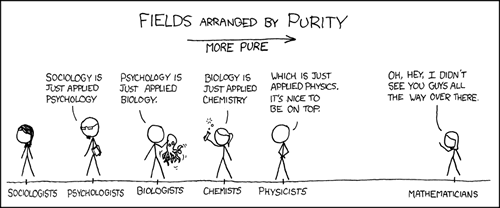
Yes, I'm familiar with Schumpeter (The Economist runs a column named after him), and as a general rule, the Austrian School is intuitively more appealing to me than the Modern, but I'd be in over my head if I tried to take a position on the chief disagreements between them. Regardless, I'm increasingly coming around to the view that it's absurd to treat this most miserable of subjects as a hard science, since it's all contingent on very complex (and still poorly understood) human behaviors:

purity.gif

(Economists would be even further to the left than the Sociologist).

And both schools are very liberal in their philosophy-- they assume that humans are autonomous individuals who interact with each other on a mostly contractual basis, and that "the market" is a pre-existing force of nature that humans discover, rather than a social construct whose contours are defined by the rules and norms that govern it. I disagree strongly with both of those premises, and I think our tendency to analyze everything in economic terms is a symptom of something that is profoundly wrong with modern society.

But I've gotten ahead of myself.

c1db2e4ea77df80976931649ae3cd4b4f487419d0572d8b10afbfbc3602ae78d.jpg
 

Whiskeyjack

Mittens Margaritas Ante Porcos
Staff member
Messages
20,894
Reaction score
8,126
The Atlantic's Peter Beinart just published an article titled Putting Ukraine in Its Place:

Let’s briefly review the American foreign-policy debates of the past year. Last August, President Obama declared that he would bomb Syria for defying his call to not use chemical weapons. Then, in a sharp about-face, he decided instead to work with Russia to dismantle the weapons, and was denounced as weak by hawkish critics. Obama’s supporters said he had done as well as he could have under the circumstances. Two months later, America and its allies struck an interim nuclear deal with Iran. Hawks called it appeasement. Obama’s supporters said it was as good as one could expect under the circumstances. Within hours of the deal, China claimed the right to monitor and possibly take military action against aircraft crossing a disputed area of the East China Sea. Hawks denounced Obama’s response as weak. The president’s supporters said it was as strong as possible under the circumstances. Then, in February, Russia began menacing Ukraine. Hawks called Obama’s response weak. His supporters said the president was doing all he reasonably could.

Each debate resembles the others, but occurs in splendid isolation. Today’s foreign-policy disputes rarely consider the way America’s response to one crisis might affect another. Adopt a tough stance on China’s air-defense zone, for instance, and Beijing is less likely to join the West in condemning Russia’s aggression in Ukraine. Severely punish Russia for that aggression, and Moscow is less likely to help America enforce sanctions against Iran. Take an ultra-hard line on Iran’s nuclear program, and Tehran is less likely to help broker an end to Syria’s civil war that the U.S. can live with. Instead of discussing each threat in isolation, America’s politicians and pundits should be debating which ones matter most. They should be prioritizing.

To understand how Americans stopped doing that, you need to go back to the middle of the 20th century. Over the course of the 1940s, as America lurched from isolationism to world war, foreign-policy strategists such as George Kennan and Walter Lippmann roughly outlined America’s core interests around the world. First, the United States must continue to prevent an enemy power from establishing a beachhead in the Americas, a principle set forth in the venerable Monroe Doctrine. Second, no enemy power should be allowed to dominate Europe, thus threatening what Lippmann called the “Atlantic highway” connecting the United States to Britain and France. Third, no enemy power should shut the United States out of East Asia; that’s what had precipitated war with Japan. Fourth, no adversary should block America’s access to Middle Eastern oil. But beyond these areas, U.S. interests were limited. “I am more and more convinced,” Lippmann wrote in 1943, “that it is just as important to define the limit beyond which we will not intervene as it is to convince our people that we cannot find security in an isolationist party.”

In the wake of World War II, as American politicians grew increasingly fearful of the Soviet Union, Kennan warned that it was foolish to talk about foreign threats without defining national interests. If America didn’t first determine which chunks of the globe were worth defending, any place Moscow threatened would become important to the United States. The U.S. would effectively outsource its foreign-policy decision making. “Our opposition to Communist expansion is not an absolute factor,” argued Kennan in 1947. Rather, containment “must be taken in relation to American security and American objectives.”

Over the decades, Lippmann and Kennan saw their worst fears realized, as U.S. presidents increasingly equated containment with stopping Communism anywhere on Earth. In January 1950, Secretary of State Dean Acheson did not include South Korea in America’s “defense perimeter,” only to see his boss, President Harry Truman, rush troops there once Pyongyang attacked. Dwight Eisenhower didn’t consider South Vietnam important enough to defend militarily; Lyndon Johnson did. By the 1970s, some American hawks were warning about the consequences of Communist control of Somalia and Angola.

But the final blow came with the Cold War’s end. After the Soviet empire fell and America vanquished Iraq in the Gulf War, it became hard to imagine any foreign power seriously challenging America’s core interests. So hard, in fact, that the framework Kennan, Lippmann, and others had established no longer seemed a useful guide to American action. The first clue as to what would replace it came in a 1993 essay by National Security Adviser Anthony Lake, titled “From Containment to Enlargement.” The idea was that instead of defending the democratic world against Soviet advance, the United States would now push forward its boundaries. In eastern Europe, for example, the Clinton administration began admitting formerly Communist countries into NATO. “Enlargement” continued in a different form during the George W. Bush administration, which, in response to the 9/11 attacks, established pro-American governments in Afghanistan and Iraq, and dramatically expanded America’s military footprint in the Middle East and Central Asia.

Promoting democracy and defending human rights were considered expressions of American values. Any country that opposed the expansion of American power was deemed a threat. But without the language of interests, as Kennan had warned, championing American values and opposing foreign threats were limitless endeavors.

Foreign-policy strategy requires harmonizing means and ends, yet during the first two decades of the post–Cold War era, American foreign-policy commentators stopped trying to “define the limit” to America’s overseas ends. The results of this shift are especially troublesome today, as America struggles with reduced means. After years of post-9/11 increases, America’s defense budget is decreasing. There’s also less money for foreign aid. Challengers like China, Russia, and Iran are fighting the enlargement of American power and American-style government. Obama, by withdrawing U.S. troops from Afghanistan and Iraq and resisting military action in Syria and Iran, has tried to better align America’s overseas obligations with its domestic resources. But he’s encountered relentless criticism from hawks who want America to push forward, as hard as possible, on every frontier.

The press bears part of the blame. When politicians and pundits write an op‑ed or go on TV to offer opinions about the crisis of the day, they are rarely asked to reconcile those opinions with the ones they offered on a different crisis the day before. Moreover, foreign-policy debates are frequently segregated from domestic-policy ones, so commentators who propose increasing the defense budget or sending more foreign aid are seldom asked to explain which domestic programs they’d cut, or which taxes they’d raise, in order to find the money.

To change that, reporters should begin their coverage of each foreign crisis with this question: Why should Americans care? In today’s environment, that sounds churlish. But it didn’t always. Lippmann famously called U.S. foreign policy the “Shield of the Republic.” Part of his point was that the best yardstick for evaluating U.S. policies overseas was their effect on citizens at home. By asking why Americans should care that Russia controls Crimea or that Iran has a nuclear program, journalists would force a discussion of American interests. They’d make politicians and pundits explain exactly how events in a given country might make Americans less safe, less prosperous, or less free. In some cases, after all, when America enlarges its sphere of influence, its citizens lose more—in money, freedom, or blood—than they gain. Focusing on ordinary Americans would bring attention to this possibility.

At times, the politicians or pundits might admit that Americans have no tangible interests in a given country, just a moral obligation to prevent killing, poverty, or oppression. That’d be fine. At least they’d be making their case honestly.

Where might a renewed focus on interests and priorities lead America’s foreign-policy debate? Toward Asia. However thuggish Vladimir Putin’s behavior is in his own backyard, Russia is in economic decline and lacks the capacity even to dominate eastern Europe, let alone to shut America out of Europe as a whole. Iran, as a Persian Shia middle-rate power widely hated for its role in the slaughter of Sunni Arabs in Syria, has little chance of achieving regional hegemony in the Middle East. The country in today’s world with the greatest capacity to threaten America’s core historic interests is China, which is converting its extraordinary economic dynamism into both military might and soft power. It is China, not Russia or Iran, that could block America’s access to key overseas markets, thus imperiling American jobs, and that could dump America’s debt, thus destabilizing the American economy. It is China, not Russia or Iran, that is developing the technology to mount a serious military challenge to the United States.

The point is not that the U.S. should see China as an enemy. Americans will be far better off if the relationship between Washington and Beijing never deteriorates into cold war. But what America needs now with regard to China is leverage: the leverage that comes from a strong economy, a strong military, and strong relations with China’s neighbors. American foreign-policy debates should focus on how to achieve these things. And if doing so requires the United States to temper its responses elsewhere, so be it. If you can’t decide which parts of the world matter less, you can’t influence the ones that matter most.
 

chicago51

Well-known member
Messages
3,658
Reaction score
387

Ah the old Hamilton vs Jefferson debate.

I have respect for Hamilton as his 11 points for American manufacturing most of which were adopted and basically in place for 180 years or so worked out pretty well for the country until globalism and advanced technology depressed wages.

I Hamilton was though was basically the big shot globman sacs type wall street bankster of his day and I too side with Jefferson on the matter of what a free market it is who basically saw a country full of independent farmers, basically small business owners in today's world.

I tend to define free market from the perspective of the consumer. Competive market = choices for consumer, competive prices for consumer hence more freedom on the part of the consumer.

Plus locally inefficiency is a good thing. If you take 10 local stores and replace it Wall Mart. You may need one bookeeper has opposed to each one having their own, maybe 2-3 janitors as opposing to each store having their own, sure Walmart may have 10-15 folks on the register through different shifts but each local store may have had 3-5, so you guys get the point. Local ineffeciency equals way more jobs than corporate effeciency.
 
Last edited:

GoIrish41

Paterfamilius
Messages
9,929
Reaction score
2,119
I appreciate the thoughtful response:


Chicago and I are pretty far apart on a lot of political issues, but we both agree that crony capitalism is a serious problem. That's the subject of Nader's book, which we both expressed some interest in. But you dismissed the book immediately based on its author, and instead recommended that a "silly liberal" like chicago would do better reading an allegorical criticism of Soviet Communism. Doesn't that seem a bit condescending?


Really? Once one starts making comparisons to extremist ideologies (fascism, communism, etc.), the prospect for meaningful dialogue goes out the window. And I would argue that uniformity of political philosophy--shared across both parties-- is a much bigger problem in America than extremism.


We're all guilty of this to varying extents, which is one reason why it's good to have civil discussions about controversial topics here. And to chicago's credit, his posting has indicated a consistent willingness to adapt his political views in response to strong arguments or evidence to the contrary. Now he knows more about futures contracts; but does that single misinformed article invalidate his underlying concerns about corporatism? Absolutely not.


There is ample evidence to support the contentions that: (1) the Antitrust Division isn't looking out for Joe Consumer; and (2) America's telecom giants are lobbying hard for the right to extract rents from Americans instead of providing the sort of infrastructure improvements that they've been promising for decades. I agree that AT&T's purchase of DirecTV doesn't have monopoly implications, but just because chicago linked to a dubious article doesn't mean that he (or his arguments) should be categorically dismissed as misinformed.


Animal Farm is a classic, and should be read for its own artistic merits. But how are chicago's politics going to be improved by reading it? I can't recall him ever recommending communistic policies, so I doubt he'd find much to disagree with there. In fact, the vast majority of people on the American left have no problem condemning communism, just as those on the right have no issue denouncing fascism.


I'm not sure how to gauge my relative knowledge of economics. I didn't major in it, but I took a handful of econ courses as electives during undergrad and law school, have had a subscription to The Economist since high school, etc. So, maybe I'm conversant? Definitely not an expert.

Yes, I'm familiar with Schumpeter (The Economist runs a column named after him), and as a general rule, the Austrian School is intuitively more appealing to me than the Modern, but I'd be in over my head if I tried to take a position on the chief disagreements between them. Regardless, I'm increasingly coming around to the view that it's absurd to treat this most miserable of subjects as a hard science, since it's all contingent on very complex (and still poorly understood) human behaviors:

purity.gif

(Economists would be even further to the left than the Sociologist).

And both schools are very liberal in their philosophy-- they assume that humans are autonomous individuals who interact with each other on a mostly contractual basis, and that "the market" is a pre-existing force of nature that humans discover, rather than a social construct whose contours are defined by the rules and norms that govern it. I disagree strongly with both of those premises, and I think our tendency to analyze everything in economic terms is a symptom of something that is profoundly wrong with modern society.

But I've gotten ahead of myself.
Excellent post!
 

T Town Tommy

Alabama Bag Man
Messages
6,278
Reaction score
2,768
The Atlantic's Peter Beinart just published an article titled Putting Ukraine in Its Place:

For this to really apply, doesn't our President need to have at least some sort of coherent foreign policy? Maybe that's the point of the whole article anyway. It appears that over the course of the last six years that Obama hasn't decided on either containment or enlargement. And that indecisiveness is a dangerous thing.
 

Whiskeyjack

Mittens Margaritas Ante Porcos
Staff member
Messages
20,894
Reaction score
8,126
For this to really apply, doesn't our President need to have at least some sort of coherent foreign policy? Maybe that's the point of the whole article anyway. It appears that over the course of the last six years that Obama hasn't decided on either containment or enlargement. And that indecisiveness is a dangerous thing.

Agreed completely. I didn't post it as a defense of Obama's foreign policy, though the first paragraph probably gives his administration more credit than it's due. I shared it as a clear description of what a sane realist foreign policy would look like.
 

chicago51

Well-known member
Messages
3,658
Reaction score
387
So I've been thinking about crony capitalism as it relates to federalism. As well as the whole race to bottom issue that got some discussion.

I guess I'm posing more of a question.

So I sort of agree that if you reduce the power and size of the federal government you reduce the effect of corporate coruption on government and on democracy.

So in theory I have to agree giving power back to the states seems like a great idea. My question though is with the whole race to the bottom we've seen amongst states what is stop states from getting in a bidding war for corporations to locate in their state? So if you transfered functions back to the states how would they be able do those functions when they fighting amongst other states to give the cheapest package to corporations?

Again not saying this makes giving power back to the states wrong or that federalism is good. Just wondering how you balance federalism vs race to the bottom amongst states. Just something I've been pondering and I lack the intelligence to see a solution.
 

Bluto

Well-known member
Messages
8,146
Reaction score
3,979
Getting serious about revoking corporate charters would be a good place to start and making all political campaigns completely publicly funded would be a good idea.
 
Last edited:

chicago51

Well-known member
Messages
3,658
Reaction score
387
Not from a right wing website. Not from the tea party. Not from a conspiracy group. It's from zerohedge.com

Big drop in retail sales nationally in Q1, falling home prices, and middle class losing good jobs. Author says it looks like 2007 all over again. I pray not.

Has The Next Recession Already Begun For America's Middle Class? | Zero Hedge

I read just a book Crash of 2016 by Thom Hartmann who is denitely on the left of the political spectrum. I don't think anyone isn't saying the economy sucks. When have a lot of people still out of work, and a changing economy where most new jobs are low wages jobs consumer spending is going to be down the housing market is going to be poor.

The stock market is doing well but I think that is more smoke and mirrors. Inflation has been normal in terms of the Consumer Price Index, despite all the debt but I think there is some high end asset inflation going on and that is responsible for the high stock price.
 

RDU Irish

Catholics vs. Cousins
Messages
8,622
Reaction score
2,722
I think a lot of the negative data is weather related and Q2 will see pent up demand produce an artificially high number. Then you have inventory destocking which also negatively affected GDP but puts us in position to goose GDP when "shelves" are restocked to normal levels.

Housing starts and new auto sales have a lot of room to go up when you look at a record average age of cars (11.4 years) and demographically tons of data indicating new household formations need to pick up. Home improvement stores and car manufacturers are what I am watching the next six months to tell me where the economy really stands.

EPA powerplant guidelines due to be issued today will be an economic buzz saw. Destroying the middle class is the unintended (although completely predictable) consequence of this BS. Our energy resources are the path to economic success. The EPA is essentially taking our trump card (Saudi Arabia of coal, cheapest form of electric generation) and telling rest of the world to please take what's left of manufacturing jobs. All done through the EPA mind you, not a single vote cast to push this devastating mandate down our throat. Pretty soon we can all be fined due to our CO2 generation just like we are fined for being alive unless we have health care coverage. Own a dog or cat? Better get some carbon credits.
 

RDU Irish

Catholics vs. Cousins
Messages
8,622
Reaction score
2,722
So at what point do we change our motto from "Land of the Free" to "Land of the Fee"
 

RDU Irish

Catholics vs. Cousins
Messages
8,622
Reaction score
2,722
Falling interest rates will stimulate housing as well. 10 year treasury below 2.5% after starting the year over 3%.

I see the Fed keeping rates low for quite a long time while they continue to use inflation to goose tax receipts/marginalize benefits from Social Security/lower the economic value of minimum wage/monetize our national debt/etc/etc.... Not a positive for our economy by any means but desensitizing the masses to a lower standard of living while leaning on the well employed/well educated to pay for it all. Yes rich get richer, but isn't that the only way to pay for a disappearing middle class?
 

Polish Leppy 22

Well-known member
Messages
6,594
Reaction score
2,009
We traded 5 Al Qaeda shitheads from Gitmo for a deserter. Outstanding.

And this, we are told, is the smartest man ever to be in the White House.
 

Whiskeyjack

Mittens Margaritas Ante Porcos
Staff member
Messages
20,894
Reaction score
8,126
First Things' Roger Scruton just published an article titled "The Good of Government -- Why American Conservatives Need a Positive View of Government":

Rousseau told us that we are “born free,” arguing that we have only to remove the chains imposed by the social order in order to enjoy our full natural potential. Although American conservatives have been skeptical of that idea, and indeed stood against its destructive influence during the time of the ’60s radicals, they nevertheless also have a sneaking tendency to adhere to it. They are heirs to the pioneer culture. They idolize the solitary entrepreneur, who takes the burden of his projects on his own shoulders and makes space for the rest of us as we timidly advance in his wake. This figure, blown up to mythic proportions in the novels of Ayn Rand, has, in less fraught varieties, a rightful place in the American story. But the story misleads people into imagining that the free individual exists in the state of nature, and that we become free by removing the shackles of government. That is the opposite of the truth.

We are not, in the state of nature, free; still less are we individuals, endowed with rights and duties, and able to take charge of our lives. We are free by nature because we can become free, in the course of our development. And this development depends at every point upon the networks and relations that bind us to the larger social world. Only certain kinds of social networks encourage people to see themselves as individuals, shielded by their rights and bound together by their duties. Only in certain conditions are people united in society not by organic necessity but by free consent. To put it simply, the human individual is a social construct. And the emergence of the individual in the course of history is part of what distinguishes our civilization from so many of the other social ventures of mankind.
...

People become free individuals by learning to take responsibility for their actions. And they do this through relating to others, subject to subject. The free individuals to whom the founders appealed were free only because they had grown through the bonds of society, to the point of taking full responsibility for their actions and granting to each other the rights and privileges that established a kind of moral equality between them.

In other words, in our tradition, government and freedom have a single source, which is the human disposition to hold each other to account for what we do. No free society can come into being without the exercise of this disposition, and the freedom that Americans rightly cherish in their heritage is simply the other side of the American habit of recognizing their accountability toward others. Americans, faced with a local emergency, combine with their neighbors to address it, while Europeans sit around helplessly until the servants of the state arrive. That is the kind of thing we have in mind when we describe this country as the “land of the free.” We don’t mean a land without government; we mean a land with this kind of government—the kind that springs up spon­taneously between individuals who feel accountable to each other.

...

This does not mean that conservatives are wedded to some libertarian conception of the minimal state. The growth of modern societies has created social needs that the old patterns of free association are no longer able to satisfy. But the correct response is not to forbid the state from intruding into the areas of welfare, health care, education, and the rest, but to limit its contribution to the point where citizens’ initiatives can once again take the lead. Conservatives want a society guided by public spirit. But public spirit grows only among people who are free to act on it, and to take pleasure in the result. Public spirit is a form of private enterprise, and it is killed when the state takes over. That is why private charity has disappeared almost completely from continental Europe, and is thriving today only in the Anglosphere, where common-law justice reminds the citizen that he is accountable to others for the freedom that he enjoys.

Conservatives therefore have an obligation to map out the true domain of government, and the limits beyond which action by the government is a trespass on the freedom of the citizen. But it seems to me that they have failed to offer the electorate a believable blueprint for this, precisely because they have failed to see that what they are advocating is not freedom from government, but another and better kind of government—a government that embodies all that we surrender to our neighbors, when we join with them as a nation.

A bit lengthy, but very good.
 

chicago51

Well-known member
Messages
3,658
Reaction score
387
EPA powerplant guidelines due to be issued today will be an economic buzz saw. Destroying the middle class is the unintended (although completely predictable) consequence of this BS. Our energy resources are the path to economic success. The EPA is essentially taking our trump card (Saudi Arabia of coal, cheapest form of electric generation) and telling rest of the world to please take what's left of manufacturing jobs. All done through the EPA mind you, not a single vote cast to push this devastating mandate down our throat. Pretty soon we can all be fined due to our CO2 generation just like we are fined for being alive unless we have health care coverage. Own a dog or cat? Better get some carbon credits.

Yea I'm not necessarily for these new EPA guidelines. I think carbon pollution is a serious problem and I am for taxing carbon. I think though it shouldn't go to the government but distributed back to the popullation. Fee and rebate system. Consumers are getting rebated so they handle the increase cost but the cost of non carbon emission energy sources because more profitable as does energy efficiency/reducing one's consumption. I think if we did this the change would take place naturally and wouldn't require government mandates or subsidies to green energy companies some of which failed.
 

chicago51

Well-known member
Messages
3,658
Reaction score
387
First Things' Roger Scruton just published an article titled "The Good of Government -- Why American Conservatives Need a Positive View of Government":


A bit lengthy, but very good.

See to me the whole government is bad argument is saying essentially America is bad.

Yes the federal government is corrupt, and "too big" operating in functions that are inappropriate for federal government involvement.

Unless you favor ancharchy you favor some level of government wouldn't want what level government you favor to be effective as opposed wishing government not work because "government sucks".
 

Polish Leppy 22

Well-known member
Messages
6,594
Reaction score
2,009
See to me the whole government is bad argument is saying essentially America is bad.

Yes the federal government is corrupt, and "too big" operating in functions that are inappropriate for federal government involvement.

Unless you favor ancharchy you favor some level of government wouldn't want what level government you favor to be effective as opposed wishing government not work because "government sucks".

Conservatives don't want anarchy. They want a smaller, efficient, constitutional government. The feds have no business in education, agriculture, energy, healthcare or retirement just off the top of my head.

RINOs like Boehner and McCain want a big government, just managed by them and not Democrats. Take em for all I care.
 

connor_in

Oh Yeeaah!!!
Messages
11,433
Reaction score
1,006
<iframe title="MRC TV video player" width="640" height="360" src="http://www.mrctv.org/embed/127536" frameborder="0" allowfullscreen></iframe>
 
Top