Miami Pedestrian Bridge Collapses

BGIF

Varsity Club
Messages
43,946
Reaction score
2,922
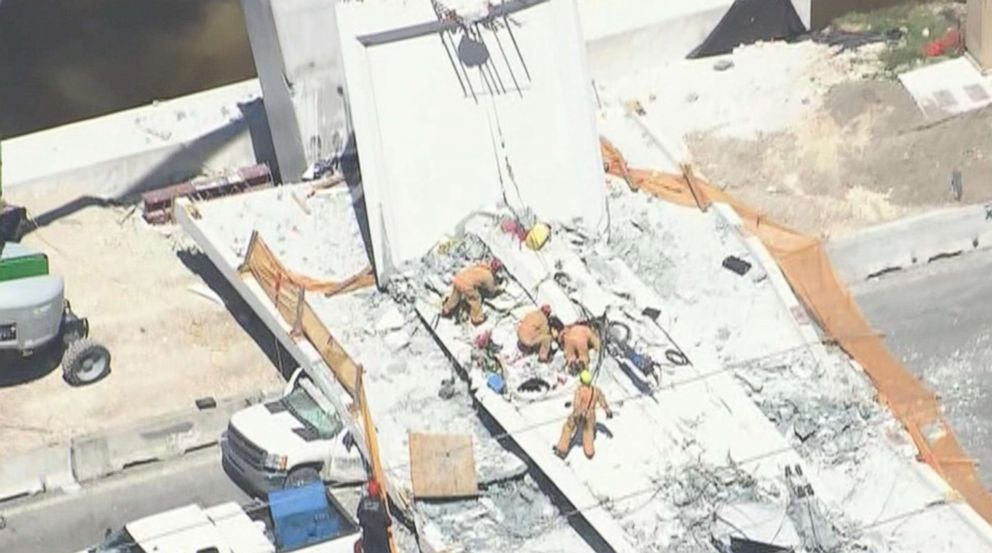
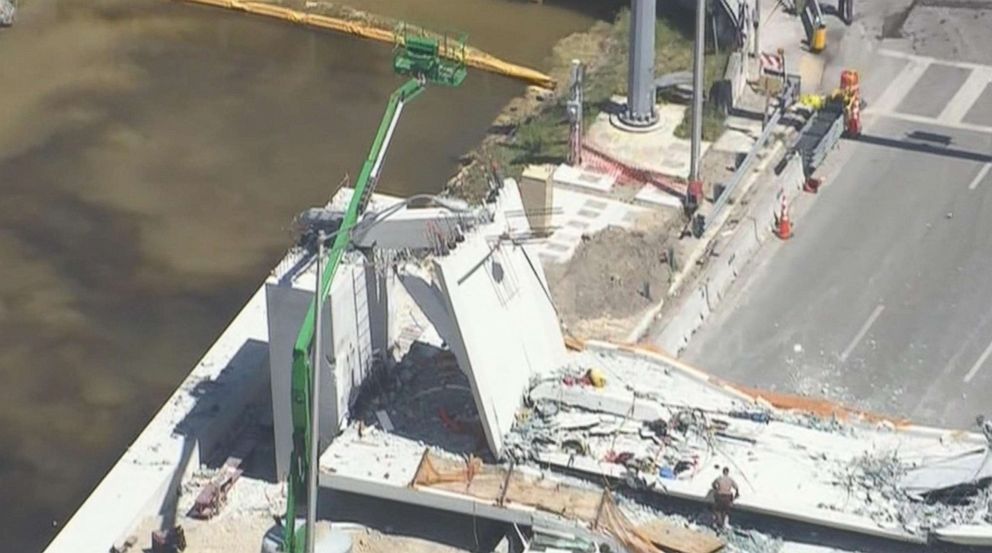
A pedestrian foot bridge at F.I.U. in Miami spanning 6 lanes of the Tamiami Trail and a median has collapsed on 8 or more cars/trucks and pedestrians. The 950 ton modular bridge was recently installed and opened on Saturday.

FIU bridge collapses; fatalities reported, Florida officials say | Fox News

The span is 200 feet and, per MSNBC reporter on site, 109 feet tall. *(The installation article linked below lists the span as 174 feet and From video it appears to be 20-30 feet tall (in place). The buildings served by the bridge appear to be 4 stories and 5 stories high.

There at least one dead, several people taken to hospital. Looking at the crushed cars I'd expect the numbers to rise.

There's a large crane about 50 feet from the failed bridge but it can't be used to lift pieces of the failed spans as it's a real Jenga puzzle. Pick out the wrong piece and other pieces fall causing a threat to the rescue workers.


The bridge was built under "accelerated bridge construction" method. Bridge is built offsite and moved into place by cranes in a few hours to limit the time busy highways/roadways like Tamiami Trail. While the bridge had opening ceremony on Saturday it was not open to pedestrians as contractors were still working on details. The bridge was installed this past week as school is closed for Spring Break.


Here's an installation video from March 10, 2018 (5 days before the collapse).

FIU installs new pedestrian bridge over the Trail in a few hours | Miami Herald

‘Instant’ bridge aims to make a dangerous crossing safer for thousands of students
BY ANDRES VIGLUCCI
miamiherald.com
March 10, 2018 01:21 PM Updated March 11, 2018 07:59 AM

Instant bridge? Not quite, but in a single morning Florida International University dropped a new elevated pedestrian span into place over the Tamiami Trail to provide students a safe route over the perilous roadway for the first time.

Once it’s finished in early 2019, the new pedestrian bridge will link FIU’s Modesto A. Maidique Campus directly to the small suburban city of Sweetwater, where the university estimates 4,000 of its students live.

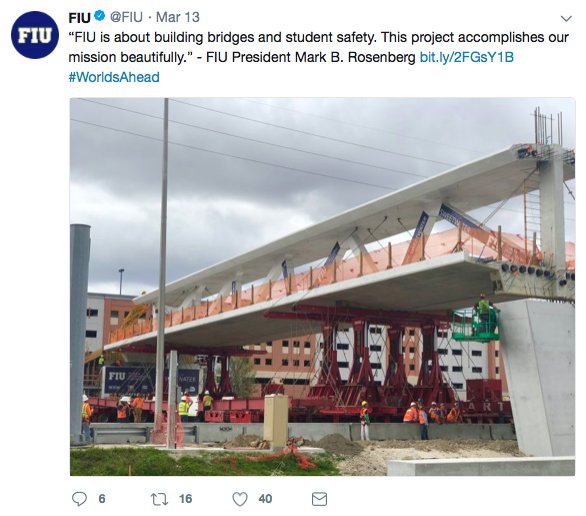
The rapid span installation was the result of months of preparation. The bridge’s main 174-foot span was assembled by the side of the Trail while support towers were built at either end.

The 950-ton span was then picked up, moved and lowered into place by special gantry cranes at the intersection of Southwest 109th Avenue in an operation that lasted several hours Saturday morning. A section of the Trail, also designated as Southwest Eighth Street, was closed to traffic Friday evening for the bridge installation, and will remain shut until 5 a.m. Monday.
 
Last edited:

IrishLax

Something Witty
Staff member
Messages
37,545
Reaction score
28,995
As a structural engineer, this is always the nightmare scenario. I'm sure there's not enough information at this time to determine if it was an erection/fabrication error or design error, but in general when people look for "economy" there is often increased risk exposure.

From looking at the photo in the article, it appears to be a precast concrete bridge. There is very little margin for error with precast concrete in terms of end bearing connections. With cast-in-place concrete there is more redundancy built in throughout the structure that a localized error (or failure of a member) likely won't cause catastrophic failure of the whole structure. However, with precast concrete, you generally have very large load being transferred through very specific, precise connections... and if those fail the whole thing can go.

I do a lot of work on precast concrete garages that routinely have shear connector failure between panels. That's not the end of the world... the end of the world is when an end bearing girder connection fails and a panel falls because all of a sudden half of it is unsupported. Often, people die. This bridge seems (from the first photo) like the end bearing on the right side failed first... exact mode of failure is unclear from this far away.
 

ACamp1900

Counting my ‘bet against ND’ winnings
Messages
48,948
Reaction score
11,228
Man, that's terrible... My heart breaks for the families of those killed, and honestly it breaks for those responsible too, no one wanted this to happen...
 

OhioIrish31

New member
Messages
1,330
Reaction score
28
Man, that's terrible... My heart breaks for the families of those killed, and honestly it breaks for those responsible too, no one wanted this to happen...

I'm sure that they want to get to the bottom of how it happened but you are right...nobody wanted this to happen. The blame game is on! Prayers for the families involved!
 
C

Cackalacky

Guest
As a structural engineer, this is always the nightmare scenario. I'm sure there's not enough information at this time to determine if it was an erection/fabrication error or design error, but in general when people look for "economy" there is often increased risk exposure.

From looking at the photo in the article, it appears to be a precast concrete bridge. There is very little margin for error with precast concrete in terms of end bearing connections. With cast-in-place concrete there is more redundancy built in throughout the structure that a localized error (or failure of a member) likely won't cause catastrophic failure of the whole structure. However, with precast concrete, you generally have very large load being transferred through very specific, precise connections... and if those fail the whole thing can go.

I do a lot of work on precast concrete garages that routinely have shear connector failure between panels. That's not the end of the world... the end of the world is when an end bearing girder connection fails and a panel falls because all of a sudden half of it is unsupported. Often, people die. This bridge seems (from the first photo) like the end bearing on the right side failed first... exact mode of failure is unclear from this far away.
I have not even seen it or watched anything on this but this all terrifies me as a structural designer. I am seeing an increased demand on structural engineers during the design process due to our teams schedule to do things faster and faster every day. Its very scary.
 
C

Cackalacky

Guest
233287.jpg


looks to me there was a lot of shear on the bottom deck at the support on the left side. The upper deck and supports look like they rotated about the bottom supports. Was this a single span?
 

BGIF

Varsity Club
Messages
43,946
Reaction score
2,922
The pedestrian bridge was to have two spans supported by a stayed cable tower. Only the first span, 40 feet wide, was installed at the time of collapse. It was supported on two vertical reinforced structures on each side of the roadway. The second span about 150 feet in length crossing the river, and the vertical tower and cables were to be installed later.

From the photos/video I'm assuming the 174 span was designed as a truss. It should have been designed to be free standing during construction (without the stayed cable system) on the two vertical concrete supports on each side of the roadway. I can see one support and there doesn't appear to any damage there (but that's from photos and video shot 50 feet or more from the structure). I haven't been able to see the other support from the views shown.

It could be a connection failure although I can't think of what would cause a connection to fail with an unloaded bridge. It wasn't struck by a crane, or vehicle passing underneath (video/photos show pickup trucks and passenger cars crushed under the bridge) nor was there additional loads such as a loaded concrete truck driving on the span or future parts of the bridge stored on the span.

In addition to serving as a pedestrian bridge the structure was also to be used a student recreation area. Tables, chairs, and WiFi were to be added later for student use. None of those static loads nor the live loads from the pedestrian traffic were present. So overloading was not an issue.

Was the span underdesigned for the construction phase without the stayed cable support system? Possible but not likely, would have been a gross error.

One reporter noted that "the concrete was made of or contained titanium oxide to resist pollution". That doesn't strike me as an issue particularly in a span that was installed 5 days ago.

There has been no mention of when the span itself was made. It wasn't poured on-site but was pre-fab.

The forensic engineers will pin it down.
 

BGIF

Varsity Club
Messages
43,946
Reaction score
2,922
233287.jpg


looks to me there was a lot of shear on the bottom deck at the support on the left side. The upper deck and supports look like they rotated about the bottom supports. Was this a single span?


Yes, it was a single 174 foot span. Look at the second video, second Link, in the first post. The span were trucked in lengthwise on trailers than rotated 90 degrees and lifted into place over several hours.
 

irishff1014

Well-known member
Messages
26,513
Reaction score
9,288
Foxnews had a local reporter on scene that said they were doing a stress test. Why wouldn't they shut the road do for that?
 

IrishLax

Something Witty
Staff member
Messages
37,545
Reaction score
28,995
I have not even seen it or watched anything on this but this all terrifies me as a structural designer. I am seeing an increased demand on structural engineers during the design process due to our teams schedule to do things faster and faster every day. Its very scary.

233287.jpg


looks to me there was a lot of shear on the bottom deck at the support on the left side. The upper deck and supports look like they rotated about the bottom supports. Was this a single span?

I believe it was single span, I don't think there was a column in the median -- <blockquote class="twitter-tweet" data-lang="en"><p lang="en" dir="ltr">my school finished putting up a bridge a few days ago and it literally just fell. my roommate and i heard it from our rooms and ran to the balcony <a href="https://t.co/JOtoLuC3Qs">pic.twitter.com/JOtoLuC3Qs</a></p>— &#55357;&#56740; (@Ialilulelo) <a href="https://twitter.com/Ialilulelo/status/974343243834957826?ref_src=twsrc%5Etfw">March 15, 2018</a></blockquote>
<script async src="https://platform.twitter.com/widgets.js" charset="utf-8"></script>

If you look at the above, the failure on the near side (or right in that photo, left in the one you linked) appears to include fracture and pull-over of the right most column. That could indicate inadequate moment capacity for that support, or it could be a byproduct of an initial shear failure at the bearing connection between the bridge and the end support. The fact that it fell "straight" down the face of the support typically indicates a shear failure at the end connection... see that crap all the time in double-t precast garages along the central girder where the panel frames into the girder if there's a concrete spall around the connection point.

My guess would be that the corner it was bearing on was under-reinforced and the bridge developed a shear crack along the face of the support.
 
C

Cackalacky

Guest
I believe it was single span, I don't think there was a column in the median -- <blockquote class="twitter-tweet" data-lang="en"><p lang="en" dir="ltr">my school finished putting up a bridge a few days ago and it literally just fell. my roommate and i heard it from our rooms and ran to the balcony <a href="https://t.co/JOtoLuC3Qs">pic.twitter.com/JOtoLuC3Qs</a></p>— �� (@Ialilulelo) <a href="https://twitter.com/Ialilulelo/status/974343243834957826?ref_src=twsrc%5Etfw">March 15, 2018</a></blockquote>
<script async src="https://platform.twitter.com/widgets.js" charset="utf-8"></script>

If you look at the above, the failure on the near side (or right in that photo, left in the one you linked) appears to include fracture and pull-over of the right most column. That could indicate inadequate moment capacity for that support, or it could be a byproduct of an initial shear failure at the bearing connection between the bridge and the end support. The fact that it fell "straight" down the face of the support typically indicates a shear failure at the end connection... see that crap all the time in double-t precast garages along the central girder where the panel frames into the girder if there's a concrete spall around the connection point.

My guess would be that the corner it was bearing on was under-reinforced and the bridge developed a shear crack along the face of the support.

there looks to be some rotation at the base of the left side here. Not sure if it could have happened before or after collapse. Definitely see the shear/ end bearing failure at the face of the bridge to support interface:
bridge-10-abc-er-180315_9x5_992.jpg


bridge-3-abc-er-180315_9x5_992.jpg
 
Last edited:

IrishLax

Something Witty
Staff member
Messages
37,545
Reaction score
28,995
The pedestrian bridge was to have two spans supported by a stayed cable tower. Only the first span, 40 feet wide, was installed at the time of collapse. It was supported on two vertical reinforced structures on each side of the roadway. The second span about 150 feet in length crossing the river, and the vertical tower and cables were to be installed later.

From the photos/video I'm assuming the 174 span was designed as a truss. It should have been designed to be free standing during construction (without the stayed cable system) on the two vertical concrete supports on each side of the roadway. I can see one support and there doesn't appear to any damage there (but that's from photos and video shot 50 feet or more from the structure). I haven't been able to see the other support from the views shown.

It could be a connection failure although I can't think of what would cause a connection to fail with an unloaded bridge. It wasn't struck by a crane, or vehicle passing underneath (video/photos show pickup trucks and passenger cars crushed under the bridge) nor was there additional loads such as a loaded concrete truck driving on the span or future parts of the bridge stored on the span.

In addition to serving as a pedestrian bridge the structure was also to be used a student recreation area. Tables, chairs, and WiFi were to be added later for student use. None of those static loads nor the live loads from the pedestrian traffic were present. So overloading was not an issue.

Was the span underdesigned for the construction phase without the stayed cable support system? Possible but not likely, would have been a gross error.

It's still got a pretty large dead load, so if the bearing plane is too small (or not sufficiently reinforced with embedded rebar in the correct orientation to pick up shear forces) you can have a shear failure.

Also, if what you're saying is that the bridge was not fully erected yet as designed it could simply be a case of it not being "shored" well enough (or, to put it another way, the engineer didn't account for certain loads in this intermediary state OR the contractor didn't follow directions correctly).

One reporter noted that "the concrete was made of or contained titanium oxide to resist pollution". That doesn't strike me as an issue particularly in a span that was installed 5 days ago.

There has been no mention of when the span itself was made. It wasn't poured on-site but was pre-fab.

The forensic engineers will pin it down.

Yeah, as a member of the International Concrete Repair Institute, your intuition is correct. There is a 0% chance that the concrete degraded substantially from the point where the precaster made it to the point where it was put up. It's effectively impossible... corrosion of reinforcing steel and other concrete degradation through carbonation, alkali-silica reaction, etc. takes YEARS to have an impact.
 

ACamp1900

Counting my ‘bet against ND’ winnings
Messages
48,948
Reaction score
11,228
I'm obviously not in my area here but you'd think a bridge that large with an awning spanning what appears to be an area large enough to fit like 8 lanes of traffic would require a middle support column,,, clearly just from the pictures there wasn't one...
 
C

Cackalacky

Guest
It's still got a pretty large dead load, so if the bearing plane is too small (or not sufficiently reinforced with embedded rebar in the correct orientation to pick up shear forces) you can have a shear failure.

Also, if what you're saying is that the bridge was not fully erected yet as designed it could simply be a case of it not being "shored" well enough (or, to put it another way, the engineer didn't account for certain loads in this intermediary state OR the contractor didn't follow directions correctly).


Yeah, as a member of the International Concrete Repair Institute, your intuition is correct. There is a 0% chance that the concrete degraded substantially from the point where the precaster made it to the point where it was put up. It's effectively impossible... corrosion of reinforcing steel and other concrete degradation through carbonation, alkali-silica reaction, etc. takes YEARS to have an impact.
That is a huge dead load it looks from the pictures. My thoughts were along these lines as well. Not shored correctly or the original design did not account for the sequencing and depended on having the backspan of the future larger bridge to help with moment capacity over the support
 
C

Cackalacky

Guest
I'm obviously not in my area here but you'd think a bridge that large with an awning spanning what appears to be an area large enough to fit like 8 lanes of traffic would require a middle support column,,, clearly just from the pictures there wasn't one...

It can be done but the cross section of the bridge needs to be thick enough and there needs to be enough reinforcing to resist bending (downward) between the supports.
 

BGIF

Varsity Club
Messages
43,946
Reaction score
2,922
Cack and Lax

Cack and Lax

FIU installs new pedestrian bridge over the Trail in a few hours | Miami Herald

This video, less than a minute long, from 5 days ago shows the 174 foot span be placed into position. You can see the two piers much clearer than from today's video.


BGIF, BSCE*, MSEnE

*I promised my structures professor, I would not design in concrete. That was never a problem at the consulting firms I worked for as we used to joke that the Structures Department designed any structure including a sidewalk slab to Nuclear Fallout Structure Design Codes.
 
C

Cackalacky

Guest
FIU installs new pedestrian bridge over the Trail in a few hours | Miami Herald

This video, less than a minute long, from 5 days ago shows the 174 foot span be placed into position. You can see the two piers much clearer than from today's video.


BGIF, BSCE*, MSEnE

*I promised my structures professor, I would not design in concrete. That was never a problem at the consulting firms I worked for as we used to joke that the Structures Department designed any structure including a sidewalk slab to Nuclear Fallout Structure Design Codes.

Haha. I mainly do steel and masonry but our foundations are in concrete, either shallow ( <3'-0" below grade) or deep driven piles. I also worked in Environmental Engineering and its all magic wand waving anyway ... ;)

From that video it looks to me like the the bottom chord is hollow-core. It was real brief but its not solid concrete slab.

Edited... it looks like post tension.
 
Last edited:

irishff1014

Well-known member
Messages
26,513
Reaction score
9,288
It can be done but the cross section of the bridge needs to be thick enough and there needs to be enough reinforcing to resist bending (downward) between the supports.

all i have seen was 174 long and 40 feet wide.
 

BGIF

Varsity Club
Messages
43,946
Reaction score
2,922
That is a huge dead load it looks from the pictures. My thoughts were along these lines as well. Not shored correctly or the original design did not account for the sequencing and depended on having the backspan of the future larger bridge to help with moment capacity over the support

If you look at this link

FIU installs new pedestrian bridge over the Trail in a few hours | Miami Herald

you'll see a rendering of the bridge, bottom of the article, showing it's clearly a stayed cable design.

The stayed cable tower, the second (shorter) span, and the cables were to be installed later.

As I mentioned earlier in the absence of the supporting cables the precast section has to be designed as a free standing span as there is no intermediate supporting pier.
 
C

Cackalacky

Guest
If you look at this link

FIU installs new pedestrian bridge over the Trail in a few hours | Miami Herald

you'll see a rendering of the bridge, bottom of the article, showing it's clearly a stayed cable design.

The stayed cable tower, the second (shorter) span, and the cables were to be installed later.

As I mentioned earlier in the absence of the supporting cables the precast section has to be designed as a free standing span as there is no intermediate supporting pier.

Yes. I understand all that. it clearly couldnt function as a free standing span. It also looks to be post-tension from the video.

It looks something like this
main-qimg-e20592b40fe6a3282284ed44db6c1f60-c


DYWeqMtVMAEdhPm.jpg:large

I do not do post-tension slabs or decks so I am unsure how they handle the tension on the bottom of the deck in this situation. They would need to shore the ends to resit bending about the supports since the tension bars do not appear to have been connected. Hard to tell from the pictures.

oh and I see I said larger...mea culpa. I do see the back span is smaller but still could help resist the moment over the supports.

I guess what my intuition is telling me is that if the bridge was designed as a multi span beam the design moment would be less than the condition of a simply supported beam spanning the large distance. In the simply supported condition it would have highest shear at the supports and highest moment midspan. I am thinking either it failed in shear at the face or that some sort of rotation occurred at one end. Wont know obviously. just spitballing.
 
Last edited:

Fbolt

I've been around
Messages
6,932
Reaction score
2,254
This a terrible situation, however the fact you three are engineers allows me to put so much in perspective.
 
C

Cackalacky

Guest
This a terrible situation, however the fact you three are engineers allows me to put so much in perspective.
Its a terrible tragedy. Even with all built in redundancies in the design things can still happen. Sucks. Lax and BGIF are much smarter than me and I am just trying to gleam something from the pictures.
 

Fbolt

I've been around
Messages
6,932
Reaction score
2,254
it is amazing something like this can happen considering the high standards and overbuilt design processes in place for things such as this. I'm surprised and do appreciate the analysis.

the only thing I recall from engr. classes are slump tests and incredibly difficult math. my degree ends with "Arts".
 

SonofOahu

King Kamehameha
Messages
1,835
Reaction score
228
233287.jpg


looks to me there was a lot of shear on the bottom deck at the support on the left side. The upper deck and supports look like they rotated about the bottom supports. Was this a single span?

At first I was like "how do you have a span that long without a center support?" Then I realized that Dan Inouye Airport (Honolulu) has that same type of structure going from the parking lot to the terminals, running about the same distance. I never gave it a second thought. Sure as shit will, now.
 

NDohio

Well-known member
Messages
5,869
Reaction score
3,060
So tragic. Watching that video from the Miami Herald is tough on the backside of the tragedy - everyone was so excited about this project and now...

Good perspective from Cack, LAX and BGIF.
 
C

Cackalacky

Guest
One woman who barely avoided the deadly bridge collapse at Florida International University said she saw the structure crumble "in front of me, and it fell on the cars that were waiting for the light to change."

"I was near the light. I was the first car that moved forward when it changed and I was near the bridge. It was fine, and all of a sudden, I saw it collapse from the left towards the middle," Suzy Bermudez told media outlets including ABC News this afternoon.

Although not stated, it appears to me the left side is likelythe side closest to the water.
 
C

Cackalacky

Guest
good article:

Quick construction method might have contributed to FIU bridge collapse | Miami Herald

Until it’s fully secured, a quick-build structure is unstable and requires the utmost precision as construction continues. Properly shoring up the bridge can take weeks, a period during which even small mistakes can compound and cause a partial or total collapse, said Amjad Aref, a researcher at University at Buffalo's Institute of Bridge Engineering.

Just before the bridge’s concrete main span abruptly gave way on Thursday, crushing four people in cars to death and injuring others, a contractor’s crews were conducting stress tests on the incomplete structure, Miami-Dade Mayor Carlos Gimenez said. The 950-ton span, assembled by the side of the road over a period of months, was hoisted into place in a matter of hours on Saturday morning.

That stress testing typically involves placing carefully calibrated weights on the span and measuring how the structure responds to ensure it’s within safe parameters, Aref said. Crews may also have been adjusting tension cables that provide structural strength for the span’s concrete slabs.

“The loads have to be calculated precisely in the analysis to make sure the partial bridge would be able to carry them safely,” Aref said.

That doesn’t mean that testing or tension adjustments caused the structure to fail, he said. Other factors, from heavy wind to design flaws to a crane hitting the structure, can also come into play in a failure. It’s still too early to even guess at a cause, engineers say.

“It might not be one factor,” Aref said. “It could be a combination of things.”

In almost all bridge or building collapses, though, construction errors are to blame, not design, said Ralph Verrastro, a Cornell-trained engineer and principal of Naples-based Bridging Solutions, which is not involved in the FIU project.

The span had undergone testing and tension cables adjusted as it was assembled from precast pieces along the side of the road.

It’s possible the cables were over-tightened, causing the bridge to elevate slightly in what's called a camber, said Verrastro, the Naples engineer. Adjusting the cables to address camber would be appropriate, but that would not impact the structural strength.

“So maybe it had too much or not enough. But that’s just a guess. It wouldn’t be because of structural strength,” he said. “If they were adjusting the structural cables, it was to try to put more or less camber.”

However, adjusting the camber, or tuning the bridge, can be tricky. Robert Bea, a University of Californai Berkeley engineer and catastrophic risk expert, has studied hundreds of structural failings including the BP’s Deepwater Horizon, and said workers adjusting the camber on a bridge in Australia in the 1970s led to a similar collapse.

“The steel buckled while they were attempting to tune this camber, so it’s very plausible,” he said.

Another vulnerability: the span’s weight capacity. At this stage in the accelerated timeline, bridges typically need additional temporary support and engineers need to be exact about how much weight is used during load-bearing tests, Buffalo’s Aref said.

The bridge also had some unusual design features.

The bridge’s superstructure was something Verrastro said he’s not seen in 42 years of designing bridges. Rather than steel trusses, it used heavier concrete trusses. The bridge also had a concrete roof, adding even more weight.

“This was a very long span and then they used very heavy material,” he said. “The majority of pedestrian bridges are steel.” A steel bridge weighs about one-tenth of a concrete one, he said.

Verrastro, an expert in accelerated construction who had spoken at FIU’s bridge engineering program, suspects that using concrete was part of the bridge’s aesthetic, rather than structural, design. The Figg firm that designed the bridge is known for its signature bridges, he said.

“They typically get involved in ones that look fancy, but they’re competent,” he said.

Using the accelerated process doesn’t necessarily change the design, just the construction, he said. However, it does require trained contractors who specialize in the method.

But Bea cautioned that innovative methods sometimes produce new ways for structures to fail.

“Innovations always bring potential 'failure modes’ that have not been previously experienced,” he said.
 
C

Cackalacky

Guest
At first I was like "how do you have a span that long without a center support?" Then I realized that Dan Inouye Airport (Honolulu) has that same type of structure going from the parking lot to the terminals, running about the same distance. I never gave it a second thought. Sure as shit will, now.

It was unfinished. It was going to have a secondary span across the pond and also have cable stays supporting the full multi-span.
 
Top