Healthcare

irish1958

Príomh comhairleoir
Messages
1,039
Reaction score
112
While it is true that the VA is authorized to negotiate with drug companies, the drug companies are under no legal obligation to negotiate with the VA.
Negotiations can only work if there is competition in the marketplace.
VA can't afford drug for veterans suffering from hepatitis C - CBS News
Multiply this example of their "negotiations" with a drug company by the result they have with the hundreds of other exclusive and patented drugs to see the uselessness of the program.
How would you like it if your veteran father or son who received a blood transfusion because of a battlefield injury is one of the 85% not treated and dies because of hepatitis C? As a physician I can assure you that liver failure is one of the most shitty ways to die.
 

MJ12666

New member
Messages
794
Reaction score
60
While it is true that the VA is authorized to negotiate with drug companies, the drug companies are under no legal obligation to negotiate with the VA.
Negotiations can only work if there is competition in the marketplace.
VA can't afford drug for veterans suffering from hepatitis C - CBS News
Multiply this example of their "negotiations" with a drug company by the result they have with the hundreds of other exclusive and patented drugs to see the uselessness of the program.
How would you like it if your veteran father or son who received a blood transfusion because of a battlefield injury is one of the 85% not treated and dies because of hepatitis C? As a physician I can assure you that liver failure is one of the most shitty ways to die.

First off I am not going to defend Gilead's pricing of this drug. However, for the patient identified in the article he should contact Gilead directly and work with them to get the drug he needs via the Gilead indigent care program.

Gilead Patient Assistance

Regarding the doctor identified in the article, how is his situation any different then Cheryl Mills and Uma Aberdeen having jobs with the State Department paying six figures and at the same time pulling in annual six figure salaries from Clinton entities? Answer, no difference. They should all be in jail. I know it is somehow legal but that does not make it right.
 

Legacy

New member
Messages
7,871
Reaction score
321
While it is true that the VA is authorized to negotiate with drug companies, the drug companies are under no legal obligation to negotiate with the VA.
Negotiations can only work if there is competition in the marketplace.
VA can't afford drug for veterans suffering from hepatitis C - CBS News
Multiply this example of their "negotiations" with a drug company by the result they have with the hundreds of other exclusive and patented drugs to see the uselessness of the program.
How would you like it if your veteran father or son who received a blood transfusion because of a battlefield injury is one of the 85% not treated and dies because of hepatitis C? As a physician I can assure you that liver failure is one of the most shitty ways to die.

You are saying what the physicians in the article above, The High Cost..... Our health system as far as drug pricing goes has morphed into a non-competitive system that harms the consumer/patient. Without competition, the drug companies have few restraints on price increases.

The physicians, as you may have read, also pointed out that sofosbuvir -- sold as Sovaldi and Harvoni -- in the long term may be considered cost-effective vs treatment of the affects of chronic Hep C. You may also know that Gilead’s Sovaldi costs $84,000 for a 12-week course of treatment in the United States, compared to $900 in Egypt.

Some other drug price increases of which you may also be aware:
-- Denmark spends about a 34 cents on drugs for each dollar spent per person in the United States. (Denmark negotiates prices with drug companies.)
-- One month of Lipitor costs $100 in America, compared to $6 in New Zealand. (The newer cholesterol medicines cost patients $14,000 per year.) Pravastatin sodium (10 mg), surged from $27 to $196 for a one-year supply.
-- Cancer drugs increased from roughly $10,000 before 2000 to over $100,000 by 2012
-- Doxycycline hyclate (100 milligrams), a widely used antibiotic and the main drug for treatment of malaria, soared from $20 for 500 capsules in October 2013 to a staggering $1,849 in April 2014.
-- Pulmicort, a steroid inhaler, generally retails for over $175 in the United States, while pharmacists in Britain buy the identical product for about $20 and dispense it free of charge to asthma patients.
-- Mylan NV’s albuterol sulfate—which increased about 4,000 percent from 2013 to 2014. Albuterol, one of the oldest asthma medicines, was less than $15 a decade ago, before it was "repatented".
-- Digoxin (generic) which used to sell for pennies a pill now costs up to $50 for a one month supply. Generic manufacturers of digoxin were narrowed to only two.

If insurance companies or the federal government can't afford to keep these monopoly-like price increases under control, they pass the costs on to consumers utilizing changes in Tier prices, high deductible plans with greater copays, and increased premiums.

If people cannot afford to take their medications for chronic conditions, the health care system treats their complications at a much higher cost, which, in the end, is passed along to the consumer.

The main question is whether drug pricing and the anti-competitive behavior has gone farther than any solution other than government intervention with anti-trust lawsuits. Will the competitive solutions in the WSJ article succeed?

The Soaring Cost of a Simple Breath

How Competition Can Bring Down Drug Prices (Wall Street Journal)

Justice Department Probes Generic Companies After Price Hike Reports
 

yankeehater

Well-known member
Messages
2,199
Reaction score
774
My Mom's shots for diabetes just went from $300 to $800. Being that she is on Social Security she cannot afford the drug. Not sure who is to blame, but the common excuse is Obamacare. If it is not the cause, companies are sure using it as the excuse.
 

MJ12666

New member
Messages
794
Reaction score
60
My Mom's shots for diabetes just went from $300 to $800. Being that she is on Social Security she cannot afford the drug. Not sure who is to blame, but the common excuse is Obamacare. If it is not the cause, companies are sure using it as the excuse.

This is not a case that can be blamed on Obamacare. If she does not have some type of insurance that covers drugs she has a problem. If she has some financial issues then she (or you) should look at the company's website to see if they have a program that provides company discounts to those who financial issues. Many do and will provide the medication as discounts. It is worth the effort.
 

Legacy

New member
Messages
7,871
Reaction score
321
My Mom's shots for diabetes just went from $300 to $800. Being that she is on Social Security she cannot afford the drug. Not sure who is to blame, but the common excuse is Obamacare. If it is not the cause, companies are sure using it as the excuse.

You can look at rebates as MJ said. This may lower the costs to your Mom who has a fixed income, and possibly factors like limited mobility, losing weight, etc that may be non-drug ways of controlling diabetes. If she does have complications that she may also need to pay the going rate in America for drugs. AARP has numerous articles on the accelerating cost of medications and some suggestions, but, in the end, in America, we have no control over prices. I exclude biologic medications which can be terrific in resolving or controlling conditions.

Also know that rebates may help lower your Mom's cost, but the drug price remains the same as far as what the pharmaceutical company charges the insurance company. The health insurance companies pass along the increased drug prices they are paying to the consumers. By expanding the pool of patients via Obamacare that increases the number of patients needing meds and, in that way, contributes.

With soaring profits, rebates help drug companies lower their taxes. They also can lower taxes by acquiring biotech companies or overseas companies who are operating with losses. Another way to lower their taxes is, of course, moving their headquarters overseas with acquistions. Finally, by donating drugs to relief agencies will lower taxes, so many are quite willing to do this.

But, if you check out the graph I posted above for costs for the different programs, the VA and Medicaid costs have gone down since 2007, while Medicaid, Dept of Defense and private insurance groups have soared. Total costs for all groups is about the same over that period of time, but only because VA and Medicaid drug costs are lower.

To get Obamacare legislation to pass, Congress had to exempt pharmaceutical companies from negotiating medication costs. In general, some Obamacare patients have deferred their health issues and are more costly, while not as many healthy patients have enrolled to balance out the sicker ones.

If we return to the former health system where Obamacare patients are not covered, hospitals, who are non-profit, will need to swallow the losses, when those patients come into the ER instead of having them addressed by primary care physicians, etc.

Fighting Against High Drug Costs:
Trend could mean poorer health and higher health care expenses
(AARP)

Let's Make Prescriptions Less Costly (AARP)

Down the road, what are drug costs and their impacts on health insurance going to be for you?
 
Last edited:

kmoose

Banned
Messages
10,298
Reaction score
1,181
First off I am not going to defend Gilead's pricing of this drug. However, for the patient identified in the article he should contact Gilead directly and work with them to get the drug he needs via the Gilead indigent care program.

Gilead Patient Assistance

Regarding the doctor identified in the article, how is his situation any different then Cheryl Mills and Uma Aberdeen having jobs with the State Department paying six figures and at the same time pulling in annual six figure salaries from Clinton entities? Answer, no difference. They should all be in jail. I know it is somehow legal but that does not make it right.

Did you mean Huma Abedin?
 

yankeehater

Well-known member
Messages
2,199
Reaction score
774
This is not a case that can be blamed on Obamacare. If she does not have some type of insurance that covers drugs she has a problem. If she has some financial issues then she (or you) should look at the company's website to see if they have a program that provides company discounts to those who financial issues. Many do and will provide the medication as discounts. It is worth the effort.

Thanks....I think this is the discounted rate. She is scheduled to meet with her doctors to look at alternative drugs. I just pray they work as well.
 

yankeehater

Well-known member
Messages
2,199
Reaction score
774
You can look at rebates as MJ said. This may lower the costs to your Mom who has a fixed income, and possibly factors like limited mobility, losing weight, etc that may be non-drug ways of controlling diabetes. If she does have complications that she may also need to pay the going rate in America for drugs. AARP has numerous articles on the accelerating cost of medications and some suggestions, but, in the end, in America, we have no control over prices. I exclude biologic medications which can be terrific in resolving or controlling conditions.

Also know that rebates may help lower your Mom's cost, but the drug price remains the same as far as what the pharmaceutical company charges the insurance company. The health insurance companies pass along the increased drug prices they are paying to the consumers. By expanding the pool of patients via Obamacare that increases the number of patients needing meds and, in that way, contributes.

With soaring profits, rebates help drug companies lower their taxes. They also can lower taxes by acquiring biotech companies or overseas companies who are operating with losses. Another way to lower their taxes is, of course, moving their headquarters overseas with acquistions. Finally, by donating drugs to relief agencies will lower taxes, so many are quite willing to do this.

But, if you check out the graph I posted above for costs for the different programs, the VA and Medicaid costs have gone down since 2007, while Medicaid, Dept of Defense and private insurance groups have soared. Total costs for all groups is about the same over that period of time, but only because VA and Medicaid drug costs are lower.

To get Obamacare legislation to pass, Congress had to exempt pharmaceutical companies from negotiating medication costs. In general, some Obamacare patients have deferred their health issues and are more costly, while not as many healthy patients have enrolled to balance out the sicker ones.

If we return to the former health system where Obamacare patients are not covered, hospitals, who are non-profit, will need to swallow the losses, when those patients come into the ER instead of having them addressed by primary care physicians, etc.

Fighting Against High Drug Costs:
Trend could mean poorer health and higher health care expenses
(AARP)

Let's Make Prescriptions Less Costly (AARP)

Down the road, what are drug costs and their impacts on health insurance going to be for you?

Unfortunately, it is genetics. Type 1 diabetes runs in the family. She already maintains a healthy diet and goes to the gym on a regular basis.
 

Legacy

New member
Messages
7,871
Reaction score
321
Unfortunately, it is genetics. Type 1 diabetes runs in the family. She already maintains a healthy diet and goes to the gym on a regular basis.

Joslin's website is great site for education and information. Joslin is a nationally recognized diabetes center in Boston that have a number of clinics in the U.S.

Joslin 50 - Year Medalist Study: 50 - Year Medalist Study Background

Here's their Medalist study on Type 1 diabetes. Fifty years with diabetes. The results are listed as far as complications, etc. Sometimes these studies will cover some diabetes costs. I don't know the details about this one. There is an "Apply Now" and a "Contact Us" links.
 
Last edited:

pkt77242

IPA Man
Messages
10,805
Reaction score
719
Insurers Can Make Obamacare Work, But They Need Help From Congress | FiveThirtyEight

An interesting article.

One fact that stood out to me was:

These two companies are succeeding where others are struggling in part because they control nonmedical costs such as marketing and executive salaries. In the second quarter, Molina spent 7.8 percent of ACA premiums on administrative expenses; at Aetna, 17.1 percent of companywide premiums went to such expenses. (Aetna declined to give numbers for the ACA business alone.)

Yes some large companies are losing money on the ACA but part of the problem is that these companies aren't use to competing on price (part of the problem is also the increased number of sick people getting insurance) and don't seem to be controlling their non-medical costs very well.
 

MJ12666

New member
Messages
794
Reaction score
60
Insurers Can Make Obamacare Work, But They Need Help From Congress | FiveThirtyEight

An interesting article.

One fact that stood out to me was:


Yes some large companies are losing money on the ACA but part of the problem is that these companies aren't use to competing on price (part of the problem is also the increased number of sick people getting insurance) and don't seem to be controlling their non-medical costs very well.

They do compete on price, just a different market. Also, they do a lot of "administrative" work for companies simply to administer the companies plans to I don't think it is an apples to apples comparison.

Plus the Fed keeping interest rates low is not helping insurance companies. Back in the mid 2000's Aetna had net investment income of a little over $1B per year. Now it is around $359B. Insurance companies need to invest in safe investments (usually bonds) and with the Fed keeping rates low they as not making nearly as much investment income as in previous decades. Plus you need to remember that to entice these big companies to participate in the exchanges they were effectively given subsidies which I believe are coming to an end.
 
Last edited:

Legacy

New member
Messages
7,871
Reaction score
321
Why were Democrats begging for bipartisanship 7 years ago when they were pushing ACA down our throats? So there could be bipartisan blame when it failed.

Aetna Has Revealed Obamacare's Many Broken Promises

You know your article is from the Cato Institute, a libertarian source?

Here are their positions on different issues: Cato Institute Research

And on health issues:
Cato’s entitlement research demonstrates that consumers are better off when they, and not the government, are in charge of how their money is spent. This applies to health care, Social Security, and other areas where the government currently controls the dispersal of our tax dollars. In particular, Cato has been a longtime advocate of deregulating the health care industry, so that consumers can afford the health care insurance and treatment of their choice, and privatizing Social Security.

From the Wall Street Journal, an opinion piece by Kaiser Foundation's CEO:
The ACA Marketplace Problems in Context (and Why They Don’t Mean Obamacare Is ‘Failing’)

Problems in the Affordable Care Act marketplaces are the big story in health care, spurred by Aetna’s pullback in participation. With headlines questioning whether these problems mean the ACA is “failing,” let’s take a step back for perspective. The marketplaces have a special role in health insurance, and they face real challenges, but they are a modest part of the overall insurance system. They are also only one part of the ACA–if an important part–and they are not having trouble in all states.


First, there absolutely are problems in the marketplaces. Premiums will rise much more rapidly next year than they did this year. As the Kaiser Family Foundation’s analysis for the Wall Street Journal story published this week shows, in almost a third of counties–31%–marketplace enrollees may have a choice of only one plan next year. This will affect about 19% of enrollees, primarily in rural areas, and is a substantial increase from this year. But the administration is right to point out that the vast majority of enrollees will be insulated from premium increases by government subsidies if they enroll in one of the lowest-cost plans available in their area. Still, some enrollees who receive partial or no subsidies cannot afford coverage. President Barack Obama recognized that this month in his Journal of the American Medical Association article on the law, which called for Congress to increase financial assistance for this group.

With some state regulation of health insurance rates, it was estimated a worker would see half his paycheck go to health deductions by 2035. Without any regulation, as Cato would have it.....

Analysis of 2017 Premium Changes and Insurer Participation in the Affordable Care Act’s Health Insurance Marketplaces (Kaiser Family Foundation)
 
Last edited:

Legacy

New member
Messages
7,871
Reaction score
321
California Senate passes legislation to stop surprise medical bills, joins other states: The bill would require insurers to reimburse out-of-network doctors and health providers at the same rate as what they pay in-network providers.

Out-of-network providers and physicians would be required to accept the lower payment.

Physicians and providers would be able to take claim disputes to an independent dispute resolution process, established under the bill.

Democratic Gov. Jerry Brown is expected to sign the bill into law.

The legislation would require hospitals in the state to notify patients when they are receiving observation care beginning Jan. 1, 2017 so that they know if they will be covered or charged an out-of-network rate, according to published sources.It permits the bundling of claims submitted to the same health plan or health insurer for the same or similar services by the same non-contracting health professional, according to the legislation.

Note: Observation care status is for less than 24 hours with the patient bearing more of the cost.

New York and Florida have enacted similar laws, while Georgia and other states are considering legislation.
 
Last edited:

Legacy

New member
Messages
7,871
Reaction score
321
*Blue Cross Blue Shield parent slammed for $9.9 billion surplus
CEO got bonus of $10M


Months before the parent company of Blue Cross Blue Shield of Texas sought to raise rates and shed coverage plans for hundreds of thousands of customers across its divisions, the Chicago-based nonprofit was sitting on a $9.9 billion surplus.

Health Care Service Corp. also had topped its previous year’s revenue by 22 percent, bringing it to $27.7 billion, and had given its CEO a $10 million bonus, according to its 2014 year-end financial statements and other documents.

A former executive of a nonprofit insurer in California described the HCSC surplus as “absolutely massive” and said the point of such a reserve fund, especially for a nonprofit, is to carry companies through difficult economic periods without making policyholders suffer.

HCSC, the largest customer-owned insurer in the nation, has countered that it already
operates on “thin margins” and recorded a nearly $282 million net loss for 2014 — although full details are not delineated.

Executives with HCSC said raising rates, dropping certain plans and narrowing networks for 2016 were necessary because losses in its individual plans are “unsustainable” and ultimately would put the company in financial peril.

And, they say, dipping into the surplus is not an option to balance those losses.

“Our reserves serve a different purpose, and that is to remain in place to protect our nearly 15 million HCSC members and ensure anticipated and unanticipated claims by our members,” said Carl McDonald, the company’s divisional senior vice president of treasury and business development.

Still, the company’s elimination of individual plans has thrown many of its members into confusion and rage. Some in the midst of complex medical treatments say the in the midst of complex medical treatments say they specifically selected — and paid more for — preferred provider organization plans offered by Blue Cross and Blue Shield of Texas to get coverage at renowned Houston hospitals.

Meanwhile, industry insiders are skeptical of HCSC’s strategy to cut programs without tapping reserves.

“That’s why companies have reserves, for a rainy day. Well, guess what? It’s raining,” said John Rowe, a health policy professor at Columbia University Mailman School of Public Health and former CEO of Aetna Inc. He acknowledged that these were difficult times for the insurance industry and that most companies have sustained losses amid the growing pains of the Affordable Care Act, which now requires coverage of those with pre-existing conditions.

“But none of that has to do with having a $9.9 billion reserve,” he said, adding that the amount of money HCSC had as a cushion was “unusually aggressive for a nonprofit.”

Michael Johnson, once the director of public policy for nonprofit Blue Shield of California, also was surprised by its assets. “Of course, they can’t sell at a loss over time. But they have an absolutely massive surplus,” he said.

After 12 years with the insurer, Johnson quit last year, turning whistleblower. He accused the nonprofit of hoarding billions in surpluses, enriching executives, pushing for large rate increases and being untruthful with regulators.

He now is being sued by his former company for allegedly disclosing confidential information. But he said his public criticism echoes the concerns raised by California officials who stripped Blue Shield of its tax-exempt status.

Executive pay criticized

The line between profit and nonprofit insurance companies can be murky.

HCSC, founded in 1936, holds an independent license from Blue Cross and Blue Shield Association and operates as a “mutual legal reserve company.” That means it pays taxes like a for-profit company. It is structured as a type of nonprofit answerable to policyholders.

A lawsuit making its way through the Illinois court system alleges that HCSC has far exceeded the nonprofit boundaries and broken its promise to “operate on a nonprofit basis for the mutual benefit of its members.”

The case, Babbitt Municipalities Inc. vs. Health Care Service Corp., offers a glimpse into the financial workings of a company that has risen to the nation’s fourth-largest in members and fifth-largest in revenue.

One of the strongest criticisms in the lawsuit focuses on executive pay.

Instead of lowering premiums or expanding coverage, the company rewarded top executives with $100 million between 2011 and 2013 for keeping profits high, according to plaintiff documents.

And in 2014, CEO Patricia Hemingway Hall earned roughly $11.7 million, including more than $10 million in bonuses, confirmed Atlantic Information Services, a health care industry publishing and information company.

Hall, who was set to retire as of Thursday, outearned other multistate nonprofits or mutual Blue Cross and Blue Shield plans nearly four times over. Hers was the sixth-highest compensation in 2014 among insurance executives in the nation. The only ones earning more headed for-profit companies, the AIS survey shows.

“The more money HCSC accumulates, the more money its executives got paid. This has resulted in a perverse incentive system that favors the continued accumulations of excess profits and expansion of HCSC’s business operations at the expense of its policy-holder members,” the lawsuit alleges.

Such a practice is in conflict with its own by-laws, the plaintiff claims, which state: “no person or entity shall receive, directly or indirectly, any profits from the corporation.”

According to the lawsuit, HCSC’s total net income between 2009 and 2013 was about $4.5 billion. In 2013, it had dropped to $684 million before registering a loss in 2014.

But the surplus has remained strong throughout, rising to $10.27 billion in 2013. Even the slightly lower amount in 2014 is much higher than many industry standards, according to the lawsuit.

“I wish I could tell you the reason they were hoarding money was because they saw the Affordable Care Act on the horizon,” said David Senoff, a Philadelphia co-counsel in the lawsuit who has brought numerous class action lawsuits against BCBS companies.

The Chicago lawsuit has been dismissed twice at the lower court level and is now before the Illinois Appellate Court. But in the circuit court judge’s ruling, the financial facts revealed in the case seem not to be in dispute.

Officials at HCSC declined to comment on pending litigation. Company officials also weren’t made available for interview, though representatives did take questions by email.

But in a statement, they said HCSC “remains strongly committed to a not-for-profit structure.”

“We do not measure success by how much money we make. Instead, we set our sights on meeting the health care needs of our members and facilitating their use of the health care system,” the statement said.

Top-tier care excluded


Blue Cross and Blue Shield of Texas has been granted a near 20 percent rate increase. The increase and elimination of its PPO plans take effect this month.

The latter touched off a firestorm of criticism when the individual markets opened on the national health exchange Nov. 1.

Customers not only lost PPO coverage, but the replacement health maintenance organization plans exclude in-network coverage at some of the biggest names in Houston’s Texas Medical Center, including the University of Texas M.D. Anderson Cancer Center, Texas Children’s Hospital, Memorial Hermann and Houston Methodist, as well as hundreds of affiliated doctors.

Dr. Robert Morrow, a family physician who is now president of Blue Cross and Blue Shield of Texas’ Houston and Southeast Texas Region, called the elimination “a difficult decision but the right decision.”

He added that his company is the only insurer to serve every county in Texas and that anyone affected by the loss of plans would be guided to providers “in network” to keep their care seamless.

Morrow and others at HCSC have said the problem lies with health care providers unwilling to negotiate lower reimbursement rates.

Plans pulled in other states

Elsewhere, another division of HCSC, Blue Cross and Blue Shield of New Mexico, pulled all its individual plans from that state’s 2016 exchange after it failed to receive a 51.6 percent rate increase requested from the state.

The company said it had lost $19.2 million, according to published reports.

Another division, Blue Cross and Blue Shield of Illinois, eliminated its broadest-coverage PPO plan from that state’s exchange, which removed in-network access to about half the state’s hospitals, including some of its most prestigious research and teaching facilities, the Chicago Tribune reported.

HCSC said the losses, such as $400 million widely reported in Texas, were mostly absorbed by the company but still contributed to its overall net lost in 2014.

Johnson, the whistleblower, said the issue boils down to the difference between for-profit and nonprofit behavior.

“A (health insurance) nonprofit exists, not to make money, but to make health care affordable,” he said. “It should use its reserves to smooth out the ups and downs.”

Blue Cross Blue Shield has its own tax exemption, 26 U.S. Code § 833 - Treatment of Blue Cross and Blue Shield organizations, etc. given in 1939 which has allowed it to have a competitive edge as a non-profit against its commercial competitors, while acting as a for-profit organization, amassing its huge surpluses. That non-profit status has been callled into question at times, especiaĺly with respect to executive pay/bonuses and in not operating for the benefit of its consumers.

BLUE CROSS TAX STATUS IS CHALLENGED (NY Times, 1986)
The differences between Blue Cross-Blue Shield health insurance plans and commercial health insurers may not be great enough to justify Blue Cross-Blue Shield's tax-exempt status, the General Accounting Office has concluded.

In a draft of a report to be released next week, the office, an investigative arm of Congress, said similarities between Blue Cross-Blue Shield and commercial health insurers diminished the justification for the tax-exempt status.

Wagons Circle On Blue Cross And Blue Shield Tax Exemptions (Forbes, April, 2015)

Tax exemptions of profit-making health care businesses, long controversial in an industry that is taking hold of a greater share of the U.S. economy, are coming under fire once again.

This time, it’s nonprofit health insurance companies like Blue Shield of California, which recently lost its state income tax exemption after a government audit. Though Blue Shield of California is protesting the decision of the California Franchise Tax Board, the Los Angeles Times’ Chad Terhune, who is doggedly following the story, reported that the insurer paid $63 million in back taxes to the state for 2013 and 2014.

At issue in these tax disputes generally centers on the business behavior of a health care company that has had an exemption for decades, but challenges emerge as critics see actions differing little from health businesses that do pay taxes. Tax-exempt hospitals, too, have lost income or property tax exemptions when their missions to treat the poor and uninsured don’t mesh with actions that have included overzealous bill collecting, high prices and lack of care to the indigent.

Could Blue Cross Blue Shield of Alabama ever lose its tax exempt status?

State tax regulators revoked the tax exempt status of Blue Shield of California several months ago, a rare step that could have implications in Alabama and other states because of a class action lawsuit that has been consolidated in a Birmingham court.

Blue Cross Blue Shield companies operate independently in different states, but are represented nationally by the Blue Cross Blue Shield Association. A lawsuit consolidated in the Northern District of Alabama alleges the companies conspire to decrease competition and drive up market share. The Blues then use that market advantage to amass large reserves and increase the size of executive salaries, according to the lawsuit. The original lawsuit was filed in 2012 by a Birmingham chiropractor, but has since grown to include several medical providers and Blue Cross Blue Shield affiliates all over the country.

But the goal of the lawsuit is not to covert non-profit insurance companies into for-profit ones, Whatley said. Instead, he said he hopes the defendants will start acting more like non-profit companies that have obligations to serve the communities where they do business. That means less reserves and smaller executive salaries, Whatley said. Then the insurers can pay providers higher rates and decrease costs for consumers.
 
Last edited:

Legacy

New member
Messages
7,871
Reaction score
321
Non-profit status & Health insurers' Surplus

Non-profit status & Health insurers' Surplus

Are Nonprofit Insurers “Legal Fictions” Too?(Non-profit Quarterly)

As NPQ readers know, in a recent court ruling, a New Jersey judge dubbed the modern nonprofit hospital a “legal fiction,” which brought its property tax status into immediate question. This ruling highlights the question, “When is a nonprofit not a nonprofit?”

Another category of nonprofit increasingly in the spotlight for its corporate behavior comprises nonprofit insurers like Blue Cross and Blue Shield, which have been under scrutiny for years but are now showing their true colors under fire. We have covered the case against the tax status of Blue Shield of California extensively.

The Chicago-based Health Care Service Corp. is the parent corporation of the Blue Cross and Blue Shield plans in Texas, Illinois, Oklahoma, New Mexico, and Montana, and it says that its reserves are not for such uses as smoothing out the transition to care under the ACA. Instead, in Texas, the company is cutting off its PPO customers and raising its rates by 20 percent.

How Much Is Too Much: Have Nonprofit Blue Cross Blue Shield Plans Amassed Excessive Amounts of Surplus? (Consumers Union)

EXECUTIVE SUMMARY

In the last decade, nonprofit Blue Cross and Blue Shield (BCBS) plans have set aside billions of dollars in surplus, even as they raised rates for many customers. Surplus is the excess of a company’s assets over liabilities – essentially a health plan’s retained profits—which plans hold to protect the company and its policyholders and providers from financial losses. Nonprofit BCBS plans, including community–owned charitable plans and subscriber–owned mutual plans, held more than $32 billion in surplus at the end of 2008.

Those surplus funds are built primarily with consumers’ premium dollars, and insurers typically include a targeted contribution to surplus in rate increases. Surplus can be used to moderate premium increases, yet we found that some financially strong BCBS plans with large surpluses have continued to seek double–digit rate increases.

In our sampling of ten diverse nonprofit BCBS plans, we found that 7 out of 10 of the plans held more than three times the amount of surplus that regulators consider to be the minimum amount needed for solvency protection. For example, as of the end of 2009, BCBS of Arizona has surplus more than seven times the regulatory minimum. Healthcare Service Corporation, a mutual insurer doing business as BCBS of Texas, Illinois, New Mexico and Oklahoma, has five times the regulatory minimum. Meanwhile, over the past three years both insurers continued to raise their rates.

In this report, Consumers Union provides background information, analysis and policy recommendations on many of the key issues concerning health insurer surplus. CU’s recommendations include:

• States should rigorously reexamine the purpose of surplus and establish minimum and maximum ranges of surplus based on current solvency risks and other appropriate factors, including affordability for consumers.

• Other non–solvency purposes for surplus, such as business “growth and development” should be transparently presented and weighed against the necessity to keep premiums affordable.

• States should analyze surplus as part of their review process for rate increases. When a company has more surplus than is necessary for solvency protection, regulators should consider disapproving additional contributions to surplus, which are included in premiums increases.

(Continues with link to full report)

From CMS.gov (Centers for Medicare and Medicaid's Center for Consumer Information & Insurance Oversight on State Effective Rate Review Programs (criteria included in linked article)

As of April, 2016,
-- Forty-six States and the District of Columbia have effective rate review in both insurance markets;
- In four States (Texas, Oklahoma, Missouri, Wyoming), the Federal government will conduct reviews in both markets, until those areas are able to strengthen their review processes and authorities.
 
Last edited:

Legacy

New member
Messages
7,871
Reaction score
321
Deposition: Blue Cross misstated rates for years to Alabama regulators (al.com) about BCBS of Alabama, Oct 31, 2016)

Blue Cross Blue Shield of Alabama had a policy for years of charging rates different from those filed with state regulators, a practice that violated state law according to attorneys suing the company in federal court.

The policy resulted in overcharges of $5 million for some small groups and undercharges of $35 million for others, according to depositions.

Blue Cross Blue Shield Accused Of Overcharging For Insurance (July 23, 2015)

Eleven surgical centers and hundreds of their patients are suing Blue Cross and Blue Shield of Georgia.

In the lawsuit filed this week, the centers allege the insurer is overcharging those with preferred provider organization policies, or PPO policies, while reimbursing out-of-network doctors less than they did several years ago. PPO policies allow patients to visit both in-network and out-of-network doctors.

Former Georgia Insurance Commissioner John Oxendine is representing the surgery centers and their patients. He says on average, PPO policy holders are being overcharged 25 percent on their monthly policies and are paying 20 percent more than they should in out-of-pocket costs when they visit an out-of-network doctor.

Blue Shield of California owes $82.8 million in Obamacare rebates (LA Times, August 4, 2015)

Health insurance giant Blue Shield of California owes $82.8 million in rebates to consumers and small employers under requirements of the federal health law.

The majority of that money, $61.7 million, will be divvied up among 454,000 individual policyholders who had Blue Shield coverage in 2014. The average rebate is $136.

The remaining rebates of $21.1 million are owed to about 19,000 small employers. Customers will receive their money by the end of next month, according to the San Francisco insurer.

Blue Shield admits to overcharging California customers by about half a billion since 2010 (Oct 13, 2011)
 
Last edited:

Legacy

New member
Messages
7,871
Reaction score
321
Health Care in the 2016 Election — A View through Voters’ Polarized Lenses (New England Journal of Medicine)

(Excerpts)
This article examines the potential effect of the 2016 election on the future of health policy in the United States. It brings together results from 14 national public opinion polls from various sources and as recently as September 2016 to address four broad questions: What is the mood of the country about health care issues as we approach the 2016 election? How do voters feel about the major health care policy issues likely to be debated after the election? How different are the health care policy views of Republican likely voters and Democratic likely voters? And what are the implications for future health care policy on the basis of the outcome of the presidential and congressional elections?

BACKGROUND
When individuals vote for these multiple offices, they take into consideration the candidates’ character, party affiliation, and stands on issues that they see as important. The views of those voters who identify themselves as affiliated with a particular political party are important in understanding future policy directions. Those who identify with a party are most likely to have voted in a partisan primary election and are often more active in political affairs. For these more engaged voters, issues matter in their vote choices, but so do their broader views of the desired role of government in domestic and international activities.
In the 2016 election, polls show that health care matters as a voting issue, but it is a second-tier issue to voters. When registered voters are asked which issue they consider most important to their 2016 presidential choice, 16% identify health care, making it the third-ranked issue. It falls well behind the economy and jobs (32%) and national security and terrorism (29%). In the 2012 presidential election, health care (18%) was similarly a second-tier issue, again far behind the economy (59%) in the percentage of voters naming it as their most important voting issue.

PUBLIC ATTITUDES ABOUT THE STATE OF HEALTH CARE AT THE TIME OF THE ELECTION
Individual voters’ choices are affected not only by preferences for the future, but also by their assessment of the nation in various domains at the time of the election. Table 1 summarizes polling results showing the mood of the country about health care issues at the time of the 2016 election. As seen in previous studies, Americans are relatively satisfied with the health care that they receive but are worried about its cost. About three fourths (79%) of Americans rate the health care that they receive as excellent or good. However, more than 4 in 10 say they are dissatisfied with the total cost they pay for their health care (42%) and are worried about being able to pay medical costs for themselves and their family in the coming year (43%). More than 1 in 4 (26%) say that during the past 2 years their health care costs have caused a serious problem for the overall financial situation of their family. When asked how much each of six groups are to blame for high health care costs, the public cites pharmaceutical companies (70%) and health insurance companies (60%) most often as bearing a lot of blame. Although they are generally satisfied with their own health care, a majority of Americans are critical of the U.S. health care system, with 61% giving it a fair or poor rating.

Likely Voters’ Views on How Well Medicare and the Affordable Care Act Are Working.
Table 2 and Figure 1 and Figure 2 present data from a recent survey on the health care views of Americans likely to vote in the 2016 presidential election, and the views specifically of Republican and Democratic likely voters. Critical to understanding future directions of U.S. health policy is noting the wide gap in views about important health policy questions between Republican and Democratic likely voters. The gap in policy preferences between the two parties toward a broad range of domestic issues has been widening over the years. This phenomenon is often referred to as political polarization between the parties.
 
Last edited:

Legacy

New member
Messages
7,871
Reaction score
321
How a Republican sweep of the Presidency and Congress will affect health care

How a Republican sweep of the Presidency and Congress will affect health care

Feel free to enter your thoughts and opinions.

For starters, here is the Republican Party Platform for 2016 (Health care section begins on page 36)

GOP's statement on Obamacare.
What’s At Stake In 2016: Moving On From The ObamaCare Disaster

Here is the market's response.
Health-care stocks skyrocket after Donald Trump stuns market with White House win

Here is Paul Ryan's plan for health care for the future.
Health Care Reform - A Plan Forward

All insurance companies hate uncertainty and risk and must now plan major future changes estimating how policies will affect them. The for-profit segments of the healthcare system will be cautious. The non-profit segments may suffer the most if seventeen million insured under ACA lose their insurance and if high-risk and expensive patients are also uninsured and lose providers, preventative care and medication assistance.
 
Last edited:

Legacy

New member
Messages
7,871
Reaction score
321
"Obamacare Enrollment Facts"

Excerpt:
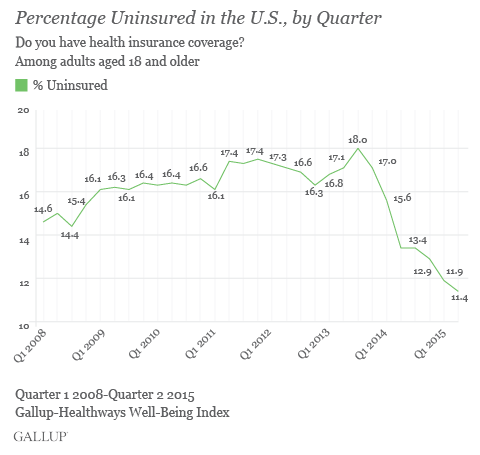
-- According to the US Census Bureau, before the ACA in 2009 about 48.6 million or 15.7% of the population was uninsured. A 2015 study by the CDC using Census data showed the total uninsured rate as 9.2% and the uninsured rate for the 18 – 64 demographic as 13%. This would mean according to the CDC and census the uninsured rate has fell from 15.7% to 9.2% under ObamaCare (the lowest uninsured rate in 50 years).

-- To contrast the reports above, a May 2015 RAND corporation study estimated that 22.8 million got coverage and 5.9 million lost plans for a net total of 16.9 million newly insured. 9.6 million people enrolled in employer-sponsored health plans, followed by Medicaid (6.5 million), the individual marketplaces (4.1 million), nonmarketplace individual plans (1.2 million) and other insurance sources (1.5 million). To clarify that is 4.1 million newly enrolled in the Marketplace and 7.1 who transitioned to Marketplace coverage for a total of 11.2 million.

gallup-healthways-2nd-quarter-2015-aca-uninusred.png


Open enrollment in Obamacare began on November 1.
 
Last edited:

phgreek

New member
Messages
6,956
Reaction score
433
"Obamacare Enrollment Facts"

Excerpt:
-- According to the US Census Bureau, before the ACA in 2009 about 48.6 million or 15.7% of the population was uninsured. A 2015 study by the CDC using Census data showed the total uninsured rate as 9.2% and the uninsured rate for the 18 – 64 demographic as 13%. This would mean according to the CDC and census the uninsured rate has fell from 15.7% to 9.2% under ObamaCare (the lowest uninsured rate in 50 years).

-- To contrast the reports above, a May 2015 RAND corporation study estimated that 22.8 million got coverage and 5.9 million lost plans for a net total of 16.9 million newly insured. 9.6 million people enrolled in employer-sponsored health plans, followed by Medicaid (6.5 million), the individual marketplaces (4.1 million), nonmarketplace individual plans (1.2 million) and other insurance sources (1.5 million). To clarify that is 4.1 million newly enrolled in the Marketplace and 7.1 who transitioned to Marketplace coverage for a total of 11.2 million.

gallup-healthways-2nd-quarter-2015-aca-uninusred.png

We are going to have to do something...Not all ACA was bad. We all acknowledge that. I think we can do some good things. Chief among them is destroy collusive environments...ie the ways in which price fixing exists is awful. The Federal oversight must think in terms of real simplification/standardization of medical codes/billing, and a process for genericizing "new" procedures until they are formally coded. We need to always encourage innovation, and care. We must posses the ability to abstract and measure components of care, and drive true competition. But you can't do that with the government playing any other role but oversight, and keeper of the standards.
 

IrishJayhawk

Rock Chalk
Messages
7,181
Reaction score
464
We are going to have to do something...Not all ACA was bad. We all acknowledge that. I think we can do some good things. Chief among them is destroy collusive environments...ie the ways in which price fixing exists is awful. The Federal oversight must think in terms of real simplification/standardization of medical codes/billing, and a process for genericizing "new" procedures until they are formally coded. We need to always encourage innovation, and care. We must posses the ability to abstract and measure components of care, and drive true competition. But you can't do that with the government playing any other role but oversight, and keeper of the standards.

But, in general, the unpopular parts pay for the popular parts.
 

ACamp1900

Counting my ‘bet against ND’ winnings
Messages
48,947
Reaction score
11,226
Whatever happens, actually allowing the dems to take part in the process and including their ideas in all of it would be a nice, refreshing start... I sincerely hope that happens.
 

Domina Nostra

Well-known member
Messages
6,251
Reaction score
1,388
Whatever happens, actually allowing the dems to take part in the process and including their ideas in all of it would be a nice, refreshing start... I sincerely hope that happens.

I agree, but it is kind of annoying to have to always "start fresh" when Republicans get elected.

The affordable Care Act was one of the most partisan, ram-it-down-their-throats bills ever created. It passed only party lines, with dissent even on the democrat side, by a legal mechanism that isn't even technically legal (reconciliation). The Democrats didn't even solicit input from their own members ("you can read it when its passed...").
 

T Town Tommy

Alabama Bag Man
Messages
6,278
Reaction score
2,768
I agree, but it is kind of annoying to have to always "start fresh" when Republicans get elected.

The affordable Care Act was one of the most partisan, ram-it-down-their-throats bills ever created. It passed only party lines, with dissent even on the democrat side, by a legal mechanism that isn't even technically legal (reconciliation). The Democrats didn't even solicit input from their own members ("you can read it when its passed...").

While I absolutely agree, at some point this country needs to work together to make it better. I don't know if Trump can somehow create that bridge, but you got to start somewhere. The Dems didn't want to do it and today their party is licking their wounds.
 

Legacy

New member
Messages
7,871
Reaction score
321
Trump, GOP sweep may disrupt every corner of health insurance market (Modern Healthcare)

Trump, GOP sweep may disrupt every corner of health insurance market

Trump's promise to repeal the ACA may dampen enrollment in 2017 exchange plans if consumers assume the coverage will be dissolved soon.

Republican Donald Trump's presidency is primed to upend every corner of the health insurance industry that has spent the past six years acclimating to the rules of the Affordable Care Act.

That shift will spill over to Americans with practically any type of health coverage—Medicare, Medicaid, employer-based or individual—which is creating anxiety for many in the industry and consumers alike. Among the most immediately affected were Medicaid-centric insurers, such as Centene Corp., Molina Healthcare and WellCare Health Plans, which took a beating in the stock markets Wednesday presuming the flood of Medicaid enrollees will come to a screeching halt.

“We weren't expecting this. All the polling seemed to point to (Hillary) Clinton winning,” Molina Healthcare CEO Dr. J. Mario Molina told Modern Healthcare on Wednesday. “I watched the returns last night, and all the political pundits, whether they were Democrats or Republicans, were surprised.”

However, Molina doesn't expect a massive impact in 2017 since Congress won't convene until after the open enrollments for all forms of coverage are closed. “I don't think Republicans want to come in and pull out the rug from a lot of people,” he said. “This was a populist movement.”

Each insurance segment under a Trump administration will face incalculable uncertainty. The new individual insurance marketplaces and Medicaid eligibility expansions created by the ACA will likely be dismantled if Trump and congressional Republicans repeal the law, which has extended coverage to nearly 20 million people.

With Republicans controlling the White House, Congress and a vast majority of statehouses, they're poised to shift Medicaid funding to block grants. Medicare premium support and the push toward more privatized Medicare Advantage plans also will be championed. Employer-based coverage has not oscillated much under the ACA, but even there the terrain will shift with the likely demise of the so-called Cadillac tax and employer mandate.

Republicans are almost certain to eliminate the vital underpinnings of the ACA's coverage provisions: the individual mandate to buy health insurance, the premium and cost-sharing subsidies, and Medicaid expansion funding.

One of the most popular provisions of the ACA is the prohibition against health plans charging more or denying coverage to people who have pre-existing health conditions. This policy is known as guaranteed issue. But the ACA included the individual mandate as a way to get healthier people to buy coverage and offset the higher costs of those sicker people. Removing the mandate but requiring insurers to cover all people isn't feasible from a policy perspective.

“If you take one of those away, this doesn't work,” said Craig Garthwaite, a health economist at Northwestern University. “If you want to get rid of the mandate, you have to go back to underwriting.”

That's why some believe Republicans and a Trump administration will selectively choose parts of the ACA to repeal while keeping others, despite campaign promises to completely "repeal and replace" it. Keeping the mandate will lead to a proliferation of bare-bones plans with even narrower networks of hospitals and doctors—which regulators and consumer advocates have termed as “junk insurance” but free-market advocates have viewed as offering more freedom and choice for consumers.

“I think the individual mandate and guaranteed issue are two sides of the same coin and will not go away,” Molina said. “People in Congress don't really want to get rid of them.”

Karen Ignagni, CEO of New York-based health insurer EmblemHealth and the former head of America's Health Insurance Plans during the ACA's formation, said in an interview Wednesday that President Barack Obama's healthcare law created an expectation to provide some baseline level of healthcare.

“I get letters every day from people who now are able to get coverage; they were not able to get coverage in the past,” Ignagni said. “Both from their standpoint and their families' standpoint, they have peace of mind because they are now able to be in the system and have their healthcare needs taken care of.”

Ignagni did not discuss specific ACA policies or potential Republican alternatives. “I think we'll hear from a number of our members asking questions about what's next, how does that affect them,” she said. “You can't answer those questions until the debate evolves.”

Open enrollment for ACA individual and small-employer plans remains underway and ends in January. If the premium and cost-sharing subsidies are eliminated as expected, coverage likely will be unaffordable for a vast majority of people. Those in the industry expect coverage for 2017 to be honored.

“Republicans don't intend to push anybody off their insurance abruptly,” said Robert Laszewski, a health insurance and policy consultant in Washington. “There will be a transition period.”

Yet there's no indication of how long a Trump administration and Congress will keep ACA plans around. That could persuade many ACA shoppers to avoid the marketplaces knowing their plans will be voided soon, which would make the risk pool worse for insurers staying in for 2017 and lead to higher medical claims. Laszewski says Republicans, “believe it or not,” will have to subsidize health insurance companies throughout the transition to cover the losses.

“If you're an insurance executive, you are extremely worried right now,” Laszewski said. “So many healthy people are not going to buy insurance waiting for the promise of the Republican plan.”

Medicaid faces a similarly precarious position. Garthwaite said Medicaid expansion enrollees who may return to the ranks of the uninsured still will get necessary care at hospitals, but hospitals will bear the cost of that in the form of higher uncompensated care.

Republicans have championed privatizing Medicaid. Congress and Trump will give states more control over how to design Medicaid benefits, but private managed-care companies won't be left out of the equation.

“I think Republicans are going to be very cost-conscious,” Molina said. Noting that Medicaid expansion is actually less expensive than premium subsidies, he ventured, “I think we will see expansion of Medicaid up to 200% of poverty.” The ACA expanded Medicaid eligibility up to 138% of the federal poverty level.

House Speaker Paul Ryan and congressional Republicans could press hard to transform Medicare into a premium-support, or voucher, program. Under that model, Medicare beneficiaries receive a fixed amount of money from the federal government, and they use those payments to get their care from either traditional Medicare or private plans. A move away from defined benefits and toward narrower provider networks would potentially expose seniors to higher out-of-pocket costs.

Many insurers have invested heavily in the private version of Medicare, called Medicare Advantage, and view it as a lucrative business line. Medicare Advantage will be “the solution to entitlement reform around health benefits,” Aetna CEO Mark Bertolini said at an investor conference in March.

But the goals of Medicare vouchers don't line up with why Medicare Advantage has grown so much. Premium support will cap how much the government will pay for coverage and presumably requires beneficiaries to pay more if they want a particular health plan. That would either erode the number of health plan options with $0 premiums, potentially dampening enrollment, or it would force Medicare to pay insurance companies much less, potentially dampening their profits and interest in participating.

Higher enrollment would be good for the plans, said Richard Lieberman, chief data scientist at consulting firm Mile High Healthcare Analytics. But Lieberman also said Republicans would probably cut the Medicare budget along the way.

Ignagni said the fundamental tenets of health insurance—quality, affordability and access—won't change with a new administration. Her company and others will be involved in the next round of reform.

“We do a lot of work with our elected officials, both state as well as federal,” said Ignagni, who led AHIP for more than two decades before she left for EmblemHealth last year. “We will continue to do that, absolutely.
 
Last edited:

Legacy

New member
Messages
7,871
Reaction score
321
Donald Trump posts 310-word plan for healthcare reform, suggests abortion legislation, touts high-risk pools The president-elect doesn't share how his administration will actually repeal Obama's legacy. (Healthcare Finance)

What the Trump Administration Needs to Do About Health Care (Harvard Business Review)

During this period of uncertainty, there is a real risk that health care companies and provider institutions will respond by pursuing mergers and acquisitions, bulking up so as to be able to sustain profits in the wake of whatever comes — or to ensure they are too big to fail and can dictate the policies that will govern their industries. Turning a blind eye to the potential for such a reaction could undermine efforts to build an efficient, high-quality health care sector. The new administration should therefore swiftly commit to promoting and protecting competition at every level in health care — and then flesh out the details of its policy agenda.
 

Legacy

New member
Messages
7,871
Reaction score
321
Drug price shock: Feds reveal how medication costs hit Medicare and Medicaid
(CNBC)

And you thought the inflation rate was low.

New data on drug spending by the nation's two biggest health-coverage programs released Monday shows eye-popping price hikes for a number of medications, as well as steep overall costs for several drugs.

Ativan, a drug that is used to treat anxiety, had an average unit cost increase of a stunning 1,264 percent between 2014 and 2015 for Medicaid, the jointly run federal-state health coverage program primarily for poor people, officials revealed.

Turing Pharmaceutical's Daraprim, a drug used to treat a parasitic condition in pregnant women, infants and people with HIV, had its costs per unit spike 874 percent for Medicaid during the same time period, according to the federal Centers for Medicare and Medicaid Services.

Three other drugs, Phenergan, Epitol and hydroxychloroquine sulfate each had per unit costs rise by more than 400 percent, according to a new Medicaid Drug Spending Dashboard launched by CMS on Monday.

Mylan's EpiPen, the anti-allergy device that has draw intense publicity this year because of its big price increase, did not make Medicaid's list of 20 biggest price hikes for 2015. While EpiPen's price has increased more than 500 percent since 2011, the cost increases were spread out over that time.

The data also showed that out of the 20 drugs that had the highest increases in per-unit costs for Medicaid, almost half — nine — were generic drugs. Generic medication is popularly seen as costing less than brand-name drugs, but that is not always the case, nor is the case that generics see lower price increases year-to-year......

Prepare for this to hit your wallet directly or indirectly. No price regulation or negotiation by feds in sight, though Trump has said he is in favor of negotiating prices and including drugs manufactured oversees (for what that's worth.)


2015 Medicaid Drug Spending Dashboard


(Click on link in article fot download of all meds and their price increases.)
 
Last edited:
Top