
connor_in
Oh Yeeaah!!!
- Messages
- 11,433
- Reaction score
- 1,006

Given the results of the most recent election, it looks like Obamacare, at least as it's currently structured, is not long for this world. Republicans seems to have recognized that a full-scale repeal is not in the cards and will have to replace it with something else. The below is a pretty comprehensive look at some of the proposed alternatives, with specific emphasis on the plans put forth by Speaker Ryan and Senator Hatch. Thoughts?
http://www.vox.com/2016/11/17/13626438/obamacare-replacement-plans-comparison
"Republicans don't intend to push anybody off their insurance abruptly,” said Robert Laszewski, a health insurance and policy consultant in Washington. “There will be a transition period.”
Yet there's no indication of how long a Trump administration and Congress will keep ACA plans around. That could persuade many ACA shoppers to avoid the marketplaces knowing their plans will be voided soon, which would make the risk pool worse for insurers staying in for 2017 and lead to higher medical claims. Laszewski says Republicans, “believe it or not,” will have to subsidize health insurance companies throughout the transition to cover the losses.
“If you're an insurance executive, you are extremely worried right now,” Laszewski said. “So many healthy people are not going to buy insurance waiting for the promise of the Republican plan.”
Medicaid faces a similarly precarious position. Garthwaite said Medicaid expansion enrollees who may return to the ranks of the uninsured still will get necessary care at hospitals, but hospitals will bear the cost of that in the form of higher uncompensated care.
Republicans have championed privatizing Medicaid. Congress and Trump will give states more control over how to design Medicaid benefits, but private managed-care companies won't be left out of the equation.
“I think Republicans are going to be very cost-conscious,” Molina said. Noting that Medicaid expansion is actually less expensive than premium subsidies, he ventured, “I think we will see expansion of Medicaid up to 200% of poverty.” The ACA expanded Medicaid eligibility up to 138% of the federal poverty level.
House Speaker Paul Ryan and congressional Republicans could press hard to transform Medicare into a premium-support, or voucher, program. Under that model, Medicare beneficiaries receive a fixed amount of money from the federal government, and they use those payments to get their care from either traditional Medicare or private plans. A move away from defined benefits and toward narrower provider networks would potentially expose seniors to higher out-of-pocket costs.
Many insurers have invested heavily in the private version of Medicare, called Medicare Advantage, and view it as a lucrative business line. Medicare Advantage will be “the solution to entitlement reform around health benefits,” Aetna CEO Mark Bertolini said at an investor conference in March.
In the summer of 2013, as state and federal officials readied new insurance marketplaces created through the Affordable Care Act, millions of Americans started getting disquieting notices from their insurers.
Health plans were being canceled because they didn’t comply with the law, often called Obamacare.
Some 4 million people were ultimately told they would lose their plans. The ensuing outrage sparked a political firestorm, seriously eroded public confidence in Obamacare and forced an embarrassed President Obama to change federal regulations so people could keep their coverage.
Yet that tumultuous episode could be dwarfed by what President-elect Donald Trump’s administration and its congressional allies unleash beginning next year. They plan to not only repeal the law but are contemplating changes that are significantly more far-reaching and could disrupt insurance coverage for many more Americans than did the original law.
“There is significant risk of chaos,” warned Ian Morrison, a healthcare consultant who advises health systems nationwide. “If they don’t get this right, a lot of people will suffer.”
Avoiding major instability has become a central focus for senior Republicans scrambling to plot a healthcare strategy since the party’s sweeping election victories, according to GOP lawmakers, current and former congressional staff and health industry officials.
But it won’t be easy, given the sheer number of people who may be affected.
About 11 million Americans, most of whom get government subsidies to offset their insurance premiums, depend on insurance marketplaces created by the health law that Republicans have proposed eliminating.
Another approximately 75 million poor Americans are enrolled in either the Children’s Health Insurance Program or Medicaid, which would be scaled back in most GOP health plans.
And House Speaker Paul Ryan (R-Wis.) has indicated he also wants to overhaul Medicare, which provides coverage to more than 50 million elderly and disabled Americans.
To reduce potential chaos, congressional Republicans have been discussing a multi-step, multi-year process for repealing and replacing the health law (Affordable Care Act).
They would vote early next year on legislation that would scrap large parts of the law, including the unpopular insurance mandate and funding for insurance subsidies and for Medicaid expansions that 31 states have enacted.
That legislation would delay the effective date of the repeal for a year or two, however, giving Republicans time to develop an alternative.
While this “repeal-and-delay” strategy may not jeopardize coverage immediately for Americans who gained it through the health law, it could seriously destabilize insurance marketplaces.
Many insurers in the marketplaces have been losing money, in large part because consumers who signed up for coverage were sicker than anticipated.
Insurers remained in hopes that the marketplaces would be stabilized by the next administration. But if the marketplaces are being eliminated, many insurers would likely reevaluate, according to industry officials and healthcare experts.
If insurers walk away, millions of consumers would be forced to switch plans or pay big premium hikes, reprising the kind of turmoil that occurred in 2013, but potentially on a larger scale.
“The markets already were somewhat fragile,” said Larry Levitt, senior vice president of the nonprofit Kaiser Family Foundation. “It was likely going to take a concerted effort ... to put marketplaces in many states on firmer footing.”
The Trump administration could take steps to solidify the marketplaces in the short term, which would likely include bolstering a controversial program to pay insurers that sustained heavy losses on the marketplaces.
But that program is a political lightning rod for Republicans, who accused the Obama administration of giving a bailout to insurance companies.
Congressional Republicans have also attacked the current administration for providing financial assistance to low-income marketplace consumers to help them pay deductibles and co-pays, arguing that that money was not appropriated by Congress.
If the Trump administration stops those payments, as some conservatives have advocated, many more insurers would likely cancel their health plans.
The 21st Century Cures Act set for a House vote Wednesday is one of the most-lobbied health care bills in recent history, with nearly three lobbyists working for its passage or defeat for every member on Capitol Hill.
More than 1,455 lobbyists representing 400 companies, universities and other organizations pushed for or against an earlier House version of a Cures bill this congressional cycle, according to federal disclosure forms compiled by the Center for Responsive Politics. A compromise version was released over the holiday weekend.
The latest version of the bill would boost funding for the National Institutes of Health by $4.8 billion over ten years, including funding for enhanced brain, cancer and precision medicine research. The NIH’s 2017 discretionary budget is $30.3 billion. It would grant an additional $1 billion to address the opioid crisis. The bill would also speed up the drug and device approval process at the Food and Drug Administration by pushing different evidence standards.
Other than major appropriations bills, a transportation spending bill and an energy infrastructure funding bill, the Cures Act garnered more lobbying activity than any of the more than 11,000 bills proposed in the 114th Congress, an analysis of the CRP data shows. It’s also the second-most lobbied health care bill since 2011, following only the Medicare Access and CHIP Reauthorization Act of 2015, which, among other things, overhauled Medicare payments to health providers....
Donald Trump and his congressional allies are making big plans to repeal the Affordable Care Act and overhaul other government health programs.
But the president-elect appears to have downgraded plans to act aggressively to control rising drug prices, handing the pharmaceutical industry an early victory and providing another illustration of the influence of lobbyists on the new Trump administration, despite Trump’s promise to “drain the swamp” of special interests in Washington.
Trump, who once made the cost of pharmaceuticals a central part of his campaign healthcare pitch and included the issue on his campaign website, hasn’t mentioned the subject since the election, even though the issue is consistently cited as the top healthcare problem Americans want to see fixed.
And Trump’s transition healthcare agenda makes no mention of drug prices, though it lists six other healthcare priorities, including restricting abortion, speeding federal approval of new drugs and restructuring Medicare and Medicaid....
Prepare for the Obamacare cliff.
Congressional Republicans are setting up their own, self-imposed deadline to make good on their vow to replace the Affordable Care Act. With buy-in from Donald Trump’s transition team, GOP leaders on both sides of the Capitol are coalescing around a plan to vote to repeal the law in early 2017 — but delay the effective date for that repeal for as long as three years.
Trump has made the GOP’s task harder by saying he wants to preserve elements of the the law that protect people with pre-existing conditions and allow young people to remain on their parent’s health insurance until they turn 26 years old, pricey provisions that will complicate Republican efforts to merely gut the law. Plus, there are millions of people now relying on Obamacare’s Medicaid expansion that the GOP will be loath to cast off the insurance rolls.
And following a repeal vote, insurance companies could bail on Obamacare immediately, even if there is a three-year grace period, leaving people with no health plans.
“The flaws in Obamacare are obvious to me. The solutions are much harder,” said Sen. Lindsey Graham (R-S.C.).
Moreover, there is already some intraparty turmoil over the repeal timeline, starting with Lamar Alexander, chairman of the Senate Health, Education, Labor and Pension Committee. He’s pressing to have a replacement plan ready before tackling repeal, which could significantly delay things, given that Republicans are far from a consensus on what kind of replacement they want.
The Tennessee Republican has notably began swapping the words “repeal and replace,” used by Republicans for years, to “replace and repeal.”
“There’s an eagerness to address it, so I think there’s no doubt we’ll start immediately to replace and repeal Obamacare, but the president-elect has said that the replacement and the repeal need to be done simultaneously, and that means to me that we need to figure out how to replace it before we repeal it,” he said.
If House Speaker Paul Ryan has his way, the 115th Congress won’t just repeal Obamacare, it will dramatically reform Medicare, turning the program into a form of private insurance.
Ryan has long supported the controversial idea and, immediately after the election, he suggested that any Obamacare reform should include Medicare reform. Another key player, House Budget Chairman Tom Price, said Medicare reform was a top priority for the unified Republican government....
The Medicare proposals in the 2015 budget resolution from House Budget Committee Chairman Paul Ryan (R-WI) are much the same as those in Ryan’s previous budgets. Once again, Chairman Ryan proposes to replace Medicare’s guarantee of health coverage with a premium-support voucher and raise the age of eligibility for Medicare from 65 to 67. Together, these changes would shift costs to Medicare beneficiaries and (with the simultaneous repeal of health reform) leave many 65- and 66-year-olds without health coverage.
The Ryan budget would cut Medicare spending by $129 billion over the 2015-2024 period, relative to the Congressional Budget Office’s (CBO) current-law baseline, by raising Medicare’s income-tested premiums, increasing cost sharing, limiting medical malpractice awards, and apparently repealing the benefit improve*ments in health reform (including closure of the prescription drug “donut hole,” described below). Ryan’s budget also includes about $140 billion in scheduled cuts from Medicare’s sustainable growth rate formula for physicians and about $110 billion in future Medicare cuts from sequestration....
But there is a much more fundamental aspect of Price’s thinking about health-care policy that should not be obscured by the focus on Obamacare or even Medicare. Specifically, he seems to be hostile to the one great recent development that health wonks in both parties and across the ideological spectrum agree on: the shift to quality-based methods of payment for health-care providers instead of the old volume-based fee-for-service model. Forbes’s Bruce Japsen points out that Price “has railed against the Obama administration’s rapid move away from fee-for-service medicine to value-based care, particularly Medicare’s mandatory bundled payment initiatives.”
Through regulations and other actions, Price has leverage to dramatically change the U.S. health care system. Even without changes in the law, HHS can significantly undermine Obamacare; it can also change some aspects of Medicaid, shift American research priorities, and allow pharmaceutical companies more leeway to market drugs. Given the breadth of policy options available, Price will have to choose what he wants go after—but his background as a surgeon suggests that he’s likely to be involved in many policy decisions across the department. To understand what those could look like, POLITICO talked with a range of health experts, former agency officials and interested parties over the major issues where Price has sway. Here are six major areas where Price could change policy at HHS.

President-elect Donald Trump's selections for the top healthcare posts in the federal government signal an appetite to move aggressively to repeal and replace the Affordable Care Act, overhaul Medicare and give states more control over Medicaid.
U.S. Rep. Tom Price, a fierce ACA critic, was nominated to be HHS secretary, and Seema Verma, who helped craft Indiana's conservative Medicaid expansion, was nominated to lead the CMS. Both nominations are subject to Senate confirmation.
Price, an orthopedic surgeon from Georgia, currently has a powerful position as chairman of the House Budget Committee. The Republican is also on the Health Subcommittee of the House Ways and Means Committee.
Verma, a consultant, worked with Vice President-elect Mike Pence, the governor of Indiana, on Healthy Indiana 2.0, a Medicaid program that requires monthly contributions to health savings accounts.
"Together, Chairman Price and Seema Verma are the dream team that will transform our healthcare system for the benefit of all Americans," Trump said in a statement.
Democrats reacted with alarm, though they lack the power to block Price because of a change to filibuster rules they orchestrated when controlling the Senate.
"Congressman Price has proven to be far out of the mainstream of what Americans want when it comes to Medicare, the Affordable Care Act and Planned Parenthood," said incoming Senate Minority Leader Charles Schumer (D-N.Y.) "Thanks to those three programs, millions of American seniors, families, people with disabilities and women have access to quality, affordable health care. Nominating Congressman Price to be the HHS secretary is akin to asking the fox to guard the hen house."
Price has been a staunch ACA critic and was one of the first to put forward his own replacement plan in the form of the Empowering Patients First Act.
It involves age-adjusted tax credits to help people buy insurance as well as increased reliance on health savings accounts and high-risk pools at the state level. It would allow people to opt out of Medicare, Medicaid or Veterans Affairs benefits and receive the tax credit to buy an individual plan. Critics say the plan would fail to keep pace with inflation and force higher out-of-pocket costs like deductibles and co-payments. The legislation has not been scored by the Congressional Budget Office.
Experts have also guessed he would concentrate on state reform efforts and noted he has worked across the aisle. Price has been a strong supporter of looking to state governments for proposals of how to spend their healthcare dollars, even if the ideas are more left-leaning than he might personally advocate.
He would likely encourage states to seek waivers for using Medicaid and other federal healthcare dollars their own way.
Price has recently touted the healthcare plan spearheaded by House Speaker Paul Ryan, which has many of the same elements.
Prospects would be unclear for federal initiatives underway that are intended to move Medicare and the entire industry away from fee-for-service reimbursement and focus on paying for the value and quality of care.
Price voted in favor of the Medicare Access and CHIP Reauthorization Act, which put Medicare payment for physician services on a path toward value-based reimbursement. Recently, however, he has criticized some aspects of the law's implementation. He has specifically said reporting requirements are a burden to physicians and should be streamlined.
Price has said the Center for Medicare & Medicaid Innovation, which develops and pilots value-based payment models and has been a frequent target for conservatives, has too much authority and should defer more to Congress. He has called on the Obama administration to end its most aggressive demonstration projects.
In September, Price requested the CMS “cease all current and future planned mandatory initiatives under the CMMI,” in a letter to CMS acting Administrator Andrew Slavitt and Deputy Administrator Dr. Patrick Conway co-signed by 178 other members of Congress.
Those initiatives include a mandatory bundled-payment model for hip and knee replacements, which took effect in April; a proposed Medicare Part B drug payment model; and a cardiac bundled-payment model slated to take effect next July.
The letter not only slammed the CMS Innovation Center as having “exceeded its authority (and) failed to engage stakeholders” but also criticized its policies and proposals as having “potentially negative effects on patients,” especially seniors, because they could limit access to care by fostering consolidation and reducing doctors' participation in Medicare.
Previously, CMMI's models were voluntary and on a small scale, the letter pointed out. But the newer programs were large-scale and mandatory. The joint replacement bundled-payment model affects over 800 hospitals in 67 metropolitan areas, while the cardiac bundle would apply in 98 randomly selected metropolitan areas.
“We insist CMMI stop experimenting with Americans' health and cease all current and future planned mandatory initiatives within the CMMI,” the letter concluded. “We look forward to your response detailing next steps as to how the agency plans to ... refrain from pursuing any future initiatives that exceed CMMI's scope of authority.”
Price also co-sponsored legislation to block the proposed Medicare Part B payment model.
But Price might turn out to be a strong advocate for value-based initiatives, according Blair Childs, senior vice president at Premier, a company that offers performance-improvement services for hospitals and health systems. “The Republicans want MACRA to succeed. It's their baby,” Childs said.
Childs also said Price is likely to support voluntary experiments with alternative payment models, but with more opportunities for waivers and innovation.
“He was concerned (with the Innovation Center) when Democrats were in charge,” he said. “I think he'll be less concerned when the Republicans are in charge.”
Price joined Congress in 2004 after four terms in the Georgia state Senate. He worked in private practice for nearly 20 years and has taught residents at Emory School of Medicine and Grady Memorial Hospital in Atlanta.
Health professionals have been a major source of donations to Price throughout his political career. Individual and political action committees in the healthcare sector have donated more than $4.8 million to him. The American Association of Orthopaedic Surgeons is a top donor group.
Industry groups, who will soon rely on Price to consider their interests as the Trump administration puts the industry in flux, generally came out in support of his nomination. They were particularly pleased to see a doctor in the role. The last HHS secretary with a medical background was Dr. Louis Wade Sullivan, who served during President George H.W. Bush's administration and was founding dean of the Morehouse School of Medicine.
Organizations that sent out statements of support of the nominations included the American Medical Association, American Hospital Association and America's Essential Hospitals.
"Particularly noteworthy about both nominees is their experience caring for low-income and other vulnerable people, shaped by their work at hospitals with a safety net role— essential hospitals," said Dr. Bruce Siegel, CEO of America's Essential Hospitals.
Several advocacy groups, however, decried the choices and said they would be especially problematic for women's healthcare.
Price has called for defunding Planned Parenthood and has supported many pieces of anti-abortion legislation. In 2015, he co-sponsored a bill that would ban abortion after 20 weeks.
He also has opposed the ACA provision that requires plans to cover birth control as a no-cost preventive measure.
Planned Parenthood President Cecile Richards called Price an “extreme opponent of women's health.”
“Fear of a Health and Human Services secretary like Tom Price is why Planned Parenthood has seen a significant increase in in online appointments for birth control, with a more than ten-fold increase in people seeking IUDs the first week following the election,” Richards said in a statement. “People are worried they will lose their health care.”
Center for American Progress CEO Neera Tanden, who worked on Hillary Clinton's campaign, sent out a statement denouncing Price as “not qualified” and saying he “shows no concern for improving the health and livelihood of working Americans.”
Price would likely work closely with Paula Stannard, a former deputy general counsel and acting general counsel at HHS, who reportedly has been tapped by the Trump team to work more broadly on health reform initiatives. Stannard oversaw the food and drug, civil rights and legislation divisions of the 450-attorney HHS Office of the General Counsel. She also provided legal advice and counsel to senior HHS officials, including secretaries Tommy Thompson and Michael Leavitt.
This is my biggest worry about Price. Value-Based Purchasing is one of the few concepts that's shown some actual ability to control costs in health care.
Of course, providers -- especially non-hospitalists -- are often pretty hostile to VBP. You're asking an industry oriented around maximizing the volume of high-margin care to completely pivot and reorient around minimizing the volume of low-impact care. This is an industry that has literally built -- from which facilities they open and where they open them, to coding conventions, to physician culture -- around the former and now you're telling them "we're shifting to VBP with downside risk; all of you are going to completely restructure your health systems and half of you are still going to lose."
If VBP works right, it should increase physician flexibility -- at bottom, VBP is about giving providers a flat rate and saying "go do health care" and leaving the rest up to them. But it can be difficult to implement quality controls (e.g. ensuring hospitals don't start dumping patients, preventing improper transfers, determining actual measurements of quality) that don't interfere with that relationship. I agree with providers who have pushed for improvements in these controls and mitigation of risk while those controls mature.
Price seems to run with the other crowd, though, that's hostile to VBP full-stop. To me, that's fine, but then what's your strategy for reducing the cost of care? Cutting Medicaid and Medicare aren't cost-control strategies, they're budgeting strategies. All that does is shift more of the cost down to the states and to hospitals. You've still got sick patients who need the same amount of care today that they did yesterday. Block granting and privatization are theoretically great, but as long as you still have a system without meaningful ability to negotiate pricing or reduce volume, you're not going to capture a whole lot of efficiencies the states and fed haven't already. We've just shifted deck chairs around -- although this time, the red ones.
EDIT: I probably should clarify -- this is my biggest concern about Price, as opposed to a hypothetical generic, Trump-approvable HHS nominee. Concerns about the overall reform plan (in its current nascent state) are a whole other kettle of fish.
Claims by some policymakers that the Medicare program is nearing “bankruptcy” are highly misleading. Although Medicare faces financing challenges, the program is not on the verge of bankruptcy or ceasing to operate. Such charges represent misunderstanding (or misrepresentation) of Medicare’s finances.
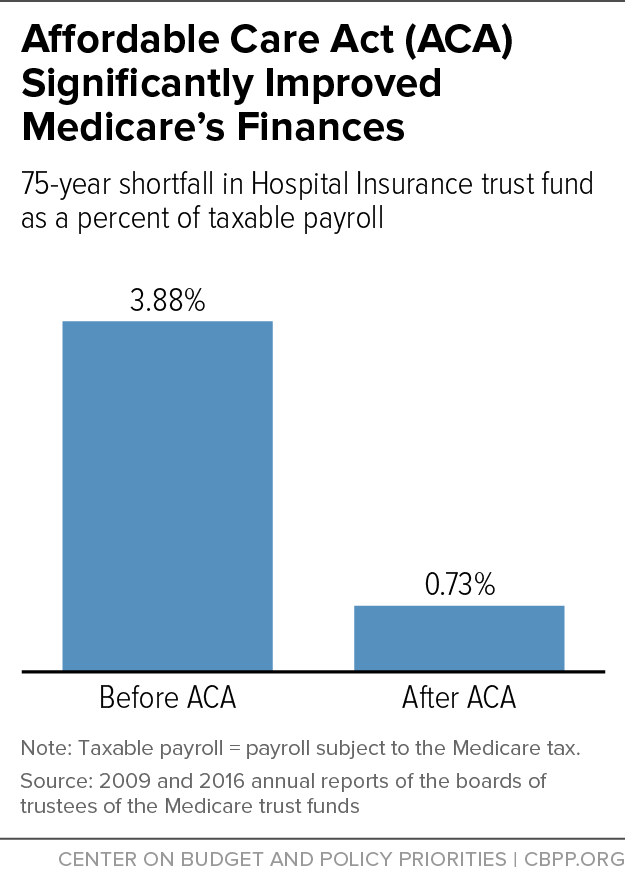
Medicare’s financing challenges would be much greater without the health reform law (the Affordable Care Act, or ACA), which substantially improved the program’s financial outlook. Repealing the ACA, a course of action promoted by some who simultaneously claim that the program is approaching “bankruptcy,” would worsen Medicare’s financial situation.
The 2016 report of Medicare’s trustees finds that Medicare’s Hospital Insurance (HI) trust fund will remain solvent — that is, able to pay 100 percent of the costs of the hospital insurance coverage that Medicare provides — through 2028.
Before private insurance market rules in the Affordable Care Act (ACA) took effect in 2014, health insurance sold in the individual market in most states was medically underwritten.1 That means insurers evaluated the health status, health history, and other risk factors of applicants to determine whether and under what terms to issue coverage. To what extent people with pre-existing health conditions are protected is likely to be a central issue in the debate over repealing and replacing the ACA.
The Affordable Care Act (ACA) established three premium stabilization programs: the permanent risk adjustment program and the transitional risk corridor and reinsurance programs. These programs were modeled after similar risk sharing programs in the Medicare Part D prescription drug program that have contributed much toward that program’s success. They have provided some stability for the first three years of the implementation of the Affordable Care Act’s individual and small group market reforms; the reinsurance program is credited with reducing marketplace premiums for 2014 by 10 to 14 percent and for 2015 by 6 to 11 percent.
The risk corridor program was intended to reduce the risk assumed by insurers offering qualified health plans (QHPs) in the marketplaces during its first three years. The program applies a statutory formula to collect funds from QHP insurers that enjoy excessively large profits and to make payments to QHP insurers that suffer exceptionally large losses.
A class action lawsuit brought by a failed health insurer in Oregon against the United States over a federal program called "Risk Corridors" has serious implications for the doctrine of separation of powers that has been a crucial part of our constitutional Republic. If differing views on separation of powers are not fully presented in that lawsuit, there is the danger of a ruling that, if not carefully written, could permit future presidents to bypass limitations in the Constitution on the power of the purse. Although there are other vehicles by which diverse views could be heard, the most straightforward would be a decision by Speaker of the House, Paul Ryan, pursuant to existing House Resolution 676, to intervene in that lawsuit. Speaker Ryan should intervene in the Risk Corridors class action. Swiftly.

In Reversal, Death Rates Rise For Middle-Aged Whites (NPR)
Referenced article: Rising morbidity and mortality in midlife among white non-Hispanic Americans in the 21st century (Proceedings of the National Academy of Sciences)
KEY FINDINGS:
The latest Kaiser Health Tracking Poll finds that health care is among the top issues, with the economy and jobs and immigration, Americans want President-elect Donald Trump and the next Congress to address in 2017. When asked about a series of health care priorities for President-elect Trump and the next Congress to act on, repealing the ACA falls behind other health care priorities including lowering the amount individuals pay for health care, lowering the cost of prescription drugs, and dealing with the prescription painkiller addiction epidemic.
When presented with two general approaches to the future of health care in the U.S., six in ten (62 percent) Americans prefer “guaranteeing a certain level of health coverage and financial help for seniors and lower-income Americans, even if it means more federal health spending and a larger role for the federal government” while three in ten (31 percent) prefer the approach of “limiting federal health spending, decreasing the federal government’s role, and giving state governments and individuals more control over health insurance, even if this means some seniors and lower-income Americans would get less financial help than they do today.”
As Congressional lawmakers make plans for the future of the ACA, the latest survey finds the public is divided on what they would like lawmakers to do when it comes to the 2010 health care law. Forty-nine percent of the public think the next Congress should vote to repeal the law compared to 47 percent who say they should not vote to repeal it. Of those who want to see Congress vote to repeal the law, a larger share say they want lawmakers to wait to vote to repeal the law until the details of a replacement plan have been announced (28 percent) than say Congress should vote to repeal the law immediately and work out the details of a replacement plan later (20 percent). However, the survey also finds malleability of attitudes towards Congress repealing the health care law with both supporters and opponents being persuaded after hearing counter-messages.
Top Issues for President-elect Trump and Congress
The latest Kaiser Health Tracking Poll finds health care among the top issues Americans want President-elect Donald Trump and the next Congress to address in 2017. When asked which issue they would most like the next administration to act on in 2017, one-fourth of the public mention the economy and jobs (24 percent), followed by immigration (20 percent), and health care (19 percent). Among Democrats and independents, the economy and jobs is the top issue (23 percent and 24 percent, respectively) while the top issues for Republicans are immigration (30 percent) and economy and jobs (29 percent). Among all partisans, health care ranks among the top three issues that the public wants the next administration to act on in 2017....
OMG LOL! Vox asked Nancy Pelosi if Obamacare underperformed, her answer was well, stupid – twitchy.com
<blockquote class="twitter-tweet" data-lang="en"><p lang="en" dir="ltr">We asked Nancy Pelosi what part of Obamacare had underperformed. "I can’t think of anything," she said. <a href="https://t.co/3EGljJwUzA">https://t.co/3EGljJwUzA</a></p>— Vox (@voxdotcom) <a href="https://twitter.com/voxdotcom/status/819529506142769152">January 12, 2017</a></blockquote>
<script async src="//platform.twitter.com/widgets.js" charset="utf-8"></script>
Of the 31 states that adopted one of Obamacare's biggest provisions, Medicaid expansion, 16 of them have Republican governors. If that provision isn't part of the replacement plan, states would likely lose millions of dollars in federal funding for health care. Even if Medicaid expansion is carried over into the new plan, millions of low-income people could lose health insurance if there's a gap between repealing and replacing the law.
That puts many Republican governors, some of whom have long criticized the ACA, in a tough spot and for many, up against their Republican counterparts in Congress. On Thursday, GOP governors will discuss Medicaid with members of the U.S. Senate Finance Committee.
In the meantime, here’s a rundown of the Republican governors who, as of Friday morning, have been most outspoken about a potential repeal since the election. The list includes governors in states that expanded Medicaid as well as those in states that refused.....

Anyone able to provide a quick explanation around the recent vote against the proposal that would allow Americans to buy prescription drugs in Canada? Sounds like it had decent bipartisan support and I'm struggling to come up with a logical reason that shouldn't be allowed. I know Booker has cited safety as his primary concern but everything I've read says that concern is overblown.


Yes, Booker the Hypocrite voted against it because he is in the pockets of big pharma. A lot of progressives like to talk the talk but not walk the walk.
Cory Booker And A Bunch Of Democrats Prove Trump Right On Big Pharma | The Huffington Post
I'm certainly disappointed in the 13, but the focus on the 13 democrats is misleading to me.
69.5% of "yea's" were democrat.(Feinstein didn't vote)
Only 25% of "nay's" we're democrat.
As disappointed as I am with the 13, it seems clear which party shot this one down.
Agree 100%Sure, that's kind of a separate point though. I don't disagree that more Republicans are responsible for it not passing than Democrats.
I was mainly talking about Booker -- who is a total fraud -- and the other Democrats who like to talk a good game but routinely refuse to put their money where their mouth is. We can't afford to give them a pass, or we get more of the same. We can't afford to anoint Booker as the next party leader because he's well spoken with charisma when he is proving to be a corporate shill.
I've always been a big Mark Warner supporter... I've voted for him in every election where I've been eligible to vote. And I was so pissed off about this vote I actually emailed his office about it looking for answers. Because this is bullshit and we should demand better than platitudes about how they care sooooo much about doing healthcare correctly. There was a direct correlation between the money most of these 13 took from Big Pharma and how they voted down a measure that would help the average American for no legitimate reason. Shame on them.
Anyone able to provide a quick explanation around the recent vote against the proposal that would allow Americans to buy prescription drugs in Canada? Sounds like it had decent bipartisan support and I'm struggling to come up with a logical reason that shouldn't be allowed. I know Booker has cited safety as his primary concern but everything I've read says that concern is overblown.
So, point still stands essentially? There is no good reason, just a bunch of shitty ones? That sucks
Anyone able to provide a quick explanation around the recent vote against the proposal that would allow Americans to buy prescription drugs in Canada? Sounds like it had decent bipartisan support and I'm struggling to come up with a logical reason that shouldn't be allowed. I know Booker has cited safety as his primary concern but everything I've read says that concern is overblown.
The HELP Committee jurisdiction encompasses most of the agencies, institutes, and programs of the Department of Health and Human Services, including the Food and Drug Administration, the Centers for Disease Control and Prevention, the National Institutes of Health, the Administration on Aging, the Substance Abuse and Mental Health Services Administration, and the Agency for Healthcare Research and Quality. The Committee also oversees public health and health insurance statutes to address emerging threats and changing patterns in the healthcare industry. This website contains information on Committee legislation, hearings and markups, and provides access to Committee hearing testimony. It also contains links to all federal agencies that are charged with enforcing federal laws related to health care.
Pharmaceutical Prices
FSS (Federal Supply Schedule) is a multiple award, multi-year federal contract that is available for use by any Federal Government agency. It satisfies all Federal contract laws and regulations. Pricing is negotiated based on how vendors do business with their commercial customers.
The FSS program also provides additional opportunities for savings to the customers with negotiated quantity and tier discounts.
Donald Trump may have a stealth health plan that would be a surprise to millions: It's called "Medicare for All. (MFA)"
He's not uttered these words and his party hasn't either -- and isn't likely to champion. The GOP has long sought the destruction of the Affordable Care Act and privatization of Medicare and Social Security.
But Trump's rhetoric has suggested Medicare for All and he could follow through and solve a basket of problems in one fell swoop. If he proposes such a plan, it would not only be a shocker, it would push a progressive solution to health care that has floated around for decades.
An expanded Medicare, in short, wouldn't just be for those over 65 and the permanently disabled. If you needed it, you'd get it at any age and wouldn't have to wait for enrollment periods or deal with an online marketplace. You could keep your doctors and local health care providers. Medicare would simply pay most the lion's share of your medical bills.
What makes me believe that Trump might back MFA? He's consistently said he wants "everybody" to be covered. That would happen with a single-payer program like Medicare.
"As far as single payer, it works in Canada," Trump said during a GOP debate in 2015. "It works incredibly well in Scotland. It could have worked in a different age, which is the age you’re talking about here,” he said, noting several times in the past he would not cut Medicare or Social Security, both of which are on the GOP's hit list.
“We’re going to have a health care that is far less expensive and far better,” said Trump at his news conference on Jan. 11. “We don’t want anyone who currently has insurance to not have insurance,” said Kellyanne Conway, a Trump adviser, on Jan. 3. “Also we are very aware that the public likes coverage for pre-existing conditions.”
To date, the GOP has offered awful alternatives to Obamacare that will not provide lower-cost coverage for tens of millions. Ideas like tax credits, health savings accounts and high-risk pools will do nothing to directly lower premiums.
"Most other industrialized countries have a national health care system similar to our Medicare to guarantee health care to all their people," notes RoseAnn DeMoro, executive director of National Nurses United, which backs Medicare for All.
"Improving and expanding Medicare would also meet the other promises made by President-elect Donald Trump. Any of the proposals devised by the repeal-and-replace crowd would herald a return to the bad old days of an escalating health care nightmare."
As Donald Trump is inaugurated, though, his campaign officially comes to an end and the American people will be expecting him to deliver and stop tweeting. Time to close the deal and make America fully insured.