Economics

Whiskeyjack

Mittens Margaritas Ante Porcos
Staff member
Messages
20,894
Reaction score
8,126
The problem with many systems other than capitalism is that they often deny that greed exists in the first place, or else try to prohibit it. A system cannot be successful if its very foundation is contradictory to human nature.

To be clear, most of my posts in this thread have been descriptive instead of normative. I'm unaware of an alternative system that could realistically be installed at the national (and global, really) level. But I read a lot of posts here describing capitalism and free markets as something akin to divine revelation-- an economic system so obviously superior to everything else that critiquing it is blasphemous. I just want people to question the assumptions that underlie our system and how its effects may be negatively impacting our lives.

I'm in a similar place. My first job offer out of school was here in Orlando. I've had enough of the distance and will be flying to Connecticut for a job interview next Friday so that I'll be closer to my family (Rhode Island) and my in-laws (Philadelphia).

Awesome.

I'd prefer that too, but I've never heard of such a system whether in theory or in practice.

Such systems exist, but they've got to be implemented locally. Thus my preference for federalism. Too bad neither of our political parties cares about states rights.

Perhaps we mean two different things when it comes to community? I am thinking more in terms of enticing business to invest in your community and to view your employers like a stock portfolio where diversification is key.

I agree that cities and states can change their legal and tax structures in order to incentivize growth. But prioritizing growth has costs of its own, and such policies ultimately turn into a race to the bottom.

Well, it sounds like people are voting with their feet, saying "I don't like it here". Otherwise they wouldn't be moving. And what are you supposed to do anyway, build a Berlin Wall?

I mentioned this to wizards above, but I'm definitely not advocating policies that restrict mobility. It is possible, though, to structure policy in such a way that a community's best and brightest kids regularly come back to become local leaders. That was the primary purpose of a university education before global capitalism took over. Now our university system resembles a human strip-mining operation-- talented kids from all over the country are vacuumed up and ultimately sent on to work in one of only a handful of cosmopolitan cities, leaving the communities they came from bereft of leadership.

Emphasizing the local over the national doesn't shackle people to their birth places. Prodigal sons have always been free to move to LA and wait tables in the hopes of becoming a movie star (and ultimately come crawling back humbled and penniless).
 
Last edited:

chicago51

Well-known member
Messages
3,658
Reaction score
387
If we ever see 30% unemployment as the direct result of automation, I'll eat my shorts.

I'm undecided what happens first. If we see a third of the population willing to work unemployed or we all die.

I'm thinking a lot of us lose our jobs to robots before a lot of us die from droughts, wars over food and water, and just too many people living on the planet. It will be a close race.
 
B

Buster Bluth

Guest
Larger lots? You think modern homes have large lots? When I bought my house here in Orlando it was quite literally impossible to find anything with more than 1/4 acre.

Its really not even debatable, we are much less dense than we were before World War II regardless of your anecdotal account.

Call me crazy but I put "driving my own car on public roads" if a far distant "dependency" category from the urban model of riding the public bus on public roads.

The bigger point is that driving is a privilege granted only by the state, which is needed to do 99% of traveling in our current society.

Regardless, if you're measuring dependence on the state in a dollar amount (ie tax dollars needed to provide your way of life) it's not even close, drivers are much more reliant on the state.

It's important to note that there is always a public-private partnership, it's not individual vs communal.
 

wizards8507

Well-known member
Messages
20,660
Reaction score
2,661
Its really not even debatable, we are much less dense than we were before World War II regardless of your anecdotal account.

Lol, what? The (continental) United States has three times the population in the same geographic footprint from World War II. We've got chicago51 thinking we're all going to starve from overpopulation and Buster who thinks population isn't dense enough.
 

RDU Irish

Catholics vs. Cousins
Messages
8,621
Reaction score
2,718
You could fit the entire world population in Rhode Island without having anyone touching (cozy at less than a square yard each but doable). The inability of people to understand the vastness of our world and resources is always fascinating to me. Now saying that people should be crammed in to less than 1/4 acre lots to build community b/c certain amongst us want a more "efficient" ant hill.... smh
 
B

Buster Bluth

Guest
Lol, what? The (continental) United States has three times the population in the same geographic footprint from World War II. We've got chicago51 thinking we're all going to starve from overpopulation and Buster who thinks population isn't dense enough.

Overpopulation worries are a joke. There is plenty of room. That's not at all the issue I brought up.
 

wizards8507

Well-known member
Messages
20,660
Reaction score
2,661
Overpopulation worries are a joke. There is plenty of room. That's not at all the issue I brought up.
You said QUOTE we are much less dense than we were before World War II END QUOTE. Population / area = population density.
 
B

Buster Bluth

Guest
You could fit the entire world population in Rhode Island without having anyone touching (cozy at less than a square yard each but doable). The inability of people to understand the vastness of our world and resources is always fascinating to me.

That has nothing to do with what I said. Before cars came around, organic cities were built as collections of neighborhoods running about 1/2-mile in diameter. That was uniform basically in all civilizations through all of history. From 1945-1990, we stopped doing that and paid the price literally and now people are in droves demanding neighborhoods again.

Now saying that people should be crammed in to less than 1/4 acre lots to build community b/c certain amongst us want a more "efficient" ant hill.... smh

I didn't say any of that. I said you're more dependent on the state's dollar if you live under what is/was the American development model. I live in an exurban village and walk to work most days, on the opposite end of the spectrum every person who wants a country house yet doesn't farm but instead makes the 30-mile trek into the city, is more dependent on the state's roads regardless of his lot size.
 
Last edited:
B

Buster Bluth

Guest
You said QUOTE we are much less dense than we were before World War II END QUOTE. Population / area = population density.

Totally meaningless, your scale is off. It's not how many people are in your country or state... or even city. It's building on a neighborhood scale. We've done little else since WW2 but sprawl via subdivisions and malls instead of walkable neighborhoods that have worked for thousands of years (regardless of one's commute or location in or around a city). Governments of all scales are now realizing how (economically, socially, and environmentally) unsustainable this has been, and we've slowly been changing course to incorporate the car culture into a development model that makes sense on a human scale.

It has jack shit to do with overall population divided by area.
 
Last edited:

chicago51

Well-known member
Messages
3,658
Reaction score
387
My early post was referring to global population more so than the US.

Man made or not we are having increased droughts globally resulting from a warming of the planet.

You are going to see more and more countries particularly along the equator (although it will spread) not able to feed themselves and the result of that is going to be wars and global instability.

The recent unrest in Egypt, and Libya where both the results of famine due to intense droughts in those countries.

I agree the United States is in a better position than most of those countries. However we have not been immune from increased droughts as evidence by what is happening in California.

Climate Change Reduces Crop Yields, Says Study - TIME

That’s a useful backdrop of a new analysis on the impact global warming will have on crop yields, just published in Nature Climate Change. The news isn’t good: the research, based on a new set of data created by the combination of 1,700 previously published studies, found that global warming of only 2º C (3.6º F) will likely reduce yields of staple crops like rice and maize as early as the 2030s. And as the globe keeps warming, crop yields will keep shriveling unless drastic steps are taken to adapt to a changing climate. As Andy Challinor, a professor of climate impacts at the University of Leeds and the lead author of the study, put it in a statement:

Our research shows that crop yields will be negatively affected by climate change much earlier than expected…Furthermore, the impact of climate change on crops will vary both from year-to-year and from place-to-place—with the variability becoming greater as the weather becomes increasingly erratic.

Heck you even got Fox kind of sort of acknowledging this: Report says global warming likely to make starvation, poverty and other problems only worse | Fox News

This is isn't one of my post trying to emphasize switching to clean energy because basically we hit a bunch self sustaining feed back loops and we are already screwed according to a lot of scientist.

So my post was so much talking about the US who seems to be shielded somewhat being on the cold side of the Atlantic in terms of ocean currents but more globally. As population increases and crop yields go down it is going to be harder to feed everyone. When that happens you get instability which can lead to unrest and even wars.

My moral of the story was I that am undecided rather a shortage of natural resources or the rise of machines will the be the culprit of what actually brings down capitalism as we know it. Maybe it will be both.
 
Last edited:

wizards8507

Well-known member
Messages
20,660
Reaction score
2,661
Totally meaningless, your scale is off. It's not how many people are in your country or state... or even city. It's building on a neighborhood scale. We've done little else since WW2 but sprawl via subdivisions and malls instead of walkable neighborhoods that have worked for thousands of years (regardless of one's commute or location in or around a city). Governments of all scales are now realizing how (economically, socially, and environmentally) unsustainable this has been, and we've slowly been changing course to incorporate the car culture into a development model that makes sense on a human scale.

It has jack shit to do with overall population divided by area.

Who cares that walkable neighborhoods were the model for "thousands of years"? So were slavery, holy war, feudalism, monarchy, and subsistence farming. Nostalgia is hardly a credential and I refuse to accept your premise that my ability to drive somewhere in twenty minutes when it used to be a three hour walk is somehow a bad thing.

Sent from my Samsung Galaxy S III using Tapatalk 4
 

wizards8507

Well-known member
Messages
20,660
Reaction score
2,661
My early post was referring to global population more so than the US.

Man made or not we are having increased droughts globally resulting from a warming of the planet.

You are going to see more and more countries particularly along the equator (although it will spread) not able to feed themselves and the result of that is going to be wars and global instability.

The recent unrest in Egypt, and Libya where both the results of famine due to intense droughts in those countries.

I agree the United States is in a better position than most of those countries. However we have not been immune from increased droughts as evidence by what is happening in California.

Climate Change Reduces Crop Yields, Says Study - TIME


Heck you even got Fox kind of sort of acknowledging this: Report says global warming likely to make starvation, poverty and other problems only worse | Fox News

This is isn't one of my post trying to emphasize switching to clean energy because basically we hit a bunch self sustaining feed back loops and we are already screwed according to a lot of scientist.

So my post was so much talking about the US who seems to be shielded somewhat being on the cold side of the Atlantic in terms of ocean currents but more globally. As population increases and crop yields go down it is going to be harder to feed everyone. When that happens you get instability which can lead to unrest and even wars.

My moral of the story was I that am undecided rather a shortage of natural resources or the rise of machines will the be the culprit of what actually brings down capitalism as we know it. Maybe it will be both.

Educate yourself. California droughts are caused by water policy because the enviro-wackos are hell bent on protecting the delta smelt.

Sent from my Samsung Galaxy S III using Tapatalk 4
 
B

Bogtrotter07

Guest
Yeah, but you should listen to Buster. He is making good points. He is accurate. And he is clearly close to an expert on what he is talking about, where the next person to him is still illiterate.

His point is specific and important. As are many others.

Now my grandpa would kick all of your asses, and laugh about it.

What did he used to say?

"When I was a boy their were no automobiles, just horses, and they even pulled the trollies. It took twenty minutes to hop the line from the house to the factory to work. Now with fancy houses, in neighborhoods of fancy houses, with your fancy cars, it takes 30 minutes to drive to work. Now that is progress!"
 
Last edited:

chicago51

Well-known member
Messages
3,658
Reaction score
387
Educate yourself. California droughts are caused by water policy because the enviro-wackos are hell bent on protecting the delta smelt.

Sent from my Samsung Galaxy S III using Tapatalk 4

Yes the delta smelt would give them more water and I assume they set up barriers (at least temporary) so they can tap into that supply. It is agriculture community down stream more so then "enviro-wackos" raising concerns.

What does that have to do with the lack of rain in the region? Not to mention the increase incidence in wild fires because it is so darn dry.
 

chicago51

Well-known member
Messages
3,658
Reaction score
387
To what Buster was saying about suburbia, sprawl, and poor developmental planning since WWII I would like to add it has been a disaster for the environment. Longer commutes have increase carbon pollution exponentially. Not to mention the increased pollution from construction cost.

Plus cities tend have more comprehensive public transit system giving people options as opposed to driving.

Also not that it is important but architecturally it sucks. Suburbs have no soul to them like neighborhoods do. I like the look of city buildings with some character to them as opposed to the barf that is the strip malls that line the downtowns of most major suburbs and outlying towns. Everything looks the same from town to town.
 
B

Buster Bluth

Guest
Who cares that walkable neighborhoods were the model for "thousands of years"? So were slavery, holy war, feudalism, monarchy, and subsistence farming.

Is this stupidity an act or have I misjudged you?

Nostalgia is hardly a credential and I refuse to accept your premise that my ability to drive somewhere in twenty minutes

Chalking it all up to nostalgia huh?

I didn't say much more than that the twenty-minute drive you take makes you more dependent on the state.

For the record, that twenty-minute commute you take has destroyed more wealth than anything in the history of the country. We had to knock down a trillion dollars worth of buildings to make room for the expressways, then we had to build the damn things (at the cost of >$600bil), now we have to maintain them (and it is fucking expensive).

Then there's the fact that, because the federal government subsidized ~91% of highway construction costs, we created a situation in which suburban land was artificially cheap (developers and towns didn't front the cost of the highways...), which in turn incentivized people to move outside the city...and thus decimated the tax bases and eventually crippled the downtowns and world-class first-ring neighborhoods of practically every city in the country (not to mention school systems...). This in turn concentrated poverty (making it worse, and double-fucking school systems...) and causing it to creep outward, so a second generation of white folk abandons their suburb of the 1950s (dat mortgage investment tho..) and moves further away.

Then there's the part where we stopped building downtowns and sturdy buildings and allowed ourselves to build a steady row of strip malls and malls (read: fake downtowns made of stucco), where the developer gets tax breaks to build the project, reaps all of the profit, and sells it before the stucco crumbles, socializing the losses and using the initial profits to build yet another mall five miles away--made of newer shinier stucco--that you can drive to instead of the initial mall....thus causing a transfer of prosperity (not generating new wealth) and creating another dilapidated pseudo-downtown to cripple the real estate values of people nearby who are just happy they got their kids through the school district before it went to shit, but still worry if they'll be able to sell the house at a high enough price to afford to GTFO like everybody else. In the words of Arcade Fire, "dead shopping malls rise like mountains beyond mountains."

Then let's add up how many trillions of dollars we've transferred to all the people who seem to hate us the most (looking at you, middle east..) in exchange for oil, in the name of "democratized mobility."

I would think the econ nut like yourself would have already read up on American development models' inability to appropriately capture wealth.

when it used to be a three hour walk is somehow a bad thing.

No, it used to be a short ride on a streetcar on one of the many world-class systems the United States once had in operation. Before we systematically destroyed those too. The walking aspect I brought up was on a neighborhood scale (again, ~1/2-mile in diameter, a ten-minute walk).

The funny thing is, no one is trying to undo your ability to drive that car (but do recognize its history of waste and your ironic dependence of the state). The neighborhood scale I brought up was for just that--the neighborhood. We started on this urban planning tangent because of a lack of community. I said we can blame subdivisions more than anything. We're changing that now, as the entire world looked and experimented with the American model and realize how fucking terrible it is for creating placed and capturing wealth. In a nutshell, this shit:

streetcomparison5.jpg
 
Last edited:

irish1958

Príomh comhairleoir
Messages
1,039
Reaction score
112
Who cares that walkable neighborhoods were the model for "thousands of years"? So were slavery, holy war, feudalism, monarchy, and subsistence farming. Nostalgia is hardly a credential and I refuse to accept your premise that my ability to drive somewhere in twenty minutes when it used to be a three hour walk is somehow a bad thing.

Sent from my Samsung Galaxy S III using Tapatalk 4
In 1900 New York City had an horseshit emergency. There was no way to get rid of the tons and tons of it. Vacant lots were piled as high as a 4 story building summer heat was rather aromatic. Flies were everywhere and intestinal disease a big killer, especially of infants and children. The automobile saved the city,
An occasional traffic jam is a small price to pay for the progress cars and trucks have brought.
 
B

Buster Bluth

Guest
In 1900 New York City had an horseshit emergency. There was no way to get rid of the tons and tons of it. Vacant lots were piled as high as a 4 story building summer heat was rather aromatic. Flies were everywhere and intestinal disease a big killer, especially of infants and children. The automobile saved the city,
An occasional traffic jam is a small price to pay for the progress cars and trucks have brought.

...you know the horseshit is gone right?


The average American spends 38 hours in traffic, it's not an occasional jam.

You do bring up a very valid point, that the urban experience in America was an absolute trauma during the growing pains of the industrial revolution. The rest of the world decided to fix their cities, America decided to abandon them. To think it's a "small price to pay" is, well, 100% incorrect.

The automobile did not save the city. That is just full potato. This is one glimpse of what automobiles did to American cities:

tumblr_lpf5kirfVm1qjmldjo1_500111.gif


EDIT: You might want to read this: 6 Freeway Removals That Changed Their Cities Forever
 
Last edited:
B

Buster Bluth

Guest
I've posted this about a hundred times before, but here's a great (and funny) video of what we did wrong in this country:

<iframe width="560" height="315" src="//www.youtube.com/embed/Q1ZeXnmDZMQ" frameborder="0" allowfullscreen></iframe>
 

Whiskeyjack

Mittens Margaritas Ante Porcos
Staff member
Messages
20,894
Reaction score
8,126
Pat Deneen just published an article on the Hobby Lobby v. Sebelius case that begins oral argument today:

Hobby Lobby—like every chain store of its kind—participates in an economy that is no longer “religious” or even “moral.” That is, it participates in an economy that arose based on the rejection of the subordination of markets embedded within, and subject to, social and moral structures. This “Great Transformation” was detailed and described with great acuity by Karl Polanyi in his masterful 1944 book of that title. He described a sea change of economic practice that took place especially beginning in the 19th-century, but whose theoretical groundwork had been laid already in the 17th- and 18th-centuries by thinkers like Thomas Hobbes, John Locke, and Adam Smith. As he succinctly described this “transformation,” previous economic arrangements in which markets were “embedded” within moral and social structures, practices, and customs were replaced by ones in which markets were liberated from those contexts, and shorn of controlling moral and religious norms and ends. “Ultimately that is why the control of the economic system by the market is of overwhelming consequence to the whole organization of society: it means no less than the running of society as an adjunct to the market. Instead of economy being embedded in social relations, social relations are embedded in the economic system.”

To summarize a complex argument, Polanyi (and more recently, Brad Gregory in his masterful work, The Unintended Reformation) described how economic arrangements were “disembedded” from particular cultural and religious contexts in which economic arrangements were understood to serve those moral ends—and hence, that limited not only actions, but even the understanding that economic actions could be considered to be undertaken to advance individual interests and priorities. As Polanyi describes, economic exchange so ordered placed a priority on the main ends of social and religious life—the sustenance of community order and flourishing of families within that order. The understanding of an economy based upon the accumulated calculations of self-maximizing individuals was largely non-existent, and a “market” was understood to be a part of the whole, an actual physical place within that social order, not an autonomous, even theoretical space for the exchange of abstracted utility maximers.

Polanyi describes how the replacement of this economy required concerted and often violent reshaping of the existing life-world, most often by elite economic and State actors disrupting and displacing traditional communities and practices. It also required not only the separation of markets from social and religious contexts, and with that move the “individuation” of people, but their acceptance that their labor and nature were nothing more than commodities subject to price mechanisms, a transformative way of considering people and nature alike in newly utilitarian terms. Yet market liberalism required treating both people and natural resources as these “fictitious commodities,” as material for use in industrial processes, in order to disassociate markets from morals and “re-train” people to think of themselves first and foremost as individuals separate from nature and each other. As Polanyi pithily described this transformation, “laissez-faire was planned.”

How delicious he would doubtless find the irony of a “religious corporation” seeking to push back against the State’s understanding of humans as radically autonomous, individuated, biologically sterile, and even hostile to their offspring. For that “religious corporation” operates in an economic system in which it has been wholly disembedded from a pervasive moral and religious context. Its “religion” is no less individuated and “disembedded” than the conception of the self being advanced by the State. It defends its religious views as a matter of individual conscience, of course, because there is no moral, social, or religious context to which it can appeal beyond the autonomy of its own religious belief. Lacking any connecting moral basis on which to stake a social claim, all it can do in the context of a society of “disembeddedness” is seek an exemption from the general practice of advancing radical autonomy. Yet, the effort to secure an exemption is itself already a concession to the very culture and economy of autonomy.

Most ironically, its entire business model is premised upon the conception of the disembedded self. Its stores are located generally in the middle of nowhere, in a sea of asphalt, providing the simulacra of ancient craft with goods produced by Chinese and transported by massive container ships, accessible only by automobiles generally by people living in suburbs. They have contributed to the displacing of smaller, local businesses with the extensive assistance of government, especially in the form of free-trade agreements, military-protected fossil-fuel production and transportation along with international shipping corridors, state-sponsored infrastructure that give major advantages to businesses that rely heavily on economies of scale based on trucking, and zoning laws that encourage the evisceration of downtowns in favor of national chains. Purchases in these chain stores result in a net outflow of money from these communities into the coffers of distant and absentee owners.

This economy—like the one it displaced—is not neutral; it is based on certain assumptions about human nature and implicitly teaches its participants to model their own behavior on those assumptions. The anthropology at the base of our modern economy is that of rationally calculating, utility maximizing individuals who have learned to understand both human labor and resources as commodities, who seek always to calculate economic activity in terms of price (hence, are always called “consumers”) in ways that obscure any connections between what is purchased and its implications for our communities. We have thoroughly accepted the separation of markets from social, moral, and religious structures—indeed, the only way that we generally speak of “morality” in economics is that which is provided after the fact not by communities and the people within them, but only by the now-distant State through regulation and redistribution.

I hope Hobby Lobby wins its case. But we should not deceive ourselves for a minute that what we are seeing is the contestation between a religious corporation and a secular State. We are seeing, rather, the culminating absurdity of what Polanyi called the “utopia” of our modern economic disembedding—the absurdity of a chain store representing the voice of religion in the defense of life amid an economy and polity that values turning people and nature into things. Our entire economy is an education in how to be “pro-choice.” What it most certainly is not in any way, shape or form, is about helping us to understand our true condition as embedded human beings.

This article neatly ties together some of the points I've been trying to make with Buster's most recent posts.
 
Last edited:
C

Cackalacky

Guest
You said QUOTE we are much less dense than we were before World War II END QUOTE. Population / area = population density.

Might be true if we don't include multi-story residential and office buildings. Its relevant because you can squeeze 5 million people into the area of Manhattan by making buildings tall.

I just have to say, some of your last few posts are well.... beligerent at best.... My Lord.
 
C

Cackalacky

Guest
Educate yourself. California droughts are caused by water policy because the enviro-wackos are hell bent on protecting the delta smelt.

Sent from my Samsung Galaxy S III using Tapatalk 4

You understand that the geography of California dictates how and where they get water from as well as the costs for moving it from the Colorado River to southern California, right? The policy is a result of the environment in California. The northern part has the most rain while the south gets little rain. Additionally, the most fertile area of California gets only seasonal rains so a policy had to be developed to ensure adequate supplies of water to a take advantage of the very fertile agricultural zone.

Aquafornia
California is the nation’s leading agricultural and dairy producer, producing 21% of the nation’s milk supply, 23% of it’s cheese, and 92% of all grapes grown in the U.S. Cotton, foliage and flowers are also in the top 10 agricultural commodities produced in California. California produces half of all domestically-grown fruits, nuts, and vegetables.
In all, over 400 different commodities are grown here. Some products, such as almonds, walnuts, artichokes, persimmons, and pomegranates, are solely produced in California.
One out of every six jobs in California is tied to agriculture in some way, and many counties rely on agriculture as their primary economic activity. California has the largest agricultural economy in the nation, containing nine of the nation’s top ten agricultural counties. Fresno is the most productive county in the nation, with an agricultural worth of $3.5 billion dollars in 2000.

Water fuels the economy of California, and managing it properly is of paramount importance. It has also been a source of decades-long political wars. Besides satisfying the needs of a growing population, demands for more water also come from the agricultural industry, businesses, manufacturers and developers. These needs must be balanced against demands for protecting water quality and for protecting fisheries, wildlife and recreational interests. The fundamental controversy is one of distribution, as conflicts between these competing interests continue to be exacerbated by continued population growth and periods of drought.
Everything depends on the manipulation of water : capturing it behind dams, storing it in reservoirs, and rerouting it in concrete rivers over hundreds of miles. California has twelve hundred major dams, the two biggest irrigation projects on earth, and some of the largest reservoirs in the country.

Providing water to residences, businesses, and agriculture consumes large amounts of energy. Energy is required to convey (deliver) the water to the areas of need. Water treatment facilities use energy to treat and pump water. Water distribution systems use energy for pumping and pressurization. Consumers and businesses use energy to filter, heat and cool water for their own uses. Wastewater treatment plants use energy to pump wastewater, run treatment procedures, and process solids. Statewide, these processes together consume 20% of the state’s electricity, 30% of the state’s natural gas, and 88 million gallons of diesel fuel.A significant amount of energy is used here in California to transport water over long distances. This generally requires pumping the water over hills and mountains, a process which consumes large amounts of energy. Some of this energy can be recaptured by sending the water down through turbines, generating hydroelectricity, but not all of it is recovered. The Central Valley Project, Hetch Hetchy Aqueduct and the Los Angeles Aqueduct are all net producers of energy; however, the State Water Project and the Colorado River Aqueduct, the two main systems that bring water into Southern California, are net users of energy.
In fact, the State Water Project is the largest single user of energy in California, accounting for about 3% of all electricity consumed statewide. The most energy is used delivering water to Southern California, where pumping one acre-foot of SWP water to Southern California requires about 3000 kWh, and pumping one acre-foot of Colorado River Aqueduct water to Southern California consumes 2000 kWh.

This requires a massive infrastructure:
050809allprojects2.jpg


And yes the smelt are very important as not only are they a massively important member of the food web, but they are an indicator species and when the smelt are dying off, that "indicates" that something is wrong in the water shed. Further they live in an area that serves as a natural filter for an important surface water source, or source for drinking water. This is the most important source of surface water in California and it is a top priority to maintain it. This is not environmental wackoism but common fucking sense.

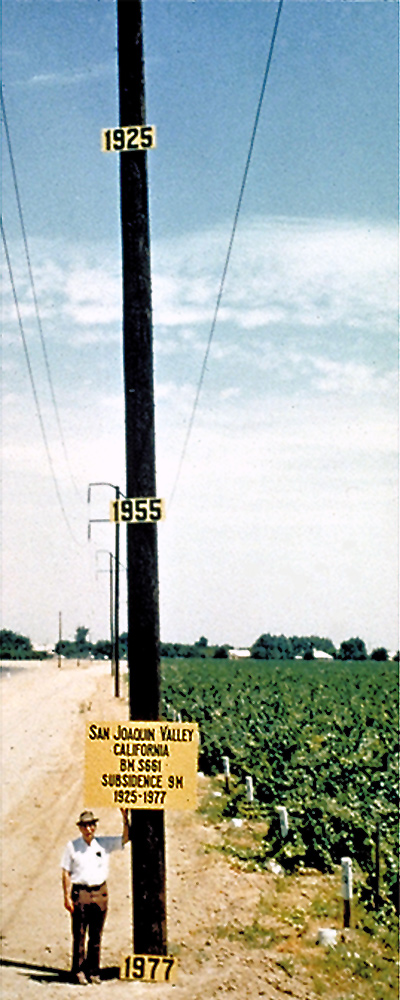
I will aslo add that California has a signifiant problem with subsidence due to extracting groundwater. This is a risk-reward scenario. As you can see in the photo below, the relatively short-term extraction of groundwater has led to significnat land alterations. The point is to get water without having to cause future problems like this:
land-subsidence-poland-calif.jpg


SubsidenceDiagram.jpg
 
Last edited:
C

Cackalacky

Guest
Wizards,
The post above was to show you how important water is the California and the US economy and how energy intensive it is and why it is incredibly important to make the best use of the water sources.

Here is an excellent source with multiple links on how MAN-MADE GLOBAL WARMING (as I showed you in several of my other posts on the topic) worsens droughts in the Western USA, particularly California.
Climatologist Who Predicted California Drought 10 Years Ago Says It May Soon Be 'Even More Dire' | ThinkProgress

Back in 2004, Sloan, professor of Earth sciences at UC Santa Cruz, and her graduate student Jacob Sewall published, “Disappearing Arctic sea ice reduces available water in the American west” (subs. req’d). They used powerful computers “to simulate the effects of reduced Arctic sea ice,” and “their most striking finding was a significant reduction in rain and snowfall in the American West.”


“Where the sea ice is reduced, heat transfer from the ocean warms the atmosphere, resulting in a rising column of relatively warm air,” Sewall said. “The shift in storm tracks over North America was linked to the formation of these columns of warmer air over areas of reduced sea ice.” In January, Sewall wrote me that “both the pattern and even the magnitude of the anomaly looks very similar to what the models predicted in the 2005 study (see Fig. 3a [below]).”
Here is what Sewall’s model predicted in his 2005 paper:

Here is the model prediction:
Sewall-2005.jpg

The 500-millibar geopotential height (meters) increases by up to 70 m off the west coast of North America. Increased geopotential height deflects storms away from the dry locus and north into the wet locus
“Geopotential height” is the height above mean sea level for a given pressure level. The “500 mb level is often referred to as the steering level as most weather systems and precipitation follow the winds at this level,” which is around 18,000 feet.

Now here is what the 500 mb geopotential height anomaly looked like over the last year, via NOAA:
2013 anomaly as measured by NOAA in 2013:
2013-anomaly.jpg

That is either a highly accurate prediction or one heck of a coincidence.

The San Jose Mercury News explained that “meteorologists have fixed their attention on the scientific phenomenon they say is to blame for the emerging drought: a vast zone of high pressure in the atmosphere off the West Coast, nearly four miles high and 2,000 miles long, so stubborn that one researcher has dubbed it the Ridiculously Resilient Ridge.” This high pressure ridge has been acting “like a brick wall” and forcing the jet stream along a much more northerly track, “blocking Pacific winter storms from coming ashore in California, deflecting them up into Alaska and British Columbia, even delivering rain and cold weather to the East Coast.
Last year, I contacted Sloan to ask her if she thought there was a connection between the staggering loss of Arctic sea ice in recent years and the brutal drought gripping the West, as her research predicted. She wrote, “Yes, sadly, I think we were correct in our findings, and it will only be worse with Arctic sea ice diminishing quickly.”

All this isn’t “proof” that human caused climate change helped shift and reduce precipitation in California during its record-setting drought. But a prediction this accurate can’t be ignored, either, especially because of its implications for the future. That’s doubly true when there is also emerging evidence — documented by Senior Weather Channel meteorologist Stu Ostro and others — that “global warming is increasing the atmosphere’s thickness, leading to stronger and more persistent ridges of high pressure, which in turn are a key to temperature, rainfall, and snowfall extremes and topsy-turvy weather patterns like we’ve had in recent years.”

So looking at the bottom chart...with the Jet stream following the path of least resistance to the north polar regions and then sinking quickly along the eastern side of it, it dumps POLAR enhanced atmospheres into the midwest and east/south US. Which is exactly what we had this year.
 
Last edited:
B

Bogtrotter07

Guest
When I see an article like this one I can't help to think America's leaders have lost their moral compass...

"The agency that tracks federal travel did not report hundreds of personal and other “nonmission” trips aboard government planes for senior Justice Department officials including Attorney General Eric Holder and former FBI Director Robert Mueller, according to a watchdog report."

Personal FBI flights for Holder and other Justice officials went unreported

If we are talking about the American leadership, it would be hard to distinguish when, at least in my lifetime, they had it.
Secrets: The True Nature of America’s War Machine

Monday, March 17th, 2014 at 3:48 pm
From the Pentagon Papers and Vietnam to Snowden and the War on Terror:

Daniel Ellsberg’s 2002 book, Secrets, A Memoir of Vietnam and the Pentagon Papers, offers a timely and chilling account of the nature of America’s war machine. For those who don’t know, Ellsberg famously leaked the Pentagon Papers to the New York Times and other sources in 1971, exposing how the United States government systematically lied the country into the Vietnam War. President Nixon tried to prosecute Ellsberg and The Times, but lost. Many celebrate Ellsberg as an American hero who risked everything to inform the public about the true nature of America’s wars. Secrets is as important as ever, particularly in the wake of President Obama’s drone wars, our near-war with Syria and the Edward Snowden story. The parallels are striking: our leaders still welcome war, the empire continues to expand, and the state still prosecutes whistleblowers with a vengeance.

Ellsberg has an intimate understanding of the inner workings of America’s power structure. Prior to becoming a whistleblower, he was “a dedicated cold warrior” (4) who served in the Marine Corp. He then went on to become a defense consultant for the Rand Corporation slated with deterring nuclear war with the Soviet Union. And during the Vietnam War he became a personal assistant to John T. McNaughton, who was special assistant to Defense Secretary Robert McNamara.

Ellsberg watched the Vietnam War unfold from his perch at the Pentagon first as an unquestioning supporter and ultimately as a horrified opponent of empire. Throughout, he witnessed how the government systematically lied to the public about the justification for war and prospects for victory.

Although most Americans have some conception that the Vietnam War was based on lies, it is important to understand just how brazen and calculated the deception was. In a dramatic opening chapter, Ellsberg dissects President Johnson’s August 4, 1964 announcement justifying war. He writes that the president

informed the American public that the North Vietnamese, for the second time in two days, had attacked U.S. warships “on routine patrol in international waters”; that this was clearly a “deliberate” pattern of “naked aggression”; that the evidence for the second attack, like the first, was “unequivocal”; that the attack had been “unprovoked”; and that the United States, by responding in order to deter any repetition, intended no wider war (12).​

Ellsberg explains that, rather than “unequivocal,” the truth is that “in the minds of various experienced navy operators and intelligence analysts at the time of our retaliation, as well as earlier and later, doubt adhered to every single piece of evidence that an attack had occurred at all on August 4” (12). With his insider’s perspective at the Pentagon, Ellsberg “knew that each one of [the president’s] assurances was false,” as no second attack occurred.

As for the first attack on August 2nd in the Gulf of Tonkin against the USS Maddox, which the president claimed was conducting a “routine patrol in international waters,” the Maddox was in fact involved in “a secret intelligence mission, code-named DeSoto patrols, [which for days had been] penetrating well within what the North Vietnamese regarded as their territorial waters” in order to “provoke [the north Vietnamese] into turning on coast defense radar so that our destroyers could plot their defenses, in preparation for possible air or sea attacks (13).” The attack on the Maddox caused “no American casualties or significant damage,” as “all the torpedoes had missed.”

In reality this act was not “unprovoked,” but rather retaliation for ongoing American operations in North Vietnam, which included plans such as “demolition of Route 1 bridge” and “destruction of section of Hanoi-Vinh railroad,” according to internal government documents which Ellsberg “carried over to the State Department to be read and initialed” by top officials. President Johnson knew of this, as his Director of National Intelligence John McCone explained to him at a National Security Council (NSC) meeting on August 4th that “the North Vietnamese are reacting defensively to our attack on their off-shore islands. They are responding out of pride and on the basis of defense considerations” (16).

The “striking” contrast between what the government knew and told the public is a recurring theme of Secrets. Ellsberg writes that “the reality unknown to the public and to most members of Congress and the press is that secrets that would be of the greatest import to many of them can be kept from them reliably for decades by the executive branch, even though they are known to thousands of insiders.” He explains that “self-discipline in sharing information—lack of a ‘need to tell’—and a capability for dissimulation in the interests of discretion were fundamental requirements for a great many jobs” in the executive branch. This “apparatus of secrecy… permitted the president to arrive at and execute a secret foreign policy, to a degree that went far beyond what even relatively informed outsiders, including journalists and members of Congress, could imagine.” He adds that “the commonplace that ‘you can’t keep secrets in Washington’ or ‘in a democracy’” is “flatly false.” Such slogans “are in fact cover stories, ways of flattering and misleading journalists and their readers, part of the process of keeping secrets well.” Ellsberg concedes that “many secrets do get out that wouldn’t in a fully totalitarian society,” but “the overwhelming majority of secrets do not leak to the American public” (43).

When he began working at the Pentagon in 1964, Ellsberg accepted this reality without question. He trusted that his superiors had the best interests of the country in mind and were acting judiciously. Outsiders simply didn’t get it, he assumed. And those anti-war protestors who branded the war criminal simply didn’t know what they were talking about. But his perspective gradually shifted towards skepticism. And when he spent two years in Vietnam as a State Department observer a few years later, his entire outlook changed radically, ultimately prompting him to leak the Pentagon Papers in an effort to stop the war. He had seen the devastation and hopelessness of the situation. The war was a disaster, and it could not be won.

Ellsberg reiterates over and over in Secrets that every president involved in Vietnam, from Eisenhower to Nixon, was fully informed by intelligence and advisers that America could not win the war, short of using a nuclear bomb. And yet each president persisted in expanding the war, slowly but surely.

Some background. Vietnam had been a French colony, and in 1945 it attained independence from its weakened occupier. Ho Chi Min sought to unite the country through a nation-wide election. But the French quickly returned in a bid to re-conquer her colony. The United States supported the French and refused to recognize Vietnam as an independent state. Why? Ellsberg reveals that “the internal documents make clear that the fact that Ho himself was a communist—though head of a mainly non-communist coalition governing the North—was far from critical in the decision in 1945 not to reply to his appeals” to recognize Vietnam. “Rather, our nonresponse reflected a policy decision, made by President Roosevelt… to assure the French that we recognized French ‘ownership’ of Vietnam as a colony” and maintain “good relations with France” (250).

Ultimately the French tired and largely abandoned their criminal quest, but the United States, obsessed with the domino theory and determined to maintain “credibility” as the most powerful State in history, eclipsed the French as chief aggressor. It sabotaged the 1954 Geneva Accords, which “called for nationwide elections for a unified regime” in Vietnam, according to Ellsberg. Amazingly, the United States cynically demanded throughout the war that Vietnam “return to observance of the 1954 Accords,” which the U.S. depicted as an effort to divide the country into two “neighbors,” the North and the South, rather than establish one unified nation.

The campaign of sabotage through proxy and direct forces continued throughout the 1950’s. America supported a corrupt puppet regime in the South led by Ngo Dinh Diem. But he became receptive to Ho Chi Min and considered cutting a deal to unite the country. Upon discovering this, JFK ordered Diem killed a couple of days before he himself was assassinated. This completely destabilized the country and led to an unavoidable escalation of the conflict, culminating in Johnson’s invasion. Tragically, Ho’s admonition in 1946, while pleading with America to recognize Vietnam, that “if we must fight… you will kill ten of our men, but we will kill one of yours and in the end it is you that will tire” proved prophetic. Untold millions of civilians were murdered during the quarter-century of warfare that followed.

But every president involved in Vietnam, particularly Johnson and Nixon, drank deep from the dark elixir that is imperial hubris. They ignored warnings from the most authoritative sources that they could not win and persisted in maintaining their Ahab-like delusions. It was inconceivable to them that the most technologically advanced, powerful nation in history could fail to subdue what they considered a primitive population.

The true nature of the war machine is laid bare by Ellsberg’s depiction of the presidential election of 1964. Johnson campaigned against the hardline Republican candidate Barry Goldwater on the theme that his administration will “seek no wider war.” He presented himself as “the reasonable, moderate ‘peace’ candidate… while painting his opponent as a dangerous, unbalanced extremist, eager to escalate to full-scale war in Vietnam.” But in reality, Ellsberg explains that “every official I dealt with in Washington that summer and fall expected a wider war under President Johnson no later than the start of the new year.” In fact, Goldwater’s proposals, which Johnson campaigned against, “ironically were identical to those of Johnson’s own Joint Chiefs of Staff… a well kept secret during the campaign” (49). It is difficult to find harder proof that Americans have little freedom of choice on the most significant issues when it comes to their leadership.

After Vietnam destroyed Johnson’s presidency and crippled the Democrats, Nixon further ratcheted up the conflict by bombing Cambodia and Laos. He dropped more tonnage on Indochina than had been dropped during World War II. Even Ellsberg’s leaking the Pentagon Papers in 1971 initially did little to slow Nixon down. Nixon’s notorious tapes reveal his true attitude about the situation. Here is a chilling excerpt of his conversation with top aides Henry Kissinger and Ron Ziegler :

President: How many did we kill in Laos?

Ziegler: Maybe ten thousand—fifteen?

President: See, the attack in the North that we have in mind… power plants, whatever’s left—POL [petroleum], the docks… And, I still think we ought to take the dikes out now. Will that drown people?

Kissinger: About two hundred thousand people.

President: No, no, no… I’d rather use the nuclear bomb. Have you got that, Henry?… I just want you to think big… I want that place bombed to smithereens… we’re gonna bomb those bastards all over the place. Let it fly, let it fly… I’ll see that the United States does not lose… We are going to cream North Vietnam… For once, we’ve got to use the maximum power of this country… against this shit-ass little country: to win the war.

Nixon later remarked to Kissinger that “the only place where you and I disagree… is with regard to the bombing. You’re so goddamned concerned about civilians and I don’t give a damn. I don’t care.” To which Kissinger replied, “I’m concerned about the civilians because I don’t want the world to be mobilized against you as a butcher” (419).

It is no surprise or coincidence that such a brutal and callous attitude translated into sadistic tactics on the ground in Vietnam. One such tactic was called “reconnaissance by fire.” Ellsberg says “it meant finding out if a particular location, either a building or vegetation, had enemies in it by shooting into it and seeing whether anyone shot back. It killed a lot of civilians.” When he witnessed this during his stay in Vietnam, Ellsberg asked the lieutenant “what if there happened to be a family inside. He said, ‘tough shit. They know we’re operating in this area, they can hear us, and they ought to be in their bunker. I’m not taking any unnecessary chances with my men’” (165). Throughout the country, the U.S. army declared certain areas “free-fire zones,’ which meant we had condemned to death anyone who might be found in it.” Ellsberg adds that “all over Vietnam humans were being hunted like animals from the air on the basis of where they were and what they were wearing” (138).

Does this remind you of anything? I hope it does. Today’s version of the American war machine employs this tactic of indiscriminate death from above in Pakistan, Afghanistan, Yemen and perhaps other countries as well. While most Americans are familiar with President Obama’s drone wars, it is imperative to understand that the administration’s “signature strikes” are governed by the same principle of reconnaissance by fire. According to Jeremy Scahill, author of Dirty Wars, the World is a Battlefield, a signature strike is a “form of pre-crime, where the U.S. determines that any military-aged males in a targeted area are in fact terrorists, and their deaths will be registered as having killed terrorists or militants.”

There are other parallels between Obama’s wars and Nixon’s handling Vietnam. Ellsberg explains that Nixon considered drawing down ground combat troops to persuade the public that the war was coming to an end. The reality “was not just that the war was going to go on, indefinitely,” Ellsberg writes, “but that it would again get larger, eventually larger than it had ever been” (260), because Nixon would compensate for this drawdown by increasing airstrikes and expanding the war to Laos and Cambodia in a bid to demonstrate to the Vietcong that the current president would not be bound by any constraints which had limited his predecessors. The above-quoted excerpts bear this out.

Obama has similarly brought our troops back from Iraq while expanding America’s presence in Afghanistan and embracing the attitude that “the world is a battlefield” where America must wipe out all “terrorists.” Journalist Glenn Greenwald aptly points out that just as it is famously said that only Nixon could have gotten his right-wing base to go along with his détente policy towards China without spurring a revolt, only Obama could have gotten the left to accept the legitimacy of drone wars. Obama also mirrors President Johnson in the way he campaigned against the surveillance state and war machine, only to embrace and expand the two as president.

The similarities between Ellsberg’s account of the war machine and today’s political climate do not stop there. Obama’s near war with Syria merits much neglected attention. In a recent bombshell exposé, journalist Seymour Hersh explains that the Obama administration deceived the public in building its case for war with Syria. Hersh writes that, based on top-level government sources with intimate knowledge of the situation,

Barack Obama did not tell the whole story this autumn when he tried to make the case that Bashar al-Assad was responsible for the chemical weapons attack near Damascus on 21 August. In some instances, he omitted important intelligence, and in others he presented assumptions as facts. Most significant, he failed to acknowledge something known to the US intelligence community: that the Syrian army is not the only party in the country’s civil war with access to sarin, the nerve agent that a UN study concluded – without assessing responsibility – had been used in the rocket attack. In the months before the attack, the American intelligence agencies produced a series of highly classified reports, culminating in a formal Operations Order – a planning document that precedes a ground invasion – citing evidence that the al-Nusra Front, a jihadi group affiliated with al-Qaida, had mastered the mechanics of creating sarin and was capable of manufacturing it in quantity. When the attack occurred al-Nusra should have been a suspect, but the administration cherry-picked intelligence to justify a strike against Assad.​

War has been averted for the time being, but Hersh’s exposé suggests there’s more to the story than the mass media’s claims that Obama does not seek war with Syria and considered strikes only reluctantly, after being confronted with hard evidence of Assad’s using chemical weapons. Unfortunately, we do not have a contemporary version of the Pentagon Papers which reveals the true nature of the administration’s Syria deliberations at the moment. And so we can only speculate about what the real motives for action and non-action are. But the pretexts of terrorism and chemical weapons can hardly be taken seriously, just as the Vietnam pretexts about communism are overthrown by the Pentagon Papers.

It is a great irony to hear America’s leaders claim the use of chemical weapons is an intolerable crime which the United States cannot condone, considering that, as Ellsberg reports, we used white phosphorous and napalm in Vietnam. He writes that “when white phosphorous touches the flesh… it burns down to the bone; you can’t put it out with water. In Vietnamese civilian hospitals… I visited, I’d seen children who had been burned by it and others who had been burned by napalm” (136). If the real motive for intervention in Syria had been a humanitarian one, America would not have waited years, as over a hundred thousand Syrians have been slaughtered.

The important thing to bear in mind is that America’s leaders continue to invite war, from Iraq to Afghanistan to Libya to drones, the list goes on. It is a symptom of a government consumed by a war machine. President Eisenhower warned us about this in his famous farewell address to the nation.

This is why we need heroic whistleblowers like Ellsberg and now, of course, Edward Snowden. Ellsberg has stated that “there has not been in American history a more important leak than Edward Snowden’s release of NSA material, and that definitely includes the Pentagon Papers 40 years ago.” He has added that “Snowden’s whistleblowing gives us the possibility to roll back a key part of what has amounted to an ‘executive coup’ against the U.S. constitution.” Thanks to Snowden we now know that the war machine which gave us Vietnam has spawned a world-wide surveillance system that could lead to classical totalitarianism. The NSA helps the CIA choose targets for drone strikes based on reconnaissance by fire principles. And the executive branch has carved out for itself the right to assassinate American citizens without due process.

Snowden faces many obstacles Ellsberg dealt with during the 70’s. Both have been called traitors, attention-seeking eccentrics, and criminals. Both risked their freedom to expose the truth. And both have faced legal challenges. Just as Nixon prosecuted Ellsberg and The Times, Obama has gone after Snowden. In fact, Obama has prosecuted more whistleblowers than all previous presidents combined, often citing the Espionage Act, a stunning misuse of the statute. His attacks on the First Amendment have prompted James Goodale, the general counsel at The Times during the Pentagon Papers crackdown, to call Obama the second worst president when it comes to freedom of the press, “behind Nixon and ahead of Bush II. And he’s moving up fast.”

This is a pivotal moment in history. The Constitution is under attack. The war machine is delivering death and terror to numerous countries. And it threatens to bankrupt America. If there’s anything we can learn from Ellsberg’s story, it is that we must always be skeptical of our government, especially when it comes to war. It doesn’t seem to make much difference which political party is in power. The United States’ foreign policy has historically conformed to Thucydides’ maxim that “the strong do what they can, and the weak suffer what they must.” The only ones with the power to curtail this most powerful war machine in history is we the people.
 
B

Bogtrotter07

Guest
If we are talking about the American leadership, it would be hard to distinguish when, at least in my lifetime, they had it.


A) None of them have had any leadership but power and money since Eisenhower;

B) They have all had the same ownership, perceived differences are theater.

Better?

[I used smaller words 2, IH, hope that helps. When I ad an article it is for the few that are interested that is why I bold and color my actual response so one can skip the long article if one chooses.]
 

Whiskeyjack

Mittens Margaritas Ante Porcos
Staff member
Messages
20,894
Reaction score
8,126
AmCon's Scott Galupo just posted an article which touches on the American habit of sanctifying the "Market":

Thinking holistically of the human person, however, consumerism, with its valorization of individual choice and autonomy, is spiritually problematic.

And so it’s a great and terrible irony that the church—I should specify, a large segment of the conservative Protestant church—has invited “the world” into the church. It has embedded its economic imperatives into its doctrines. Indeed, it has elevated the marketplace into a thing affirmed and designed by God himself.

...

Deneen of course is a conservative Catholic. I’ve yet to come across a rejoinder from a conservative Protestant arguing against Deneen’s contention that there is, or should be, a “separation of church and economy.” If no one has written it yet, someone will soon. For this is an unfortunate, ahistorical, heretical bedrock belief of the conservative base: the American economy is God’s economy. Any attempt to regulate it is contrary to the God-breathed Constitution. It is atheistic, humanistic, and tyrannical.

This could be the greatest trick the devil ever played.
 
Top